I Understand How You Feel: Enhancing Deeper Emotional Support Through Multilingual Emotional Validation in Dialogue System
Pith reviewed 2026-06-27 09:43 UTC · model grok-4.3
The pith
MEGUMI fuses semantic and emotion encoders to improve when dialogue systems should validate user feelings in English and Japanese.
A machine-rendered reading of the paper's core claim, the machinery that carries it, and where it could break.
Core claim
By releasing M-EDESConv and M-TESC and training MEGUMI to combine frozen XLM-RoBERTa representations with language-specific emotion encoders through cross-modal attention and gated fusion, the authors establish superior objective and subjective results on the task of detecting the correct timing for emotional validation responses in multilingual dialogue.
What carries the argument
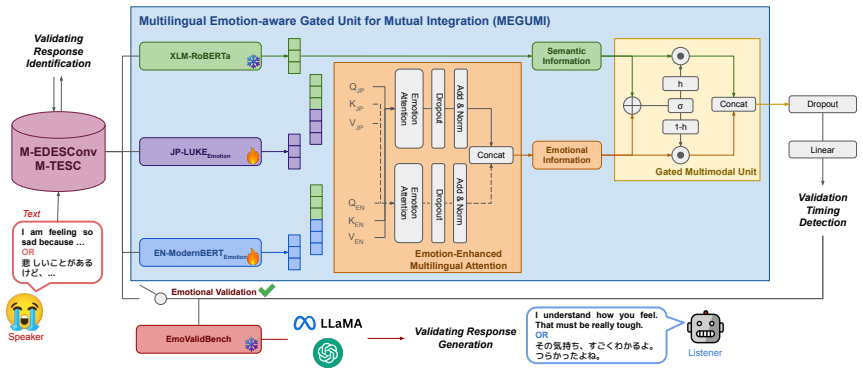
MEGUMI (Multilingual Emotion-aware Gated Unit for Mutual Integration), which fuses frozen XLM-RoBERTa semantics with language-specific emotion encoders via cross-modal attention and gated fusion to decide validation timing.
If this is right
- Dialogue systems equipped with MEGUMI-style timing detection can deliver validating replies at moments that better match user expectations.
- The M-EDESConv corpus directly supports separate study of validating response identification, timing detection, and response generation.
- Multilingual training data allows the same validation timing model to operate across English and Japanese without separate monolingual systems.
- Current large language models already produce contextually appropriate and diverse validating responses once the timing cue is supplied.
- Emotional understanding remains the main bottleneck for large language models on this task.
Where Pith is reading between the lines
- The gated-fusion design could be tested on additional language pairs to check whether the same architecture scales beyond English and Japanese.
- If timing detection improves, downstream user studies could measure whether users report higher perceived support or lower distress after interacting with the system.
- The hybrid annotation pipeline may need explicit checks for cultural differences in what counts as validation before the datasets are used to train models for new language communities.
Load-bearing premise
The hybrid manual-automatic labels in M-EDESConv faithfully mark genuine emotional validation without large amounts of noise or cultural bias.
What would settle it
A blinded human rating study on held-out dialogues in which raters mark the moments they would expect validation; if MEGUMI's predicted timings receive lower agreement or preference scores than strong baselines, the claimed superiority on timing detection is falsified.
Figures
read the original abstract
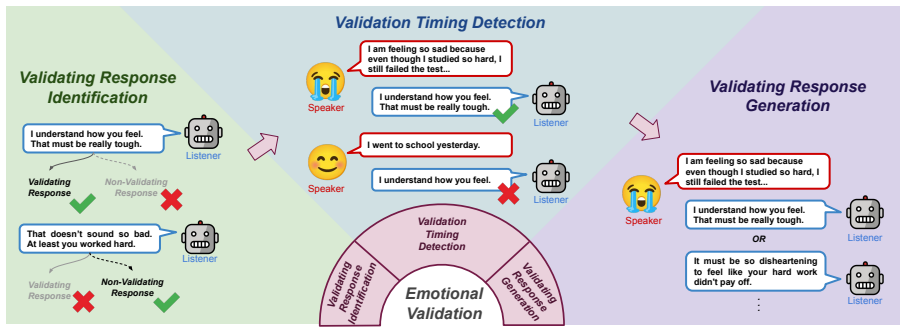
Emotional validation - explicitly acknowledging that a user's feelings make sense - has proven therapeutic value but has received little computational attention. Emotional validation in dialogue systems can be decomposed into (i) validating response identification, (ii) validation timing detection, and (iii) validating response generation. To support research on all three subtasks, we release M-EDESConv, a 120k English-Japanese multilingual corpus created through hybrid manual and automatic annotation, and M-TESC, a multilingual spoken-dialogue test set. For timing detection, we propose MEGUMI, a Multilingual Emotion-aware Gated Unit for Mutual Integration, that fuses frozen XLM-RoBERTa semantics with language-specific emotion encoders via cross-modal attention and gated fusion. MEGUMI shows superior performance on both the M-EDESConv and M-TESC datasets, both objectively and subjectively. Finally, our EmoValidBench benchmarks of GPT-4.1 Nano and Llama-3.1 8B indicate that current LLMs generate contextually similar and diverse validating responses, but emotional understanding remains a major area for improvement. Project page: https://github.com/zihaurpang/Multilingual-Emotional-Validation
Editorial analysis
A structured set of objections, weighed in public.
Referee Report
Summary. The paper claims that emotional validation in dialogue systems decomposes into validating response identification, timing detection, and response generation. It releases M-EDESConv (120k English-Japanese utterances via hybrid manual-automatic annotation) and M-TESC (multilingual spoken test set) to support research on these subtasks, proposes MEGUMI (a model fusing frozen XLM-RoBERTa semantics with language-specific emotion encoders via cross-modal attention and gated fusion), reports that MEGUMI achieves superior objective and subjective performance on both datasets, and shows via EmoValidBench that current LLMs produce contextually similar and diverse validating responses but still lack strong emotional understanding.
Significance. If the results hold after verification of label quality, the work supplies the first large-scale multilingual resources explicitly targeting emotional validation and a model architecture tailored to timing detection across languages. Dataset release and the explicit three-subtask framing are concrete strengths that could enable follow-on work in therapeutic dialogue systems.
major comments (2)
- [Corpus construction (abstract and §3)] Corpus construction (abstract and §3): The hybrid manual-automatic annotation process for the 120k M-EDESConv labels is described without inter-annotator agreement figures, without any held-out human validation of the automatic component, and without cross-lingual consistency checks. Because every reported MEGUMI performance number (both on M-EDESConv and on M-TESC) depends on these labels faithfully encoding emotional validation, the absence of these diagnostics is load-bearing for the central superiority claim.
- [Experiments (§5)] Experiments (§5): No ablation isolating the contribution of the gated fusion versus the cross-modal attention, no error bars or statistical significance tests on the reported objective metrics, and no breakdown of performance by language or by validation timing difficulty. These omissions prevent assessment of whether the claimed gains are robust or driven by particular subsets of the (unvalidated) labels.
minor comments (2)
- [Figure 2] Figure 2 (model diagram): The gated fusion block is shown schematically but the exact equations for the gate computation and the cross-modal attention are not written out; adding them would improve reproducibility.
- [Related work] Related work: The positioning relative to prior emotional support dialogue datasets (e.g., ESConv) is brief; a short table comparing label granularity and language coverage would clarify the novelty of M-EDESConv.
Simulated Author's Rebuttal
We thank the referee for the constructive feedback. We address each major comment below and will revise the manuscript accordingly to strengthen the claims regarding label quality and experimental robustness.
read point-by-point responses
-
Referee: [Corpus construction (abstract and §3)] Corpus construction (abstract and §3): The hybrid manual-automatic annotation process for the 120k M-EDESConv labels is described without inter-annotator agreement figures, without any held-out human validation of the automatic component, and without cross-lingual consistency checks. Because every reported MEGUMI performance number (both on M-EDESConv and on M-TESC) depends on these labels faithfully encoding emotional validation, the absence of these diagnostics is load-bearing for the central superiority claim.
Authors: We agree that these diagnostics are necessary to support the reliability of the labels. In the revised manuscript we will report inter-annotator agreement for the manual portion of the annotation, accuracy results from a held-out human validation set for the automatic component, and cross-lingual consistency metrics between English and Japanese. These additions will directly address the concern that label quality underpins the reported performance numbers. revision: yes
-
Referee: [Experiments (§5)] Experiments (§5): No ablation isolating the contribution of the gated fusion versus the cross-modal attention, no error bars or statistical significance tests on the reported objective metrics, and no breakdown of performance by language or by validation timing difficulty. These omissions prevent assessment of whether the claimed gains are robust or driven by particular subsets of the (unvalidated) labels.
Authors: We concur that the current experimental section would benefit from these analyses. The revised version will include an ablation study isolating the gated fusion and cross-modal attention components, error bars with statistical significance tests on all objective metrics, and performance breakdowns by language and by validation timing difficulty. These changes will allow readers to evaluate the robustness of the gains. revision: yes
Circularity Check
No circularity; empirical model evaluation on released datasets
full rationale
The paper contains no equations, derivations, or parameter-fitting steps that could reduce to self-definition or fitted-input-as-prediction. MEGUMI is presented as a novel architecture fusing existing encoders, with superiority claims resting solely on held-out test performance (objective metrics plus subjective evaluation) on the newly released M-EDESConv and M-TESC corpora. The hybrid annotation process is a data-construction detail, not a load-bearing derivation or self-citation chain. No self-citations are invoked to justify uniqueness or ansatzes, and no renaming of known results occurs. This is a standard empirical NLP contribution whose central claims are externally falsifiable via the released data and code.
Axiom & Free-Parameter Ledger
axioms (1)
- domain assumption Emotional validation in dialogue systems decomposes cleanly into validating response identification, validation timing detection, and validating response generation.
Reference graph
Works this paper leans on
-
[1]
MIME : MIM icking Emotions for Empathetic Response Generation
Majumder, Navonil and Hong, Pengfei and Peng, Shanshan and Lu, Jiankun and Ghosal, Deepanway and Gelbukh, Alexander and Mihalcea, Rada and Poria, Soujanya. MIME : MIM icking Emotions for Empathetic Response Generation. Proceedings of the 2020 Conference on Empirical Methods in Natural Language Processing (EMNLP). 2020
2020
-
[2]
Proceedings of the AAAI Conference on Artificial Intelligence , volume=
Cem: Commonsense-aware empathetic response generation , author=. Proceedings of the AAAI Conference on Artificial Intelligence , volume=
-
[3]
Towards Empathetic Open-domain Conversation Models: A New Benchmark and Dataset
Rashkin, Hannah and Smith, Eric Michael and Li, Margaret and Boureau, Y-Lan. Towards Empathetic Open-domain Conversation Models: A New Benchmark and Dataset. Proceedings of the 57th Annual Meeting of the Association for Computational Linguistics. 2019
2019
-
[4]
Towards Emotional Support Dialog Systems
Liu, Siyang and Zheng, Chujie and Demasi, Orianna and Sabour, Sahand and Li, Yu and Yu, Zhou and Jiang, Yong and Huang, Minlie. Towards Emotional Support Dialog Systems. Proceedings of the 59th Annual Meeting of the Association for Computational Linguistics and the 11th International Joint Conference on Natural Language Processing (Volume 1: Long Papers). 2021
2021
-
[5]
arXiv preprint arXiv:2311.15732 , year=
GPT4Vis: what can GPT-4 do for zero-shot visual recognition? , author=. arXiv preprint arXiv:2311.15732 , year=
-
[6]
arXiv preprint arXiv:2402.11409 , year=
Multi-dimensional Evaluation of Empathetic Dialog Responses , author=. arXiv preprint arXiv:2402.11409 , year=
-
[7]
G o E motions: A Dataset of Fine-Grained Emotions
Demszky, Dorottya and Movshovitz-Attias, Dana and Ko, Jeongwoo and Cowen, Alan and Nemade, Gaurav and Ravi, Sujith. G o E motions: A Dataset of Fine-Grained Emotions. Proceedings of the 58th Annual Meeting of the Association for Computational Linguistics. 2020
2020
-
[8]
Gated Multimodal Units for Information Fusion
Gated multimodal units for information fusion , author=. arXiv preprint arXiv:1702.01992 , year=
work page internal anchor Pith review Pith/arXiv arXiv
-
[9]
Proceedings of the conference
Multimodal transformer for unaligned multimodal language sequences , author=. Proceedings of the conference. Association for computational linguistics. Meeting , volume=
-
[10]
arXiv preprint arXiv:2505.00013 , year=
Performance Evaluation of Emotion Classification in Japanese Using RoBERTa and DeBERTa , author=. arXiv preprint arXiv:2505.00013 , year=
-
[11]
Biomedical informatics insights , volume=
A hybrid model for automatic emotion recognition in suicide notes , author=. Biomedical informatics insights , volume=. 2012 , publisher=
2012
-
[12]
2022 ieee spoken language technology workshop (slt) , pages=
Empirical analysis of training strategies of transformer-based japanese chit-chat systems , author=. 2022 ieee spoken language technology workshop (slt) , pages=. 2023 , organization=
2022
-
[13]
Educational technology research and development , pages=
Pedagogical AI conversational agents in higher education: a conceptual framework and survey of the state of the art , author=. Educational technology research and development , pages=. 2025 , publisher=
2025
-
[14]
Empathy and Business Transformation , pages=
Human or nonhuman agent?: Experiences of empathy in a digital customer tourism journey , author=. Empathy and Business Transformation , pages=. 2022 , publisher=
2022
-
[15]
In Proceedings of 2023 IEEE International Conference on Robot & Human Interactive Communication (RO-MAN) , year=
Developing social robots with empathetic non-verbal cues using large language models , author=. In Proceedings of 2023 IEEE International Conference on Robot & Human Interactive Communication (RO-MAN) , year=
2023
-
[16]
Findings of the association for computational linguistics: EMNLP 2021 , pages=
Improving empathetic response generation by recognizing emotion cause in conversations , author=. Findings of the association for computational linguistics: EMNLP 2021 , pages=
2021
-
[17]
ICASSP 2024-2024 IEEE International Conference on Acoustics, Speech and Signal Processing (ICASSP) , pages=
Pecer: Empathetic response generation via dynamic personality extraction and contextual emotional reasoning , author=. ICASSP 2024-2024 IEEE International Conference on Acoustics, Speech and Signal Processing (ICASSP) , pages=. 2024 , organization=
2024
-
[18]
Towards Persona-Based Empathetic Conversational Models
Zhong, Peixiang and Zhang, Chen and Wang, Hao and Liu, Yong and Miao, Chunyan. Towards Persona-Based Empathetic Conversational Models. Proceedings of the 2020 Conference on Empirical Methods in Natural Language Processing (EMNLP). 2020
2020
-
[19]
Processes , volume=
Development of an empathy-centric counseling chatbot system capable of sentimental dialogue analysis , author=. Processes , volume=. 2022 , publisher=
2022
-
[20]
Immersive Learning Research-Practitioner , pages=
Empathetic chatbot: Enhancing medical education with artificial intelligence , author=. Immersive Learning Research-Practitioner , pages=
-
[21]
Journal of the Academy of Marketing Science , volume=
Artificial empathy in marketing interactions: Bridging the human-AI gap in affective and social customer experience , author=. Journal of the Academy of Marketing Science , volume=. 2022 , publisher=
2022
-
[22]
arXiv preprint arXiv:2408.11599 , year=
Cause-Aware Empathetic Response Generation via Chain-of-Thought Fine-Tuning , author=. arXiv preprint arXiv:2408.11599 , year=
-
[23]
Computers in Human Behavior , volume=
Nonverbal behaviors perceived as most empathic in a simulated medical context , author=. Computers in Human Behavior , volume=. 2024 , publisher=
2024
-
[24]
Findings of the Association for Computational Linguistics: NAACL 2022 , pages=
Empathetic persuasion: reinforcing empathy and persuasiveness in dialogue systems , author=. Findings of the Association for Computational Linguistics: NAACL 2022 , pages=
2022
-
[25]
Proceedings of the 24th Annual Meeting of the Special Interest Group on Discourse and Dialogue , pages=
Empathetic response generation for distress support , author=. Proceedings of the 24th Annual Meeting of the Special Interest Group on Discourse and Dialogue , pages=
-
[26]
ACM Transactions on Human-Robot Interaction , volume=
The effects of healthcare robot empathy statements and head nodding on trust and satisfaction: a video study , author=. ACM Transactions on Human-Robot Interaction , volume=. 2023 , publisher=
2023
-
[27]
Borderline Personality Disorder and Emotion Dysregulation , volume=
The who and what of validation: an experimental examination of validation and invalidation of specific emotions and the moderating effect of emotion dysregulation , author=. Borderline Personality Disorder and Emotion Dysregulation , volume=. 2022 , publisher=
2022
-
[28]
Patient Experience Journal , volume=
Is Timing Everything?: The Role of Time on the Relationship between Patient-Centered Communication and Provider Empathy , author=. Patient Experience Journal , volume=
-
[29]
, author=
Validation and psychotherapy. , author=. 1997 , journal=
1997
-
[30]
Exploring emotional validation in cross-cultural management: a case study , author=
-
[31]
Scandinavian Journal of Pain , volume=
I see you're in pain--The effects of partner validation on emotions in people with chronic pain , author=. Scandinavian Journal of Pain , volume=. 2015 , publisher=
2015
-
[32]
Computational linguistics , volume=
Dialogue act modeling for automatic tagging and recognition of conversational speech , author=. Computational linguistics , volume=. 2000 , publisher=
2000
-
[33]
Linguistics Vanguard , volume=
Could this be next for corpus linguistics? Methods of semi-automatic data annotation with contextualized word embeddings , author=. Linguistics Vanguard , volume=. 2024 , publisher=
2024
-
[34]
The 37th Annual Conference of the Japanese Society for Artificial Intelligence , pages=
Prediction of Validating Response from Emotional Storytelling Corpus , author=. The 37th Annual Conference of the Japanese Society for Artificial Intelligence , pages=
-
[35]
Proceedings of the Workshop on Computational Modeling of People's Opinions, Personality, and Emotions in Social Media (PEOPLES) , pages=
Innovative semi-automatic methodology to annotate emotional corpora , author=. Proceedings of the Workshop on Computational Modeling of People's Opinions, Personality, and Emotions in Social Media (PEOPLES) , pages=
-
[36]
E mp H i: Generating Empathetic Responses with Human-like Intents
Chen, Mao Yan and Li, Siheng and Yang, Yujiu. E mp H i: Generating Empathetic Responses with Human-like Intents. Proceedings of the 2022 Conference of the North American Chapter of the Association for Computational Linguistics: Human Language Technologies. 2022
2022
-
[37]
A Taxonomy of Empathetic Response Intents in Human Social Conversations
Welivita, Anuradha and Pu, Pearl. A Taxonomy of Empathetic Response Intents in Human Social Conversations. Proceedings of the 28th International Conference on Computational Linguistics. 2020
2020
-
[38]
Signals , volume=
Dialogue act classification via transfer learning for automated labeling of interviewee responses in virtual reality job interview training platforms for autistic individuals , author=. Signals , volume=. 2023 , publisher=
2023
-
[39]
Archives of general psychiatry , volume=
Trauma and posttraumatic stress disorder in the community: the 1996 Detroit Area Survey of Trauma , author=. Archives of general psychiatry , volume=. 1998 , publisher=
1996
-
[40]
arXiv preprint arXiv:2412.09867 , year=
Human-Like Embodied AI Interviewer: Employing Android ERICA in Real International Conference , author=. arXiv preprint arXiv:2412.09867 , year=
-
[41]
Lee, Akinobu , license =
-
[42]
9th International Workshop on Spoken Dialogue System Technology , pages=
Spoken dialogue system for a human-like conversational robot ERICA , author=. 9th International Workshop on Spoken Dialogue System Technology , pages=. 2019 , organization=
2019
-
[43]
Proceedings of the 18th Annual SIGdial Meeting on Discourse and Dialogue , pages=
Attentive listening system with backchanneling, response generation and flexible turn-taking , author=. Proceedings of the 18th Annual SIGdial Meeting on Discourse and Dialogue , pages=
-
[44]
International Journal of Social Robotics , volume=
Enhancing emotional support: The effect of a robotic object on human--human support quality , author=. International Journal of Social Robotics , volume=. 2022 , publisher=
2022
-
[45]
arXiv preprint arXiv:2503.13625 , year=
Does the Appearance of Autonomous Conversational Robots Affect User Spoken Behaviors in Real-World Conference Interactions? , author=. arXiv preprint arXiv:2503.13625 , year=
-
[46]
, author=
The effect of therapist use of validation strategies on change in client emotion in individual dbt treatment sessions. , author=. Personality Disorders: Theory, Research, and Treatment , volume=. 2018 , publisher=
2018
-
[47]
Merrill-Palmer Quarterly , volume=
The role of maternal emotional validation and invalidation on children's emotional awareness , author=. Merrill-Palmer Quarterly , volume=. 2016 , publisher=
2016
-
[48]
Administration and Policy in Mental Health and Mental Health Services Research , pages=
Youths' perceived impact of invalidation and validation on their mental health treatment journeys , author=. Administration and Policy in Mental Health and Mental Health Services Research , pages=. 2022 , publisher=
2022
-
[49]
14th International Workshop on Spoken Dialogue System Technology , year=
Acknowledgment of emotional states: Generating validating responses for empathetic dialogue , author=. 14th International Workshop on Spoken Dialogue System Technology , year=
-
[50]
arXiv preprint arXiv:2404.01657 , year=
Release of pre-trained models for the Japanese language , author=. arXiv preprint arXiv:2404.01657 , year=
-
[51]
My child will actually say ‘I am upset'… Before all they would do was scream
“My child will actually say ‘I am upset'… Before all they would do was scream”: Teaching parents emotion validation in a social care setting , author=. Child: Care, Health and Development , volume=. 2020 , publisher=
2020
-
[52]
Advanced Robotics , volume=
Dual variational generative model and auxiliary retrieval for empathetic response generation by conversational robot , author=. Advanced Robotics , volume=. 2023 , publisher=
2023
-
[53]
Proceedings of the AAAI conference on artificial intelligence , volume=
A hierarchical latent variable encoder-decoder model for generating dialogues , author=. Proceedings of the AAAI conference on artificial intelligence , volume=
-
[54]
arXiv preprint arXiv:1905.05471 , year=
Improving neural conversational models with entropy-based data filtering , author=. arXiv preprint arXiv:1905.05471 , year=
-
[55]
How not to evaluate your dialogue system: An empirical study of unsupervised evaluation metrics for dialogue response generation , author=. arXiv preprint arXiv:1603.08023 , year=
work page internal anchor Pith review Pith/arXiv arXiv
-
[56]
A Diversity-Promoting Objective Function for Neural Conversation Models
Li, Jiwei and Galley, Michel and Brockett, Chris and Gao, Jianfeng and Dolan, Bill. A Diversity-Promoting Objective Function for Neural Conversation Models. Proceedings of the 2016 Conference of the North A merican Chapter of the Association for Computational Linguistics: Human Language Technologies. 2016
2016
-
[57]
Proceedings of the 40th annual meeting of the Association for Computational Linguistics , pages=
Bleu: a method for automatic evaluation of machine translation , author=. Proceedings of the 40th annual meeting of the Association for Computational Linguistics , pages=
-
[58]
International Conference on Learning Representations , year=
BERTScore: Evaluating Text Generation with BERT , author=. International Conference on Learning Representations , year=
-
[59]
Sentence-BERT: Sentence Embeddings using Siamese BERT-Networks
Sentence-bert: Sentence embeddings using siamese bert-networks , author=. arXiv preprint arXiv:1908.10084 , year=
work page internal anchor Pith review Pith/arXiv arXiv 1908
-
[60]
Proceedings of the 61st Annual Meeting of the Association for Computational Linguistics (Volume 1: Long Papers) , pages=
A Close Look into the Calibration of Pre-trained Language Models , author=. Proceedings of the 61st Annual Meeting of the Association for Computational Linguistics (Volume 1: Long Papers) , pages=
-
[61]
JAMIA open , volume=
Decoding disparities: evaluating automatic speech recognition system performance in transcribing Black and White patient verbal communication with nurses in home healthcare , author=. JAMIA open , volume=. 2024 , publisher=
2024
-
[62]
Unsupervised Cross-lingual Representation Learning at Scale
Conneau, Alexis and Khandelwal, Kartikay and Goyal, Naman and Chaudhary, Vishrav and Wenzek, Guillaume and Guzm \'a n, Francisco and Grave, Edouard and Ott, Myle and Zettlemoyer, Luke and Stoyanov, Veselin. Unsupervised Cross-lingual Representation Learning at Scale. Proceedings of the 58th Annual Meeting of the Association for Computational Linguistics. 2020
2020
-
[63]
Advances in neural information processing systems , volume=
Large language models are zero-shot reasoners , author=. Advances in neural information processing systems , volume=
-
[64]
Advances in neural information processing systems , volume=
Chain-of-thought prompting elicits reasoning in large language models , author=. Advances in neural information processing systems , volume=
-
[65]
2021 24th Conference of the Oriental COCOSDA International Committee for the Co-ordination and Standardisation of Speech Databases and Assessment Techniques (O-COCOSDA) , pages=
Design and Basic Analysis of the TUT Emotional Storytelling Corpus , author=. 2021 24th Conference of the Oriental COCOSDA International Committee for the Co-ordination and Standardisation of Speech Databases and Assessment Techniques (O-COCOSDA) , pages=. 2021 , organization=
2021
-
[66]
American scientist , volume=
The nature of emotions: Human emotions have deep evolutionary roots, a fact that may explain their complexity and provide tools for clinical practice , author=. American scientist , volume=. 2001 , publisher=
2001
-
[67]
Proceedings of the 25th Annual Meeting of the Special Interest Group on Discourse and Dialogue , pages=
StyEmp: Stylizing Empathetic Response Generation via Multi-Grained Prefix Encoder and Personality Reinforcement , author=. Proceedings of the 25th Annual Meeting of the Special Interest Group on Discourse and Dialogue , pages=
-
[68]
29th COLING , pages=
Does GPT-3 Generate Empathetic Dialogues? A Novel In-Context Example Selection Method and Automatic Evaluation Metric for Empathetic Dialogue Generation , author=. 29th COLING , pages=
-
[69]
RoBERTa: A Robustly Optimized BERT Pretraining Approach
Roberta: A robustly optimized bert pretraining approach , author=. arXiv preprint arXiv:1907.11692 , year=
work page internal anchor Pith review Pith/arXiv arXiv 1907
-
[70]
No Language Left Behind: Scaling Human-Centered Machine Translation
No language left behind: Scaling human-centered machine translation , author=. arXiv preprint arXiv:2207.04672 , year=
work page internal anchor Pith review Pith/arXiv arXiv
-
[71]
International journal of human-computer studies , volume=
The influence of empathy in human--robot relations , author=. International journal of human-computer studies , volume=. 2013 , publisher=
2013
-
[72]
Journal of medical Internet research , volume=
Towards an artificially empathic conversational agent for mental health applications: system design and user perceptions , author=. Journal of medical Internet research , volume=. 2018 , publisher=
2018
-
[73]
Proceedings of the 21st ACM international conference on intelligent virtual agents , pages=
Enhancing conversational agents with empathic abilities , author=. Proceedings of the 21st ACM international conference on intelligent virtual agents , pages=
-
[74]
Proceedings of the 24th Annual Meeting of the Special Interest Group on Discourse and Dialogue , pages=
Reasoning before Responding: Integrating Commonsense-based Causality Explanation for Empathetic Response Generation , author=. Proceedings of the 24th Annual Meeting of the Special Interest Group on Discourse and Dialogue , pages=
-
[75]
Proceedings of the 2020 Conference on Empirical Methods in Natural Language Processing (EMNLP) , pages=
A Computational Approach to Understanding Empathy Expressed in Text-Based Mental Health Support , author=. Proceedings of the 2020 Conference on Empirical Methods in Natural Language Processing (EMNLP) , pages=
2020
-
[76]
M o EL : Mixture of Empathetic Listeners
Lin, Zhaojiang and Madotto, Andrea and Shin, Jamin and Xu, Peng and Fung, Pascale. M o EL : Mixture of Empathetic Listeners. Proceedings of the 2019 Conference on Empirical Methods in Natural Language Processing and the 9th International Joint Conference on Natural Language Processing (EMNLP-IJCNLP). 2019
2019
-
[77]
Proceedings of the AAAI conference on artificial intelligence , volume=
Knowledge bridging for empathetic dialogue generation , author=. Proceedings of the AAAI conference on artificial intelligence , volume=
-
[78]
Can Large Language Models be Good Emotional Supporter? Mitigating Preference Bias on Emotional Support Conversation
Kang, Dongjin and Kim, Sunghwan and Kwon, Taeyoon and Moon, Seungjun and Cho, Hyunsouk and Yu, Youngjae and Lee, Dongha and Yeo, Jinyoung. Can Large Language Models be Good Emotional Supporter? Mitigating Preference Bias on Emotional Support Conversation. Proceedings of the 62nd Annual Meeting of the Association for Computational Linguistics (Volume 1: Lo...
2024
-
[79]
ESC o T : Towards Interpretable Emotional Support Dialogue Systems
Zhang, Tenggan and Zhang, Xinjie and Zhao, Jinming and Zhou, Li and Jin, Qin. ESC o T : Towards Interpretable Emotional Support Dialogue Systems. Proceedings of the 62nd Annual Meeting of the Association for Computational Linguistics (Volume 1: Long Papers). 2024
2024
-
[80]
Frontiers in Psychiatry , volume=
Enhancing the conversational agent with an emotional support system for mental health digital therapeutics , author=. Frontiers in Psychiatry , volume=. 2023 , publisher=
2023
discussion (0)
Sign in with ORCID, Apple, or X to comment. Anyone can read and Pith papers without signing in.