REVIEW 2 major objections 2 minor 1 cited by
Cooperative Switched Formation Control of Autonomous Vehicles: An Event-triggered Approach to Input Saturation and Time-delay Challenges
T0 review · 2 major / 2 minor · reviewed 2026-06-27 · grok-4.3
Pith's one-line read A new event-triggered adaptive framework enables cooperative switched formation control for autonomous vehicles despite input saturation and communication delays.
desk verdict This paper integrates standard tools like event-triggered control, saturation compensation, and barrier functions into a switched AV formation scheme, but validates only via simulation with no proofs shown. read the letter →
The pith
A machine-rendered reading of the paper's core claim, the machinery that carries it, and where it could break.
The reading
What carries the argument
Input saturation compensation mechanism and delay-compensating auxiliary system integrated with dynamic-threshold event-triggered control, uncertainty observers, and symmetric barrier Lyapunov functions
What would settle it
Numerical or physical experiments showing that formation tracking errors become unbounded when the delay-compensating auxiliary system is disabled in the presence of communication delays.
Extended reading notes
Core claim
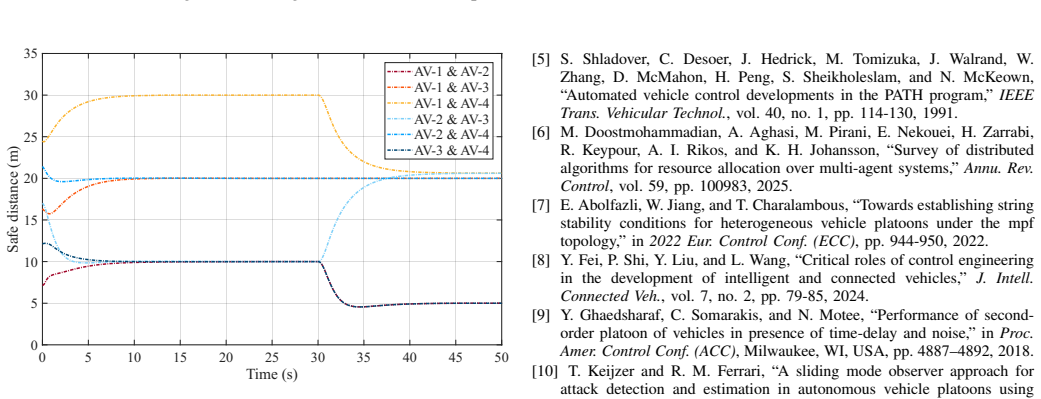
The paper claims that by introducing an input saturation compensation mechanism, a delay-compensating auxiliary system, dynamic-threshold event-triggered control, uncertainty observers, and symmetric barrier Lyapunov functions, a collaborative adaptive formation control framework can achieve robust and safe formation maneuvers for autonomous vehicles under uncertainties, saturation, and delays, as verified through numerical simulations and 3D visualization.
Load-bearing premise
The models of the vehicles support the uncertainty observers functioning effectively, and the auxiliary system compensates for bounded delays without destabilizing the overall formation.
Editorial analysis
A structured set of objections, weighed in public.
Referee Report
Summary. The manuscript presents a collaborative adaptive formation control framework for autonomous vehicles that handles system uncertainties, input saturation, and communication delays. It introduces an input saturation compensation mechanism, a delay-compensating auxiliary system, a dynamic-threshold event-triggered control strategy, uncertainty observers, and symmetric barrier Lyapunov functions, with effectiveness validated through numerical simulations of vehicle formations and a 3D visualization video.
Significance. If the design provides the claimed robustness and safety guarantees, the integration of adaptive observers, barrier functions, saturation compensation, and event-triggered control could offer a practical contribution to handling multiple real-world challenges in AV platoon control simultaneously. The simulation-based validation route is standard for such design papers but limits the strength of the claims.
major comments (2)
- [Abstract] Abstract: the central claims that the framework 'ensures robust and safe formation maneuvers' rest solely on numerical simulations without any stability proofs, Lyapunov analysis details, or error bounds; this is load-bearing for the contribution as the design elements (observers, auxiliary system, barrier functions) are asserted to deliver the guarantees but are not analytically verified.
- [Validation] The weakest assumption (vehicle models allow uncertainty observers to function effectively and bounded delays are mitigated without destabilization) is not tested beyond the specific simulation scenarios; no sensitivity analysis or counterexample checks are described to support generalizability.
minor comments (2)
- [Title/Abstract] The title refers to 'switched' formation control, but the abstract does not mention or describe any switching logic or mode-dependent design; this notation mismatch should be clarified.
- [Abstract] The dynamic-threshold ETC and auxiliary system are described at a high level; explicit equations for the threshold update law and delay compensation would improve reproducibility.
Simulated Author's Rebuttal
We thank the referee for the detailed review and constructive comments. We address each major comment point by point below and indicate where revisions will be made to strengthen the manuscript.
read point-by-point responses
-
Referee: [Abstract] Abstract: the central claims that the framework 'ensures robust and safe formation maneuvers' rest solely on numerical simulations without any stability proofs, Lyapunov analysis details, or error bounds; this is load-bearing for the contribution as the design elements (observers, auxiliary system, barrier functions) are asserted to deliver the guarantees but are not analytically verified.
Authors: The manuscript develops symmetric barrier Lyapunov functions along with uncertainty observers and provides the corresponding Lyapunov stability analysis to prove boundedness of the formation tracking errors and observer errors under the stated assumptions; these analytical results underpin the robustness and safety claims, with the simulations serving as numerical validation. The abstract summarizes the outcome of this analysis rather than providing the full details. To address the concern about clarity, we will revise the abstract to explicitly reference the Lyapunov-based guarantees and will add a brief statement on the error bounds derived in the main text. revision: partial
-
Referee: [Validation] The weakest assumption (vehicle models allow uncertainty observers to function effectively and bounded delays are mitigated without destabilization) is not tested beyond the specific simulation scenarios; no sensitivity analysis or counterexample checks are described to support generalizability.
Authors: We agree that additional validation would strengthen the generalizability claims. The current simulations demonstrate performance under the modeled uncertainties and bounded delays, but we will incorporate further simulation cases with varied delay magnitudes and uncertainty levels, along with a short discussion of the assumptions and their implications for broader applicability. revision: yes
Circularity Check
No significant circularity in derivation chain
full rationale
The paper outlines a standard adaptive formation control design for AVs that combines uncertainty observers, symmetric barrier Lyapunov functions, input saturation compensation, a delay-mitigating auxiliary system, and dynamic-threshold ETC. These components are conventional in the switched-systems and adaptive control literature; the abstract and described framework do not reduce any central claim to a fitted parameter renamed as prediction, a self-definitional loop, or a load-bearing self-citation chain. Validation proceeds via numerical simulations and visualization, which are independent of the design steps themselves. No quoted equations or steps exhibit the enumerated circularity patterns.
Assumptions & free parameters
Cite this review
Pith. "Pith review of Cooperative Switched Formation Control of Autonomous Vehicles: An Event-triggered Approach to Input Saturation and Time-delay Challenges." pith.science (2026). https://pith.science/paper/Z455SU3K
@misc{pith2026260611971,
  author       = {Pith},
  title        = {Pith review of: Cooperative Switched Formation Control of Autonomous Vehicles: An Event-triggered Approach to Input Saturation and Time-delay Challenges},
  year         = {2026},
  howpublished = {\url{https://pith.science/paper/Z455SU3K}},
  note         = {Machine review of arXiv:2606.11971}
}
read the original abstract
This paper presents a collaborative adaptive formation control framework for autonomous vehicles (AVs), that explicitly handles system uncertainties, input saturation, and communication delays. To overcome the inherent physical torque limits of steering and braking actuators, an input saturation compensation mechanism is introduced to render nonlinearities tractable and improve control reliability. Additionally, a delay-compensating auxiliary system is designed to mitigate the effects of communication delays and reduce tracking errors. Our framework incorporates a dynamic-threshold event-triggered control (ETC) strategy to optimize resource usage. Additionally, uncertainty observers and symmetric barrier Lyapunov functions are developed to ensure robust and safe formation maneuvers. Finally, the effectiveness of the proposed approach is validated through numerical simulations of vehicle formations, complemented by a 3D visualization video demonstrating the dynamic fleet reconfiguration process.
Figures


Figures from the paper (5 more)


Forward citations
Cited by 1 Pith paper
-
On Optimal Event-Triggered Distributed Control for Stochastic Multi-Agent Systems via Reinforcement Learning
An actor-critic-identifier backstepping controller with hybrid event-triggering is claimed to optimally stabilize stochastic multi-agent tracking, but internal inconsistencies in the optimality derivation and stabilit...
Reference graph
Works this paper leans on
-
[1]
Platoon control in traffic networks: New challenges and opportunities,
S. Sacone, “Platoon control in traffic networks: New challenges and opportunities,”IEEE Trans. Intell. Transp. Syst., vol. 25, no. 4, pp. 149- 183, 2024
2024
-
[2]
Analysis and validation of a freeway traffic model including controlled vehicles,
B. Block, C. Pasquale, S. Stockar, S. Siri, and S. Sacone, “Analysis and validation of a freeway traffic model including controlled vehicles,” in 2025 IEEE 64th Conf. Decis. Control (CDC), pp. 243-248, 2025
2025
-
[3]
String Stability and a Delay-Based Spacing Policy for Vehicle Platoons Subject to Disturbances,
B. Besselink and K. H. Johansson, “String Stability and a Delay-Based Spacing Policy for Vehicle Platoons Subject to Disturbances,” IEEE Trans. Autom. Control, vol. 62, no. 9, pp. 4376-4391, 2017
2017
-
[4]
Platoon control leveraging network performance and state estimation under dynamic V2V network,
J. Gao, Z. Peng, S. Jang, and C. Piao, “Platoon control leveraging network performance and state estimation under dynamic V2V network,”IEEE Trans. Intell. Transp. Syst., vol. 26, no. 8, pp. 12093-12105, 2025
2025
-
[5]
Automated vehicle control developments in the PATH program,
S. Shladover, C. Desoer, J. Hedrick, M. Tomizuka, J. Walrand, W. Zhang, D. McMahon, H. Peng, S. Sheikholeslam, and N. McKeown, “Automated vehicle control developments in the PATH program,”IEEE Trans. Vehicular Technol., vol. 40, no. 1, pp. 114-130, 1991
1991
-
[6]
Survey of distributed algorithms for resource allocation over multi-agent systems,
M. Doostmohammadian, A. Aghasi, M. Pirani, E. Nekouei, H. Zarrabi, R. Keypour, A. I. Rikos, and K. H. Johansson, “Survey of distributed algorithms for resource allocation over multi-agent systems,”Annu. Rev. Control, vol. 59, pp. 100983, 2025
2025
-
[7]
Towards establishing string stability conditions for heterogeneous vehicle platoons under the mpf topology,
E. Abolfazli, W. Jiang, and T. Charalambous, “Towards establishing string stability conditions for heterogeneous vehicle platoons under the mpf topology,” in2022 Eur. Control Conf. (ECC), pp. 944-950, 2022
2022
-
[8]
Critical roles of control engineering in the development of intelligent and connected vehicles,
Y . Fei, P. Shi, Y . Liu, and L. Wang, “Critical roles of control engineering in the development of intelligent and connected vehicles,”J. Intell. Connected Veh., vol. 7, no. 2, pp. 79-85, 2024
2024
Show all 43 references
-
[9]
Performance of second- order platoon of vehicles in presence of time-delay and noise,
Y . Ghaedsharaf, C. Somarakis, and N. Motee, “Performance of second- order platoon of vehicles in presence of time-delay and noise,” inProc. Amer. Control Conf. (ACC), Milwaukee, WI, USA, pp. 4887–4892, 2018
2018
-
[10]
A sliding mode observer approach for attack detection and estimation in autonomous vehicle platoons using event triggered communication,
T. Keijzer and R. M. Ferrari, “A sliding mode observer approach for attack detection and estimation in autonomous vehicle platoons using event triggered communication,” in2019 IEEE 58th Conf. Decis. Control (CDC), pp. 5742-5747, 2019
2019
-
[11]
Platoon- ing of car-like vehicles in urban environments: Longitudinal control considering actuator dynamics, time delays, and limited communication capabilities,
A. Khalifa, O. Kermorgant, S. Dominguez, and P. Martinet, “Platoon- ing of car-like vehicles in urban environments: Longitudinal control considering actuator dynamics, time delays, and limited communication capabilities,”IEEE Trans. Control Syst. Technol., vol. 29, no. 6, pp. ...
2020
-
[12]
Time-varying formation control with moving obstacle avoidance for input-saturated quadrotors with external disturbances,
B. S. Park and S. J. Yoo, “Time-varying formation control with moving obstacle avoidance for input-saturated quadrotors with external disturbances,”IEEE Trans. Syst., Man, Cybern. Syst., vol. 54, no. 5, pp. 3270–3282, 2024
2024
-
[13]
Adaptive event-triggered formation control of autonomous vehicles,
Z. Wang, Y . Zhang, C. Zhao, and H. Yu, “Adaptive event-triggered formation control of autonomous vehicles,” 2025, arXiv preprint arXiv:2506.06746. [Online]. Available: https://arxiv.org/abs/2506.06746
2025
-
[14]
Dynamic event-triggered platooning control of automated vehicles under random communication topologies and various spacing policies,
S. Xiao, X. Ge, Q. L. Han, and Y . Zhang, “Dynamic event-triggered platooning control of automated vehicles under random communication topologies and various spacing policies,”IEEE Trans. Cybern., vol. 52, no. 11, pp. 11477-11490, 2021
2021
-
[15]
RBFNN-based adaptive event-triggered 11 control for heterogeneous vehicle platoon consensus,
Z. Wu, J. Sun, and S. Hong, “RBFNN-based adaptive event-triggered 11 control for heterogeneous vehicle platoon consensus,”IEEE Trans. Intell. Transp. Syst., vol. 23, no. 10, pp. 18761-18773, 2022
2022
-
[16]
Key challenge in the field of platoon formation: Observer-based event-triggered sliding mode formation control for multivehicle systems with external disturbances,
X. Li, X. Zhang, and Q. Zhao, “Key challenge in the field of platoon formation: Observer-based event-triggered sliding mode formation control for multivehicle systems with external disturbances,”J. Transp. Eng. Part A Syst., vol. 152, no. 1, 2026
2026
-
[17]
Stability of platoon of adaptive cruise control vehicles with time delay,
S. G. Hu, H. Y . Wen, L. Xu, and H. Fu, “Stability of platoon of adaptive cruise control vehicles with time delay,”Transp. Lett., vol. 11, no. 9, pp. 506-515, 2019
2019
-
[18]
Distributed anytime-feasible resource allocation subject to heterogeneous time-varying delays,
M. Doostmohammadian, A. Aghasi, A. I. Rikos, A. Grammenos, E. Kalyvianaki, C. N. Hadjicostis,et al., “Distributed anytime-feasible resource allocation subject to heterogeneous time-varying delays,”IEEE Open J. Control Syst., vol. 1, pp. 255-267, 2022
2022
-
[19]
Nonlinear consensus-based connected vehicle platoon control incorporating car-following interactions and heterogeneous time delays,
Y . Li, C. Tang, S. Peeta, and Y . Wang, “Nonlinear consensus-based connected vehicle platoon control incorporating car-following interactions and heterogeneous time delays,”IEEE Trans. Intell. Transp. Syst., vol. 20, no. 6, pp. 2209-2219, 2018
2018
-
[20]
Data-driven stabilization of linear discrete-time delay systems with noisy data,
X. M. Zhang, Q. L. Han, X. Ge, and B. L. Zhang, “Data-driven stabilization of linear discrete-time delay systems with noisy data,”Int. J. Robust Nonlinear Control, vol. 36, no. 3, pp. 1217-1227, 2026
2026
-
[21]
Robust adaptive neural network control for a class of uncertain MIMO nonlinear systems with input nonlinearities,
M. Chen, S. S. Ge, and B. V . E. How, “Robust adaptive neural network control for a class of uncertain MIMO nonlinear systems with input nonlinearities,”IEEE Trans. Neural Netw., vol. 21, no. 5, pp. 796-812, 2010
2010
-
[22]
Distributed adaptive prescribed performance control for interconnected Euler-Lagrange sys- tems under input constraints,
T. Tao, C. P. Bechlioulis, and D. V . Dimarogonas, “Distributed adaptive prescribed performance control for interconnected Euler-Lagrange sys- tems under input constraints,”IEEE Trans. Control Netw. Syst., vol. 12, no. 4, pp. 2932-2943, 2025
2025
-
[23]
Adaptive fuzzy control of nonlinear systems with unmodeled dynamics and input saturation using small-gain approach,
Q. Zhou, H. Li, C. Wu, L. Wang, and C. K. Ahn, “Adaptive fuzzy control of nonlinear systems with unmodeled dynamics and input saturation using small-gain approach,”IEEE Trans. Syst., Man, Cybern. Syst., vol. 47, no. 8, pp. 1979-1989, 2016
1979
-
[24]
On disturbance propagation in vehicular platoons with different communication ranges,
C. Wu, M. Zhang, and D. V . Dimarogonas, “On disturbance propagation in vehicular platoons with different communication ranges,”Automatica, vol. 165, pp. 111665, 2024
2024
-
[25]
Distributed platooning control of automated vehicles subject to replay attacks based on proportional integral observers,
M. Xie, D. Ding, X. Ge, Q. L. Han, H. Dong, and Y . Song, “Distributed platooning control of automated vehicles subject to replay attacks based on proportional integral observers,”IEEE/CAA J. Autom. Sin., vol. 11, no. 9, pp. 1954-1966, 2022
1954
-
[26]
Hub-based platoon formation: Optimal release policies and approximate solutions,
A. Johansson, E. Nekouei, X. Sun, K. H. Johansson, and J. M ˚artensson, “Hub-based platoon formation: Optimal release policies and approximate solutions,”IEEE Trans. Intell. Transp. Syst., vol. 25, no. 6, pp. 5755-5766, 2023
2023
-
[27]
Event-triggered adaptive neural control for full state-constrained nonlinear systems with unknown disturbances,
Z. Wang, H. Wang, X. Wang, N. Pang, and Q. Shi, “Event-triggered adaptive neural control for full state-constrained nonlinear systems with unknown disturbances,”Cogn. Comput., vol. 16, no. 2, pp. 717-726, 2024
2024
-
[28]
Distributed event-triggered control for multi-agent systems,
D. V . Dimarogonas, E. Frazzoli, and K. H. Johansson, “Distributed event-triggered control for multi-agent systems,”IEEE Trans. Autom. Control, vol. 57, no. 5, pp. 1291-1297, 2011
2011
-
[29]
Optimized leader-following con- sensus control for stochastic multiagent systems via switched-triggered input,
L. Wang, Z. Wang, and X. Wang, “Optimized leader-following con- sensus control for stochastic multiagent systems via switched-triggered input,”J. Franklin Inst., vol. 363, no. 8, pp. 108678, 2026
2026
-
[30]
Krstic, I
M. Krstic, I. Kanellakopoulos, and P. V . Kokotovic,Nonlinear and Adaptive Control Design. New York, NY , USA: Wiley, 1995
1995
-
[31]
Robust adaptive control of uncertain nonlinear systems in the presence of input saturation and external disturbance,
C. Wen, J. Zhou, Z. Liu, and H. Su, “Robust adaptive control of uncertain nonlinear systems in the presence of input saturation and external disturbance,”IEEE Trans. Automat. Control, vol. 56, no. 7, pp. 1672-1678, 2011
2011
-
[32]
Event-triggered adaptive control for a class of uncertain nonlinear systems,
L. Xing, C. Wen, Z. Liu, H. Su, and J. Cai, “Event-triggered adaptive control for a class of uncertain nonlinear systems,”IEEE Trans. Automat. Control, vol. 62, no. 4, pp. 2071-2076, 2017
-
[33]
Adaptive Fixed-Time Control for Full State-Constrained Nonlinear Systems: Switched-Self-Triggered Case
Z. Wang, X. Wang and N. Pang, “Adaptive Fixed-Time Control for Full State-Constrained Nonlinear Systems: Switched-Self-Triggered Case” IEEE Trans. Circuits Syst. II Express Briefs, vol. 71, no. 2, pp. 752– 756, 2024
2024
-
[34]
Barrier Lyapunov functions for the control of output-constrained nonlinear systems,
K. P. Tee, S. S. Ge, and E. H. Tay, “Barrier Lyapunov functions for the control of output-constrained nonlinear systems,”Automatica, vol. 45, no. 4, pp. 918-927, 2009
2009
-
[35]
Observer-based event-triggered adaptive platooning control for autonomous vehicles with motion uncertainties,
Y . J. Xue, C. L. Wang, C. Ding, B. Yu and S. H. Cui. “Observer-based event-triggered adaptive platooning control for autonomous vehicles with motion uncertainties,”Transp. Res. Part C Emerg. Technol, vol. 159, no. 104462, 2024
2024
-
[36]
Fixed-relative- switched threshold strategies for consensus tracking control of nonlinear multiagent systems,
Z. Wang, Y . Gao, A. I. Rikos, N. Pang, and Y . Ji, “Fixed-relative- switched threshold strategies for consensus tracking control of nonlinear multiagent systems,”2025 IEEE 19th Int. Conf. Control Autom. (ICCA), pp. 899-905, 2025
2025
-
[37]
An efficient dual- observer method for leader-following consensus control of multiagent systems,
Z. Wang, S. Piao, Y . Ji, X. Wang, and F. Tsung, “An efficient dual- observer method for leader-following consensus control of multiagent systems,” in2025 IEEE 21st Int. Conf. Autom. Sci. Eng. (CASE), pp. 3468-3473, 2025
2025
-
[38]
Distributed formation control of networked multi-agent systems using a dynamic event-triggered communication mechanism,
X. Ge and Q.-L. Han, “Distributed formation control of networked multi-agent systems using a dynamic event-triggered communication mechanism,”IEEE Trans. Ind. Electron., vol. 64, no. 10, pp. 8118–8127, 2017
2017
-
[39]
Connected automated vehicle platoon control with input saturation and variable time headway strategy,
J. Chen, H. Liang, J. Li, and Z. Lv, “Connected automated vehicle platoon control with input saturation and variable time headway strategy,” IEEE Trans. Intell. Transp. Syst., vol. 22, no. 8, pp. 4929–4940, 2021
2021
-
[40]
An adaptive disturbance decoupling perspective to longitudinal platooning,
D. Liu, B. Besselink, S. Baldi, W. Yu, and H. L. Trentelman, “An adaptive disturbance decoupling perspective to longitudinal platooning,” IEEE Control Syst. Lett., vol. 6, pp. 668–673, 2022
2022
-
[41]
When trust collides: exploring human-LLM cooperation intention through the prisoner’s dilemma,
G. Jiang, S. Yang, Y . Wang, and P. Hui, “When trust collides: exploring human-LLM cooperation intention through the prisoner’s dilemma,”Int. J. Hum.-Comput. Stud., vol. 209, p. 103740, 2026
2026
-
[42]
Ecological cooperative adaptive cruise control for heterogenous vehicle platoons subject to time delays and input saturations,
C. Zhai, C. Chen, X. Zheng, Z. Han, Y . Gao, C. Yan, J. Xu, and S. Li, “Ecological cooperative adaptive cruise control for heterogenous vehicle platoons subject to time delays and input saturations,”IEEE Trans. Intell. Transp. Syst., vol. 24, no. 3, pp. 2862–2873, 2023
2023
-
[43]
Adaptive neural output feedback control of uncertain nonlinear systems with unknown hysteresis using disturbance observer,
M. Chen and S. S. Ge, “Adaptive neural output feedback control of uncertain nonlinear systems with unknown hysteresis using disturbance observer,”IEEE Trans. Ind. Electron., vol. 62, no. 12, pp. 7706–7716, 2015. Ziming Wangreceived the B.Eng. degree in Elec- tronic Information...
2015
Reviewed June 27, 2026 · model on record in the stance chip above.
Discussion (0). Sign in to comment.