Reflective Metastructure Q-plate for Ultrashort Laser Pulses
Pith reviewed 2026-06-27 08:21 UTC · model grok-4.3
The pith
A plasmonic metasurface q-plate reflects ultrashort pulses while adding orbital angular momentum without temporal broadening.
A machine-rendered reading of the paper's core claim, the machinery that carries it, and where it could break.
Core claim
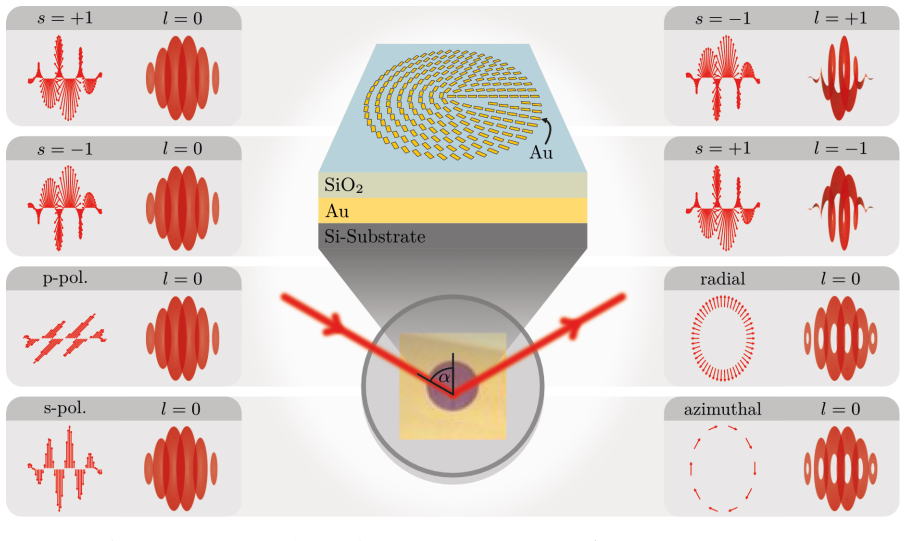
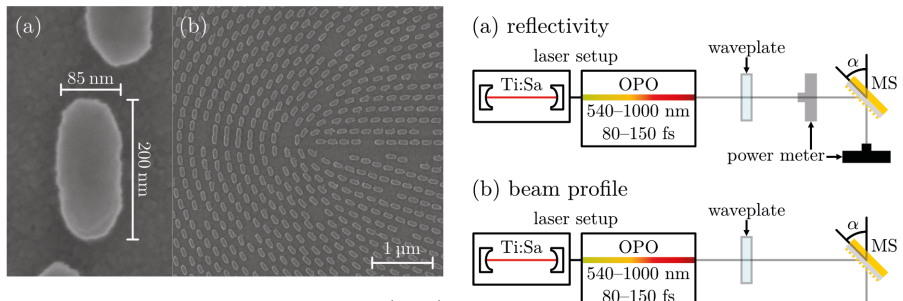
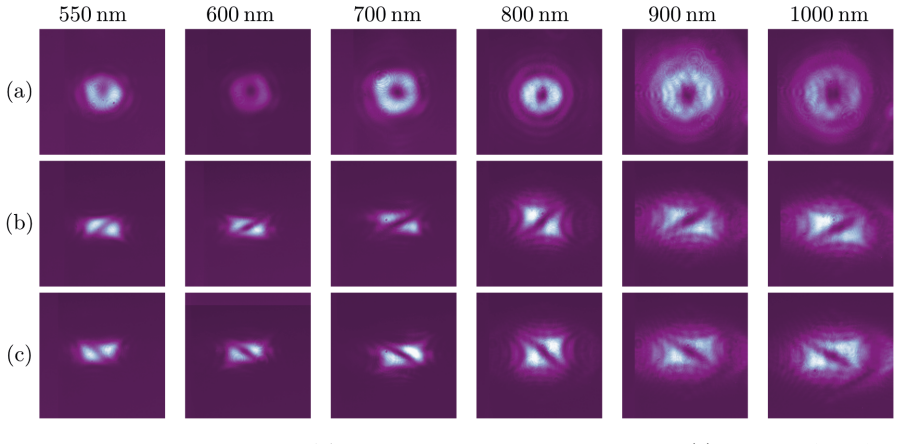
We present a highly reflective q-plate based on a plasmonic metasurface capable of converting orbital angular momentum from the nanostructure to ultrashort laser pulses without temporal broadening. We highlight its working principle over a wide range of wavelengths for reflection under normal and grazing incidence.
What carries the argument
Plasmonic metasurface that supplies the radial phase profile for q-plate OAM conversion while operating in reflection.
If this is right
- The reflected pulses retain their original temporal duration after OAM conversion.
- The device functions over a wide wavelength range.
- Reflection works at both normal and grazing incidence.
- OAM conversion becomes available in purely reflective optical paths.
Where Pith is reading between the lines
- A reflective geometry could simplify alignment in surface-sensitive ultrafast setups.
- The approach may reduce absorption losses compared with transmissive plates at high intensities.
- Integration with existing plasmonic platforms could allow combined OAM and near-field control.
Load-bearing premise
The metasurface delivers the exact radial phase modulation for OAM conversion without adding dispersion that would lengthen the ultrashort pulse.
What would settle it
Direct measurement of the reflected beam showing either missing OAM (via fork interference or mode decomposition) or measurable temporal broadening at the tested wavelengths and incidence angles.
Figures
read the original abstract
The orbital angular momentum of light is an intriguing property for developing light driven applications. It emerged as an independent degree of freedom by which to manipulate light and, consequently, the interaction of light with matter. Several methods exist for the generation of light carrying orbital angular momentum, mostly employing transmitting or reflecting optical components, which radially modulate the phase profile of the light. As one of such components, transmissive q-plates established themselves as standard elements due to their usability over a broad wavelength range. Here, we present our approach to build a highly reflective q-plate based on a plasmonic metasurface capable of converting orbital angular momentum from the nanostructure to ultrashort laser pulses without temporal broadening. We highlight its working principle over a wide range of wavelengths for reflection under normal and gracing incidence.
Editorial analysis
A structured set of objections, weighed in public.
Referee Report
Summary. The manuscript presents a plasmonic metasurface-based reflective q-plate intended to impart orbital angular momentum to ultrashort laser pulses while preserving pulse duration, with operation claimed over a wide wavelength range under both normal and grazing incidence.
Significance. A validated reflective metasurface q-plate that avoids temporal broadening for ultrashort pulses would be useful for compact OAM-based ultrafast optics setups. The combination of plasmonic phase control with q-plate functionality in reflection is a reasonable direction, but the absence of any quantitative support for the no-broadening claim prevents a positive assessment of significance.
major comments (2)
- [Abstract] Abstract: the central claim that the device converts OAM 'without temporal broadening' is unsupported by any calculation or measurement of the wavelength-dependent complex reflection coefficient, group-delay dispersion, or Fourier-transformed pulse shape; this directly undermines evaluation of the design given the known rapid phase variation of plasmonic resonances.
- [Abstract] Abstract: no description is given of the metasurface unit-cell geometry, the specific azimuthal phase ramp 2qθ implementation, or how |r|≈1 and near-zero dispersion are simultaneously achieved across the pulse bandwidth under both normal and grazing incidence.
Simulated Author's Rebuttal
We thank the referee for their detailed review and constructive comments. We address each major comment below and plan revisions to strengthen the manuscript.
read point-by-point responses
-
Referee: [Abstract] Abstract: the central claim that the device converts OAM 'without temporal broadening' is unsupported by any calculation or measurement of the wavelength-dependent complex reflection coefficient, group-delay dispersion, or Fourier-transformed pulse shape; this directly undermines evaluation of the design given the known rapid phase variation of plasmonic resonances.
Authors: The referee correctly identifies that the abstract's claim requires supporting evidence. While the manuscript includes simulations of the metasurface response, we did not explicitly compute the group-delay dispersion or the Fourier-transformed pulse shape in the provided sections. We will revise the manuscript to include these calculations, demonstrating that the phase variation is sufficiently linear across the pulse bandwidth to avoid temporal broadening. revision: yes
-
Referee: [Abstract] Abstract: no description is given of the metasurface unit-cell geometry, the specific azimuthal phase ramp 2qθ implementation, or how |r|≈1 and near-zero dispersion are simultaneously achieved across the pulse bandwidth under both normal and grazing incidence.
Authors: We agree that additional details on the unit-cell geometry and the implementation of the azimuthal phase ramp are needed for clarity. The full manuscript describes the plasmonic metasurface approach, but we will expand the methods and results sections to provide specific geometry parameters, the 2qθ phase implementation, and explanations of how high reflectivity and low dispersion are achieved for both incidence angles. revision: yes
Circularity Check
No circularity: device design and principle described without self-referential derivations
full rationale
The manuscript presents an experimental metasurface q-plate design for OAM conversion in ultrashort pulses. No equations, fitted parameters, or derivation chains appear that could reduce to self-definition, fitted inputs renamed as predictions, or self-citation load-bearing steps. Claims rest on physical structure and measured performance rather than internal mathematical closure. This is the expected outcome for a fabrication-focused optics paper with no theoretical modeling loop.
Axiom & Free-Parameter Ledger
Reference graph
Works this paper leans on
-
[1]
J. H. Poynting. “The Wave Motion of a Revolving Shaft, and a Suggestion as to the Angular Momentum in a Beam of Circularly Polarised Light”. In:Proceedings of the Royal Society of London. Series A, Containing Papers of a Mathematical and Physical Character 82.557 (1909), pp. 560–567.doi:10.1098/rspa.1909.0060
-
[2]
Mechanical Detection and Measurement of the Angular Momentum of Light
R. A. Beth. “Mechanical Detection and Measurement of the Angular Momentum of Light”. In:Physical Review50.2 (1936), pp. 115–125.doi:10.1103/PhysRev.50.115
-
[3]
Orbital angular momentum of light and the transformation of Laguerre- Gaussian laser modes,
L. Allen, M. W. Beijersbergen, R. J. C. Spreeuw, and J. P. Woerdman. “Orbital Angular Momentum of Light and the Transformation of Laguerre-Gaussian Laser Modes”. In: Physical Review A45.11 (1992), pp. 8185–8189.doi:10.1103/PhysRevA.45.8185
-
[4]
Light’s Orbital Angular Momentum
M. Padgett, J. Courtial, and L. Allen. “Light’s Orbital Angular Momentum”. In:Physics Today57.5 (2004), pp. 35–40.doi:10.1063/1.1768672. 12
-
[5]
Transfer of optical orbital angular momentum to a bound electron,
C. T. Schmiegelow, J. Schulz, H. Kaufmann, T. Ruster, U. G. Poschinger, and F. Schmidt- Kaler. “Transfer of Optical Orbital Angular Momentum to a Bound Electron”. In:Nature Communications7.1 (2016), p. 12998.doi:10.1038/ncomms12998
-
[6]
Twisted photons: new quantum perspectives in high dimensions,
M. Erhard, R. Fickler, M. Krenn, and A. Zeilinger. “Twisted Photons: New Quantum Perspectives in High Dimensions”. In:Light: Science & Applications7.3 (2017), pp. 17146– 17146.doi:10.1038/lsa.2017.146
-
[7]
Terabit Free-Space Data Transmission Employing Orbital Angular Momentum Multiplexing
J. Wang, J.-Y. Yang, I. M. Fazal, N. Ahmed, Y. Yan, H. Huang, Y. Ren, Y. Yue, S. Dolinar, M. Tur, and A. E. Willner. “Terabit Free-Space Data Transmission Employing Orbital Angular Momentum Multiplexing”. In:Nature Photonics6.7 (2012), pp. 488–496.doi: 10.1038/nphoton.2012.138
-
[8]
Terabit-Scale Orbital Angular Momentum Mode Division Multiplexing in Fibers
N. Bozinovic, Y. Yue, Y. Ren, M. Tur, P. Kristensen, H. Huang, A. E. Willner, and S. Ramachandran. “Terabit-Scale Orbital Angular Momentum Mode Division Multiplexing in Fibers”. In:Science340.6140 (2013), pp. 1545–1548.doi:10.1126/science.1237861
-
[9]
Advances in Communications Using Optical Vortices
J. Wang. “Advances in Communications Using Optical Vortices”. In:Photonics Research 4.5 (2016), B14.doi:10.1364/PRJ.4.000B14
-
[10]
Toward Plasmonic Neuronal Architectures at the Nanometer Scale
C. G. O. Weiß, T. Eul, E. Kruel, M. F. Pfeiffer, B. Lägel, B. Stadtmüller, and M. Aeschlimann. “Toward Plasmonic Neuronal Architectures at the Nanometer Scale”. In: Nanophotonics15.7 (2026), e70066.doi:10.1002/nap2.70066
-
[11]
H. He, N. Heckenberg, and H. Rubinsztein-Dunlop. “Optical Particle Trapping with Higher- order Doughnut Beams Produced Using High Efficiency Computer Generated Holograms”. In:Journal of Modern Optics42.1 (1995), pp. 217–223.doi:10.1080/09500349514550171
-
[12]
M. Padgett and R. Bowman. “Tweezers with a Twist”. In:Nature Photonics5.6 (2011), pp. 343–348.doi:10.1038/nphoton.2011.81
-
[13]
Quantum Teleportation of Multiple Degrees of Freedom of a Single Photon
X.-L. Wang, X.-D. Cai, Z.-E. Su, M.-C. Chen, D. Wu, L. Li, N.-L. Liu, C.-Y. Lu, and J.-W. Pan. “Quantum Teleportation of Multiple Degrees of Freedom of a Single Photon”. In:Nature518.7540 (2015), pp. 516–519.doi:10.1038/nature14246
-
[14]
Optical Vortices 30 Years on: OAM Manipulation from Topological Charge to Multiple Singularities
Y. Shen, X. Wang, Z. Xie, C. Min, X. Fu, Q. Liu, M. Gong, and X. Yuan. “Optical Vortices 30 Years on: OAM Manipulation from Topological Charge to Multiple Singularities”. In: Light: Science & Applications8.1 (2019), p. 90.doi:10.1038/s41377-019-0194-2
-
[15]
A note on diffrac\on by a disloca\on,
M. W. Beijersbergen, R. P. C. Coerwinkel, M. Kristensen, and J. P. Woerdman. “Helical- Wavefront Laser Beams Produced with a Spiral Phaseplate”. In:Optics Communications 112.5 (1994), pp. 321–327.doi:10.1016/0030-4018(94)90638-6
-
[16]
Laguerre-GaussianBeamGenerated with a Multilevel Spiral Phase Plate for High Intensity Laser Pulses
K.Sueda,G.Miyaji,N.Miyanaga,andM.Nakatsuka.“Laguerre-GaussianBeamGenerated with a Multilevel Spiral Phase Plate for High Intensity Laser Pulses”. In:Opt. Express 12.15 (2004), pp. 3548–3553.doi:10.1364/OPEX.12.003548
-
[17]
Production and Characterization of Spiral Phase Plates for Optical Wavelengths
S. S. R. Oemrawsingh, J. A. W. Van Houwelingen, E. R. Eliel, J. P. Woerdman, E. J. K. Verstegen, J. G. Kloosterboer, and G. W. ’T Hooft. “Production and Characterization of Spiral Phase Plates for Optical Wavelengths”. In:Applied Optics43.3 (2004), pp. 688–694. doi:10.1364/AO.43.000688
-
[18]
Generation of High-Order Optical Vortices Using Directly Machined Spiral Phase Mirrors
G. Campbell, B. Hage, B. Buchler, and P. K. Lam. “Generation of High-Order Optical Vortices Using Directly Machined Spiral Phase Mirrors”. In:Applied Optics51.7 (2012), pp. 873–876.doi:10.1364/AO.51.000873. 13
-
[19]
Off-Axis Spiral Phase Mirrors for Generating High-Intensity Optical Vortices
A. Longman, C. Salgado, G. Zeraouli, J. I. Apiñaniz, J. Antonio Pérez-Hernández, M. K. Eltahlawy, L. Volpe, and R. Fedosejevs. “Off-Axis Spiral Phase Mirrors for Generating High-Intensity Optical Vortices”. In:Optics Letters45.8 (2020), pp. 2187–2190.doi: 10.1364/OL.387363
-
[20]
J. Y. Bae, C. Jeon, K. H. Pae, C. M. Kim, H. S. Kim, I. Han, W.-J. Yeo, B. Jeong, M. Jeon, D.-H. Lee, D. U. Kim, S. Hyun, H. Hur, K.-S. Lee, G. H. Kim, K. S. Chang, I. W. Choi, C. H. Nam, and I. J. Kim. “Generation of Low-Order Laguerre-Gaussian Beams Using Hybrid-Machined Reflective Spiral Phase Plates for Intense Laser-Plasma Interactions”. In:Results i...
-
[22]
Phase-Only Modulation with Twisted Nematic Liquid-Crystal Spatial Light Modulators
N. Konforti, E. Marom, and S.-T. Wu. “Phase-Only Modulation with Twisted Nematic Liquid-Crystal Spatial Light Modulators”. In:Optics Letters13.3 (1988), pp. 251–253. doi:10.1364/OL.13.000251
-
[23]
Creation and Detection of Optical Modes with Spatial Light Modulators
A. Forbes, A. Dudley, and M. McLaren. “Creation and Detection of Optical Modes with Spatial Light Modulators”. In:Advances in Optics and Photonics8.2 (2016), p. 200.doi: 10.1364/AOP.8.000200
-
[24]
ProgrammableShapingofUltrabroad-Bandwidth Pulses from a Ti:Sapphire Laser
A.Efimov,C.Schaffer,andD.H.Reitze.“ProgrammableShapingofUltrabroad-Bandwidth Pulses from a Ti:Sapphire Laser”. In:Journal of the Optical Society of America B12.10 (1995), pp. 1968–1980.doi:10.1364/JOSAB.12.001968
-
[25]
M. M. Wefers and K. A. Nelson. “Analysis of Programmable Ultrashort Waveform Gener- ation Using Liquid-Crystal Spatial Light Modulators”. In:Journal of the Optical Society of America B12.7 (1995), pp. 1343–1362.doi:10.1364/JOSAB.12.001343
-
[26]
Application of Cooled Spatial Light Modulator for High Power Nanosecond Laser Micromachining
R. J. Beck, J. P. Parry, W. N. MacPherson, A. Waddie, N. J. Weston, J. D. Shephard, and D. P. Hand. “Application of Cooled Spatial Light Modulator for High Power Nanosecond Laser Micromachining”. In:Optics Express18.16 (2010), pp. 17059–17065.doi:10.1364/ OE.18.017059
2010
-
[27]
Formation of Helical Beams by Use of Pancharatnam–Berry Phase Optical Elements
G. Biener, A. Niv, V. Kleiner, and E. Hasman. “Formation of Helical Beams by Use of Pancharatnam–Berry Phase Optical Elements”. In:Optics Letters27.21 (2002), pp. 1875– 1877.doi:10.1364/OL.27.001875
-
[28]
Optical Spin-to-Orbital Angular Momentum Conversion in Inhomogeneous Anisotropic Media
L. Marrucci, C. Manzo, and D. Paparo. “Optical Spin-to-Orbital Angular Momentum Conversion in Inhomogeneous Anisotropic Media”. In:Physical Review Letters96.16 (2006), p. 163905.doi:10.1103/PhysRevLett.96.163905
-
[29]
Absorption of scalars by nonextremal charged black holes in string theory
L. Marrucci, E. Karimi, S. Slussarenko, B. Piccirillo, E. Santamato, E. Nagali, and F. Sciarrino. “Spin-to-Orbital Optical Angular Momentum Conversion in Liquid Crystal “q- Plates”: Classical and Quantum Applications”. In:Molecular Crystals and Liquid Crystals 561.1 (2012), pp. 48–56.doi:10.1080/15421406.2012.686710
work page internal anchor Pith review Pith/arXiv arXiv doi:10.1080/15421406.2012.686710 2012
-
[30]
Q-Plate Technology: A Progress Review [Invited]
A. Rubano, F. Cardano, B. Piccirillo, and L. Marrucci. “Q-Plate Technology: A Progress Review [Invited]”. In:Journal of the Optical Society of America B36.5 (2019), pp. D70– D87.doi:10.1364/JOSAB.36.000D70
-
[31]
Bragg-Berry Mirrors: Reflective Broadband q-Plates
M. Rafayelyan and E. Brasselet. “Bragg-Berry Mirrors: Reflective Broadband q-Plates”. In:Optics Letters41.17 (2016), pp. 3972–3975.doi:10.1364/OL.41.003972. 14
-
[32]
M. M. Sánchez-López, I. Abella, D. Puerto-García, J. A. Davis, and I. Moreno. “Spectral Performance of a Zero-Order Liquid-Crystal Polymer Commercial q-Plate for the Gen- eration of Vector Beams at Different Wavelengths”. In:Optics & Laser Technology106 (2018), pp. 168–176.doi:10.1016/j.optlastec.2018.04.008
-
[33]
Con- tinuously Tunable Femtosecond Delay-Line Based on Liquid Crystal Cells
A. Jullien, U. Bortolozzo, S. Grabielle, J.-P. Huignard, N. Forget, and S. Residori. “Con- tinuously Tunable Femtosecond Delay-Line Based on Liquid Crystal Cells”. In:Optics Express24.13 (2016), pp. 14483–14493.doi:10.1364/OE.24.014483
-
[34]
Kats, Francesco Aieta, Jean-Philippe Tetienne, Fed- erico Capasso, and Zeno Gaburro
N. Yu, P. Genevet, M. A. Kats, F. Aieta, J.-P. Tetienne, F. Capasso, and Z. Gaburro. “Light Propagation with Phase Discontinuities: Generalized Laws of Reflection and Refraction”. In:Science334.6054 (2011), pp. 333–337.doi:10.1126/science.1210713
-
[35]
F. Aieta, P. Genevet, N. Yu, M. A. Kats, Z. Gaburro, and F. Capasso. “Out-of-Plane ReflectionandRefractionofLightbyAnisotropicOpticalAntennaMetasurfaceswithPhase Discontinuities”. In:Nano Letters12.3 (2012), pp. 1702–1706.doi:10.1021/nl300204s
-
[36]
Giant Birefringence in Optical Antenna Arrays with Widely Tailorable Optical Anisotropy
M. A. Kats, P. Genevet, G. Aoust, N. Yu, R. Blanchard, F. Aieta, Z. Gaburro, and F. Capasso. “Giant Birefringence in Optical Antenna Arrays with Widely Tailorable Optical Anisotropy”. In:Proceedings of the National Academy of Sciences109.31 (2012), pp. 12364–12368.doi:10.1073/pnas.1210686109
-
[37]
A Review of Metasurfaces: Physics and Applications
H.-T. Chen, A. J. Taylor, and N. Yu. “A Review of Metasurfaces: Physics and Applications”. In:Reports on Progress in Physics79.7 (2016), p. 076401.doi:10.1088/0034-4885/79/ 7/076401
-
[38]
Orbital Angular Momentum Generation and Detection by Geometric-Phase Based Metasurfaces
M. Chen, L. Jiang, and W. Sha. “Orbital Angular Momentum Generation and Detection by Geometric-Phase Based Metasurfaces”. In:Applied Sciences8.3 (2018), p. 362.doi: 10.3390/app8030362
-
[39]
Plasmonic Metasurfaces for Efficient Phase Control in Reflection
A. Pors and S. I. Bozhevolnyi. “Plasmonic Metasurfaces for Efficient Phase Control in Reflection”. In:Optics Express21.22 (2013), pp. 27438–27451.doi:10.1364/OE.21. 027438
-
[40]
Manipulating Light Polarization with Ultrathin Plasmonic Metasur- faces
Y. Zhao and A. Alù. “Manipulating Light Polarization with Ultrathin Plasmonic Metasur- faces”. In:Physical Review B84.20 (2011), p. 205428.doi:10.1103/PhysRevB.84.205428
-
[41]
Broadband and Wide Field-of-view Plasmonic Metasurface-enabled Waveplates
Z. H. Jiang, L. Lin, D. Ma, S. Yun, D. H. Werner, Z. Liu, and T. S. Mayer. “Broadband and Wide Field-of-view Plasmonic Metasurface-enabled Waveplates”. In:Scientific Reports 4.1 (2014), p. 7511.doi:10.1038/srep07511
-
[42]
Vector Vortex Beam Generation with a Single Plasmonic Metasurface
F. Yue, D. Wen, J. Xin, B. D. Gerardot, J. Li, and X. Chen. “Vector Vortex Beam Generation with a Single Plasmonic Metasurface”. In:ACS Photonics3.9 (2016), pp. 1558– 1563.doi:10.1021/acsphotonics.6b00392
-
[43]
Multi- channel Polarization-Controllable Superpositions of Orbital Angular Momentum States
F. Yue, D. Wen, C. Zhang, B. D. Gerardot, W. Wang, S. Zhang, and X. Chen. “Multi- channel Polarization-Controllable Superpositions of Orbital Angular Momentum States”. In:Advanced Materials29.15 (2017), p. 1603838.doi:10.1002/adma.201603838
-
[44]
Z. Liu, Z. Li, Z. Liu, H. Cheng, W. Liu, C. Tang, C. Gu, J. Li, H.-T. Chen, S. Chen, and J. Tian. “Single-Layer Plasmonic Metasurface Half-Wave Plates with Wavelength- Independent Polarization Conversion Angle”. In:ACS Photonics4.8 (2017), pp. 2061–2069. doi:10.1021/acsphotonics.7b00491. 15
-
[45]
Nanoparticle Spectroscopy: Birefringence in Two-Dimensional Arrays of L-Shaped Silver Nanoparticles
J. Sung, M. Sukharev, E. M. Hicks, R. P. Van Duyne, T. Seideman, and K. G. Spears. “Nanoparticle Spectroscopy: Birefringence in Two-Dimensional Arrays of L-Shaped Silver Nanoparticles”. In:The Journal of Physical Chemistry C112.9 (2008), pp. 3252–3260. doi:10.1021/jp077389y
-
[46]
Generating Optical Orbital Angular Momentum at Visible Wavelengths Using a Plasmonic Metasur- face
E. Karimi, S. A. Schulz, I. De Leon, H. Qassim, J. Upham, and R. W. Boyd. “Generating Optical Orbital Angular Momentum at Visible Wavelengths Using a Plasmonic Metasur- face”. In:Light: Science & Applications3.5 (2014), e167–e167.doi:10.1038/lsa.2014.48
-
[47]
L-Shaped Metallic Antenna for Linear Polarization Conversion in Reflection
P. Bouchon, Q. Lévesque, M. Makhsiyan, F. Pardo, J. Jaeck, R. Haïdar, and J.-L. Pelouard. “L-Shaped Metallic Antenna for Linear Polarization Conversion in Reflection”. In:Photonic and Phononic Properties of Engineered Nanostructures V9371 (2015), 93710O.doi: 10.1117/12.2080143
-
[48]
L-Shaped Metasurface for Both the Linear and Circular Polarization Conversions
W. Wang, Z. Guo, R. Li, J. Zhang, A. Zhang, Y. Li, Y. Liu, X. Wang, and S. Qu. “L-Shaped Metasurface for Both the Linear and Circular Polarization Conversions”. In:Journal of Optics17.6 (2015), p. 065103.doi:10.1088/2040-8978/17/6/065103
-
[49]
Wavelength Dependent Birefringence of Surface Plasmon Polaritonic Crystals
J. Elliott, I. I. Smolyaninov, N. I. Zheludev, and A. V. Zayats. “Wavelength Dependent Birefringence of Surface Plasmon Polaritonic Crystals”. In:Physical Review B70.23 (2004), p. 233403.doi:10.1103/PhysRevB.70.233403
-
[50]
Polarization Conversion with Elliptical Patch Nanoantennas
F. Wang, A. Chakrabarty, F. Minkowski, K. Sun, and Q.-H. Wei. “Polarization Conversion with Elliptical Patch Nanoantennas”. In:Applied Physics Letters101.2 (2012), p. 023101. doi:10.1063/1.4731792
-
[51]
A. Arbabi, Y. Horie, M. Bagheri, and A. Faraon. “Dielectric Metasurfaces for Complete Control of Phase and Polarization with Subwavelength Spatial Resolution and High Transmission”. In:Nature Nanotechnology10.11 (2015), pp. 937–943.doi:10.1038/nnano. 2015.186
-
[52]
P. M. Walmsness, T. Brakstad, B. B. Svendsen, J.-P. Banon, J. C. Walmsley, and M. Kildemo. “Optical Response of Rectangular Array of Elliptical Plasmonic Particles on Glass Revealed by Mueller Matrix Ellipsometry and Finite Element Modelling”. In:Journal of the Optical Society of America B36.7 (2019), E78–E87.doi:10.1364/JOSAB.36.000E78
-
[53]
S. Link, M. B. Mohamed, and M. A. El-Sayed. “Simulation of the Optical Absorption Spectra of Gold Nanorods as a Function of Their Aspect Ratio and the Effect of the Medium Dielectric Constant”. In:The Journal of Physical Chemistry B103.16 (1999), pp. 3073–3077.doi:10.1021/jp990183f
-
[54]
Plasmonic Optical Properties of a Single Gold Nano-Rod
H. J. Huang, C.-p. Yu, H. C. Chang, K. P. Chiu, H. Ming Chen, R. S. Liu, and D. P. Tsai. “Plasmonic Optical Properties of a Single Gold Nano-Rod”. In:Optics Express15.12 (2007), pp. 7132–7139.doi:10.1364/OE.15.007132
-
[55]
Optical Characterization of Single Plasmonic Nanoparticles
J. Olson, S. Dominguez-Medina, A. Hoggard, L.-Y. Wang, W.-S. Chang, and S. Link. “Optical Characterization of Single Plasmonic Nanoparticles”. In:Chemical Society Reviews 44.1 (2015), pp. 40–57.doi:10.1039/C4CS00131A
-
[56]
Tailoring the Dispersion of Plasmonic Nanorods To Realize Broad- band Optical Meta-Waveplates
Y. Zhao and A. Alù. “Tailoring the Dispersion of Plasmonic Nanorods To Realize Broad- band Optical Meta-Waveplates”. In:Nano Letters13.3 (2013), pp. 1086–1091.doi: 10.1021/nl304392b. 16
-
[57]
Terahertz Metamaterials for Linear Polarization Conversion and Anomalous Refraction
N. K. Grady, J. E. Heyes, D. R. Chowdhury, Y. Zeng, M. T. Reiten, A. K. Azad, A. J. Taylor, D. A. R. Dalvit, and H.-T. Chen. “Terahertz Metamaterials for Linear Polarization Conversion and Anomalous Refraction”. In:Science340.6138 (2013), pp. 1304–1307.doi: 10.1126/science.1235399
-
[58]
Broadband Plasmonic Half-Wave Plates in Reflection
A. Pors, M. G. Nielsen, and S. I. Bozhevolnyi. “Broadband Plasmonic Half-Wave Plates in Reflection”. In:Optics Letters38.4 (2013), pp. 513–515.doi:10.1364/OL.38.000513
-
[59]
A. Pors and S. I. Bozhevolnyi. “Efficient and Broadband Quarter-Wave Plates by Gap- Plasmon Resonators”. In:Optics Express21.3 (2013), pp. 2942–2952.doi:10.1364/OE. 21.002942
work page doi:10.1364/oe 2013
-
[60]
Broadband High-Efficiency Half-Wave Plate: A Supercell-Based Plasmonic Metasurface Approach
F. Ding, Z. Wang, S. He, V. M. Shalaev, and A. V. Kildishev. “Broadband High-Efficiency Half-Wave Plate: A Supercell-Based Plasmonic Metasurface Approach”. In:ACS Nano9.4 (2015), pp. 4111–4119.doi:10.1021/acsnano.5b00218
-
[61]
Dispersionless Phase Discontinuities for Controlling Light Propagation
L. Huang, X. Chen, H. Mühlenbernd, G. Li, B. Bai, Q. Tan, G. Jin, T. Zentgraf, and S. Zhang. “Dispersionless Phase Discontinuities for Controlling Light Propagation”. In: Nano Letters12.11 (2012), pp. 5750–5755.doi:10.1021/nl303031j
-
[62]
Metasurface Holograms Reaching 80% Efficiency
G. Zheng, H. Mühlenbernd, M. Kenney, G. Li, T. Zentgraf, and S. Zhang. “Metasurface Holograms Reaching 80% Efficiency”. In:Nature Nanotechnology10.4 (2015), pp. 308–312. doi:10.1038/nnano.2015.2
-
[63]
Determination of Topological Charges of Polychromatic Optical Vortices
V. Denisenko, V. Shvedov, A. S. Desyatnikov, D. N. Neshev, W. Krolikowski, A. Volyar, M. Soskin, and Y. S. Kivshar. “Determination of Topological Charges of Polychromatic Optical Vortices”. In:Optics Express17.26 (2009), pp. 23374–23379.doi:10.1364/OE.17.023374
-
[64]
Plasmonic Metasur- faces with 42.3% Transmission Efficiency in the Visible
J. Zhang, M. ElKabbash, R. Wei, S. C. Singh, B. Lam, and C. Guo. “Plasmonic Metasur- faces with 42.3% Transmission Efficiency in the Visible”. In:Light: Science & Applications 8.1 (2019), p. 53.doi:10.1038/s41377-019-0164-8
-
[65]
Optical Reflective Metasurfaces Based on Mirror-Coupled Slot Antennas
S. Ebel, Y. Deng, M. Hentschel, C. Meng, S. I. Sande, H. Giessen, F. Ding, and S. I. Bozhevolnyi. “Optical Reflective Metasurfaces Based on Mirror-Coupled Slot Antennas”. In:Advanced Photonics Nexus2.1 (2023), p. 016005.doi:10.1117/1.APN.2.1.016005. 17
discussion (0)
Sign in with ORCID, Apple, or X to comment. Anyone can read and Pith papers without signing in.