Reliable Error Estimation for PINNs: Lower and Upper A Posteriori Bounds
Pith reviewed 2026-06-27 10:54 UTC · model grok-4.3
The pith
Computable lower and upper a posteriori bounds certify PINN errors for ODEs without the exact solution.
A machine-rendered reading of the paper's core claim, the machinery that carries it, and where it could break.
Core claim
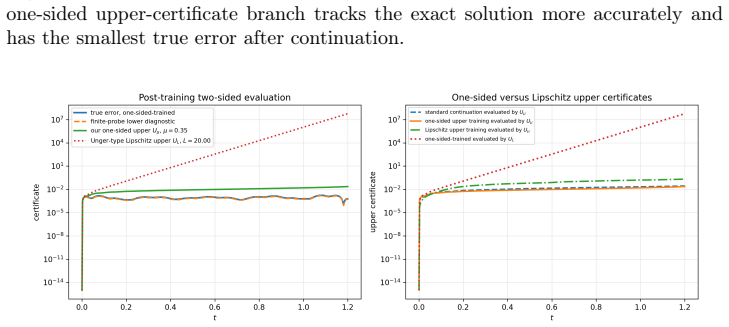
Under a localized strong monotonicity condition on certified state-space domains, the pointwise error of a PINN solution to an ODE admits a computable a posteriori lower bound that depends only on the residual and local growth constants; this lower bound can be combined with an upper bound obtained from a one-sided Lipschitz condition to produce two-sided, fully computable error enclosures that require no access to the exact solution.
What carries the argument
Localized strong monotonicity condition (for lower bounds) paired with one-sided Lipschitz condition (for upper bounds) on certified state-space domains, yielding residual-based a posteriori error estimates.
If this is right
- Two-sided error enclosures become available for PINN solutions of ODEs on domains where the monotonicity and Lipschitz conditions can be checked.
- For linear systems the bounds reduce to explicit expressions involving only the minimal and maximal eigenvalues of the symmetric part of the system matrix.
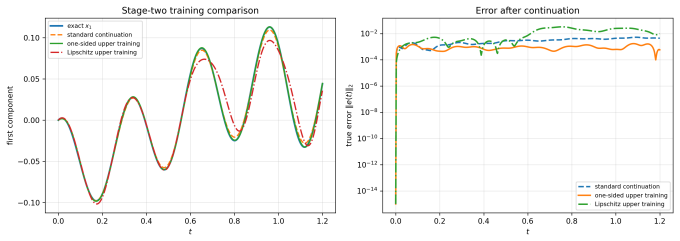
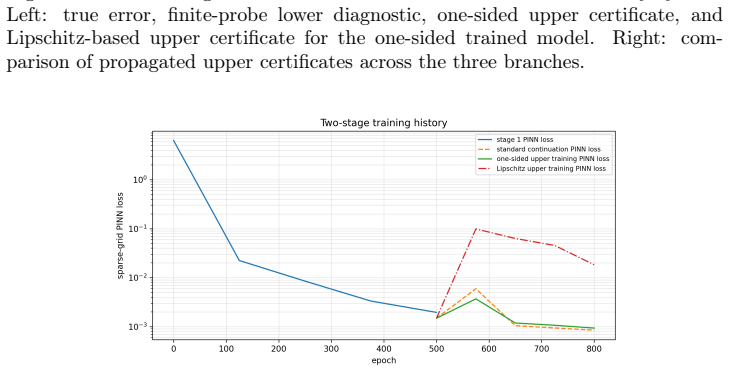
- A certificate-informed training procedure can use the propagated upper bound as an auxiliary regularizer while retaining lower certificates as post-training diagnostics.
- Exact enforcement of initial conditions can render the scalar lower certificate uninformative, but a signed-residual finite-probe certificate recovers nontrivial lower information in the linear setting.
Where Pith is reading between the lines
- The same residual-plus-monotonicity strategy could be tested on classes of nonlinear ODEs where the required local constants remain computable from the vector field alone.
- If the certified domains can be enlarged adaptively during training, the framework might produce progressively tighter error bands without retraining from scratch.
- The distinction between soft and hard initial-condition enforcement suggests analogous trade-offs may appear when PINNs are applied to boundary-value problems.
- The eigenvalue formulas for linear systems invite direct comparison with classical a posteriori estimators used in finite-element or finite-difference schemes for the same ODEs.
Load-bearing premise
The ODE must satisfy a localized strong monotonicity condition on the chosen domains for the lower bound and a one-sided Lipschitz condition for the upper bound, and both conditions must be verifiable from the data without the exact solution.
What would settle it
For an ODE whose exact solution is known, compute the PINN approximation, evaluate the derived lower and upper bounds on a certified domain, and check whether the true error lies strictly outside the interval formed by those bounds.
Figures


read the original abstract
Physics-informed neural networks (PINNs) combine machine learning with physical laws to solve differential equations. While existing results provide rigorous \emph{a posteriori} upper bounds for PINN prediction errors, complete certification also requires complementary lower information in order to obtain computable two-sided error enclosures. In this paper, we derive computable \emph{a posteriori} lower bounds for PINN errors in ordinary differential equations on suitable certified state-space domains under a localized strong monotonicity condition. We combine these estimates with complementary localized upper bounds under a one-sided Lipschitz condition, which is weaker than the global Lipschitz assumption used in previous work and can yield sharper upper error bands. The resulting bounds depend only on the neural-network approximation, the ODE residual, and local monotonicity and growth constants, and therefore do not require access to the exact solution. For linear time-invariant and time-varying systems, we further derive explicit formulas in terms of the minimal and maximal eigenvalues of the symmetric part of the system matrix. We also discuss the distinction between soft and hard enforcement of initial conditions in PINNs and explain why exact enforcement can make the scalar lower certificate uninformative. To recover nontrivial lower information in the linear setting, we use a signed-residual finite-probe certificate based on coordinate unit vectors. We also formulate a certificate-informed training strategy in which the propagated upper certificate is used as an auxiliary regularizer, while lower certificates remain post-training diagnostics. Altogether, the proposed framework provides rigorous and practically computable error certificates for PINN approximations of ODEs, while making explicit the domains and model classes for which the assumptions can be verified.
Editorial analysis
A structured set of objections, weighed in public.
Referee Report
Summary. The manuscript derives computable a posteriori lower bounds on PINN approximation errors for ODEs on certified state-space domains under a localized strong monotonicity condition, paired with complementary upper bounds under a one-sided Lipschitz condition (weaker than global Lipschitz). Explicit eigenvalue formulas are given for linear time-invariant and time-varying systems; the work also distinguishes soft versus hard initial-condition enforcement, introduces a signed-residual finite-probe certificate for nontrivial lower bounds in the linear case, and proposes using the propagated upper certificate as an auxiliary regularizer during training while treating lower certificates as post-training diagnostics. All bounds are claimed to depend only on the network, the ODE residual, and local constants without requiring the exact solution.
Significance. If the localized monotonicity and growth constants can be certified a posteriori as asserted, the framework supplies the first rigorous two-sided error enclosures for PINNs on ODEs under assumptions weaker than those in prior work. The explicit linear-system formulas and the certificate-informed training strategy are concrete strengths that could improve reliability assessment in scientific machine learning. The explicit delineation of model classes and domains where the assumptions are verifiable is also a positive contribution.
major comments (2)
- [Abstract / §3] Abstract and §3 (localized strong monotonicity construction): the central claim that the lower bounds are 'computable' and 'do not require access to the exact solution' depends on the existence of a general, non-circular procedure to locate certified state-space domains and evaluate the monotonicity/growth constants from the residual alone. For nonlinear ODEs no such algorithm is supplied; any search over state space risks either depending on a priori knowledge comparable to solving the ODE or producing empty certificates. This assumption is load-bearing for the 'reliable error estimation' title claim.
- [Abstract] Abstract (one-sided Lipschitz upper bounds): while the weakening from global to one-sided Lipschitz is correctly noted as potentially sharper, the manuscript must still demonstrate that the local growth constants remain computable without the exact solution on the same certified domains used for the lower bound; otherwise the two-sided enclosure is not fully a posteriori.
minor comments (1)
- [Abstract] The distinction between soft and hard enforcement of initial conditions and the signed-residual probe are clearly motivated, but the precise statement of the finite-probe certificate (coordinate unit vectors) should be given as an explicit proposition or algorithm rather than only in prose.
Simulated Author's Rebuttal
We thank the referee for the thorough review and for highlighting the strengths of the framework. We address the two major comments below, clarifying the scope of our a posteriori claims while acknowledging limitations in the current presentation for nonlinear systems.
read point-by-point responses
-
Referee: [Abstract / §3] Abstract and §3 (localized strong monotonicity construction): the central claim that the lower bounds are 'computable' and 'do not require access to the exact solution' depends on the existence of a general, non-circular procedure to locate certified state-space domains and evaluate the monotonicity/growth constants from the residual alone. For nonlinear ODEs no such algorithm is supplied; any search over state space risks either depending on a priori knowledge comparable to solving the ODE or producing empty certificates. This assumption is load-bearing for the 'reliable error estimation' title claim.
Authors: We agree that the manuscript does not supply a general algorithm for locating certified domains in nonlinear cases, and that this step is essential for the bounds to be fully practical. The core contribution is the derivation of the error estimates themselves: once a domain is certified (by any means) where localized strong monotonicity holds, the lower bound is then computable from the residual and network weights alone, without the exact solution. For linear systems the domains and eigenvalue-based constants are explicit. We will revise the abstract, §3, and add a short subsection discussing practical certification approaches (e.g., residual-guided sampling combined with interval arithmetic or Lipschitz-constant verification on candidate boxes) to make the scope and limitations explicit. We do not claim a universal black-box search procedure, and will adjust wording to avoid overstating generality. revision: partial
-
Referee: [Abstract] Abstract (one-sided Lipschitz upper bounds): while the weakening from global to one-sided Lipschitz is correctly noted as potentially sharper, the manuscript must still demonstrate that the local growth constants remain computable without the exact solution on the same certified domains used for the lower bound; otherwise the two-sided enclosure is not fully a posteriori.
Authors: The local one-sided Lipschitz growth constants are properties of the known vector field f on the certified domain and can be computed directly from f (via its Jacobian or finite differences) restricted to that domain, without any reference to the unknown exact solution. Because the same certified domains are used for both bounds, and the constants depend only on f and the domain geometry, the upper bound remains a posteriori with respect to the PINN approximation. We will add an explicit statement and a short example in the revised manuscript confirming that these constants are evaluated solely from the ODE right-hand side on the certified region. revision: yes
Circularity Check
No circularity: bounds derived mathematically from residuals and explicit assumptions
full rationale
The paper derives computable a posteriori lower and upper bounds directly from the neural network residual, the ODE, and local monotonicity/growth constants under stated conditions (localized strong monotonicity and one-sided Lipschitz). For linear cases, explicit eigenvalue formulas are provided. No self-definitional reductions, fitted inputs renamed as predictions, or load-bearing self-citations appear in the derivation chain. The assumptions are external and verifiable in principle (e.g., via eigenvalues for linear systems), making the central claims independent of the target error quantities. This is the standard non-circular case for a mathematical error-estimation paper.
Axiom & Free-Parameter Ledger
axioms (2)
- domain assumption The ODE satisfies a localized strong monotonicity condition on suitable certified state-space domains
- domain assumption The ODE satisfies a one-sided Lipschitz condition (weaker than global Lipschitz) on the same domains
Reference graph
Works this paper leans on
-
[1]
Hillebrecht, B
B. Hillebrecht, B. Unger, Certified machine learning: a posteriori error estimation for physics-informed neural networks, in: International Joint Conference on Neural Networks, IEEE, 2022, pp. 1–8
2022
-
[2]
Cuomo, et al., Scientific machine learning through physics-informed neural networks: where we are and what’s next, Journal of Scientific Computing 92 (2022) 88
S. Cuomo, et al., Scientific machine learning through physics-informed neural networks: where we are and what’s next, Journal of Scientific Computing 92 (2022) 88. 38
2022
-
[3]
M. Raissi, P. Perdikaris, G. E. Karniadakis, Physics-informed neural networks: A deep learning framework for solving forward and inverse problems involving nonlinear partial differential equations, Journal of ComputationalPhysics378(2019)686–707.doi:10.1016/j.jcp.2018. 10.045
-
[4]
G. E. Karniadakis, I. G. Kevrekidis, L. Lu, P. Perdikaris, S. Wang, L. Yang, Physics-informed machine learning, Nature Reviews Physics 3 (6) (2021) 422–440
2021
-
[5]
Cortés-Ciriano, A
I. Cortés-Ciriano, A. Bender, Deep confidence: a computationally effi- cient framework for calculating reliable prediction errors for deep neural networks, Journal of Chemical Information and Modeling 59 (3) (2019) 1269–1281
2019
-
[6]
P. Minakowski, T. Richter, Error estimates for neural network solutions ofpartialdifferential equations, arXivpreprintArXiv:2107.11035(2021)
-
[7]
R. van der Meer, C. W. Oosterlee, A. Borzi, Goal-oriented er- ror estimation for physics-informed neural networks, arXiv preprint- ArXiv:2203.04247 (2022)
-
[8]
J. S. Hesthaven, G. Rozza, B. Stamm, Certified Reduced Basis Methods for Parametrized Partial Differential Equations, Springer, 2016
2016
-
[9]
E.Hairer, S.P.Nørsett, G.Wanner, SolvingOrdinaryDifferentialEqua- tions I: Nonstiff Problems, Springer, 2008
2008
- [10]
- [11]
-
[12]
Hillebrecht, B
B. Hillebrecht, B. Unger, Rigorous a posteriori error bounds for PDE- defined physics-informed neural networks, IEEE Transactions on Neural Networks and Learning Systems 36 (1) (2025) 1583–1593
2025
-
[13]
B. Hillebrecht, B. Unger, Prediction error certification for pinns: Theory, computation, and application to stokes flow, arXiv preprint arXiv:2508.07994 (2025). 39
-
[14]
Eiras, A
F. Eiras, A. Bibi, R. R. Bunel, K. D. Dvijotham, P. Torr, M. P. Kumar, Efficient error certification for physics-informed neural networks, in: In- ternational Conference on Machine Learning, Vol. 235 of Proceedings of Machine Learning Research, 2024, pp. 12318–12347
2024
-
[15]
V. Fanaskov, A. Rudikov, I. Oseledets, Neural functional a posteriori error estimates, arXiv preprintArXiv:2402.05585 (2024)
- [16]
-
[17]
G. Chowell, L. Sattenspiel, S. Bansal, C. Viboud, Mathematical models to characterize early epidemic growth: A review, Physics of Life Reviews 18 (2016) 66–97.doi:10.1016/j.plrev.2016.07.005
-
[18]
O. Diekmann, J. A. P. Heesterbeek, M. G. Roberts, The construction of next-generation matrices for compartmental epidemic models, Journal of the Royal Society Interface 7 (47) (2010) 873–885.doi:10.1098/ rsif.2009.0386
-
[19]
M. T. Hoang, M. J. Ehrhardt, Differential equation models for infec- tious diseases: Mathematical modeling, qualitative analysis, numeri- cal methods and applications, SeMA Journal (2025).doi:10.1007/ s40324-025-00404-9
2025
-
[20]
Schuster, What is special about autocatalysis?, Monat- shefte für Chemie – Chemical Monthly (2019).doi:10.1007/ s00706-019-02437-z
P. Schuster, What is special about autocatalysis?, Monat- shefte für Chemie – Chemical Monthly (2019).doi:10.1007/ s00706-019-02437-z
2019
-
[21]
A. I. Hanopolskyi, V. A. Smaliak, A. I. Novichkov, S. N. Semenov, Autocatalysis: Kinetics, mechanisms and design, ChemSystemsChem (2020).doi:10.1002/syst.202000026
-
[22]
D. V. Kriukov, J. Huskens, A. S. Y. Wong, Exploring the programmabil- ityofautocatalyticchemicalreactionnetworks, NatureCommunications (2024).doi:10.1038/s41467-024-52649-z
-
[23]
L. Lu, R. Pestourie, W. Yao, Z. Wang, F. Verdugo, S. G. Johnson, Physics-informed neural networks with hard constraints for inverse de- sign, SIAM Journal on Scientific Computing 43 (6) (2021) B1105– B1132.doi:10.1137/21M1397908. 40
-
[24]
B. Hao, U. Braga-Neto, C. Liu, L. Wang, M. Zhong, Stability in train- ing pinns for stiff pdes: Why initial conditions matter, arXiv preprint arXiv:2404.16189 (2024).doi:10.48550/arXiv.2404.16189
-
[25]
V. I. Arnold, Ordinary Differential Equations, MIT Press, 1978
1978
-
[26]
L. B. Rall, Automatic Differentiation: Techniques and Applications, Vol. 120 of Lecture Notes in Computer Science, Springer, 1981
1981
-
[27]
J. E. Marsden, T. S. Ratiu, Introduction to Mechanics and Symme- try: A Basic Exposition of Classical Mechanical Systems, Vol. 17 of Texts in Applied Mathematics, Springer, New York, 1999.doi: 10.1007/978-0-387-21792-5
-
[28]
Y.Nutku, Hamiltonianstructureofthelotka-volterraequations, Physics Letters A 145 (1) (1990) 27–28.doi:10.1016/0375-9601(90)90270-X. 41
discussion (0)
Sign in with ORCID, Apple, or X to comment. Anyone can read and Pith papers without signing in.