Limit on the nuclear Schiff moment of europium-153
Pith reviewed 2026-06-27 07:41 UTC · model grok-4.3
The pith
The Schiff moment of europium-153 is limited to less than 1.7 × 10^{-8} e fm³ at 95% confidence.
A machine-rendered reading of the paper's core claim, the machinery that carries it, and where it could break.
Core claim
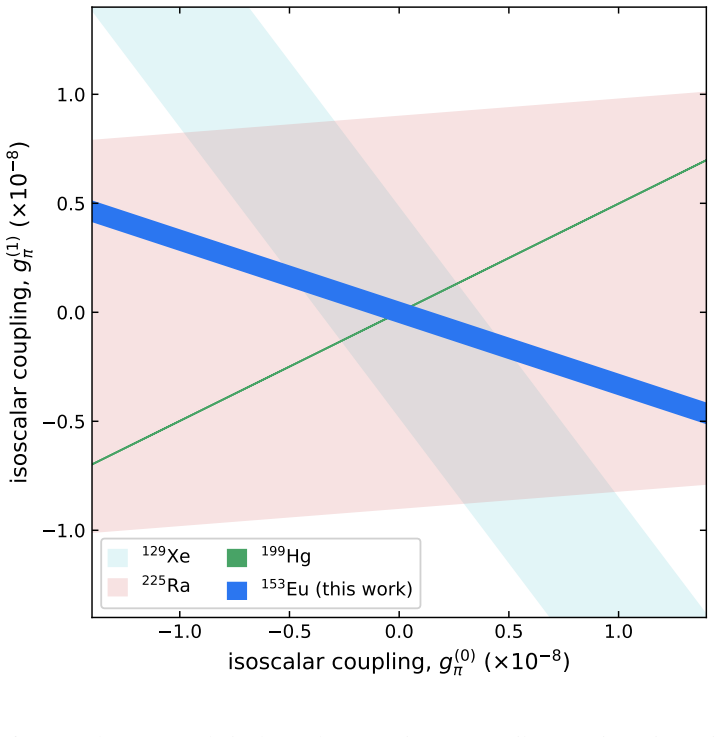
Using nuclear spin resonances in two ensembles of oppositely-polarized ¹⁵³Eu³⁺ ions in a Y₂SiO₅ crystal, the authors place the limit |S(¹⁵³Eu)| < 1.7 × 10^{-8} e fm³ (95% confidence) on the Schiff moment of the ¹⁵³Eu nucleus. This measurement constrains new physics at the TeV energy-scale.
What carries the argument
Comparison of nuclear spin resonance frequencies between oppositely polarized ion ensembles in a crystal to extract the Schiff moment after canceling other effects.
If this is right
- The bound constrains new physics at the TeV energy scale.
- It shows that octupolar nuclei in solid crystals can be used for such precision tests.
- The method cancels many systematic effects through the use of oppositely polarized ensembles.
Where Pith is reading between the lines
- The solid-state approach might enable larger sample sizes or longer coherence times compared to other techniques.
- Similar limits on other nuclei could further narrow the parameter space for beyond-Standard-Model theories.
- Improvements in the experimental sensitivity would directly translate to stronger constraints on high-energy physics.
Load-bearing premise
The frequency difference observed is caused by the Schiff moment once all other systematic contributions have been subtracted or canceled.
What would settle it
Observation of a frequency difference that persists after all known systematics are accounted for but is inconsistent with the reported limit, or a theoretical calculation showing no Schiff moment contribution is needed to explain the data.
Figures
read the original abstract
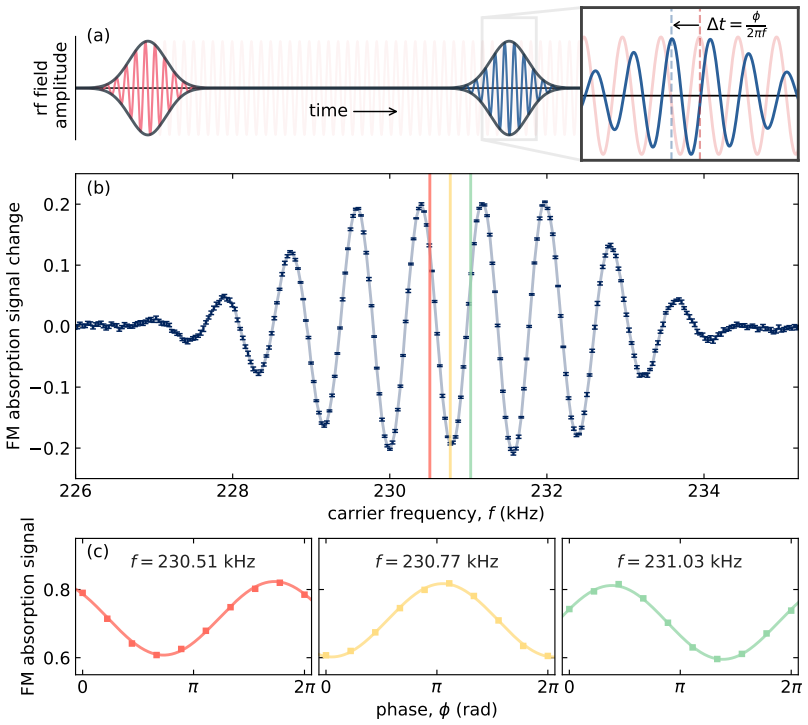
The Schiff moment of a nucleus is a symmetry-violating nuclear moment that indicates new physics beyond the Standard Model. We place the limit, $|\mathscr{S}({}^{153}$Eu)$| < 1.7 \times 10^{-8}$ $e\,$fm$^3$ (95\% confidence), on the Schiff moment of the $^{153}$Eu nucleus, using nuclear spin resonances in two ensembles of oppositely-polarized $^{153}$Eu$^{3+}$ ions in a Y${}_2$SiO${}_5$ crystal. This measurement using octupolar nuclei in a mm-scale crystal constrains new physics at the TeV energy-scale.
Editorial analysis
A structured set of objections, weighed in public.
Referee Report
Summary. The manuscript reports an experimental upper limit |S(¹⁵³Eu)| < 1.7 × 10^{-8} e fm³ (95% confidence) on the nuclear Schiff moment of ¹⁵³Eu, obtained from the difference in nuclear spin resonance frequencies between two ensembles of oppositely polarized ¹⁵³Eu³⁺ ions embedded in a Y₂SiO₅ crystal. The result is presented as a constraint on new physics at the TeV scale.
Significance. If the result holds after full validation of systematics, the work would constitute a novel solid-state approach to bounding a CP-violating nuclear moment using octupolar nuclei, offering a potentially scalable complement to existing atomic and molecular searches for beyond-Standard-Model physics.
major comments (2)
- [Abstract] Abstract: the quoted 95% CL limit is stated without any reported value for the raw frequency difference between the two ensembles, the size of the systematic uncertainty budget, or the statistical procedure that converts the difference into the bound. These elements are required to substantiate that the difference is produced by the Schiff moment after cancellation of other effects.
- [Abstract (and implied methods/results)] The central claim rests on the assumption that magnetic-field gradients, residual electric fields, crystal-strain shifts, polarization-dependent light shifts, and temperature drifts are either canceled by the polarization reversal or subtracted with quantified uncertainty; the provided text supplies neither the measured difference nor the error analysis needed to verify this cancellation at the reported sensitivity level.
minor comments (1)
- [Abstract] Abstract: the notation \mathscr{S} for the Schiff moment should be checked for consistency with standard usage in the nuclear physics literature.
Simulated Author's Rebuttal
We thank the referee for their careful reading and constructive comments on our manuscript. The points raised highlight the need for greater transparency in presenting the raw data, uncertainty analysis, and cancellation of systematics. We address each comment below and have revised the manuscript to incorporate the requested details.
read point-by-point responses
-
Referee: [Abstract] Abstract: the quoted 95% CL limit is stated without any reported value for the raw frequency difference between the two ensembles, the size of the systematic uncertainty budget, or the statistical procedure that converts the difference into the bound. These elements are required to substantiate that the difference is produced by the Schiff moment after cancellation of other effects.
Authors: We agree that the abstract, as originally written, is too concise and omits these key elements. In the revised manuscript we have expanded the abstract to report the measured raw frequency difference between the oppositely polarized ensembles, the size of the systematic uncertainty budget, and the statistical procedure (including how the 95% CL bound is derived after accounting for cancellations). The full analysis remains in the Methods and Results sections. revision: yes
-
Referee: [Abstract (and implied methods/results)] The central claim rests on the assumption that magnetic-field gradients, residual electric fields, crystal-strain shifts, polarization-dependent light shifts, and temperature drifts are either canceled by the polarization reversal or subtracted with quantified uncertainty; the provided text supplies neither the measured difference nor the error analysis needed to verify this cancellation at the reported sensitivity level.
Authors: The original manuscript describes the polarization-reversal technique intended to cancel common-mode systematics, but we acknowledge that the measured frequency difference and the quantitative error budget were not presented with sufficient clarity. We have added an explicit subsection in the Methods that tabulates the residual contributions from each listed effect (magnetic-field gradients, residual electric fields, crystal-strain shifts, polarization-dependent light shifts, and temperature drifts), reports the measured frequency difference, and details the statistical procedure used to convert the difference into the quoted bound. This allows direct verification of the cancellation at the reported sensitivity. revision: yes
Circularity Check
No circularity: direct experimental bound
full rationale
The paper reports a laboratory measurement of nuclear spin resonance frequency differences between two oppositely polarized ensembles of 153Eu3+ ions in a crystal, from which an upper limit on the Schiff moment is extracted. No derivation chain, ansatz, fitted parameter renamed as prediction, or self-citation load-bearing step is present in the provided text. The result is a direct experimental constraint whose validity rests on experimental controls and systematic budgets rather than any self-referential construction. This matches the default expectation for an experimental limit paper.
Axiom & Free-Parameter Ledger
axioms (1)
- domain assumption The Schiff moment produces a measurable shift in nuclear spin resonance frequencies that can be isolated by comparing oppositely polarized ensembles in the crystal host.
Reference graph
Works this paper leans on
-
[1]
D. E. Morrissey and M. J. Ramsey-Musolf, Electroweak baryogenesis, New J. Phys.14, 125003 (2012)
2012
-
[2]
A. D. Sakharov, Violation of CP Invariance, C Asymmetry, and Baryon Asymmetry of the Universe, Soviet Journal of Experimental and Theoretical Physics Letters5, 24 (1967)
1967
-
[3]
Khriplovich and S
I. Khriplovich and S. Lamoreaux,CP Violation Without Strangeness: Electric Dipole Moments of Particles, Atoms, and Molecules, Theoretical and Mathematical Physics (Springer Berlin Heidelberg, 2012)
2012
-
[4]
D. A. Wilkening, N. F. Ramsey, and D. J. Larson, Search for𝑝and𝑡violations in the hyperfine structure of thallium fluoride, Phys. Rev. A29, 425 (1984)
1984
-
[5]
Graner, Y
B. Graner, Y. Chen, E. G. Lindahl, and B. R. Heckel, Reduced Limit on the Permanent Electric Dipole Moment of 199Hg, Phys. Rev. Lett.116, 161601 (2016)
2016
-
[6]
Bishof, R
M. Bishof, R. H. Parker, K. G. Bailey, J. P. Greene, R. J. Holt, M. R. Kalita, W. Korsch, N. D. Lemke, Z.-T. Lu, P. Mueller, T. P. O’Connor, J. T. Singh, and M. R. Dietrich, Improved limit on the 225Raelectric dipole moment, Phys. Rev. C94, 025501 (2016)
2016
-
[7]
Allmendinger, I
F. Allmendinger, I. Engin, W. Heil, S. Karpuk, H.-J. Krause, B. Niederländer, A. Offen- häusser, M. Repetto, U. Schmidt, and S. Zimmer, Measurement of the permanent electric dipole moment of the 129Xeatom, Phys. Rev. A100, 022505 (2019). 13
2019
-
[8]
T. A. Zheng, Y. A. Yang, S.-Z. Wang, J. T. Singh, Z.-X. Xiong, T. Xia, and Z.-T. Lu, Mea- surement of the electric dipole moment of 171Ybatoms in an optical dipole trap, Phys. Rev. Lett.129, 083001 (2022)
2022
-
[9]
L. I. Schiff, Measurability of Nuclear Electric Dipole Moments, Phys. Rev.132, 2194 (1963)
1963
-
[10]
Engel, Nuclear Schiff moments and CP violation, Annual Review Nuclear and Particle Science75, 129 (2025)
J. Engel, Nuclear Schiff moments and CP violation, Annual Review Nuclear and Particle Science75, 129 (2025)
2025
-
[11]
Vutha, What is a Schiff moment anyway?, Eur
A. Vutha, What is a Schiff moment anyway?, Eur. J. Phys.47, 035204 (2026)
2026
-
[12]
Auerbach, V
N. Auerbach, V. V. Flambaum, and V. Spevak, Collective t- and p-odd electromagnetic moments in nuclei with octupole deformations, Phys. Rev. Lett.76, 4316 (1996)
1996
-
[13]
Spevak, N
V. Spevak, N. Auerbach, and V. V. Flambaum, Enhanced𝑡-odd,𝑝-odd electromagnetic moments in reflection asymmetric nuclei, Phys. Rev. C56, 1357 (1997)
1997
-
[14]
Engel, J
J. Engel, J. L. Friar, and A. C. Hayes, Nuclear octupole correlations and the enhancement of atomic time-reversal violation, Phys. Rev. C61, 035502 (2000)
2000
-
[15]
B. Nima, M. Fan, A. Radak, A. M. Jayich, and A. Vutha, Precision comagnetometry for T-violation searches in crystals, Phys. Rev. A112, L030801 (2025)
2025
-
[16]
See Appendix, sections A1-A4
-
[17]
E. F. Zhou, J. M. Yao, J. Engel, and J. Meng, Effects of beyond-mean-field correlations on nuclear Schiff moments, arXiv:2507.01369 (2025), arXiv:2507.01369 [nucl-th]
arXiv 2025
-
[18]
E. F. Zhou, X. Y. Wu, and J. M. Yao, Multireference covariant density-functional theory for the low-lying states of odd-mass nuclei, Phys. Rev. C109, 034305 (2024)
2024
-
[19]
J. Engel, M. J. Ramsey-Musolf, and U. van Kolck, Electric Dipole Moments of Nucleons, Nuclei, and Atoms: The Standard Model and Beyond, Prog. Part. Nucl. Phys.71, 21 (2013), arXiv:1303.2371 [nucl-th]
Pith/arXiv arXiv 2013
-
[20]
O. P. Sushkov, Schiff moments of deformed nuclei, Phys. Rev. C110, 015501 (2024)
2024
-
[21]
V. V. Flambaum and A. J. Mansour, Enhanced nuclear Schiff and electric dipole moments in nuclei with octupole deformation, Phys. Rev. C111, 055501 (2025)
2025
-
[22]
F. Könz, Y. Sun, C. W. Thiel, R. L. Cone, R. W. Equall, R. L. Hutcheson, and R. M. Mac- farlane, Temperature and concentration dependence of optical dephasing, spectral-hole lifetime, and anisotropic absorption inEu 3+:Y2SiO5, Phys. Rev. B68, 085109 (2003). 14
2003
-
[23]
X. Wang, S. Wang, Y. Wu, and L. Cheng, Relativistic Complete Active Space Self- Consistent-Field method with a hierarchy of exact two-component Hamiltonians, J. Chem. Theory Comput.22, 3988 (2026)
2026
-
[24]
T. Chen, C. Zhang, L. Cheng, K. B. Ng, S. Malbrunot-Ettenauer, V. V. Flambaum, Z. Las- ner, J. M. Doyle, P. Yu, C. J. Conn, C. Zhang, N. R. Hutzler, A. M. Jayich, B. Augenbraun, and D. DeMille, Relativistic Exact Two-Component Coupled-Cluster Study of Molecular Sensitivity Factors for Nuclear Schiff Moments, J. Phys. Chem. A128, 6540 (2024)
2024
-
[25]
Chen and M
J. Chen and M. Afzelius, Optical pumping simulations and optical Rabi frequency mea- surements in 151Eu3+:Y2SiO5 under magnetic field, Phys. Rev. B112, 245144 (2025)
2025
-
[26]
A. C. Vutha and E. A. Hessels, Frequency-offset separated oscillatory fields, Phys. Rev. A92, 052504 (2015)
2015
-
[27]
K. Kato, T. D. G. Skinner, and E. A. Hessels, Ultrahigh-precision measurement of the𝑛= 2triplet𝑃fine structure of atomic helium using frequency-offset separated oscillatory fields, Phys. Rev. Lett.121, 143002 (2018)
2018
-
[28]
Bezginov, T
N. Bezginov, T. Valdez, M. Horbatsch, A. Marsman, A. Vutha, and E. Hessels, A mea- surement of the atomic hydrogen lamb shift and the proton charge radius, Science365, 1007 (2019)
2019
-
[29]
Heydarizadmotlagh, T
F. Heydarizadmotlagh, T. D. G. Skinner, K. Kato, M. C. George, and E. A. Hessels, Pre- cision measurement of the𝑛=2triplet𝑃 𝐽=1to𝐽=0fine structure of atomic helium using frequency-offset separated oscillatory fields, Phys. Rev. Lett.132, 163001 (2024)
2024
-
[30]
G. J. Feldman and R. D. Cousins, Unified approach to the classical statistical analysis of small signals, Phys. Rev. D57, 3873 (1998)
1998
-
[31]
Mulder, R
H. Mulder, R. Timmermans, and J. de Vries, Probing the QCD¯𝜃term with paramagnetic molecules, J. High Energ. Phys.232
-
[32]
Möller, A
P. Möller, A. Sierk, T. Ichikawa, and H. Sagawa, Nuclear ground-state masses and defor- mations: Frdm(2012), Atomic Data and Nuclear Data Tables109-110, 1 (2016)
2012
-
[33]
National Nuclear Data Center, NuDat 2 Database (2020),https://www.nndc.bnl.gov/ nudat2
2020
-
[34]
Ring and P
P. Ring and P. Schuck,The nuclear many-body problem(Springer-Verlag, New York, 1980). 15
1980
-
[35]
E. F. Zhou and J. M. Yao, Microscopic study of low-lying states in odd-mass nuclei for atomic electric dipole moment searches, arXiv:2511.05984 (2025), arXiv:2511.05984 [nucl-th]
arXiv 2025
-
[36]
V. A. Dzuba, V. V. Flambaum, J. S. M. Ginges, and M. G. Kozlov, Electric dipole moments of Hg, Xe, Rn, Ra, Pu, and TlF induced by the nuclear Schiff moment and limits on time- reversal violating interactions, Phys. Rev. A66, 12111 (2002)
2002
-
[37]
L. V. Skripnikov, N. S. Mosyagin, A. V. Titov, and V. V. Flambaum, Actinide and lan- thanide molecules to search for strong CP-violation, Phys. Chem. Chem. Phys.22, 18374 (2020)
2020
-
[38]
M. Abe, T. Tsutsui, J. Ekman, M. Hada, and B. Das, Accurate determination of the en- hancement factor X for the nuclear Schiff moment in 205TlF molecule based on the four- component relativistic coupled-cluster theory, Mol. Phys.118, e1767814 (2020)
2020
-
[39]
Hubert and T
M. Hubert and T. Fleig, Electric dipole moments generated by nuclear Schiff moment interactions: A reassessment of the atoms 129Xe and 199Hg and the molecule 205TlF, Phys. Rev. A106, 22817 (2022)
2022
-
[40]
Sunet al., Recent developments in the PySCF program package, J
Q. Sunet al., Recent developments in the PySCF program package, J. Chem. Phys.153, 024109 (2020)
2020
-
[41]
K. G. Dyall, Interfacing relativistic and nonrelativistic methods. I. Normalized elimina- tion of the small component in the modified Dirac equation, J. Chem. Phys.106, 9618 (1997)
1997
-
[42]
Kutzelnigg and W
W. Kutzelnigg and W. Liu, Quasirelativistic theory equivalent to fully relativistic theory, J. Chem. Phys.123, 241102 (2005)
2005
-
[43]
Iliaš and T
M. Iliaš and T. Saue, An infinite-order two-component relativistic Hamiltonian by a sim- ple one-step transformation, J. Chem. Phys.126, 064102 (2007)
2007
-
[44]
Liu and D
W. Liu and D. Peng, Exact two-component hamiltonians revisited, J. Chem. Phys.131, 031104 (2009)
2009
-
[45]
Liu and L
J. Liu and L. Cheng, An atomic mean-field spin-orbit approach within exact two- component theory for a non-perturbative treatment of spin-orbit coupling, J. Chem. Phys. 148, 144108 (2018)
2018
-
[46]
Zhang and L
C. Zhang and L. Cheng, Atomic Mean-Field Approach within Exact Two-Component The- ory Based on the Dirac–Coulomb–Breit Hamiltonian, J. Phys. Chem. A126, 4537 (2022). 16
2022
-
[47]
Zhang, X2CAMF,https://github.com/warlocat/x2camf, accessed May 28, 2026
C. Zhang, X2CAMF,https://github.com/warlocat/x2camf, accessed May 28, 2026
2026
-
[48]
Wang, socutils,https://github.com/xubwa/socutils, accessed May 28, 2026
X. Wang, socutils,https://github.com/xubwa/socutils, accessed May 28, 2026
2026
-
[49]
Sharma, A
S. Sharma, A. A. Holmes, G. Jeanmairet, A. Alavi, and C. J. Umrigar, Semistochas- tic heat-bath configuration interaction method: Selected configuration interaction with semistochastic perturbation theory, J. Chem. Theory Comput.13, 1595 (2017)
2017
-
[50]
Wang and S
X. Wang and S. Sharma, Relativistic semistochastic heat-bath configuration interaction, J. Chem. Theory Comput.19, 848 (2023)
2023
-
[51]
J. F. Stantonet al., CFOUR, Coupled-Cluster techniques for Computational Chemistry, a quantum-chemical program package
-
[52]
D. A. Matthews, L. Cheng, M. E. Harding, F. Lipparini, S. Stopkowicz, T.-C. Jagau, P. G. Szalay, J. Gauss, and J. F. Stanton, Coupled-cluster techniques for computational chem- istry: The CFOUR program package, J. Chem. Phys.152, 214108 (2020)
2020
-
[53]
A. Jain, S. P. Ong, G. Hautier, W. Chen, W. D. Richards, S. Dacek, S. Cholia, D. Gunter, D. Skinner, G. Ceder, and K. A. Persson, The Materials Project: A materials genome approach to accelerating materials innovation, APL Mater.1, 011002 (2013)
2013
-
[54]
Materials Project, Materials data on Y 2SiO5 (mp-3520) by materials project (2020)
2020
-
[55]
M. Fan, B. Nima, A. Radak, G. Alonso-Álvarez, and A. Vutha, Wideband search for axion- like dark matter using octupolar nuclei in a crystal, Phys. Rev. Lett.136, 121802 (2026)
2026
-
[56]
rf (230 kHz)
J. de Vries, E. Mereghetti, R. Timmermans, and U. van Kolck, The effective chiral la- grangian from dimension-six parity and time-reversal violation, Annals of Physics338, 50 (2013). 17 APPENDIX A1. CALCULATION OF𝒮 Figure A1 displays energy surfaces of 153Eu on the quadrupole–octupole deformation plane(𝛽 2,𝛽 3)obtained using different levels of MR-CDFT ca...
2013
-
[57]
dir”) are compared with the values obtained using the additivity scheme (denoted with subscripts “add
is related to ¯𝑔(1) 𝜋 that appears in Equation 3 as ¯𝑔1 ≈𝐹 𝜋 ¯𝑔(1) 𝜋 .) Using this relation, the bound|𝑔 (1) 𝜋 | ≤4.6×10 −10 leads to𝑀 𝑇 ≳9.7TeV. A14 Appendix: Tables TABLE A1. Electric dipole transition strengths𝐵(𝐸1)(in Weisskopf units) of 153Eucalculated with the MR-CDFT approach, in comparison with available experimental data [33]. 𝐽𝑓 →𝐽 𝑖 MR-CDFT Exp...
1961
discussion (0)
Sign in with ORCID, Apple, or X to comment. Anyone can read and Pith papers without signing in.