Direct nanoscale observation of melting and solute redistribution in a hypoeutectic Al-Cu alloy with it{in\ situ} STEM
Pith reviewed 2026-06-27 08:51 UTC · model grok-4.3
The pith
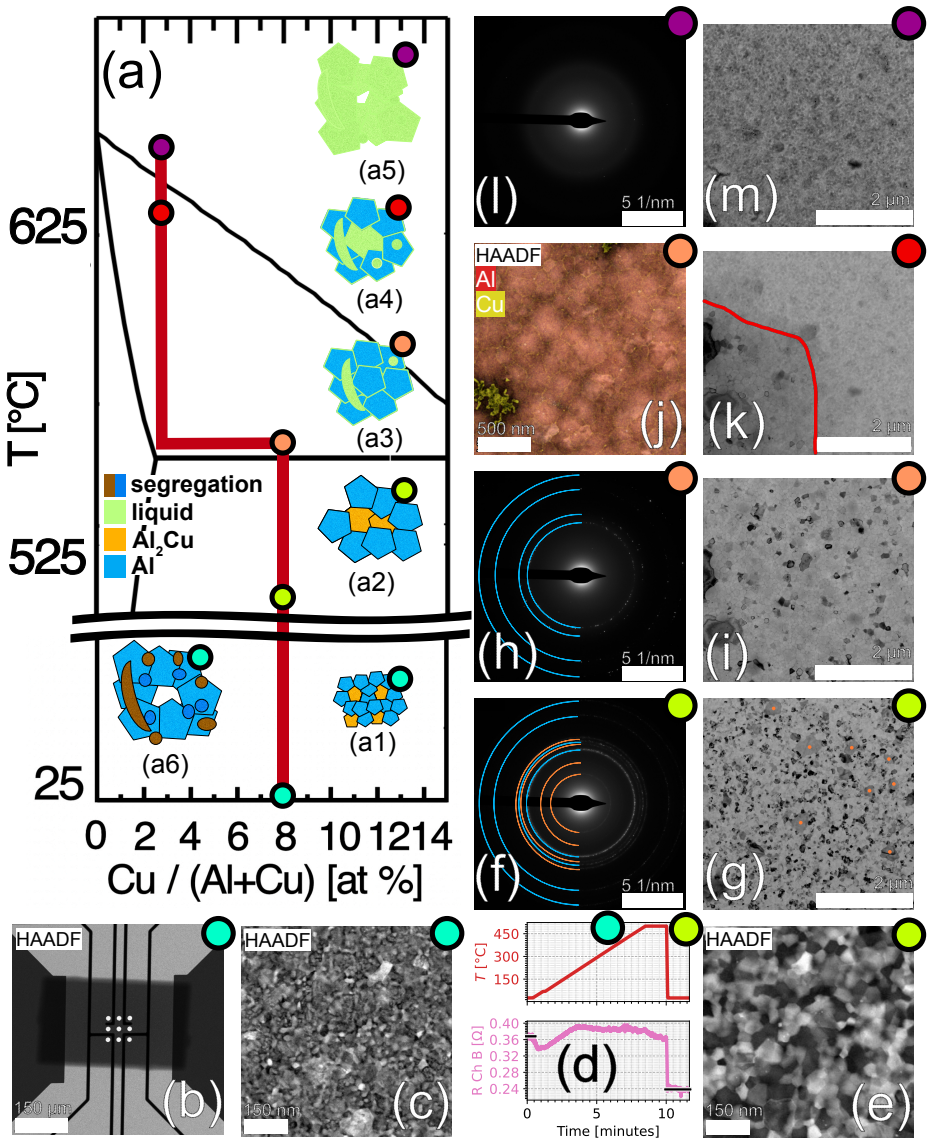
Melting in a hypoeutectic Al-Cu alloy begins centrally and spreads outward along grain boundaries via copper enrichment, with the Al2Cu phase melting first and liquid copper redistributing over 258 micrometers.
A machine-rendered reading of the paper's core claim, the machinery that carries it, and where it could break.
Core claim
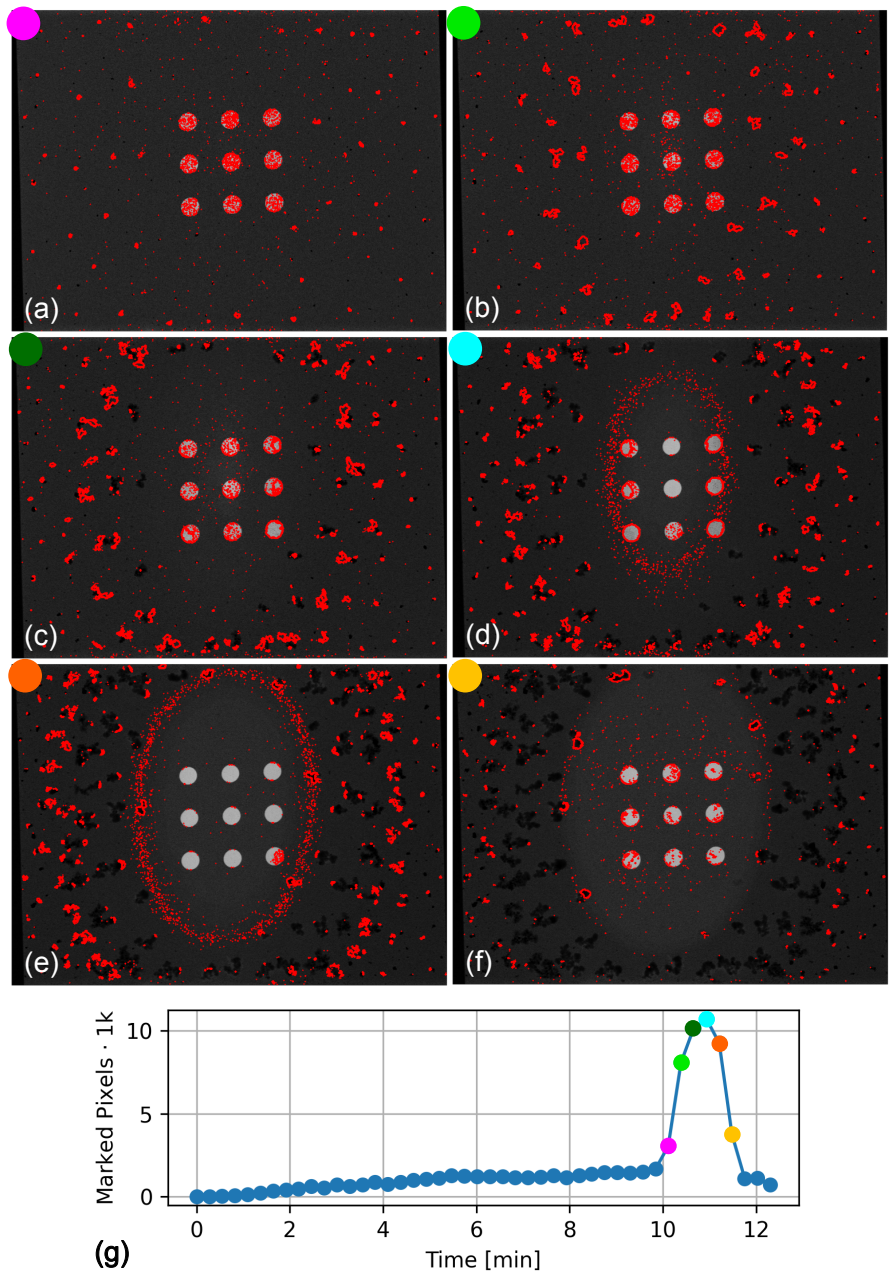
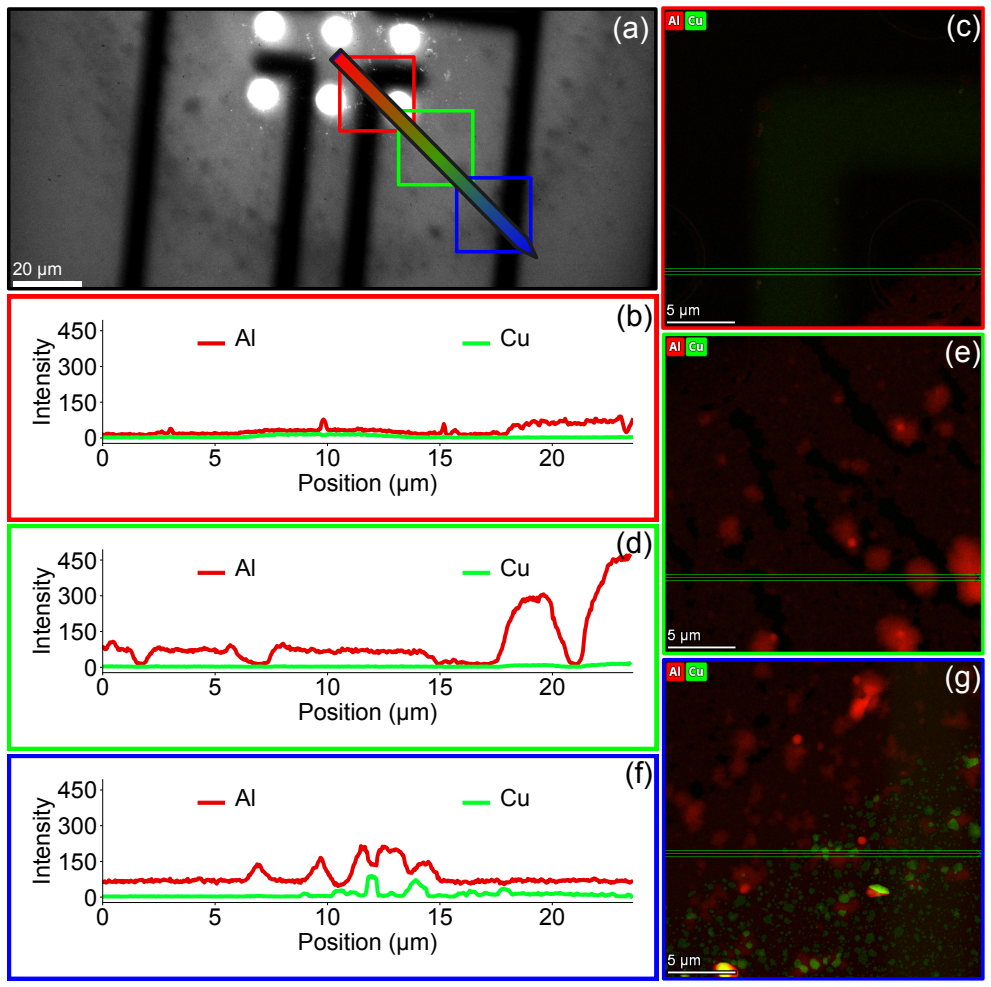
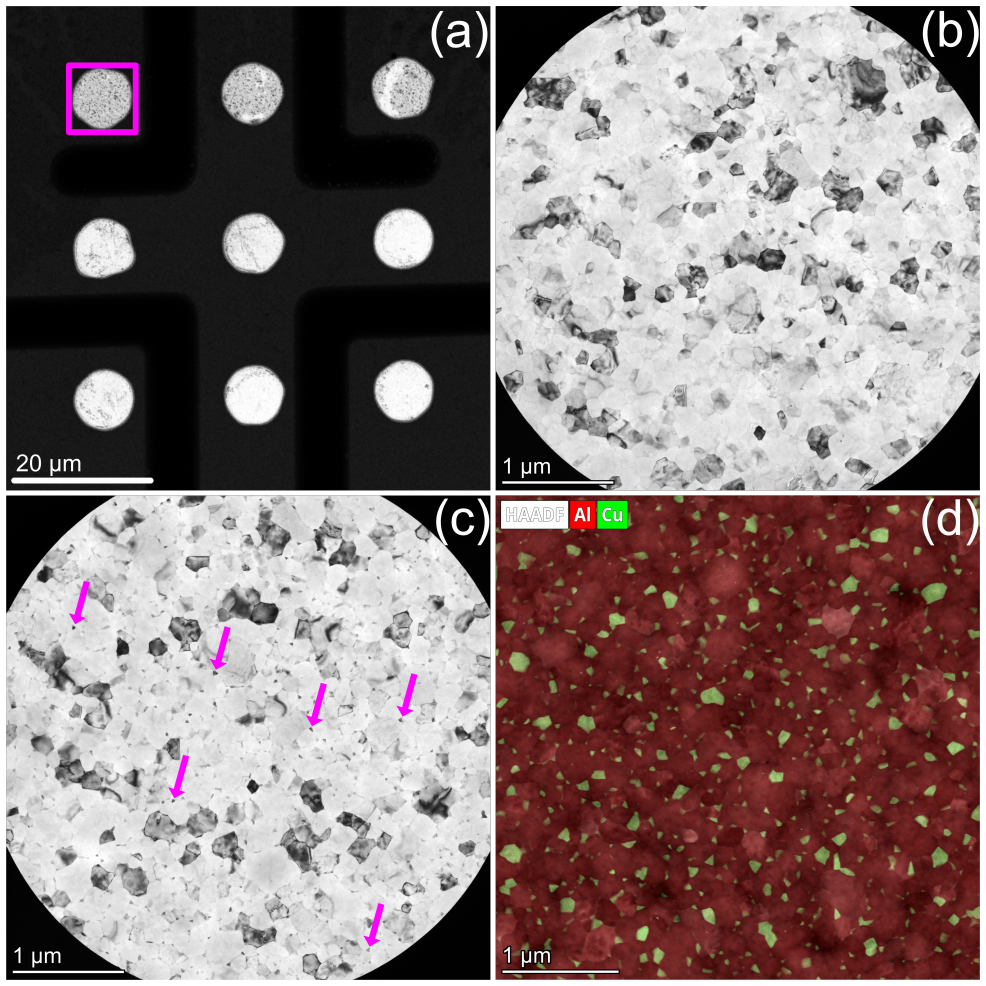
Melting initiated in the hotter central region and propagated outward, with grain boundaries acting as preferred sites for eutectic liquid formation via Cu enrichment. The Al2Cu phase melted prior to complete matrix melting. Liquid-state Cu redistribution over a distance of 258 μm resulted in Al-rich rim accumulations and Cu enrichment at the outermost edge of the observed chip region.
What carries the argument
In situ STEM contrast changes during MEMS-based heating that track copper enrichment and liquid formation at grain boundaries.
If this is right
- Grain boundaries are the first sites to form eutectic liquid through local copper enrichment.
- The Al2Cu phase melts completely before the surrounding aluminum matrix does.
- Copper moves through the liquid phase over distances of 258 micrometers, orders of magnitude beyond solid-state limits.
- This produces aluminum-rich material near the edges and copper accumulation at the outermost boundary.
- The sequence aligns with classical eutectic melting predictions but adds nanoscale detail on initiation and transport.
Where Pith is reading between the lines
- The observed liquid-state transport could alter predictions for microstructure evolution during rapid heating of Al-Cu components.
- The same imaging approach may reveal comparable grain-boundary-driven melting sequences in other eutectic alloy systems.
- Edge accumulation effects might influence solute segregation in thin-film or MEMS-scale devices subjected to thermal gradients.
- Uniform heating experiments could test whether the central-to-edge propagation depends on the imposed temperature gradient.
- keywords:[
Load-bearing premise
The STEM image contrast changes are caused by local copper concentration variations rather than by thickness changes or other imaging effects.
What would settle it
Independent spectroscopy confirming that copper levels match the observed contrast patterns even when sample thickness is measured and held constant throughout the heating cycle.
Figures
read the original abstract
Melting and solidification of eutectic systems are classical topics in physical metallurgy, yet the mechanisms at nanoscale are less investigated, due to experimental limitations in spatiotemporal resolution. The advent of $\it{in\ situ}$ STEM heating with MEMS technology has recently enabled investigation of eutectic behavior as a function of temperature, time and electrical resistivity. Using this methodology, we investigate the evolution of a nanocrystalline hypoeutectic Al-Cu alloy. Melting initiated in the hotter central region and propagated outward, with grain boundaries acting as preferred sites for eutectic liquid formation via Cu enrichment. The Al$_2$Cu phase melted prior to complete matrix melting. Liquid-state Cu redistribution over a distance of 258 $\mu$m - several orders of magnitude beyond solid-state diffusion limits - resulted in Al-rich rim accumulations and Cu enrichment at the outermost edge of the observed chip region. These observations are discussed in the context of classical predictions for melting of eutectic systems.
Editorial analysis
A structured set of objections, weighed in public.
Referee Report
Summary. The manuscript uses in-situ STEM with MEMS heating to observe melting and solidification in a nanocrystalline hypoeutectic Al-Cu alloy. It reports that melting begins in the hotter central region and propagates outward, with grain boundaries as preferred sites for eutectic liquid formation via Cu enrichment; the Al2Cu phase melts before the Al matrix is fully melted; and liquid-state Cu redistribution occurs over 258 μm, producing Al-rich rim accumulations and Cu enrichment at the chip edge. These observations are placed in the context of classical eutectic melting predictions.
Significance. If the compositional interpretations of the STEM contrast are robust, the work supplies direct nanoscale evidence of melting sequence, grain-boundary wetting, and long-range liquid-state solute transport that exceeds solid-state diffusion limits by orders of magnitude. Such observations can refine classical models of eutectic melting and inform processing of Al-Cu alloys; the MEMS-based in-situ approach itself demonstrates useful spatiotemporal resolution for phase-change studies.
major comments (2)
- [Results and Methods (contrast interpretation and redistribution distance)] The central claims of Cu enrichment at grain boundaries, Al-rich rims, and the 258 μm redistribution distance rest on interpreting HAADF-STEM intensity variations as local composition changes. No simultaneous EDS or EELS acquisition, post-experiment EELS log-ratio thickness mapping, or control experiments on pure Al are described to exclude artifacts from local thickness reduction, buckling, or orientation changes during heating (see the results paragraphs describing contrast evolution and the methods section on imaging conditions).
- [Results (melting sequence and grain-boundary observations)] The reported melting sequence (Al2Cu prior to matrix) and the attribution of grain-boundary liquid formation to Cu enrichment are load-bearing for the paper's mechanistic conclusions, yet they are presented without quantitative intensity-to-composition calibration or error analysis on the contrast data.
minor comments (1)
- [Abstract and Methods] The abstract mentions investigation 'as a function of temperature, time and electrical resistivity,' but the methods and results sections do not clarify whether resistivity was measured in situ or how it correlates with the observed microstructural changes.
Simulated Author's Rebuttal
We thank the referee for the constructive feedback on our manuscript. The comments highlight important considerations for strengthening the interpretation of our in-situ STEM observations. We address each major comment below and indicate where revisions will be made.
read point-by-point responses
-
Referee: [Results and Methods (contrast interpretation and redistribution distance)] The central claims of Cu enrichment at grain boundaries, Al-rich rims, and the 258 μm redistribution distance rest on interpreting HAADF-STEM intensity variations as local composition changes. No simultaneous EDS or EELS acquisition, post-experiment EELS log-ratio thickness mapping, or control experiments on pure Al are described to exclude artifacts from local thickness reduction, buckling, or orientation changes during heating (see the results paragraphs describing contrast evolution and the methods section on imaging conditions).
Authors: We acknowledge that simultaneous EDS/EELS mapping, post-heating thickness measurements, and pure-Al control experiments were not included in the original study, as the experimental priority was high-frame-rate HAADF imaging to capture rapid melting dynamics. The HAADF contrast interpretation relies on the strong atomic-number sensitivity (Cu Z=29 vs. Al Z=13) and the directional, time-dependent nature of the observed changes, which align with the expected Cu partitioning during eutectic melting and the measured 258 μm transport distance (determined from the full chip geometry). We will add a dedicated paragraph in the revised Results and Discussion sections that (i) explicitly discusses potential thickness/orientation artifacts and why they are inconsistent with the observed rim accumulation and edge enrichment patterns, (ii) cites supporting literature on HAADF-based composition mapping in Al-Cu systems, and (iii) notes the limitation that quantitative calibration was not performed. This constitutes a partial revision because the raw data for EDS/EELS or controls cannot be retroactively acquired, but the mechanistic conclusions can be better contextualized. revision: partial
-
Referee: [Results (melting sequence and grain-boundary observations)] The reported melting sequence (Al2Cu prior to matrix) and the attribution of grain-boundary liquid formation to Cu enrichment are load-bearing for the paper's mechanistic conclusions, yet they are presented without quantitative intensity-to-composition calibration or error analysis on the contrast data.
Authors: The melting sequence is inferred from the temporal order of contrast loss: the brighter Al2Cu particles disappear before the surrounding Al matrix fully darkens, consistent with the lower solidus temperature of the θ phase in the Al-Cu phase diagram. Grain-boundary liquid formation is attributed to Cu enrichment because the contrast increase at boundaries precedes matrix melting and matches the expected wetting behavior. While no quantitative intensity-to-composition calibration curve or formal error propagation was provided, the qualitative trends are reproducible across multiple grains and heating cycles. In the revision we will (i) include a supplementary figure showing intensity line profiles with standard-deviation error bars extracted from multiple regions and (ii) add a short methods paragraph describing how intensity thresholds were chosen relative to the initial state. This will be a full revision on this point. revision: yes
Circularity Check
No circularity: purely observational claims with no derivations or fitted predictions
full rationale
The paper reports direct in-situ STEM observations of melting and solute redistribution in an Al-Cu alloy. No equations, derivations, parameter fits, or 'predictions' are present in the abstract or described methodology. Claims rest on image contrast interpretation rather than any self-referential chain that reduces to inputs by construction. Self-citation is irrelevant here as there is no load-bearing theoretical premise. This matches the default expectation of no significant circularity for observational work.
Axiom & Free-Parameter Ledger
axioms (2)
- domain assumption In situ STEM imaging contrast accurately reflects local Cu composition changes without major artifacts from sample thickness or beam effects
- domain assumption MEMS-based heating produces known temperature gradients allowing attribution of melting order to position and phase
Reference graph
Works this paper leans on
-
[1]
B. Chen, A comprehensive review ofθ-series precipitates in aluminum alloys, Materials 18 (23) (2025) 5406.doi:10.3390/ma18235406
-
[2]
P. Dumitraschkewitz, M. A. Tunes, C. R. Quick, D. Santa Rosa Coradini, T. M. Kremmer, P. Ramasamy, P. J. Uggowitzer, S. Pogatscher, Mems-based in situ electron-microscopy investigation of rapid solidification and heat treatment on eutectic al-cu, Acta Materialia 239 (2022) 118225.doi:10.1016/j.actamat.2022.118225
-
[3]
Meier, R
C. Meier, R. W. Penny, Y. Zou, J. S. Gibbs, A. J. Hart, Thermophysical phenomena in metal additive manufacturing by selective laser melting: fundamentals, modeling, simulation, and experimentation, Annual Review of Heat Transfer 20 (1) (2017) 241–316.doi:10.1615/ annualrevheattransfer.2018019042
2017
-
[4]
R. M. German, P. Suri, S. J. Park, Review: liquid phase sintering, Journal of Materials Science 44 (1) (2009) 1–39.doi:10.1007/s10853-008-3008-0
-
[5]
A. Bolouri, M. Shahmiri, E. Chesmeh, Microstructural evolution during semisolid state strain induced melt activation process of aluminum 7075 alloy, Transactions of Nonferrous Metals Society of China 20 (9) (2010) 1663–1671.doi:10.1016/s1003-6326(09)60355-1
-
[6]
D. M. Stefanescu, Science and Engineering of Casting Solidification, Springer International Publishing, 2015.doi:10.1007/978-3-319-15693-4
-
[7]
G. J. Davies, J. G. Garland, Solidification structures and properties of fusion welds, Interna- tional Metallurgical Reviews 20 (1) (1975) 83–108.doi:10.1179/imtlr.1975.20.1.83
-
[8]
J. T. McKeown, K. Zweiacker, C. Liu, D. R. Coughlin, A. J. Clarke, J. K. Baldwin, J. W. Gibbs, J. D. Roehling, S. D. Imhoff, P. J. Gibbs, D. Tourret, J. M. K. Wiezorek, G. H. Campbell, Time-resolved in situ measurements during rapid alloy solidification: Experimental insight for additive manufacturing, JOM 68 (3) (2016) 985–999.doi:10.1007/s11837-015-1793-x. 6
-
[9]
H. V. Atkinson, Modelling the semisolid processing of metallic alloys, Progress in Materials Science 50 (2005) 341–412.doi:10.1016/j.pmatsci.2004.04.003
-
[10]
Z. Noori, M. Panjepour, M. Ahmadian, Study of the effect of grain size on melting temperature of al nanocrystals by molecular dynamics simulation, Journal of Materials Research 30 (10) (2015) 1648–1660.doi:10.1557/jmr.2015.109
-
[11]
D. S. R. Coradini, M. A. Tunes, C. Quick, P. D. Willenshofer, T. M. Kremmer, S. Luidold, P. J. Uggowitzer, S. Pogatscher, Unravelling nanometallurgy with in situ transmission electron microscopy: A case-study with copper nanowires, Nano Today 59 (2024) 102485. doi:10.1016/j.nantod.2024.102485
-
[12]
M. Legros, D. S. Gianola, K. J. Hemker, In situ tem observations of fast grain-boundary motion in stressed nanocrystalline aluminum films, Acta Materialia 56 (14) (2008) 3380–3393. doi:10.1016/j.actamat.2008.03.032
-
[13]
D. S. R. Coradini, M. A. Tunes, P. Willenshofer, S. Samberger, T. Kremmer, P. Dumitras- chkewitz, P. J. Uggowitzer, S. Pogatscher, In situ transmission electron microscopy as a toolbox for the emerging science of nanometallurgy, Lab on a Chip 23 (14) (2023) 3186–3193. doi:10.1039/d3lc00228d
-
[14]
A. Casu, A. Chiodoni, Y. P. Ivanov, G. Divitini, P. Milani, A. Falqui, In situ tem investigation of thermally induced modifications of cluster-assembled gold films undergoing resistive switch- ing: Implications for nanostructured neuromorphic devices, ACS Applied Nano Materials 7 (7) (2024) 7203–7212.doi:10.1021/acsanm.3c06261
-
[15]
S. Fischer, M. Rettenmayr, Observation of early melting stages of an al – cu alloy in a temperature gradient, International Journal of Materials Research 102 (10) (2011) 1226–1231. doi:10.3139/146.110576
-
[16]
B. B. Straumal, O. A. Kogtenkova, A. N. Nekrasov, J. Dutta Majumdar, G. Faraji, D. Bradai, Grain boundary wetting phenomena in the al-cu system, Physical sciences, FOS: Physical sciences (2024).doi:10.48612/LETTERS/2024-4-319-324
-
[17]
L. E. Scriven, C. V. Sternling, The marangoni effects, Nature 187 (1960) 186–188.doi: 10.1038/187186a0
-
[18]
B. Zhang, A. Griesche, A. Meyer, Relation between self diffusion and interdiffusion in al-cu melts, Diffusion Fundamentals 11 (2009).doi:10.62721/diffusion-fundamentals.11.552
-
[19]
Protochips, Inc., Fusion Select User Manual, document Number: M-00003 v3.0 (2020). doi:10.4095/328626
-
[20]
R. Daniel, J. Zalesak, I. Matko, W. Baumegger, A. Hohenwarter, E. P. George, J. Keckes, Microstructure-dependent phase stability and precipitation kinetics in equiatomic crmnfeconi high-entropy alloy: Role of grain boundaries, Acta Materialia 223 (2022) 117470. doi: 10.1016/j.actamat.2021.117470
-
[21]
J. E. Palmer, C. V. Thompson, H. I. Smith, Grain growth and grain size distributions in thin germanium films, Journal of Applied Physics 62 (6) (1987) 2492–2497.doi:10.1063/1. 339460. 7
work page doi:10.1063/1 1987
-
[22]
L. Moraga, R. Henriquez, B. Solis, Quantum theory of the effect of grain boundaries on the electrical conductivity of thin films and wires, Physica B: Condensed Matter 470–471 (2015) 39–49.doi:10.1016/j.physb.2015.04.034
-
[23]
K. Barmak, R. A. Ristau, K. R. Coffey, M. A. Parker, J. K. Howard, Grain growth and ordering kinetics in copt thin films, Journal of Applied Physics 79 (8) (1996) 5330–5332. doi:10.1063/1.361368
-
[24]
H. Liu, I. Papadimitriou, F. Lin, J. LLorca, Precipitation during high temperature aging of al–cu alloys: A multiscale analysis based on first principles calculations, Acta Materialia 167 (2019) 121–135.doi:10.1016/j.actamat.2019.01.024
-
[25]
H. Zhao, F. De Geuser, A. Kwiatkowski da Silva, A. Szczepaniak, B. Gault, D. Ponge, D. Raabe, Segregation assisted grain boundary precipitation in a model al-zn-mg-cu alloy, Acta Materialia 156 (2018) 318–329.doi:10.1016/j.actamat.2018.07.003
-
[26]
M. de Hass, J. De Hosson, Grain boundary segregation and precipitation in aluminium alloys, Scripta Materialia 44 (2) (2001) 281–286.doi:10.1016/s1359-6462(00)00577-7
-
[27]
F. Niekiel, S. M. Kraschewski, J. Müller, B. Butz, E. Spiecker, Local temperature measurement in tem by parallel beam electron diffraction, Ultramicroscopy 176 (2017) 161–169.doi: 10.1016/j.ultramic.2016.11.028
-
[28]
V. G. Levich, Physicochemical Hydrodynamics, Prentice-Hall, 1962
1962
-
[29]
S. H. Davis, Thermocapillary instabilities, Annual Review of Fluid Mechanics 19 (1987) 403–435.doi:10.1146/annurev.fl.19.010187.002155
-
[30]
A. Karbalaei, R. Kumar, H. J. Cho, Thermocapillarity in microfluidics: A review, Microma- chines 7 (2016) 13.doi:10.3390/mi7010013
-
[31]
C. V. Thompson, Solid-state dewetting of thin films, Annual Review of Materials Research 42 (2012) 399–434.doi:10.1146/annurev-matsci-070511-155048
-
[32]
Fick, Ueber diffusion, Annalen der Physik 170 (1) (1855) 59–86.doi:10.1002/andp
A. Fick, Ueber diffusion, Annalen der Physik 170 (1) (1855) 59–86.doi:10.1002/andp. 18551700105
-
[33]
Shewmon, Diffusion in solids, Springer, 2016.doi:10.1007/978-3-319-48206-4
P. Shewmon, Diffusion in solids, Springer, 2016.doi:10.1007/978-3-319-48206-4
-
[34]
Y. Du, Y. A. Chang, B. Huang, W. Gong, Z. Jin, H. Xu, Z. Yuan, Y. Liu, Y. He, F.- Y. Xie, Diffusion coefficients of some solutes in fcc and liquid al: Critical evaluation and correlation, Materials Science and Engineering A 363 (1–2) (2003) 140–151.doi:10.1016/ S0921-5093(03)00624-5. 8 150 300 450T [°C] 0 5 10 Time [minutes] 0.24 0.28 0.32 0.36 0.40R Ch B...
2003
discussion (0)
Sign in with ORCID, Apple, or X to comment. Anyone can read and Pith papers without signing in.