Scalable Conformal MoSx Catalyst for Efficient Hydrogen Evolution at Industrial-Level Current Density in Alkaline Electrolyzers
Pith reviewed 2026-06-27 08:48 UTC · model grok-4.3
The pith
A coating-annealing process creates MoS3 on nickel foam that sustains alkaline electrolysis at 1 A/cm² and 1.96 V for 1000 hours.
A machine-rendered reading of the paper's core claim, the machinery that carries it, and where it could break.
Core claim
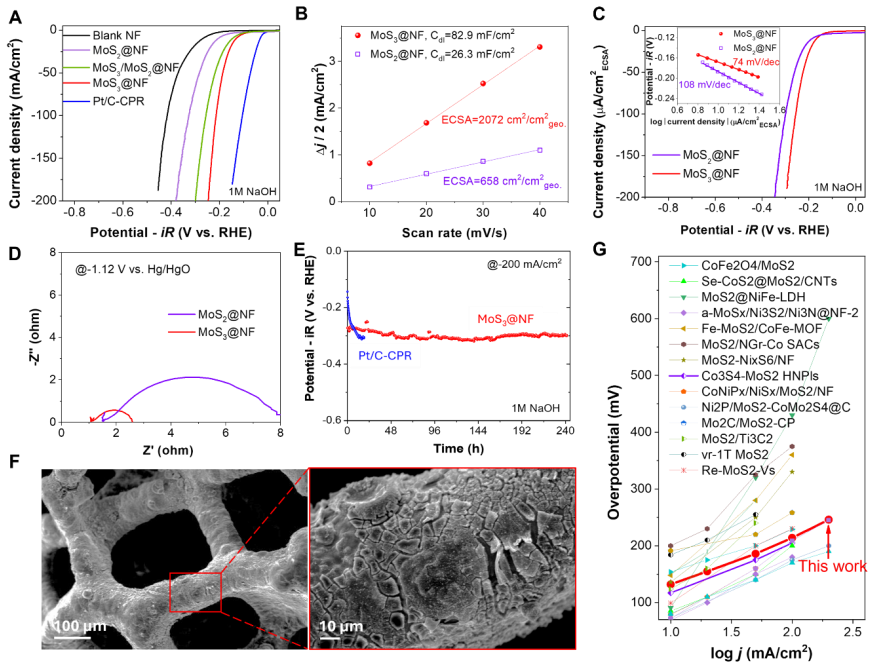
By controlling the annealing step after coating, the composition of the MoSx layer on nickel foam can be tuned to MoS3, whose abundant edge-sulfur atoms function as active sites for the hydrogen evolution reaction; the resulting MoS3@NF cathode delivers 200 mA/cm² at 246 mV overpotential, operates stably for over 240 h in half-cell tests, and, when combined with a stainless-steel anode, enables a complete alkaline water electrolyzer to run continuously at 1 A/cm² and 1.96 V for 1000 h.
What carries the argument
The conformal MoS3 layer on porous nickel foam, whose edge-sulfur atoms serve as the active sites for alkaline HER and whose composition is set by the annealing step.
If this is right
- MoS3@NF reaches industrially relevant 200 mA/cm² at only 246 mV overpotential in alkaline media.
- The electrode maintains stable hydrogen evolution for more than 240 hours at high current density.
- A complete alkaline electrolyzer using this cathode and a stainless-steel anode sustains 1 A/cm² at 1.96 V for 1000 hours.
- The performance exceeds that of most previously reported MoSx-based water electrolyzers.
- The coating-annealing route is presented as a scalable route to cost-effective cathodes for alkaline water electrolyzers.
Where Pith is reading between the lines
- If the edge-sulfur sites remain active after prolonged operation, the same annealing control could be applied to other porous substrates to increase active surface area further.
- The 1000-hour full-cell result implies that MoS3 may reduce the need for platinum-group metals in alkaline electrolyzers, but only if the nickel-foam substrate itself survives industrial cycling without degradation.
- A direct comparison of edge-site density before and after 1000 hours would test whether the claimed active-site mechanism persists at scale.
Load-bearing premise
The reported overpotentials, current densities, and 1000-hour stability values were measured under conditions that match industrial operation and that the annealing step reliably produces the claimed MoS3 composition with abundant edge-sulfur sites in every batch.
What would settle it
A replicate electrode that, after the same coating-annealing sequence, shows either a different sulfur-to-molybdenum ratio by XPS or fails to hold 1 A/cm² at or below 1.96 V for more than a few hundred hours.
Figures
read the original abstract
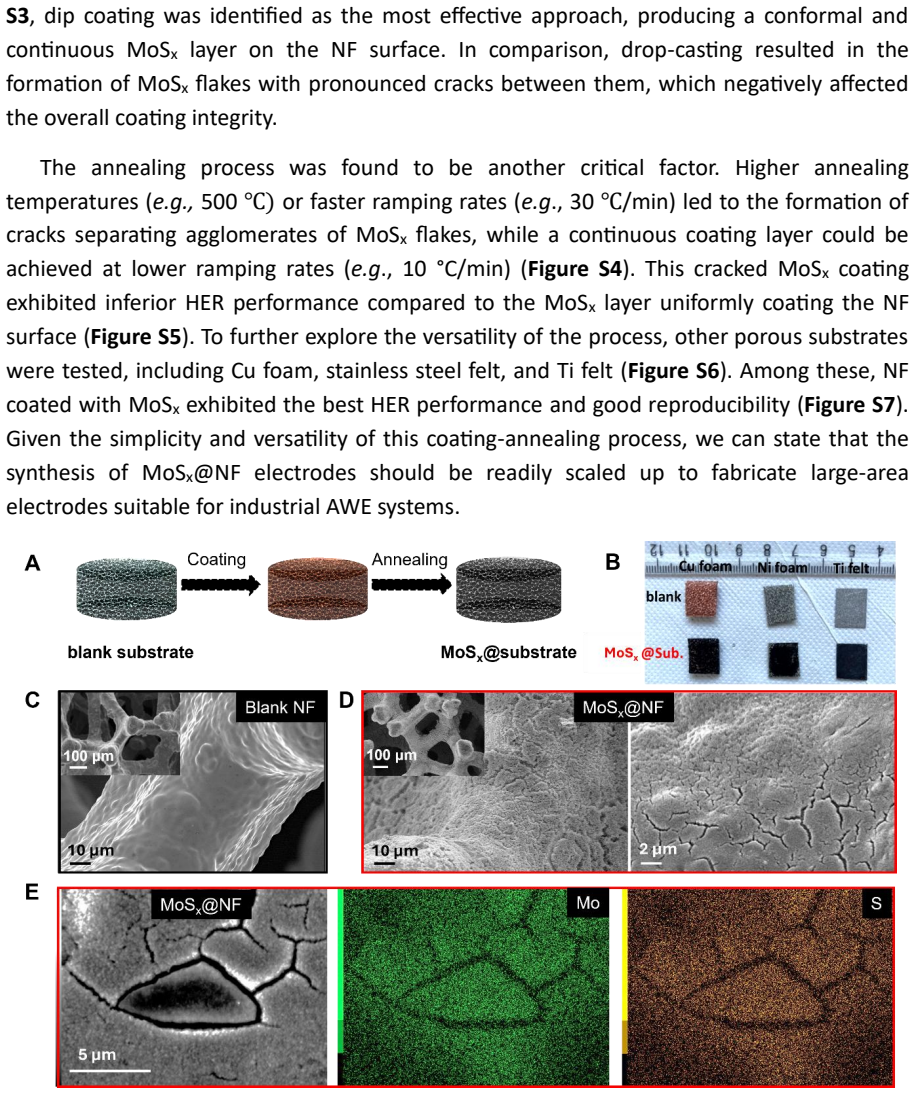
The development of simple and scalable fabrication strategies for cost-effective electrodes is crucial to advance water splitting in alkaline water electrolyzers (AWEs). Here, we present a coating-annealing method to conformally coat a MoSx catalyst layer onto a porous Ni foam (NF) substrate. By controlling the annealing process, the composition of the MoSx layer could be tuned from MoS2 to MoS3 and its catalytic performance for hydrogen evolution reaction (HER) in alkaline media was optimized. The MoS3@NF synthesized by this method achieved industrially relevant HER current densities of 200 mA/cm2 at a low overpotential of 246 mV, maintaining stable operation for over 240 h. The MoS3@NF cathode, combined with a stainless steel anode, enabled an alkaline water electrolyzer (AWE) cell to operate steadily at 1.96 V and 1 A/cm2 for 1000 h. This performance surpasses that of most of the previously reported water electrolyzers employing MoSx-based cathodes. Our work demonstrates the potential of MoS3 (with its abundant edge-sulfur atoms serving as active sites) as a high-performance cathode material for industrial AWEs.
Editorial analysis
A structured set of objections, weighed in public.
Referee Report
Summary. The manuscript reports a coating-annealing fabrication method to conformally deposit a tunable MoSx layer on porous Ni foam. By adjusting the annealing step the composition is shifted from MoS2 to MoS3; the resulting MoS3@NF cathode delivers 200 mA cm⁻² at 246 mV overpotential in alkaline HER and remains stable for >240 h. When paired with a stainless-steel anode in a two-electrode alkaline water electrolyzer the cell sustains 1.96 V at 1 A cm⁻² for 1000 h, stated to exceed most prior MoSx-based devices. The work attributes the activity to abundant edge-sulfur sites in MoS3 and positions the approach as a scalable route for industrial AWEs.
Significance. If the reported half-cell and full-cell metrics are reproducible and the MoS3 phase assignment is confirmed by quantitative characterization, the result would be significant for the field. A simple, scalable route to a non-precious-metal cathode that meets industrial current density with 1000-hour stability directly addresses a key barrier to alkaline electrolyzer deployment. The long-duration full-cell demonstration is a strength that, if properly documented, would strengthen the practical relevance of MoSx catalysts.
major comments (4)
- [Experimental Methods] Experimental Methods (annealing protocol): the temperature, duration, and atmosphere of the annealing step that is asserted to produce phase-pure MoS3 with abundant edge-S sites are not specified, preventing reproduction and verification that the claimed composition (rather than a MoS2/MoS3 mixture) is obtained across batches.
- [Results] Results (catalyst characterization): no XPS survey or high-resolution spectra, no S/Mo elemental ratios from EDS or ICP, and no reference to any quantitative phase analysis are supplied to substantiate the statement that the annealed layer is MoS3 whose edge-sulfur atoms are the dominant active sites.
- [Electrochemical Measurements] Electrochemical section / full-cell data: the two-electrode AWE test at 1 A cm⁻² / 1.96 V lacks any description of iR compensation method, reference-electrode placement (if used), KOH concentration and temperature, membrane/separator type, or confirmation that current density is reported on true geometric area without excessive ohmic losses; these omissions directly affect the validity of the industrial-relevance and “surpasses most prior MoSx” claims.
- [Results] Stability data presentation: the 1000 h full-cell run and the 240 h half-cell run are reported without error bars, number of replicates, or criteria for data exclusion, making it impossible to assess whether the headline metrics are statistically representative.
minor comments (2)
- [Abstract] The abstract states that performance “surpasses that of most of the previously reported water electrolyzers employing MoSx-based cathodes” but supplies no explicit benchmark table or cited references for that comparison; a supplementary table collating overpotentials, current densities, and stability metrics from the literature would strengthen the claim.
- [Throughout] Notation for current density (mA/cm2 vs mA cm⁻²) is inconsistent between the abstract and the body; uniform SI-style formatting should be adopted throughout.
Simulated Author's Rebuttal
We thank the referee for the constructive comments and for recognizing the potential significance of the scalable fabrication approach and long-term full-cell stability. We address each major comment point-by-point below, indicating where revisions will be made to strengthen the manuscript.
read point-by-point responses
-
Referee: [Experimental Methods] Experimental Methods (annealing protocol): the temperature, duration, and atmosphere of the annealing step that is asserted to produce phase-pure MoS3 with abundant edge-S sites are not specified, preventing reproduction and verification that the claimed composition (rather than a MoS2/MoS3 mixture) is obtained across batches.
Authors: We apologize for the omission. The annealing protocol to obtain the MoS3 phase consisted of heating the coated Ni foam at 350 °C for 3 h under flowing argon. This condition was selected after screening to maximize the S/Mo ratio while preserving conformal coverage. The full details (temperature, duration, atmosphere, and ramp rate) will be added to the Experimental Methods section in the revised manuscript. revision: yes
-
Referee: [Results] Results (catalyst characterization): no XPS survey or high-resolution spectra, no S/Mo elemental ratios from EDS or ICP, and no reference to any quantitative phase analysis are supplied to substantiate the statement that the annealed layer is MoS3 whose edge-sulfur atoms are the dominant active sites.
Authors: The referee correctly identifies that quantitative characterization supporting the MoS3 assignment was not presented. We have XPS survey spectra yielding an S/Mo ratio of 2.9–3.1, high-resolution Mo 3d and S 2p spectra consistent with Mo(IV) and polysulfide-like S, and EDS area scans confirming the same ratio; these data will be added to the Results section together with a brief discussion of edge-S site density estimated from the morphology. revision: yes
-
Referee: [Electrochemical Measurements] Electrochemical section / full-cell data: the two-electrode AWE test at 1 A cm⁻² / 1.96 V lacks any description of iR compensation method, reference-electrode placement (if used), KOH concentration and temperature, membrane/separator type, or confirmation that current density is reported on true geometric area without excessive ohmic losses; these omissions directly affect the validity of the industrial-relevance and “surpasses most prior MoSx” claims.
Authors: We agree that these experimental parameters must be stated explicitly. The two-electrode tests used 6 M KOH at 80 °C with a commercial Zirfon separator; iR compensation was performed by the current-interrupt technique at 85 % level; current density is reported on the geometric area (4 cm² electrodes); no reference electrode was employed. These details, together with a note on measured cell resistance, will be inserted into the Electrochemical Measurements section. revision: yes
-
Referee: [Results] Stability data presentation: the 1000 h full-cell run and the 240 h half-cell run are reported without error bars, number of replicates, or criteria for data exclusion, making it impossible to assess whether the headline metrics are statistically representative.
Authors: The long-term tests were performed in triplicate; the displayed curves are representative averages. No data points were excluded except for obvious instrument interruptions. We will revise the stability figures to include shaded standard-deviation bands (or note their omission for visual clarity in the 1000 h plot) and add a sentence stating the number of replicates and reproducibility criteria. revision: partial
Circularity Check
No circularity: purely experimental report with no derivations or models
full rationale
This is an experimental materials science paper describing a coating-annealing fabrication method, compositional tuning via annealing, and direct electrochemical measurements of HER performance and full-cell stability. No equations, fitted parameters, predictive models, or derivation chains appear in the abstract or described content. Performance claims rest on measured quantities (overpotentials, current densities, stability times) compared to external literature, not on any self-referential construction. The reader's assessment of score 1.0 aligns with the default expectation for non-circular experimental work; no load-bearing steps reduce to inputs by definition or self-citation.
Axiom & Free-Parameter Ledger
Reference graph
Works this paper leans on
-
[1]
Tran, P .D., Tran, T. V., Orio, M., Torelli, S., Truong, Q.D., Nayuki, K., Sasaki, Y ., Chiam, S.Y ., Yi, R., Honma, I., et al. (2016). Coordination polymer structure and revisited hydrogen evolution catalytic mechanism for amorphous molybdenum sulfide. Nat. Mater. 15, 640–646. https://doi.org/10.1038/nmat4588
-
[2]
Kresse, G., and Joubert, D. (1999). From ultrasoft pseudopotentials to the projector augmented-wave method. Phys. Rev. B 59, 1758. https://doi.org/10.1103/PhysRevB.59.1758
-
[3]
Kresse, G., and Furthmüller, J. (1996). Efficiency of ab-initio total energy calculations for metals and semiconductors using a plane-wave basis set. Comput. Mater. Sci. 6, 15–50. https://doi.org/10.1016/0927-0256(96)00008-0
-
[4]
Kresse, G., and Furthmüller, J. (1996). Efficient iterative schemes for ab initio total- energy calculations using a plane-wave basis set. Phys. Rev. B 54, 11169. https://doi.org/10.1103/PhysRevB.54.11169
-
[5]
Blöchl, P .E. (1994). Projector augmented-wave method. Phys. Rev. B 50, 17953. https://doi.org/10.1103/PhysRevB.50.17953
-
[6]
Perdew, J.P ., Burke, K., and Ernzerhof, M. (1996). Generalized Gradient Approximation Made Simple. Phys. Rev. Lett. 77, 3865. https://doi.org/10.1103/PhysRevLett.77.3865
-
[7]
Grimme, S. (2006). Semiempirical GGA-type density functional constructed with a long-range dispersion correction. J. Comput. Chem. 27, 1787–1799. https://doi.org/10.1002/JCC.20495
-
[8]
Furness, J.W., Kaplan, A.D., Ning, J., Perdew, J.P ., and Sun, J. (2020). Accurate and Numerically Efficient r2SCAN Meta-Generalized Gradient Approximation. J. Phys. Chem. Lett. 11, 8208–8215. https://doi.org/10.1021/ACS.JPCLETT.0C02405
-
[9]
http://www.w3.org/1998/Math/MathML
Ning, J., Kothakonda, M., Furness, J.W., Kaplan, A.D., Ehlert, S., Brandenburg, J.G., Perdew, J.P ., and Sun, J. (2022). Workhorse minimally empirical dispersion-corrected density functional with tests for weakly bound systems: <math xmlns="http://www.w3.org/1998/Math/MathML"><mrow><msup><mrow><mi mathvariant="normal">r</mi></mrow><mn>2</mn></msup><mi>SCA...
-
[10]
Kothakonda, M., Kaplan, A.D., Isaacs, E.B., Bartel, C.J., Furness, J.W., Ning, J., Wolverton, C., Perdew, J.P ., and Sun, J. (2022). Testing the r2SCAN Density Functional for the Thermodynamic Stability of Solids with and without a van der Waals Correction. ACS Mater. Au 3, 102–111. https://doi.org/10.1021/ACSMATERIALSAU.2C00059. 27
-
[11]
Kaplan, A.D., Shahi, C., Sah, R.K., Bhetwal, P ., Kanungo, B., Gavini, V., and Perdew, J.P . (2024). How does HF-DFT achieve chemical accuracy for water clusters? ChemRxiv. https://doi.org/10.26434/CHEMRXIV-2024-S1WHK
-
[12]
Weber, T., Muijsers, J.C., and Niemantsverdriet, J.W. (1995). Structure of amorphous MoS3. J. Phys. Chem. 99, 9194–9200. https://doi.org/10.1021/J100022A037
-
[13]
Ting, L.R.L., Deng, Y ., Ma, L., Zhang, Y .J., Peterson, A.A., and Yeo, B.S. (2016). Catalytic Activities of Sulfur Atoms in Amorphous Molybdenum Sulfide for the Electrochemical Hydrogen Evolution Reaction. ACS Catal. 6, 861–867. https://doi.org/10.1021/ACSCATAL.5B02369
-
[14]
Liang, K.S., Cramer, S.P ., Johnston, D.C., Chang, C.H., Jacobson, A.J., deNeufville, J.P ., and Chianelli, R.R. (1980). Amorphous MoS3 and WS3. J. Non-Cryst. Solids 42, 345–
1980
-
[15]
https://doi.org/10.1016/0022-3093(80)90035-6
-
[16]
Hibble, S.J., and Wood, G.B. (2004). Modeling the Structure of Amorphous MoS3: A Neutron Diffraction and Reverse Monte Carlo Study. J. Am. Chem. Soc. 126, 959–965. https://doi.org/10.1021/JA037666O
-
[17]
Hinnemann, B., Moses, P .G., Bonde, J., Jørgensen, K.P ., Nielsen, J.H., Horch, S., Chorkendorff, I., and Nørskov, J.K. (2005). Biomimetic hydrogen evolution: MoS2 nanoparticles as catalyst for hydrogen evolution. J. Am. Chem. Soc. 127, 5308–5309. https://doi.org/10.1021/JA0504690
-
[18]
Kronberg, R., Hakala, M., Holmberg, N., and Laasonen, K. (2017). Hydrogen adsorption on MoS2-surfaces: a DFT study on preferential sites and the effect of sulfur and hydrogen coverage. Phys. Chem. Chem. Phys. 19, 16231–16241. https://doi.org/10.1039/C7CP03068A
-
[19]
Su, H.Y ., Ma, X., and Sun, K. (2022). Single-atom metal tuned sulfur vacancy for efficient H2 activation and hydrogen evolution reaction on MoS2 basal plane. Appl. Surf. Sci. 597, 153614. https://doi.org/10.1016/J.APSUSC.2022.153614
-
[20]
V., Zappia, M.I., Buha, J., Brescia, R., Prato, M., Pascazio, R., et al
Zuo, Y ., Bellani, S., Saleh, G., Ferri, M., Shinde, D. V., Zappia, M.I., Buha, J., Brescia, R., Prato, M., Pascazio, R., et al. (2023). Ru-Cu Nanoheterostructures for Efficient Hydrogen Evolution Reaction in Alkaline Water Electrolyzers. J. Am. Chem. Soc. 145, 21419–21431. https://doi.org/10.1021/JACS.3C06726
-
[21]
Daeneke, T., Dahr, N., Atkin, P ., Clark, R.M., Harrison, C.J., Brkljača, R., Pillai, N., Zhang, B.Y ., Zavabeti, A., Ippolito, S.J., et al. (2017). Surface Water Dependent Properties of Sulfur-Rich Molybdenum Sulfides: Electrolyteless Gas Phase Water Splitting. ACS Nano 11, 6782–6794. https://doi.org/10.1021/ACSNANO.7B01632. 28
-
[22]
Kibsgaard, J., Jaramillo, T.F., and Besenbacher, F. (2014). Building an appropriate active-site motif into a hydrogen-evolution catalyst with thiomolybdate [Mo3S13]2− clusters. Nat. Chem. 6, 248–253. https://doi.org/10.1038/nchem.1853
discussion (0)
Sign in with ORCID, Apple, or X to comment. Anyone can read and Pith papers without signing in.