AGE-MIL: Anchor-Guided Evidence Learning for Patient-Level Prediction
Pith reviewed 2026-06-27 09:59 UTC · model grok-4.3
The pith
AGE-MIL builds a patient-level anchor from slide representations to guide patch retrieval and models risk as evidence accumulation for stable patient predictions under weak labels.
A machine-rendered reading of the paper's core claim, the machinery that carries it, and where it could break.
Core claim
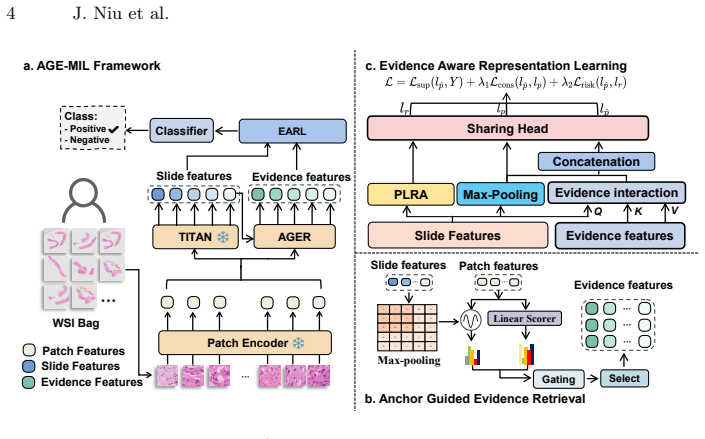
AGE-MIL constructs a patient-level anchor from slide representations to capture global pathological context and guide the retrieval and integration of diagnostically relevant local patches, enabling robust patient-level modeling. Patient-level risk is further modeled as an evidence accumulation process, promoting stable optimization under weak supervision.
What carries the argument
The patient-level anchor derived from slide representations, which encodes global context to steer selection and integration of local patches inside an evidence-accumulation model for risk scoring.
If this is right
- The method outperforms eight existing multiple-instance learning approaches on six clinically relevant patient-level tasks drawn from two independent cohorts.
- Patient-level risk modeling becomes more stable because the evidence accumulation process smooths optimization under weak supervision.
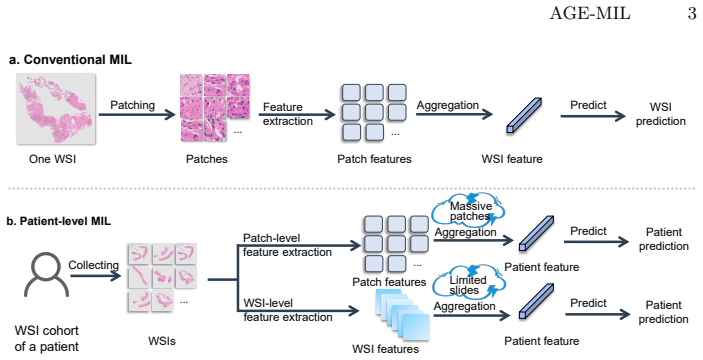
- Integration of local patches is guided by global context captured in the anchor, reducing misalignment with multi-slide diagnostic workflows.
- The framework supports direct use of patient-level labels without requiring slide-level annotations for training.
Where Pith is reading between the lines
- If the anchor remains effective across variable numbers of slides per patient, the same structure could support training on larger, less curated clinical archives.
- The evidence accumulation framing may lend itself to uncertainty estimates that clinicians could use to decide when additional slides are needed.
- Similar anchor-plus-accumulation patterns might transfer to other medical domains where multiple images or samples belong to one subject and labels are coarse.
Load-bearing premise
A single patient-level anchor derived from slide representations will reliably capture global context and steer patch retrieval without introducing selection bias or optimization instability when only patient-level labels are available.
What would settle it
Retraining the model after removing the anchor component and measuring whether performance on the six patient-level tasks declines or training becomes unstable would directly test the central mechanism.
Figures
read the original abstract
Existing computational pathology methods predominantly operate within whole-slide image (WSI)-level multiple instance learning (MIL) paradigms, while patient-level modeling remains underexplored. In routine pathological practice, however, pathologists derive diagnostic and prognostic conclusions by integrating evidence across multiple WSIs rather than relying on any single slide. This discrepancy creates a fundamental misalignment when patient-level supervision is directly imposed on conventional MIL frameworks, often leading to unstable optimization and degraded predictive reliability. To address this issue, we propose Anchor-Guided Evidence MIL (AGE-MIL), a weakly supervised framework for patient-level prediction. AGE-MIL constructs a patient-level anchor from slide representations to capture global pathological context and guide the retrieval and integration of diagnostically relevant local patches, enabling robust patient-level modeling. Patient-level risk is further modeled as an evidence accumulation process, promoting stable optimization under weak supervision. AGE-MIL is evaluated on six clinically relevant patient-level prediction tasks from two independent cohorts. Experimental results show that the proposed framework consistently outperforms eight state-of-the-art MIL methods. Code is available at https://github.com/wodeniua/AGE-MIL.
Editorial analysis
A structured set of objections, weighed in public.
Referee Report
Summary. The paper proposes AGE-MIL, a weakly supervised framework for patient-level prediction from multiple whole-slide images in computational pathology. It constructs a patient-level anchor from slide representations to capture global pathological context and guide retrieval and integration of relevant local patches, while modeling patient-level risk as an evidence accumulation process to enable stable optimization under weak supervision. The framework is evaluated on six clinically relevant tasks from two independent cohorts and reports consistent outperformance versus eight state-of-the-art MIL baselines, with code released publicly.
Significance. If the results and derivations hold, the work addresses a practical gap between standard WSI-level MIL and the multi-slide evidence integration used in routine pathology, potentially improving stability and reliability for patient-level tasks. Public code availability supports reproducibility and independent verification.
major comments (2)
- [Abstract] Abstract: the central claim that a single patient-level anchor derived from slide representations reliably captures global context and steers patch retrieval without selection bias or optimization instability cannot be assessed, as no equations, pseudocode, or implementation details for anchor construction or evidence accumulation are provided.
- [Abstract] Abstract: the claim of consistent outperformance on six tasks is load-bearing for the contribution but is unsupported by any mention of statistical tests, confidence intervals, ablation studies, or error analysis, preventing verification of robustness versus the eight baselines.
minor comments (1)
- [Abstract] Abstract: the GitHub link is a positive for reproducibility, but the manuscript should explicitly state which experimental splits, metrics, and baseline implementations are included in the released code.
Simulated Author's Rebuttal
We thank the referee for their review and for highlighting points that warrant clarification regarding the abstract. We address each major comment below, noting that the full manuscript contains the supporting details while the abstract follows standard length and format constraints.
read point-by-point responses
-
Referee: [Abstract] Abstract: the central claim that a single patient-level anchor derived from slide representations reliably captures global context and steers patch retrieval without selection bias or optimization instability cannot be assessed, as no equations, pseudocode, or implementation details for anchor construction or evidence accumulation are provided.
Authors: The abstract provides a high-level textual summary of the framework as is conventional for the venue. The full manuscript details the patient-level anchor construction in Section 3.2 (Equations 2-3), the evidence accumulation process in Section 3.3 (Equations 4-6), and includes pseudocode in Algorithm 1. These elements directly address selection bias and optimization stability through the anchor-guided retrieval and accumulation mechanisms. We do not believe mathematical notation belongs in the abstract given space limits, but we can add a brief clarifying sentence if the editor requests. revision: no
-
Referee: [Abstract] Abstract: the claim of consistent outperformance on six tasks is load-bearing for the contribution but is unsupported by any mention of statistical tests, confidence intervals, ablation studies, or error analysis, preventing verification of robustness versus the eight baselines.
Authors: The abstract summarizes the empirical outcome. The full paper reports paired statistical tests (p-values in Table 2), 95% confidence intervals, ablation studies (Section 4.3), and error analysis (Section 4.5 and supplementary material) demonstrating consistent, statistically significant gains (p < 0.05) over the eight baselines across all six tasks. These elements are standardly placed in the results section rather than the abstract. revision: no
Circularity Check
No significant circularity; derivation is self-contained
full rationale
The paper's abstract and description present AGE-MIL as a new framework that constructs a patient-level anchor from slide representations and models risk via evidence accumulation, but no equations, self-citations, or fitted parameters are shown that reduce any claimed prediction or result to its own inputs by construction. The central claims rely on architectural choices and empirical evaluation on external cohorts rather than definitional equivalence or load-bearing self-citation chains. Without visible reductions of the form 'prediction X equals fitted input Y', the derivation chain remains independent of the target outputs.
Axiom & Free-Parameter Ledger
Reference graph
Works this paper leans on
-
[1]
Nature medicine25(8), 1301–1309 (2019)
Campanella, G., Hanna, M.G., Geneslaw, L., Miraflor, A., Werneck Krauss Silva, V., Busam, K.J., Brogi, E., Reuter, V.E., Klimstra, D.S., Fuchs, T.J.: Clinical- grade computational pathology using weakly supervised deep learning on whole slide images. Nature medicine25(8), 1301–1309 (2019)
2019
-
[2]
In: Proceedings of the IEEE/CVF conference on computer vision and pattern recognition
Chen, R.J., Chen, C., Li, Y., Chen, T.Y., Trister, A.D., Krishnan, R.G., Mahmood, F.: Scaling vision transformers to gigapixel images via hierarchical self-supervised learning. In: Proceedings of the IEEE/CVF conference on computer vision and pattern recognition. pp. 16144–16155 (2022)
2022
-
[3]
IEEE Transactions on Medical Imaging44(1), 409–421 (2024)
Chikontwe, P., Kim, M., Jeong, J., Sung, H.J., Go, H., Nam, S.J., Park, S.H.: Fr- mil: Distribution re-calibration-based multiple instance learning with transformer for whole slide image classification. IEEE Transactions on Medical Imaging44(1), 409–421 (2024)
2024
-
[4]
Nature medicine25(10), 1519–1525 (2019)
Courtiol, P., Maussion, C., Moarii, M., Pronier, E., Pilcer, S., Sefta, M., Manceron, P., Toldo, S., Zaslavskiy, M., Le Stang, N., et al.: Deep learning-based classification of mesothelioma improves prediction of patient outcome. Nature medicine25(10), 1519–1525 (2019)
2019
-
[5]
Artificial intelligence89(1-2), 31–71 (1997)
Dietterich, T.G., Lathrop, R.H., Lozano-Pérez, T.: Solving the multiple instance problem with axis-parallel rectangles. Artificial intelligence89(1-2), 31–71 (1997)
1997
-
[6]
Nature medicine pp
Ding, T., Wagner, S.J., Song, A.H., Chen, R.J., Lu, M.Y., Zhang, A., Vaidya, A.J., Jaume,G.,Shaban,M.,Kim,A.,etal.:Amultimodalwhole-slidefoundationmodel for pathology. Nature medicine pp. 1–13 (2025)
2025
-
[7]
medRxiv pp
Gao, Z., He, K., Su, W., Machado, I.P., McGough, W., Jimenez-Linan, M., Rous, B., Wang, C., Li, C., Pang, X., et al.: Alpaca: Adapting llama for pathology context analysis to enable slide-level question answering. medRxiv pp. 2025–04 (2025) 10 J. Niu et al
2025
-
[8]
Nature Cancer pp
Gao, Z., Mao, A., Dong, Y., Clayton, H., Wu, J., Liu, J., Wang, C., He, K., Gong, T., Li, C., et al.: Smmile enables accurate spatial quantification in digital pathology using multiple-instance learning. Nature Cancer pp. 1–17 (2025)
2025
-
[9]
In: Proceedings of the AAAI conference on artificial intelligence
Hou, W., Yu, L., Lin, C., Huang, H., Yu, R., Qin, J., Wang, L.: Hˆ 2-mil: explor- ing hierarchical representation with heterogeneous multiple instance learning for whole slide image analysis. In: Proceedings of the AAAI conference on artificial intelligence. vol. 36, pp. 933–941 (2022)
2022
-
[10]
In: International conference on machine learning
Ilse,M.,Tomczak,J.,Welling,M.:Attention-baseddeepmultipleinstancelearning. In: International conference on machine learning. pp. 2127–2136. PMLR (2018)
2018
-
[11]
In: Proceedings of the IEEE/CVF Conference on Com- puter Vision and Pattern Recognition
Jaume, G., Oldenburg, L., Vaidya, A., Chen, R.J., Williamson, D.F., Peeters, T., Song, A.H., Mahmood, F.: Transcriptomics-guided slide representation learning in computational pathology. In: Proceedings of the IEEE/CVF Conference on Com- puter Vision and Pattern Recognition. pp. 9632–9644 (2024)
2024
-
[12]
In: Proceedings of the AAAI conference on artificial intelligence
Lee, P., Wang, J., Lu, Y., Byun, H.: Weakly-supervised temporal action localiza- tion by uncertainty modeling. In: Proceedings of the AAAI conference on artificial intelligence. vol. 35, pp. 1854–1862 (2021)
2021
-
[13]
In: Pro- ceedings of the IEEE/CVF conference on computer vision and pattern recognition
Li, B., Li, Y., Eliceiri, K.W.: Dual-stream multiple instance learning network for whole slide image classification with self-supervised contrastive learning. In: Pro- ceedings of the IEEE/CVF conference on computer vision and pattern recognition. pp. 14318–14328 (2021)
2021
-
[14]
In: International Conference on Medical Image Computing and Computer-Assisted Intervention
Liu, J., Mao, A., Niu, Y., Zhang, X., Gong, T., Li, C., Gao, Z.: Pamil: Prototype attention-based multiple instance learning for whole slide image classification. In: International Conference on Medical Image Computing and Computer-Assisted Intervention. pp. 362–372. Springer (2024)
2024
-
[15]
Nature Medicine 30, 863–874 (2024)
Lu, M.Y., Chen, B., Williamson, D.F.K., Chen, R.J., Liang, I., Ding, T., et al.: A visual-language foundation model for computational pathology. Nature Medicine 30, 863–874 (2024)
2024
-
[16]
Nature biomedical engineering5(6), 555–570 (2021)
Lu, M.Y., Williamson, D.F., Chen, T.Y., Chen, R.J., Barbieri, M., Mahmood, F.: Data-efficient and weakly supervised computational pathology on whole-slide images. Nature biomedical engineering5(6), 555–570 (2021)
2021
-
[17]
In: 2025 IEEE International Conference on Bioinformatics and Biomedicine (BIBM)
Niu, Y., Liu, J., Zhan, Y., Shi, J., Chen, J., Zhang, D., Li, C., Gao, Z.: Learning heterogeneous embedding with prototype-aware graph attention for whole slide image classification. In: 2025 IEEE International Conference on Bioinformatics and Biomedicine (BIBM). pp. 2671–2678. IEEE (2025)
2025
-
[18]
arXiv preprint arXiv:2405.10254 (2024) 12 J
Shaikovski, G., Casson, A., Severson, K., Zimmermann, E., Wang, Y.K., Kunz, J.D., Retamero, J.A., Oakley, G., Klimstra, D., Kanan, C., et al.: Prism: A multi- modal generative foundation model for slide-level histopathology. arXiv preprint arXiv:2405.10254 (2024)
-
[19]
Advances in neural information processing systems34, 2136–2147 (2021)
Shao, Z., Bian, H., Chen, Y., Wang, Y., Zhang, J., Ji, X., et al.: Transmil: Trans- former based correlated multiple instance learning for whole slide image classifica- tion. Advances in neural information processing systems34, 2136–2147 (2021)
2021
-
[20]
IEEE transactions on pattern analysis and machine intelligence43(2), 567–578 (2019)
Tellez, D., Litjens, G., Van der Laak, J., Ciompi, F.: Neural image compression for gigapixel histopathology image analysis. IEEE transactions on pattern analysis and machine intelligence43(2), 567–578 (2019)
2019
-
[21]
Molecular-driven foundation model for oncologic pathology.arXiv preprint arXiv:2501.16652, 2025
Vaidya, A., Zhang, A., Jaume, G., Song, A.H., Ding, T., Wagner, S.J., Lu, M.Y., Doucet, P., Robertson, H., Almagro-Perez, C., et al.: Molecular-driven foundation model for oncologic pathology. arXiv preprint arXiv:2501.16652 (2025)
-
[22]
Nature634(8035), 970–978 (2024) AGE-MIL 11
Wang, X., Zhao, J., Marostica, E., Yuan, W., Jin, J., Zhang, J., Li, R., Tang, H., Wang, K., Li, Y., et al.: A pathology foundation model for cancer diagnosis and prognosis prediction. Nature634(8035), 970–978 (2024) AGE-MIL 11
2024
-
[23]
In: The Eleventh International Conference on Learning Representations (2023)
Xiang, J., Zhang, J.: Exploring low-rank property in multiple instance learning for whole slide image classification. In: The Eleventh International Conference on Learning Representations (2023)
2023
-
[24]
Nature630(8015), 181–188 (2024)
Xu, H., Usuyama, N., Bagga, J., Zhang, S., Rao, R., Naumann, T., Wong, C., Gero, Z., González, J., Gu, Y., et al.: A whole-slide foundation model for digital pathology from real-world data. Nature630(8015), 181–188 (2024)
2024
-
[25]
Medical image analysis65, 101789 (2020)
Yao, J., Zhu, X., Jonnagaddala, J., Hawkins, N., Huang, J.: Whole slide images based cancer survival prediction using attention guided deep multiple instance learning networks. Medical image analysis65, 101789 (2020)
2020
-
[26]
Zhang, D., Gong, Z., Pang, X., Liu, J., Lu, J., Cui, H., Ge, J., Zeng, Z., Yi, K., Li, Y., Liu, S., Yu, T., Wang, H., Crispin-Ortuzar, M., eimiao Yu, Li, C., Gao, Z.: Care: A molecular-guided foundation model with adaptive region modeling for whole slide image analysis (2026), https://arxiv.org/abs/2602.21637
-
[27]
Information Fusion119, 103027 (2025)
Zhang, Y., Gao, Z., He, K., Li, C., Mao, R.: From patches to wsis: A systematic review of deep multiple instance learning in computational pathology. Information Fusion119, 103027 (2025)
2025
-
[28]
IEEE transactions on medical imaging41(11), 3003–3015 (2022)
Zheng, Y., Gindra, R.H., Green, E.J., Burks, E.J., Betke, M., Beane, J.E., Ko- lachalama, V.B.: A graph-transformer for whole slide image classification. IEEE transactions on medical imaging41(11), 3003–3015 (2022)
2022
discussion (0)
Sign in with ORCID, Apple, or X to comment. Anyone can read and Pith papers without signing in.