Time-Conditioned and Multi-Time Survival Prediction from 2D PET/CT Projections in Lung Cancer
Pith reviewed 2026-06-27 09:57 UTC · model grok-4.3
The pith
Attention-guided and multi-time survival models outperform baseline for lung cancer survival prediction from PET/CT images.
A machine-rendered reading of the paper's core claim, the machinery that carries it, and where it could break.
Core claim
The central claim is that ATCS and MTS models provide improved time-dependent survival prediction performance from 2D PET/CT projections in NSCLC, outperforming the TCS baseline with mean AUCs of 0.794 and 0.793 compared to 0.767, and that temporal formulation, feature type, and discretization level influence the results.
What carries the argument
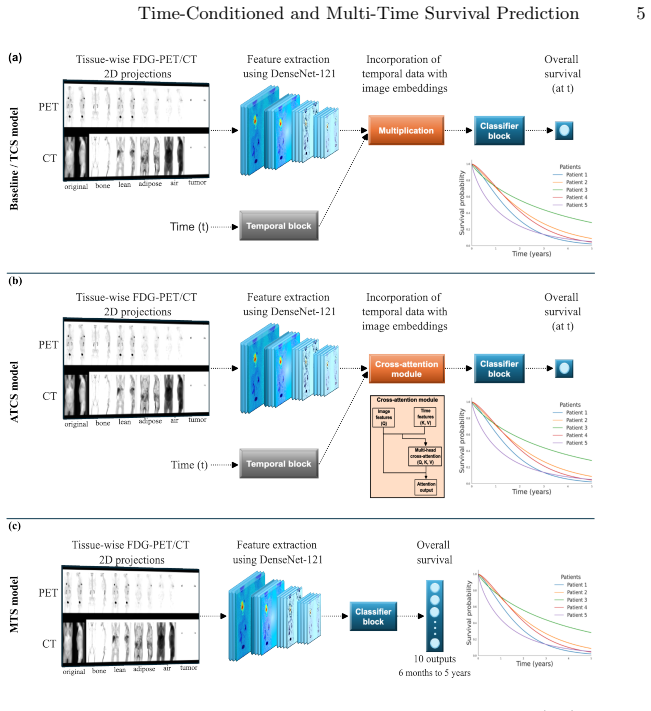
The ATCS and MTS temporal formulations applied to 2D PET/CT projections, which condition survival predictions on time and incorporate attention or multi-time elements.
If this is right
- ATCS performs better at earlier time points (0.5-3 years) and MTS at later intervals (3.5-5 years).
- Combining tumor-specific and tissue-wise PET/CT features improves performance over single inputs.
- Finer temporal discretization improves short-term prediction while coarser intervals stabilize long-term estimates.
- Time-specific survival estimation from pre-treatment imaging becomes possible.
- The models may support improved risk stratification and clinical decision-making.
Where Pith is reading between the lines
- Similar temporal modeling could be tested in other cancer types with PET/CT data to check for broader applicability.
- Prospective studies would be required to determine if the AUC gains translate to better patient outcomes in practice.
- Hybrid models merging ATCS and MTS could potentially optimize performance across all time horizons.
- The approach might reduce need for additional prognostic tests if imaging alone suffices for reliable estimates.
Load-bearing premise
The 292-patient held-out test set from the retrospective NSCLC cohort is representative of future patients and free of biases that would change the reported AUC differences.
What would settle it
Failure to observe AUC improvements over 0.767 for ATCS or MTS on an independent external cohort of NSCLC patients would falsify the superiority claim.
Figures
read the original abstract
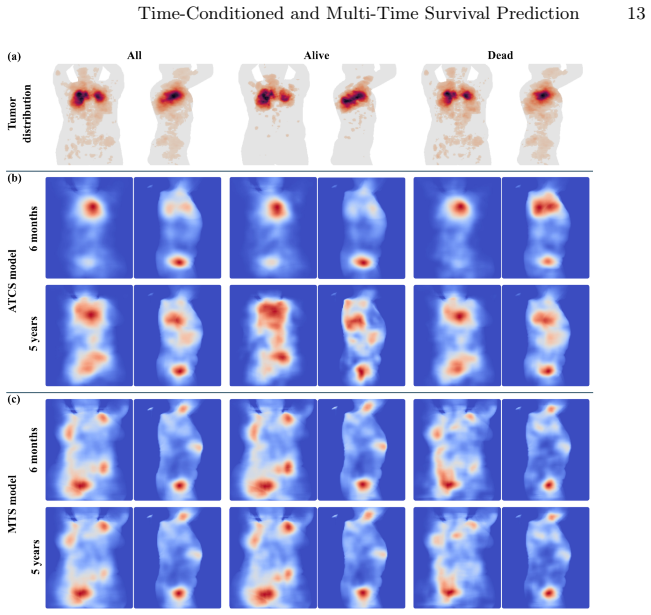
Accurate prediction of overall survival (OS) from positron emission tomography/computed tomography (PET/CT) can support personalized treatment and follow-up strategies in oncology. However, the impact of temporal modeling on imaging-based survival prediction remains insufficiently explored. We investigate how different temporal formulations influence survival prediction by developing two complementary approaches: Attention-guided Time-Conditioned Survival (ATCS) and Multi-Time Survival (MTS). We retrospectively analyzed pre-treatment PET/CT images from 848 patients with non-small cell lung cancer (NSCLC), including 556 for model development and 292 for held-out testing. A previously proposed Time-Conditioned Survival (TCS) model was used as a baseline. Models were trained using 5-fold cross-validation and evaluated on the test set using time-dependent area under the curve (AUC) at 6-month intervals from 0.5 to 5 years. Both ATCS and MTS outperformed the baseline TCS model, achieving mean AUCs of 0.794 and 0.793, respectively, compared to 0.767. ATCS performed better at earlier time points (0.5-3 years), whereas MTS performed better at later intervals (3.5-5 years). Combining tumor-specific and tissue-wise PET/CT features improved performance over either input alone. Finer temporal discretization improved short-term prediction, while coarser intervals provided more stable long-term estimates. These findings demonstrate that temporal modeling and input design influence PET/CT-based survival prediction. The proposed approaches enable time-specific survival estimation from pre-treatment imaging and may support improved risk stratification and clinical decision-making.
Editorial analysis
A structured set of objections, weighed in public.
Referee Report
Summary. The manuscript develops two temporal modeling approaches—Attention-guided Time-Conditioned Survival (ATCS) and Multi-Time Survival (MTS)—for overall survival prediction from pre-treatment 2D PET/CT projections in NSCLC. On a retrospective 848-patient cohort (556 development, 292 held-out test), both models are reported to outperform a Time-Conditioned Survival (TCS) baseline, with mean time-dependent AUCs of 0.794 (ATCS) and 0.793 (MTS) versus 0.767 (TCS) across 6-month intervals from 0.5–5 years; ATCS is stronger at early horizons and MTS at later ones, with additional gains from combined tumor/tissue features and varying temporal discretization.
Significance. If the AUC gains prove robust, the work would usefully demonstrate that explicit temporal conditioning and multi-time formulations can improve imaging-based survival estimation and support time-specific risk stratification. The held-out evaluation and time-dependent AUC metric are appropriate choices; the observation that performance varies systematically with time horizon and input granularity is a concrete contribution. However, the absolute differences are modest and the absence of external validation or detailed methodological reporting limits immediate translational weight.
major comments (3)
- [Abstract/Methods] Abstract and Methods: The headline claim that ATCS/MTS outperform TCS rests on mean AUC values (0.794/0.793 vs 0.767), yet the abstract supplies no architecture details, loss functions, hyperparameter search protocol, or ablation tables. Without these, it is impossible to determine whether the reported gains arise from the proposed temporal innovations or from other implementation choices.
- [Evaluation] Evaluation: All results are obtained on a 292-patient held-out subset drawn from the same single retrospective 848-patient NSCLC cohort, with no external cohort, temporal split by acquisition date, or multi-site stratification described. The small absolute AUC differences could therefore reflect cohort-specific imaging protocols or selection effects rather than the temporal modeling contributions.
- [Abstract] Abstract: The mean AUC figures are presented without standard deviations across folds or time points, confidence intervals, or statistical tests comparing the models; this prevents assessment of whether the observed differences are statistically reliable.
minor comments (1)
- [Abstract] The abstract states that models were trained with 5-fold cross-validation but does not clarify whether the temporal discretization grid is fixed before or after cross-validation, which could affect reproducibility of the time-dependent AUC curves.
Simulated Author's Rebuttal
We thank the referee for the constructive feedback. We address each major comment below, indicating revisions where the manuscript will be updated for improved transparency and reporting.
read point-by-point responses
-
Referee: [Abstract/Methods] Abstract and Methods: The headline claim that ATCS/MTS outperform TCS rests on mean AUC values (0.794/0.793 vs 0.767), yet the abstract supplies no architecture details, loss functions, hyperparameter search protocol, or ablation tables. Without these, it is impossible to determine whether the reported gains arise from the proposed temporal innovations or from other implementation choices.
Authors: The full Methods section describes the ATCS attention-guided time-conditioning mechanism, MTS multi-time formulation, 2D PET/CT projection processing, tumor/tissue feature extraction, and the time-dependent Cox loss. Hyperparameter optimization used grid search within 5-fold CV on the development set. Ablations on feature types and temporal binning appear in Results. To address the concern, we will expand the abstract with brief methodological highlights and add a supplementary table detailing architectures, loss, search protocol, and key ablations. revision: yes
-
Referee: [Evaluation] Evaluation: All results are obtained on a 292-patient held-out subset drawn from the same single retrospective 848-patient NSCLC cohort, with no external cohort, temporal split by acquisition date, or multi-site stratification described. The small absolute AUC differences could therefore reflect cohort-specific imaging protocols or selection effects rather than the temporal modeling contributions.
Authors: The 292-patient test set was held out entirely from development and tuning, providing a strict internal validation. We agree external validation would be stronger; however, this single-center retrospective study had no access to external or multi-site data. We will add explicit discussion of this limitation and note plans for future multi-center work. No date-based split was applied due to uniform acquisition protocols within the cohort. revision: partial
-
Referee: [Abstract] Abstract: The mean AUC figures are presented without standard deviations across folds or time points, confidence intervals, or statistical tests comparing the models; this prevents assessment of whether the observed differences are statistically reliable.
Authors: We agree variability and significance testing are needed. Although 5-fold CV was performed, only means appear in the abstract. The revision will report standard deviations across folds, bootstrap confidence intervals for time-dependent AUCs, and statistical comparisons (DeLong test for time-dependent AUC) between models. These will be added to the abstract, Results, and tables. revision: yes
- Lack of external validation cohort, as no multi-site or external data were available for this retrospective single-center study.
Circularity Check
No circularity in derivation or evaluation chain
full rationale
The paper trains ATCS and MTS models (plus TCS baseline) via 5-fold cross-validation on a 556-patient development set drawn from a single retrospective NSCLC cohort, then evaluates time-dependent AUC on an independent 292-patient held-out test set. No equations, parameters, or predictions are defined in terms of the target outputs; the baseline is an external prior model; and performance differences are measured with standard metrics on data never used in training. This setup is self-contained against external benchmarks with no self-definitional, fitted-input, or self-citation reductions.
Axiom & Free-Parameter Ledger
axioms (2)
- domain assumption The retrospective 848-patient NSCLC cohort (556 development, 292 held-out) is representative and free of selection bias for survival modeling.
- domain assumption Time-dependent AUC at 6-month intervals is an appropriate and sufficient metric for comparing time-conditioned survival models.
Reference graph
Works this paper leans on
-
[1]
Physics in medicine & biology66(20), 205017 (2021)
Amini, M., Nazari, M., Shiri, I., Hajianfar, G., Deevband, M.R., Abdollahi, H., Arabi, H., Rahmim, A., Zaidi, H.: Multi-level multi-modality (pet and ct) fu- sion radiomics: prognostic modeling for non-small cell lung carcinoma. Physics in medicine & biology66(20), 205017 (2021)
2021
-
[2]
Bray, F., Laversanne, M., Sung, H., Ferlay, J., Siegel, R.L., Soerjomataram, I., Je- mal, A.: Global cancer statistics 2022: Globocan estimates of incidence and mor- tality worldwide for 36 cancers in 185 countries. CA: a cancer journal for clinicians 74(3), 229–263 (2024). https://doi.org/https://doi.org/10.3322/caac.21834
-
[3]
Medical Physics48(12), 7946–7958 (2021)
Chen, W., Hou, X., Hu, Y., Huang, G., Ye, X., Nie, S.: A deep learning-and ct image-based prognostic model for the prediction of survival in non-small cell lung cancer. Medical Physics48(12), 7946–7958 (2021)
2021
-
[4]
Scientific reports9(1), 2764 (2019)
Diamant, A., Chatterjee, A., Vallières, M., Shenouda, G., Seuntjens, J.: Deep learn- ing in head & neck cancer outcome prediction. Scientific reports9(1), 2764 (2019)
2019
-
[5]
arXiv preprint arXiv:2010.11929 (2020)
Dosovitskiy, A.: An image is worth 16x16 words: Transformers for image recogni- tion at scale. arXiv preprint arXiv:2010.11929 (2020)
Pith/arXiv arXiv 2010
-
[6]
Scientific Reports13(1), 13111 (2023)
Ferrández, M.C., Golla, S.S., Eertink, J.J., de Vries, B.M., Lugtenburg, P.J., Wiegers, S.E., Zwezerijnen, G.J., Pieplenbosch, S., Kurch, L., Hüttmann, A., et al.: An artificial intelligence method using fdg pet to predict treatment outcome in diffuse large b cell lymphoma patients. Scientific Reports13(1), 13111 (2023). https://doi.org/https://doi.org/10...
-
[7]
Cancers14(6), 1400 (2022)
Garinet, S., Wang, P., Mansuet-Lupo, A., Fournel, L., Wislez, M., Blons, H.: Up- dated prognostic factors in localized nsclc. Cancers14(6), 1400 (2022)
2022
-
[8]
arXiv preprint arXiv:2104.08771 (2021)
Gheini, M., Ren, X., May, J.: Cross-attention is all you need: Adapting pretrained transformers for machine translation. arXiv preprint arXiv:2104.08771 (2021)
arXiv 2021
-
[9]
Girum, K.B., Rebaud, L., Cottereau, A.S., Meignan, M., Clerc, J., Vercellino, L., Casasnovas, O., Morschhauser, F., Thieblemont, C., Buvat, I.: 18f-fdg pet maximum-intensity projections and artificial intelligence: a win-win combination to easilymeasureprognosticbiomarkersindlbclpatients.JournalofNuclearMedicine 63(12), 1925–1932 (2022)
1925
-
[10]
Acta oncologica57(2), 187–194 (2018)
Glimelius, B., Melin, B., Enblad, G., Alafuzoff, I., Beskow, A., Ahlström, H., Bill-Axelson, A., Birgisson, H., Björ, O., Edqvist, P.H., et al.: U-can: a prospective longitudinal collection of biomaterials and clinical information from adult cancer patients in sweden. Acta oncologica57(2), 187–194 (2018). https://doi.org/https://doi.org/10.1080/0284186X.2...
-
[11]
Nature reviews Disease primers1(1), 1–16 (2015)
Gridelli, C., Rossi, A., Carbone, D.P., Guarize, J., Karachaliou, N., Mok, T., Pe- trella, F., Spaggiari, L., Rosell, R.: Non-small-cell lung cancer. Nature reviews Disease primers1(1), 1–16 (2015)
2015
-
[12]
Nature Re- views Disease Primers10(1), 71 (2024)
Hendriks, L.E., Remon, J., Faivre-Finn, C., Garassino, M.C., Heymach, J.V., Kerr, K.M., Tan, D.S., Veronesi, G., Reck, M.: Non-small-cell lung cancer. Nature Re- views Disease Primers10(1), 71 (2024)
2024
-
[13]
Lung cancer13(3), 253–267 (1995) Time-Conditioned and Multi-Time Survival Prediction 15
Hespanhol, V., Queiroga, H., Magalhaes, A., Santos, A., Coelho, M., Marques, A.: Survival predictors in advanced non-small cell lung cancer. Lung cancer13(3), 253–267 (1995) Time-Conditioned and Multi-Time Survival Prediction 15
1995
-
[14]
Frontiers in medicine 10, 1217037 (2023)
Huynh, B.N., Groendahl, A.R., Tomic, O., Liland, K.H., Knudtsen, I.S., Hoebers, F., van Elmpt, W., Malinen, E., Dale, E., Futsaether, C.M.: Head and neck can- cer treatment outcome prediction: a comparison between machine learning with conventional radiomics features and deep learning radiomics. Frontiers in medicine 10, 1217037 (2023)
2023
-
[15]
Biomedical engineering online22(1), 110 (2023)
Jönsson, H., Ahlström, H., Kullberg, J.: Spatial mapping of tumor heterogeneity in whole-body pet–ct: a feasibility study. Biomedical engineering online22(1), 110 (2023)
2023
-
[16]
Scientific Reports12(1), 18768 (2022)
Jönsson, H., Ekström, S., Strand, R., Pedersen, M.A., Molin, D., Ahlström, H., Kullberg, J.: An image registration method for voxel-wise analysis of whole-body oncological pet-ct. Scientific Reports12(1), 18768 (2022)
2022
-
[17]
BMC medical research methodology18(1), 24 (2018)
Katzman, J.L., Shaham, U., Cloninger, A., Bates, J., Jiang, T., Kluger, Y.: Deep- surv:personalizedtreatmentrecommendersystemusingacoxproportionalhazards deep neural network. BMC medical research methodology18(1), 24 (2018)
2018
-
[18]
In: Proceedings of the IEEE conference on computer vision and pattern recognition
Kendall, A., Gal, Y., Cipolla, R.: Multi-task learning using uncertainty to weigh losses for scene geometry and semantics. In: Proceedings of the IEEE conference on computer vision and pattern recognition. pp. 7482–7491 (2018)
2018
-
[19]
Expert review of respiratory medicine10(3), 317–330 (2016)
Khiewvan, B., Ziai, P., Houshmand, S., Salavati, A., Ziai, P., Alavi, A.: The role of pet/ct as a prognosticator and outcome predictor in lung cancer. Expert review of respiratory medicine10(3), 317–330 (2016)
2016
-
[20]
In: Seminars in Ultrasound, CT and MRI
Kinahan, P.E., Fletcher, J.W.: Positron emission tomography-computed tomog- raphy standardized uptake values in clinical practice and assessing response to therapy. In: Seminars in Ultrasound, CT and MRI. vol. 31, pp. 496–505. Elsevier (2010)
2010
-
[21]
Journal of machine learning research20(129), 1–30 (2019)
Kvamme, H., Borgan, Ø., Scheel, I.: Time-to-event prediction with neural networks and cox regression. Journal of machine learning research20(129), 1–30 (2019)
2019
-
[22]
The oncologist23(7), 844–848 (2018)
Lababede, O., Meziane, M.A.: The eighth edition of tnm staging of lung cancer: reference chart and diagrams. The oncologist23(7), 844–848 (2018). https://doi.org/https://doi.org/10.1634/theoncologist.2017-0659
-
[23]
In: Proceedings of the AAAI conference on artificial intelligence
Lee, C., Zame, W., Yoon, J., Van Der Schaar, M.: Deephit: A deep learning ap- proach to survival analysis with competing risks. In: Proceedings of the AAAI conference on artificial intelligence. vol. 32 (2018)
2018
-
[24]
arXiv preprint arXiv:2305.09946 (2023)
Meng, M., Gu, B., Fulham, M., Song, S., Feng, D., Bi, L., Kim, J.: Adamss: Adap- tive multi-modality segmentation-to-survival learning for survival outcome predic- tion from pet/ct images. arXiv preprint arXiv:2305.09946 (2023)
arXiv 2023
-
[25]
In: Proceedings of the IEEE international conference on computer vision
Selvaraju, R.R., Cogswell, M., Das, A., Vedantam, R., Parikh, D., Batra, D.: Grad- cam: Visual explanations from deep networks via gradient-based localization. In: Proceedings of the IEEE international conference on computer vision. pp. 618–626 (2017)
2017
-
[26]
tarai et al
Tarai, S., Chauhan, A., Lundström, E., Öfverstedt, J., Sjöholm, T., Sanchez Ro- driguez, V., Ahlström, H., Kullberg, J.: Time-driven survival analysis from fdg- pet/ct in non-small cell lung cancer: S. tarai et al. Annals of Biomedical Engineer- ing pp. 1–15 (2026)
2026
-
[27]
In: Annual Confer- ence on Medical Image Understanding and Analysis
Tarai, S., Lundström, E., Öfverstedt, J., Jönsson, H., Ahmad, N., Ahlström, H., Kullberg, J.: Prediction of total metabolic tumor volume from tissue-wise fdg- pet/ct projections, interpreted using cohort saliency analysis. In: Annual Confer- ence on Medical Image Understanding and Analysis. pp. 242–255. Springer (2024)
2024
-
[28]
Heliyon10(4) (2024) 16 A
Tarai, S., Lundström, E., Sjöholm, T., Jönsson, H., Korenyushkin, A., Ahmad, N., Pedersen, M.A., Molin, D., Enblad, G., Strand, R., et al.: Improved automated tumor segmentation in whole-body 3d scans using multi-directional 2d projection- based priors. Heliyon10(4) (2024) 16 A. Chauhan et al
2024
-
[29]
All”), patients alive at follow-up (“Alive
Woodard, G.A., Jones, K.D., Jablons, D.M.: Lung cancer staging and prognosis. Lung cancer: treatment and research pp. 47–75 (2016) Time-Conditioned and Multi-Time Survival Prediction 17 S1 Additional Ablation Results We evaluated the impact of backbone architectures across different model vari- ants and input configurations. The TCS model follows the conf...
2016
discussion (0)
Sign in with ORCID, Apple, or X to comment. Anyone can read and Pith papers without signing in.