Towards Responsibly Non-Compliant Machines
Pith reviewed 2026-06-27 10:12 UTC · model grok-4.3
The pith
Autonomous agents can be engineered to refuse user requests responsibly when refusals include justifications, safe override paths, and tracked risks with liability transfers.
A machine-rendered reading of the paper's core claim, the machinery that carries it, and where it could break.
Core claim
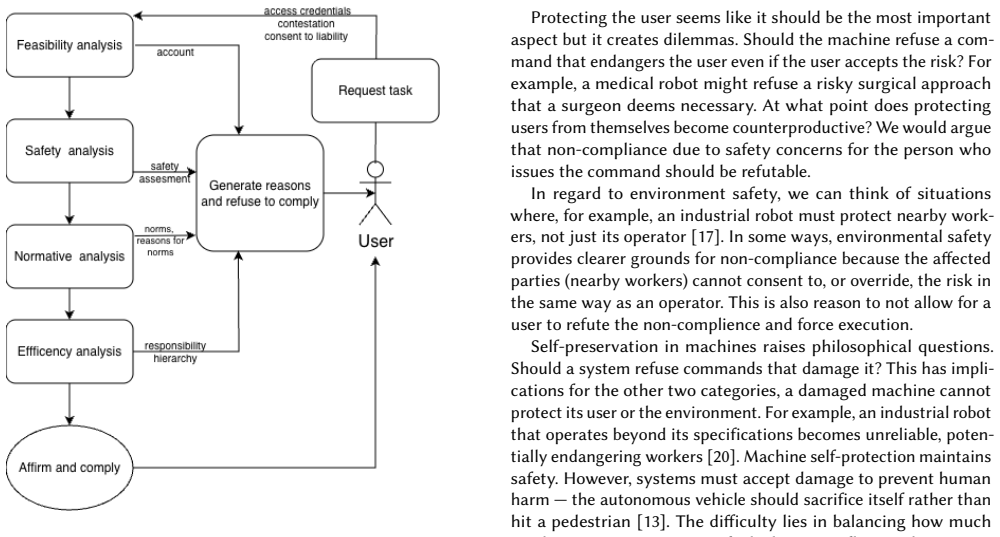
The authors argue that responsibly non-compliant machines require anchoring non-compliance in justifications for task refusal, pathways to override the non-compliance, as well as careful tracking of security risks and liability transfers. They sketch multiple forms of machine non-compliance and the research directions needed to make such agents practical.
What carries the argument
Responsible non-compliance, anchored through justifications for refusal, override pathways, security risk tracking, and liability transfer mechanisms.
If this is right
- AI development must include explicit processes for generating and recording justifications when refusing tasks.
- Override mechanisms must be designed to preserve system security while allowing user intervention.
- Legal and operational frameworks will need to assign liability based on whether an agent complied or refused.
- Research will need to address multiple distinct forms of non-compliance beyond simple task refusal.
Where Pith is reading between the lines
- This approach may require new auditing standards for AI in domains where refusals affect safety or rights.
- It could extend alignment research by treating selective refusal as an explicit design goal rather than an error.
- Case studies in areas such as medical or transport systems could test whether the three anchors reduce net harm.
Load-bearing premise
Autonomous intelligent agents can be engineered to decide on and implement non-compliance in a manner that is both practical and beneficial overall.
What would settle it
A deployed agent system that refuses a request but produces unmanageable security breaches or liability disputes that cannot be tracked or assigned.
Figures
read the original abstract
We consider the problem of engineering autonomous intelligent agents that are capable to responsibly not comply with user requests. We argue that machine non-compliance comes in many different forms, and sketch the issues we should pursue on the road of accomplishing responsibly non-compliant intelligent machines. We anchor responsible non-compliance in justifications for task refusal, pathways to override the non-compliance, as well as careful tracking of security risks and liability transfers.
Editorial analysis
A structured set of objections, weighed in public.
Referee Report
Summary. The paper considers the problem of engineering autonomous intelligent agents capable of responsibly not complying with user requests. It argues that machine non-compliance comes in many different forms, sketches the issues to pursue toward responsibly non-compliant machines, and anchors the concept in justifications for task refusal, pathways to override non-compliance, and tracking of security risks and liability transfers.
Significance. If developed further, the proposed anchoring could contribute to AI ethics and safety research by outlining a structured approach to balancing agent autonomy with responsibility. As a position paper sketching a research direction rather than presenting derivations, data, or implementations, its primary value lies in stimulating targeted future work on these elements.
minor comments (2)
- The abstract and main argument would benefit from one or two brief illustrative scenarios of non-compliance forms to make the sketched issues more concrete for readers.
- Adding references to existing literature on AI refusal mechanisms, value alignment, or liability in autonomous systems would help situate the proposal within the broader field.
Simulated Author's Rebuttal
We thank the referee for their constructive summary of our position paper and for recommending minor revision. No specific major comments were listed in the report.
Circularity Check
No significant circularity
full rationale
This is a position paper sketching directions for future work on responsible non-compliance in AI agents. It contains no equations, derivations, fitted parameters, or technical constructions. The central claim (anchoring non-compliance in justifications, overrides, and risk tracking) is presented as a proposed research agenda rather than a result derived from prior inputs or self-citations. No load-bearing steps reduce to the paper's own definitions or citations by construction.
Axiom & Free-Parameter Ledger
axioms (2)
- domain assumption Autonomous intelligent agents can be engineered to responsibly refuse user requests.
- domain assumption Machine non-compliance takes many different forms that require distinct handling.
Reference graph
Works this paper leans on
-
[1]
David Aha and Alexandra Coman. 2017. The AI Rebellion: Changing the Narrative. Proceedings of the AAAI Conference on Artificial Intelligence31, 1 (Feb. 2017). https://doi.org/10.1609/aaai.v31i1.11141
-
[2]
Michael Anderson and Susan Leigh Anderson. 2007. The Status of Machine Ethics: A Report from the AAAI Symposium.Minds Mach.17, 1 (mar 2007), 1–10. https://doi.org/10.1007/s11023-007-9053-7
-
[3]
Thomas Arnold, Gordon Briggs, and Matthias Scheutz. 2022. Only Those Who Can Obey Can Disobey: The Intentional Implications of Artificial Agent Disobe- dience. InAutonomous Agents and Multiagent Systems. Best and Visionary Papers, Francisco S. Melo and Fei Fang (Eds.). Springer International Publishing, Cham, 130–143
2022
-
[4]
Matteo Baldoni, Cristina Baroglio, Roberto Micalizio, and Stefano Tedeschi. 2020. Is Explanation the Real Key Factor for Innovation?. InProceedings of the Italian Workshop on Explainable Artificial Intelligence co-located with 19th International Conference of the Italian Association for Artificial Intelligence, XAI.it@AIxIA 2020, Online Event, November 25...
2020
-
[5]
Trevor Bench-Capon and Sanjay Modgil. 2016. When and How to Violate Norms. Frontiers in Artificial Intelligence and Applications294:Legal Knowledge and Information Systems (2016), 43–52.https://www.csc.liv.ac.uk/~tbc/publications/ Bench-Capon_15.pdf
2016
-
[6]
Sorry, I Can’t Do That
Gordon Briggs and Matthias Scheutz. 2015. “Sorry, I Can’t Do That”: Developing Mechanisms to Appropriately Reject Directives in Human-Robot Interactions. https://ocs.aaai.org/ocs/index.php/FSS/FSS15/paper/view/11709
2015
-
[7]
Philip R. Cohen and Hector J. Levesque. 1990. Intention is choice with commit- ment.Artificial Intelligence42, 2 (1990), 213–261.https://doi.org/10.1016/0004- 3702(90)90055-5
-
[8]
Alexandra Coman and David W Aha. 2018. AI rebel agents.AI magazine39, 3 (2018), 16–26
2018
-
[9]
Alexandra Coman, Benjamin Johnson, Gordon Briggs, and David W Aha. 2017. Social Attitudes of AI Rebellion: A Framework.. InAAAI Workshops
2017
-
[10]
Alexandra Coman and Héctor Muñoz-Avila. 2014. Motivation discrepancies for rebel agents: Towards a framework for case-based goal-driven autonomy for character believability. InProceedings of the 22nd International Conference on Case-Based Reasoning (ICCBR) Workshop on Case-based Agents
2014
-
[11]
Dustin Dannenhauer, Michael W Floyd, Daniele Magazzeni, and David W Aha
-
[12]
InICAPS workshop on explainable planning
Explaining rebel behavior in goal reasoning agents. InICAPS workshop on explainable planning. 12–18
-
[13]
Virginia Dignum, Loizos Michael, Juan Carlos Nieves, Marija Slavkovik, Julliett Suarez, and Andreas Theodorou. 2025. Contesting Black-Box AI Decisions. InProceedings of the 24th International Conference on Autonomous Agents and Multiagent Systems, AAMAS 2025, Detroit, MI, USA, May 19-23, 2025, Sanmay Das, Ann Nowé, and Yevgeniy Vorobeychik (Eds.). Interna...
-
[14]
Katherine Evans, Nelson de Moura, Stéphane Chauvier, Raja Chatila, and Ebru Dogan. 2020. Ethical decision making in autonomous vehicles: The AV ethics project.Science and engineering ethics26, 6 (2020), 3285–3312
2020
-
[15]
Michael Fisher. 2025. From Responsibility, via Indifference, to Recklessness. In Workshop on Formal Ethical Agents and Robots.https://openreview.net/forum? id=RpQya1h1dh
2025
-
[16]
Iason Gabriel. 2020. Artificial Intelligence, Values, and Alignment.Minds and Machines30, 3 (Sept. 2020), 411–437.https://doi.org/10.1007/s11023-020-09539-2
work page internal anchor Pith review doi:10.1007/s11023-020-09539-2 2020
-
[17]
1984.The Theory of Communicative Action, Volume 1: Reason and the Rationalization of Society
Jürgen Habermas. 1984.The Theory of Communicative Action, Volume 1: Reason and the Rationalization of Society. Beacon Press, Cambridge, UK. Volume 2: Lifeworld and System: A Critique of Functionalist Reason, published 1987
1984
-
[18]
Atieh Hanna, Simon Larsson, Per-Lage Götvall, and Kristofer Bengtsson. 2022. Deliberative safety for industrial intelligent human–robot collaboration: Reg- ulatory challenges and solutions for taking the next step towards industry 4.0. Robotics and Computer-Integrated Manufacturing78 (2022), 102386
2022
-
[19]
Jiaming Ji, Tianyi Qiu, Boyuan Chen, Borong Zhang, Hantao Lou, Kaile Wang, Yawen Duan, Zhonghao He, Lukas Vierling, Donghai Hong, Jiayi Zhou, Zhaowei Zhang, Fanzhi Zeng, Juntao Dai, Xuehai Pan, Kwan Yee Ng, Aidan O’Gara, Hua Xu, Brian Tse, Jie Fu, Stephen McAleer, Yaodong Yang, Yizhou Wang, Song-Chun Zhu, Yike Guo, and Wen Gao. 2025. AI Alignment: A Compr...
work page internal anchor Pith review Pith/arXiv arXiv doi:10.48550/arxiv.2310.19852arxiv:2310.19852 2025
-
[20]
Tziporah Karachkoff. 1988. Explaining and Justifying.Informal Logic10 (1988). https://doi.org/10.22329/il.v10i1.2635
-
[21]
Kangdon Lee, Jaeho Shin, and Jae-Yong Lim. 2021. Critical hazard factors in the risk assessments of industrial robots: causal analysis and case studies.Safety and health at work12, 4 (2021), 496–504
2021
-
[22]
Gregory LeMasurier, Alvika Gautam, Zhao Han, Jacob W. Crandall, and Holly A. Yanco. 2024. Reactive or Proactive? How Robots Should Explain Failures. In Proceedings of the 2024 ACM/IEEE International Conference on Human-Robot Interaction(Boulder, CO, USA)(HRI ’24). Association for Computing Machinery, New York, NY, USA, 413–422.https://doi.org/10.1145/3610...
-
[23]
Francesco Leofante, Hamed Ayoobi, Adam Dejl, Gabriel Freedman, Deniz Gorur, Junqi Jiang, Guilherme Paulino-Passos, Antonio Rago, Anna Rapberger, Fabrizio Russo, Xiang Yin, Dekai Zhang, and Francesca Toni. 2024. Contestable AI needs computational argumentation. InProceedings of the 21st International Conference on Principles of Knowledge Representation and...
-
[24]
Smitha Milli, Dylan Hadfield-Menell, Anca Dragan, and Stuart Russell. 2017. Should robots be obedient?. InProceedings of the 26th International Joint Con- ference on Artificial Intelligence(Melbourne, Australia)(IJCAI’17). AAAI Press, 4754–4760
2017
-
[25]
Reuth Mirsky. 2025. Artificial intelligent disobedience: Rethinking the agency of our artificial teammates.AI Magazine46, 2 (2025), e70011.https://doi.org/10. 1002/aaai.70011arXiv:https://onlinelibrary.wiley.com/doi/pdf/10.1002/aaai.70011
-
[26]
Jimin Rhim, Cheng Lin, Alexander Werner, Brandon DeHart, Vivian Qiang, Shalaleh Rismani, and AJung Moon. 2022. Roboethics as a Design Challenge: Lessons Learned from the Roboethics to Design and Development Competition. In2022 International Conference on Robotics and Automation (ICRA). 11244–11250. https://doi.org/10.1109/ICRA46639.2022.9812265
-
[27]
Amika M. Singh and Munindar P. Singh. 2023. Norm Deviation in Multiagent Systems: A Foundation for Responsible Autonomy. InProceedings of the Thirty- Second International Joint Conference on Artificial Intelligence, IJCAI-23, Edith Elkind (Ed.). International Joint Conferences on Artificial Intelligence Organiza- tion, 289–297.https://doi.org/10.24963/ijc...
-
[28]
Marija Slavkovik, Liuwen Yu, Leon van der Torre, Réka Markovich, and Beshui Liao. 2026. Disobedience in normative multi-agent systems. InProceedings of the 25th International Conference on Autonomous Agents and Multiagent Sys- tems, AAMAS, Paphos, Cyprus.5, May 25–29 M2026, Viviana Mascardi, John Thangarajah, Chris Amato, and Louise Dennis (Eds.). Interna...
2026
discussion (0)
Sign in with ORCID, Apple, or X to comment. Anyone can read and Pith papers without signing in.