Path convergence in diffusion models
Pith reviewed 2026-06-27 08:04 UTC · model grok-4.3
The pith
In one dimension, backward diffusion paths with identical noise converge to the infinite-pattern limit on a 1/sqrt(p) scale, enabling extrapolation to sample the target distribution.
A machine-rendered reading of the paper's core claim, the machinery that carries it, and where it could break.
Core claim
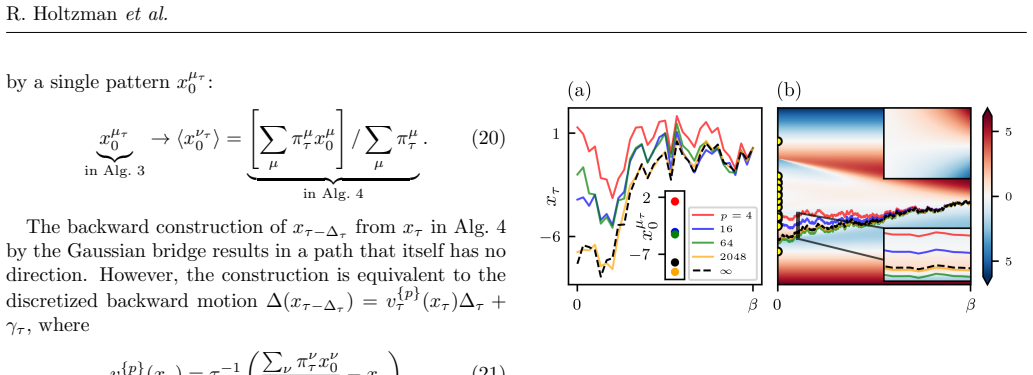
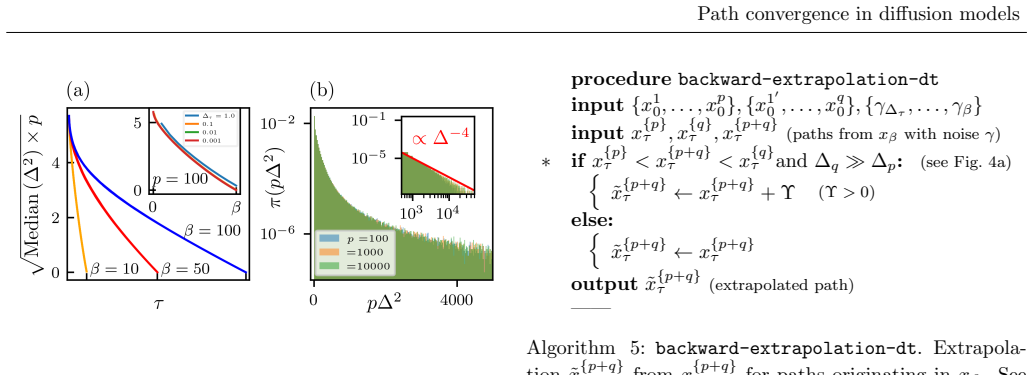
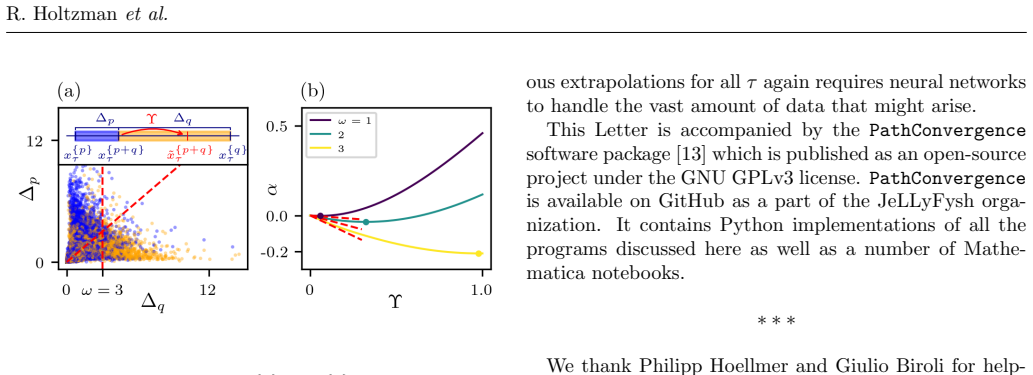
For backward paths with identical diffusion noise, the deviation from the p-equals-infinity path scales as 1/sqrt(p) in a one-dimensional test case, despite an infinite mean-square deviation; this scaling permits an extrapolation algorithm that approximates the infinite-pattern path and thereby samples the target distribution.
What carries the argument
Path convergence of backward diffusion trajectories under identical noise, whose scaling with the number of patterns p enables extrapolation to the infinite-p limit.
If this is right
- The p-equals-infinity path exactly samples the target distribution.
- Extrapolation from finite-p paths yields an approximation to the target-sampling path.
- The method supplies a concrete algorithm for density estimation from a modest number of patterns.
- The same extrapolation step offers a route to generalization beyond the supplied patterns.
Where Pith is reading between the lines
- If the scaling persists in higher dimensions, the same extrapolation could reduce the number of patterns needed for accurate sampling in practical generative models.
- The infinite mean-square deviation suggests that convergence is weak in an L2 sense yet still sufficient for pointwise or distributional extrapolation.
- The approach may connect to other finite-sample corrections used in statistical mechanics sampling methods.
Load-bearing premise
The 1/sqrt(p) convergence and extrapolation observed in the one-dimensional test case can be used as a general strategy for density estimation.
What would settle it
A direct numerical check in the one-dimensional case of whether the extrapolated path at large but finite p recovers the known target distribution to within the expected 1/sqrt(p) error.
Figures
read the original abstract
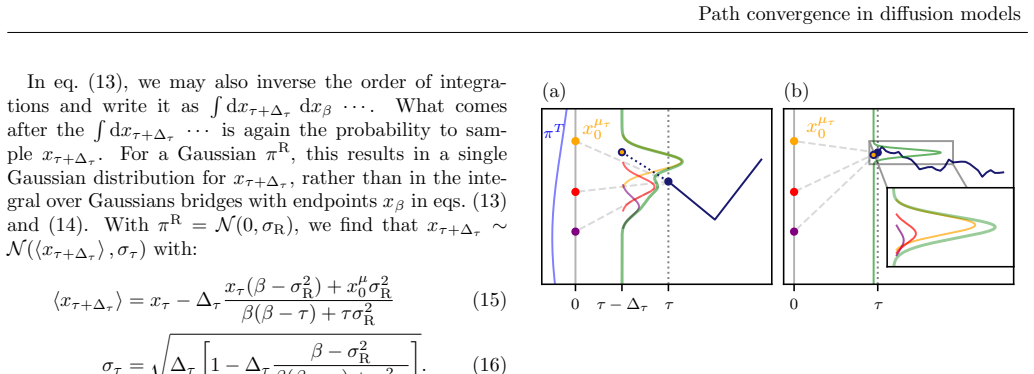
We discuss diffusion-model paths interpolating between a target distribution known only through p patterns and a reference distribution that can be sampled. These interpolating paths can be constructed symmetrically or else in forward direction (often referred to as a "noising") from the target patterns to the reference distribution or in backward direction (as a "denoising") from the reference distribution to the patterns. For backward paths with identical diffusion noise, we consider the path convergence in number of patterns p towards the path for infinitely many patterns. In a one-dimensional test case, we show that this convergence is on a scale 1/sqrt(p), but with infinite mean square deviation. We demonstrate that the path convergence allows for extrapolation towards the p=infinity path which samples the target distribution. We provide a proof-of-concept extrapolation algorithm and propose the convergence and extrapolation of paths as a possible strategy for density estimation and generalization. We illustrate all our algorithms through pseudo-codes and provide Python implementations.
Editorial analysis
A structured set of objections, weighed in public.
Referee Report
Summary. The paper analyzes diffusion-model paths interpolating between a target distribution known only through p patterns and a reference distribution. For backward paths with identical diffusion noise, it claims that in a one-dimensional test case the paths converge to the p=∞ path on a scale 1/sqrt(p) despite infinite mean square deviation. It demonstrates that this convergence permits extrapolation to the infinite-p path (which samples the target distribution), proposes the approach as a strategy for density estimation and generalization, and supplies pseudo-codes together with Python implementations.
Significance. If the 1D convergence result can be placed on a rigorous footing with an explicit mode of convergence and the extrapolation shown to be stable, the work would supply a new perspective on using path limits for density estimation in diffusion models. The provision of reproducible code is a clear strength.
major comments (1)
- [Abstract] Abstract: the claim that convergence occurs 'on a scale 1/sqrt(p)' while the mean square deviation is infinite does not identify the norm or topology in which the scaling holds. Infinite MSD precludes L2 convergence and leaves the well-posedness of the proposed extrapolation operator unclear; this ambiguity is load-bearing for the central claim that the observed convergence enables a usable density-estimation strategy.
Simulated Author's Rebuttal
We thank the referee for their detailed review and valuable feedback on our work. We address the major comment point by point below.
read point-by-point responses
-
Referee: [Abstract] Abstract: the claim that convergence occurs 'on a scale 1/sqrt(p)' while the mean square deviation is infinite does not identify the norm or topology in which the scaling holds. Infinite MSD precludes L2 convergence and leaves the well-posedness of the proposed extrapolation operator unclear; this ambiguity is load-bearing for the central claim that the observed convergence enables a usable density-estimation strategy.
Authors: We agree that the abstract does not explicitly identify the norm or topology. In the one-dimensional test case presented in the manuscript, the 1/sqrt(p) scaling is demonstrated through direct computation of path differences and numerical simulations, indicating that the typical deviation between finite-p and infinite-p paths behaves as 1/sqrt(p). The infinite mean square deviation is due to the presence of heavy-tailed fluctuations, but the convergence holds in a weaker sense, such as in probability. The extrapolation algorithm is constructed based on this scaling and is shown to be effective in our proof-of-concept examples for density estimation. We will revise the abstract to clarify the observed mode of convergence and add discussion on the well-posedness of the extrapolation based on the numerical evidence provided. revision: yes
Circularity Check
No significant circularity detected.
full rationale
The paper's central result is a direct numerical/analytical demonstration of path convergence scaling in a one-dimensional test case, together with an extrapolation algorithm. No equations or claims reduce by construction to fitted parameters, self-definitions, or load-bearing self-citations; the 1/sqrt(p) observation and infinite-MSD statement are presented as outcomes of the test case rather than tautological renamings or imported uniqueness theorems. The derivation chain is therefore self-contained against external benchmarks.
Axiom & Free-Parameter Ledger
axioms (2)
- domain assumption Target distribution known only through p patterns; reference distribution can be sampled.
- domain assumption Paths constructed symmetrically or in forward/backward directions with identical diffusion noise for backward case.
Reference graph
Works this paper leans on
-
[1]
W., Rosenbluth M
Metropolis N., Rosenbluth A. W., Rosenbluth M. N., Teller A. H. Teller E. J. Chem. Phys. 21 1953 1087
1953
-
[2]
Binder K
Landau D. Binder K. A guide to Monte Carlo Simulations in Statistical Physics (Cambridge University Press) 2013. ://books.google.de/books?id=hrIhAwAAQBAJ
2013
-
[3]
A., Peres Y
Levin D. A., Peres Y. Wilmer E. L. Markov Chains and Mixing Times (American Mathematical Society) 2008
2008
-
[4]
Statistical Mechanics: Algorithms and Computations (Oxford University Press) 2006
Krauth W. Statistical Mechanics: Algorithms and Computations (Oxford University Press) 2006
2006
-
[5]
All of Statistics (Springer, New York) 2004
Wasserman L. All of Statistics (Springer, New York) 2004. ://doi.org/10.1007/978-0-387-21736-9
-
[6]
All of Nonparametric Statistics (Springer, New York) 2006
Wasserman L. All of Nonparametric Statistics (Springer, New York) 2006
2006
-
[7]
Ganguli S
Sohl-Dickstein J., Weiss E., Maheswaranathan N. Ganguli S. Deep Unsupervised Learning using Nonequilibrium Thermodynamics in proc. of Proceedings of the 32nd International Conference on Machine Learning , edited by Bach F. Blei D. Vol. 37 of Proceedings of Machine Learning Research (PMLR, Lille, France) 2015 pp. 2256--2265
2015
-
[8]
Abbeel P
Ho J., Jain A. Abbeel P. presented at Advances in Neural Information Processing Systems
-
[9]
P., Kumar A., Ermon S
Song Y., Sohl-Dickstein J., Kingma D. P., Kumar A., Ermon S. Poole B. Score-based generative modeling through stochastic differential equations presented at International Conference on Learning Representations 2021
2021
-
[10]
Song Y. Ermon S. Generative modeling by estimating gradients of the data distribution presented at Advances in Neural Information Processing Systems Vol. 32 2019
2019
-
[11]
Feynman R. P. Statistical mechanics: a set of lectures Frontiers in physics (W. A. Benjamin, Reading, Massachusetts.) 1972
1972
-
[12]
Ceperley D. M. Rev. Mod. Phys. 67 1995 279–355 . ://dx.doi.org/10.1103/RevModPhys.67.279
-
[13]
Krauth W
Holtzman R., Beauvallet R. Krauth W. PathConvergence software package https://github.com/jellyfysh/PathConvergence.git (2026)
2026
-
[14]
L \'e vy P. Compos. Math. 7 1939 283
1939
-
[15]
Hyv \"a rinen A. Dayan P. J. Mach. Learn. Res. 6 2005
2005
-
[16]
Neural Comput
Vincent P. Neural Comput. 23 2011 1661
2011
-
[17]
Propp J. G. Wilson D. B. Random Structures & Algorithms 9 1996 223
1996
-
[18]
Krauth W
Holtzman R., Beauvallet R. Krauth W. Manuscript in preparation (2026)
2026
-
[19]
Albergo M., Boffi N. M. Vanden-Eijnden E. J. Mach. Learn. Res. 26 2025 1
2025
-
[20]
Zhang K., Yin H., Liang F. Liu J. Minimax optimality of score-based diffusion models: Beyond the density lower bound assumptions in proc. of Proceedings of the 41st International Conference on Machine Learning (PMLR) 2024 pp. 60134--60178
2024
-
[21]
Chen S., Chewi S., Li J., Li Y., Salim A. Zhang A. Sampling is as easy as learning the score: theory for diffusion models with minimal data assumptions presented at NeurIPS 2022 Workshop on Score-Based Methods 2022
2022
-
[22]
Suzuki T
Oko K., Akiyama S. Suzuki T. Diffusion models are minimax optimal distribution estimators in proc. of Proceedings of the 40th International Conference on Machine Learning Vol. 202 of Proceedings of Machine Learning Research (PMLR) 2023 pp. 26517--26582
2023
-
[23]
M \'e zard M
Biroli G. M \'e zard M. SIAM Journal on Mathematics of Data Science 8 2026 46
2026
- [24]
discussion (0)
Sign in with ORCID, Apple, or X to comment. Anyone can read and Pith papers without signing in.