Fabricating fiber cavity mirror substrates compatible with high coupling efficiency
Pith reviewed 2026-06-27 08:41 UTC · model grok-4.3
The pith
Back-reflection measurement on cleaved fiber tips pre-selects substrates that retain 95.3-99.2% mode matching after CO2 laser ablation.
A machine-rendered reading of the paper's core claim, the machinery that carries it, and where it could break.
Core claim
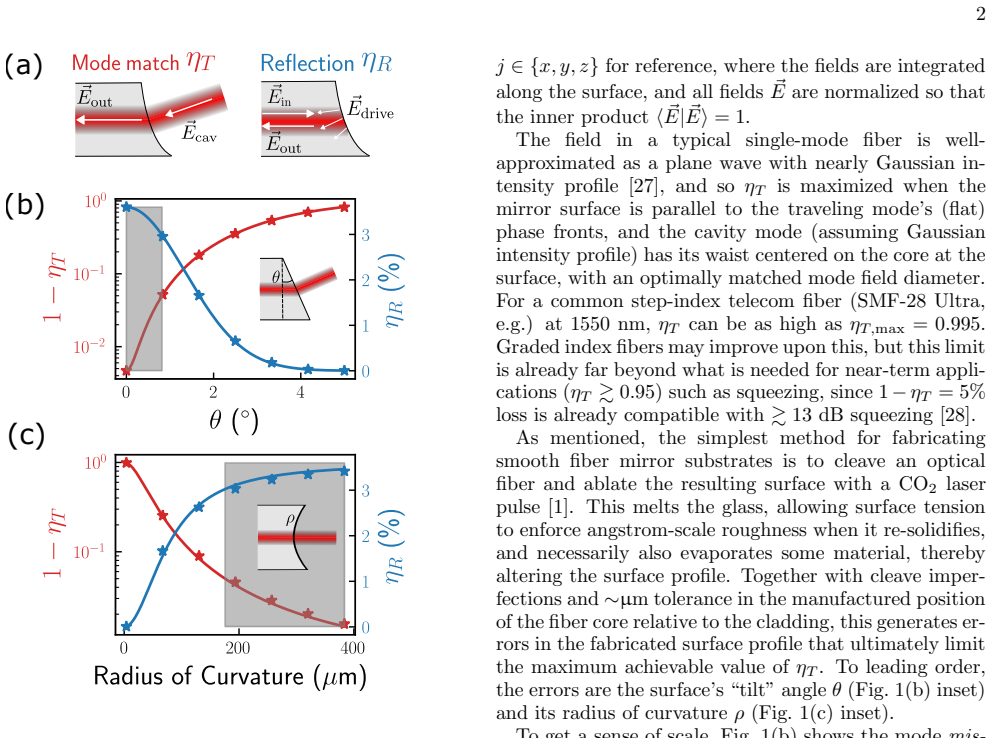
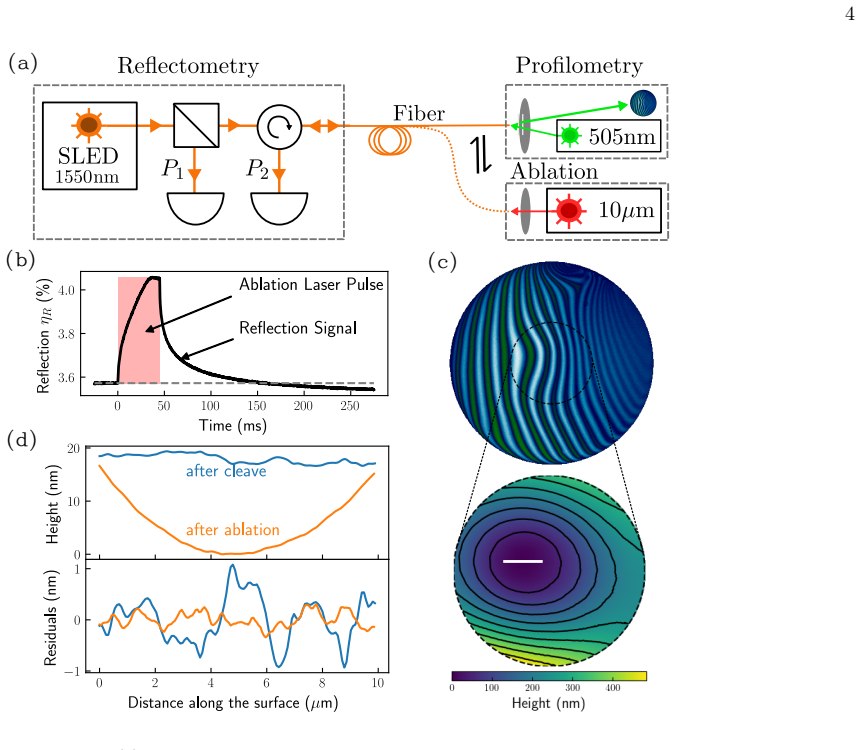
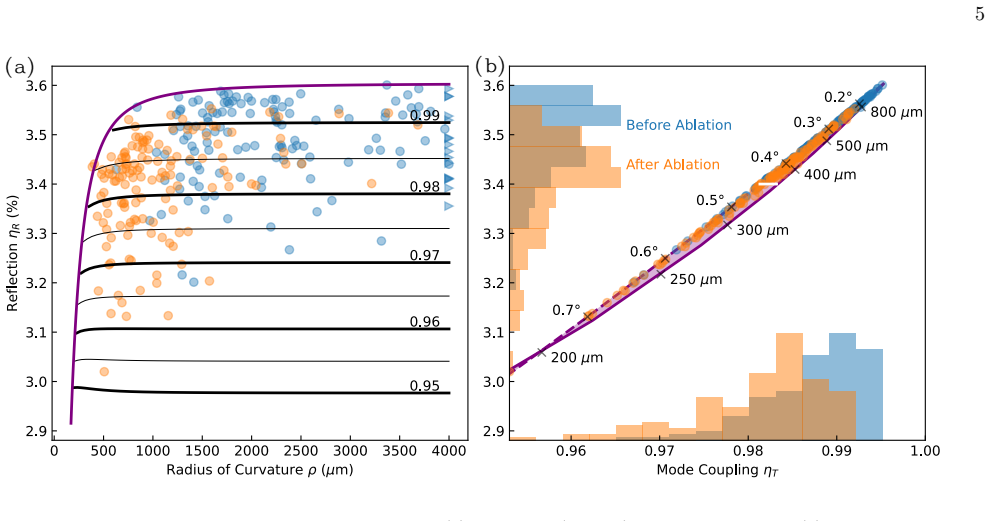
By measuring the back-reflection from freshly cleaved fiber tips, the authors pre-select 138 fibers compatible with 96.5-99.5% mode matching, and after a single CO2 laser ablation pulse, these fibers remained compatible with 95.3-99.2%. This in situ reflectometry constrains the achievable mode matching prior to coating and provides rapid feedback during each stage of substrate fabrication.
What carries the argument
Back-reflection measurement from freshly cleaved fiber tips, serving as an in situ predictor of post-ablation surface profile and mode matching.
If this is right
- Pre-selection raises the fraction of fibers that meet high mode-matching criteria after ablation.
- Fewer fibers reach the coating stage only to be discarded, cutting wasted coating runs.
- Rapid feedback at the cleaved and ablated stages improves overall yield of usable fiber mirror substrates.
- The method integrates with existing single-pulse CO2 ablation without added process steps.
Where Pith is reading between the lines
- The same cleaved-tip check could be applied to other fiber-shaping methods to test whether it remains predictive.
- Higher mode-matching yields may support fiber-cavity experiments that require stronger light-matter coupling than current substrates allow.
- If the predictor proves stable across fiber batches, it could become a standard early gate in cavity fabrication workflows.
Load-bearing premise
The back-reflection from a freshly cleaved fiber tip reliably forecasts the mode matching that will result after the CO2 laser ablation step.
What would settle it
Finding that a large fraction of the pre-selected fibers drop below 95% mode matching after ablation would show the cleaved-tip measurement does not predict post-ablation performance.
Figures
read the original abstract
Fiber optical cavities offer small mode volumes and correspondingly strong light-matter interactions in an open Fabry-Perot geometry. However, existing fabrication techniques do not reliably produce substrates with surface profiles amenable to high mode matching between the cavity mode and fiber core, thereby limiting the achievable collection efficiency. Here we present a technique to fabricate fiber mirror substrates while using $\textit{in situ}$ reflectometry to constrain the achievable mode matching prior to coating. By measuring the back-reflection from freshly cleaved fiber tips, we pre-select 138 fibers compatible with 96.5-99.5% mode matching, and after a single CO$_2$ laser ablation pulse, these fibers remained compatible with 95.3-99.2\%. This simple technique provides rapid feedback during each stage of substrate fabrication, greatly enhancing the yield of viable fiber mirror substrates prior to (expensive) coating runs.
Editorial analysis
A structured set of objections, weighed in public.
Referee Report
Summary. The manuscript presents a fabrication technique for fiber cavity mirror substrates that employs in situ reflectometry on freshly cleaved fiber tips to pre-select fibers expected to achieve high mode matching efficiencies of 96.5-99.5%. After applying a single CO2 laser ablation pulse to 138 such pre-selected fibers, the mode matching remained high at 95.3-99.2%, demonstrating the method's potential to enhance yield prior to expensive coating processes.
Significance. Should the predictive validity of the cleaved-tip reflectometry hold, this work provides a straightforward and rapid feedback mechanism during substrate fabrication, which could substantially improve the production of high-coupling-efficiency fiber mirrors for open Fabry-Perot cavities in quantum optics and related fields. The direct empirical measurements on a large sample of 138 fibers lend concrete support to the reported yield.
major comments (1)
- [Results section describing the pre-selection and post-ablation measurements] The manuscript's central claim that back-reflection measurements on cleaved tips allow pre-selection of fibers compatible with high mode matching relies on the assumption that this metric reliably forecasts the post-ablation surface profile. However, only the post-ablation performance of the selected fibers is reported (95.3-99.2%); no correlation between pre-ablation back-reflection values and post-ablation mode-matching efficiencies is presented, nor are surface profile comparisons or a control cohort of non-selected fibers included. This omission leaves the predictive power unconfirmed and is load-bearing for the technique's claimed advantage.
minor comments (1)
- [Abstract] The range of mode matching percentages is given, but without accompanying uncertainties or details on how these values were derived from the reflectometry data.
Simulated Author's Rebuttal
We thank the referee for their positive evaluation of the work's significance and for the detailed feedback. We address the major comment below.
read point-by-point responses
-
Referee: [Results section describing the pre-selection and post-ablation measurements] The manuscript's central claim that back-reflection measurements on cleaved tips allow pre-selection of fibers compatible with high mode matching relies on the assumption that this metric reliably forecasts the post-ablation surface profile. However, only the post-ablation performance of the selected fibers is reported (95.3-99.2%); no correlation between pre-ablation back-reflection values and post-ablation mode-matching efficiencies is presented, nor are surface profile comparisons or a control cohort of non-selected fibers included. This omission leaves the predictive power unconfirmed and is load-bearing for the technique's claimed advantage.
Authors: We agree that an explicit correlation between the pre-ablation back-reflection values and post-ablation mode-matching efficiencies would provide a more direct demonstration of predictive validity. The pre-selection threshold is based on a calibrated relationship between measured back-reflection from the cleaved tip and the expected mode-matching efficiency derived from the surface geometry. The reported results show that this threshold successfully identifies fibers whose mode matching remains high (95.3-99.2%) after ablation, confirming the practical utility of the method. To address the point, we will add to the revised manuscript a supplementary figure displaying the pre-ablation back-reflection values for the 138 fibers alongside their post-ablation mode-matching efficiencies, thereby making the correlation explicit. Mode-matching values are computed directly from measured surface profiles both before and after ablation; we will clarify this calculation and its link to the reflectometry metric in the text. A control cohort of non-selected fibers was outside the scope of the present study, which focused on yield improvement via pre-selection, but we can reference prior measurements on unselected fibers for context. revision: yes
Circularity Check
No circularity; purely experimental measurements with no derivations or self-referential predictions
full rationale
The paper reports an experimental fabrication process: back-reflection measurements on cleaved fiber tips are used to pre-select fibers, followed by CO2 ablation and post-ablation mode-matching checks. No equations, fitted parameters, predictions derived from models, or self-citations of uniqueness theorems appear in the provided text. The central claim rests on direct empirical data (pre- and post-ablation mode-matching percentages for 138 fibers), with no reduction of any result to its own inputs by construction. This matches the default expectation of no circularity for measurement-based work.
Axiom & Free-Parameter Ledger
Reference graph
Works this paper leans on
-
[1]
Hunger, T
D. Hunger, T. Steinmetz, Y. Colombe, C. Deutsch, T. W. H¨ ansch, and J. Reichel, A fiber Fabry–Perot cavity with high finesse, New J. Phys.12, 065038 (2010)
2010
-
[2]
Pfeifer, L
H. Pfeifer, L. Ratschbacher, J. Gallego, C. Saavedra, A. Faßbender, A. von Haaren, W. Alt, S. Hofferberth, M. K¨ ohl, S. Linden, and D. Meschede, Achievements and perspectives of optical fiber Fabry–Perot cavities, Ap- plied Physics B128, 29 (2022)
2022
-
[3]
Benedikter, T
J. Benedikter, T. H¨ ummer, M. Mader, B. Schled- erer, J. Reichel, T. W. H¨ ansch, and D. Hunger, Transverse-mode coupling and diffraction loss in tunable Fabry–P´ erot microcavities, New Journal of Physics17, 053051 (2015)
2015
-
[4]
J. Volz, R. Gehr, G. Dubois, J. Est` eve, and J. Reichel, Measurement of the internal state of a single atom with- out energy exchange, Nature475, 210 (2011)
2011
-
[5]
C. Monroe, Large-scale modular quantum-computer architecture with atomic memory and photonic in- terconnects, Physical Review A89, 10.1103/Phys- RevA.89.022317 (2014)
-
[6]
Brekenfeld, D
M. Brekenfeld, D. Niemietz, J. D. Christesen, and G. Rempe, A quantum network node with crossed op- tical fibre cavities, Nature Physics16, 647 (2020)
2020
-
[7]
Niemietz, P
D. Niemietz, P. Farrera, S. Langenfeld, and G. Rempe, Nondestructive detection of photonic qubits, Nature591, 570 (2021)
2021
-
[8]
Awschalom, K
D. Awschalom, K. K. Berggren, H. Bernien, S. Bhave, L. D. Carr, P. Davids, S. E. Economou, D. Englund, A. Faraon, M. Fejer, S. Guha, M. V. Gustafsson, E. Hu, L. Jiang, J. Kim, B. Korzh, P. Kumar, P. G. Kwiat, M. Lonˇ car, M. D. Lukin, D. A. Miller, C. Monroe, S. W. Nam, P. Narang, J. S. Orcutt, M. G. Raymer, A. H. Safavi-Naeini, M. Spiropulu, K. Srinivasa...
2021
-
[9]
J. P. Covey, H. Weinfurter, and H. Bernien, Quantum networks with neutral atom processing nodes, npj Quan- tum Information9, 90 (2023)
2023
-
[10]
Wagner, F
R. Wagner, F. Guzman, A. Chijioke, G. K. Gulati, M. Keller, and G. Shaw, Direct measurement of radia- 8 tion pressure and circulating power inside a passive op- tical cavity, Optics Express26, 23492 (2018)
2018
-
[11]
Gallego, W
J. Gallego, W. Alt, T. Macha, M. Martinez-Dorantes, D. Pandey, and D. Meschede, Strong Purcell Effect on a Neutral Atom Trapped in an Open Fiber Cavity, Physical Review Letters121, 173603 (2018)
2018
-
[12]
Fernandez-Gonzalvo and M
X. Fernandez-Gonzalvo and M. Keller, A fully fiber- integrated ion trap for portable quantum technologies, Scientific Reports13, 523 (2023)
2023
-
[13]
Zifkin, C
R. Zifkin, C. D. Rodr´ ıguez Rosenblueth, E. Janitz, Y. Fontana, and L. Childress, Lifetime Reduction of Sin- gle Germanium-Vacancy Centers in Diamond via a Tun- able Open Microcavity, PRX Quantum5, 030308 (2024)
2024
-
[14]
J. J. Hansen, S. Minniberger, D. Ilk, P. Asenbaum, G. Higgins, R. G. Povey, P. Schmidt, J. Hofer, R. Claessen, M. Aspelmeyer, and M. Trupke, Optical In- terferometric Readout of a Magnetically Levitated Su- perconducting Microsphere (2025)
2025
-
[15]
Brieussel, K
A. Brieussel, K. Ott, M. Joos, N. Treps, and C. Fabre, Toward a compact fibered squeezing parametric source, Optics Letters43, 1267 (2018)
2018
-
[16]
Takanashi, W
N. Takanashi, W. Inokuchi, T. Serikawa, and A. Furu- sawa, Generation and measurement of a squeezed vac- uum up to 100 MHz at 1550 nm with a semi-monolithic optical parametric oscillator designed towards direct cou- pling with waveguide modules, Optics Express27, 18900 (2019)
2019
-
[17]
Takanashi, T
N. Takanashi, T. Kashiwazaki, T. Kazama, K. Enbutsu, R. Kasahara, T. Umeki, and A. Furusawa, 4-dB Quadra- ture Squeezing With Fiber-Coupled PPLN Ridge Waveg- uide Module, IEEE Journal of Quantum Electronics56, 1 (2020)
2020
-
[18]
McGarry, K
C. McGarry, K. Harrington, A. O. C. Davis, P. J. Mosley, and K. R. Rusimova, Microstructured optical fibers for quantum applications: Perspective, APL Quantum1, 030901 (2024)
2024
-
[19]
A. A. Clerk, M. H. Devoret, S. M. Girvin, F. Marquardt, and R. J. Schoelkopf, Introduction to quantum noise, measurement, and amplification, Rev. Mod. Phys.82, 1155 (2010)
2010
-
[20]
Gallego, S
J. Gallego, S. Ghosh, S. K. Alavi, W. Alt, M. Martinez- Dorantes, D. Meschede, and L. Ratschbacher, High- finesse fiber Fabry–Perot cavities: stabilization and mode matching analysis, Applied Physics B122, 47 (2016)
2016
-
[21]
Garcia, F
S. Garcia, F. Ferri, K. Ott, J. Reichel, and R. Long, Dual- wavelength fiber Fabry-Perot cavities with engineered birefringence, Optics Express26, 22249 (2018)
2018
-
[22]
Ruelle, M
T. Ruelle, M. Poggio, and F. Braakman, Optimized single-shot laser ablation of concave mirror templates on optical fibers, Applied Optics58, 3784 (2019)
2019
-
[23]
S. Gao, V. Kavungal, S. Oya, D. Okuno, E. Kassa, W. J. Hughes, P. Horak, and H. Takahashi, Profile control of fiber-based micro-mirrors using adaptive laser shooting within situimaging, Optics Express33, 39009 (2025)
2025
-
[24]
K. Ott, S. Garcia, R. Kohlhaas, K. Sch¨ uppert, P. Rosen- busch, R. Long, and J. Reichel, Millimeter-long fiber Fabry-Perot cavities, Optics Express24, 9839 (2016)
2016
-
[25]
G. K. Gulati, H. Takahashi, N. Podoliak, P. Horak, and M. Keller, Fiber cavities with integrated mode matching optics, Scientific Reports7, 5556 (2017)
2017
-
[26]
W. Wang, W. Zhu, A. Agrawal, and J. W. Britton, Coupling a Fabry-P´ erot Cavity to a Single-Mode Op- tical Fiber Using a Metalens (2025), arXiv:2506.03626 [physics]
arXiv 2025
-
[27]
Saleh and M
B. Saleh and M. Teich,Fundamentals of Photonics, 3rd Edition(2019)
2019
-
[28]
Bachor and T
H.-A. Bachor and T. Ralph,A Guide to Experiments in Quantum Optics, 2nd, Revised and Enlarged Edition (2004)
2004
-
[29]
W. B. Joyce and B. C. DeLoach, Alignment of Gaussian beams, Applied Optics, Vol. 23, Issue 23, pp. 4187-4196 10.1364/AO.23.004187 (1984)
-
[30]
M. A. Henri, Mirau Patent Interferometer (1952)
1952
-
[31]
Wu and F
D. Wu and F. Fang, Development of surface reconstruc- tion algorithms for optical interferometric measurement, Frontiers of Mechanical Engineering16, 1 (2021)
2021
-
[32]
P. J. Bustard, R. Tannous, K. Bonsma-Fisher, D. Poitras, C. Hnatovsky, S. J. Mihailov, D. England, and B. J. Suss- man, Toward deterministic sources: Photon generation in a fiber-cavity quantum memory, Physical Review A109, 013711 (2024)
2024
-
[33]
C. Bond, P. Fulda, L. Carbone, K. Kokeyama, and A. Freise, Higher order Laguerre-Gauss mode degener- acy in realistic, high finesse cavities, Physical Review D 84, 102002 (2011)
2011
-
[34]
Sivia and J
D. Sivia and J. Skilling,Data Analysis: A Bayesian Tu- torial, second edition, second edition ed. (Oxford Univer- sity Press, Oxford, New York, 2006)
2006
-
[35]
D. Foreman-Mackey, D. W. Hogg, D. Lang, and J. Good- man, emcee: The MCMC Hammer, Publications of the Astronomical Society of the Pacific125, 306 (2013), arXiv:1202.3665 [astro-ph.IM]
Pith/arXiv arXiv 2013
discussion (0)
Sign in with ORCID, Apple, or X to comment. Anyone can read and Pith papers without signing in.