REVIEW 2 major objections 2 minor 24 references
On-Chip Quantum Randomness Amplification
T0 review · 2 major / 2 minor · reviewed 2026-06-27 · grok-4.3
Pith's one-line read Silicon photonic chip performs first semi-device-independent randomness amplification at 20 Mbps with tighter entropy bounds.
desk verdict The paper reports the first on-chip SDI randomness amplification at 20 Mbps with a new entropy certification method, but the central energy bounds remain unspecified in the abstract. read the letter →
The pith
A machine-rendered reading of the paper's core claim, the machinery that carries it, and where it could break.
The reading
What carries the argument
The novel technique for SDI entropy certification that produces strictly tighter von Neumann entropy bounds.
What would settle it
An experiment in which the measured min-entropy or extractable randomness falls below the new certified bound or fails to reach 20 Mbps under the stated energy constraints.
Extended reading notes
Core claim
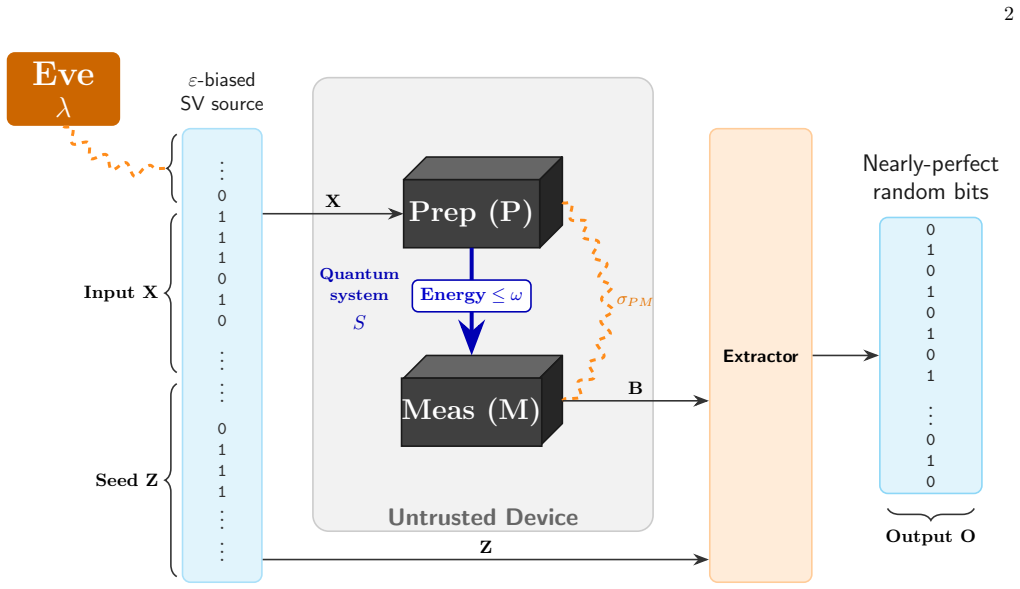
The authors establish the first experimental realization of SDI randomness amplification on a silicon photonic chip, reaching 20 Mbps throughput through a novel entropy certification technique that supplies strictly tighter von Neumann entropy bounds than existing approaches while remaining valid under shared quantum correlations between devices.
Load-bearing premise
Security depends on the devices obeying bounds on the energy they consume.
Editorial extensions
If this is right
- SDI randomness amplification becomes feasible inside compact, integrable photonic circuits rather than free-space or bulk-optic setups.
- The protocol supplies private random bits at rates high enough for real-time cryptographic applications.
- Security guarantees hold without assuming full device independence and without requiring the devices to be isolated from each other.
- The same certification method can be applied to other SDI tasks that rely on entropy lower bounds.
Reading between the lines
- Chip-scale implementations could allow quantum random number generators to be embedded directly in consumer telecom modules.
- Tighter entropy bounds may raise the secure key rate in related quantum key distribution protocols that use similar SDI assumptions.
- Compatibility with silicon fabrication suggests the approach can be scaled using existing semiconductor foundry processes.
- The energy-bound assumption could be enforced on-chip through calibrated power monitoring circuits.
Editorial analysis
A structured set of objections, weighed in public.
Referee Report
Summary. The manuscript reports the first experimental demonstration of semi-device-independent (SDI) randomness amplification on an integrated silicon photonic chip. It achieves a 20 Mbps throughput using a novel entropy certification technique claimed to yield strictly tighter von Neumann entropy bounds than prior methods, with the bounds remaining valid even under shared quantum correlations between preparation and measurement devices. Security rests on natural assumptions including explicit bounds on device energy consumption.
Significance. If the experimental results and security reduction hold, the work would be significant for enabling practical, high-rate SDI randomness sources in portable telecom hardware, addressing the integration challenges of device-independent protocols while maintaining security under minimal assumptions.
major comments (2)
- [Security analysis] Security analysis (energy bounds subsection): the SDI security reduction is stated to require explicit bounds on device energy consumption, yet no numerical values for these bounds, no calibration procedure, and no description of on-chip enforcement or measurement are supplied; this is load-bearing for confirming that the physical devices satisfy the premise of the tighter entropy bounds and shared-correlation robustness.
- [Results] Results section (entropy bound comparison): the claim of 'strictly tighter' von Neumann entropy bounds is presented without an explicit side-by-side derivation or table comparing the new certification method to the prior SDI bounds (e.g., via the relevant min-entropy or von Neumann expressions), making it impossible to verify the improvement factor or its dependence on the energy bound parameter.
minor comments (2)
- [Abstract] The abstract states a 20 Mbps rate 'suitable for practical applications' but does not indicate the raw data rate, post-processing overhead, or duty cycle; a brief clarification in the methods would aid reproducibility.
- [Methods] Notation for the energy bound parameter (e.g., E_max) should be introduced consistently in the security model and then referenced in the experimental characterization.
Simulated Author's Rebuttal
We thank the referee for their careful reading and positive assessment of the significance of our work. We address each major comment below and will revise the manuscript to incorporate the requested clarifications.
read point-by-point responses
-
Referee: [Security analysis] Security analysis (energy bounds subsection): the SDI security reduction is stated to require explicit bounds on device energy consumption, yet no numerical values for these bounds, no calibration procedure, and no description of on-chip enforcement or measurement are supplied; this is load-bearing for confirming that the physical devices satisfy the premise of the tighter entropy bounds and shared-correlation robustness.
Authors: We agree that explicit numerical values, calibration procedures, and on-chip enforcement details are necessary to fully substantiate the security reduction. The current manuscript states the energy bounds as a modeling assumption but does not provide the supporting experimental details. In the revised manuscript we will add a new subsection (Security Analysis, Energy Bounds) that reports the specific numerical energy consumption bounds measured for the silicon photonic chip (in pJ per pulse), describes the calibration procedure using integrated photodetectors and standard lab power meters, and explains the on-chip enforcement via bias monitoring circuits. These additions will confirm that the devices satisfy the premises of the tighter entropy bounds and shared-correlation robustness. revision: yes
-
Referee: [Results] Results section (entropy bound comparison): the claim of 'strictly tighter' von Neumann entropy bounds is presented without an explicit side-by-side derivation or table comparing the new certification method to the prior SDI bounds (e.g., via the relevant min-entropy or von Neumann expressions), making it impossible to verify the improvement factor or its dependence on the energy bound parameter.
Authors: We acknowledge that the main text presents the claim of strictly tighter bounds without a direct comparative table or derivation. While the analytic improvement is derived in the Methods and Supplementary Information, an explicit side-by-side comparison is indeed absent from the Results section. In the revised manuscript we will insert a new table (Table 2) in the Results section that lists the von Neumann entropy lower bounds obtained with our certification method versus the prior SDI bounds, parameterized by the energy bound. The table will also include the corresponding min-entropy expressions and the numerical improvement factor as a function of the energy parameter, allowing direct verification of the strict improvement. revision: yes
Circularity Check
No significant circularity; experimental demonstration with independent content
full rationale
The paper reports an experimental demonstration of SDI randomness amplification on a silicon photonic chip, achieving 20 Mbps throughput via a novel entropy certification technique that provides tighter von Neumann bounds. The abstract and available text contain no derivation chain, equations, or self-citations that reduce a claimed prediction or result to fitted inputs or prior self-work by construction. Security assumptions (e.g., energy bounds) are invoked as external premises but are not shown to be self-defined or load-bearing in a circular manner within the provided content. This is a standard experimental result with independent empirical content against external benchmarks.
Assumptions & free parameters
assumptions (1)
- domain assumption Security holds under bounds on the energy used by the preparation and measurement devices
Cite this review
Pith. "Pith review of On-Chip Quantum Randomness Amplification." pith.science (2026). https://pith.science/paper/LWY6N3JI
@misc{pith2026260612173,
  author       = {Pith},
  title        = {Pith review of: On-Chip Quantum Randomness Amplification},
  year         = {2026},
  howpublished = {\url{https://pith.science/paper/LWY6N3JI}},
  note         = {Machine review of arXiv:2606.12173}
}
read the original abstract
Randomness amplification, the task of extracting uniform private bits from biased seeds that may be partly known by a malicious third party, is of central importance in cryptography. The highest security in this task is provided by a class of quantum protocols known as device-independent, which however are challenging to integrate into scalable devices. Semi-device-independent (SDI) protocols are a promising alternative that guarantees security under few natural assumptions, such as bounds on the amount of energy used by the devices. Here, we provide the first demonstration of SDI randomness amplification on an integrated silicon photonic chip, achieving a throughput rate of 20 Mbps suitable for practical applications. This rate is achieved through a novel technique for SDI entropy certification, which delivers strictly tighter von Neumann entropy bounds compared to existing methods and remains valid even if the preparation and measurement devices share quantum correlations. Overall, the methods developed in this work enable the integration of SDI technology into portable telecom devices, opening up a new generation of quantum cryptographic hardware.
Figures


Figures from the paper (9 more)


Reference graph
Works this paper leans on
-
[1]
J., Garc´ ıa-Patr´ on, R., and Pironio, S
Van Himbeeck, T., Woodhead, E., Cerf, N. J., Garc´ ıa-Patr´ on, R., and Pironio, S. (2017).Semi-device-independent frame- work based on natural physical assumptions.Quantum, 1, 33
2017
-
[2]
(2021).Semi-device-independent full randomness amplification based on energy bounds
Senno, G., and Ac´ ın, A. (2021).Semi-device-independent full randomness amplification based on energy bounds. arXiv:2108.09100
-
[3]
Shannon, C. E. (1948).A mathematical theory of communication.The Bell system technical journal, 27(3), 379-423
1948
-
[4]
(2009).The operational meaning of min-and max-entropy.IEEE Transactions on Information theory, 55(9), 4337-4347
Konig, R., Renner, R., and Schaffner, C. (2009).The operational meaning of min-and max-entropy.IEEE Transactions on Information theory, 55(9), 4337-4347
2009
-
[5]
(2008).Security of quantum key distribution
Renner, R. (2008).Security of quantum key distribution. International Journal of Quantum Information, 6(01), 1-127
2008
-
[6]
(2009).A fully quantum asymptotic equipartition property.IEEE Transactions on information theory, 55(12), 5840-5847
Tomamichel, M., Colbeck, R., and Renner, R. (2009).A fully quantum asymptotic equipartition property.IEEE Transactions on information theory, 55(12), 5840-5847
2009
-
[7]
(1927).Thermodynamik quantenmechanischer gesamtheiten.Nachrichten von der Gesellschaft der Wis- senschaften zu G¨ ottingen, Mathematisch-Physikalische Klasse, 1927, 273-291
Von Neumann, J. (1927).Thermodynamik quantenmechanischer gesamtheiten.Nachrichten von der Gesellschaft der Wis- senschaften zu G¨ ottingen, Mathematisch-Physikalische Klasse, 1927, 273-291
1927
-
[8]
(2004).Orthogonal polynomials: computation and approximation
Gautschi, W. (2004).Orthogonal polynomials: computation and approximation
2004
Show all 24 references
-
[9]
Gottlieb, D., and Orszag, S. A. (1977).Numerical analysis of spectral methods: theory and applications.Society for Industrial and applied mathematics
1977
-
[10]
(2011).Calculus of variations and optimal control theory: a concise introduction
Liberzon, D. (2011).Calculus of variations and optimal control theory: a concise introduction
2011
-
[11]
(2025).Entanglement in the energy-constrained prepare-and-measure scenario: applications to randomness certification and channel discrimination.arXiv:2510.27559
D’Avino, R., Senno, G., Alimuddin, M., and Ac´ ın, A. (2025).Entanglement in the energy-constrained prepare-and-measure scenario: applications to randomness certification and channel discrimination.arXiv:2510.27559
2025
-
[12]
Foreman, C., Yeung, R., Edgington, A., and Curchod, F. J. (2025).Cryptomite: A versatile and user-friendly library of randomness extractors.Quantum, 9, 1584
2025
-
[13]
Cherchiet al.,Supporting quantum technologies with an ultralow-loss silicon photonics platform, Advanced Photonics Nexus2(2), 024002 (2023)
M. Cherchiet al.,Supporting quantum technologies with an ultralow-loss silicon photonics platform, Advanced Photonics Nexus2(2), 024002 (2023)
2023
-
[14]
Xuet al.,On-chip input-hidden-layer-degenerate optical diffractive nonlinear neural network, Optica13(1), 172 (2026)
W. Xuet al.,On-chip input-hidden-layer-degenerate optical diffractive nonlinear neural network, Optica13(1), 172 (2026)
2026
-
[15]
Belogolovskiiet al.,Dynamics of nonlinear optical losses in silicon-rich nitride nano-waveguides, Advanced Optical Materials12(32), 2401299 (2024)
E. Belogolovskiiet al.,Dynamics of nonlinear optical losses in silicon-rich nitride nano-waveguides, Advanced Optical Materials12(32), 2401299 (2024)
2024
-
[16]
Xiaoet al.,Recent progress in silicon-based photonic integrated circuits and emerging applications, Advanced Optical Materials11(20), 2301028 (2023)
H. Xiaoet al.,Recent progress in silicon-based photonic integrated circuits and emerging applications, Advanced Optical Materials11(20), 2301028 (2023)
2023
-
[17]
D., Premaratne, M., and Agrawal, G
Rukhlenko, I. D., Premaratne, M., and Agrawal, G. P.,et al.,Nonlinear silicon photonics: Analytical tools, IEEE Journal of Selected Topics in Quantum Electronics16(1), 200-215 (2009)
2009
-
[18]
Chanana, A., Larocque, H., Moreira, R.,et al.,Ultra-low-loss quantum photonic circuits integrated with single quantum emitters, Nature Communications13(1), 7693 (2022)
2022
-
[19]
Cherchiet al.,An unconventional ultra-low-loss silicon photonics platform for quantum technologies, In Quantum 2.0 (pp
M. Cherchiet al.,An unconventional ultra-low-loss silicon photonics platform for quantum technologies, In Quantum 2.0 (pp. QW4A-5). Optica Publishing Group(2022, June)
2022
-
[20]
Luo, W., Cao, L., Shi, Y.,et al.,Recent progress in quantum photonic chips for quantum communication and internet, Light: Science & Applications12(1), 175 (2023)
2023
-
[21]
Jia, Y., Wang, X., Hu, X.,et al.,Silicon-photonics-integrated time-domain balanced homodyne detector for quantum to- mography and quantum key distribution, New Journal of Physics25(10), 103001 (2023)
2023
-
[22]
Raffaelliet al.,A homodyne detector integrated onto a photonic chip for measuring quantum states and generating random numbers, Quantum Science and Technology3(2), 025003 (2018)
F. Raffaelliet al.,A homodyne detector integrated onto a photonic chip for measuring quantum states and generating random numbers, Quantum Science and Technology3(2), 025003 (2018)
2018
-
[23]
Zhang, G.,et al.,Integrated photonic platform with high-speed entanglement generation and witnessing, Optica12(11), 1737 (2025). 42
2025
-
[24]
Shekhar, S., Bogaerts, W., Chrostowski, L.,et al.,Roadmapping the next generation of silicon photonics, Nature Commu- nications15(1), 751 (2024)
2024
Reviewed June 27, 2026 · model on record in the stance chip above.
Discussion (0). Sign in to comment.