Effect of polar distortions on the anomalous Hall conductivity of altermagnetic α-MnTe
Pith reviewed 2026-06-27 08:59 UTC · model grok-4.3
The pith
Polar lattice distortions substantially modify the anomalous Hall conductivity in altermagnetic α-MnTe.
A machine-rendered reading of the paper's core claim, the machinery that carries it, and where it could break.
Core claim
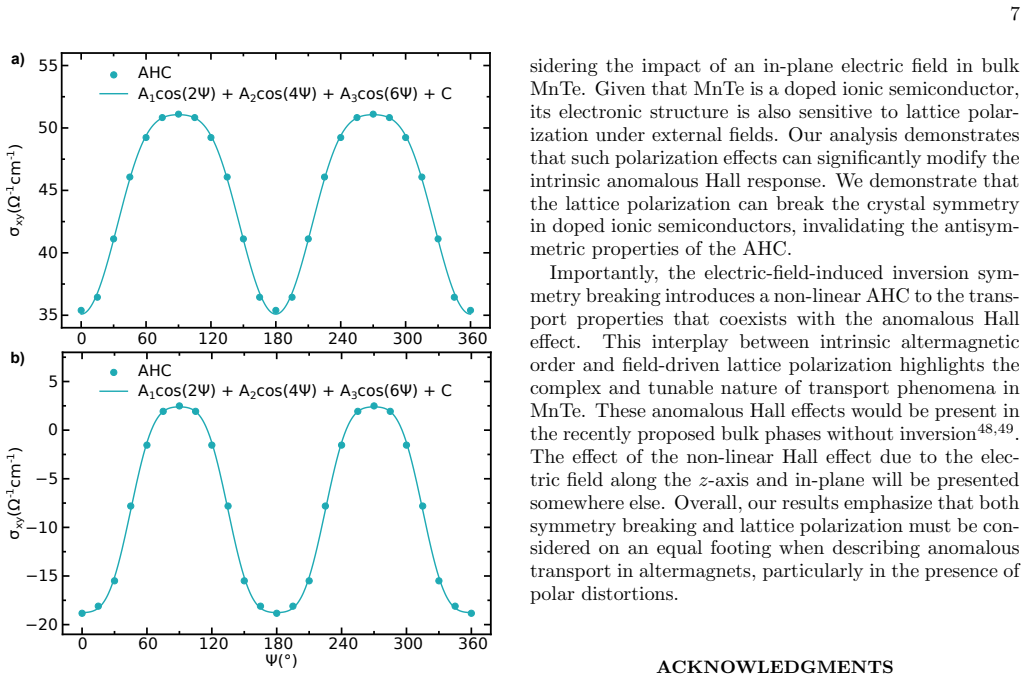
α-MnTe with Néel vector along y has a finite AHC and weak ferromagnetism along z. The surface reduces the space group from P6₃/mmc to Amm2, allowing polar distortions along z and y together with weak ferrimagnetism along y. Modeling the surface via an in-plane electric field applied to the bulk shows that lattice polarization substantially changes the AHC; the electric field simultaneously breaks inversion symmetry so the polar contribution coexists with the nonlinear anomalous Hall effect.
What carries the argument
The symmetry reduction to orthorhombic Amm2 on the surface, which permits polar lattice distortions that couple to and modify the anomalous Hall conductivity when an in-plane electric field is applied.
If this is right
- Lattice polarization induced by electric field changes the value of the anomalous Hall conductivity.
- The polar contribution to the Hall response appears alongside the nonlinear anomalous Hall effect once inversion symmetry is broken.
- Surface polar distortions along z and y, plus weak ferrimagnetism along y, appear once C₂ symmetry is lifted by the surface.
- Altermagnets can exhibit additional transport channels when both magnetic order and electric-field-induced polarization are present.
Where Pith is reading between the lines
- Surface termination or substrate choice could be used to tune the anomalous Hall conductivity through controlled polar distortions.
- Similar polarization effects may appear in other altermagnets that lose inversion symmetry at their surfaces or under external fields.
- Time-resolved or gate-tuned transport experiments on thin films could separate the polar and nonlinear contributions to the Hall signal.
Load-bearing premise
The bulk response to an applied in-plane electric field is taken as an adequate stand-in for the actual surface polar distortions and their impact on the anomalous Hall conductivity.
What would settle it
A first-principles calculation or transport measurement that finds the anomalous Hall conductivity of α-MnTe remains essentially unchanged when an in-plane electric field is applied would falsify the claim of a substantial polarization effect.
Figures

read the original abstract
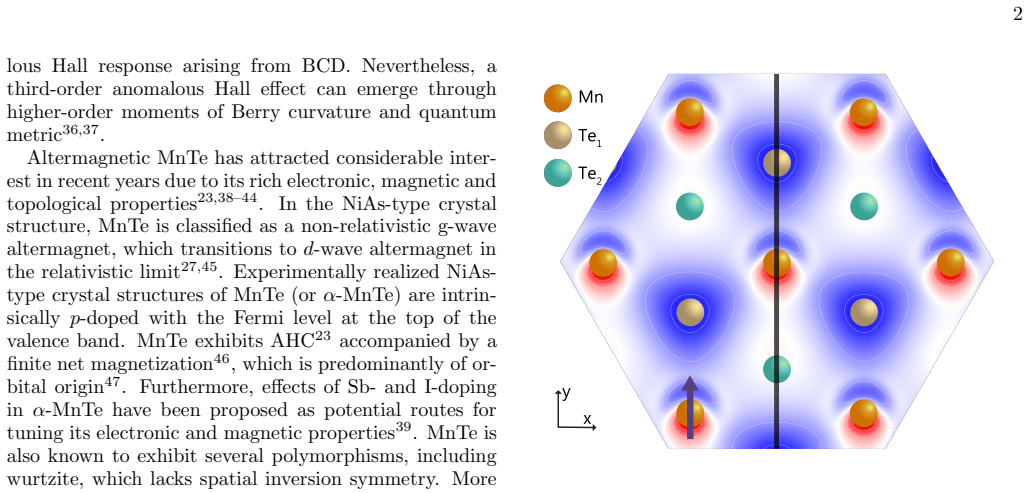
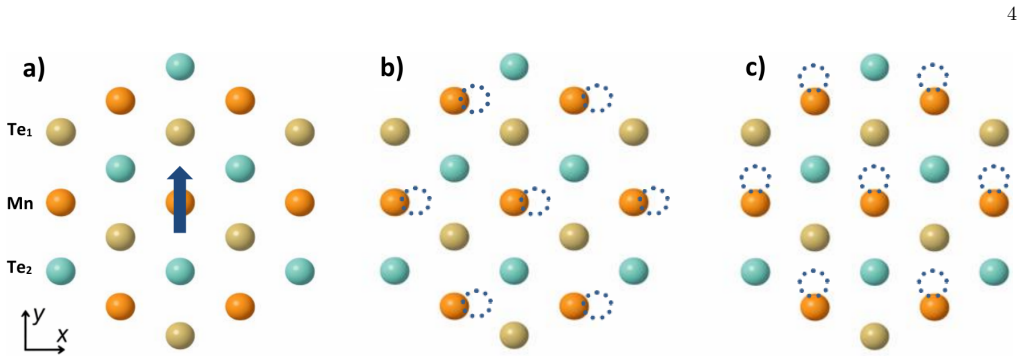
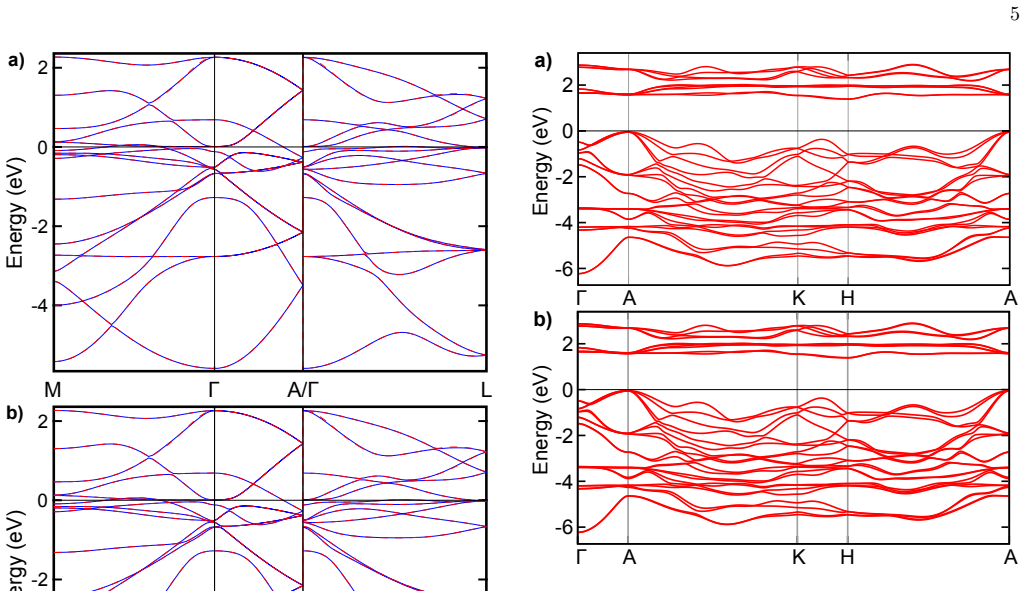
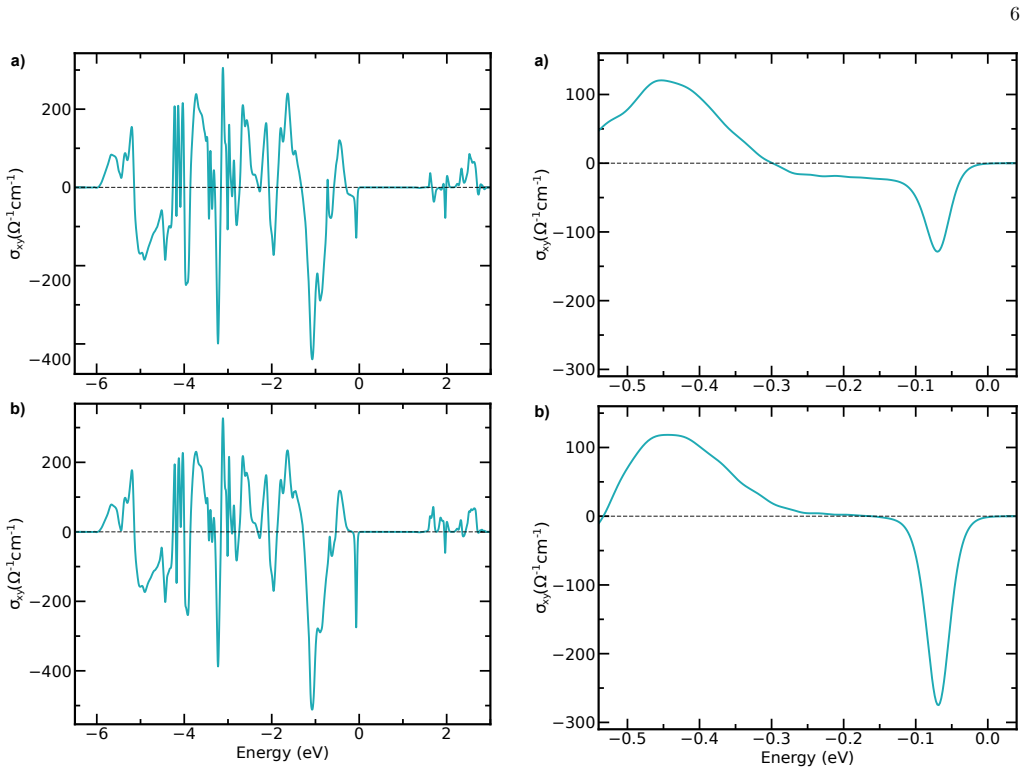
Altermagnetic $\alpha$-MnTe with N\'eel vector along the $y$-axis exhibits a finite anomalous Hall conductivity (AHC) and weak ferromagnetism along the $z$-axis. As already demonstrated in the bulk, there is the breaking of the C$_6$ symmetry by the in-plane N\'eel vector, leaving a C$_2$-type magnetic symmetry. The surface of $\alpha$-MnTe breaks the C$_2$, leaving only a time-reversed mirror symmetry with respect to the $x=0$ plane. Therefore, we demonstrate that on the surface, the interplay between breaking of the crystal symmetry and N\'eel vector orientation produces a reduction of the space group from hexagonal P6$_3$/mmc to orthorhombic Amm2. As a result, the surface exhibits not only a polar distortion along the $z$-axis, but also a polar distortion and a weak ferrimagnetism along the $y$-axis. To describe the surface of MnTe in an accessible way, we simplify the problem and examine the effect of the in-plane electric field in bulk MnTe. Moreover, as a doped ionic semiconductor, the properties of MnTe can be influenced by lattice polarization under an applied electric field. We investigate the interplay between the intrinsic anomalous Hall effect and lattice polarization, showing that polarization effects can substantially affect the AHC. Since the electric field breaks inversion symmetry, this contribution from the lattice polarization coexists with the non-linear anomalous Hall effect, highlighting the rich transport phenomenology of altermagnets.
Editorial analysis
A structured set of objections, weighed in public.
Referee Report
Summary. The manuscript claims that the surface of altermagnetic α-MnTe (Néel vector along y) breaks C2 symmetry, reducing the space group to orthorhombic Amm2 and inducing polar distortions along both z and y plus weak ferrimagnetism along y. To model these surface effects accessibly, the authors apply an in-plane electric field to bulk MnTe and show that the resulting lattice polarization substantially modifies the anomalous Hall conductivity (AHC), with this contribution coexisting with the nonlinear AHE due to inversion-symmetry breaking.
Significance. If the bulk in-plane E-field proxy is shown to faithfully reproduce the surface Amm2 distortions and their quantitative impact on AHC, the result would establish an additional electric-field-tunable mechanism in altermagnets, extending beyond the standard symmetry-protected AHC and highlighting coexistence with nonlinear Hall effects in doped ionic semiconductors.
major comments (2)
- [Abstract] Abstract (modeling simplification): the central claim that polarization 'substantially affect[s] the AHC' rests on replacing the surface (C2 broken, Amm2 symmetry with y- and z-polar modes plus y-ferrimagnetism) by a uniform in-plane E-field in bulk MnTe; the bulk retains C2 symmetry, so the y-directed polar distortion and associated ferrimagnetism have no direct counterpart, undermining the claimed effect size for the actual surface.
- [Abstract] Abstract (quantitative support): no specific calculations, band-structure results, AHC values, or error bars are provided to quantify how large the polarization-induced change in AHC is relative to the zero-field case, leaving the 'substantially' qualifier unsupported.
minor comments (1)
- [Abstract] The phrase 'as already demonstrated in the bulk' lacks a citation to the prior work establishing the finite AHC and weak ferromagnetism.
Simulated Author's Rebuttal
We thank the referee for the careful review and constructive comments. We address each major comment below and indicate the revisions planned for the next version of the manuscript.
read point-by-point responses
-
Referee: [Abstract] Abstract (modeling simplification): the central claim that polarization 'substantially affect[s] the AHC' rests on replacing the surface (C2 broken, Amm2 symmetry with y- and z-polar modes plus y-ferrimagnetism) by a uniform in-plane E-field in bulk MnTe; the bulk retains C2 symmetry, so the y-directed polar distortion and associated ferrimagnetism have no direct counterpart, undermining the claimed effect size for the actual surface.
Authors: We agree that the uniform in-plane E-field applied to bulk MnTe is a simplification that does not reproduce the full surface symmetry reduction to Amm2, including the y-directed polar distortion and associated weak ferrimagnetism, because the bulk retains C2 symmetry. The proxy is used to make the polarization effects computationally accessible while capturing the inversion-symmetry breaking and z-polar distortions that modify the AHC. We will revise the abstract and main text to explicitly note these limitations of the bulk proxy and clarify that the reported AHC changes illustrate the polarization contribution without claiming quantitative equivalence to all surface-specific modes. revision: partial
-
Referee: [Abstract] Abstract (quantitative support): no specific calculations, band-structure results, AHC values, or error bars are provided to quantify how large the polarization-induced change in AHC is relative to the zero-field case, leaving the 'substantially' qualifier unsupported.
Authors: The abstract is concise by design and does not contain the detailed numerical results. The manuscript body presents the first-principles band structures, polarization values, and AHC computations with and without the electric field. To better support the claim, we will revise the abstract to include a brief quantitative statement on the magnitude of the AHC modification based on the calculations already reported in the main text. revision: yes
Circularity Check
No circularity; modeling choice is not a derivation that reduces to inputs
full rationale
Abstract and description contain no equations, parameters, or derivations. The approach of using bulk in-plane E-field to proxy surface polar distortions is presented as a simplification for accessibility, not as a fitted or self-defined result. No self-citations, ansatzes, or uniqueness theorems are invoked in a load-bearing way. The central claim (polarization affects AHC) rests on external computation rather than reducing to its own inputs by construction. This matches the expected non-finding for papers without shown derivations.
Axiom & Free-Parameter Ledger
Reference graph
Works this paper leans on
-
[1]
Physical review B , volume=
Ab initio molecular dynamics for liquid metals , author=. Physical review B , volume=. 1993 , publisher=
1993
-
[2]
Computational materials science , volume=
Efficiency of ab-initio total energy calculations for metals and semiconductors using a plane-wave basis set , author=. Computational materials science , volume=. 1996 , publisher=
1996
-
[3]
Is There A Pure Electronic Ferroelectric? , volume =
Wang, Xudong and Teng, Guichen and Meng, Xiangjian and Cheng, Zhenxiang and Lin, Tie and Shen, Hao and Wang, Xiaodan and Wang, Jianlu and Chu, Junhao , year =. Is There A Pure Electronic Ferroelectric? , volume =. Advanced Electronic Materials , publisher =
-
[4]
and Schmidt, Marcus and Fartab, Dorsa and Mackenzie, Andrew P
Kim, Seo-Jin and Zhu, Jihang and Piva, Mario M. and Schmidt, Marcus and Fartab, Dorsa and Mackenzie, Andrew P. and Baenitz, Michael and Nicklas, Michael and Rosner, Helge and Cook, Ashley M. and González-Hernández, Rafael and Šmejkal, Libor and Zhang, Haijing , title =. Advanced Science , volume =. doi:https://doi.org/10.1002/advs.202307306 , abstract =
-
[5]
G. Zanmarchi , abstract =. Optical measurements on the antiferromagnetic semiconductor. Journal of Physics and Chemistry of Solids , volume =. 1967 , issn =. doi:https://doi.org/10.1016/0022-3697(67)90235-1 , url =
-
[6]
High-resolution photoemission on Sr2RuO4 reveals correlation-enhanced effective spin-orbit coupling and dominantly local self-energies
Tamai, A and Zingl, M and Rozbicki, E and Cappelli, E and Ricc \`o , S and de la Torre, A and McKeown Walker, S and Bruno, F Y and King, P D C and Meevasana, W and Shi, M and Radovi \'c , M and Plumb, N C and Gibbs, A S and Mackenzie, A P and Berthod, C and Strand, H U R and Kim, M and Georges, A and Baumberger, F. High-resolution photoemission on Sr2RuO4...
-
[7]
Physical review b , volume=
From ultrasoft pseudopotentials to the projector augmented-wave method , author=. Physical review b , volume=. 1999 , publisher=
1999
-
[8]
Density-functional theory and strong interactions: Orbital ordering in
Liechtenstein, AI and Anisimov, Vladimir I and Zaanen, Jan , journal=. Density-functional theory and strong interactions: Orbital ordering in. 1995 , publisher=
1995
-
[9]
2023 , eprint=
Piezomagnetic Properties in Altermagnetic MnTe , author=. 2023 , eprint=
2023
-
[10]
He, Keke and Bian, Mengying and Seddon, Samuel D. and Jagadish, Koushik and Mucchietto, Andrea and Ren, He and Kirstein, Erik and Asadi, Reza and Bai, Jaeil and Yao, Chao and Pan, Sheng and Yu, Jie-Xiang and Milde, Peter and Huai, Chang and Hui, Haolei and Zang, Jiadong and Sabirianov, Renat and Cheng, Xuemei M. and Miao, Guoxing and Xing, Hui and Shao, Y...
-
[11]
León, Andrea and Autieri, Carmine and Brumme, Thomas and González, Jhon W. , year =. Hybrid d/p-wave altermagnetism in Ca3Ru2O7 and strain-controlled spin splitting , volume =. npj Quantum Materials , publisher =. doi:10.1038/s41535-025-00814-y , number =
-
[12]
Multipolar Anisotropy in Anomalous Hall Effect from Spin-Group Symmetry Breaking , author =. Phys. Rev. X , volume =. 2025 , month =. doi:10.1103/PhysRevX.15.031006 , url =
-
[13]
Rui-Chun Xiao and Yuanjun Jin and Zhi-Fan Zhang and Zi-Hao Feng and Ding-Fu Shao and Mingliang Tian , keywords =. TensorSymmetry: a package to get symmetry-adapted tensors disentangling spin-orbit coupling effect and establishing analytical relationship with magnetic order , journal =. 2025 , issn =. doi:https://doi.org/10.1016/j.cpc.2025.109872 , url =
-
[14]
Noncollinear magnetism and single-ion anisotropy in multiferroic perovskites , author =. Phys. Rev. B , volume =. 2012 , month =. doi:10.1103/PhysRevB.86.094413 , url =
-
[15]
2023 , eprint=
X-ray Magnetic Circular Dichroism in Altermagnetic -MnTe , author=. 2023 , eprint=
2023
-
[16]
Altermagnetism in MnTe: Origin, predicted manifestations, and routes to detwinning , author =. Phys. Rev. B , volume =. 2023 , month =. doi:10.1103/PhysRevB.107.L100418 , url =
-
[17]
Jungwirth and J
Libor Šmejkal and Rafael González-Hernández and T. Jungwirth and J. Sinova , title =. Science Advances , volume =. 2020 , doi =
2020
-
[18]
Beyond Conventional Ferromagnetism and Antiferromagnetism: A Phase with Nonrelativistic Spin and Crystal Rotation Symmetry , author =. Phys. Rev. X , volume =. 2022 , month =. doi:10.1103/PhysRevX.12.031042 , url =
-
[19]
Hua, Guiyuan and Nie, Simin and Song, Zhida and Yu, Rui and Xu, Gang and Yao, Kailun , journal =. Dirac semimetal in type-. 2018 , month =. doi:10.1103/PhysRevB.98.201116 , url =
-
[20]
Wang, Lin-Lin and Jo, Na Hyun and Kuthanazhi, B. and Wu, Yun and McQueeney, R. J. and Kaminski, A. and Canfield, P. C. , journal =. Single pair of. 2019 , month =. doi:10.1103/PhysRevB.99.245147 , url =
-
[21]
Wang, Hao and Mao, Ning and Hu, Xiangting and Dai, Ying and Huang, Baibiao and Niu, Chengwang. A magnetic topological insulator in two-dimensional EuCd _2 Bi _2 : giant gap with robust topology against magnetic transitions. Mater. Horiz. 2021. doi:10.1039/D0MH01214A
-
[23]
Journal of Physics: Condensed Matter , abstract =
Yuhan Du and Ju Chen and Wenbin Wu and Zeping Shi and Xianghao Meng and Cheng Zhang and Shijing Gong and Junhao Chu and Xiang Yuan , title =. Journal of Physics: Condensed Matter , abstract =. 2022 , month =. doi:10.1088/1361-648X/ac5d1b , url =
-
[24]
Schellenberg, I. and Pfannenschmidt, U. and Eul, M. and Schwickert, C. and P\"ottgen, R. , title =. Z. Anorg. Allg. Chem , volume =. doi:10.1002/zaac.201100179 , year =
-
[25]
Zhang, Hongbin , title =. Elect. Struct. , abstract =. 2021 , month =. doi:10.1088/2516-1075/abbb25 , url =
-
[26]
Nature , volume =
High-throughput calculations of magnetic topological materials nature research , author =. Nature , volume =. 2020 , doi =
2020
-
[27]
Nature , volume =
Progress and prospects in magnetic topological materials , author =. Nature , volume =. 2022 , doi =
2022
-
[28]
and Fuchs, F
Bechstedt, F. and Fuchs, F. and Kresse, G. , year =. Ab-initio theory of semiconductor band structures: New developments and progress , volume =. phys. stat. sol. (b) , doi =
-
[29]
A. J. Garza and G. E. Scuseria , year =. Predicting Band Gaps with Hybrid Density Functionals , volume =. J. Phys. Chem. Lett. , doi =
-
[30]
Ab initio molecular dynamics for liquid metals , author =. Phys. Rev. B , volume =. 1993 , month =. doi:10.1103/PhysRevB.47.558 , url =
-
[31]
Efficiency of ab-initio total energy calculations for metals and semiconductors using a plane-wave basis set , journal =. 1996 , issn =. doi:https://doi.org/10.1016/0927-0256(96)00008-0 , url =
-
[32]
Efficient iterative schemes for ab initio total-energy calculations using a plane-wave basis set , author =. Phys. Rev. B , volume =. 1996 , month =. doi:10.1103/PhysRevB.54.11169 , url =
-
[33]
From ultrasoft pseudopotentials to the projector augmented-wave method , author =. Phys. Rev. B , volume =. 1999 , month =. doi:10.1103/PhysRevB.59.1758 , url =
-
[34]
Generalized Gradient Approximation Made Simple , author =. Phys. Rev. Lett. , volume =. 1996 , month =. doi:10.1103/PhysRevLett.77.3865 , url =
-
[35]
Momentum-resolved spin splitting in
Autieri, Carmine and. Momentum-resolved spin splitting in. Phys. Rev. B , volume =. 2021 , month =. doi:10.1103/PhysRevB.103.115209 , url =
-
[36]
and Marsman,M
Paier,J. and Marsman,M. and Hummer,K. and Kresse,G. and Gerber,I. C. and Ángyán,J. G. , title =. The Journal of Chemical Physics , volume =. 2006 , doi =
2006
-
[37]
Density-based mixing parameter for hybrid functionals , author =. Phys. Rev. B , volume =. 2011 , month =. doi:10.1103/PhysRevB.83.035119 , url =
-
[38]
Journal of Physics: Condensed Matter , abstract =
David Koller and Peter Blaha and Fabien Tran , title =. Journal of Physics: Condensed Matter , abstract =. doi:10.1088/0953-8984/25/43/435503 , url =
-
[39]
Schlipf, M. and Betzinger, M. and Le. Structural, electronic, and magnetic properties of the europium chalcogenides: A hybrid-functional. Phys. Rev. B , volume =. 2013 , month =. doi:10.1103/PhysRevB.88.094433 , url =
-
[40]
R. Atta-Fynn and A. K. Ray , title =. 2009 , month =. doi:10.1209/0295-5075/85/27008 , url =
-
[41]
Combined hybrid functional and
Aras, Mehmet and Kili. Combined hybrid functional and. The Journal of Chemical Physics , volume =. 2014 , doi =
2014
-
[42]
Rahn, M. C. and Soh, J.-R. and Francoual, S. and Veiga, L. S. I. and Strempfer, J. and Mardegan, J. and Yan, D. Y. and Guo, Y. F. and Shi, Y. G. and Boothroyd, A. T. , journal =. Coupling of magnetic order and charge transport in the candidate. 2018 , month =. doi:10.1103/PhysRevB.97.214422 , url =
-
[43]
Strong potential impurities on the surface of a topological insulator , author =. Phys. Rev. B , volume =. 2012 , month =. doi:10.1103/PhysRevB.85.121103 , url =
-
[44]
Spin-orbit coupling effects on the electronic properties of the pressure-induced superconductor
Cuono, Giuseppe and Autieri, Carmine and Guarnaccia, Giuseppe and Avella, Adolfo and Cuoco, Mario and Forte, Filomena and Noce, Canio , journal =. Spin-orbit coupling effects on the electronic properties of the pressure-induced superconductor. 2019 , doi =
2019
-
[45]
Porter, D. G. and Granata, V. and Forte, F. and Di Matteo, S. and Cuoco, M. and Fittipaldi, R. and Vecchione, A. and Bombardi, A. , journal =. Magnetic anisotropy and orbital ordering in. 2018 , month =. doi:10.1103/PhysRevB.98.125142 , url =
-
[46]
and Lee, Wei-Cheng and Aynajian, Pegor , journal =
Gong, Mingda and Sar, Divyanshi and Friedman, Joel and Kaczorowski, Dariusz and Abdel Razek, S. and Lee, Wei-Cheng and Aynajian, Pegor , journal =. Surface state evolution induced by magnetic order in axion insulator candidate. 2022 , month =. doi:10.1103/PhysRevB.106.125156 , url =
-
[47]
Regmi, Sabin and Hosen, M. Mofazzel and Ghosh, Barun and Singh, Bahadur and Dhakal, Gyanendra and Sims, Christopher and Wang, Baokai and Kabir, Firoza and Dimitri, Klauss and Liu, Yangyang and Agarwal, Amit and Lin, Hsin and Kaczorowski, Dariusz and Bansil, Arun and Neupane, Madhab , journal =. Temperature-dependent electronic structure in a higher-order ...
-
[48]
and Klavins, Peter and Fettinger, James C
Goforth, Andrea M. and Klavins, Peter and Fettinger, James C. and Kauzlarich, Susan M. , journal =. Magnetic Properties and Negative Colossal Magnetoresistance of the Rare Earth Zintl phase. 2008 , publisher =. doi:10.1021/ic801290u , url =
-
[49]
Rosa, P. F. S. and Adriano, C. and Garitezi, T. M. and Ribeiro, R. A. and Fisk, Z. and Pagliuso, P. G. , journal =. Electron spin resonance of the intermetallic antiferromagnet. 2012 , month =. doi:10.1103/PhysRevB.86.094408 , url =
-
[50]
and Sai Gautam, Gopalakrishnan and Carter, Emily A
Long, Olivia Y. and Sai Gautam, Gopalakrishnan and Carter, Emily A. , journal =. Evaluating optimal. 2020 , month =. doi:10.1103/PhysRevMaterials.4.045401 , url =
-
[51]
Sai Gautam, Gopalakrishnan and Carter, Emily A. , journal =. Evaluating transition metal oxides within. 2018 , month =. doi:10.1103/PhysRevMaterials.2.095401 , url =
-
[52]
and Curtarolo, Stefano and Buongiorno Nardelli, Marco , journal =
Agapito, Luis A. and Curtarolo, Stefano and Buongiorno Nardelli, Marco , journal =. Reformulation of. 2015 , month =. doi:10.1103/PhysRevX.5.011006 , url =
-
[53]
Cococcioni, Matteo and de Gironcoli, Stefano , journal =. Linear response approach to the calculation of the effective interaction parameters in the. 2005 , month =. doi:10.1103/PhysRevB.71.035105 , url =
-
[54]
and Arab, Arian and Strocov, Vladimir N
Sato, Takafumi and Wang, Zhiwei and Takane, Daichi and Souma, Seigo and Cui, Chaoxi and Li, Yongkai and Nakayama, Kosuke and Kawakami, Tappei and Kubota, Yuya and Cacho, Cephise and Kim, Timur K. and Arab, Arian and Strocov, Vladimir N. and Yao, Yugui and Takahashi, Takashi , journal =. Signature of band inversion in the antiferromagnetic phase of axion i...
-
[55]
Alam, Md Shahin and Fakhredine, Amar and Ahmed, Mujeeb and Tanwar, P. K. and Yang, Hung-Yu and Tafti, Fazel and Cuono, Giuseppe and Islam, Rajibul and Singh, Bahadur and Lynnyk, Artem and Autieri, Carmine and Matusiak, Marcin , keywords =. Sign change of the anomalous Hall effect and the anomalous Nernst effect in. 2022 , copyright =. doi:10.48550/ARXIV.2...
-
[58]
Taddei, K. M. and Yin, L. and Sanjeewa, L. D. and Li, Y. and Xing, J. and dela Cruz, C. and Phelan, D. and Sefat, A. S. and Parker, D. S. , journal =. Single pair of. 2022 , month =. doi:10.1103/PhysRevB.105.L140401 , url =
-
[59]
and Shi, Youguo and Cao, Chao and Steglich, F
Du, Feng and Yang, Lin and Nie, Zhiyong and Wu, Ninghua and Li, Yong and Luo, Shuaishuai and Chen, Ye and Su, Dajun and Smidman, M. and Shi, Youguo and Cao, Chao and Steglich, F. and Song, Yu and Yuan, Huiqiu , title =. npj Quantum Mater. , volume =. doi:10.1038/s41535-022-00468-0 , url =
-
[60]
Journal of Physics D: Applied Physics , abstract =
Ghulam Hussain and Giuseppe Cuono and Rajibul Islam and Artur Trajnerowicz and Jaros³aw Jureñczyk and Carmine Autieri and Tomasz Dietl , title =. Journal of Physics D: Applied Physics , abstract =. 2022 , month =. doi:10.1088/1361-6463/ac984d , url =
-
[62]
and Nie, S
Ma, J.-Z. and Nie, S. M. and Yi, C. J. and Jandke, J. and Shang, T. and Yao, M. J. and Naamneh, M. and Yan, L. Q. and Sun, Y. and Chikina, A. and Strocov, V. N. and Medarde, M. and Song, M. and Xiong, Y. M. and Xu, G. and Wulfhekel, W. and Mesot, J. and Reticcioli, M. and Franchini, C. and Mudry, C. and M\''uller, M. and Shi, Y. G. and Qian, T. and Ding, ...
2019
-
[63]
Higher-Order Topology of the Axion Insulator
Xu, Yuanfeng and Song, Zhida and Wang, Zhijun and Weng, Hongming and Dai, Xi , journal =. Higher-Order Topology of the Axion Insulator. 2019 , month =. doi:10.1103/PhysRevLett.122.256402 , url =
-
[64]
The Zintl phase compounds AEIn2As2 (AE = Ca , Sr , Ba): topological phase transition under pressure
Guo, Wen-Ti and Huang, Zhigao and Zhang, Jian-Min. The Zintl phase compounds AEIn2As2 (AE = Ca , Sr , Ba): topological phase transition under pressure. Phys. Chem. Chem. Phys. 2022. doi:10.1039/D2CP01764D
-
[65]
and Yao, Xiaohan and Nichols, Renee and Atay, Kemal and Xu, Bochao and Franklin, Jacob and Sochnikov, Ilya and Ryan, Philip J
Wang, Zhi-Cheng and Rogers, Jared D. and Yao, Xiaohan and Nichols, Renee and Atay, Kemal and Xu, Bochao and Franklin, Jacob and Sochnikov, Ilya and Ryan, Philip J. and Haskel, Daniel and Tafti, Fazel , title =. Advanced Materials , year=
-
[66]
AM2X2-Verbindungen mit CaAl2Si2-Struktur. XI. Struktur und Eigenschaften der Verbindungen ACd2X2 (A: Eu, Yb; X: P, As, Sb) , author=. Zeitschrift f. 1996 , volume=
1996
-
[67]
Predicting stable crystalline compounds using chemical similarity , author=. npj Comput. Mater. , year=. doi:10.1038/s41524-020-00481-6 , url=
-
[68]
npj Computational Materials , year=
Yu, Maituo and Yang, Shuyang and Wu, Chunzhi and Marom, Noa , title=. npj Computational Materials , year=. doi:10.1038/s41524-020-00446-9 , url=
-
[69]
Journal of Physics: Condensed Matter , abstract =
Paul Larson and Walter R L Lambrecht , title =. Journal of Physics: Condensed Matter , abstract =. 2006 , month =. doi:10.1088/0953-8984/18/49/024 , url =
-
[70]
Engineering axion insulator and other topological phases in superlattices without inversion symmetry , author =. Phys. Rev. B , volume =. 2023 , month =. doi:10.1103/PhysRevB.107.125102 , url =
-
[71]
Riberolles, S. X. M. and Trevisan, T. V. and Kuthanazhi, B. and Heitmann, T. W. and Ye, F. and Johnston, D. C. and Bud'ko, S. L. and Ryan, D. H. and Canfield, P. C. and Kreyssig, A. and Vishwanath, A. and McQueeney, R. J. and Wang, L.-L. and Orth, P. P. and Ueland, B. G. , title=. Nature Communications , year=. doi:10.1038/s41467-021-21154-y , url=
-
[72]
Correlation-corrected band topology and topological surface states in iron-based superconductors , author =. Phys. Rev. B , volume =. 2022 , month =. doi:10.1103/PhysRevB.106.115114 , url =
-
[73]
and Autieri, Carmine and Cuono, Giuseppe , TITLE =
Hussain, Ghulam and Fakhredine, Amar and Islam, Rajibul and Sattigeri, Raghottam M. and Autieri, Carmine and Cuono, Giuseppe , TITLE =. Materials , VOLUME =. 2023 , NUMBER =
2023
-
[74]
Zhang, Yang and Deng, Ke and Zhang, Xiao and Wang, Meng and Wang, Yuan and Liu, Cai and Mei, Jia-Wei and Kumar, S. and Schwier, E. F. and Shimada, K. and Chen, Chaoyu and Shen, Bing , journal =. In-plane antiferromagnetic moments and magnetic polaron in the axion topological insulator candidate. 2020 , month =. doi:10.1103/PhysRevB.101.205126 , url =
-
[75]
Sunko and Y
V. Sunko and Y. Sun and M. Vranas and C. C. Homes and C. Lee and E. Donoway and Z.-C. Wang and S. Balguri and M. B. Mahendru and A. Ruiz and B. Gunn and R. Basak and E. Schierle and E. Weschke and F. Tafti and A. Frano and and J. Orenstein , journal =. Spin-carrier coupling induced ferromagnetism and giant resistivity peak in. 2022 , doi =
2022
-
[76]
Krishna, J. and Nautiyal, T. and Maitra, T. , journal =. First-principles study of electronic structure, transport, and optical properties of. 2018 , month =. doi:10.1103/PhysRevB.98.125110 , url =
-
[77]
Wang, Yang and Li, Cong and Miao, Taimin and Zhang, Shuai and Li, Yong and Zhou, Liqin and Yang, Meng and Yin, Chaohui and Cai, Yongqing and Song, Chunyao and Luo, Hailan and Chen, Hao and Mao, Hanqing and Zhao, Lin and Deng, Hanbin and Sun, Yingkai and Zhu, Changjiang and Zhang, Fengfeng and Yang, Feng and Wang, Zhimin and Zhang, Shenjin and Peng, Qinjun...
-
[78]
Ma and S
J.-Z. Ma and S. M. Nie and C. J. Yi and J. Jandke and T. Shang and M. Y. Yao and M. Naamneh and L. Q. Yan and Y. Sun and A. Chikina and V. N. Strocov and M. Medarde and M. Song and Y.-M. Xiong and G. Xu and W. Wulfhekel and J. Mesot and M. Reticcioli and C. Franchini and C. Mudry and M. M\"uller and Y. G. Shi and T. Qian and H. Ding and M. Shi , title =. ...
2019
-
[79]
Gati, E. and Bud'ko, S. L. and Wang, Lin-Lin and Valadkhani, A. and Gupta, R. and Kuthanazhi, B. and Xiang, Li and Wilde, J. M. and Sapkota, A. and Guguchia, Z. and Khasanov, R. and Valent\'. Pressure-induced ferromagnetism in the topological semimetal. Phys. Rev. B , volume =. 2021 , month =. doi:10.1103/PhysRevB.104.155124 , url =
-
[80]
Wang, H. P. and Wu, D. S. and Shi, Y. G. and Wang, N. L. , journal =. Anisotropic transport and optical spectroscopy study on antiferromagnetic triangular lattice. 2016 , doi =
2016
-
[81]
Soh, J.-R. and. Ideal. Phys. Rev. B , volume =. 2019 , month =. doi:10.1103/PhysRevB.100.201102 , url =
-
[82]
Ma, Junzhang and Wang, Han and Nie, Simin and Yi, Changjiang and Xu, Yuanfeng and Li, Hang and Jandke, J. and Wulfhekel, W. and Huang, Yaobo and West, D. and Richard, P. and Chikina, A. and Strocov, V. N. and Mesot, J. and Weng, Hongming and Zhang, Shengbai and Shi, Youguo and Qian, Tian and Shi, Ming and Ding, Hong , title =. Adv. Mater. , volume =. doi:...
-
[83]
Experimental evidence for field-induced metamagnetic transition of
Sun, Yingkai and Li, Yong and Li, Shuaishuai and Changjiang Yi, Changjiang and Hanbin Deng, Hanbin and Du, Xin and Liu, Limin and Zhu, Changjiang and Li, Yuan and Wang, Zheng and Mao, Hanqing and Shi, Youguo and Wu, Rui , keywords =. Experimental evidence for field-induced metamagnetic transition of. J. Rare Earths , volume =. 2022 , issn =. doi:https://d...
-
[84]
npj Quantum Mater
Consecutive topological phase transitions and colossal magnetoresistance in a magnetic topological semimetal , author =. npj Quantum Mater. , volume =. 2021 , doi =
2021
discussion (0)
Sign in with ORCID, Apple, or X to comment. Anyone can read and Pith papers without signing in.