REVIEW 3 major objections 2 minor 17 references
Controller rankings in edge scheduling reverse with load intensity, as a reinforcement learning method loses nearly 29 percentage points to a rule-based heuristic under heavier workloads.
Reviewed by Pith at T0; open to challenge. T0 means a machine referee read the full paper against a public rubric. the ladder, T0–T4 →
T0 review · grok-4.3
2026-06-27 08:12 UTC pith:H5IAYDGB
load-bearing objection The paper delivers a practical open benchmark for CMMS schedulers with clear evidence that rankings reverse under heavier load, but the tested configs are too narrow to support broad claims about configuration dependence. the 3 major comments →
Fair Comparison of Scheduling Algorithms on Heterogeneous Edge Clusters: A Continuous Adaptive Benchmark
The pith
A machine-rendered reading of the paper's core claim, the machinery that carries it, and where it could break.
Core claim
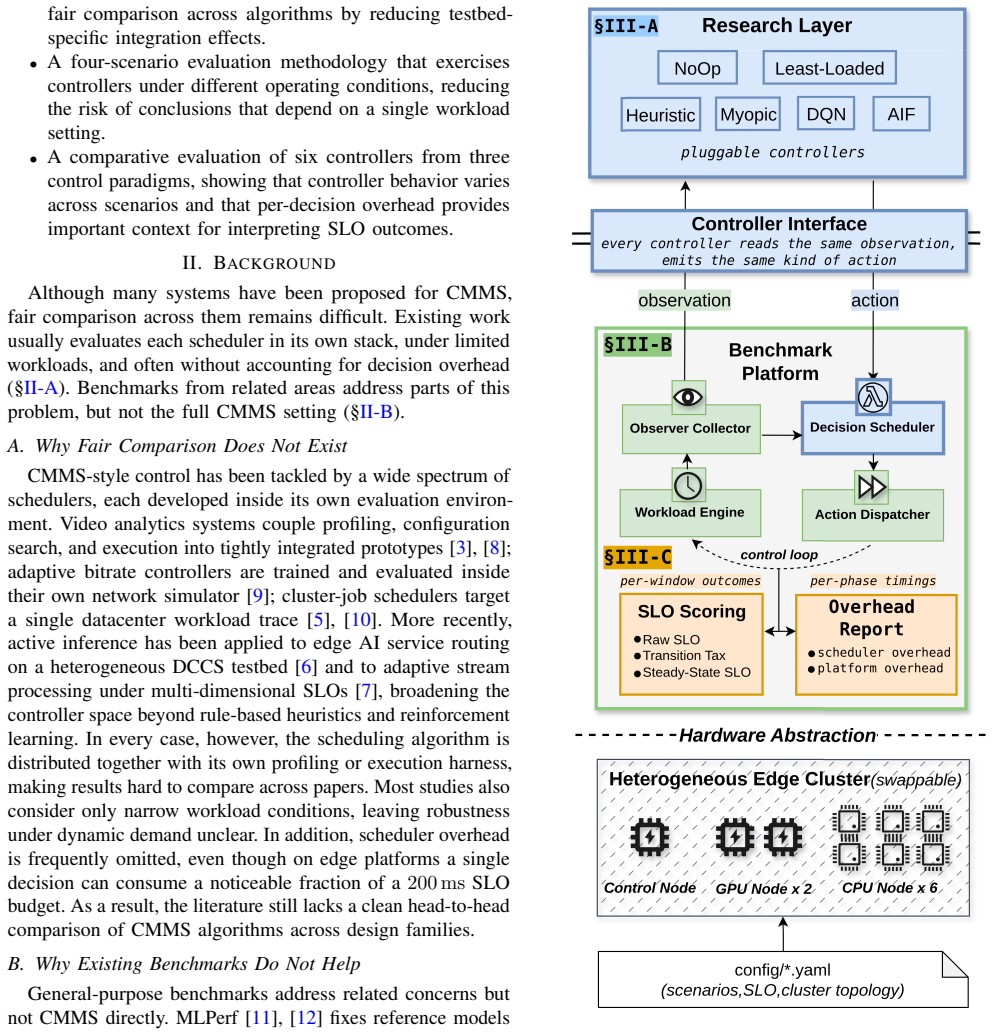
We present an open source benchmark with a unified controller interface, a closed-loop workload driver for multiple patterns, and dual-metric SLO scoring that distinguishes overall compliance from compliance during stable operation. Across 424 episodes with six controllers, five cluster configurations, and two load regimes, controller rankings prove strongly configuration-dependent: the deep reinforcement-learning winner under light workloads loses to a rule-based heuristic by nearly 29 percentage points once load intensifies, at roughly 500 times the per-decision operational overhead.
What carries the argument
The open source benchmark platform with unified interface, closed-loop workload driver, and dual-metric SLO scoring for Continuous Multi-Mode Scheduling problems.
Load-bearing premise
The five cluster configurations and two load regimes used in the benchmark sufficiently represent real heterogeneous edge deployments for the observed ranking reversals to apply more broadly.
What would settle it
Running the same six controllers on a substantially different set of heterogeneous edge cluster configurations or with continuously varying workloads and finding no significant ranking reversals would falsify the claim of strong configuration dependence.
If this is right
- Controller selection must account for expected workload intensity rather than assuming one algorithm dominates.
- Per-decision operational overhead becomes a critical factor when comparing complex controllers like deep reinforcement learning to simpler heuristics.
- Using separate raw and steady-state SLO metrics prevents conflating switching costs with overall performance.
- Unified evaluation stacks and multiple workload patterns are necessary for reliable algorithm comparisons.
- Rankings observed in light load regimes do not predict behavior under intensified loads.
Where Pith is reading between the lines
- Deployments in real edge environments may benefit from load-aware or hybrid scheduling that switches between controller types.
- The benchmark platform could serve as a standard testbed for developing new Continuous Multi-Mode Scheduling algorithms.
- High overhead of advanced controllers may limit their practicality in resource-constrained edge settings despite potential benefits in specific scenarios.
Editorial analysis
A structured set of objections, weighed in public.
Referee Report
Summary. The paper introduces an open-source benchmark platform for Continuous Multi-Mode Scheduling (CMMS) on heterogeneous edge clusters. It provides a unified controller interface, closed-loop workload driver across multiple patterns, and dual-metric SLO scoring (raw compliance vs. steady-state compliance). Experiments evaluate six controllers over five cluster configurations and two load regimes in 424 episodes, showing that rankings are strongly configuration-dependent: a DRL controller wins under light load but loses to a rule-based heuristic by nearly 29 percentage points under intensified load, at ~500× per-decision overhead. The dual metrics also expose switching costs hidden by aggregate scores.
Significance. If the tested configurations prove representative, the results demonstrate that single-workload or single-configuration evaluations can produce misleading rankings in edge scheduling, a finding with direct implications for how future CMMS research should be conducted. The open-source platform, closed-loop driver, and separation of raw vs. steady-state SLOs are concrete strengths that could improve reproducibility and practical relevance in the distributed systems community. The scale (424 episodes) and explicit overhead reporting further add value.
major comments (3)
- [Abstract and §4] Abstract and §4 (Experiments): the central claim that rankings reverse by 'nearly 29 percentage points' under intensified load is presented without error bars, confidence intervals, or statistical significance tests across the 424 episodes; this is load-bearing for the configuration-dependence conclusion because scheduling outcomes are stochastic.
- [§3.1] §3.1 (Cluster and Workload Models): the five synthetic cluster topologies and two load regimes are used to support the generalization that rankings are 'strongly configuration-dependent,' yet no sensitivity analysis is reported for additional axes such as interconnect bandwidth distributions, node failure rates, or arrival processes drawn from production traces; this directly affects whether the observed reversals transfer beyond the closed test set.
- [§4.4] §4.4 (Overhead Measurement): the 500× per-decision operational overhead for the DRL controller is stated as a key practical drawback, but the measurement protocol (hardware platform, timing granularity, inclusion/exclusion of training vs. inference) is not specified in sufficient detail to allow independent reproduction or comparison.
minor comments (2)
- The abstract states the platform is 'open source' but does not include a repository URL or DOI; this should be added in the introduction or a footnote to enable immediate access.
- [§2] Notation for the two SLO variants (raw vs. steady-state) is introduced in the abstract but could be formalized earlier with explicit equations in §2 to improve clarity for readers unfamiliar with the distinction.
Simulated Author's Rebuttal
We thank the referee for their thorough review and constructive comments. We address each major comment below, proposing revisions to improve the manuscript's statistical rigor, discussion of limitations, and reproducibility.
read point-by-point responses
-
Referee: [Abstract and §4] Abstract and §4 (Experiments): the central claim that rankings reverse by 'nearly 29 percentage points' under intensified load is presented without error bars, confidence intervals, or statistical significance tests across the 424 episodes; this is load-bearing for the configuration-dependence conclusion because scheduling outcomes are stochastic.
Authors: We agree that including statistical measures is essential for substantiating the configuration-dependence claim given the stochastic nature of scheduling. In the revised version, we will add error bars (standard deviation or confidence intervals) to the key figures and tables in §4, and perform appropriate statistical tests (e.g., paired t-tests) across the 424 episodes to assess the significance of the observed ranking reversals. This will also be reflected in the abstract. revision: yes
-
Referee: [§3.1] §3.1 (Cluster and Workload Models): the five synthetic cluster topologies and two load regimes are used to support the generalization that rankings are 'strongly configuration-dependent,' yet no sensitivity analysis is reported for additional axes such as interconnect bandwidth distributions, node failure rates, or arrival processes drawn from production traces; this directly affects whether the observed reversals transfer beyond the closed test set.
Authors: The selected configurations were designed to cover a range of heterogeneity levels and load intensities to illustrate the dependence. However, we acknowledge the value of sensitivity analysis on additional parameters. In the revision, we will expand §3.1 and the discussion section to include a more detailed justification of the chosen parameters and explicitly note the lack of sensitivity analysis on interconnect bandwidth, node failures, and production traces as a limitation, suggesting it as future work. A full sensitivity study would require new experiments and is beyond the current scope. revision: partial
-
Referee: [§4.4] §4.4 (Overhead Measurement): the 500× per-decision operational overhead for the DRL controller is stated as a key practical drawback, but the measurement protocol (hardware platform, timing granularity, inclusion/exclusion of training vs. inference) is not specified in sufficient detail to allow independent reproduction or comparison.
Authors: We agree that the overhead measurement protocol requires more detail for reproducibility. In the revised §4.4, we will specify: the hardware platform used (CPU/GPU specifications), the timing method (e.g., Python time.perf_counter for wall-clock time per decision), the granularity (per-decision inference time), and confirm that only runtime inference overhead is measured, excluding any training or initialization phases. revision: yes
Circularity Check
No circularity: purely empirical benchmark with direct observations
full rationale
The paper conducts an empirical evaluation of six controllers across five cluster configurations and two load regimes (424 episodes total), reporting observed ranking reversals and overhead differences directly from the runs. No derivation, prediction, or first-principles result is claimed that reduces to a fitted parameter, self-citation, or ansatz defined inside the work; the central claim is a set of measured outcomes under the stated experimental conditions, making the analysis self-contained against external benchmarks.
Axiom & Free-Parameter Ledger
read the original abstract
Modern Artificial Intelligence (AI) workloads deployed across the heterogeneous tiers of an edge--cloud continuum must satisfy multi-dimensional Service Level Objectives (SLOs) over latency, throughput, and output quality. For each incoming task, the scheduler picks both a target node and a processing mode (e.g., full or reduced inference precision). We call this class of problems \emph{Continuous Multi-Mode Scheduling} (CMMS). Comparing CMMS algorithms fairly is difficult because prior studies typically evaluate each controller in its own stack, under a single workload, and without reporting per-decision overhead. To close these gaps, we present an open source benchmark platform that features (i) a unified controller interface, (ii) a closed-loop workload driver covering multiple workload patterns, and (iii) dual-metric SLO scoring that reports raw SLO (overall compliance) and steady-state SLO (compliance during stable operation) separately. Running six controllers across five cluster configurations and two load regimes (424 episodes), we find that controller rankings are strongly configuration-dependent: a deep reinforcement-learning winner under light workloads loses to a rule-based heuristic by nearly 29 percentage points once load intensifies, at roughly 500$\times$ the per-decision operational overhead. We further show that separating raw from steady-state SLOs exposes switching costs that a single aggregate score would otherwise conflate.
Figures


Reference graph
Works this paper leans on
-
[1]
Equilibrium in the computing continuum through active inference,
B. Sedlak, V . C. Pujol, P. K. Donta, and S. Dustdar, “Equilibrium in the computing continuum through active inference,”Future Generation Computer Systems, vol. 160, pp. 92–108, 2024
2024
-
[2]
Benchmarking dynamic slo compliance in distributed computing continuum systems,
A. Lapkovskis, B. Sedlak, S. Magnússon, S. Dustdar, and P. K. Donta, “Benchmarking dynamic slo compliance in distributed computing continuum systems,” in2025 IEEE International Conference on Edge Computing and Communications (EDGE), 2025, pp. 93–102
2025
-
[3]
Live video analytics at scale with approximation and delay-tolerance,
H. Zhang, G. Ananthanarayanan, P. Bodik, M. Philipose, P. Bahl, and M. J. Freedman, “Live video analytics at scale with approximation and delay-tolerance,” inProceedings of the 14th USENIX Symposium on Networked Systems Design and Implementation (NSDI), 2017, pp. 377–392
2017
-
[4]
Serving DNNs like clockwork: Performance predictability from the bottom up,
A. Gujarati, R. Karimi, S. Alzayat, W. Hao, A. Kaufmann, Y . Vigfusson, and J. Mace, “Serving DNNs like clockwork: Performance predictability from the bottom up,” inProceedings of the 14th USENIX Symposium on Operating Systems Design and Implementation (OSDI), 2020, pp. 443–462
2020
-
[5]
Learning scheduling algorithms for data processing clusters,
H. Mao, M. Schwarzkopf, S. B. Venkatakrishnan, Z. Meng, and M. Alizadeh, “Learning scheduling algorithms for data processing clusters,” inProceedings of the ACM SIGCOMM Conference, 2019, pp. 270–288
2019
-
[6]
Active inference-based adaptive routing for heterogeneous edge AI services,
Z. Wang, B. Sedlak, and S. Dustdar, “Active inference-based adaptive routing for heterogeneous edge AI services,” inService-Oriented Com- puting – ICSOC 2025 Workshops (SOC4AI). Springer, 2025, to appear
2025
-
[7]
Adaptive stream processing on edge devices through active inference,
B. Sedlak, V . Casamayor Pujol, A. Morichetta, P. K. Donta, and S. Dustdar, “Adaptive stream processing on edge devices through active inference,”Evolving Systems, 2025
2025
-
[8]
Chameleon: Scalable adaptation of video analytics,
J. Jiang, G. Ananthanarayanan, P. Bodik, S. Sen, and I. Stoica, “Chameleon: Scalable adaptation of video analytics,” inProceedings of the 2018 ACM SIGCOMM Conference, 2018, pp. 253–266
2018
-
[9]
Neural adaptive video streaming with Pensieve,
H. Mao, R. Netravali, and M. Alizadeh, “Neural adaptive video streaming with Pensieve,” inProceedings of the ACM SIGCOMM Conference, 2017, pp. 197–210
2017
-
[10]
Joint configuration adaptation and bandwidth allocation for edge-based real- time video analytics,
C. Wang, S. Zhang, Y . Chen, Z. Qian, J. Wu, and M. Xiao, “Joint configuration adaptation and bandwidth allocation for edge-based real- time video analytics,” inProceedings of IEEE INFOCOM, 2020, pp. 257–266
2020
-
[11]
MLPerf inference benchmark,
V . J. Reddi, C. Cheng, D. Kanter, P. Mattson, G. Schmuelling, C.-J. Wu, B. Anderson, M. Breughe, M. Charlebois, W. Chouet al., “MLPerf inference benchmark,” inProceedings of the ACM/IEEE International Symposium on Computer Architecture (ISCA), 2020, pp. 446–459
2020
-
[12]
MLPerf training benchmark,
P. Mattson, C. Cheng, C. Coleman, G. Diamos, P. Micikevicius, D. Patterson, H. Tang, G.-Y . Wei, P. Bailis, V . Bittorfet al., “MLPerf training benchmark,” inProceedings of the 3rd Conference on Machine Learning and Systems (MLSys), 2020
2020
-
[13]
An open-source benchmark suite for microservices and their hardware-software implications for cloud and edge systems,
Y . Gan, Y . Zhang, D. Cheng, A. Shetty, P. Rathi, N. Katarki, A. Bruno, J. Hu, B. Ritchken, B. Jacksonet al., “An open-source benchmark suite for microservices and their hardware-software implications for cloud and edge systems,” inProceedings of the 24th ACM International Conference on Architectural Support for Programming Languages and Operating System...
2019
-
[14]
BUNGEE: An elasticity benchmark for self-adaptive IaaS cloud environments,
N. R. Herbst, S. Kounev, A. Weber, and H. Groenda, “BUNGEE: An elasticity benchmark for self-adaptive IaaS cloud environments,” inProceedings of the 10th International Symposium on Software Engineering for Adaptive and Self-Managing Systems (SEAMS). IEEE Press, 2015, pp. 46–56
2015
-
[15]
Ultralytics yolov8,
G. Jocher, A. Chaurasia, and J. Qiu, “Ultralytics yolov8,” https://github. com/ultralytics/ultralytics, 2023
2023
-
[16]
Deep reinforcement learning with double Q-learning,
H. van Hasselt, A. Guez, and D. Silver, “Deep reinforcement learning with double Q-learning,” inProceedings of the AAAI Conference on Artificial Intelligence, 2016, pp. 2094–2100
2016
-
[17]
T. Parr, G. Pezzulo, and K. J. Friston,Active Inference: The Free Energy Principle in Mind, Brain, and Behavior. MIT Press, 2022. 6
2022
discussion (0)
Sign in with ORCID, Apple, or X to comment. Anyone can read and Pith papers without signing in.