Scaling-optimal purification of noisy qubit unitary channels
Pith reviewed 2026-06-27 09:35 UTC · model grok-4.3
The pith
A parallel protocol using a novel entanglement-assisted code purifies noisy qubit unitaries with O(1/n) noise suppression that is asymptotically optimal even for sequential strategies.
A machine-rendered reading of the paper's core claim, the machinery that carries it, and where it could break.
Core claim
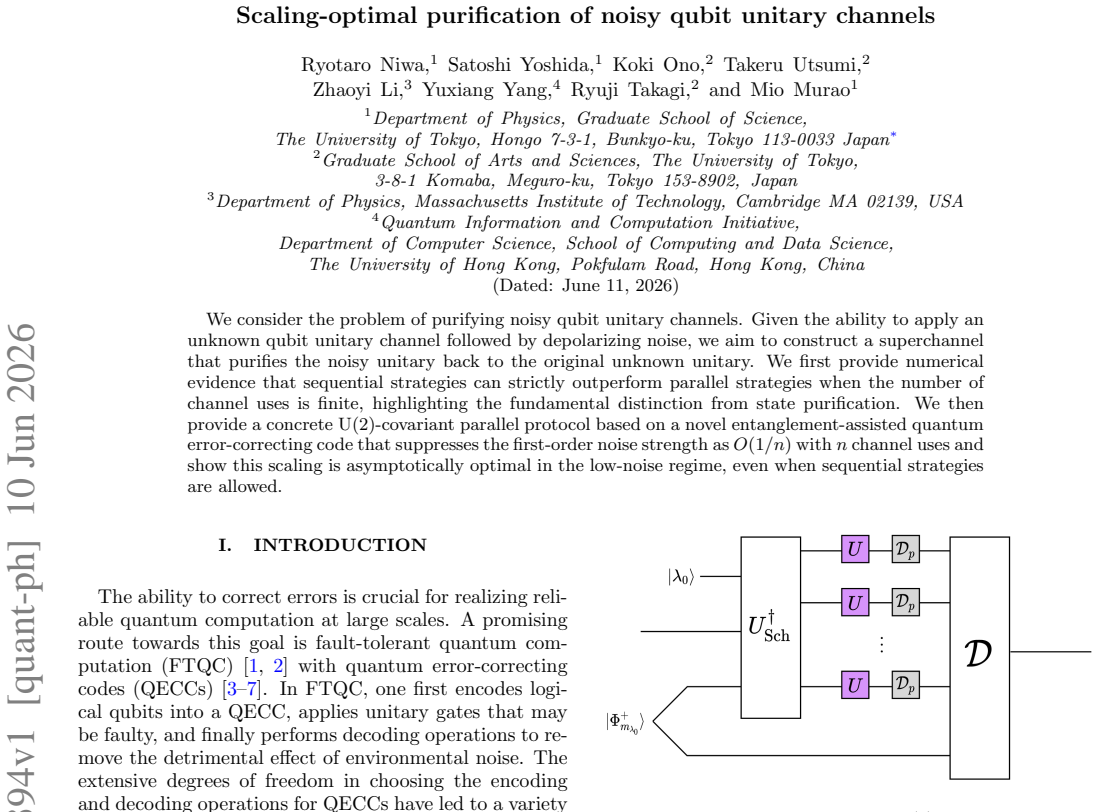
The authors construct a U(2)-covariant parallel protocol based on a novel entanglement-assisted quantum error-correcting code that suppresses the first-order noise strength as O(1/n) with n channel uses and show this scaling is asymptotically optimal in the low-noise regime, even when sequential strategies are allowed.
What carries the argument
novel entanglement-assisted quantum error-correcting code enabling U(2)-covariant parallel purification of noisy qubit unitaries
Load-bearing premise
The analysis assumes depolarizing noise and focuses on the low-noise regime where higher-order terms can be neglected.
What would settle it
A protocol, sequential or parallel, that achieves strictly better than O(1/n) scaling on the leading noise term under depolarizing noise in the low-noise limit would falsify the optimality claim.
Figures
read the original abstract
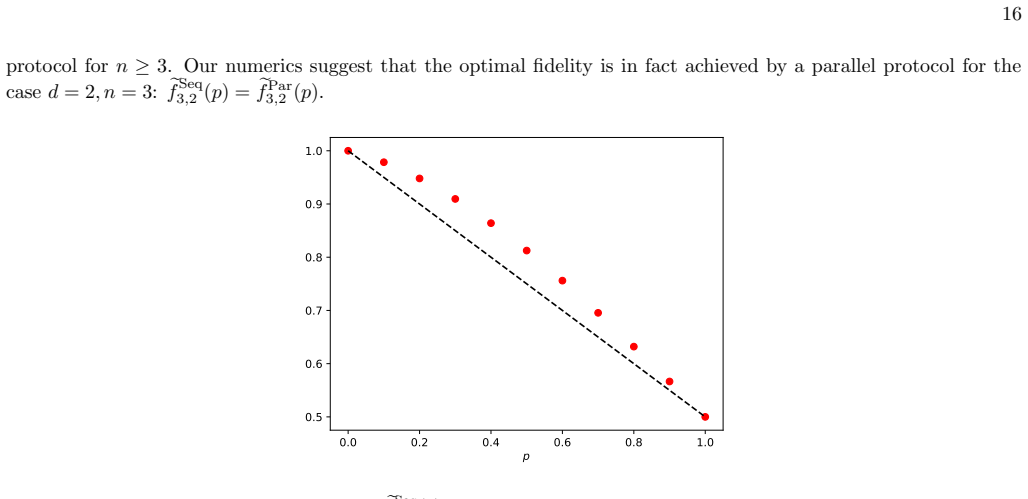
We consider the problem of purifying noisy qubit unitary channels. Given the ability to apply an unknown qubit unitary channel followed by depolarizing noise, we aim to construct a superchannel that purifies the noisy unitary back to the original unknown unitary. We first provide numerical evidence that sequential strategies can strictly outperform parallel strategies when the number of channel uses is finite, highlighting the fundamental distinction from state purification. We then provide a concrete $\mathrm{U}(2)$-covariant parallel protocol based on a novel entanglement-assisted quantum error-correcting code that suppresses the first-order noise strength as $O(1/n)$ with $n$ channel uses and show this scaling is asymptotically optimal in the low-noise regime, even when sequential strategies are allowed.
Editorial analysis
A structured set of objections, weighed in public.
Referee Report
Summary. The paper considers the purification of noisy qubit unitary channels under depolarizing noise. It provides numerical evidence that sequential strategies can strictly outperform parallel strategies for finite numbers of channel uses. It then introduces a concrete U(2)-covariant parallel protocol based on a novel entanglement-assisted quantum error-correcting code that suppresses the leading (first-order) noise term as O(1/n) and proves that this scaling is asymptotically optimal in the low-noise regime, even when sequential strategies are permitted.
Significance. If the optimality result holds, the work establishes a fundamental scaling limit for unitary channel purification that is distinct from state purification and supplies an explicit covariant protocol achieving the bound. This would provide a benchmark for low-noise channel purification tasks with potential relevance to quantum error correction and simulation.
major comments (1)
- [Optimality analysis for sequential strategies] The section establishing asymptotic optimality for sequential strategies (the paragraph following the protocol construction) expands only to first order in the depolarizing parameter ε and neglects higher-order terms. The reported numerical evidence that sequential strategies outperform parallel ones at finite n indicates that adaptive choices or O(ε²) contributions may permit better leading-order suppression, so the claimed bound on sequential strategies requires an explicit argument that higher-order or adaptive cancellations cannot improve the O(1/n) scaling as ε→0.
minor comments (2)
- [Abstract and numerical results section] The abstract states that numerical evidence exists for sequential outperforming parallel strategies, but the main text should include a dedicated figure or table (with explicit parameters and error bars) so that the strength of this evidence can be assessed directly.
- [Protocol construction] The construction of the novel entanglement-assisted QECC is described at a high level; adding an explicit circuit diagram or stabilizer tableau in the protocol section would improve reproducibility.
Simulated Author's Rebuttal
We thank the referee for their careful reading and constructive comment on the optimality analysis. We address the concern directly below, providing the requested clarification on why the first-order analysis suffices for the asymptotic claim. We will incorporate a brief explanatory remark into the revised manuscript.
read point-by-point responses
-
Referee: The section establishing asymptotic optimality for sequential strategies (the paragraph following the protocol construction) expands only to first order in the depolarizing parameter ε and neglects higher-order terms. The reported numerical evidence that sequential strategies outperform parallel ones at finite n indicates that adaptive choices or O(ε²) contributions may permit better leading-order suppression, so the claimed bound on sequential strategies requires an explicit argument that higher-order or adaptive cancellations cannot improve the O(1/n) scaling as ε→0.
Authors: We agree that the optimality paragraph focuses on the leading O(ε) term. In the low-noise regime (ε → 0), this term dominates the total deviation from the ideal unitary channel; any O(ε²) or higher contribution is o(ε) and cannot cancel or improve the coefficient of the leading term. The U(2)-covariance constraint, combined with the representation-theoretic decomposition of the effective noise map, forces the first-order deviation (in the adjoint representation) to be at least Ω(1/n) regardless of adaptivity or higher-order cancellations, as the bound derives from the minimal dimension of the code space needed to protect against all unitaries simultaneously. The numerical evidence of sequential advantage at finite n and fixed ε pertains to sub-leading constants or O(ε²) effects and does not alter the leading scaling as ε → 0. We will add one sentence in the revised manuscript explicitly stating that higher-order terms are negligible in this asymptotic limit and cannot improve the O(1/n) scaling. revision: yes
Circularity Check
No significant circularity; optimality derived from explicit analysis rather than construction or self-citation.
full rationale
The paper constructs an explicit U(2)-covariant parallel protocol via a novel entanglement-assisted QECC and derives the O(1/n) scaling from that construction. The asymptotic optimality claim for sequential strategies is presented as following from a separate low-noise analysis (neglecting higher-order terms), not from fitting parameters to the protocol output or from a self-citation chain that reduces the result to its inputs. Numerical evidence distinguishing sequential from parallel strategies at finite n further indicates independent content. No quoted equations or sections exhibit self-definition, fitted-input-as-prediction, or load-bearing self-citation that collapses the central claim.
Axiom & Free-Parameter Ledger
invented entities (1)
-
novel entanglement-assisted quantum error-correcting code for unitary channel purification
no independent evidence
Reference graph
Works this paper leans on
-
[1]
Gottesman, Theory of fault-tolerant quantum compu- tation, Phys
D. Gottesman, Theory of fault-tolerant quantum compu- tation, Phys. Rev. A57, 127 (1998)
1998
-
[2]
D. Gottesman, Fault-tolerant quantum computation with constant overhead (2014), arXiv:1310.2984 [quant-ph]
Pith/arXiv arXiv 2014
-
[3]
Gottesman, Stabilizer codes and quantum error cor- rection (1997), arXiv:quant-ph/9705052
D. Gottesman, Stabilizer codes and quantum error cor- rection (1997), arXiv:quant-ph/9705052
Pith/arXiv arXiv 1997
-
[4]
A. R. Calderbank and P. W. Shor, Good quantum error- correcting codes exist, Phys. Rev. A54, 1098 (1996)
1996
-
[5]
A. M. Steane, Simple quantum error-correcting codes, Phys. Rev. A54, 4741 (1996)
1996
-
[6]
Kitaev, Fault-tolerant quantum computation by anyons, Annals of Physics303, 2 (2003)
A. Kitaev, Fault-tolerant quantum computation by anyons, Annals of Physics303, 2 (2003)
2003
-
[7]
Dennis, A
E. Dennis, A. Kitaev, A. Landahl, and J. Preskill, Topological quantum memory, Journal of Mathematical Physics43, 4452–4505 (2002)
2002
-
[8]
Bombin and M
H. Bombin and M. A. Martin-Delgado, Topological quan- tum distillation, Phys. Rev. Lett.97, 180501 (2006)
2006
-
[9]
T. Brun, I. Devetak, and M.-H. Hsieh, Correcting quan- tum errors with entanglement, Science314, 436–439 (2006)
2006
-
[10]
J. I. Cirac, A. K. Ekert, and C. Macchiavello, Optimal purification of single qubits, Phys. Rev. Lett.82, 4344 (1999)
1999
-
[11]
A. M. Childs, H. Fu, D. Leung, Z. Li, M. Ozols, and V. Vyas, Streaming quantum state purification, Quan- tum9, 1603 (2025)
2025
- [12]
-
[13]
S. Brahmachari, A. Hulse, H. D. Pfister, and I. Marvian, Optimal qubit purification and unitary schur sampling via random swap tests (2025), arXiv:2508.05046 [quant- ph]
arXiv 2025
-
[14]
Z. Li, H. Fu, T. Isogawa, C. Silva, and I. Chuang, Optimal quantum purity amplification (2025), arXiv:2409.18167 [quant-ph]
arXiv 2025
-
[15]
Chiribella, G
G. Chiribella, G. M. D’Ariano, and P. Perinotti, Trans- forming quantum operations: Quantum supermaps, EPL (Europhysics Letters)83, 30004 (2008)
2008
-
[16]
Z. Liu, X. Zhang, Y.-Y. Fei, and Z. Cai, Virtual channel purification, PRX Quantum6, 020325 (2025)
2025
-
[17]
J. Zhao, Y.-A. Chen, G. Zhen, C. Zhu, R. Chen, and X. Wang, Distilling unitary operations: A no-go theorem and minimal realization (2026), arXiv:2604.01048 [quant- ph]
Pith/arXiv arXiv 2026
-
[18]
D. Bacon, I. L. Chuang, and A. W. Harrow, The quan- tum schur transform: I. efficient qudit circuits (2005), arXiv:quant-ph/0601001 [quant-ph]
Pith/arXiv arXiv 2005
-
[19]
W. M. Kirby and F. W. Strauch, A practical quantum algorithm for the schur transform, Quantum Information and Computation18, 721–742 (2018)
2018
-
[20]
A. Burchardt, J. Fei, D. Grinko, M. Larocca, M. Ozols, S. Timmerman, and V. Visnevskyi, High-dimensional quantum schur transforms (2025), arXiv:2509.22640 [quant-ph]
arXiv 2025
-
[21]
Gour, Comparison of quantum channels by superchan- nels, IEEE Transactions on Information Theory65, 5880 (2019)
G. Gour, Comparison of quantum channels by superchan- nels, IEEE Transactions on Information Theory65, 5880 (2019)
2019
-
[22]
G. Chiribella, G. M. D’Ariano, and P. Perinotti, Quan- tum Circuit Architecture, Phys. Rev. Lett.101, 060401 (2008), arXiv:0712.1325
Pith/arXiv arXiv 2008
-
[23]
Knill, R
E. Knill, R. Laflamme, and L. Viola, Theory of quantum error correction for general noise, Phys. Rev. Lett.84, 2525 (2000)
2000
-
[24]
Barnum and E
H. Barnum and E. Knill, Reversing quantum dynamics with near-optimal quantum and classical fidelity, Journal of Mathematical Physics43, 2097 (2002)
2097
-
[25]
B´ eny and O
C. B´ eny and O. Oreshkov, General conditions for approx- imate quantum error correction and near-optimal recov- ery channels, Phys. Rev. Lett.104, 120501 (2010)
2010
-
[26]
H. K. Ng and P. Mandayam, Simple approach to approx- imate quantum error correction based on the transpose channel, Phys. Rev. A81, 062342 (2010)
2010
-
[27]
Note that the references [28, 33, 34] use the square root fidelityf root := Tr p ρ1/2σρ1/2
-
[28]
Faist, S
P. Faist, S. Nezami, V. V. Albert, G. Salton, F. Pastawski, P. Hayden, and J. Preskill, Continuous symmetries and approximate quantum error correction, Phys. Rev. X10, 041018 (2020)
2020
-
[29]
C. W. Helstrom, Quantum detection and estimation the- ory, Journal of Statistical Physics1, 231 (1969)
1969
-
[30]
A.S.Holevo,Probabilistic and Statistical Aspects of Quan- tum Theory(Springer Science & Business Media, 1982)
1982
-
[31]
Fujiwara and H
A. Fujiwara and H. Imai, A fibre bundle over manifolds of quantum channels and its application to quantum statis- tics, Journal of Physics A: Mathematical and Theoretical 41, 255304 (2008)
2008
-
[32]
Zhou and L
S. Zhou and L. Jiang, Asymptotic theory of quantum channel estimation, PRX Quantum2, 010343 (2021)
2021
-
[33]
Kubica and R
A. Kubica and R. Demkowicz-Dobrza´ nski, Using quan- tum metrological bounds in quantum error correction: A simple proof of the approximate eastin-knill theorem, Phys. Rev. Lett.126, 150503 (2021)
2021
-
[34]
Zhou, Z.-W
S. Zhou, Z.-W. Liu, and L. Jiang, New perspectives on covariant quantum error correction, Quantum5, 521 (2021)
2021
-
[35]
Chiribella and D
G. Chiribella and D. Ebler, Optimal quantum networks and one-shot entropies, New Journal of Physics18, 093053 (2016)
2016
-
[36]
Grinko and M
D. Grinko and M. Ozols, Linear programming with unitary-equivariant constraints, Communications in Mathematical Physics405, 278 (2024)
2024
-
[37]
Yoshida, A
S. Yoshida, A. Soeda, and M. Murao, Reversing unknown qubit-unitary operation, deterministically and exactly, Phys. Rev. Lett.131, 120602 (2023)
2023
-
[38]
M. T. Quintino and D. Ebler, Deterministic transforma- tions between unitary operations: Exponential advantage with adaptive quantum circuits and the power of indefi- nite causality, Quantum6, 679 (2022)
2022
-
[39]
MATLAB,version 9.11.0 (R2021b)(The MathWorks Inc., Natick, Massachusetts, 2021)
2021
-
[40]
Grant and S
M. Grant and S. Boyd, CVX: Matlab software for disci- plined convex programming, version 2.2,http://cvxr. com/cvx(2020)
2020
-
[41]
Grant and S
M. Grant and S. Boyd, Graph implementations for nons- mooth convex programs, inRecent Advances in Learn- ing and Control, Lecture Notes in Control and Infor- mation Sciences, edited by V. Blondel, S. Boyd, and H. Kimura (Springer-Verlag Limited, 2008) pp. 95–110, http://stanford.edu/~boyd/graph_dcp.html. [42]http://www.math.nus.edu.sg/.mattohkc/sdpt3.html. 8
2008
-
[42]
K.-C. Toh, M. J. Todd, and R. H. T¨ ut¨ unc¨ u, Sdpt3—a matlab software package for semidefinite programming, version 1.3, Optim. Methods Software11, 545 (1999)
1999
-
[43]
R. H. T¨ ut¨ unc¨ u, K.-C. Toh, and M. J. Todd, Solv- ing semidefinite-quadratic-linear programs using sdpt3, Math. Program.95, 189 (2003)
2003
-
[44]
J. F. Sturm, Using sedumi 1.02, a matlab toolbox for op- timization over symmetric cones, Optim. Methods Soft- ware11, 625 (1999)
1999
-
[45]
sagemath.org
The Sage Developers,SageMath, the Sage Mathemat- ics Software System (Version 9.7)(2022),https://www. sagemath.org
2022
-
[46]
F. G. S. L. Brand˜ ao, E. Crosson, M. B. S ¸ahino˘ glu, and J. Bowen, Quantum error correcting codes in eigenstates of translation-invariant spin chains, Phys. Rev. Lett.123, 110502 (2019)
2019
-
[47]
Y. Yang, Y. Mo, J. M. Renes, G. Chiribella, and M. P. Woods, Optimal universal quantum error correction via bounded reference frames, Phys. Rev. Res.4, 023107 (2022)
2022
-
[48]
Kong and Z.-W
L. Kong and Z.-W. Liu, Near-optimal covariant quan- tum error-correcting codes from random unitaries with symmetries, PRX Quantum3, 020314 (2022)
2022
-
[49]
Choi, Completely positive linear maps on complex matrices, Linear Algebra Appl.10, 285 (1975)
M.-D. Choi, Completely positive linear maps on complex matrices, Linear Algebra Appl.10, 285 (1975)
1975
-
[50]
Jamio lkowski, Linear transformations which preserve trace and positive semidefiniteness of operators, Rep
A. Jamio lkowski, Linear transformations which preserve trace and positive semidefiniteness of operators, Rep. Math. Phys.3, 275 (1972)
1972
-
[51]
G. D. James,The Representation Theory of the Symmet- ric Groups, Vol. 682 (Springer, 2006)
2006
-
[52]
Goodman and N
R. Goodman and N. R. Wallach,Symmetry, Representa- tions, and Invariants, Vol. 255 (Springer, 2009). [54]https://github.com/rn8128/ Qubit-unitary-purification. 9 Appendix A: Notation and Background
2009
-
[53]
Notation Here we clarify the big-OnotationO(·), Ω(·), and Θ(·), used in the main text. They are defined as follows: f(x) =O(g(x))⇔lim sup x→∞ f(x) g(x) <∞(A1) f(x) = Ω(g(x))⇔g(x) =O(f(x)) (A2) f(x) = Θ(g(x))⇔f(x) =O(g(x)),andf(x) = Ω(g(x)).(A3) We also useO n(·), which means fn(x) =O n(g(x))⇔lim sup x→0 fn(x) g(x) <∞(A4) for every fixedn
-
[54]
Given a quantum channel Φ :L(I)→ L(O), its Choi matrix is defined by JΦ := dIX i,j=1 |i⟩ ⟨j|I ⊗Φ(|i⟩ ⟨j|)O ∈ L(I ⊗ O),(A5) satisfying the conditionJ Φ ≥0,Tr O(JΦ) =I I
Choi–Jamio lkowski isomorphism for quantum channels and superchannels The Choi–Jamio lkowski isomorphism [50, 51] is a convenient way to represent quantum channels and superchannels. Given a quantum channel Φ :L(I)→ L(O), its Choi matrix is defined by JΦ := dIX i,j=1 |i⟩ ⟨j|I ⊗Φ(|i⟩ ⟨j|)O ∈ L(I ⊗ O),(A5) satisfying the conditionJ Φ ≥0,Tr O(JΦ) =I I. Under...
-
[55]
Schur-Weyl duality Consider the following representation of the unitary groupU(d) and the symmetric groupS n, U ⊗n|i1⟩ ⊗ · · · ⊗ |in⟩=U|i 1⟩ ⊗ · · · ⊗U|i n⟩(A12) π(σ)|i1⟩ ⊗ · · · ⊗ |in⟩=|i σ−1(1)⟩ ⊗ · · · ⊗ |iσ−1(n)⟩,(A13) forU∈U(d) andσ∈S n. The Schur-Weyl duality is the following decomposition of the Hilbert space: (Cd)⊗n ≃ M λ⊢n ℓ(λ)≤d Uλ ⊗ Sλ (A14) U ...
-
[56]
Then, P=D q ◦ Ufor some real numberq
Validity of concatenation schemes Lemma 2.LetN=D p ◦ U, and let the output of a twirled purification superchannelΞbeP= Ξ(N ⊗n). Then, P=D q ◦ Ufor some real numberq. Proof.Let Ξ denote the twirled superchannel with the symmetry [V ∗ P ⊗V ⊗n I ⊗W ∗ F ⊗W ⊗n O ,J Ξ] = 0.(D1) LetQdenote the channel Q= Ξ(D ⊗n p ).(D2) 15 Using the symmetry, we can show that Ξ(...
-
[57]
Fork= 3, we have the valueC (1) 3 = 5 4 − 2 √ 2 3 ≃0.3072
Performance of concatenation schemes Suppose that ak-slot purification superchannel satisfies fk(p) = 1−C (1) k p+O k(p2).(D5) Then, the effective depolarizing parameter after one layer is p7→r kp+O k(p2), r k := 4C(1) k 3 .(D6) Afterℓconcatenation layers, one has pℓ =r ℓ kp+O k(p2), n=k ℓ.(D7) Therefore, pn ∼r logk n k p=n logk rk p=n logk 4C(1) k 3 ! p....
1968
discussion (0)
Sign in with ORCID, Apple, or X to comment. Anyone can read and Pith papers without signing in.