Pluralistic-Alignment Urbanism: Operationalizing a Right to AI for Inclusive Public Space
Pith reviewed 2026-06-30 18:51 UTC · model grok-4.3
The pith
Municipal AI systems for public space can be governed by a procedural Right to AI that incorporates structured disagreement and limited scaling from participatory cases.
A machine-rendered reading of the paper's core claim, the machinery that carries it, and where it could break.
Core claim
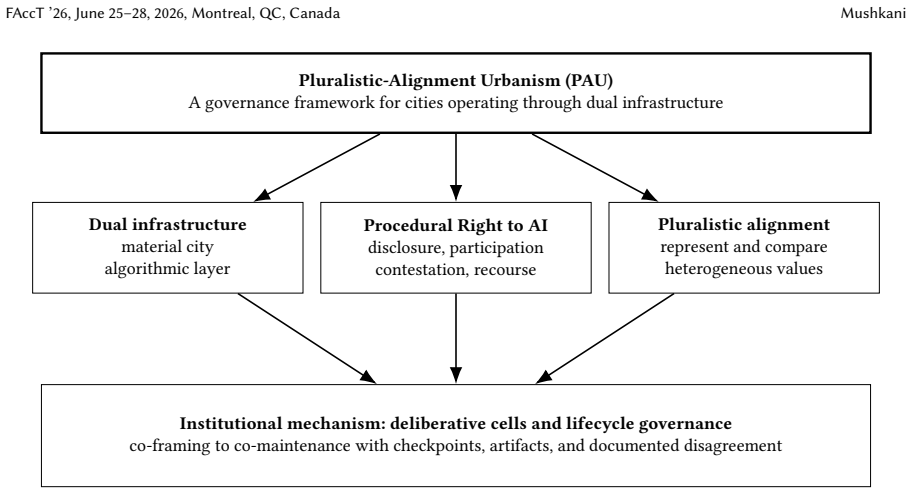
Pluralistic-Alignment Urbanism translates observed constraints from two Montreal cases into a municipal governance architecture: Street Review produces subgroup-aware scaling models with R2 of 0.89 on held-out data; LIVS builds pluralistic preference data for text-to-image alignment and treats neutral selections as indeterminacy. Across cases, disagreement is structured, deliberation alters evidence, scaling is feasible yet modality-limited, and neutrality bounds preference tuning. These patterns yield disaggregated reporting, a versioned value register, standing deliberative cells, procurement clauses, and defined pause and rollback authority.
What carries the argument
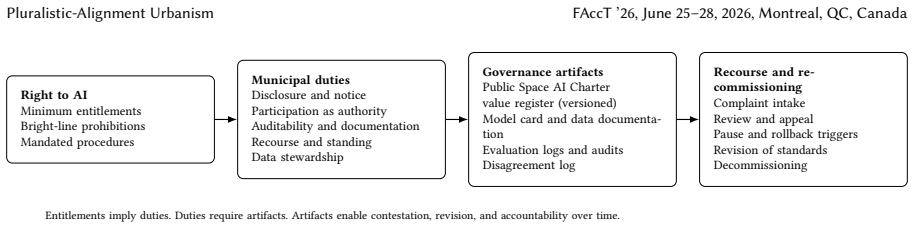
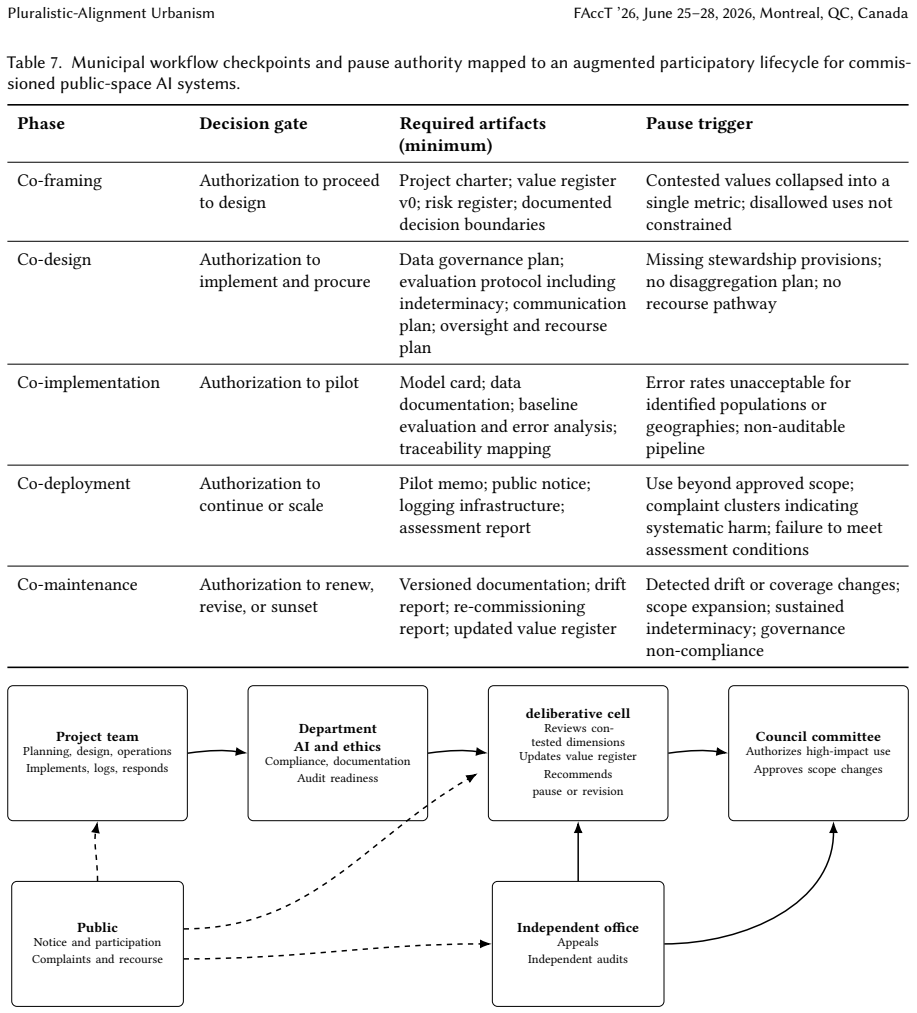
Pluralistic-Alignment Urbanism (PAU), a procedural governance framework that converts participatory constraints on disagreement, scaling, and neutrality into municipal AI oversight rules including reporting, registers, cells, clauses, and rollback powers.
If this is right
- Disaggregated reporting would require AI outputs to be broken down by demographic or spatial subgroups rather than city-wide aggregates.
- A versioned value register would record shifting community criteria over time and tie them to specific model versions.
- Standing deliberative cells would maintain ongoing resident input separate from one-off consultations.
- Procurement clauses would embed pause and rollback authority into contracts with AI vendors.
Where Pith is reading between the lines
- The same architecture could extend to other municipal AI domains such as traffic or waste systems if the participatory patterns prove similar.
- Neutrality-as-indeterminacy might limit how far preference-tuned models can claim democratic legitimacy without additional justification layers.
- Versioned registers could create audit trails usable by oversight bodies beyond the original municipality.
Load-bearing premise
The patterns of structured disagreement, limited scaling, and neutrality observed in two Montreal projects can be turned into effective, generalizable governance rules for AI systems in other municipalities.
What would settle it
Implementation of the PAU elements in a second city yields no measurable change in how resident subgroups contest or accept AI outputs on public-space decisions, or produces rollback decisions that ignore the value register.
Figures
read the original abstract
Municipal agencies increasingly use machine learning to inventory sidewalks, score streetscapes, and generate visualizations of public-space interventions. These systems produce outputs that enter budgeting, design iteration, and public justification, yet judgments about inclusion, safety, and belonging remain contested. This paper proposes Pluralistic-Alignment Urbanism (PAU), a procedural governance framework that treats public-space AI systems as civic infrastructure and formulates a procedural Right to AI for municipal uses of such systems. Drawing on two participatory case studies with community organizations in Montreal, Canada, the paper examines how disagreement, subgroup variation, bounded predictive scaling, and neutral preference judgments can inform municipal AI governance. Street Review elicits resident criteria for streetscape evaluation and trains a subgroup-aware scaling model for co-produced judgments, achieving an R2 of 0.89 on a held-out test set. LIVS, a Local Intersectional Visual Spaces dataset, constructs pluralistic preference data for aligning text-to-image models and treats neutral selections as evidence of indeterminacy. Across the cases, disagreement appears structured, deliberation changes what counts as evidence, scaling is feasible but limited by modality and coverage, and neutrality constrains what preference tuning can justify. PAU translates these constraints into a municipal governance architecture with disaggregated reporting, a versioned value register, standing deliberative cells, procurement clauses, and defined pause and rollback authority.
Editorial analysis
A structured set of objections, weighed in public.
Referee Report
Summary. The paper proposes Pluralistic-Alignment Urbanism (PAU), a procedural governance framework that treats municipal public-space AI systems as civic infrastructure and operationalizes a Right to AI. Drawing on two Montreal participatory case studies—Street Review, which elicits resident criteria and trains a subgroup-aware scaling model achieving R²=0.89 on held-out data, and LIVS, which constructs pluralistic preference data treating neutral selections as indeterminacy—the paper identifies patterns of structured disagreement, bounded scaling, and neutrality constraints, then translates them into a municipal architecture featuring disaggregated reporting, a versioned value register, standing deliberative cells, procurement clauses, and pause/rollback authority.
Significance. If the framework holds, PAU would offer a concrete procedural approach to incorporating pluralistic values into urban AI governance, addressing contested judgments about inclusion and belonging. The provision of quantitative results from the case studies (R²=0.89) and explicit mapping from empirical patterns to governance components is a strength that could inform future work in computational social science and municipal AI deployment.
major comments (3)
- [PAU governance architecture (final sections)] The section proposing the PAU governance architecture asserts that patterns observed in the two Montreal case studies (structured disagreement, bounded scaling, neutrality-as-indeterminacy) directly support a general municipal architecture with disaggregated reporting, versioned value register, standing deliberative cells, procurement clauses, and pause/rollback authority. No cross-municipal validation, counterfactual testing, or demonstration is provided showing these components produce effective outcomes when applied elsewhere; this is load-bearing for the central claim of operationalizing a Right to AI.
- [Street Review case study] In the Street Review case study description, the subgroup-aware scaling model is reported to achieve an R² of 0.89 on a held-out test set, yet the manuscript supplies no information on sample size, model architecture, exclusion criteria, or statistical controls. This omission prevents evaluation of the 'bounded predictive scaling' and 'limited by modality and coverage' conclusions.
- [LIVS case study] The LIVS case study treats neutral selections as evidence of indeterminacy and uses this to motivate governance rules such as standing deliberative cells, but the manuscript does not test or demonstrate that these procedural components would effectively manage pluralistic preferences or improve outcomes in other municipal settings.
minor comments (2)
- [Abstract and Introduction] The abstract and introduction would benefit from explicit separation between the empirical observations (e.g., R² value, preference data) and the normative governance proposals to clarify the evidential basis.
- [Related Work / Discussion] Additional references to prior work on AI governance frameworks, participatory budgeting, and value-sensitive design in urban planning would help situate PAU within existing literature.
Simulated Author's Rebuttal
We thank the referee for the constructive report and address each major comment below. Our responses clarify the scope of the claims as a case-study-derived proposal while indicating revisions to improve transparency and precision.
read point-by-point responses
-
Referee: [PAU governance architecture (final sections)] The section proposing the PAU governance architecture asserts that patterns observed in the two Montreal case studies (structured disagreement, bounded scaling, neutrality-as-indeterminacy) directly support a general municipal architecture with disaggregated reporting, versioned value register, standing deliberative cells, procurement clauses, and pause/rollback authority. No cross-municipal validation, counterfactual testing, or demonstration is provided showing these components produce effective outcomes when applied elsewhere; this is load-bearing for the central claim of operationalizing a Right to AI.
Authors: The manuscript frames PAU as a procedural framework translated from patterns observed in the two Montreal cases rather than a validated general solution. The central claim is that these patterns inform the listed governance components; we do not assert empirical effectiveness elsewhere. We will revise the final sections to explicitly qualify the architecture as a proposal derived from the case studies and to include a limitations paragraph calling for future cross-municipal testing. revision: partial
-
Referee: [Street Review case study] In the Street Review case study description, the subgroup-aware scaling model is reported to achieve an R² of 0.89 on a held-out test set, yet the manuscript supplies no information on sample size, model architecture, exclusion criteria, or statistical controls. This omission prevents evaluation of the 'bounded predictive scaling' and 'limited by modality and coverage' conclusions.
Authors: The omission is an oversight. We will revise the Street Review section to add a methods paragraph reporting sample size (n=312 valid responses), model architecture (hierarchical linear regression with subgroup random effects), exclusion criteria (incomplete surveys and duplicate IP addresses), and controls (demographic covariates). These additions will allow readers to assess the bounded-scaling claim directly. revision: yes
-
Referee: [LIVS case study] The LIVS case study treats neutral selections as evidence of indeterminacy and uses this to motivate governance rules such as standing deliberative cells, but the manuscript does not test or demonstrate that these procedural components would effectively manage pluralistic preferences or improve outcomes in other municipal settings.
Authors: We agree no empirical test of the proposed governance components is provided. The LIVS data illustrate the indeterminacy pattern that motivates standing deliberative cells as one procedural response. We will revise the relevant paragraphs to state explicitly that the components are proposed mechanisms derived from the observed constraints, not tested interventions, and to flag this as requiring future evaluation. revision: partial
- No cross-municipal validation, counterfactual testing, or demonstration of the PAU governance components' effectiveness when applied in other municipal settings.
Circularity Check
No significant circularity in derivation from case studies to PAU framework
full rationale
The paper presents two Montreal participatory projects (Street Review with R2=0.89 and LIVS) as independent empirical inputs documenting structured disagreement, bounded scaling, and neutrality-as-indeterminacy. These observations are then used to propose the PAU governance architecture (disaggregated reporting, versioned value register, deliberative cells, procurement clauses, pause/rollback authority). No equations, fitted parameters, or self-citations reduce the central procedural claims to the inputs by construction. The R2 metric is a standard held-out performance statistic and does not create circularity. The derivation chain is self-contained against external benchmarks.
Axiom & Free-Parameter Ledger
free parameters (1)
- subgroup-aware scaling model parameters
invented entities (1)
-
Pluralistic-Alignment Urbanism (PAU)
no independent evidence
Reference graph
Works this paper leans on
-
[1]
Tim Alpherts, Sennay Ghebreab, Yen-Chia Hsu, and Nanne Van Noord. 2024. Perceptive Visual Urban Analytics is Not (Yet) Suitable for Municipalities. InProceedings of the 2024 ACM Conference on Fairness, Accountability, and Transparency (FAccT ’24). ACM, New York, NY, USA, 1341–1354. doi:10.1145/3630106.3658976
-
[2]
Sherry R. Arnstein. 1969. A Ladder Of Citizen Participation.Journal of the American Institute of Planners35, 4 (1969), 216–224. doi:10.1080/01944366908977225
-
[3]
Lora Aroyo and Chris Welty. 2015. Truth is a Lie: CrowdTruth and the Seven Myths of Human Annotation.AI Magazine36, 1 (2015), 15–24. https://ojs.aaai.org/aimagazine/index.php/aimagazine/article/view/2564
2015
-
[4]
Solon Barocas and Andrew D. Selbst. 2016. Big data’s disparate impact.California Law Review104, 3 (2016), 671–732
2016
-
[5]
John J. Bartko. 1966. The Intraclass Correlation Coefficient as a Measure of Reliability.Psychological Reports19, 1 (1966), 3–11. doi:10.2466/pr0.1966.19.1.3
-
[6]
2018.Inventing Future Cities
Michael Batty. 2018.Inventing Future Cities. MIT Press, Cambridge, MA, USA
2018
-
[7]
2024.The Computable City: Histories, Technologies, Stories, Predictions
Michael Batty. 2024.The Computable City: Histories, Technologies, Stories, Predictions. MIT Press, Cambridge, MA, USA
2024
-
[8]
2019.Race After Technology: Abolitionist Tools for the New Jim Code
Ruha Benjamin. 2019.Race After Technology: Abolitionist Tools for the New Jim Code. Polity, Cambridge, UK
2019
-
[9]
Isaiah Berlin. 1969. Two Concepts of Liberty. InFour Essays on Liberty. Oxford University Press, Oxford. Inaugural lecture delivered 1958; reprinted in 1969 collection
1969
-
[10]
Geoffrey C. Bowker and Susan Leigh Star. 1999.Sorting Things Out: Classification and Its Consequences. MIT Press, Cambridge, MA. doi:10.7551/mitpress/6352.001.0001
-
[11]
S. Brayne. 2017. Big Data Surveillance: The Case of Policing.American Sociological Review82, 5 (2017), 977–1008. doi:10.1177/ 0003122417725865
2017
-
[12]
Quanze Chen, Jonathan Bragg, Lydia B. Chilton, and Daniel S. Weld. 2019. Cicero: Multi-Turn, Contextual Argumentation for Accurate Crowdsourcing. InProceedings of the 2019 CHI Conference on Human Factors in Computing Systems (CHI ’19). ACM, New York, NY, USA, Article 531, 14 pages. doi:10.1145/3290605.3300761
-
[13]
Deep reinforcement learning from human preferences
Paul F. Christiano, Jan Leike, Tom B. Brown, Miljan Martic, Shane Legg, and Dario Amodei. 2017. Deep Reinforcement Learning from Human Preferences. doi:10.48550/arXiv.1706.03741
work page internal anchor Pith review Pith/arXiv arXiv doi:10.48550/arxiv.1706.03741 2017
-
[14]
T. Cohen and N. P. Suzor. 2024. Contesting the Public Interest in AI Governance.Internet Policy Review13, 3 (2024), 32 pages. doi:10.14763/2024.3.1794
-
[15]
Holliday, Bob M
Vincent Conitzer, Rachel Freedman, Jobst Heitzig, Wesley H. Holliday, Bob M. Jacobs, Nathan Lambert, Milan Mossé, Eric Pacuit, Stuart Russell, Hailey Schoelkopf, Emanuel Tewolde, and William S. Zwicker. 2024. Position: social choice should guide AI alignment in dealing with diverse human feedback. InProceedings of the 41st International Conference on Mach...
2024
-
[16]
2020.Design Justice: Community-Led Practices to Build the Worlds We Need
Sasha Costanza-Chock. 2020.Design Justice: Community-Led Practices to Build the Worlds We Need. The MIT Press, Cambridge, MA. doi:10.7551/mitpress/12255.001.0001
-
[17]
2021.Atlas of AI: Power, Politics, and the Planetary Costs of Artificial Intelligence
Kate Crawford. 2021.Atlas of AI: Power, Politics, and the Planetary Costs of Artificial Intelligence. Yale University Press, New Haven, CT, USA
2021
-
[18]
Kimberlé Crenshaw. 1989. Demarginalizing the intersection of race and sex: A black feminist critique of anti-discrimination doctrine, feminist theory and antiracist politics.University of Chicago Legal Forum1989, 1 (1989), 139–167
1989
-
[19]
Fernando Delgado, Stephen Yang, Michael Madaio, and Qian Yang. 2023. The Participatory Turn in AI Design: Theoretical Foundations and the Current State of Practice. InProceedings of the 3rd ACM Conference on Equity and Access in Algorithms, Mechanisms, and Optimization (EAAMO ’23). ACM, New York, NY, USA, 1–23. doi:10.1145/3617694.3623261
-
[20]
1998.The Politics of Large Numbers: A History of Statistical Reasoning
Alain Desrosières. 1998.The Politics of Large Numbers: A History of Statistical Reasoning. Harvard University Press, Cambridge, MA. Translated by Camille Naish
1998
-
[21]
1927.The Public and Its Problems
John Dewey. 1927.The Public and Its Problems. Henry Holt and Company, New York, NY, USA
1927
-
[22]
Rachit Dubey, Mathew D. Hardy, Thomas L. Griffiths, and Rahul Bhui. 2024. AI-generated visuals of car-free US cities help improve support for sustainable policies.Nature Sustainability7, 4 (2024), 399–403. doi:10.1038/s41893-024-01299-6
-
[23]
Wendy Nelson Espeland and Mitchell L. Stevens. 2008. A Sociology of Quantification.European Journal of Sociology / Archives Européennes de Sociologie49, 3 (2008), 401–436. doi:10.1017/S0003975609000150
-
[24]
2018.Automating Inequality: How High-Tech Tools Profile, Police, and Punish the Poor
Virginia Eubanks. 2018.Automating Inequality: How High-Tech Tools Profile, Police, and Punish the Poor. St. Martin’s Press, New York, NY, USA
2018
-
[25]
James S. Fishkin. 2009.When the People Speak: Deliberative Democracy and Public Consultation. Oxford University Press, Oxford
2009
-
[26]
2004.Empowered Participation: Reinventing Urban Democracy
Archon Fung. 2004.Empowered Participation: Reinventing Urban Democracy. Princeton University Press, Princeton, NJ
2004
-
[27]
2016.Program Earth: Environmental Sensing Technology and the Making of a Computational Planet
Jennifer Gabrys. 2016.Program Earth: Environmental Sensing Technology and the Making of a Computational Planet. University of Minnesota Press, Minneapolis, MN. Pluralistic-Alignment Urbanism FAccT ’26, June 25–28, 2026, Montreal, QC, Canada
2016
-
[28]
William A. Galston. 2002.Liberal Pluralism: The Implications of Value Pluralism for Political Theory and Practice. Cambridge University Press, Cambridge
2002
-
[29]
Timnit Gebru, Jamie Morgenstern, Briana Vecchione, Jennifer Wortman Vaughan, Hanna Wallach, Hal Daumé III, and Kate Crawford
-
[30]
Datasheets for datasets.Communications of the ACM, 64(12):86–92, 2021
Datasheets for Datasets.Commun. ACM64, 12 (nov 2021), 86–92. doi:10.1145/3458723 arXiv:1803.09010 (revised 2021)
-
[31]
Jose A. Guridi, Cristobal Cheyre, Maria Goula, Duarte Santo, Lee Humphreys, Achilleas Souras, and Aishwarya Shankar. 2025. Image Generative AI to Design Public Spaces: A Reflection of How AI Could Improve Co-Design of Public Parks.Digital Government: Research and Practice6, 1, Article 7 (2025), 14 pages. doi:10.1145/3656588
-
[32]
Guridi, Cristobal Cheyre, and Qian Yang
Jose A. Guridi, Cristobal Cheyre, and Qian Yang. 2025. Thoughtful Adoption of NLP for Civic Participation: Understanding Differences Among Policymakers.Proceedings of the ACM on Human-Computer Interaction9, CSCW2, Article CSCW193 (2025). doi:10.1145/3711091
-
[33]
1996.Between Facts and Norms: Contributions to a Discourse Theory of Law and Democracy
Jürgen Habermas. 1996.Between Facts and Norms: Contributions to a Discourse Theory of Law and Democracy. MIT Press, Cambridge, MA
1996
-
[34]
David Harvey. 2003. The right to the city.International Journal of Urban and Regional Research27, 4 (2003), 939–941. doi:10.1111/j.0309- 1317.2003.00492.x
-
[35]
1997.Collaborative Planning: Shaping Places in Fragmented Societies
Patsy Healey. 1997.Collaborative Planning: Shaping Places in Fragmented Societies. Red Globe Press, London. doi:10.1007/978-1-349- 25538-2
-
[36]
Tianchen Huang, Xinyue Ye, Tan Yigitcanlar, Boqian Xu, Galen Newman, Bo Zhao, Benjamin Ennemoser, Dayong Wu, Junghwan Kim, and Dongjie Wang. 2026. Artificial Intelligence in Urban Design: A Systematic Review.Cities169 (2026), 106527. doi:10.1016/j.cities. 2025.106527
-
[37]
Ibrahim, John Haworth, and Tao Cheng
Mohamed R. Ibrahim, John Haworth, and Tao Cheng. 2020. Understanding cities with machine eyes: A review of deep computer vision in urban analytics.Cities96 (2020), 102481. doi:10.1016/j.cities.2019.102481
-
[38]
2004.States of Knowledge: The Co-production of Science and Social Order
Sheila Jasanoff (Ed.). 2004.States of Knowledge: The Co-production of Science and Social Order. Routledge, London
2004
-
[39]
Margot E. Kaminski and Jennifer M. Urban. 2021. The Right to Contest AI.Columbia Law Review121, 7 (2021), 1957–2048. https: //www.jstor.org/stable/27083420
-
[40]
Yuhao Kang, Jonatan Abraham, Vania Ceccato, Fábio Duarte, Song Gao, Lukas Ljungqvist, Fan Zhang, Per Näsman, and Carlo Ratti
-
[41]
doi:10.1016/j.landurbplan.2023.104768
Assessing differences in safety perceptions using GeoAI and survey across neighbourhoods in Stockholm, Sweden.Landscape and Urban Planning236 (2023), 104768. doi:10.1016/j.landurbplan.2023.104768
-
[42]
Anna Kawakami, Amanda Coston, Hoda Heidari, Kenneth Holstein, and Haiyi Zhu. 2024. Studying Up Public Sector AI: How Networks of Power Relations Shape Agency Decisions Around AI Design and Use.Proceedings of the ACM on Human-Computer Interaction8, CSCW2, Article 450 (2024), 24 pages. doi:10.1145/3686989
-
[43]
2014.The Data Revolution: Big Data, Open Data, Data Infrastructures and Their Consequences
Rob Kitchin. 2014.The Data Revolution: Big Data, Open Data, Data Infrastructures and Their Consequences. SAGE Publications Ltd, London
2014
-
[44]
Rob Kitchin. 2014. The real-time city? Big data and smart urbanism.GeoJournal79, 1 (2014), 1–14. doi:10.1007/s10708-013-9516-8
-
[45]
Rob Kitchin. 2016. The ethics of smart cities and urban science.Philosophical Transactions of the Royal Society A: Mathematical, Physical and Engineering Sciences374, 2083 (2016), 20160115. doi:10.1098/rsta.2016.0115
-
[46]
Terry K. Koo and Mae Y. Li. 2016. A Guideline of Selecting and Reporting Intraclass Correlation Coefficients for Reliability Research. Journal of Chiropractic Medicine15, 2 (2016), 155–163. doi:10.1016/j.jcm.2016.02.012
-
[47]
1968.Le droit à la ville
Henri Lefebvre. 1968.Le droit à la ville. Anthropos, Paris
1968
-
[48]
Setha Low. 2020. Social justice as a framework for evaluating public space. InCompanion to Public Space(1 ed.). Routledge, London, UK, 11
2020
-
[49]
Setha M. Low. 2000.On the Plaza: The Politics of Public Space and Culture. University of Texas Press, Austin, TX
2000
-
[50]
Low and Neil Smith (Eds.)
Setha M. Low and Neil Smith (Eds.). 2006.The Politics of Public Space. Routledge, New York, NY
2006
-
[51]
Shannon Mattern. 2017. A City Is Not a Computer. Places Journal. doi:10.22269/170207 Accessed 2025-12-28
-
[52]
Vikas Mehta. 2014. Evaluating Public Space.Journal of Urban Design19, 1 (2014), 53–88. doi:10.1080/13574809.2013.854698
-
[53]
2016.The Seductions of Quantification: Measuring Human Rights, Gender Violence, and Sex Trafficking
Sally Engle Merry. 2016.The Seductions of Quantification: Measuring Human Rights, Gender Violence, and Sex Trafficking. University of Chicago Press, Chicago, IL
2016
-
[54]
Don Mitchell. 1995. The End of Public Space? People’s Park, Definitions of the Public, and Democracy.Annals of the Association of American Geographers85, 1 (1995), 108–133. doi:10.1111/j.1467-8306.1995.tb01797.x
-
[55]
2003.The Right to the City: Social Justice and the Fight for Public Space
Don Mitchell. 2003.The Right to the City: Social Justice and the Fight for Public Space. Guilford Press, New York, NY
2003
-
[56]
Margaret Mitchell, Simone Wu, Andrew Zaldivar, Parker Barnes, Lucy Vasserman, Ben Hutchinson, Elena Spitzer, Inioluwa Deborah Raji, and Timnit Gebru. 2019. Model Cards for Model Reporting. InProceedings of the Conference on Fairness, Accountability, and Transparency (FAT* ’19). ACM, New York, NY, USA, 220–229. doi:10.1145/3287560.3287596
-
[57]
2000.The Democratic Paradox
Chantal Mouffe. 2000.The Democratic Paradox. Verso, London
2000
-
[58]
Rashid Mushkani, Hugo Berard, Allison Cohen, and Shin Koseki. 2025. Position: The Right to AI. InProceedings of the 42nd International Conference on Machine Learning (Proceedings of Machine Learning Research, Vol. 267), Aarti Singh, Maryam Fazel, Daniel Hsu, Simon Lacoste-Julien, Felix Berkenkamp, Tegan Maharaj, Kiri Wagstaff, and Jerry Zhu (Eds.). PMLR, ...
2025
-
[59]
Rashid Mushkani and Shin Koseki. 2026. Street review: A participatory AI-based framework for assessing streetscape inclusivity.Cities 170 (2026), 106602. doi:10.1016/j.cities.2025.106602
-
[60]
Rashid Mushkani, Shravan Nayak, Hugo Berard, Allison Cohen, Shin Koseki, and Hadrien Bertrand. 2025. LIVS: A Pluralistic Alignment Dataset for Inclusive Public Spaces. InProceedings of the 42nd International Conference on Machine Learning (Proceedings of Machine Learning Research, Vol. 267), Aarti Singh, Maryam Fazel, Daniel Hsu, Simon Lacoste-Julien, Fel...
2025
-
[61]
Nikhil Naik, Jade Philipoom, Ramesh Raskar, and César A. Hidalgo. 2014. Streetscore – Predicting the Perceived Safety of One Million Streetscapes. InProceedings of the IEEE Conference on Computer Vision and Pattern Recognition Workshops (CVPRW). IEEE, Piscataway, NJ, USA, 793–799. doi:10.1109/CVPRW.2014.121
-
[62]
2010.Privacy in Context: Technology, Policy, and the Integrity of Social Life
Helen Nissenbaum. 2010.Privacy in Context: Technology, Policy, and the Integrity of Social Life. Stanford University Press, Stanford, CA. https://www.sup.org/books/law/privacy-context
2010
-
[63]
2018.Algorithms of Oppression: How Search Engines Reinforce Racism
Safiya Umoja Noble. 2018.Algorithms of Oppression: How Search Engines Reinforce Racism. NYU Press, New York, NY
2018
-
[64]
Long Ouyang, Jeff Wu, Xu Jiang, Diogo Almeida, Carroll L. Wainwright, Pamela Mishkin, Chong Zhang, Sandhini Agarwal, Katarina Slama, Alex Ray, John Schulman, Jacob Hilton, Fraser Kelton, Luke Miller, Maddie Simens, Amanda Askell, Peter Welinder, Paul Christiano, Jan Leike, and Ryan Lowe. 2022. Training language models to follow instructions with human fee...
work page internal anchor Pith review Pith/arXiv arXiv 2022
-
[65]
2015.The Black Box Society: The Secret Algorithms That Control Money and Information
Frank Pasquale. 2015.The Black Box Society: The Secret Algorithms That Control Money and Information. Harvard University Press, Cambridge, MA
2015
-
[66]
Ellie Pavlick and Tom Kwiatkowski. 2019. Inherent Disagreements in Human Textual Inferences.Transactions of the Association for Computational Linguistics7 (2019), 677–694. doi:10.1162/tacl_a_00293
-
[67]
Dustin Podell, Zion English, Kyle Lacey, Andreas Blattmann, Tim Dockhorn, Jonas Müller, Joe Penna, and Robin Rombach. 2023. SDXL: Improving Latent Diffusion Models for High-Resolution Image Synthesis. arXiv:2307.01952 [cs.CV] doi:10.48550/arXiv.2307.01952
work page internal anchor Pith review Pith/arXiv arXiv doi:10.48550/arxiv.2307.01952 2023
-
[68]
Theodore M. Porter. 1995.Trust in Numbers: The Pursuit of Objectivity in Science and Public Life. Princeton University Press, Princeton, NJ
1995
-
[69]
Marie-Therese Puth, Markus Neuhäuser, and Graeme D. Ruxton. 2015. Effective use of Spearman’s and Kendall’s correlation coefficients for association between two measured traits.Animal Behaviour102 (2015), 77–84. doi:10.1016/j.anbehav.2015.01.010
-
[70]
Direct Preference Optimization: Your Language Model is Secretly a Reward Model
Rafael Rafailov, Archit Sharma, Eric Mitchell, Stefano Ermon, Christopher D. Manning, and Chelsea Finn. 2023. Direct Preference Optimization: Your Language Model is Secretly a Reward Model. arXiv:2305.18290 [cs.LG] doi:10.48550/arXiv.2305.18290
work page internal anchor Pith review Pith/arXiv arXiv doi:10.48550/arxiv.2305.18290 2023
-
[71]
Dillon Reisman, Jason Schultz, Kate Crawford, and Meredith Whittaker. 2018. Algorithmic Impact Assessments Report: A Practical Framework for Public Agency Accountability. AI Now Institute. https://ainowinstitute.org/
2018
-
[72]
Roberts, Volker Bahn, Simone Ciuti, Mark S
David R. Roberts, Volker Bahn, Simone Ciuti, Mark S. Boyce, Jane Elith, Gurutzeta Guillera-Arroita, Severin Hauenstein, José J. Lahoz-Monfort, Boris Schröder, Wilfried Thuiller, David I. Warton, Brendan A. Wintle, Florian Hartig, and Carsten F. Dormann. 2017. Cross-validation strategies for data with temporal, spatial, hierarchical, or phylogenetic struct...
-
[73]
Manaswi Saha, Michael Saugstad, Hanuma Teja Maddali, Aileen Zeng, Ryan Holland, Steven Bower, Aditya Dash, Sage Chen, Anthony Li, Kotaro Hara, and Jon Froehlich. 2019. Project Sidewalk: A Web-based Crowdsourcing Tool for Collecting Sidewalk Accessibility Data At Scale. InProceedings of the 2019 CHI Conference on Human Factors in Computing Systems(Glasgow,...
-
[74]
James C. Scott. 1998.Seeing Like a State: How Certain Schemes to Improve the Human Condition Have Failed. Yale University Press, New Haven, CT
1998
-
[75]
Sculley, Gary Holt, Daniel Golovin, Eugene Davydov, Todd Phillips, Dietmar Ebner, Vinay Chaudhary, Michael Young, Jean-François Crespo, and Dan Dennison
D. Sculley, Gary Holt, Daniel Golovin, Eugene Davydov, Todd Phillips, Dietmar Ebner, Vinay Chaudhary, Michael Young, Jean-François Crespo, and Dan Dennison. 2015. Hidden Technical Debt in Machine Learning Systems. InAdvances in Neural Information Processing Systems 28. 2503–2511. https://papers.nips.cc/paper/5656-hidden-technical-debt-in-machine-learning-systems
2015
-
[76]
Andrew D. Selbst. 2021. An Institutional View of Algorithmic Impact Assessments.Harvard Journal of Law & Technology35, 1 (2021), 117–191. https://jolt.law.harvard.edu/assets/articlePDFs/v35/Selbst-An-Institutional-View-of-Algorithmic-Impact-Assessments.pdf
2021
-
[77]
Andrew D. Selbst, Danah Boyd, Sorelle A. Friedler, Suresh Venkatasubramanian, and Janet Vertesi. 2019. Fairness and Abstraction in Sociotechnical Systems. InProceedings of the 2019 Conference on Fairness, Accountability, and Transparency. ACM, New York, NY, USA, 59–68. doi:10.1145/3287560.3287598
-
[78]
Yiming Shao, Ning Ma, Mingxue Chen, Chuni Zhang, and Yuanlong Cui. 2025. Machine Learning in Landscape Architecture: A Compre- hensive Review of Advancements, Applications, and Future Directions.Buildings15, 21 (2025), 3827. doi:10.3390/buildings15213827
-
[79]
Taylor Shelton, Matthew Zook, and Alan Wiig. 2015. The ‘actually existing smart city’.Cambridge Journal of Regions, Economy and Society8, 1 (2015), 13–25. doi:10.1093/cjres/rsu026
-
[80]
Taylor Sorensen, Jared Moore, Jillian Fisher, Mitchell Gordon, Niloofar Mireshghallah, Christopher Michael Rytting, Andre Ye, Liwei Jiang, Ximing Lu, Nouha Dziri, Tim Althoff, and Yejin Choi. 2024. A Roadmap to Pluralistic Alignment. arXiv:2402.05070 [cs.AI] Pluralistic-Alignment Urbanism FAccT ’26, June 25–28, 2026, Montreal, QC, Canada doi:10.48550/arXi...
work page internal anchor Pith review Pith/arXiv arXiv doi:10.48550/arxiv.2402.05070 2024
discussion (0)
Sign in with ORCID, Apple, or X to comment. Anyone can read and Pith papers without signing in.