Experimental updates on development of accelerator-driven ion source at TRIUMF to benchmark Ba-tagging techniques for future neutrinoless double beta decay searches
Pith reviewed 2026-06-27 10:37 UTC · model grok-4.3
The pith
An accelerator-driven ion source is being developed to inject radioactive ions into liquid xenon for benchmarking barium tagging techniques.
A machine-rendered reading of the paper's core claim, the machinery that carries it, and where it could break.
Core claim
An accelerator-driven ion source is currently being developed where radioactive ions will be injected into and stopped in a liquid xenon volume, collected electrostatically and detected using gamma spectroscopy, to serve as a testbed for barium tagging techniques.
What carries the argument
The accelerator-driven ion source that stops radioactive ions in liquid xenon for electrostatic collection and gamma-ray detection.
If this is right
- Allows testing of various extraction and identification methods for the daughter nucleus.
- Provides a way to quantify the efficiency of barium tagging.
- Supports efforts to increase sensitivity in searches for neutrinoless double beta decay.
- Facilitates comparison of different tagging approaches.
Where Pith is reading between the lines
- Such a source could be used to develop tagging methods applicable to other rare decay searches.
- Successful operation might lead to integration with larger detector systems for real-time background rejection.
- The electrostatic collection method could be adapted for other ion species in noble liquid detectors.
Load-bearing premise
The ion source can be successfully commissioned to produce and detect barium ions in liquid xenon in sufficient quantities for meaningful tests of tagging techniques.
What would settle it
A failure to observe gamma rays from the collected ions after multiple injection attempts, indicating insufficient delivery or collection efficiency.
Figures
read the original abstract
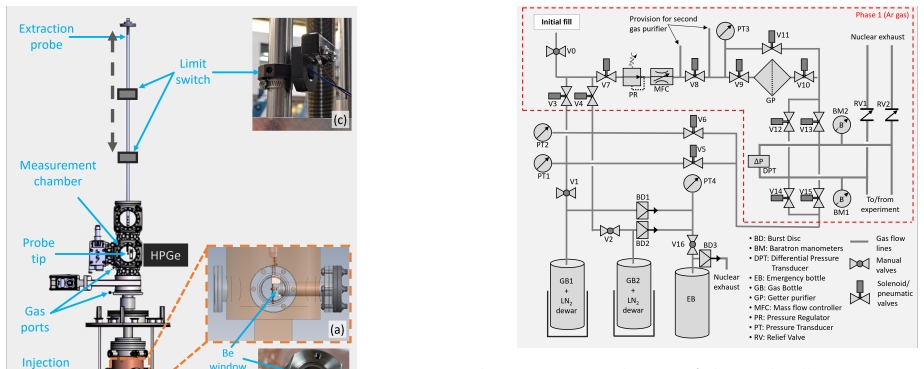
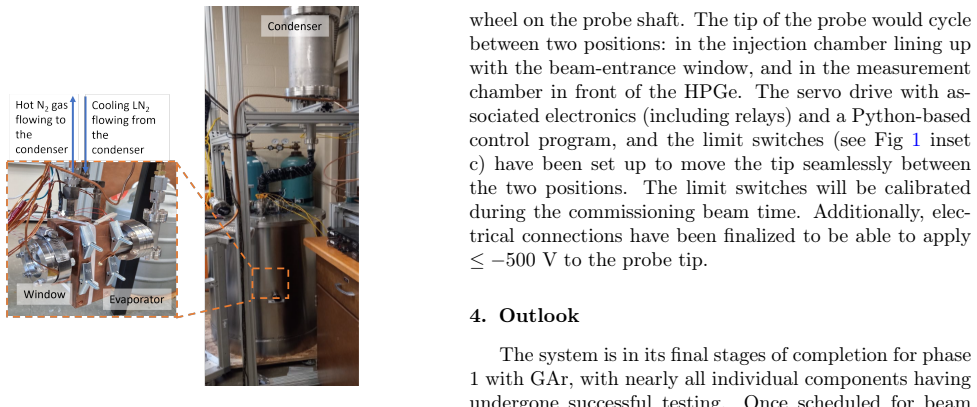
Neutrinoless double beta decay ($0\nu\beta\beta$) could provide a way to probe physics beyond the Standard Model of particle physics. The proposed nEXO experiment aims to search for $0\nu\beta\beta$ in $^{136}$Xe using a tonne-scale liquid xenon (LXe) time projection chamber. The projected half-life sensitivity for nEXO for 10 years of livetime is $>$10$^{28}$ years. Efforts are ongoing to further suppress backgrounds and increase the experiment's sensitivity. One approach pursued is Ba-tagging, which entails extracting and identifying the daughter nuclide from the $\beta\beta$-decay of $^{136}$Xe, $^{136}$Ba. Once successful, this technique has the potential to separate background events from true $\beta\beta$ events. While different extraction and identification methods are being investigated by different groups, a Ba-ion source is required for testing, quantifying and optimizing them. An accelerator-driven ion source is currently being developed at TRIUMF, where radioactive ions will be be injected into and stopped in an LXe volume, collected electrostatically and detected using $\gamma$ spectroscopy. In this contribution, an experimental status update on the commissioning of this Ba-ion source at TRIUMF is provided.
Editorial analysis
A structured set of objections, weighed in public.
Referee Report
Summary. The manuscript is a status report on the ongoing development of an accelerator-driven ion source at TRIUMF. Radioactive ions are to be injected into and stopped in a liquid xenon volume, collected electrostatically, and detected via γ spectroscopy in order to benchmark Ba-tagging techniques for background suppression in the proposed nEXO 0νββ experiment.
Significance. A working Ba-ion source of this type would enable controlled, quantitative tests of extraction and identification methods for the 136Ba daughter nucleus. This capability is directly relevant to improving the projected sensitivity of tonne-scale LXe detectors beyond the >10^28 yr half-life goal stated for nEXO.
major comments (1)
- [Abstract] The abstract states that 'an experimental status update on the commissioning of this Ba-ion source at TRIUMF is provided,' yet the manuscript contains no description of the ion source design, beam parameters, stopping efficiency in LXe, collection method, or any commissioning data. Without these elements the central claim cannot be evaluated.
minor comments (1)
- [Abstract] Typographical error: 'will be be injected' should read 'will be injected'.
Simulated Author's Rebuttal
We thank the referee for the review and for highlighting the mismatch between the abstract's phrasing and the manuscript's actual content. We agree that the current abstract overstates what is delivered in this short status report and will revise accordingly.
read point-by-point responses
-
Referee: [Abstract] The abstract states that 'an experimental status update on the commissioning of this Ba-ion source at TRIUMF is provided,' yet the manuscript contains no description of the ion source design, beam parameters, stopping efficiency in LXe, collection method, or any commissioning data. Without these elements the central claim cannot be evaluated.
Authors: We agree that the abstract's wording implies more detailed experimental results (design, beam parameters, efficiencies, and data) than the manuscript actually contains. This short contribution is a high-level project overview rather than a technical report on commissioning, as the work remains in an early development phase. We will revise the abstract to: 'In this contribution, we provide an update on the development and initial commissioning plans for an accelerator-driven Ba-ion source at TRIUMF.' Full technical details will appear in subsequent publications once quantitative results become available. revision: yes
Circularity Check
No significant circularity; pure experimental status report
full rationale
The paper contains no derivations, equations, predictions, fitted parameters, or load-bearing self-citations. Its content is limited to a descriptive status update on commissioning an ion source, with no quantitative claims or chains that reduce to inputs by construction. This matches the default expectation of no circularity for non-derivational experimental reports.
Axiom & Free-Parameter Ledger
Reference graph
Works this paper leans on
-
[1]
W. Buchmüller, P. Di Bari, M. Plümacher, Lepto- genesis for pedestrians, Ann. Phys. 315 (2) (2005) 3 305–351.doi:10.1016/j.aop.2004.02.003. URLhttps://www.sciencedirect.com/science/ article/pii/S000349160400137X
-
[2]
M. J. Dolinski, A. W. Poon, W. Rodejohann, Neu- trinoless double-beta decay: Status and prospects, Annu. Rev. Nucl. Part. Sci. 69 (1) (2019) 219–251. doi:10.1146/annurev-nucl-101918-023407
-
[3]
Majorana, Teoria simmetrica dell’elettrone e del positrone, Il Nuovo Cim
E. Majorana, Teoria simmetrica dell’elettrone e del positrone, Il Nuovo Cim. (1924-1942) 14 (4) (1937) 171–184.doi:10.1007/BF02961314. URLhttps://doi.org/10.1007/BF02961314
-
[4]
J. Engel, J. Menéndez, Status and future of nuclear matrix elements for neutrinoless double-beta decay: a review, Reports on Progress in Physics 80 (4) (2017) 046301.doi:10.1088/1361-6633/aa5bc5. URLhttps://doi.org/10.1088/1361-6633/ aa5bc5
-
[5]
S. A. Kharusi, A. Alamre, J. B. Albert, et al., nEXO Pre-Conceptual Design Report, arXiv 1805.11142 (2018).doi:10.48550/arXiv.1805.11142
work page internal anchor Pith review Pith/arXiv arXiv doi:10.48550/arxiv.1805.11142 2018
-
[6]
M. Auger, D. J. Auty, P. S. Barbeau, et al., The EXO-200 detector, part i: detector design and con- struction, J. Instrum. 7 (05) (2012) P05010.doi: 10.1088/1748-0221/7/05/P05010. URLhttps://dx.doi.org/10.1088/1748-0221/7/ 05/P05010
-
[7]
N. Ackerman, J. Albert, M. Auger, et al., The EXO-200 detector, part ii: auxiliary systems, J. Instrum. 17 (02) (2022) P02015. doi:10.1088/1748-0221/17/02/P02015. URLhttps://dx.doi.org/10.1088/1748-0221/ 17/02/P02015
-
[8]
N.Ackerman, B.Aharmim, M.Auger, etal., Observa- tion of two-neutrino double-beta decay in136Xewith the EXO-200 detector, Phys. Rev. Lett. 107 (2011) 212501.doi:10.1103/PhysRevLett.107.212501. URLhttps://link.aps.org/doi/10.1103/ PhysRevLett.107.212501
-
[9]
G. Anton, I. Badhrees, P. S. Barbeau, et al., Search for Neutrinoless Double-βDecay with the Com- plete EXO-200 Dataset, Phys. Rev. Lett. 123 (2019) 161802.doi:10.1103/PhysRevLett.123.161802
-
[10]
G. Adhikari, S. A. Kharusi, E. Angelico, et al., nEXO: Neutrinoless double beta decay search beyond10 28 year half-life sensitivity, J. Phys. G 49 (2021) 015104. doi:10.1088/1361-6471/ac3631
-
[11]
J. B. Albert, G. Anton, I. J. Arnquist, et al., Sensitiv- ity and Discovery Potential of nEXO to Neutrinoless Double Beta Decay, Phys. Rev. C 97 (2018) 065503. doi:10.1103/PhysRevC.97.065503
-
[12]
M. K. Moe, Detection of neutrinoless double- beta decay, Phys. Rev. C 44 (1991) R931–R934. doi:10.1103/PhysRevC.44.R931. URLhttps://link.aps.org/doi/10.1103/ PhysRevC.44.R931
-
[13]
D. Ray, R. Collister, H. Rasiwala, et al., Ion Ma- nipulation from Liquid Xe to Vacuum: Ba-Tagging for a nEXO Upgrade and Future0νββExperiments, Atoms 12 (12) (2024).doi:10.3390/atoms12120071. URLhttps://www.mdpi.com/2218-2004/12/12/71
-
[14]
Green, J
M. Green, J. Wodin, R. DeVoe, et al., Observation of single collisionally cooled trapped ions in a buffer gas, Phys. Rev. A 76 (2) (2007) 023404.doi:10. 1103/PhysRevA.76.023404
2007
-
[15]
B. Mong, S. Cook, T. Walton, et al., Spectroscopy of Ba and Ba+ deposits in solid xenon for barium tagging in nexo, Phys. Rev. A 91 (2015) 022505. doi:10.1103/PhysRevA.91.022505. URLhttps://link.aps.org/doi/10.1103/ PhysRevA.91.022505
-
[16]
nEXO Collaboration, Imaging individual barium atoms in solid xenon for barium tagging in nEXO, Nature 569 (7755) (2019) 203–207.doi:10.1038/ s41586-019-1169-4
2019
-
[17]
M. Yvaine, D. Fairbank, J. Soderstrom, et al., Overcoming photobleaching in imag- ing of single barium atoms in a solid xenon matrix, Phys. Rev. Res. 6 (2024) 043193. doi:10.1103/PhysRevResearch.6.043193. URLhttps://link.aps.org/doi/10.1103/ PhysRevResearch.6.043193
-
[18]
H. Rasiwala, K. Murray, Y. Lan, et al., ‘Searching for a needle in a haystack;’ A Ba-tagging ap- proach for an upgraded nEXO experiment, Nucl. Instrum. Methods Phys. Res. B 541 (2023) 298–300. doi:10.1016/j.nimb.2023.05.047. URLhttps://www.sciencedirect.com/science/ article/pii/S0168583X2300246X
-
[19]
A. D. McDonald, B. J. P. Jones, D. R. Nygren, et al., Demonstration of Single Barium Ion Sensi- tivity for Neutrinoless Double Beta Decay using Sin- gle Molecule Fluorescence Imaging, Phys. Rev. Lett. 120 (13) (2018) 132504.doi:10.1103/PhysRevLett. 120.132504
-
[20]
J. Aalbers, S. S. AbdusSalam, K. Abe, et al., A next-generation liquid xenon observatory for dark matter and neutrino physics, Journal of Physics G: Nuclear and Particle Physics 50 (1) (2022) 013001. doi:10.1088/1361-6471/ac841a. URLhttp://dx.doi.org/10.1088/1361-6471/ ac841a 4
-
[21]
J. Aalbers, K. Abe, M. Adrover, et al., Neutri- noless double beta decay sensitivity of the XLZD rare event observatory, Journal of Physics G: Nu- clear and Particle Physics 52 (4) (2025) 045102. doi:10.1088/1361-6471/adb900. URLhttp://dx.doi.org/10.1088/1361-6471/ adb900
-
[22]
Byrnes, F
N. Byrnes, F. W. Foss, B. J. P. Jones, et al., Progress toward barium tagging in high pressure xenon gas with single molecule fluorescence imaging, J. Phys. Conf. Ser. 1312 (1) (2019) 012001.doi:10.1088/ 1742-6596/1312/1/012001
2019
-
[23]
F. Kondev, M. Wang, W. Huang, et al., The NUBASE2020 evaluation of nuclear physics properties, Chin. Phys. C 45 (3) (2021) 030001. doi:10.1088/1674-1137/abddae. URLhttps://doi.org/10.1088/1674-1137/ abddae
-
[24]
G. C. Ball, G. Hackman, R. Krücken, The TRIUMF- ISAC facility: two decades of discovery with rare isotope beams, Phys. Scr. 91 (9) (2016) 093002. doi:10.1088/0031-8949/91/9/093002. URLhttps://dx.doi.org/10.1088/0031-8949/ 91/9/093002 5
discussion (0)
Sign in with ORCID, Apple, or X to comment. Anyone can read and Pith papers without signing in.