Net-Ev²: A Generative Simulator for Network Event Evolution
Pith reviewed 2026-06-27 10:06 UTC · model grok-4.3
The pith
Net-Ev² generates simulations of event propagation in networks from natural language descriptions alone while maintaining topological structure.
A machine-rendered reading of the paper's core claim, the machinery that carries it, and where it could break.
Core claim
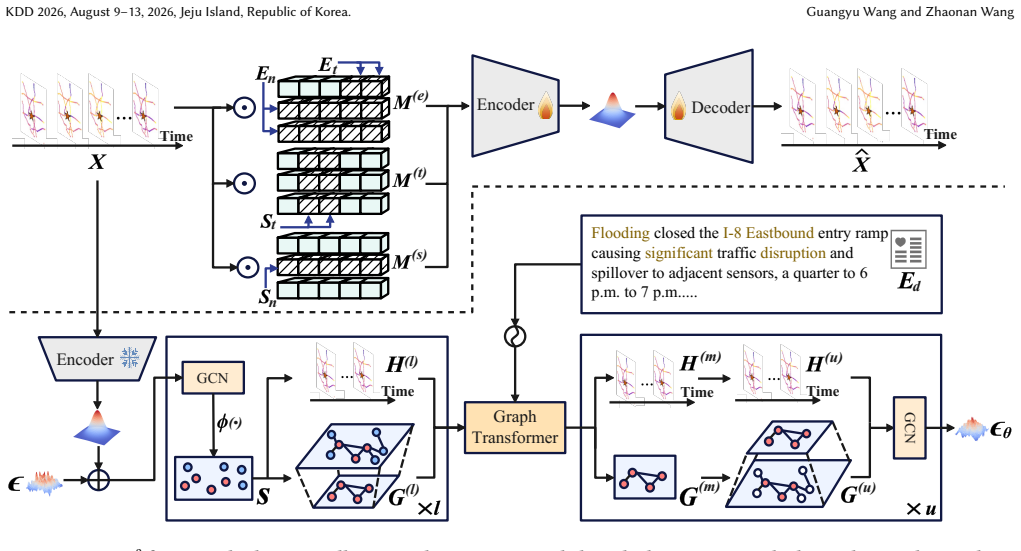
Net-Ev² jointly leverages event cues while preserving network topology in simulations through a framework of structure-guided masked pre-training and topology-aware diffusion process achieved by U-Net-like graph downsampling and upsampling during denoising, allowing generation of simulations from natural-language event input only at inference time.
What carries the argument
The topology-aware diffusion process using U-Net-like graph downsampling and upsampling during denoising, which preserves network topology while modeling event evolution.
Load-bearing premise
The U-Net-like graph downsampling and upsampling during the diffusion denoising successfully preserves the network topology while modeling how events evolve.
What would settle it
Running the model on the benchmark networks and observing that the generated event propagations exhibit topological measures, such as average path lengths or clustering, that deviate substantially from those in the real data.
Figures
read the original abstract
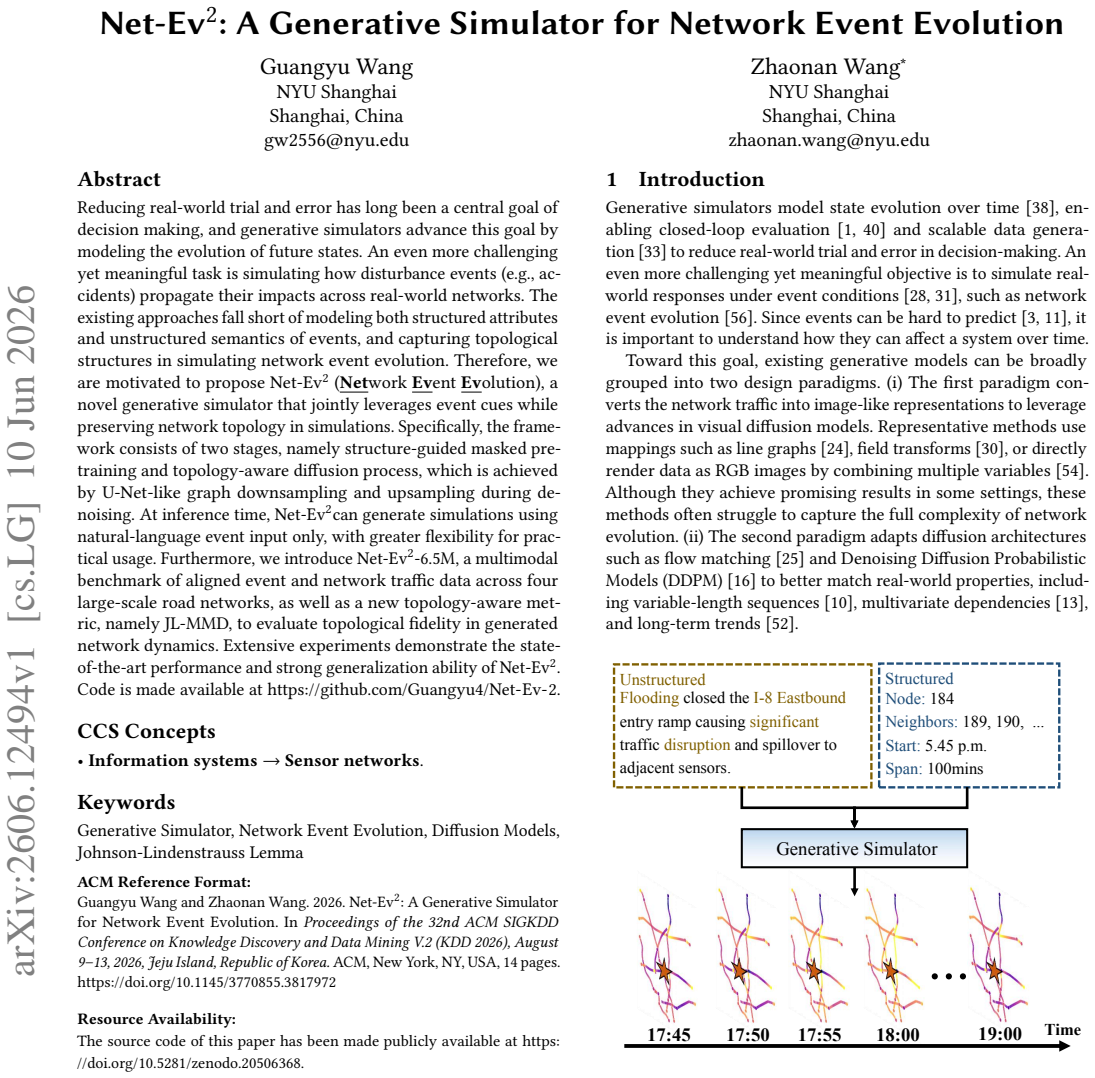
Reducing real-world trial and error has long been a central goal of decision making, and generative simulators advance this goal by modeling the evolution of future states. An even more challenging yet meaningful task is simulating how disturbance events (e.g., accidents) propagate their impacts across real-world networks. The existing approaches fall short of modeling both structured attributes and unstructured semantics of events, and capturing topological structures in simulating network event evolution. Therefore, we are motivated to propose Net-Ev$^2$ ($\underline{\textbf{Net}}$work $\underline{\textbf{Ev}}$ent $\underline{\textbf{Ev}}$olution), a novel generative simulator that jointly leverages event cues while preserving network topology in simulations. Specifically, the framework consists of two stages, namely structure-guided masked pre-training and topology-aware diffusion process, which is achieved by U-Net-like graph downsampling and upsampling during denoising. At inference time, Net-Ev$^2$ can generate simulations using natural-language event input only, with greater flexibility for practical usage. Furthermore, we introduce Net-Ev$^2$-6.5M, a multimodal benchmark of aligned event and network traffic data across four large-scale road networks, as well as a new topology-aware metric, namely JL-MMD, to evaluate topological fidelity in generated network dynamics. Extensive experiments demonstrate the state-of-the-art performance and strong generalization ability of Net-Ev$^2$. Code is made available at https://github.com/Guangyu4/Net-Ev-2.
Editorial analysis
A structured set of objections, weighed in public.
Referee Report
Summary. The paper proposes Net-Ev², a generative simulator for modeling how disturbance events propagate across networks. It consists of structure-guided masked pre-training followed by a topology-aware diffusion process implemented via U-Net-like graph downsampling and upsampling during denoising. At inference the model accepts only natural-language event descriptions. The authors introduce the Net-Ev²-6.5M multimodal benchmark spanning four large road networks, a new topology-aware metric JL-MMD, and claim state-of-the-art performance together with strong generalization; code is released.
Significance. If the central empirical claims hold, the work would supply a practical generative tool for network dynamics that jointly handles semantic event cues and topological structure, an area where prior simulators are limited. The public benchmark, JL-MMD metric, and code release constitute concrete, reusable contributions that could support follow-on research in transportation and infrastructure modeling.
major comments (2)
- [Abstract / framework description] Abstract and framework description: the topology-aware diffusion stage is characterized only as 'U-Net-like graph downsampling and upsampling during denoising' with no specification of the pooling operator, whether it is edge-preserving (spectral, hierarchical with edge retention) or merely feature-based, or any proof that original connectivity is retained. Because this mechanism is load-bearing for the central claim of topology-preserving event-evolution simulation, the absence of an explicit construction leaves open the possibility that generated trajectories match marginal statistics while violating the input graph structure.
- [Abstract] Abstract: the claim of 'state-of-the-art performance and strong generalization ability' is asserted without any quantitative results, baseline comparisons, error bars, dataset statistics, or experimental protocol. This directly undermines evaluation of the empirical contribution that the paper positions as its primary advance.
minor comments (1)
- [Abstract] The abstract introduces the new JL-MMD metric but supplies neither its formal definition nor any sensitivity analysis showing that it detects topology violations of the kind the skeptic note raises.
Simulated Author's Rebuttal
We thank the referee for the thoughtful review and constructive feedback on our manuscript. We address each major comment point-by-point below, providing clarifications from the full paper and indicating where revisions will be made to improve clarity and presentation.
read point-by-point responses
-
Referee: [Abstract / framework description] Abstract and framework description: the topology-aware diffusion stage is characterized only as 'U-Net-like graph downsampling and upsampling during denoising' with no specification of the pooling operator, whether it is edge-preserving (spectral, hierarchical with edge retention) or merely feature-based, or any proof that original connectivity is retained. Because this mechanism is load-bearing for the central claim of topology-preserving event-evolution simulation, the absence of an explicit construction leaves open the possibility that generated trajectories match marginal statistics while violating the input graph structure.
Authors: We appreciate the referee's emphasis on the need for explicit construction details, as this is central to our topology-preserving claim. The full manuscript (Section 3.2 and Figure 2) specifies that the graph U-Net employs a hierarchical clustering-based pooling operator (inspired by DiffPool-style methods) that is edge-preserving: it coarsens the graph while retaining connectivity via learned cluster assignments that map edges to the coarsened level, with upsampling using the transpose assignment matrix to restore the exact original node set and adjacency. A brief connectivity preservation argument is provided via the bijective mapping property of the hierarchy. However, we agree this level of detail is insufficiently highlighted in the abstract and high-level framework overview. In the revision, we will expand the abstract's description of the diffusion stage to explicitly name the pooling operator and note its edge-preserving property, and add a short paragraph in Section 3.2 with the connectivity retention argument. revision: yes
-
Referee: [Abstract] Abstract: the claim of 'state-of-the-art performance and strong generalization ability' is asserted without any quantitative results, baseline comparisons, error bars, dataset statistics, or experimental protocol. This directly undermines evaluation of the empirical contribution that the paper positions as its primary advance.
Authors: We acknowledge that the abstract states the performance claim at a high level without numbers, which is common due to length constraints but can reduce immediate evaluability. The full paper addresses this in Section 4 (Experiments), with Table 1 reporting quantitative results on the Net-Ev²-6.5M benchmark (including JL-MMD and other metrics), comparisons against multiple baselines with error bars from 5 runs, dataset statistics (4 networks, 6.5M samples), and a detailed experimental protocol in Section 4.1. Generalization is shown via cross-network transfer experiments in Table 3. To strengthen the abstract, we will add a concise sentence summarizing the key quantitative gains (e.g., 'achieving X% improvement in JL-MMD over baselines') if space allows under the conference limits, or move the claim to the introduction with a forward reference to the tables. revision: partial
Circularity Check
No circularity: architecture, benchmark, and metric introduced as independent components
full rationale
The paper's core claims rest on a described two-stage framework (structure-guided masked pre-training followed by a U-Net-style diffusion process) and newly introduced artifacts (Net-Ev²-6.5M benchmark and JL-MMD metric). No equations, fitted parameters, or self-citations are shown to reduce any prediction or topology-preservation claim to a quantity defined by the inputs themselves. The derivation chain is therefore self-contained against external benchmarks and does not exhibit any of the enumerated circularity patterns.
Axiom & Free-Parameter Ledger
free parameters (1)
- diffusion and U-Net hyperparameters
axioms (2)
- domain assumption U-Net-like graph downsampling and upsampling during denoising preserves topological structures
- domain assumption Masked pre-training on event cues and network structure yields useful joint representations
invented entities (3)
-
Net-Ev² generative simulator
no independent evidence
-
JL-MMD metric
no independent evidence
-
Net-Ev²-6.5M benchmark
no independent evidence
Reference graph
Works this paper leans on
-
[1]
Tenenbaum, Tommi S
Anurag Ajay, Yilun Du, Abhi Gupta, Joshua B. Tenenbaum, Tommi S. Jaakkola, and Pulkit Agrawal. 2023. Is Conditional Generative Modeling all you need for Decision Making?. InThe Eleventh International Conference on Learning Represen- tations. https://openreview.net/forum?id=sP1fo2K9DFG
2023
-
[2]
Jacob Devlin, Ming-Wei Chang, Kenton Lee, and Kristina Toutanova. 2019. BERT: Pre-training of Deep Bidirectional Transformers for Language Understanding. In Proceedings of the 2019 Conference of the North American Chapter of the Association for Computational Linguistics: Human Language Technologies, Volume 1 (Long and Short Papers), Jill Burstein, Christy...
2019
-
[3]
Daizong Ding, Mi Zhang, Xudong Pan, Min Yang, and Xiangnan He. 2019. Mod- eling extreme events in time series prediction. InProceedings of the 25th ACM SIGKDD international conference on knowledge discovery & data mining. 1114– 1122
2019
-
[4]
Felix Draxler, Yang Meng, Kai Nelson, Lukas Laskowski, Yibo Yang, Theofanis Karaletsos, and Stephan Mandt. 2025. Transformers for Mixed-type Event Se- quences. InThe Thirty-ninth Annual Conference on Neural Information Processing Systems. https://openreview.net/forum?id=MtwsRjPZhf
2025
-
[5]
Otto Fabius and Joost R. van Amersfoort. 2015. Variational Recurrent Auto- Encoders. arXiv:1412.6581 [stat.ML] https://arxiv.org/abs/1412.6581
Pith/arXiv arXiv 2015
-
[6]
Hongyang Gao, Yongjun Chen, and Shuiwang Ji. 2019. Learning Graph Pooling and Hybrid Convolutional Operations for Text Representations. InThe World Wide Web Conference(San Francisco, CA, USA)(WWW ’19). Association for Computing Machinery, New York, NY, USA, 2743–2749. doi:10.1145/3308558. 3313395
-
[7]
Hongyang Gao and Shuiwang Ji. 2019. Graph U-Nets. InInternational Conference on Machine Learning. 2083–2092
2019
-
[8]
Haotian Gao, Renhe Jiang, Zheng Dong, Jinliang Deng, Yuxin Ma, and Xuan Song. 2024. Spatial-temporal-decoupled masked pre-training for spatiotemporal forecasting. InProceedings of the Thirty-Third International Joint Conference on Artificial Intelligence(Jeju, Korea)(IJCAI ’24). Article 442, 9 pages. doi:10.24963/ ijcai.2024/442
2024
-
[9]
Hongfan Gao, Wangmeng Shen, Xiangfei Qiu, Ronghui Xu, Bin Yang, and Jilin Hu. 2025. SSD-TS: Exploring the Potential of Linear State Space Models for Diffusion Models in Time Series Imputation. InProceedings of the 31st ACM SIGKDD Conference on Knowledge Discovery and Data Mining V.2(Toronto ON, Canada)(KDD ’25). Association for Computing Machinery, New Yo...
-
[10]
Yunfeng Ge, Jiawei Li, Yiji Zhao, Haomin Wen, Zhao Li, Meikang Qiu, Hongyan Li, Ming Jin, and Shirui Pan. 2025. T2S: High-resolution Time Series Generation with Text-to-Series Diffusion Models. InInternational Joint Conference on Artificial Intelligence
2025
-
[11]
M Ghil, Pascal Yiou, Stéphane Hallegatte, BD Malamud, P Naveau, A Soloviev, P Friederichs, V Keilis-Borok, D Kondrashov, V Kossobokov, et al. 2011. Extreme events: dynamics, statistics and prediction.Nonlinear Processes in Geophysics18, 3 (2011), 295–350
2011
-
[12]
Xiaochuan Gou, Ziyue Li, Tian Lan, Junpeng Lin, zhishuai Li, Bingyu Zhao, Chen Zhang, Di Wang, and Xiangliang Zhang. 2025. TraffiDent: A Dataset for Understanding the Interplay Between Traffic Dynamics and Incidents. InThe Thirty-ninth Annual Conference on Neural Information Processing Systems Datasets and Benchmarks Track. https://openreview.net/forum?id...
2025
-
[13]
Shuqi Gu, Chuyue Li, Baoyu Jing, and Kan Ren. 2025. VerbalTS: Generating Time Series from Texts. InInternational Conference on Machine Learning
2025
-
[14]
Hamilton, Rex Ying, and Jure Leskovec
William L. Hamilton, Rex Ying, and Jure Leskovec. 2017. Inductive representation learning on large graphs. InProceedings of the 31st International Conference on Neural Information Processing Systems(Long Beach, California, USA)(NIPS’17). Curran Associates Inc., Red Hook, NY, USA, 1025–1035
2017
-
[15]
Mingguo He, Zhewei Wei, and Ji-Rong Wen. 2022. Convolutional Neural Networks on Graphs with Chebyshev Approximation, Revisited. InAdvances in Neural Information Processing Systems, S. Koyejo, S. Mohamed, A. Agar- wal, D. Belgrave, K. Cho, and A. Oh (Eds.), Vol. 35. Curran Associates, Inc., 7264–7276. https://proceedings.neurips.cc/paper_files/paper/2022/f...
2022
-
[16]
Jonathan Ho, Ajay Jain, and Pieter Abbeel. 2020. Denoising diffusion probabilistic models.Advances in neural information processing systems33 (2020), 6840–6851
2020
-
[17]
Ryien Hosseini, Filippo Simini, Venkatram Vishwanath, Rebecca Willett, and Henry Hoffmann. 2025. Quality Measures for Dynamic Graph Generative Models. InThe Thirteenth International Conference on Learning Representations. https: //openreview.net/forum?id=8bjspmAMBk
2025
-
[18]
Rongjie Huang, Jiawei Huang, Dongchao Yang, Yi Ren, Luping Liu, Mingze Li, Zhenhui Ye, Jinglin Liu, Xiang Yin, and Zhou Zhao. 2023. Make-an-audio: Text- to-audio generation with prompt-enhanced diffusion models. InInternational Conference on Machine Learning. PMLR, 13916–13932
2023
-
[19]
Richard Jordan, David Kinderlehrer, and Felix Otto. 1998. The variational formu- lation of the Fokker–Planck equation.SIAM journal on mathematical analysis29, 1 (1998), 1–17
1998
-
[20]
Kipf and Max Welling
Thomas N. Kipf and Max Welling. 2017. Semi-Supervised Classification with Graph Convolutional Networks. InInternational Conference on Learning Repre- sentations. https://openreview.net/forum?id=SJU4ayYgl
2017
-
[21]
Daniel Krajzewicz, Jakob Erdmann, Michael Behrisch, Laura Bieker, et al. 2012. Recent development and applications of SUMO-Simulation of Urban MObility. International journal on advances in systems and measurements5, 3&4 (2012), 128–138
2012
-
[22]
Tomáš Kučera and Jan Chocholáč. 2021. Design of the city logistics simulation model using PTV VISSIM software.Transportation Research Procedia53 (2021), 258–265
2021
-
[23]
Yaguang Li, Rose Yu, Cyrus Shahabi, and Yan Liu. 2018. Diffusion Convolu- tional Recurrent Neural Network: Data-Driven Traffic Forecasting. InInterna- tional Conference on Learning Representations. https://openreview.net/forum?id= SJiHXGWAZ
2018
-
[24]
Zekun Li, Shiyang Li, and Xifeng Yan. 2023. Time Series as Images: Vision Transformer for Irregularly Sampled Time Series. InThirty-seventh Conference on Neural Information Processing Systems. https://openreview.net/forum?id= ZmeAoWQqe0
2023
-
[25]
Yaron Lipman, Ricky T. Q. Chen, Heli Ben-Hamu, Maximilian Nickel, and Matt Le. 2023. Flow Matching for Generative Modeling. arXiv:2210.02747 [cs.LG] https://arxiv.org/abs/2210.02747
Pith/arXiv arXiv 2023
-
[26]
Haohe Liu, Zehua Chen, Yi Yuan, Xinhao Mei, Xubo Liu, Danilo Mandic, Wenwu Wang, and Mark D Plumbley. 2023. Audioldm: Text-to-audio generation with latent diffusion models.arXiv preprint arXiv:2301.12503(2023)
arXiv 2023
-
[27]
Xu Liu, Yutong Xia, Yuxuan Liang, Junfeng Hu, Yiwei Wang, Lei Bai, Chao Huang, Zhenguang Liu, Bryan Hooi, and Roger Zimmermann. 2023. LargeST: A Benchmark Dataset for Large-Scale Traffic Forecasting. InAdvances in Neural Information Processing Systems
2023
-
[28]
Danni Lu, Chenyang Tao, Junya Chen, Fan Li, Feng Guo, and Lawrence Carin
-
[29]
InPro- ceedings of the 34th International Conference on Neural Information Processing Systems(Vancouver, BC, Canada)(NIPS ’20)
Reconsidering generative objectives for counterfactual reasoning. InPro- ceedings of the 34th International Conference on Neural Information Processing Systems(Vancouver, BC, Canada)(NIPS ’20). Curran Associates Inc., Red Hook, NY, USA, Article 1808, 15 pages
-
[30]
Sobhan Moosavi, Mohammad Hossein Samavatian, Arnab Nandi, Srinivasan Parthasarathy, and Rajiv Ramnath. 2019. Short and Long-term Pattern Discovery Over Large-Scale Geo-Spatiotemporal Data. InProceedings of the ACM SIGKDD Conference on Knowledge Discovery and Data Mining (KDD ’19). 2905–2913. doi:10. 1145/3292500.3330755
arXiv 2019
-
[31]
Ilan Naiman, Nimrod Berman, Itai Pemper, Idan Arbiv, Gal Fadlon, and Omri Azencot. 2024. Utilizing Image Transforms and Diffusion Models for Generative Modeling of Short and Long Time Series. InThe Thirty-eighth Annual Conference on Neural Information Processing Systems. https://openreview.net/forum?id= 2NfBBpbN9x
2024
-
[32]
Michael Oberst and David Sontag. 2019. Counterfactual Off-Policy Evaluation with Gumbel-Max Structural Causal Models. InProceedings of the 36th Interna- tional Conference on Machine Learning (Proceedings of Machine Learning Research, Vol. 97), Kamalika Chaudhuri and Ruslan Salakhutdinov (Eds.). PMLR, 4881–4890. https://proceedings.mlr.press/v97/oberst19a.html
2019
-
[33]
Venkatesh Babu, Daniel Cohen- Or, and Kuan-Chieh Wang
Rishubh Parihar, Or Patashnik, Daniil Ostashev, R. Venkatesh Babu, Daniel Cohen- Or, and Kuan-Chieh Wang. 2025. Kontinuous Kontext: Continuous Strength Control for Instruction-based Image Editing. arXiv:2510.08532 [cs.CV] https: //arxiv.org/abs/2510.08532
arXiv 2025
-
[34]
Ethan Pronovost, Meghana Reddy Ganesina, Noureldin Hendy, Zeyu Wang, Andres Morales, Kai Wang, and Nick Roy. 2023. Scenario Diffusion: Controllable Driving Scenario Generation With Diffusion. InAdvances in Neural Information Processing Systems, A. Oh, T. Naumann, A. Globerson, K. Saenko, M. Hardt, and S. Levine (Eds.), Vol. 36. Curran Associates, Inc., 68...
2023
-
[35]
Alec Radford, Jong Wook Kim, Chris Hallacy, Aditya Ramesh, Gabriel Goh, Sandhini Agarwal, Girish Sastry, Amanda Askell, Pamela Mishkin, Jack Clark, Gretchen Krueger, and Ilya Sutskever. 2021. Learning Transferable Visual Models From Natural Language Supervision.CoRRabs/2103.00020 (2021). arXiv:2103.00020 https://arxiv.org/abs/2103.00020
Pith/arXiv arXiv 2021
-
[36]
Kashif Rasul, Calvin Seward, Ingmar Schuster, and Roland Vollgraf. 2021. Au- toregressive Denoising Diffusion Models for Multivariate Probabilistic Time Series Forecasting. InInternational Conference on Machine Learning. https: //api.semanticscholar.org/CorpusID:231719657
2021
-
[37]
Robin Rombach, Andreas Blattmann, Dominik Lorenz, Patrick Esser, and Björn Ommer. 2022. High-Resolution Image Synthesis With Latent Diffusion Models. In Proceedings of the IEEE/CVF Conference on Computer Vision and Pattern Recognition Net-Ev2: A Generative Simulator for Network Event Evolution KDD 2026, August 9–13, 2026, Jeju Island, Republic of Korea. (...
2022
-
[38]
Olaf Ronneberger, Philipp Fischer, and Thomas Brox. 2015. U-Net: Convolutional Networks for Biomedical Image Segmentation. InMedical Image Computing and Computer-Assisted Intervention – MICCAI 2015, Nassir Navab, Joachim Horneg- ger, William M. Wells, and Alejandro F. Frangi (Eds.). Springer International Publishing, Cham, 234–241
2015
-
[39]
Alvaro Sanchez-Gonzalez, Jonathan Godwin, Tobias Pfaff, Rex Ying, Jure Leskovec, and Peter Battaglia. 2020. Learning to Simulate Complex Physics with Graph Networks. InProceedings of the 37th International Conference on Ma- chine Learning (Proceedings of Machine Learning Research, Vol. 119), Hal Daumé III and Aarti Singh (Eds.). PMLR, 8459–8468. https://p...
2020
-
[40]
Uriel Singer, Adam Polyak, Thomas Hayes, Xi Yin, Jie An, Songyang Zhang, Qiyuan Hu, Harry Yang, Oron Ashual, Oran Gafni, et al. 2022. Make-a-video: Text-to-video generation without text-video data.arXiv preprint arXiv:2209.14792 (2022)
Pith/arXiv arXiv 2022
-
[41]
Shuhan Tan, Boris Ivanovic, Yuxiao Chen, Boyi Li, Xinshuo Weng, Yulong Cao, Philipp Kraehenbuehl, and Marco Pavone. 2024. Promptable Closed-loop Traffic Simulation. In8th Annual Conference on Robot Learning. https://openreview.net/ forum?id=5iXG6EgByK
2024
-
[42]
Yusuke Tashiro, Jiaming Song, Yang Song, and Stefano Ermon. 2021. CSDI: conditional score-based diffusion models for probabilistic time series imputation. InProceedings of the 35th International Conference on Neural Information Processing Systems (NIPS ’21)
2021
-
[43]
Gomez, Łukasz Kaiser, and Illia Polosukhin
Ashish Vaswani, Noam Shazeer, Niki Parmar, Jakob Uszkoreit, Llion Jones, Aidan N. Gomez, Łukasz Kaiser, and Illia Polosukhin. 2017. Attention is all you need. InProceedings of the 31st International Conference on Neural Information Processing Systems(Long Beach, California, USA)(NIPS’17). Curran Associates Inc., Red Hook, NY, USA, 6000–6010
2017
-
[44]
Petar Veličković, Guillem Cucurull, Arantxa Casanova, Adriana Romero, Pietro Liò, and Yoshua Bengio. 2018. Graph Attention Networks. InInternational Confer- ence on Learning Representations. https://openreview.net/forum?id=rJXMpikCZ
2018
-
[45]
Jingsong Wang, Hao Liu, and Zhiting Zhou. 2026. Power System Multi-source Events Dataset. doi:10.21227/tj1p-4y20
-
[46]
GCK Wong and SC Wong. 2002. A multi-class traffic flow model–an extension of LWR model with heterogeneous drivers.Transportation Research Part A: Policy and Practice36, 9 (2002), 827–841
2002
-
[47]
Junkai Xia, Chenxin Xu, Qingyao Xu, Yanfeng Wang, and Siheng Chen. 2024. Language-Driven Interactive Traffic Trajectory Generation. InThe Thirty-eighth Annual Conference on Neural Information Processing Systems. https://openreview. net/forum?id=1u3qkG7BkQ
2024
-
[48]
Qinge Xie, Tiancheng Guo, Yang Chen, Yu Xiao, Xin Wang, and Ben Y Zhao
-
[49]
InProceedings of the 29th ACM international conference on information & knowledge management
Deep graph convolutional networks for incident-driven traffic speed prediction. InProceedings of the 29th ACM international conference on information & knowledge management. 1665–1674
-
[50]
Xiaojie Yang, Hangli Ge, Jiawei Wang, Zipei Fan, Renhe Jiang, Ryosuke Shibasaki, and Noboru Koshizuka. 2025. Causalmob: Causal human mobility prediction with llms-derived human intentions toward public events. InProceedings of the 31st ACM SIGKDD Conference on Knowledge Discovery and Data Mining V. 1. 1773–1784
2025
-
[51]
Hamilton, and Jure Leskovec
Rex Ying, Jiaxuan You, Christopher Morris, Xiang Ren, William L. Hamilton, and Jure Leskovec. 2018. Hierarchical graph representation learning with differ- entiable pooling. InProceedings of the 32nd International Conference on Neural Information Processing Systems(Montréal, Canada)(NIPS’18). Curran Associates Inc., Red Hook, NY, USA, 4805–4815
2018
-
[52]
Jinsung Yoon, Daniel Jarrett, and Mihaela van der Schaar. 2019. Time-series Generative Adversarial Networks. InAdvances in Neural Information Processing Systems, H. Wallach, H. Larochelle, A. Beygelzimer, F. d'Alché-Buc, E. Fox, and R. Garnett (Eds.), Vol. 32. Curran Associates, Inc. https://proceedings.neurips.cc/ paper_files/paper/2019/file/c9efe5f26cd1...
2019
-
[53]
Dong Yu, Kaisheng Yao, Hang Su, Gang Li, and Frank Seide. 2013. KL-divergence regularized deep neural network adaptation for improved large vocabulary speech recognition. In2013 IEEE International Conference on Acoustics, Speech and Signal Processing. IEEE, 7893–7897
2013
-
[54]
Xinyu Yuan and Yan Qiao. 2024. Diffusion-TS: Interpretable Diffusion for General Time Series Generation. InThe Twelfth International Conference on Learning Representations. https://openreview.net/forum?id=4h1apFjO99
2024
-
[55]
Zhihan Yue, Yujing Wang, Juanyong Duan, Tianmeng Yang, Congrui Huang, Yunhai Tong, and Bixiong Xu. 2022. TS2Vec: Towards Universal Representation of Time Series.Proceedings of the AAAI Conference on Artificial Intelligence36, 8 (2022), 8980–8987. doi:10.1609/aaai.v36i8.20881
-
[56]
Chengyang Zhang, Yong Zhang, Qitan Shao, Bo Li, Yisheng Lv, Xinglin Piao, and Baocai Yin. 2025. ChatTraffic: Text-to-Traffic Generation via Diffusion Model. IEEE Transactions on Intelligent Transportation Systems26, 2 (2025), 2656–2668. doi:10.1109/TITS.2024.3510402
-
[57]
Yingxue Zhang, Yanhua Li, Xun Zhou, Xiangnan Kong, and Jun Luo. 2019. Traf- ficGAN: Off-Deployment Traffic Estimation with Traffic Generative Adversarial Networks. In2019 IEEE International Conference on Data Mining (ICDM). 1474–
2019
-
[58]
doi:10.1109/ICDM.2019.00193
-
[59]
Yingxue Zhang, Yanhua Li, Xun Zhou, Xiangnan Kong, and Jun Luo. 2020. Curb- gan: Conditional urban traffic estimation through spatio-temporal generative adversarial networks. InProceedings of the 26th ACM SIGKDD international con- ference on knowledge discovery & data mining. 842–852
2020
-
[60]
Chuanpan Zheng, Xiaoliang Fan, Cheng Wang, and Jianzhong Qi. 2020. GMAN: A Graph Multi-Attention Network for Traffic Prediction.Proceedings of the AAAI Conference on Artificial Intelligence34, 01 (2020), 1234–1241. doi:10.1609/aaai. v34i01.5477
-
[61]
{weather_type} weather event occurred at {location_description}
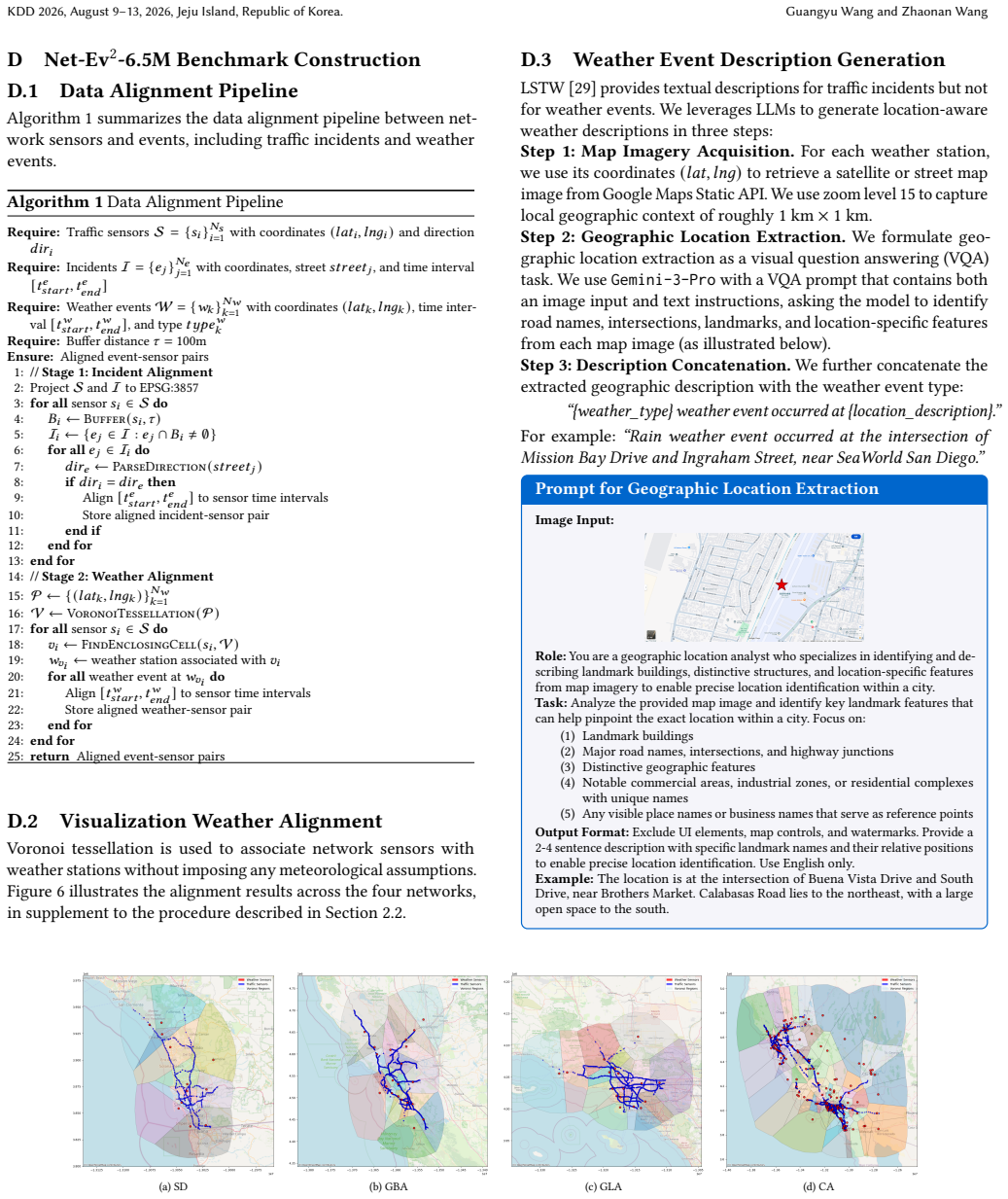
Zhilun Zhou, Jingtao Ding, Yu Liu, Depeng Jin, and Yong Li. 2023. Towards generative modeling of urban flow through knowledge-enhanced denoising diffusion. InProceedings of the 31st ACM International Conference on Advances in Geographic Information Systems. 1–12. A Further Analysis of JL-MMD A.1 Error Bound and Computational Efficiency JL-MMD evaluates ge...
2023
discussion (0)
Sign in with ORCID, Apple, or X to comment. Anyone can read and Pith papers without signing in.