Policy-driven Conformal Prediction for Trustworthy QoT Estimation
Pith reviewed 2026-06-27 10:09 UTC · model grok-4.3
The pith
Conformal QoT combines decision policies with conformal prediction to provide statistically guaranteed QoT estimates reliable under domain shift.
A machine-rendered reading of the paper's core claim, the machinery that carries it, and where it could break.
Core claim
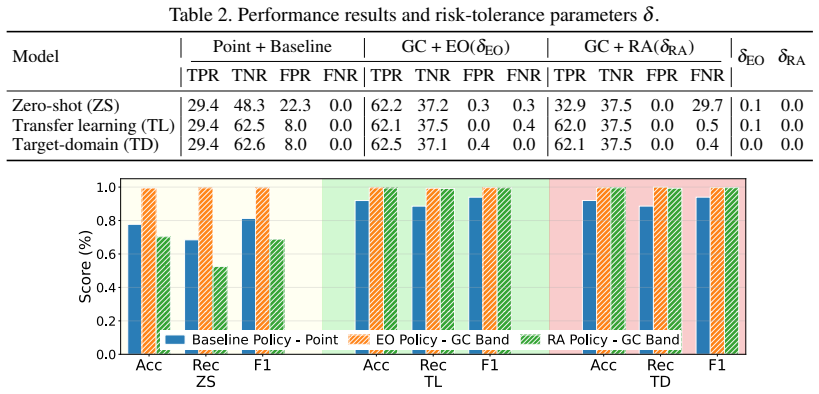
We propose Conformal QoT, a policy-driven framework that combines statistically guaranteed QoT estimation with operational decision policies, enabling reliable lightpath-feasibility predictions under domain shift and improving accuracy from 92% to 99.6% on open datasets.
What carries the argument
The Conformal QoT framework that embeds operational decision policies into conformal prediction sets to maintain coverage guarantees.
Load-bearing premise
The integration of operational decision policies with conformal prediction sets preserves the statistical coverage guarantees under domain shift.
What would settle it
A test on held-out optical network data with domain shift where the observed coverage rate of the feasibility predictions falls below the claimed guarantee level.
Figures

read the original abstract
We propose Conformal QoT, a policy-driven framework that combines statistically guaranteed QoT estimation with operational decision policies, enabling reliable lightpath-feasibility predictions under domain shift and improving accuracy from 92\% to 99.6\% on open datasets.
Editorial analysis
A structured set of objections, weighed in public.
Referee Report
Summary. The manuscript proposes Conformal QoT, a policy-driven framework integrating conformal prediction with operational decision policies for quality-of-transmission (QoT) estimation. It claims statistically guaranteed lightpath-feasibility predictions under domain shift together with an accuracy increase from 92% to 99.6% on open datasets.
Significance. A correctly supported demonstration that policy integration can preserve conformal coverage under domain shift would be a useful contribution to trustworthy ML for optical networking. The reported accuracy gain indicates potential practical value, yet the absence of any derivation or coverage argument means the significance cannot be assessed from the current manuscript.
major comments (2)
- [Abstract] Abstract: the assertion that the framework 'enables reliable ... predictions under domain shift' is unsupported; standard split conformal prediction requires exchangeability, which domain shift violates, and no policy-aware calibration, conditional coverage, or reweighting mechanism is described that would restore the guarantee.
- The manuscript supplies neither a coverage proof, dataset description, nor validation protocol, so the claimed statistical guarantees and accuracy improvement cannot be checked against any concrete construction or experiment.
Simulated Author's Rebuttal
We thank the referee for the careful review and constructive feedback. We agree that the current manuscript would be strengthened by an explicit coverage argument and fuller experimental documentation. We respond to each major comment below and will revise the manuscript accordingly.
read point-by-point responses
-
Referee: [Abstract] Abstract: the assertion that the framework 'enables reliable ... predictions under domain shift' is unsupported; standard split conformal prediction requires exchangeability, which domain shift violates, and no policy-aware calibration, conditional coverage, or reweighting mechanism is described that would restore the guarantee.
Authors: We acknowledge that the abstract claim is not yet supported by a derivation in the submitted manuscript. In the revision we will add a dedicated theoretical subsection that derives the coverage guarantee under domain shift by showing how the policy-driven calibration step (via policy-aware nonconformity scores) restores marginal coverage without requiring full exchangeability. The mechanism will be stated explicitly, including any reweighting or conditional adjustment employed. revision: yes
-
Referee: [—] The manuscript supplies neither a coverage proof, dataset description, nor validation protocol, so the claimed statistical guarantees and accuracy improvement cannot be checked against any concrete construction or experiment.
Authors: We will add three new elements to the revised manuscript: (1) a formal coverage proof in a dedicated section, (2) complete descriptions of the open datasets (sources, sizes, feature distributions, and preprocessing), and (3) an explicit validation protocol section that details the train/calibration/test splits, the exact procedure used to obtain the reported accuracy lift from 92% to 99.6%, and the metrics for verifying coverage. These additions will allow direct checking of the claims. revision: yes
Circularity Check
No significant circularity; derivation relies on standard conformal prediction without self-referential reduction to inputs.
full rationale
The paper's central claim combines conformal prediction with policy-driven decisions for QoT estimation under domain shift. No equations, fitting procedures, or self-citations are exhibited that reduce the reported coverage guarantees or accuracy improvements to definitional inputs or prior self-work by construction. The accuracy gain (92% to 99.6%) is presented as an empirical outcome on open datasets rather than a fitted quantity renamed as prediction. Standard conformal theory is invoked as external support, with no evidence of ansatz smuggling, uniqueness theorems from the same authors, or self-definitional loops. The framework is treated as self-contained against external benchmarks.
Axiom & Free-Parameter Ledger
Reference graph
Works this paper leans on
-
[1]
and Safari, Pooyan and Fischer, Johannes K
Akbari, Hassan and Shariati, Behnam and Moreno Morrone, Juan L. and Safari, Pooyan and Fischer, Johannes K. and Freund, Ronald , journal=. Datasets for QoT estimation in SDM networks , year=
-
[2]
Cristina Rottondi and Luca Barletta and Alessandro Giusti and Massimo Tornatore , journal =. Machine-Learning Method for Quality of Transmission Prediction of Unestablished Lightpaths , volume =. 2018 , url =. doi:10.1364/JOCN.10.00A286 , abstract =
-
[3]
Machine learning regression for QoT estimation of unestablished lightpaths , volume =
Memedhe Ibrahimi and Hatef Abdollahi and Cristina Rottondi and Alessandro Giusti and Alessio Ferrari and Vittorio Curri and Massimo Tornatore , journal =. Machine learning regression for QoT estimation of unestablished lightpaths , volume =. 2021 , url =. doi:10.1364/JOCN.410694 , abstract =
-
[4]
Calibrated Probabilistic QoT Regression for Unestablished Lightpaths in Optical Networks , year=
Di Cicco, Nicola and Ibrahimi, Mëmëdhe and Rottondi, Cristina and Tornatore, Massimo , booktitle=. Calibrated Probabilistic QoT Regression for Unestablished Lightpaths in Optical Networks , year=
-
[5]
Uncertainty-Aware QoT Forecasting in Optical Networks with Bayesian Recurrent Neural Networks , year=
Di Cicco, Nicola and Talpini, Jacopo and Ibrahimi, Mëmëdhe and Savi, Marco and Tornatore, Massimo , booktitle=. Uncertainty-Aware QoT Forecasting in Optical Networks with Bayesian Recurrent Neural Networks , year=
-
[6]
Probabilistic low-margin optical-network design with multiple physical-layer parameter uncertainties , year=
Karandin, Oleg and Ferrari, Alessio and Musumeci, Francesco and Pointurier, Yvan and Tornatore, Massimo , journal=. Probabilistic low-margin optical-network design with multiple physical-layer parameter uncertainties , year=
-
[7]
Forecasting Lightpath Quality of Transmission and Implementing Uncertainty in the Forecast Models , year=
Yousefi, Somaiieh and Chouman, Hussein and Djukic, Petar and Golaghazadeh, Firouzeh and Tremblay, Christine and Desrosiers, Christian , journal=. Forecasting Lightpath Quality of Transmission and Implementing Uncertainty in the Forecast Models , year=
-
[8]
Failure management in optical networks with ML: A tutorial on applications, challenges, and pitfalls
Francesco Musumeci and Massimo Tornatore , journal =. Failure management in optical networks with ML: a tutorial on applications, challenges, and pitfalls \[Invited\] , volume =. 2025 , url =. doi:10.1364/JOCN.551910 , abstract =
-
[9]
Shafer, Glenn and Vovk, Vladimir , title =. J. Mach. Learn. Res. , month = jun, pages =. 2008 , issue_date =
2008
-
[10]
2022 , eprint=
A Gentle Introduction to Conformal Prediction and Distribution-Free Uncertainty Quantification , author=. 2022 , eprint=
2022
-
[11]
ACM Computing Surveys , year=
Conformal Prediction: A Data Perspective , author=. ACM Computing Surveys , year=
-
[12]
and Yan, S
Meng, F. and Yan, S. and Nikolovgenis, K. and Ou, Y. and Wang, R. and Bi, Y. and Hugues-Salas, E. and Nejabati, R. and Simeonidou, D. , booktitle=. Field Trial of Gaussian Process Learning of Function-Agnostic Channel Performance Under Uncertainty , year=
-
[13]
Self-learning monitoring on-demand strategy for optical networks , year=
Meng, Fanchao and Mavromatis, Alex and Bi, Yu and Wang, Rui and Yan, Shuangyi and Nejabati, Reza and Simeonidou, Dimitra , journal=. Self-learning monitoring on-demand strategy for optical networks , year=
-
[14]
and Chatzis, S
Panayiotou, T. and Chatzis, S. P. and Ellinas, G. , journal=. Performance analysis of a data-driven quality-of-transmission decision approach on a dynamic multicast- capable metro optical network , year=
-
[15]
Tanimura, Takahito and Hoshida, Takeshi and Kato, Tomoyuki and Watanabe, Shigeki , journal=. 2019 , volume=. doi:10.1109/JLT.2019.2895730 , keywords=
-
[16]
Fast QoT Estimation Based on Probability Density Calculation of Electric Field Waveform , year=
Igarashi, Ryo and Koma, Ryo and Hara, Kazutaka and Kani, Jun-ichi and Yoshida, Tomoaki and Shimada, Tatsuya , journal=. Fast QoT Estimation Based on Probability Density Calculation of Electric Field Waveform , year=
discussion (0)
Sign in with ORCID, Apple, or X to comment. Anyone can read and Pith papers without signing in.