Spectral analysis of magnetized advective accretion flows around rotating black holes
Pith reviewed 2026-06-27 08:24 UTC · model grok-4.3
The pith
Spectra of magnetized accretion flows around rotating black holes show distinct features between SANE and MAD magnetic configurations that allow identification of field characteristics.
A machine-rendered reading of the paper's core claim, the machinery that carries it, and where it could break.
Core claim
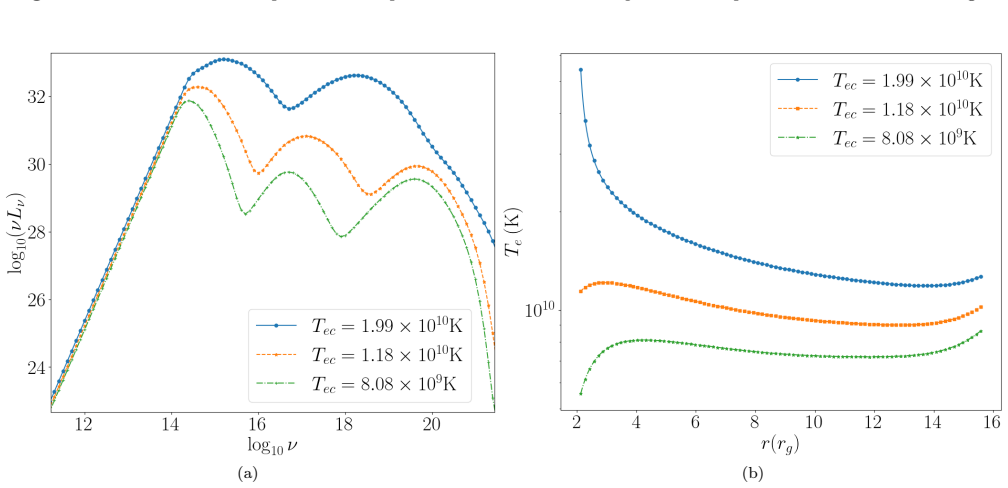
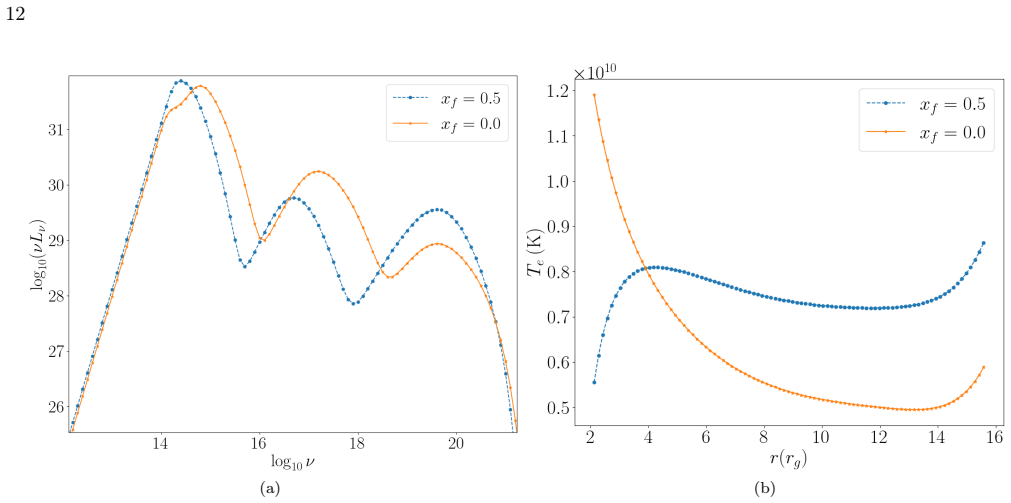
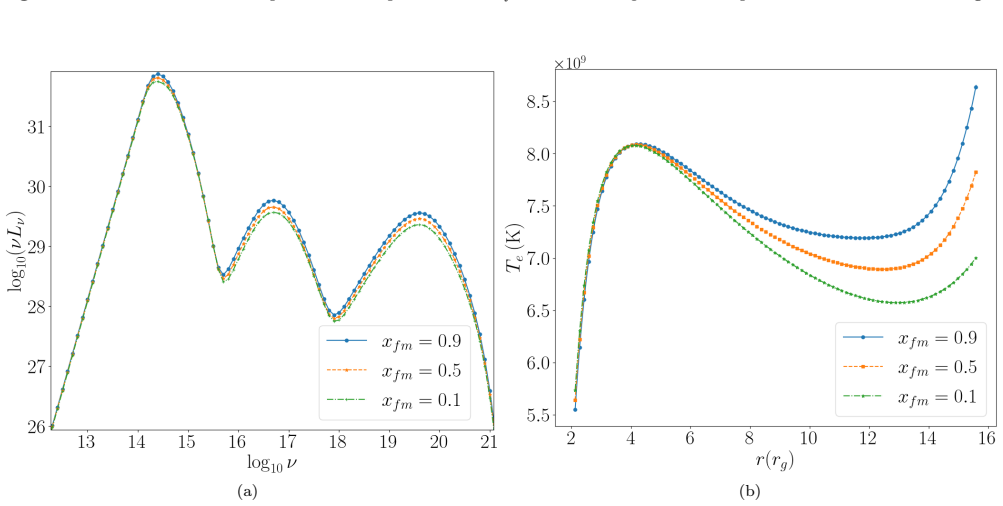
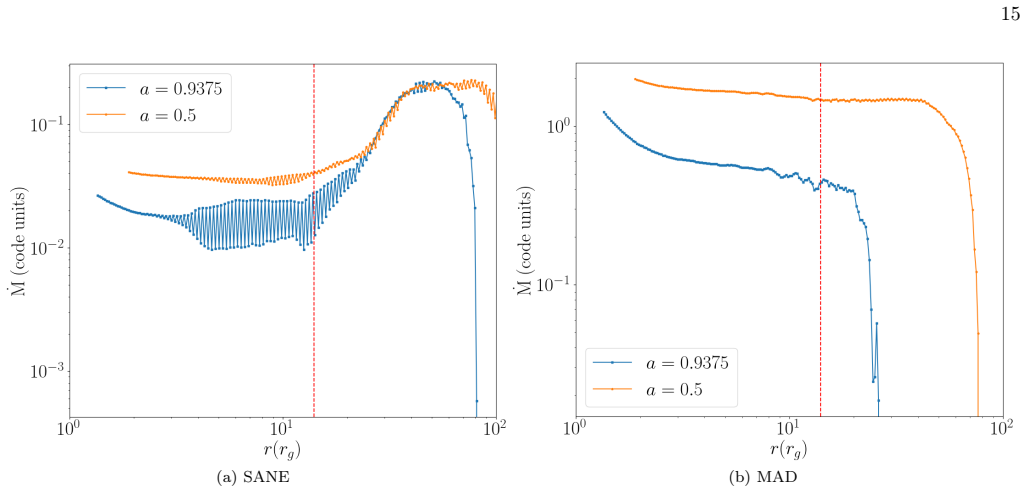
Numerical steady state MHD solutions of magnetized accretion flows around black holes show strong dependence of the spectrum on the spin of the black hole, accretion rate, magnetic field and the electron temperature of the flow. Validation with GRMHD simulations using SANE and MAD vector potentials for spins a=0.5 and a=0.9375 finds large differences in bolometric luminosities and emission peak locations between the two states, along with drastically distinct ratios of synchrotron radiation to synchrotron self-Comptonization peaks. The overall luminosity combined with such metrics can distinguish the magnetic field characteristics in astrophysical systems.
What carries the argument
Spectral comparison between SANE and MAD vector potentials in GRMHD simulations of magnetized advective flows around rotating black holes.
If this is right
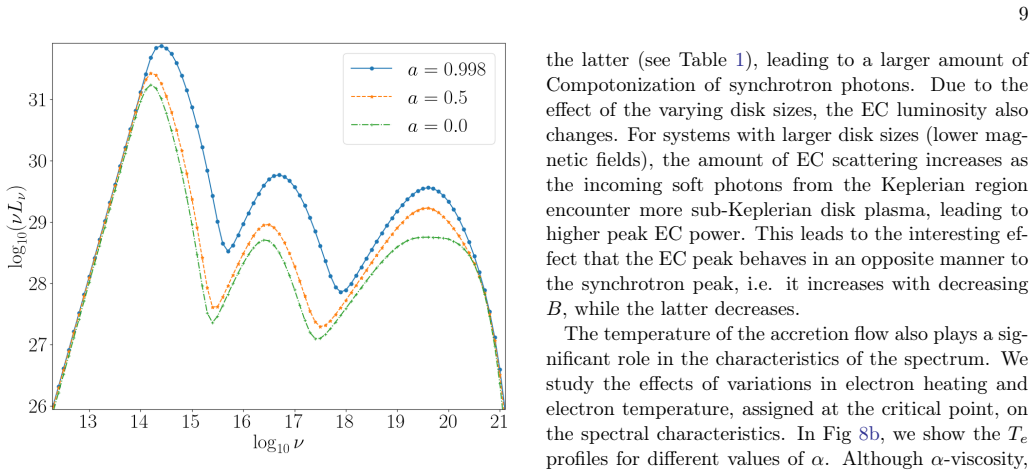
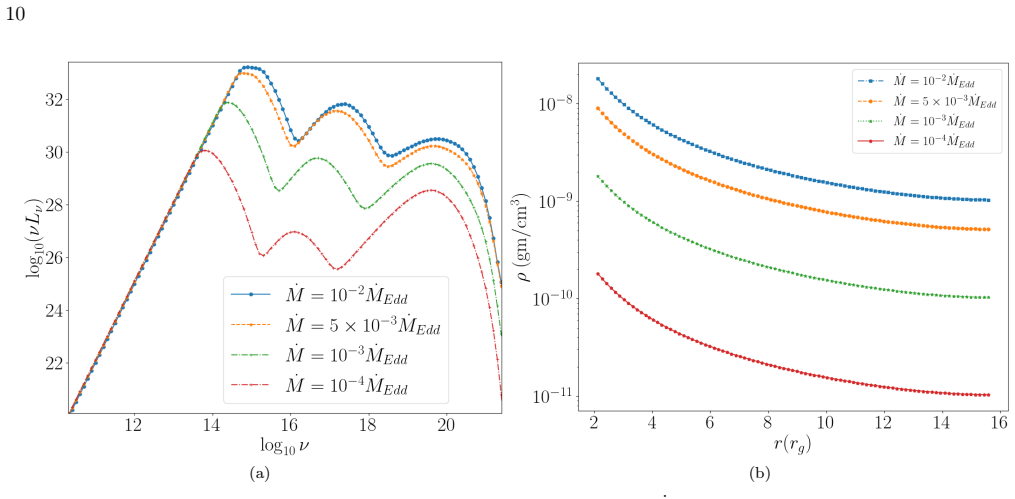
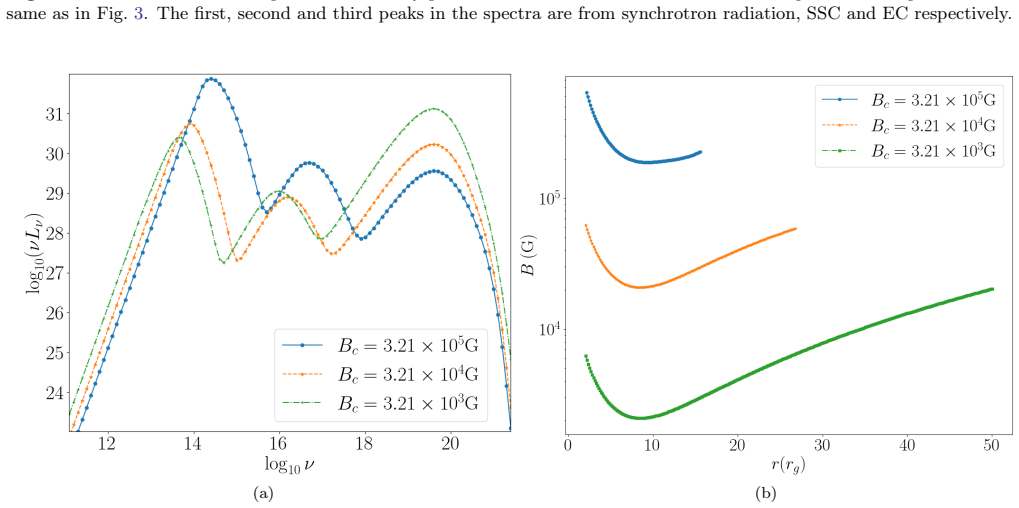
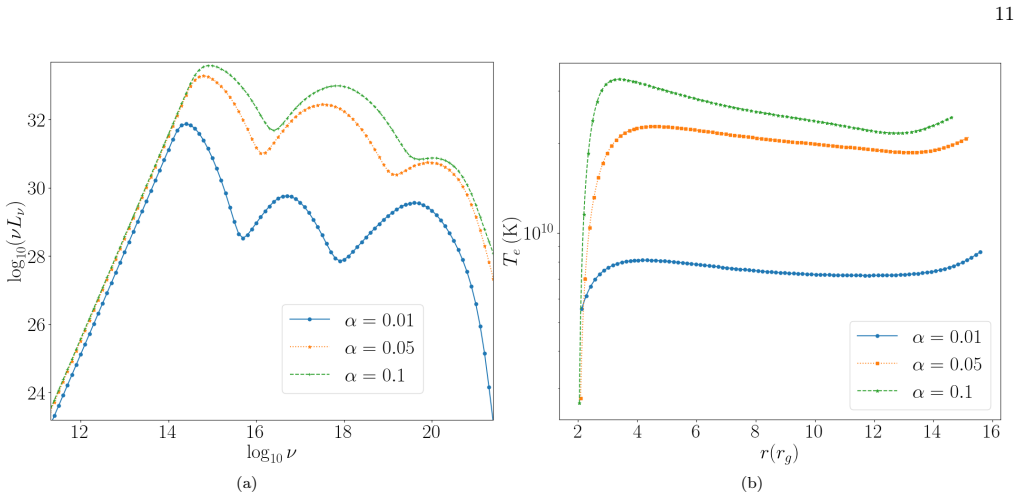
- The spectrum exhibits strong dependence on the spin of the black hole, accretion rate, magnetic field and the electron temperature of the flow.
- Variations in these quantities influence the emission peaks and overall luminosity.
- There is a large difference in the bolometric luminosities and the location of the emission peaks between SANE and MAD flows.
- The ratio of synchrotron radiation to synchrotron self-Comptonization peaks shows drastically distinct features in SANE and MAD.
Where Pith is reading between the lines
- If the luminosity and ratio distinctions persist, they could be applied to classify the magnetic states of observed X-ray binaries or active galactic nuclei from existing spectral data.
- The approach might be extended to time-variable flows to test whether the same metrics remain stable under realistic accretion fluctuations.
- Polarization measurements could be combined with these spectral ratios to provide an independent check on the inferred magnetic configurations.
Load-bearing premise
The chosen steady-state MHD solutions and the specific SANE/MAD vector potentials in the GRMHD runs represent the dominant physics in real magnetized accretion flows around rotating black holes.
What would settle it
High-quality multi-wavelength spectra from a rotating black hole accretion system that exhibit similar bolometric luminosities and synchrotron-to-SSC peak ratios under conditions expected to produce SANE versus MAD states would falsify the distinguishing power of these metrics.
Figures
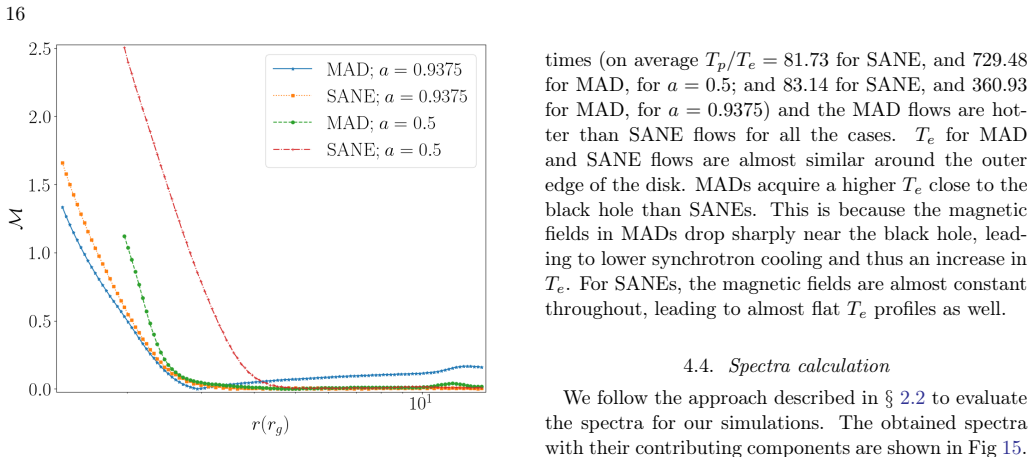
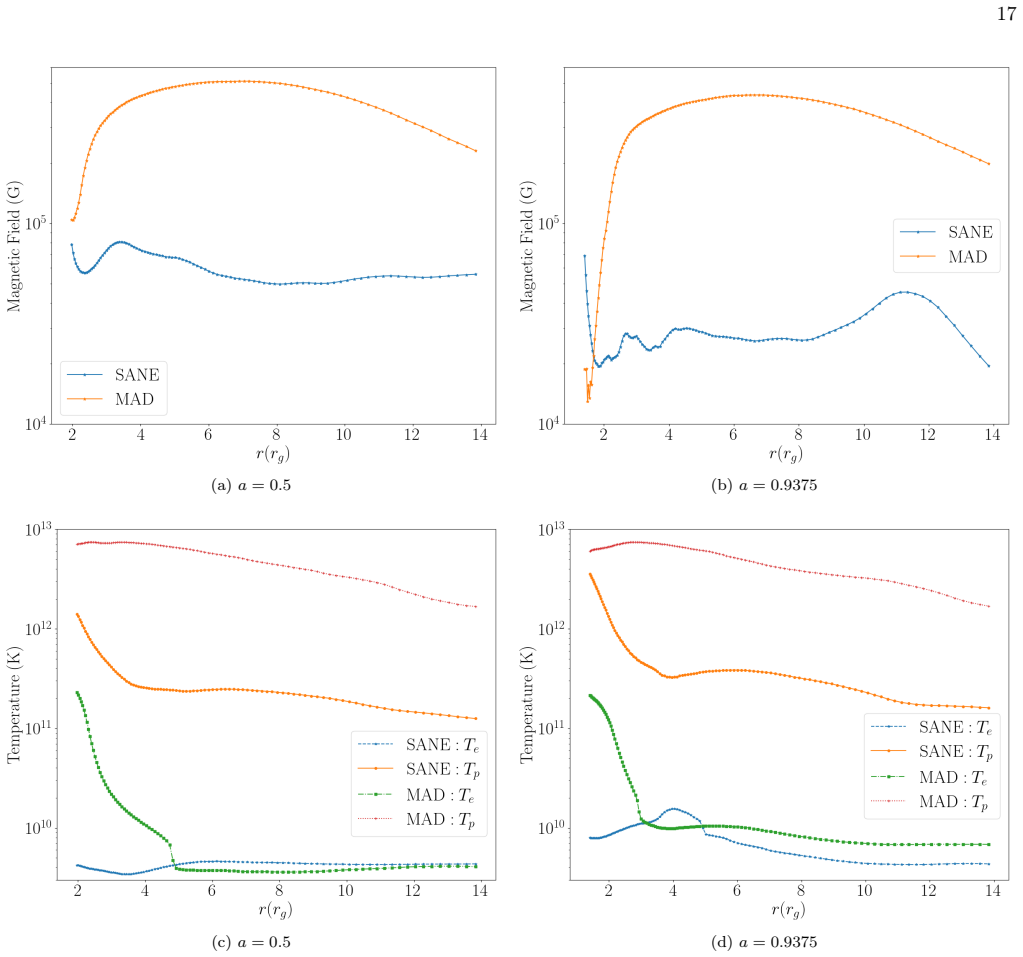
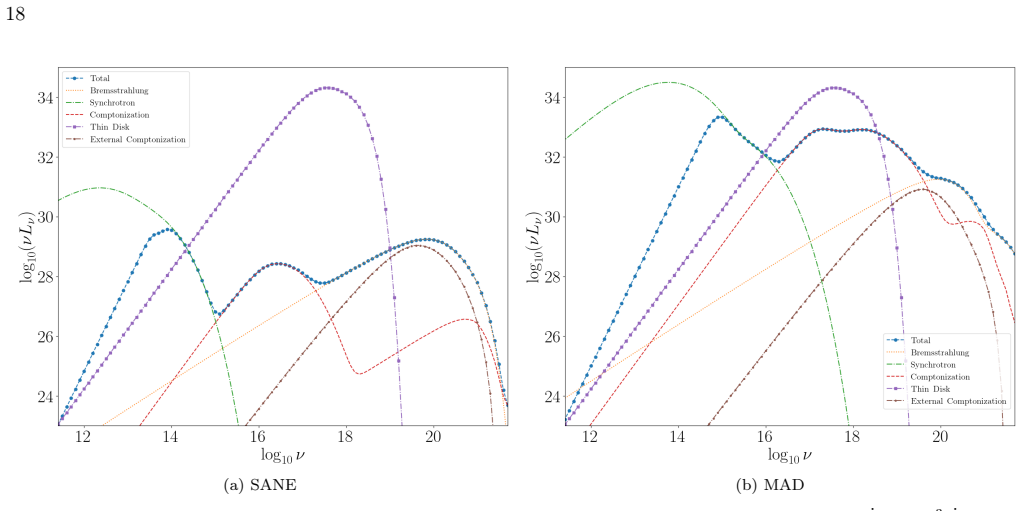
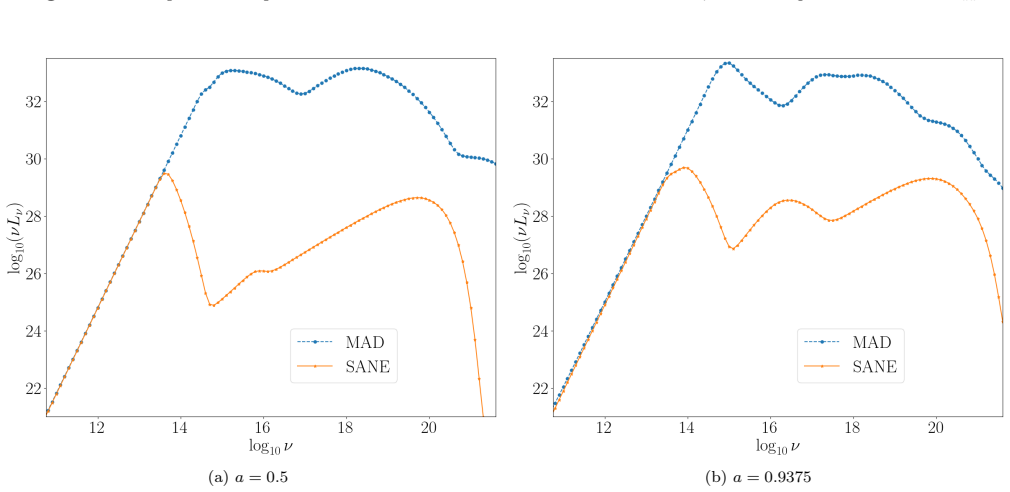
read the original abstract
The spectra of an accretion disk around black holes are the basic diagnostic tool to enlighten the underlying flows and then black holes. Accretion flows around black holes, however, are controlled by parameters like the magnetic field, spin of the black hole, accretion rate and temperature of the flow. These quantities affect the (magneto)hydrodynamics of the flow thus consequently lead to variations in the spectrum. We first consider numerical steady state magnetohydrodynamic (MHD) solutions of magnetized accretion flows around black holes to study the dependence of the spectra on these disk properties. The spectrum exhibits strong dependence on the spin of the black hole, accretion rate, magnetic field and the electron temperature of the flow. Variations in these quantities influence the emission peaks and overall luminosity, which can be a tell-tale sign to extract physics of observed spectra. We further validate our results with general relativistic MHD (GRMHD) simulations using the standard and normal evolution (SANE) and magnetically arrested disk (MAD) vector potentials. We consider two black hole spins ($a=0.5$ and $a=0.9375$) to model the magnetic field configurations and study the resulting spectra by comparing MAD and SANE results. We find a large difference in the bolometric luminosities and the location of the emission peaks between SANE and MAD flows. Certain properties of the spectra, like, the ratio of synchrotron radiation to synchrotron self-Comptonization peaks in SANE and MAD, show drastically distinct features. The overall luminosity combined with such metrics can distinguish the magnetic field characteristics in astrophysical systems.
Editorial analysis
A structured set of objections, weighed in public.
Referee Report
Summary. The paper claims that spectra of magnetized advective accretion flows around rotating black holes depend strongly on black hole spin, accretion rate, magnetic field strength, and electron temperature, as shown via numerical steady-state MHD solutions. It further validates this with GRMHD simulations using standard SANE and MAD vector potentials at spins a=0.5 and a=0.9375, reporting large differences in bolometric luminosity, emission peak locations, and the synchrotron-to-SSC peak ratio that together serve as diagnostics to distinguish magnetic field characteristics in astrophysical systems.
Significance. If the reported spectral distinctions between SANE and MAD configurations prove robust, the work would provide a potentially useful observational diagnostic for inferring magnetic field properties from black hole accretion spectra, aiding interpretation of high-energy observations.
major comments (2)
- [GRMHD simulations] GRMHD simulations section: The claim that bolometric luminosity combined with emission peak ratios and synchrotron-to-SSC ratios can distinguish magnetic field characteristics rests on the representativeness of the standard SANE and MAD vector potentials; only two spins (a=0.5 and a=0.9375) are tested with no sensitivity analysis to alternative initial field geometries, intermediate magnetization states, or resolution variations, which is load-bearing for the diagnostic assertion.
- [Results] Steady-state MHD solutions and results sections: No quantitative validation such as error bars, convergence tests, or tabulated spectral data is referenced to support the reported dependencies of luminosity and peak locations on the varied parameters, undermining assessment of the strength of the distinctions.
minor comments (1)
- The abstract does not specify the numerical methods, codes, or grid resolutions employed for either the steady-state MHD solutions or the GRMHD runs.
Simulated Author's Rebuttal
We thank the referee for the detailed and constructive report. We address each major comment below and indicate the revisions planned for the manuscript.
read point-by-point responses
-
Referee: [GRMHD simulations] GRMHD simulations section: The claim that bolometric luminosity combined with emission peak ratios and synchrotron-to-SSC ratios can distinguish magnetic field characteristics rests on the representativeness of the standard SANE and MAD vector potentials; only two spins (a=0.5 and a=0.9375) are tested with no sensitivity analysis to alternative initial field geometries, intermediate magnetization states, or resolution variations, which is load-bearing for the diagnostic assertion.
Authors: The standard SANE and MAD vector potentials are the most widely adopted benchmarks in the GRMHD literature precisely because they bracket the range of magnetic field strengths relevant to observed systems. We selected a=0.5 and a=0.9375 to sample moderate and high-spin regimes. We agree that the diagnostic claim would be strengthened by explicit tests of alternative initial geometries or intermediate magnetization; such an expanded study lies beyond the scope of the present work. In revision we will add a dedicated limitations paragraph stating that the reported distinctions apply to these canonical configurations and that future work should explore additional setups. revision: partial
-
Referee: [Results] Steady-state MHD solutions and results sections: No quantitative validation such as error bars, convergence tests, or tabulated spectral data is referenced to support the reported dependencies of luminosity and peak locations on the varied parameters, undermining assessment of the strength of the distinctions.
Authors: We will insert a new table that tabulates bolometric luminosity, synchrotron and SSC peak frequencies, and their ratio for each combination of spin, accretion rate, magnetic field strength, and electron temperature explored in the steady-state MHD solutions. We will also add a short subsection describing the numerical convergence criteria (grid resolution, iteration tolerance, and residual norms) employed by the MHD solver and the typical fractional uncertainties on the derived spectral quantities. For the GRMHD runs we will reference the standard resolution and convergence practices used in the community. revision: yes
Circularity Check
No circularity; spectra computed from independent MHD/GRMHD setups
full rationale
The paper solves steady-state MHD equations for magnetized flows, then computes spectra from GRMHD runs initialized with standard SANE and MAD vector potentials at two spins. Spectral features (luminosities, peak locations, synchrotron/SSC ratios) are direct numerical outputs from these distinct input configurations. No parameters are fitted to data and renamed as predictions, no quantities are defined in terms of each other, and no self-citations or uniqueness theorems are invoked to force the result. The derivation chain is self-contained against external benchmarks.
Axiom & Free-Parameter Ledger
Reference graph
Works this paper leans on
-
[1]
1988, ApJ, 332, 646, doi: 10.1086/166683
Szuszkiewicz, E. 1988, ApJ, 332, 646, doi: 10.1086/166683
-
[2]
Abramowicz, M. A., & Fragile, P. C. 2013, Living Reviews in Relativity, 16, 1, doi: 10.12942/lrr-2013-1
-
[3]
Balbus, S. A., & Hawley, J. F. 1991, ApJ, 376, 214, doi: 10.1086/170270
-
[4]
Bardeen, J. M., Press, W. H., & Teukolsky, S. A. 1972, ApJ, 178, 347, doi: 10.1086/151796 20
-
[5]
1997, The Astrophysical Journal Letters, 486, L43
Bisnovatyi-Kogan, G., & Lovelace, R. 1997, The Astrophysical Journal Letters, 486, L43
1997
-
[6]
Bisnovatyi-Kogan, G. S., & Lovelace, R. V. E. 1997, The Astrophysical Journal, 486, L43, doi: 10.1086/310826
-
[7]
Chakrabarti, S., & Titarchuk, L. G. 1995, ApJ, 455, 623, doi: 10.1086/176610
-
[8]
2015, ApJ, 799, 1, doi: 10.1088/0004-637X/799/1/1
Chan, C.-K., Psaltis, D., Özel, F., Narayan, R., & Sądowski, A. 2015, ApJ, 799, 1, doi: 10.1088/0004-637X/799/1/1
-
[9]
1967, An Introduction to the Study Of Stellar Structure (Dover, New York)
Chandrasekhar, S. 1967, An Introduction to the Study Of Stellar Structure (Dover, New York)
1967
-
[10]
2022, ApJ, 941, 30, doi: 10.3847/1538-4357/ac9d97
Chatterjee, K., & Narayan, R. 2022, ApJ, 941, 30, doi: 10.3847/1538-4357/ac9d97
-
[11]
, year = 1990, month = aug, volume =
Coppi, P. S., & Blandford, R. D. 1990, MNRAS, 245, 453, doi: 10.1093/mnras/245.3.453 Fernández-Ontiveros, J. A., & Muñoz-Darias, T. 2021, MNRAS, 504, 5726, doi: 10.1093/mnras/stab1108
-
[12]
Fishbone, L. G., & Moncrief, V. 1976, ApJ, 207, 962, doi: 10.1086/154565
-
[13]
2026, Journal of High Energy Astrophysics, 50, 100469, doi: 10.1016/j.jheap.2025.100469
Ghosh, S., & Bhattacharyya, S. 2026, Journal of High Energy Astrophysics, 50, 100469, doi: 10.1016/j.jheap.2025.100469
-
[14]
Hawley, J. F., & Balbus, S. A. 1992, ApJ, 400, 595, doi: 10.1086/172021
-
[15]
Heckman, T. M., & Best, P. N. 2014, ARA&A, 52, 589, doi: 10.1146/annurev-astro-081913-035722 Körding, E., Falcke, H., & Corbel, S. 2006, A&A, 456, 439, doi: 10.1051/0004-6361:20054144
work page internal anchor Pith review doi:10.1146/annurev-astro-081913-035722 2014
-
[16]
2014, PhRvD, 89, 024041, doi: 10.1103/PhysRevD.89.024041
Tchekhovskoy, A., & Narayan, R. 2014, PhRvD, 89, 024041, doi: 10.1103/PhysRevD.89.024041
-
[17]
Liu, B. F., Taam, R. E., Meyer-Hofmeister, E., & Meyer, F. 2007, The Astrophysical Journal, 671, 695, doi: 10.1086/522619
-
[18]
Mandal, S., & Chakrabarti, S. K. 2005, A&A, 434, 839, doi: 10.1051/0004-6361:20041235
-
[19]
1997, The Astrophysical Journal, 489, 791, doi: 10.1086/304817
Manmoto, T., Mineshige, S., & Kusunose, M. 1997, The Astrophysical Journal, 489, 791, doi: 10.1086/304817
-
[20]
Merloni, A., Heinz, S., & di Matteo, T. 2003, MNRAS, 345, 1057, doi: 10.1046/j.1365-2966.2003.07017.x
-
[21]
2020, MNRAS, 495, 350, doi: 10.1093/mnras/staa1161
Mondal, T., & Mukhopadhyay, B. 2020, MNRAS, 495, 350, doi: 10.1093/mnras/staa1161
-
[22]
2022, Astronomy & Astrophysics, 662, A28
Moravec, E., Svoboda, J., Borkar, A., et al. 2022, Astronomy & Astrophysics, 662, A28
2022
-
[23]
2002, ApJ, 581, 427, doi: 10.1086/344227
Mukhopadhyay, B. 2002, ApJ, 581, 427, doi: 10.1086/344227
-
[24]
2015, ApJ, 807, 43, doi: 10.1088/0004-637X/807/1/43
Mukhopadhyay, B., & Chatterjee, K. 2015, ApJ, 807, 43, doi: 10.1088/0004-637X/807/1/43
-
[25]
Curd, B. 2022, MNRAS, 511, 3795, doi: 10.1093/mnras/stac285
-
[26]
Advection-dominated Accretion: Underfed Black Holes and Neutron Stars.Astrophys
Narayan, R., & Yi, I. 1995, ApJ, 452, 710, doi: 10.1086/176343
-
[27]
1995, Nature, 374, 623, doi: 10.1038/374623a0
Narayan, R., Yi, I., & Mahadevan, R. 1995, Nature, 374, 623, doi: 10.1038/374623a0
-
[28]
2025, ApJ, 981, 162, doi: 10.3847/1538-4357/adb286
Pathak, M., & Mukhopadhyay, B. 2025, ApJ, 981, 162, doi: 10.3847/1538-4357/adb286
-
[29]
Magnetic Fields of Compact Objects in Close X-Ray Binary Systems
Piotrovich, M. Y., Gnedin, Y. N., Buliga, S. D., et al. 2015, in Astronomical Society of the Pacific Conference Series, Vol. 494, Physics and Evolution of Magnetic and Related Stars, ed. Y. Y. Balega, I. I. Romanyuk, & D. O. Kudryavtsev, 114, doi: 10.48550/arXiv.1409.2283
work page internal anchor Pith review Pith/arXiv arXiv doi:10.48550/arxiv.1409.2283 2015
-
[30]
2017, Computational Astrophysics and Cosmology, 4, 1, doi: 10.1186/s40668-017-0020-2
Porth, O., Olivares, H., Mizuno, Y., et al. 2017, Computational Astrophysics and Cosmology, 4, 1, doi: 10.1186/s40668-017-0020-2
-
[31]
1999, ApJ, 520, 248, doi: 10.1086/307423
Quataert, E., & Gruzinov, A. 1999, ApJ, 520, 248, doi: 10.1086/307423
-
[32]
, archivePrefix = "arXiv", eprint =
Rajesh, S. R., & Mukhopadhyay, B. 2010, MNRAS, 402, 961, doi: 10.1111/j.1365-2966.2009.15925.x
-
[33]
M., Tchekhovskoy, A., Quataert, E., & Gammie, C
Ressler, S. M., Tchekhovskoy, A., Quataert, E., & Gammie, C. F. 2017, MNRAS, 467, 3604, doi: 10.1093/mnras/stx364
-
[34]
Scepi, N., Begelman, M. C., & Dexter, J. 2024, MNRAS, 527, 1424, doi: 10.1093/mnras/stad3299
-
[35]
Scepi, N., Dexter, J., & Begelman, M. C. 2022, MNRAS, 511, 3536, doi: 10.1093/mnras/stac337
-
[36]
I., & Sunyaev, R
Shakura, N. I., & Sunyaev, R. A. 1973, A&A, 24, 337
1973
-
[37]
Shapiro, S. L., Lightman, A. P., & Eardley, D. M. 1976, ApJ, 204, 187, doi: 10.1086/154162
-
[38]
Sharma, P., Quataert, E., Hammett, G. W., & Stone, J. M. 2007, The Astrophysical Journal, 667, 714, doi: 10.1086/520800
-
[39]
Tchekhovskoy, A., Narayan, R., & McKinney, J. C. 2011, MNRAS, 418, L79, doi: 10.1111/j.1745-3933.2011.01147.x
-
[40]
, archivePrefix = "arXiv", eprint =
Xie, F.-G., & Yuan, F. 2012, MNRAS, 427, 1580, doi: 10.1111/j.1365-2966.2012.22030.x
-
[41]
Xie, F.-G., & Zdziarski, A. A. 2019, ApJ, 887, 167, doi: 10.3847/1538-4357/ab5848
-
[42]
2014, ARA&A, 52, 529, doi: 10.1146/annurev-astro-082812-141003
Yuan, F., & Narayan, R. 2014, ARA&A, 52, 529, doi: 10.1146/annurev-astro-082812-141003
work page internal anchor Pith review doi:10.1146/annurev-astro-082812-141003 2014
-
[43]
2003, ApJ, 598, 301, doi: 10.1086/378716
Yuan, F., Quataert, E., & Narayan, R. 2003, ApJ, 598, 301, doi: 10.1086/378716
-
[44]
A., Pjanka, P., Sikora, M., & Stawarz, Ł
Zdziarski, A. A., Pjanka, P., Sikora, M., & Stawarz, Ł. 2014, MNRAS, 442, 3243, doi: 10.1093/mnras/stu1009
-
[45]
Zhu, S. F., Brandt, W. N., Luo, B., et al. 2020, Mon. Not. Roy. Astron. Soc., 496, 245, doi: 10.1093/mnras/staa1411
discussion (0)
Sign in with ORCID, Apple, or X to comment. Anyone can read and Pith papers without signing in.