The Mathematics of AI Winters: The mathematical Taxonomy of Paradigm Fragility in AI Winter
Pith reviewed 2026-06-27 09:58 UTC · model grok-4.3
The pith
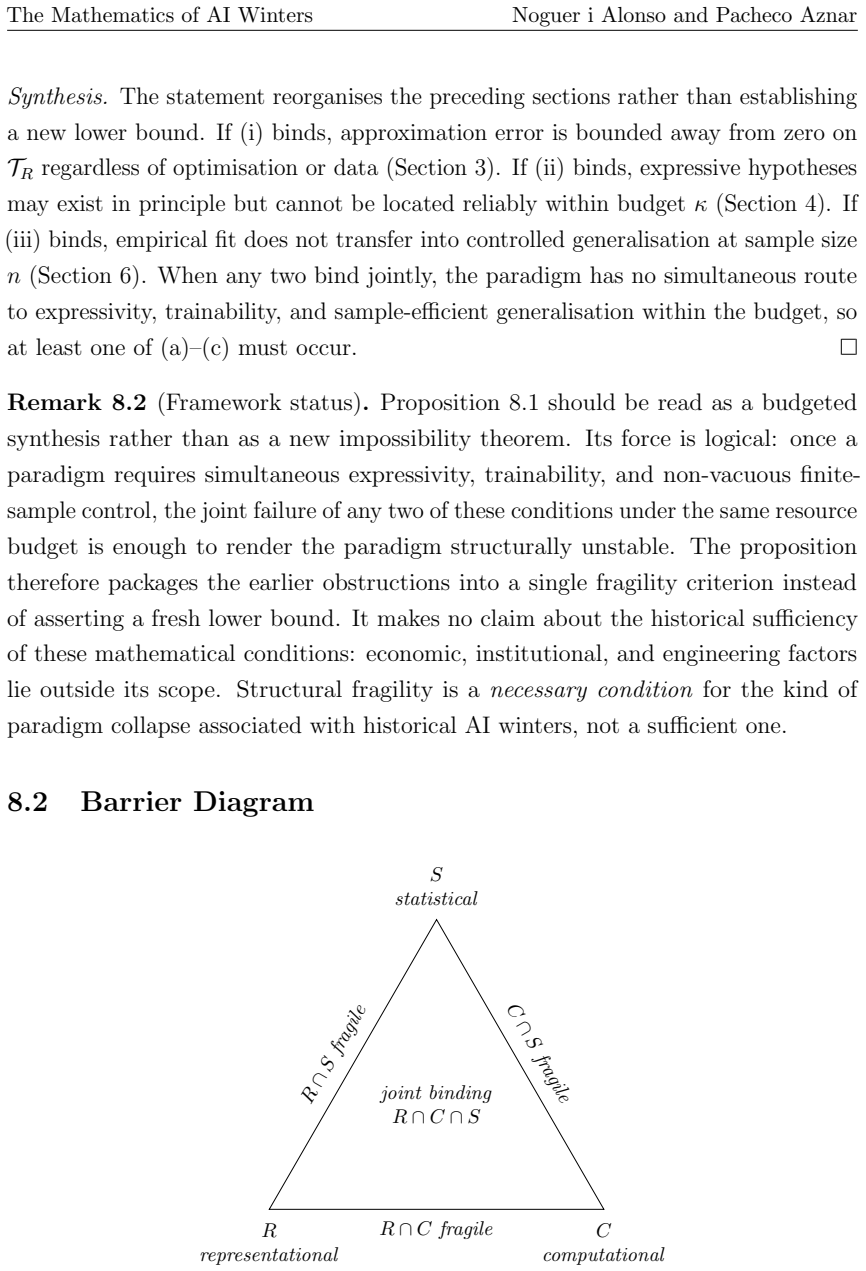
AI winters were aligned with formal mathematical barriers in representation, optimization, and learnability
A machine-rendered reading of the paper's core claim, the machinery that carries it, and where it could break.
Core claim
The dominant paradigms of the AI winters met genuine formal barriers, including limitations of representation, optimisation, computational complexity, statistical learnability, and high-dimensional approximation. Several central disappointments of early AI aligned with mathematically precise bottlenecks from the perceptron impossibility results of Minsky and Papert, the complexity-theoretic hardness of exact neural-network training, minimax rates for nonparametric estimation in high dimension, vanishing-gradient analyses, and classical statistical learning theory in the tradition of Vapnik-Chervonenkis and Valiant. These barriers are related to later breakthroughs that mitigated rather than
What carries the argument
The taxonomy of paradigm fragility, which maps historical AI disappointments onto mathematically precise bottlenecks drawn from representation theory, complexity, and statistical learning.
If this is right
- The technical disappointments of early AI were aligned with precise mathematical limits in addition to practical difficulties.
- Later advances mitigated these barriers through architectural and algorithmic changes.
- AI progress involves identifying and working around formal constraints identified by learning theory and complexity results.
- Paradigm shifts occur in part when new methods circumvent or relax the bottlenecks that stalled prior approaches.
Where Pith is reading between the lines
- The same taxonomy could be applied to later periods of AI development to test whether current approaches are approaching new formal limits.
- Funding cycles in AI may reflect the point at which paradigms encounter these mathematical ceilings.
- Modern scaling efforts may still be constrained by residual versions of the high-dimensional and optimization barriers discussed.
Load-bearing premise
The cited mathematical results constitute the relevant bottlenecks and their alignment with historical disappointments is meaningful and non-trivial rather than post-hoc selection.
What would settle it
A historical or technical record showing that the actual obstacles faced by researchers during the AI winters were unrelated to the mathematical limits analyzed here, or that the alignment collapses under systematic comparison.
Figures
read the original abstract
Two major periods of reduced funding and confidence in artificial intelligence research, commonly called the first and second AI winters, are usually explained through engineering failure, commercial disappointment, and inflated expectations. This article develops a complementary thesis: that the dominant paradigms of those periods also met genuine formal barriers, including limitations of representation, optimisation, computational complexity, statistical learnability, and high-dimensional approximation. The contribution is synthetic rather than archival. We do not claim that particular theorems mechanically caused the winters; rather, we show that several central disappointments of early AI were aligned with mathematically precise bottlenecks. We analyse these bottlenecks through the perceptron impossibility results of Minsky and Papert, the complexity-theoretic hardness of exact neural-network training established by Blum and Rivest, minimax rates for nonparametric estimation in high dimension due to Stone, vanishing-gradient analyses by Hochreiter and by Bengio and collaborators, and classical statistical learning theory in the tradition of Vapnik and Chervonenkis, Valiant, and Blumer and collaborators. We then relate these barriers to the later breakthroughs that mitigated, rather than eliminated, them.
Editorial analysis
A structured set of objections, weighed in public.
Referee Report
Summary. The paper develops a complementary thesis to socio-economic explanations of the first and second AI winters: that dominant paradigms encountered genuine formal barriers in representation (Minsky-Papert perceptron limits), computational complexity (Blum-Rivest NP-completeness of exact NN training), high-dimensional approximation (Stone minimax rates), optimization (Hochreiter/Bengio vanishing gradients), and statistical learnability (VC theory). The contribution is explicitly synthetic and interpretive; it disclaims mechanical causation and instead maps specific historical disappointments to these established mathematical results, then relates the barriers to later mitigating breakthroughs.
Significance. If the interpretive alignments are accepted as substantive rather than post-hoc, the paper supplies a mathematical taxonomy of paradigm fragility that could usefully complement existing accounts of AI history and inform assessments of current paradigms. Its strengths are the explicit disclaimer of causation, reliance on well-known external theorems, and focus on mitigation rather than elimination of barriers. However, because the work offers no new derivations, systematic citation analysis, or falsifiable tests, its significance hinges entirely on whether readers find the selected mappings non-trivial and representative.
major comments (2)
- [sections analyzing Minsky-Papert, Blum-Rivest, Stone, Hochreiter/Bengio, and VC results] The central claim that the listed results constitute the relevant bottlenecks (rather than one possible retrospective mapping) is load-bearing for the thesis. The manuscript would need to supply an explicit criterion for 'alignment' or a comparison against alternative mathematical and non-mathematical factors to demonstrate that the selection is non-arbitrary; absent this, the interpretive step risks appearing post-hoc.
- [relation of barriers to historical periods] The paper correctly notes that the barriers were mitigated rather than removed, but does not address the temporal gap: many of the cited results (e.g., Blum-Rivest 1992, Hochreiter 1991) post-date the onset of the second winter, weakening the claim that they explain contemporaneous disappointments.
minor comments (2)
- Notation for the various theorems is introduced without a consolidated table or consistent cross-referencing, making it difficult to track which result addresses which barrier.
- [abstract and introduction] The abstract and introduction repeat the disclaimer against mechanical causation; a single, prominent statement would suffice.
Simulated Author's Rebuttal
We thank the referee for the constructive and precise comments. We respond to each major point below, indicating revisions where appropriate to strengthen the interpretive framework while preserving the paper's synthetic and non-causal character.
read point-by-point responses
-
Referee: The central claim that the listed results constitute the relevant bottlenecks (rather than one possible retrospective mapping) is load-bearing for the thesis. The manuscript would need to supply an explicit criterion for 'alignment' or a comparison against alternative mathematical and non-mathematical factors to demonstrate that the selection is non-arbitrary; absent this, the interpretive step risks appearing post-hoc.
Authors: We agree that an explicit selection criterion would improve transparency. The manuscript already disclaims mechanical causation and presents the work as a mapping of central disappointments to established results. We will add a short subsection in the introduction that states the criterion: results are included when they (i) formalize limitations repeatedly identified in the historical literature as blocking the dominant paradigm of the period and (ii) correspond to technical challenges whose mitigation enabled subsequent progress. This makes the interpretive choices explicit without asserting exclusivity or post-hoc fitting. A full comparison against every alternative factor lies outside the paper's synthetic scope, but the added criterion addresses the arbitrariness concern directly. revision: yes
-
Referee: The paper correctly notes that the barriers were mitigated rather than removed, but does not address the temporal gap: many of the cited results (e.g., Blum-Rivest 1992, Hochreiter 1991) post-date the onset of the second winter, weakening the claim that they explain contemporaneous disappointments.
Authors: We acknowledge the publication dates. Blum and Rivest (1992) and Hochreiter (1991) appeared at or after the conventional start of the second winter. However, the underlying phenomena—training intractability and gradient instability—were already documented in empirical work of the mid-to-late 1980s. The theorems supplied rigorous accounts of difficulties that researchers had encountered in practice. We will revise the relevant passages to note the chronology explicitly and to reiterate that the analysis concerns alignment between the formal statements and the character of the reported disappointments, consistent with the paper's disclaimer against mechanical causation. revision: yes
Circularity Check
No circularity: synthetic alignment of external theorems with no self-reduction or fitted predictions
full rationale
The paper is explicitly synthetic and disclaims mechanical causation. Its central thesis aligns historical AI winter disappointments with well-known external results (Minsky-Papert perceptron limits, Blum-Rivest NP-completeness, Stone minimax rates, Hochreiter/Bengio vanishing gradients, VC theory) without deriving new theorems, fitting parameters to data, or reducing claims to self-citations. No equations or load-bearing steps reduce by construction to the paper's own inputs; the argument is retrospective mapping rather than a closed derivation. This matches the default non-circular case for synthetic historical analyses relying on independent prior theorems.
Axiom & Free-Parameter Ledger
Reference graph
Works this paper leans on
-
[1]
doi: 10.1017/S0962492921000027. Eric B. Baum and David Haussler. What size net gives valid generalization?Neural Computation, 1(1):151–160,
-
[2]
Mikhail Belkin, Daniel Hsu, Siyuan Ma, and Soumik Mandal
doi: 10.1162/neco.1989.1.1.151. Mikhail Belkin, Daniel Hsu, Siyuan Ma, and Soumik Mandal. Reconciling modern machine-learning practice and the classical bias–variance trade-off.Proceedings of the National Academy of Sciences, 116(32):15849–15854,
-
[3]
Neural networks and physical systems with emergent collective com- putational abilities
doi: 10.1073/pnas. 1903070116. Richard E. Bellman.Adaptive Control Processes: A Guided Tour. Princeton University Press, Princeton, NJ,
-
[4]
Learning long-term dependencies with gradient descent is difficult
doi: 10.1109/72.279181. Kevin Beyer, Jonathan Goldstein, Raghu Ramakrishnan, and Uri Shaft. When is “nearest neighbor” meaningful? InProceedings of the 7th International Conference on Database Theory (ICDT), pages 217–235. Springer,
-
[5]
doi: 10.1007/3-540-49257-7
-
[6]
Anselm Blumer, Andrzej Ehrenfeucht, David Haussler, and Manfred K
doi: 10.1016/S0893-6080(05)80010-3. Anselm Blumer, Andrzej Ehrenfeucht, David Haussler, and Manfred K. Warmuth. Learnability and the Vapnik–Chervonenkis dimension.Journal of the ACM, 36(4): 929–965,
-
[7]
doi: 10.1145/76359.76371. Bernhard E. Boser, Isabelle M. Guyon, and Vladimir N. Vapnik. A training algorithm for optimal margin classifiers. InProceedings of the Fifth Annual Workshop on Computational Learning Theory (COLT), pages 144–152. ACM,
-
[8]
doi: 10.1145/130385.130401. Bruce G. Buchanan and Edward H. Shortliffe.Rule-Based Expert Systems: The MYCIN Experiments of the Stanford Heuristic Programming Project. Addison- Wesley, Reading, MA,
-
[9]
doi: 10.1007/BF00994018. George Cybenko. Approximation by superpositions of a sigmoidal function.Math- ematics of Control, Signals and Systems, 2(4):303–314,
-
[10]
doi: 10.1214/aos/1024691081. Hubert L. Dreyfus.What Computers Can’t Do: A Critique of Artificial Reason. Harper & Row, New York,
-
[11]
doi: 10.1016/0890-5401(89)90002-3. Ronen Eldan and Ohad Shamir. The power of depth for feedforward neural networks. InProceedings of the 29th Conference on Learning Theory (COLT), pages 907–940. PMLR,
-
[12]
Xavier Glorot and Yoshua Bengio
arXiv:1803.03635. Xavier Glorot and Yoshua Bengio. Understanding the difficulty of training deep feedforward neural networks. InProceedings of the Thirteenth International Conference on Artificial Intelligence and Statistics (AISTATS), pages 249–256. PMLR,
-
[13]
doi: 10.1214/21-AOS2133. Kaiming He, Xiangyu Zhang, Shaoqing Ren, and Jian Sun. Delving deep into rectifiers: Surpassing human-level performance on ImageNet classification. In Proceedings of the IEEE International Conference on Computer Vision (ICCV), pages 1026–1034,
-
[14]
doi: 10.1109/ICCV.2015.123. Kaiming He, Xiangyu Zhang, Shaoqing Ren, and Jian Sun. Deep residual learning for image recognition. InProceedings of the IEEE Conference on Computer Vision and Pattern Recognition (CVPR), pages 770–778,
-
[15]
Deep Residual Learning for Image Recognition
doi: 10.1109/CVPR.2016.90. Sepp Hochreiter. Untersuchungen zu dynamischen neuronalen netzen. Master’s thesis, Technische Universit¨ at M¨ unchen,
-
[16]
Arthur Jacot, Franck Gabriel, and Cl´ ement Hongler
doi: 10.1016/0893-6080(91)90009-T. Arthur Jacot, Franck Gabriel, and Cl´ ement Hongler. Neural tangent kernel: Conver- gence and generalization in neural networks. InAdvances in Neural Information Processing Systems, volume 31, pages 8571–8580. Curran Associates,
-
[17]
Brown, Benjamin Chess, Rewon Child, Scott Gray, Alec Radford, Jeffrey Wu, and Dario Amodei
Jared Kaplan, Sam McCandlish, Tom Henighan, Tom B. Brown, Benjamin Chess, Rewon Child, Scott Gray, Alec Radford, Jeffrey Wu, and Dario Amodei. Scaling laws for neural language models.arXiv preprint arXiv:2001.08361,
Pith/arXiv arXiv 2001
-
[18]
10 Evaluating Bivariate Causal Statements Based on Mutual Compatibility Richardson, T
doi: 10.1214/aos/ 1015957395. Yann LeCun, Yoshua Bengio, and Geoffrey Hinton. Deep learning.Nature, 521 (7553):436–444,
-
[19]
doi: 10.1038/nature14539. 31 The Mathematics of AI Winters Noguer i Alonso and Pacheco Aznar Moshe Leshno, Vladimir Ya. Lin, Allan Pinkus, and Shimon Schocken. Multilayer feedforward networks with a nonpolynomial activation function can approximate any function.Neural Networks, 6(6):861–867,
-
[20]
doi: 10.1016/S0893-6080(05) 80131-5. James Lighthill. Artificial intelligence: A general survey. Technical report, Science Research Council, London, UK,
-
[21]
doi: 10.1037/h0042519. 32 The Mathematics of AI Winters Noguer i Alonso and Pacheco Aznar David E. Rumelhart, Geoffrey E. Hinton, and Ronald J. Williams. Learning rep- resentations by back-propagating errors.Nature, 323(6088):533–536,
-
[22]
doi: 10.1038/323533a0. Bernhard Sch¨ olkopf, Ralf Herbrich, and Alex J. Smola. A generalized representer theorem. InProceedings of the 14th Annual Conference on Computational Learning Theory (COLT), pages 416–426. Springer,
-
[23]
doi: 10.1007/3-540-44581-1
-
[24]
The Annals of Statistics , author =
doi: 10.1214/aos/1176345969. Matus Telgarsky. Benefits of depth in neural networks. InProceedings of the 29th Conference on Learning Theory (COLT), pages 1517–1539. PMLR,
-
[25]
doi: 10.1145/1968.1972. Vladimir N. Vapnik and Alexey Ya. Chervonenkis. On the uniform convergence of relative frequencies of events to their probabilities.Theory of Probability and Its Applications, 16(2):264–280,
-
[26]
Roman Vershynin.High-Dimensional Probability: An Introduction with Applications in Data Science
doi: 10.1137/1116025. Roman Vershynin.High-Dimensional Probability: An Introduction with Applications in Data Science. Cambridge University Press, Cambridge,
-
[27]
arXiv:1611.03530. 33
discussion (0)
Sign in with ORCID, Apple, or X to comment. Anyone can read and Pith papers without signing in.