Stable, bidirectional electro-optic transduction in thin film lithium tantalate
Pith reviewed 2026-06-27 09:11 UTC · model grok-4.3
The pith
Thin-film lithium tantalate enables the first stable bidirectional microwave-optical transducers with multi-day operation on a static bias.
A machine-rendered reading of the paper's core claim, the machinery that carries it, and where it could break.
Core claim
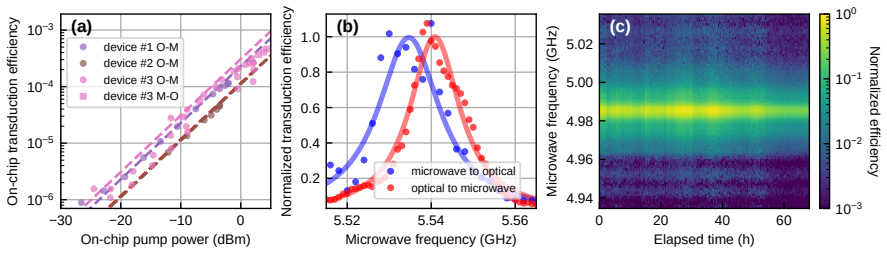
We demonstrate the first integrated electro-optic microwave-optical transducers realized in thin-film lithium tantalate, observing coherent bidirectional conversion between C-band optical photons and 4.9-5.5 GHz microwave photons with measured on-chip efficiencies and inferred single-photon coupling rates g0/2π ~ 1 kHz consistent with theory, and continuous operation over multiple days using a static bias field with minimal feedback.
What carries the argument
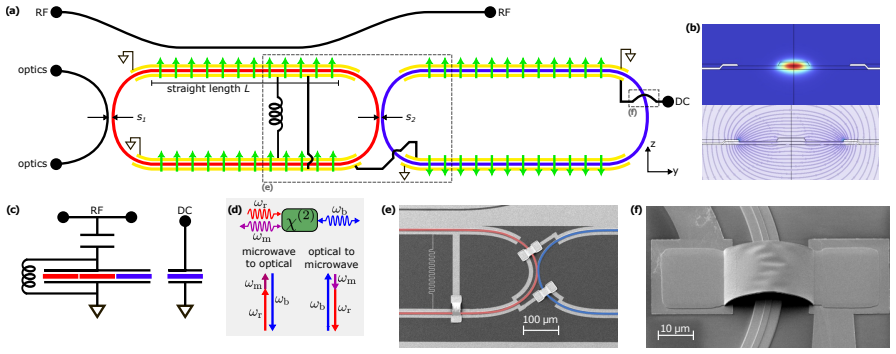
Superconducting microwave resonators coupled to tunable photonic-molecule optical resonators fabricated in thin-film lithium tantalate, using its Pockels nonlinearity to mediate the microwave-to-optical interaction.
If this is right
- Bidirectional conversion supports quantum state transfer in both directions for modular quantum processors.
- Static bias operation reduces the need for continuous active stabilization in deployed quantum networks.
- Wafer-scale deep ultraviolet lithography enables high-volume production of transducers for large-scale interconnects.
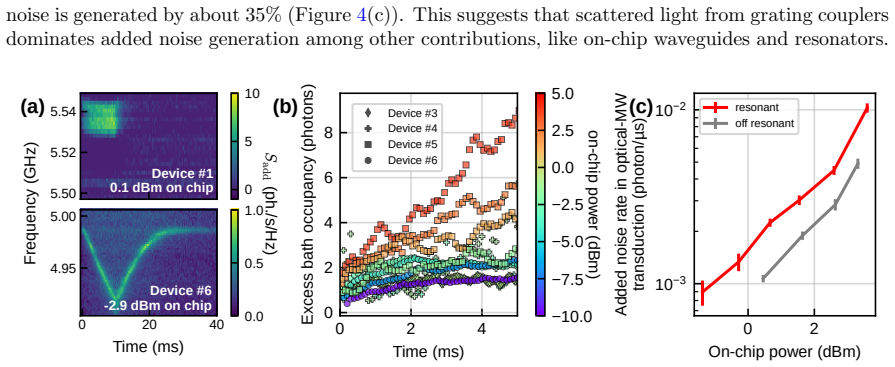
- Low added noise under pulsed pumping allows compatibility with superconducting qubit readout and control cycles.
- Improved high-power handling and stability position the platform for higher-efficiency operation in future devices.
Where Pith is reading between the lines
- The reported optical loss statistics could be used to predict device yield improvements through process optimization.
- If the coupling rates scale with device geometry as expected, smaller mode volumes might increase g0 without changing the material.
- The combination of stability and bidirectional operation could simplify calibration procedures in heterogeneous quantum systems.
- Pulsed operation data suggests the platform might tolerate higher average powers in continuous-wave regimes than lithium niobate equivalents.
Load-bearing premise
The material properties of thin-film lithium tantalate, including its Pockels nonlinearity and bias stability, produce working devices with the reported efficiencies and long-term stability without major unaccounted losses or fabrication variations.
What would settle it
A direct measurement on multiple devices showing on-chip conversion efficiency far below the value predicted from the observed coupling rate g0, or bias voltage drift requiring adjustments within hours rather than days of continuous operation.
Figures
read the original abstract
Efficient and stable microwave-optical transduction is a key enabling technology for distributed superconducting quantum computing and heterogeneous quantum networks. Electro-optic transducers based on thin-film lithium niobate (TFLN) have shown strong promise, but demonstrations to date have been limited by various factors such as low frequency bias drift, low efficiency, fabrication complexity, and scalability. Here we demonstrate the first integrated electro-optic microwave-optical transducers realized in thin-film lithium tantalate (TFLT), a material platform offering Pockels nonlinearity comparable to TFLN together with improved bias stability and high-power handling. We fabricate superconducting microwave resonators coupled to tunable photonic-molecule optical resonators using wafer-scale deep ultraviolet lithography, offering high-throughput production of hundreds of devices per wafer. Across six devices we observe coherent bidirectional conversion between C-band optical photons and 4.9-5.5 GHz microwave photons, with measured on-chip efficiencies and inferred single-photon coupling rates g_0/2{\pi} ~ 1 kHz consistent with theory. Continuous operation over multiple days is achieved using a static bias field with minimal feedback, demonstrating a major operational advantage. We further characterize optical loss statistics, microwave resonator performance, and optically induced added noise under pulsed pumping, finding less than one added photon for 100 microsecond pulses at the highest measured efficiencies. These results establish TFLT as a scalable and robust electro-optic platform for future quantum interconnects and modular quantum processors.
Editorial analysis
A structured set of objections, weighed in public.
Referee Report
Summary. The manuscript reports the first demonstration of integrated electro-optic microwave-to-optical transducers fabricated in thin-film lithium tantalate (TFLT). Using wafer-scale DUV lithography, the authors realize superconducting microwave resonators coupled to tunable photonic-molecule optical resonators. Across six devices, they observe coherent bidirectional conversion between C-band optical photons and 4.9-5.5 GHz microwaves, with measured on-chip efficiencies and inferred single-photon coupling rates g_0/2π ≈ 1 kHz stated to be consistent with theory. Continuous multi-day operation is achieved with a static bias field and minimal feedback. Additional characterization covers optical loss statistics, microwave resonator performance, and optically induced added noise under pulsed pumping, reporting less than one added photon for 100 μs pulses at peak efficiencies. The work positions TFLT as offering Pockels nonlinearity comparable to TFLN with improved bias stability and power handling.
Significance. If the reported efficiencies, coupling rates, bidirectional coherence, and multi-day stability hold under full scrutiny, the result is significant as the first experimental validation of TFLT for integrated electro-optic transduction. It directly addresses documented limitations of TFLN devices (bias drift, power handling) while retaining comparable nonlinearity. The wafer-scale fabrication of hundreds of devices per wafer and the explicit multi-device statistics provide evidence of scalability. The static-bias stability demonstration and pulsed-noise characterization are concrete operational advantages for quantum-network applications. These strengths are grounded in the experimental platform choice and the breadth of reported metrics rather than in any parameter-free derivation.
major comments (3)
- [Abstract] Abstract and Results: The central claims of 'measured on-chip efficiencies' and 'inferred single-photon coupling rates g_0/2π ~ 1 kHz consistent with theory' across six devices are presented without reported uncertainties, error bars, or the number of independent measurements per device. This omission directly affects assessment of whether unaccounted optical or microwave loss channels alter the extracted values, which is load-bearing for the performance comparison to TFLN and the claim of theory consistency.
- [Results] Results (multi-day operation paragraph): The claim of 'continuous operation over multiple days ... with minimal feedback' is central to the operational-advantage argument, yet no drift plots, bias-voltage time series, or quantitative stability metrics (e.g., frequency shift per hour) are referenced. Without these data, it is impossible to verify that fabrication variations or hidden loss mechanisms do not compromise the reported stability.
- [Methods] Methods or supplementary information: The procedure for extracting on-chip efficiencies (including calibration of all loss channels and any assumptions about coupling or propagation losses) is not described at a level that allows independent verification that the reported numbers are free of unaccounted mechanisms. This extraction step is load-bearing for the efficiency and g_0 claims.
minor comments (2)
- [Abstract] Abstract: The notation 'g_0/2{π}' contains a LaTeX formatting artifact that should be rendered as g_0/2π.
- The manuscript would benefit from a table summarizing the six devices (efficiencies, g_0 values, resonance frequencies, and stability durations) to make the multi-device statistics immediately accessible.
Simulated Author's Rebuttal
We thank the referee for their detailed and constructive review. The comments highlight important points regarding data presentation and methodological transparency that we will address in the revision. Below we respond point-by-point to the major comments.
read point-by-point responses
-
Referee: [Abstract] Abstract and Results: The central claims of 'measured on-chip efficiencies' and 'inferred single-photon coupling rates g_0/2π ~ 1 kHz consistent with theory' across six devices are presented without reported uncertainties, error bars, or the number of independent measurements per device. This omission directly affects assessment of whether unaccounted optical or microwave loss channels alter the extracted values, which is load-bearing for the performance comparison to TFLN and the claim of theory consistency.
Authors: We agree that explicit uncertainties and measurement statistics are necessary for rigorous evaluation. In the revised manuscript we will add error bars to the reported efficiencies and g_0 values (derived from the standard deviation across repeated measurements on each device), state the number of independent measurements per device (typically 3–5 per device across the six devices), and briefly describe how optical and microwave loss channels were calibrated and subtracted in the extraction procedure. These additions will be placed in both the abstract/results and the methods/supplementary sections to support the consistency claim with theory. revision: yes
-
Referee: [Results] Results (multi-day operation paragraph): The claim of 'continuous operation over multiple days ... with minimal feedback' is central to the operational-advantage argument, yet no drift plots, bias-voltage time series, or quantitative stability metrics (e.g., frequency shift per hour) are referenced. Without these data, it is impossible to verify that fabrication variations or hidden loss mechanisms do not compromise the reported stability.
Authors: We acknowledge that quantitative stability data would strengthen the multi-day operation claim. In the revision we will add a supplementary figure (or extended data panel) showing representative bias-voltage time series and optical resonance frequency drift over >48 hours under static bias, together with extracted metrics such as average frequency shift per hour. These data were collected during the experiments but were not included in the original submission; their addition will directly address the concern about hidden drift or fabrication variations. revision: yes
-
Referee: [Methods] Methods or supplementary information: The procedure for extracting on-chip efficiencies (including calibration of all loss channels and any assumptions about coupling or propagation losses) is not described at a level that allows independent verification that the reported numbers are free of unaccounted mechanisms. This extraction step is load-bearing for the efficiency and g_0 claims.
Authors: We agree that a fully documented extraction procedure is required for independent verification. In the revised supplementary information we will provide a step-by-step description of the on-chip efficiency calibration, including (i) how optical coupling and propagation losses were measured and subtracted using reference devices, (ii) the microwave resonator internal and external loss rates extracted from circle fits, and (iii) the assumptions made regarding frequency-dependent losses. This expanded methods section will allow readers to reproduce the reported efficiencies and g_0 values from the raw data. revision: yes
Circularity Check
No circularity: experimental device report with direct measurements
full rationale
This is a purely experimental paper reporting fabrication of TFLT transducers via wafer-scale lithography, bidirectional conversion measurements across six devices, on-chip efficiencies, g0/2π ~1 kHz values, and multi-day static-bias stability. No derivations, fitted-parameter predictions, self-citation load-bearing steps, or ansatzes appear in the abstract or described results. All claims rest on observed data and consistency with external theory, with no reduction of outputs to inputs by the paper's own equations. The reader's assessment of score 0.0 is confirmed.
Axiom & Free-Parameter Ledger
axioms (1)
- domain assumption Thin-film lithium tantalate exhibits Pockels nonlinearity comparable to thin-film lithium niobate while providing improved bias stability and high-power handling.
Reference graph
Works this paper leans on
-
[1]
Quantum error correction below the surface code threshold
Rajeev Acharya et al. “Quantum error correction below the surface code threshold”. en. In: Nature638.8052 (Feb. 2025), pp. 920–926.doi:10.1038/s41586-024-08449-y
-
[2]
Scalable, High-Fidelity All-Electronic Control of Trapped-Ion Qubits
C.M. L¨ oschnauer et al. “Scalable, High-Fidelity All-Electronic Control of Trapped-Ion Qubits”. In:PRX Quantum6.4 (Oct. 2025), p. 040313.doi:10.1103/h4wk-v31j
-
[3]
A digitally controlled silicon quantum processing unit
Members of the HRL Quantum Team et al.A digitally controlled silicon quantum processing unit. arXiv:2604.16216 [quant-ph]. Apr. 2026.doi:10.48550/arXiv.2604.16216.url:http: //arxiv.org/abs/2604.16216(visited on 04/24/2026)
work page internal anchor Pith review Pith/arXiv arXiv doi:10.48550/arxiv.2604.16216.url:http: 2026
-
[4]
Nature453(7198), 1023–1030 (2008) https: //doi.org/10.1038/nature07127
H. J. Kimble. “The quantum internet”. en. In:Nature453.7198 (June 2008), pp. 1023–1030.doi: 10.1038/nature07127
-
[5]
Large-scale modular quantum-computer architecture with atomic memory and photonic interconnects
C. Monroe et al. “Large-scale modular quantum-computer architecture with atomic memory and photonic interconnects”. In:Physical Review A89.2 (Feb. 2014), p. 022317.doi:10.1103/ PhysRevA.89.022317. 9
2014
-
[6]
Microwave-optical quantum frequency conversion
Xu Han et al. “Microwave-optical quantum frequency conversion”. EN. In:Optica8.8 (Aug. 2021), pp. 1050–1064.doi:10.1364/OPTICA.425414
-
[7]
Light-matter entanglement over 50 km of optical fibre
V. Krutyanskiy et al. “Light-matter entanglement over 50 km of optical fibre”. en. In:npj Quan- tum Information5.1 (Aug. 2019), p. 72.doi:10.1038/s41534-019-0186-3
-
[8]
Long-lived remote ion–ion entanglement for scalable quantum repeaters
Wen-Zhao Liu et al. “Long-lived remote ion–ion entanglement for scalable quantum repeaters”. en. In:Nature652.8108 (Apr. 2026), pp. 51–57.doi:10.1038/s41586-026-10177-4
-
[9]
Linran Fan et al. “Superconducting cavity electro-optics: A platform for coherent photon con- version between superconducting and photonic circuits”. In:Science Advances4.8 (Aug. 2018), eaar4994.doi:10.1126/sciadv.aar4994
-
[10]
Cavity electro-optic circuit for microwave-to-optical conversion in the quantum ground state
Wei Fu et al. “Cavity electro-optic circuit for microwave-to-optical conversion in the quantum ground state”. In:Physical Review A103.5 (May 2021), p. 053504.doi:10.1103/PhysRevA. 103.053504
-
[11]
Bidirectional interconversion of microwave and light with thin-film lithium niobate
Yuntao Xu et al. “Bidirectional interconversion of microwave and light with thin-film lithium niobate”. en. In:Nature Communications12.1 (July 2021), p. 4453.doi:10.1038/s41467-021- 24809-y
-
[12]
Optically heralded microwave photon addition
Wentao Jiang et al. “Optically heralded microwave photon addition”. en. In:Nature Physics 19.10 (Oct. 2023), pp. 1423–1428.doi:10.1038/s41567-023-02129-w
-
[13]
An integrated microwave-to-optics interface for scalable quantum computing
Matthew J. Weaver et al. “An integrated microwave-to-optics interface for scalable quantum computing”. en. In:Nature Nanotechnology19.2 (Feb. 2024), pp. 166–172.doi:10.1038/s41565- 023-01515-y
-
[14]
Han Zhao et al.Quantum-enabled continuous microwave-to-optics frequency conversion. arXiv:2406.02704 [quant-ph]. June 2024.doi:10.48550/arXiv.2406.02704.url:http://arxiv.org/abs/2406. 02704(visited on 12/23/2024)
work page doi:10.48550/arxiv.2406.02704.url:http://arxiv.org/abs/2406 2024
-
[15]
Coherent control of a superconducting qubit using light
Hana K. Warner et al. “Coherent control of a superconducting qubit using light”. en. In:Nature Physics21.5 (May 2025), pp. 831–838.doi:10.1038/s41567-025-02812-0
-
[16]
Charles M¨ ohl et al.Bidirectional microwave-optical conversion with an integrated soft-ferroelectric barium titanate transducer. arXiv:2501.09728 [physics]. Jan. 2025.doi:10.1103/1gvf- w6lx. url:http://arxiv.org/abs/2501.09728(visited on 11/27/2025)
-
[17]
Yiyu Zhou et al.A kilometer photonic link connecting superconducting circuits in two dilution refrigerators. arXiv:2508.02444 [quant-ph]. Aug. 2025.doi:10.48550/arXiv.2508.02444.url: http://arxiv.org/abs/2508.02444(visited on 04/24/2026)
-
[18]
Integrated millimeter-wave cavity electro-optic transduction
Kevin K. S. Multani et al. “Integrated millimeter-wave cavity electro-optic transduction”. en. In:Nature Communications17.1 (Jan. 2026), p. 1166.doi:10.1038/s41467-025-67932-w
-
[19]
Twenty-nine million intrinsicQ-factor monolithic microresonators on thin-film lithium niobate
Xinrui Zhu et al. “Twenty-nine million intrinsicQ-factor monolithic microresonators on thin-film lithium niobate”. EN. In:Photonics Research12.8 (Aug. 2024), A63–A68.doi:10.1364/PRJ. 521172
work page doi:10.1364/prj 2024
-
[20]
Lithium tantalate photonic integrated circuits for volume manufacturing
Chengli Wang et al. “Lithium tantalate photonic integrated circuits for volume manufacturing”. en. In:Nature629.8013 (May 2024), pp. 784–790.doi:10.1038/s41586-024-07369-1
-
[21]
Thin-Film Lithium Tantalate Modulator Operating at High Optical Power
Haohua Wang et al. “Thin-Film Lithium Tantalate Modulator Operating at High Optical Power”. In:ACS Photonics12.10 (Oct. 2025), pp. 5345–5351.doi:10.1021/acsphotonics.5c00159
-
[22]
Ayed Sayem et al.High-power handling and bias stability of thin-film Lithium Tantalate microring and coupling resonators. arXiv:2602.00922 [physics]. Apr. 2026.doi:10.48550/arXiv.2602. 00922.url:http://arxiv.org/abs/2602.00922(visited on 04/24/2026)
work page internal anchor Pith review Pith/arXiv arXiv doi:10.48550/arxiv.2602 2026
-
[23]
DC-stable electro-optic modulators using thin-film lithium tantalate
Keith Powell et al. “DC-stable electro-optic modulators using thin-film lithium tantalate”. EN. In:Optics Express32.25 (Dec. 2024), pp. 44115–44122.doi:10.1364/OE.538870
-
[24]
Electronically programmable photonic molecule
Mian Zhang et al. “Electronically programmable photonic molecule”. en. In:Nature Photonics 13.1 (Jan. 2019), pp. 36–40.doi:10.1038/s41566-018-0317-y
-
[25]
Cavity electro-optics in thin-film lithium niobate for efficient microwave- to-optical transduction
Jeffrey Holzgrafe et al. “Cavity electro-optics in thin-film lithium niobate for efficient microwave- to-optical transduction”. EN. In:Optica7.12 (Dec. 2020), pp. 1714–1720.doi:10.1364/OPTICA. 397513. 10
-
[26]
Light-induced microwave noise in superconducting microwave-optical trans- ducers
Mingrui Xu et al. “Light-induced microwave noise in superconducting microwave-optical trans- ducers”. In:Physical Review Applied21.1 (Jan. 2024), p. 014022.doi:10.1103/PhysRevApplied. 21.014022
-
[27]
Efficient quantum microwave-to-optical conversion using electro-optic nanophotonic coupled resonators
Mohammad Soltani et al. “Efficient quantum microwave-to-optical conversion using electro-optic nanophotonic coupled resonators”. In:Physical Review A96.4 (Oct. 2017), p. 043808.doi:10. 1103/PhysRevA.96.043808
2017
-
[28]
Microwave dielectric loss at single photon energies and millikelvin temperatures
Aaron D. O’Connell et al. “Microwave dielectric loss at single photon energies and millikelvin temperatures”. In:Applied Physics Letters92.11 (Mar. 2008), p. 112903.doi:10 . 1063 / 1 . 2898887
2008
-
[29]
Electro-optic behavior of lithium niobate at cryogenic temperatures
Christian Herzog, Gorazd Poberaj, and Peter G¨ unter. “Electro-optic behavior of lithium niobate at cryogenic temperatures”. In:Optics Communications281.4 (Feb. 2008), pp. 793–796.doi: 10.1016/j.optcom.2007.10.031
-
[30]
Cryogenic electro-optic modulation in titanium in-diffused lithium niobate waveguides
Frederik Thiele et al. “Cryogenic electro-optic modulation in titanium in-diffused lithium niobate waveguides”. en. In:Journal of Physics: Photonics4.3 (June 2022), p. 034004.doi:10.1088/ 2515-7647/ac6c63
2022
-
[31]
Dominik Bisang et al. “Plasmonic Modulators in Cryogenic Environment Featuring Bandwidths in Excess of 100 GHz and Reduced Plasmonic Losses”. In:ACS Photonics11.7 (July 2024), pp. 2691–2699.doi:10.1021/acsphotonics.4c00507
-
[32]
Anja Ulrich et al. “Engineering high Pockels coefficients in thin-film strontium titanate for cryo- genic quantum electro-optic applications”. In:Science390.6771 (Oct. 2025), pp. 390–393.doi: 10.1126/science.adx3741
-
[33]
Parasitic conduction loss of lithium niobate on insulator platform
Mohan Shen et al. “Parasitic conduction loss of lithium niobate on insulator platform”. In: Applied Physics Letters124.10 (Mar. 2024), p. 101107.doi:10.1063/5.0180557
-
[34]
Relaxation of the electro-optic response in thin-film lithium niobate modulators
Jeffrey Holzgrafe et al. “Relaxation of the electro-optic response in thin-film lithium niobate modulators”. EN. In:Optics Express32.3 (Jan. 2024), pp. 3619–3631.doi:10.1364/OE.507536
-
[35]
Silicon optomechanical crystal resonator at millikelvin temperatures
Se´ an M. Meenehan et al. “Silicon optomechanical crystal resonator at millikelvin temperatures”. In:Physical Review A90.1 (July 2014), p. 011803.doi:10.1103/PhysRevA.90.011803
-
[36]
Cryogenic optical packaging using photonic wire bonds
Becky Lin et al. “Cryogenic optical packaging using photonic wire bonds”. In:APL Photonics 8.12 (Dec. 2023). Number: 12, p. 126109.doi:10.1063/5.0170974
-
[37]
Cryogenic packaging of nanophotonic devices with a low coupling loss<1 dB
Beibei Zeng et al. “Cryogenic packaging of nanophotonic devices with a low coupling loss<1 dB”. In:Applied Physics Letters123.16 (Oct. 2023), p. 161106.doi:10.1063/5.0170324
-
[38]
High-performance, adiabatically nanotapered fiber-chip couplers in silicon at 2 microns wavelength
Dominic A. Sulway et al. “High-performance, adiabatically nanotapered fiber-chip couplers in silicon at 2 microns wavelength”. EN. In:Optics Express31.16 (July 2023), pp. 25350–25358. doi:10.1364/OE.484312
-
[39]
Hassan Shapourian et al.Quantum Data Center Infrastructures: A Scalable Architectural Design Perspective. arXiv:2501.05598 [quant-ph]. Jan. 2025.doi:10.48550/arXiv.2501.05598.url: http://arxiv.org/abs/2501.05598(visited on 05/16/2025)
-
[40]
S. Probst et al. “Efficient and robust analysis of complex scattering data under noise in microwave resonators”. In:Review of Scientific Instruments86.2 (Feb. 2015), p. 024706.doi:10.1063/1. 4907935
work page doi:10.1063/1 2015
-
[41]
M.V. Jacob et al. “Temperature dependence of permittivity and loss tangent of lithium tantalate at microwave frequencies”. In:IEEE Transactions on Microwave Theory and Techniques52.2 (Feb. 2004), pp. 536–541.doi:10.1109/TMTT.2003.821911. A Methods: Device A.1 Transducer design The bare electro-optic interaction Hamiltonian describing bi-directional conver...
discussion (0)
Sign in with ORCID, Apple, or X to comment. Anyone can read and Pith papers without signing in.