Extending the La Solubility Limit in Sr₃Ir₂O₇ through High-Pressure High-Temperature Synthesis
Pith reviewed 2026-06-27 08:38 UTC · model grok-4.3
The pith
High-pressure high-temperature synthesis extends La solubility in bilayer iridates to x=0.23, yielding an insulating state with 186 K magnetic transition at x=0.11 and metal-like behavior at x=0.23.
A machine-rendered reading of the paper's core claim, the machinery that carries it, and where it could break.
Core claim
High-pressure high-temperature synthesis substantially extends the La solubility limit in Sr3Ir2O7, producing (Sr0.89La0.11)3Ir2O7 that remains strongly insulating with a ferromagnetic-like transition at 186 K and (Sr0.77La0.23)3Ir2O7 that exhibits metal-like behavior with weakened magnetic order, states inaccessible through conventional synthesis routes.
What carries the argument
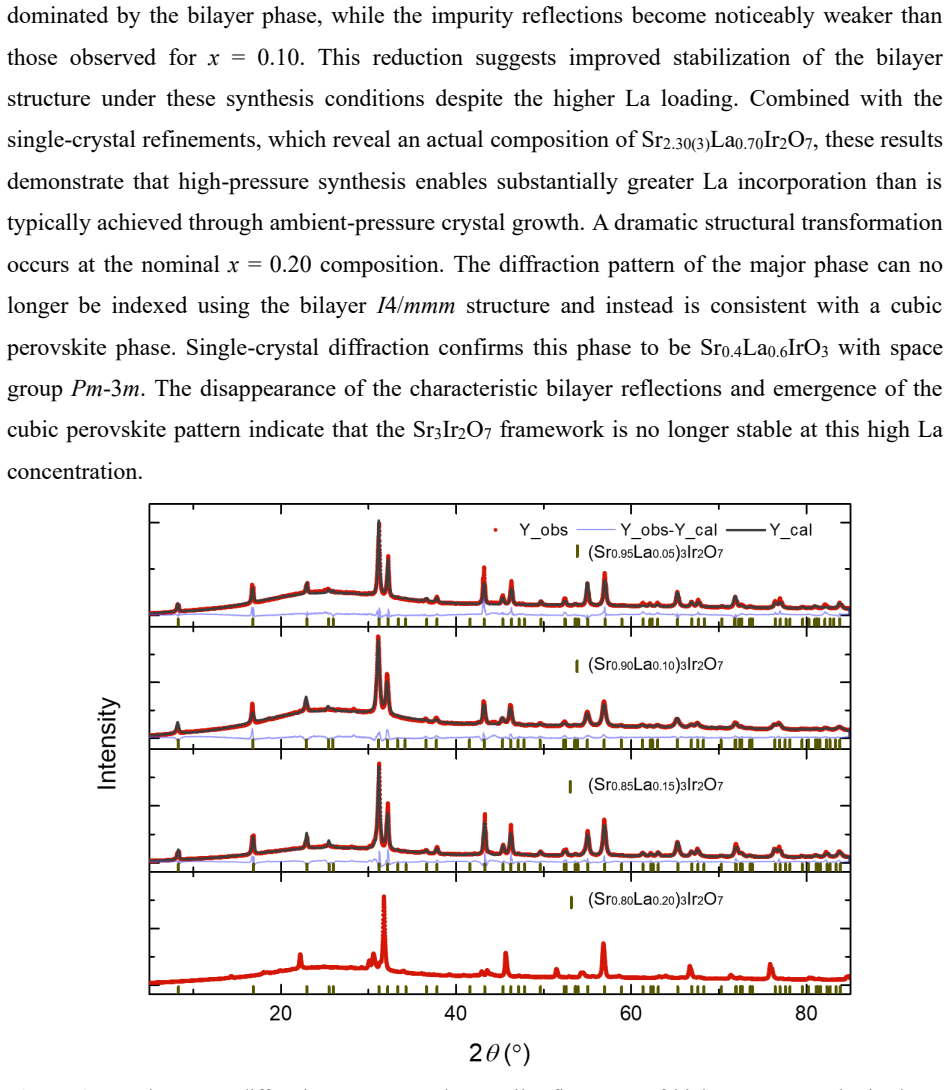
High-pressure high-temperature synthesis that stabilizes higher La content in the Ruddlesden-Popper bilayer phase before it converts to perovskite at nominal x=0.20
If this is right
- The bilayer structure transforms into cubic perovskite Sr1-xLaxIrO3 once nominal La exceeds x=0.20.
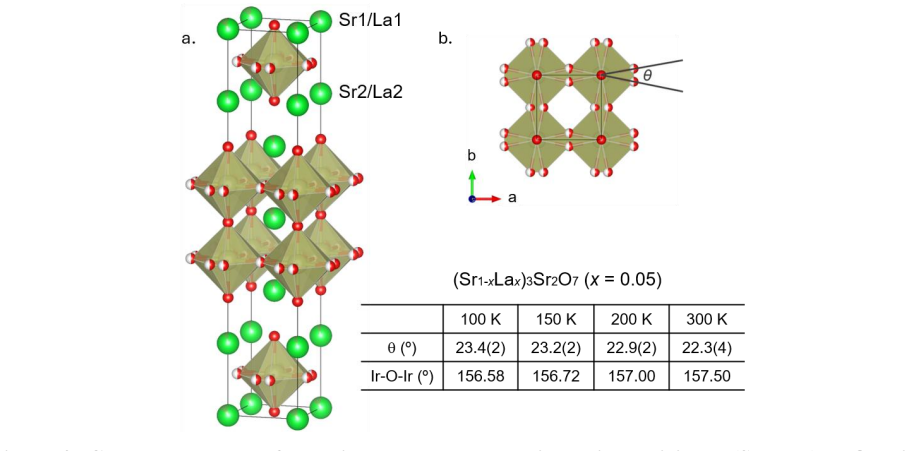
- Lattice anomalies appear at the 186 K transition in the x=0.11 crystal, indicating spin-lattice coupling.
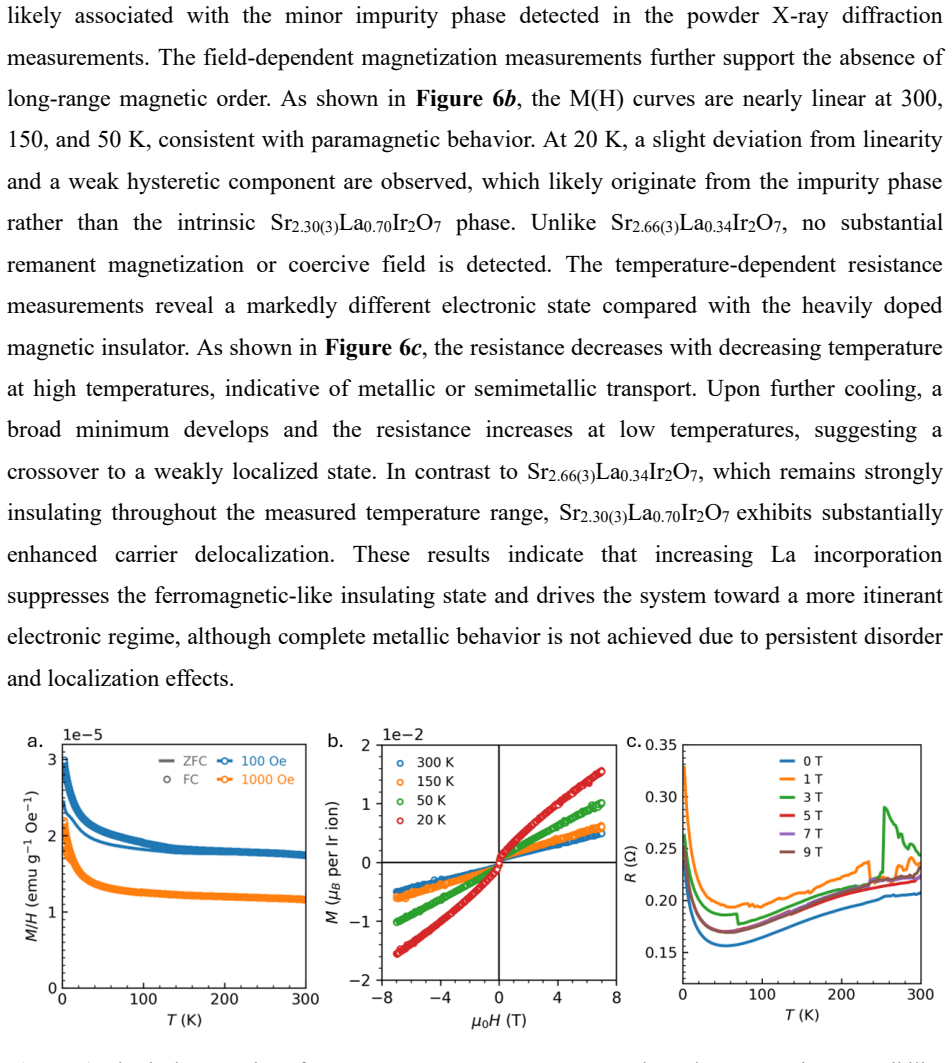
- The x=0.23 crystal shows enhanced carrier delocalization yet retains disorder-driven localization at low temperature.
- The high-doping insulating state differs from both the parent Sr3Ir2O7 and ambient-pressure La-doped samples.
Where Pith is reading between the lines
- The same high-pressure route could be tested on other layered iridates to reach doping levels outside ambient solubility limits.
- The survival of insulation at high electron doping points to disorder or localization mechanisms that may require separate theoretical treatment.
- Single-crystal studies at intermediate doping levels between 0.11 and 0.23 could map the boundary between localized and delocalized regimes.
Load-bearing premise
The La contents measured by SEM-EDX and single-crystal XRD refinements accurately reflect the bulk composition of the bilayer phase without undetected secondary phases or segregation dominating the transport and magnetic data.
What would settle it
Observation of impurity phases, composition gradients, or surface segregation whose signals match the reported resistivity, magnetization, and transition temperatures would show that the bilayer compositions alone do not produce the claimed properties.
Figures
read the original abstract
La-doped bilayer iridates provide an important platform for studying the evolution of the spin-orbit-assisted Mott state under electron doping, but the La solubility achieved by conventional ambient-pressure synthesis is limited. Here, we report the synthesis and physical properties of nominally La-doped (Sr$_{1-x}$La$_x$)$_3$Ir$_2$O$_7$ (x = 0.05, 0.10, 0.15, and 0.20) prepared using high-pressure high-temperature techniques. Single-crystal X-ray diffraction refinements, supported by scanning electron microscopy-energy-dispersive X-ray spectroscopy (SEM-EDX), reveal significantly enhanced La incorporation, with nominal x = 0.05 and 0.15 corresponding to actual compositions of approximately (Sr$_{0.89}$La$_{0.11}$)$_3$Ir$_2$O$_7$ and (Sr$_{0.77}$La$_{0.23}$)$_3$Ir$_2$O$_7$, respectively. At nominal x = 0.20, the bilayer phase is no longer stabilized and instead transforms into cubic perovskite Sr$_{1-x}$La$_x$IrO$_3$. (Sr$_{0.89}$La$_{0.11}$)$_3$Ir$_2$O$_7$ exhibits a ferromagnetic-like transition near 186 K accompanied by magnetic hysteresis and subtle lattice anomalies indicative of spin-lattice coupling. Despite its high electron-doping level, the compound remains strongly insulating, consistent with a heavily doped localized magnetic insulating state distinct from both parent Sr$_3$Ir$_2$O$_7$ and ambient-pressure La-doped samples. In contrast, (Sr$_{0.77}$La$_{0.23}$)$_3$Ir$_2$O$_7$ displays metal-like electronic behavior, weakened magnetic order, and enhanced carrier delocalization, although disorder-driven localization persists at low temperatures. These results demonstrate that high-pressure synthesis substantially extends the accessible doping range of bilayer iridates and reveals electronic and magnetic states inaccessible through conventional synthesis routes.
Editorial analysis
A structured set of objections, weighed in public.
Referee Report
Summary. The manuscript claims that high-pressure high-temperature synthesis extends the La solubility limit in the bilayer iridate Sr3Ir2O7 beyond conventional ambient-pressure methods. Single-crystal XRD refinements and SEM-EDX indicate actual compositions of approximately (Sr0.89La0.11)3Ir2O7 (from nominal x=0.05) and (Sr0.77La0.23)3Ir2O7 (from nominal x=0.15), with the former remaining strongly insulating but showing a ferromagnetic-like transition near 186 K with hysteresis and lattice anomalies, and the latter displaying metal-like transport with weakened magnetic order. At nominal x=0.20 the bilayer phase is no longer stabilized and a cubic perovskite forms instead.
Significance. If the reported compositions accurately reflect the bulk bilayer phase without significant undetected secondary phases or segregation dominating the signals, the work would meaningfully extend the accessible electron-doping range in bilayer iridates and enable study of heavily doped localized magnetic insulating states and the approach to an insulator-metal crossover that are inaccessible via ambient-pressure routes.
major comments (2)
- [Composition analysis via XRD and SEM-EDX] Composition determination (single-crystal XRD refinements and SEM-EDX results): the central claim of substantially extended solubility to actual x≈0.11 and x≈0.23 rests on these measurements, yet no error bars, raw spectra, or refinement statistics are provided, and there is no explicit discussion of possible minor perovskite impurities (noted to form at nominal x=0.20) or surface vs. bulk differences that could affect the assigned doping levels and property attributions.
- [Magnetic and transport measurements] Physical properties section: the reported ferromagnetic-like transition at 186 K, insulating vs. metal-like behaviors, and weakened magnetic order lack error bars on transition temperatures or resistivity values, raw data presentation, and quantitative comparison to prior ambient-pressure La-doped samples, which is required to substantiate that the observed states are new and attributable to the extended doping range rather than experimental artifacts.
minor comments (1)
- Notation for nominal vs. actual compositions could be made more consistent and explicit throughout the text and abstract to avoid reader confusion.
Simulated Author's Rebuttal
We thank the referee for their careful reading of the manuscript and constructive comments. We address each major comment below and will revise the manuscript accordingly to strengthen the presentation of our results.
read point-by-point responses
-
Referee: [Composition analysis via XRD and SEM-EDX] Composition determination (single-crystal XRD refinements and SEM-EDX results): the central claim of substantially extended solubility to actual x≈0.11 and x≈0.23 rests on these measurements, yet no error bars, raw spectra, or refinement statistics are provided, and there is no explicit discussion of possible minor perovskite impurities (noted to form at nominal x=0.20) or surface vs. bulk differences that could affect the assigned doping levels and property attributions.
Authors: We agree that additional details are needed to fully support the composition claims. In the revised manuscript we will add error bars to the refined La occupancies from single-crystal XRD and to the SEM-EDX compositions, include refinement statistics (R-factors and goodness-of-fit), and provide representative raw EDX spectra in the supplementary information. We will also explicitly discuss the absence of detectable perovskite impurities in the nominal x=0.05 and 0.15 crystals (confirmed by powder XRD on crushed crystals) and note that single-crystal XRD probes the bulk while EDX provides local surface-sensitive confirmation, with both methods yielding consistent results. These changes will address concerns about possible undetected phases or surface-bulk discrepancies. revision: yes
-
Referee: [Magnetic and transport measurements] Physical properties section: the reported ferromagnetic-like transition at 186 K, insulating vs. metal-like behaviors, and weakened magnetic order lack error bars on transition temperatures or resistivity values, raw data presentation, and quantitative comparison to prior ambient-pressure La-doped samples, which is required to substantiate that the observed states are new and attributable to the extended doping range rather than experimental artifacts.
Authors: We accept that improved data presentation and context are required. The revised version will include error bars on the 186 K transition temperature and on resistivity values in the relevant figures. Raw magnetization and resistivity curves will be deposited in the supplementary information. We will also add a dedicated paragraph with quantitative comparisons to prior ambient-pressure La-doped Sr3Ir2O7 literature (e.g., transition temperatures, resistivity magnitudes, and magnetic ordering), highlighting how the higher actual doping levels (x≈0.11 and 0.23) produce the observed ferromagnetic-like order in the insulator and the metal-like behavior, which are inaccessible at ambient-pressure solubility limits. revision: yes
Circularity Check
No circularity: purely experimental synthesis and characterization with no derivations
full rationale
The manuscript contains no equations, no fitted parameters renamed as predictions, no self-citation load-bearing uniqueness theorems, and no ansatz smuggling. All reported compositions (e.g., (Sr0.89La0.11)3Ir2O7) and properties arise directly from high-pressure synthesis followed by SEM-EDX and single-crystal XRD measurements; these are independent experimental outputs rather than reductions of prior results by construction. The central claim of extended La solubility is therefore self-contained against external benchmarks and receives the default non-circularity finding.
Axiom & Free-Parameter Ledger
Reference graph
Works this paper leans on
-
[1]
(1) Crawford, M. K.; Subramanian, M. A.; Harlow, R. L.; Fernandez-Baca, J. A.; Wang, Z. R.; Johnston, D. C. Structural and Magnetic Studies of Sr2IrO4. Phys. Rev. B 1994, 49 (13), 9198–9201. https://doi.org/10.1103/PhysRevB.49.9198. (2) Cao, G.; Bolivar, J.; McCall, S.; Crow, J. E.; Guertin, R. P . Weak Ferromagnetism, Metal-to-Nonmetal Transition, and Ne...
-
[2]
Low Level of Anthropization Linked to Harsh Vertebrate Biodiversity Declines in Amazonia
https://doi.org/10.1038/s41467-022- 28207-w. (11) Li, L.; Kong, P . P .; Qi, T. F.; Jin, C. Q.; Yuan, S. J.; DeLong, L. E.; Schlottmann, P .; Cao, G. Tuning the Jeff = 1/2 Insulating State via Electron Doping and Pressure in the Double-Layered Iridate Sr3Ir2O7. Phys. Rev. B 2013, 87 (23), 235127. https://doi.org/10.1103/PhysRevB.87.235127. (12) Nichols, J...
-
[3]
(17) Hogan, T.; Yamani, Z.; Walkup, D.; Chen, X.; Dally, R.; Ward, T
https://doi.org/10.1038/s41535-019-0183-y. (17) Hogan, T.; Yamani, Z.; Walkup, D.; Chen, X.; Dally, R.; Ward, T. Z.; Dean, M. P . M.; Hill, J.; Islam, Z.; Madhavan, V.; Wilson, S. D. First-Order Melting of a Weak Spin-Orbit Mott Insulator into a Correlated Metal. Phys. Rev. Lett. 2015, 114 (25), 257203. https://doi.org/10.1103/PhysRevLett.114.257203. (18)...
-
[4]
https://doi.org/10.1038/s41535-019-0162-3. (29) Toby, B. H.; Von Dreele, R. B. GSAS-II: The Genesis of a Modern Open-Source All Purpose Crystallography Software Package. J Appl Cryst 2013, 46 (2), 544–549. https://doi.org/10.1107/S0021889813003531. (30) Sheldrick, G. M. SHELXT – Integrated Space-Group and Crystal-Structure Determination. Acta Cryst A 2015...
discussion (0)
Sign in with ORCID, Apple, or X to comment. Anyone can read and Pith papers without signing in.