Deep Unfolded Latent Optimally Partitioned-l2/l1 Networks for Data-driven Block-Sparse Recovery
Reviewed by Pith T0 review T1 audit T2 compute T3 formal T4 kernel 2026-06-27 09:42 UTCgrok-4.3pith:DQVO66HJrecord.jsonopen to challenge →
The pith
Deep unfolded LOP-l2/l1 networks enable data-driven block-sparse recovery with unknown partitions
A machine-rendered reading of the paper's core claim, the machinery that carries it, and where it could break.
Core claim
By unfolding LOP-l2/l1 iterations into a neural network and replacing unstable differentiation of its proximal operator with either implicit differentiation or deep weight factorization, the method enables automatic learning of all parameters for block-sparse recovery while retaining the original method's ability to handle unknown partitions and impulsive noise.
What carries the argument
Two deep-unfolded architectures for LOP-l2/l1: an implicit-differentiation framework and a deep-weight-factorization variant that also admits nonconvex data terms.
If this is right
- Hyperparameters of LOP-l2/l1 no longer need manual selection and can be learned from data.
- The DWF variant extends the framework to nonconvex smooth data-fidelity terms.
- Recovery performance remains competitive with existing methods on block-sparse tasks.
- Resilience to impulsive noise is preserved or improved in the learned networks.
Where Pith is reading between the lines
- The same stabilization techniques could be applied to other proximal operators that currently block deep unfolding in sparse-recovery algorithms.
- Learned models may reduce the need for expert tuning in practical signal-processing pipelines that encounter unknown block structures.
- The DWF route opens a path to combine LOP-style partitioning with additional nonconvex penalties not covered in the current work.
Load-bearing premise
The proximal operator of the original LOP-l2/l1 can be stably differentiated via implicit differentiation or deep weight factorization without introducing new instabilities or losing the block-sparse recovery guarantees.
What would settle it
A set of block-sparse recovery experiments in which the unfolded networks either lose recovery accuracy relative to the convex baseline or exhibit divergence when the proximal operator is replaced by either proposed stable mechanism.
Figures



read the original abstract
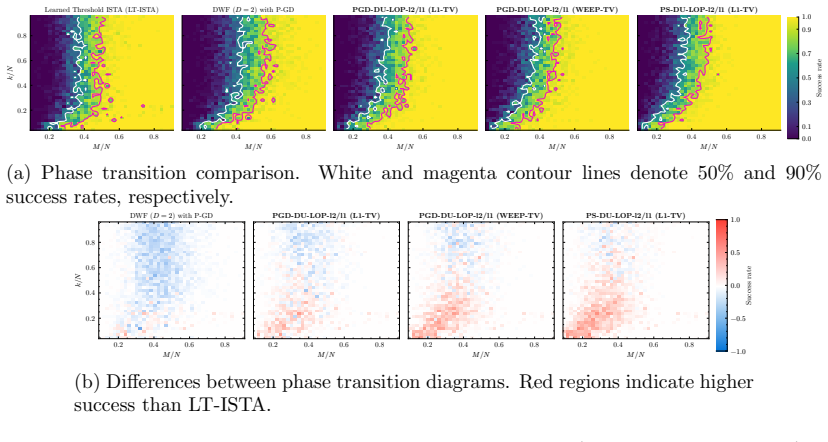
The convex Latent Optimal Partition (LOP)-l2/l1 approach enables block-sparse signal recovery with unknown partitions but relies on manual hyperparameter tuning. Additionally, numerical instability in differentiating its proximal operator prevents its automatic parameter tuning via Deep Unfolding (DU). To address these limitations, we propose two architectures: a stable framework utilizing implicit differentiation and a flexible variant leveraging Deep Weight Factorization (DWF). The DWF-based approach also supports nonconvex smooth data fidelity terms. Numerical experiments demonstrate that DU-LOP-l2/l1 yields competitive performance and high resilience against impulsive noise.
Editorial analysis
A structured set of objections, weighed in public.
Referee Report
Summary. The paper proposes two deep-unfolding (DU) architectures for the Latent Optimal Partition (LOP)-l2/l1 convex optimization method to enable automatic, data-driven tuning of its hyperparameters for block-sparse signal recovery. The first uses implicit differentiation to stably differentiate the proximal operator; the second employs Deep Weight Factorization (DWF) and additionally supports nonconvex smooth data-fidelity terms. Numerical experiments are reported to demonstrate that the resulting DU-LOP-l2/l1 networks achieve competitive recovery performance and high resilience to impulsive noise.
Significance. If the experimental claims hold under proper controls, the work would supply a concrete route to make the LOP-l2/l1 formulation trainable end-to-end while preserving its block-sparsity inductive bias and improving robustness to heavy-tailed noise. The DWF variant’s ability to accommodate nonconvex fidelity terms is a potentially useful extension beyond standard DU literature.
major comments (2)
- [Numerical Experiments / Results] The central empirical claim (competitive performance and impulsive-noise resilience) is stated in the abstract and repeated in the results narrative, yet the manuscript supplies no information on the datasets used, the choice or implementation of baselines, the number of Monte-Carlo trials, error bars, or exclusion criteria. Without these details the numerical evidence cannot be evaluated and the claim that the proposed DU architectures “yield competitive performance” remains unverifiable.
- [Proposed Architectures / Implicit Differentiation and DWF sections] The manuscript asserts that implicit differentiation (or DWF) resolves the known numerical instability of the LOP-l2/l1 proximal operator without introducing new instabilities or sacrificing block-sparse recovery guarantees. No derivation, stability bound, or ablation isolating the effect of the chosen differentiation scheme on the proximal mapping is provided; the claim therefore rests on an unshown technical step that is load-bearing for both proposed architectures.
minor comments (2)
- [Preliminaries] Notation for the partition variables and the latent optimality criterion should be introduced once with a single consistent symbol table rather than redefined across sections.
- [Figures] Figure captions for the network diagrams should explicitly label which blocks correspond to the implicit-differentiation path versus the DWF path.
Simulated Author's Rebuttal
We thank the referee for the constructive feedback. We address each major comment below and will revise the manuscript to supply the requested information and clarifications.
read point-by-point responses
-
Referee: [Numerical Experiments / Results] The central empirical claim (competitive performance and impulsive-noise resilience) is stated in the abstract and repeated in the results narrative, yet the manuscript supplies no information on the datasets used, the choice or implementation of baselines, the number of Monte-Carlo trials, error bars, or exclusion criteria. Without these details the numerical evidence cannot be evaluated and the claim that the proposed DU architectures “yield competitive performance” remains unverifiable.
Authors: We agree that the experimental protocol details are insufficient for independent verification. The current draft emphasizes the architectural contributions but omits full reporting of the setup. In the revised manuscript we will expand the numerical experiments section to specify the synthetic and real datasets (including generation parameters for block-sparse signals), the exact baselines and their implementations, the number of Monte-Carlo trials, the use of error bars (standard deviation across trials), and any exclusion criteria applied. This will allow direct evaluation of the performance and noise-resilience claims. revision: yes
-
Referee: [Proposed Architectures / Implicit Differentiation and DWF sections] The manuscript asserts that implicit differentiation (or DWF) resolves the known numerical instability of the LOP-l2/l1 proximal operator without introducing new instabilities or sacrificing block-sparse recovery guarantees. No derivation, stability bound, or ablation isolating the effect of the chosen differentiation scheme on the proximal mapping is provided; the claim therefore rests on an unshown technical step that is load-bearing for both proposed architectures.
Authors: The manuscript describes the motivation for implicit differentiation and DWF as avoiding direct differentiation of the unstable proximal operator, yet we acknowledge that an explicit derivation, stability bound, or isolating ablation is not supplied. We will add a concise technical subsection outlining the implicit-differentiation step for the proximal mapping together with a brief stability argument and, where space permits, a small ablation comparing forward-mode, implicit, and DWF differentiation on the same proximal operator. This will substantiate the claim that the chosen schemes preserve the block-sparsity properties while improving numerical stability. revision: yes
Circularity Check
No significant circularity in derivation chain
full rationale
The paper proposes DU-LOP-l2/l1 architectures to enable automatic tuning of the LOP-l2/l1 proximal operator via implicit differentiation or deep weight factorization, addressing instability while supporting nonconvex terms. No equations or claims in the abstract reduce a prediction or result to a fitted parameter or self-citation by construction. The central performance claims rest on numerical experiments that are independent of the derivation steps. The method builds on existing LOP-l2/l1 and deep unfolding techniques without self-definitional loops or load-bearing self-citations that collapse the argument. The derivation chain is self-contained against external benchmarks.
Axiom & Free-Parameter Ledger
Reference graph
Works this paper leans on
-
[1]
Deep Unfolding for Communications Systems: A Survey and Some New Directions
Alexios Balatsoukas-Stimming and Christoph Studer. Deep Unfolding for Communications Systems: A Survey and Some New Directions. InIEEE International Workshop on Signal Processing Systems (SiPS), pages 266–271, 2019
2019
-
[2]
Baraniuk, Volkan Cevher, Marco F
Richard G. Baraniuk, Volkan Cevher, Marco F. Duarte, and Chinmay Hegde. Model-Based Compressive Sensing.IEEE Transactions on Information Theory, 56(4):1982–2001, 2010
1982
-
[3]
Bauschke, Manish Krishan Lal, and Xianfu Wang
Heinz H. Bauschke, Manish Krishan Lal, and Xianfu Wang. Real roots of real cubics and optimization. arXiv:2302.10731, 2023
-
[4]
Escaping saddle points without Lipschitz smoothness: The power of nonlinear preconditioning
Alexander Bodard and Panagiotis Patrinos. Escaping saddle points without Lipschitz smoothness: The power of nonlinear preconditioning. InAnnual Conference on Neural Information Processing Systems (NeurIPS), 2025
2025
-
[5]
AMP-Inspired Deep Networks for Sparse Linear Inverse Problems.IEEE Transactions on Signal Processing, 65(16):4293– 4308, 2017
Mark Borgerding, Philip Schniter, and Sundeep Rangan. AMP-Inspired Deep Networks for Sparse Linear Inverse Problems.IEEE Transactions on Signal Processing, 65(16):4293– 4308, 2017
2017
-
[6]
Carrillo, Kenneth E
Rafael E. Carrillo, Kenneth E. Barner, and Tuncer C. Aysal. Robust Sampling and Recon- struction Methods for Sparse Signals in the Presence of Impulsive Noise.IEEE Journal of Selected Topics in Signal Processing, 4(2):392–408, 2010
2010
-
[7]
Combettes and Christian L
Patrick L. Combettes and Christian L. M¨ uller. Perspective functions: Proximal calcu- lus and applications in high-dimensional statistics.Journal of Mathematical Analysis and Applications, 457(2):1283–1306, 2018
2018
-
[8]
Eldar, Patrick Kuppinger, and Helmut Bolcskei
Yonina C. Eldar, Patrick Kuppinger, and Helmut Bolcskei. Block-sparse signals: Uncer- tainty relations and efficient recovery.IEEE Transactions on Signal Processing, 58(6):3042– 3054, 2010. 8
2010
-
[9]
Pattern-coupled sparse bayesian learning for recovery of block-sparse signals.IEEE Transactions on Signal Processing, 63(2):360–372, 2015
Jun Fang, Yanning Shen, Hongbin Li, and Pu Wang. Pattern-coupled sparse bayesian learning for recovery of block-sparse signals.IEEE Transactions on Signal Processing, 63(2):360–372, 2015
2015
-
[10]
Deep Unfolding Network for Block-Sparse Signal Recovery
Rong Fu, Vincent Monardo, Tianyao Huang, and Yimin Liu. Deep Unfolding Network for Block-Sparse Signal Recovery. InIEEE International Conference on Acoustics, Speech and Signal Processing (ICASSP), pages 2880–2884, 2021
2021
-
[11]
WEEP: A Differ- entiable Nonconvex Sparse Regularizer via Weakly-Convex Envelope
Takanobu Furuhashi, Hidekata Hontani, Qibin Zhao, and Tatsuya Yokota. WEEP: A Differ- entiable Nonconvex Sparse Regularizer via Weakly-Convex Envelope. InIEEE International Conference on Acoustics, Speech and Signal Processing (ICASSP), 2026
2026
-
[12]
Soriaga, and Arash Behboodi
Jiabao Gao, Caijun Zhong, Geoffrey Ye Li, Joseph B. Soriaga, and Arash Behboodi. Deep Learning-Based Channel Estimation for Wideband Hybrid MmWave Massive MIMO.IEEE Transactions on Communications, 71(6):3679–3693, 2023
2023
-
[13]
Block-Sparse RPCA for Salient Motion Detection.IEEE Transactions on Pattern Analysis and Machine Intelligence, 36(10):1975– 1987, 2014
Zhi Gao, Loong-Fah Cheong, and Yu-Xiang Wang. Block-Sparse RPCA for Salient Motion Detection.IEEE Transactions on Pattern Analysis and Machine Intelligence, 36(10):1975– 1987, 2014
1975
-
[14]
What every computer scientist should know about floating-point arith- metic.ACM Comput
David Goldberg. What every computer scientist should know about floating-point arith- metic.ACM Comput. Surv., 23(1):5–48, 1991
1991
-
[15]
Learning fast approximations of sparse coding
Karol Gregor and Yann LeCun. Learning fast approximations of sparse coding. InInter- national Conference on Machine Learning (ICML), pages 399–406, 2010
2010
-
[16]
Deep Unfolding: Model-Based Inspiration of Novel Deep Architectures
John R. Hershey, Jonathan Le Roux, and Felix Weninger. Deep Unfolding: Model-Based Inspiration of Novel Deep Architectures. arXiv:1409.2574, 2014
work page internal anchor Pith review Pith/arXiv arXiv 2014
-
[17]
Peter J. Huber. Robust Estimation of a Location Parameter.The Annals of Mathematical Statistics, 35(1):73–101, 1964
1964
-
[18]
Trainable ISTA for Sparse Signal Recovery.IEEE Transactions on Signal Processing, 67(12):3113–3125, 2019
Daisuke Ito, Satoshi Takabe, and Tadashi Wadayama. Trainable ISTA for Sparse Signal Recovery.IEEE Transactions on Signal Processing, 67(12):3113–3125, 2019
2019
-
[19]
Differentiable Sparsity via D-Gating: Simple and Versatile Structured Penalization
Chris Kolb, Laetitia Frost, Bernd Bischl, and David R¨ ugamer. Differentiable Sparsity via D-Gating: Simple and Versatile Structured Penalization. InAnnual Conference on Neural Information Processing Systems (NeurIPS), 2025
2025
-
[20]
M¨ uller, Bernd Bischl, and David R¨ ugamer
Chris Kolb, Christian L. M¨ uller, Bernd Bischl, and David R¨ ugamer. Smoothing the Edges: Smooth Optimization for Sparse Regularization Using Hadamard Overparametrization.Ma- chine Learning, 115(4):87, 2026
2026
-
[21]
Deep Weight Factorization: Sparse Learning Through the Lens of Artificial Symmetries
Chris Kolb, Tobias Weber, Bernd Bischl, and David R¨ ugamer. Deep Weight Factorization: Sparse Learning Through the Lens of Artificial Symmetries. InInternational Conference on Learning Representations (ICLR), 2024
2024
-
[22]
A convex-nonconvex framework for enhancing minimization induced penal- ties.Journal of the Franklin Institute, 362(15):107969, 2025
Hiroki Kuroda. A convex-nonconvex framework for enhancing minimization induced penal- ties.Journal of the Franklin Institute, 362(15):107969, 2025
2025
-
[23]
Theoretical Val- idation of the Latent Optimally Partitioned-L2/L1 Penalty with Application to Angular Power Spectrum Estimation, 2025
Hiroki Kuroda, Renato Luis Garrido Cavalcante, and Masahiro Yukawa. Theoretical Val- idation of the Latent Optimally Partitioned-L2/L1 Penalty with Application to Angular Power Spectrum Estimation, 2025
2025
-
[24]
Block-sparse recovery with optimal block partition
Hiroki Kuroda and Daichi Kitahara. Block-sparse recovery with optimal block partition. IEEE Transactions on Signal Processing, 70:1506–1520, 2022. 9
2022
-
[25]
Structured Sparse Cod- ing With the Group Log-regularizer for Key Frame Extraction.IEEE/CAA Journal of Automatica Sinica, 9(10):1818–1830, 2022
Zhenni Li, Yujie Li, Benying Tan, Shuxue Ding, and Shengli Xie. Structured Sparse Cod- ing With the Group Log-regularizer for Key Frame Extraction.IEEE/CAA Journal of Automatica Sinica, 9(10):1818–1830, 2022
2022
-
[26]
Background Subtraction Based on Low- Rank and Structured Sparse Decomposition.IEEE Transactions on Image Processing, 24(8):2502–2514, 2015
Xin Liu, Guoying Zhao, Jiawen Yao, and Chun Qi. Background Subtraction Based on Low- Rank and Structured Sparse Decomposition.IEEE Transactions on Image Processing, 24(8):2502–2514, 2015
2015
-
[27]
The Group Lasso for Stable Recovery of Block- Sparse Signal Representations.IEEE Transactions on Signal Processing, 59(4):1371–1382, 2011
Xiaolei Lv, Guoan Bi, and Chunru Wan. The Group Lasso for Stable Recovery of Block- Sparse Signal Representations.IEEE Transactions on Signal Processing, 59(4):1371–1382, 2011
2011
-
[28]
Vishal Monga, Yuelong Li, and Yonina C. Eldar. Algorithm Unrolling: Interpretable, Efficient Deep Learning for Signal and Image Processing.IEEE Signal Processing Magazine, 38(2):18–44, 2021
2021
-
[29]
Yuntao Qian and Minchao Ye. Hyperspectral Imagery Restoration Using Nonlocal Spectral- Spatial Structured Sparse Representation With Noise Estimation.IEEE Journal of Selected Topics in Applied Earth Observations and Remote Sensing, 6(2):499–515, 2013
2013
-
[30]
Aditya Sant, Markus Leinonen, and Bhaskar D. Rao. Block-Sparse Signal Recovery via General Total Variation Regularized Sparse Bayesian Learning.IEEE Transactions on Signal Processing, 70:1056–1071, 2022
2022
- [31]
-
[32]
On the Reconstruction of Block- Sparse Signals With an Optimal Number of Measurements.IEEE Transactions on Signal Processing, 57(8):3075–3085, 2009
Mihailo Stojnic, Farzad Parvaresh, and Babak Hassibi. On the Reconstruction of Block- Sparse Signals With an Optimal Number of Measurements.IEEE Transactions on Signal Processing, 57(8):3075–3085, 2009
2009
-
[33]
Recovery of sparsely corrupted signals.IEEE Transactions on Information Theory, 58(5):3115–3130, 2012
Christoph Studer, Patrick Kuppinger, Graeme Pope, and Helmut Bolcskei. Recovery of sparsely corrupted signals.IEEE Transactions on Information Theory, 58(5):3115–3130, 2012
2012
-
[34]
Robust Bayesian compressed sensing with outliers.Signal Processing, 140:104–109, 2017
Qian Wan, Huiping Duan, Jun Fang, Hongbin Li, and Zhengli Xing. Robust Bayesian compressed sensing with outliers.Signal Processing, 140:104–109, 2017
2017
-
[35]
Enhanced ISAR Imaging by Exploiting the Continuity of the Target Scene.IEEE Transactions on Geoscience and Remote Sensing, 52(9):5736–5750, 2014
Lu Wang, Lifan Zhao, Guoan Bi, Chunru Wan, and Lei Yang. Enhanced ISAR Imaging by Exploiting the Continuity of the Target Scene.IEEE Transactions on Geoscience and Remote Sensing, 52(9):5736–5750, 2014
2014
-
[36]
RPCANet: Deep Unfolding RPCA Based Infrared Small Target Detection
Fengyi Wu, Tianfang Zhang, Lei Li, Yian Huang, and Zhenming Peng. RPCANet: Deep Unfolding RPCA Based Infrared Small Target Detection. InIEEE/CVF Winter Conference on Applications of Computer Vision (WACV), pages 4797–4806, 2024
2024
-
[37]
InIEEE/CVF Conference on Computer Vision and Pattern Recognition (CVPR), pages 5369–5377, 2015
Ganzhao Yuan and Bernard Ghanem.ℓ0TV: A new method for image restoration in the presence of impulse noise. InIEEE/CVF Conference on Computer Vision and Pattern Recognition (CVPR), pages 5369–5377, 2015
2015
-
[38]
Model selection and estimation in regression with grouped variables
Ming Yuan and Yi Lin. Model selection and estimation in regression with grouped variables. Journal of the Royal Statistical Society: Series B (Statistical Methodology), 68(1):49–67, 2006. 10
2006
-
[39]
Improved analysis of clipping algorithms for non-convex optimization
Bohang Zhang, Jikai Jin, Cong Fang, and Liwei Wang. Improved analysis of clipping algorithms for non-convex optimization. InAnnual Conference on Neural Information Processing Systems (NeurIPS), pages 15511–15521, 2020
2020
-
[40]
ISTA-Net: Interpretable Optimization-Inspired Deep Network for Image Compressive Sensing
Jian Zhang and Bernard Ghanem. ISTA-Net: Interpretable Optimization-Inspired Deep Network for Image Compressive Sensing. InIEEE/CVF Conference on Computer Vision and Pattern Recognition (CVPR), pages 1828–1837, 2018
2018
-
[41]
Why gradient clipping accel- erates training: A theoretical justification for adaptivity
Jingzhao Zhang, Tianxing He, Suvrit Sra, and Ali Jadbabaie. Why gradient clipping accel- erates training: A theoretical justification for adaptivity. arXiv:1905.13655, 2020
-
[42]
Zhilin Zhang and Bhaskar D. Rao. Extension of SBL Algorithms for the Recovery of Block Sparse Signals With Intra-Block Correlation.IEEE Transactions on Signal Processing, 61(8):2009–2015, 2013
2009
-
[43]
Hyperspectral Anomaly Detection via Structured Sparsity Plus Enhanced Low-Rankness.IEEE Transac- tions on Geoscience and Remote Sensing, 61:1–15, 2023
Yin-Ping Zhao, Hongyan Li, Yongyong Chen, Zhen Wang, and Xuelong Li. Hyperspectral Anomaly Detection via Structured Sparsity Plus Enhanced Low-Rankness.IEEE Transac- tions on Geoscience and Remote Sensing, 61:1–15, 2023. 11
2023
discussion (0)
Sign in with ORCID, Apple, or X to comment. Anyone can read and Pith papers without signing in.