REVIEW 2 major objections 2 minor 55 references
Candidate overtone shear horizontal SAW resonators in thin-film lithium niobate for intermodal acousto-optic modulation
T0 review · 2 major / 2 minor · reviewed 2026-06-27 · grok-4.3
Pith's one-line read Shear-horizontal SAW modes in thin-film lithium niobate deliver more than tenfold higher acousto-optic overlap than Rayleigh modes.
desk verdict This reports decent experimental SH0 overtone resonators on thin-film LN with Q=843 and 29 dBm handling, but the order-of-magnitude acousto-optic overlap gain is only simulated and unverified in the actual devices. read the letter →
The pith
A machine-rendered reading of the paper's core claim, the machinery that carries it, and where it could break.
The reading
What carries the argument
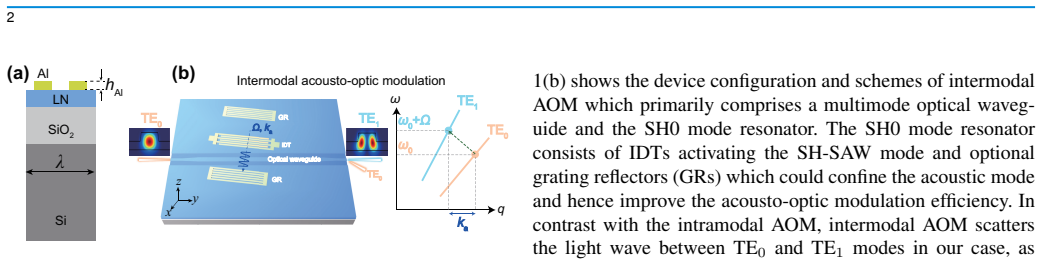
The SH0 shear-horizontal surface acoustic wave mode in thin-film lithium niobate, tuned by cut angle, wavelength, and IDT electrode thickness to maximize the acousto-optic overlap integral.
What would settle it
A side-by-side measurement of actual acousto-optic modulation efficiency in identical thin-film lithium niobate structures driven by SH0 versus Rayleigh modes would directly test whether the order-of-magnitude overlap improvement is realized.
Extended reading notes
Core claim
The central claim is that optimized SH0 shear-horizontal modes in thin-film lithium niobate produce acousto-optic overlap factors more than an order of magnitude larger than those obtained with Rayleigh modes; fabricated proof-of-principle overtone resonators with grating reflectors exhibit quality factors up to 843, effective coupling coefficients of 0.96-4.72 percent, temperature coefficients of frequency between 32.3 and 68.9 ppm per degree Celsius, and reliable operation at 29 dBm input power.
Load-bearing premise
The calculated improvements from cut-angle, wavelength, and electrode-thickness choices will appear in actual fabricated devices without hidden losses or fabrication limits erasing the gains.
Editorial extensions
If this is right
- Higher acousto-optic overlap enables lower-power, higher-efficiency intermodal modulators.
- Overtone SH0 resonators with grating reflectors combine usable coupling coefficients with quality factors above 800.
- SH0 modes maintain more uniform temperature coefficients of frequency across overtones than Rayleigh modes.
- Power handling to 29 dBm supports robust operation in microwave-photonic and quantum-information circuits.
Reading between the lines
- Integration of these resonators with existing lithium-niobate photonic circuits could reduce the drive power needed for on-chip frequency conversion.
- The observed power-handling margin suggests the devices could be scaled to higher frequencies without immediate electrode failure.
- Temperature-coefficient uniformity across overtones may simplify compensation schemes in multi-frequency photonic systems.
Editorial analysis
A structured set of objections, weighed in public.
Referee Report
Summary. The manuscript proposes shear-horizontal (SH0) SAW resonators on thin-film lithium niobate for intermodal acousto-optic modulation. It reports that optimization of LN cut angle, SAW wavelength, and IDT electrode thickness yields calculated acousto-optic overlap factors for SH0 modes improved by more than an order of magnitude relative to Rayleigh modes. It further describes fabrication and characterization of three proof-of-principle overtone SH0 resonators (with/without grating reflectors), reporting keff² = 0.96–4.72 %, Q up to 843, TCF = 32.3–68.9 ppm/°C, and power handling to 29 dBm.
Significance. If the calculated overlap improvement translates to fabricated devices, the work could support higher-efficiency intermodal acousto-optic modulators for integrated optics, microwave photonics, and quantum applications. The experimental characterization supplies concrete measured values (Q = 843, power handling to 29 dBm) that demonstrate basic feasibility of SH0 overtone resonators on the platform; this experimental component is a clear strength.
major comments (2)
- [optimization and fabrication sections] The central claim of >10× acousto-optic overlap improvement rests on FEM-style calculations after tuning cut angle, wavelength, and electrode thickness (Abstract and optimization results). The fabricated devices are explicitly labeled “proof-of-principle” and the text does not state that they employ the exact optimized parameter set, so the experimental data do not directly confirm that the calculated gain survives fabrication.
- [experimental characterization section] No experimental acousto-optic modulation data (e.g., modulation efficiency or overlap factor extracted from optical measurements) are reported on the fabricated resonators. Consequently the application claim for intermodal modulators remains an unverified prediction rather than a demonstrated result.
minor comments (2)
- Reported values (Q, keff², TCF) lack error bars or uncertainty estimates; full device dimensions, fabrication process details, and raw data tables are not supplied, hindering independent verification.
- The distinction between Rayleigh-mode and SH0-mode TCF behavior is stated but would benefit from a short table or plot comparing the two families across the same overtones.
Simulated Author's Rebuttal
We thank the referee for the constructive review and for noting the potential significance of SH0 SAW resonators for intermodal acousto-optic applications. We respond point-by-point to the major comments, indicating where revisions will be made to improve clarity without altering the manuscript's core claims.
read point-by-point responses
-
Referee: [optimization and fabrication sections] The central claim of >10× acousto-optic overlap improvement rests on FEM-style calculations after tuning cut angle, wavelength, and electrode thickness (Abstract and optimization results). The fabricated devices are explicitly labeled “proof-of-principle” and the text does not state that they employ the exact optimized parameter set, so the experimental data do not directly confirm that the calculated gain survives fabrication.
Authors: We acknowledge that the fabricated devices are described as proof-of-principle and that the manuscript does not explicitly state they use the precise optimized parameter set from the FEM calculations. The optimization section uses FEM to identify cut angles, wavelengths, and electrode thicknesses that yield >10× improvement in acousto-optic overlap for SH0 modes relative to Rayleigh modes. The experimental section separately demonstrates fabrication feasibility and reports measured keff², Q up to 843, TCF, and power handling to 29 dBm for overtone SH0 resonators. In revision we will add explicit text stating the fabricated device parameters and clarifying that the experiments validate the SH0 platform while the overlap gain remains a calculated result. revision: yes
-
Referee: [experimental characterization section] No experimental acousto-optic modulation data (e.g., modulation efficiency or overlap factor extracted from optical measurements) are reported on the fabricated resonators. Consequently the application claim for intermodal modulators remains an unverified prediction rather than a demonstrated result.
Authors: The manuscript centers on the design optimization and resonator characterization of overtone SH0 SAW devices as an enabling component. The acousto-optic overlap factors are obtained from FEM calculations to quantify the advantage of SH0 modes for anticipated intermodal modulation. No optical modulation or extracted overlap measurements are included because the work does not integrate optical waveguides or perform AO experiments. We will revise the abstract, introduction, and conclusions to more precisely frame the modulator application as a predicted benefit supported by the calculated overlap and the demonstrated resonator metrics, rather than an experimentally verified outcome in this study. revision: partial
Circularity Check
No significant circularity; calculations and measurements are independent
full rationale
The paper's central claim rests on FEM-style optimization of cut angle, wavelength, and electrode thickness to compute acousto-optic overlap factors for SH0 vs. Rayleigh modes, followed by separate fabrication and direct measurement of resonator parameters (keff², Q, TCF, power handling). No quoted step reduces a result to its own inputs by definition, renames a fitted quantity as a prediction, or relies on a self-citation chain for a uniqueness theorem or ansatz. The overlap improvement is presented as an output of parameter tuning, not a self-definitional or statistically forced quantity. Experimental results are reported as measured values without derivation from the paper's own equations.
Assumptions & free parameters
Cite this review
Pith. "Pith review of Candidate overtone shear horizontal SAW resonators in thin-film lithium niobate for intermodal acousto-optic modulation." pith.science (2026). https://pith.science/paper/XAH6KZSS
@misc{pith2026260612853,
  author       = {Pith},
  title        = {Pith review of: Candidate overtone shear horizontal SAW resonators in thin-film lithium niobate for intermodal acousto-optic modulation},
  year         = {2026},
  howpublished = {\url{https://pith.science/paper/XAH6KZSS}},
  note         = {Machine review of arXiv:2606.12853}
}
read the original abstract
The merits of thin-film surface acoustic wave (SAW) devices are pivotal to develop the high-performance intermodal acousto-optic modulators. In this work, we have proposed shear-horizontal (SH) SAW resonators for anticipated intermodal acousto-optic modulation on the thin-film lithium niobate platform. Through optimization of the cut angle of LN films, the SAW wavelength, and the thickness of interdigital transducer (IDT) electrodes, the calculated acousto-optic overlap factors utilizing SH0 modes are improved by more than an order of magnitude compared with those of Rayleigh modes. Furthermore, we have fabricated and characterized three kinds of proof-of-principle SH0 mode devices without/with grating reflectors. The electromechanical coupling coefficients (keff^2) and quality factors (Q) in the overtone resonators with grating reflectors are systematically evaluated, featuring the highest Q of 843 with the compromised keff^2 of 0.96%-4.72%. The results reveal that the temperature coefficients of frequency (TCF) of Rayleigh modes vary across various overtones, whereas the SH0 modes exhibit TCFs in the range of 32.3-68.9 ppm/C. Our fabricated SH0-mode overtone resonators demonstrate the capability of operating at power levels up to 29 dBm without electrode damage, offering a promising paradigm for robust and high-efficiency intermodal acousto-optic modulators with potential applications in integrated optical signal processing, microwave photonics,and quantum information technologies.
Figures


Figures from the paper (8 more)


Reference graph
Works this paper leans on
-
[1]
Solidly mounted anti- symmetric Lamb-wave delay lines as an alternate to SAW devices,
A. Qamar, M. Jafari, and M. Rais-Zadeh, “Solidly mounted anti- symmetric Lamb-wave delay lines as an alternate to SAW devices,” IEEE Electron Device Lett., vol. 39, no. 12, pp. 1916–1919, Oct. 2018
1916
-
[2]
High-performance SAW resonator with simplified LiTaO 3/SiO2 double layer structure on Si substrate,
T. Takai, H. Iwamoto, Y . Takamine, T. Fuyutsume, T. Nakao, M. Hi- ramoto, T. Toi, and M. Koshino, “High-performance SAW resonator with simplified LiTaO 3/SiO2 double layer structure on Si substrate,” IEEE Trans. Ultrason., Ferroelectr ., Freq. Control, vol. 66, no. 5, pp. 1006–1013, Feb. 2019
2019
-
[3]
Comparative study of acoustic wave devices using thin piezoelectric plates in the 3– 5-GHz range,
T. Kimura, M. Omura, Y . Kishimoto, and K. Hashimoto, “Comparative study of acoustic wave devices using thin piezoelectric plates in the 3– 5-GHz range,”IEEE Trans. Microw. Theory Techn., vol. 67, no. 3, pp. 915–921, Jan. 2019
2019
-
[4]
Innovative smart cut™ piezo on insulator (POI) substrates for 5G acoustic filters,
E. Butaud, S. Ballandras, M. Bousquet, A. Drouin, B. Tavel, I. Huyet, A. Clairet, I. Bertrand, A. Ghorbel, and A. Reinhardt, “Innovative smart cut™ piezo on insulator (POI) substrates for 5G acoustic filters,” in IEDM Tech. Dig., San Francisco, CA, USA, Dec. 2020, pp. 34.6.1– 34.6.4
2020
-
[5]
Surface acoustic wave devices using lithium niobate on silicon carbide,
S. Zhang, R. Lu, H. Zhou, S. Link, Y . Yang, Z. Li, K. Huang, X. Ou, and S. Gong, “Surface acoustic wave devices using lithium niobate on silicon carbide,”IEEE Trans. Microw. Theory Techn., vol. 68, no. 9, pp. 3653–3666, Jul. 2020
2020
-
[6]
Single-crystalline LiNbO 3 film based wideband SAW devices with spurious-free responses for future RF front-ends,
X. He, K. Chen, L. Kong, and P. Li, “Single-crystalline LiNbO 3 film based wideband SAW devices with spurious-free responses for future RF front-ends,”Appl. Phys. Lett., vol. 120, no. 11, p. 113507, Mar. 2022
2022
-
[7]
Thin-film lithium niobate-on- insulator (LNOI) shear horizontal surface acoustic wave resonators,
T.-H. Hsu, K.-J. Tseng, and M.-H. Li, “Thin-film lithium niobate-on- insulator (LNOI) shear horizontal surface acoustic wave resonators,”J. Micromech. Microeng., vol. 31, no. 5, p. 054003, Apr. 2021
2021
-
[8]
High-performance surface acoustic wave devices using LiNbO 3/SiO2/SiC multilayered substrates,
J. Shen, S. Fu, R. Su, H. Xu, Z. Lu, Z. Xu, J. Luo, F. Zeng, C. Song, W. Wanget al., “High-performance surface acoustic wave devices using LiNbO 3/SiO2/SiC multilayered substrates,”IEEE Trans. Microw. Theory Techn., vol. 69, no. 8, pp. 3693–3705, May 2021
2021
Show all 55 references
-
[9]
Surface-acoustic-wave devices based on lithium niobate and amorphous silicon thin films on a silicon substrate,
Y . Yang, L. Gao, and S. Gong, “Surface-acoustic-wave devices based on lithium niobate and amorphous silicon thin films on a silicon substrate,” IEEE Trans. Microw. Theory Techn., vol. 70, no. 11, pp. 5185–5194, Nov. 2022
2022
-
[10]
High-performance LLSAW devices on X-cut LiNbO3 thin film with Bragg reflector for n78 band applications,
W. Fan, D. Wu, Z. Wei, P. Li, Y . Wang, Z. Yang, J. Bao, Y . Shuai, B. Peng, C. Wuet al., “High-performance LLSAW devices on X-cut LiNbO3 thin film with Bragg reflector for n78 band applications,”IEEE Trans. Electron Devices, vol. 72, no. 4, pp. 1954–1960, Feb. 2025
1954
-
[11]
Plasmonic piezoelectric nanomechanical resonator for spectrally selective infrared sensing,
Y . Hui, J. S. Gomez-Diaz, Z. Qian, A. Alu, and M. Rinaldi, “Plasmonic piezoelectric nanomechanical resonator for spectrally selective infrared sensing,”Nat. Commun., vol. 7, no. 1, p. 11249, Apr. 2016
2016
-
[12]
A wideband oscillator exploiting multiple resonances in lithium niobate MEMS resonator,
A. Kourani, R. Lu, and S. Gong, “A wideband oscillator exploiting multiple resonances in lithium niobate MEMS resonator,”IEEE Trans. Ultrason., Ferroelectr ., Freq. Control, vol. 67, no. 9, pp. 1854–1866, Apr. 2020
2020
-
[13]
Acousto-optical modulation of thin film lithium niobate waveguide devices,
L. Cai, A. Mahmoud, M. Khan, M. Mahmoud, T. Mukherjee, J. Bain, and G. Piazza, “Acousto-optical modulation of thin film lithium niobate waveguide devices,”Photon. Res., vol. 7, no. 9, pp. 1003–1013, Aug. 2019
2019
-
[14]
Per- spective on lithium-niobate-on-insulator photonics utilizing the electro- optic and acousto-optic effects,
B. Pan, H. Liu, Y . Huang, Z. Yu, H. Li, Y . Shi, L. Liu, and D. Dai, “Per- spective on lithium-niobate-on-insulator photonics utilizing the electro- optic and acousto-optic effects,”ACS Photon., vol. 10, no. 7, pp. 2078– 2090, Jan. 2023
-
[15]
Microwave-to-optical conversion using lithium niobate thin-film acoustic resonators,
L. Shao, M. Yu, S. Maity, N. Sinclair, L. Zheng, C. Chia, A. Shams- Ansari, C. Wang, M. Zhang, K. Laiet al., “Microwave-to-optical conversion using lithium niobate thin-film acoustic resonators,”Optica, vol. 6, no. 12, pp. 1498–1505, Dec. 2019
2019
-
[16]
Resolving phonon Fock states in a multimode cavity with a double-slit qubit,
L. R. Sletten, B. A. Moores, J. J. Viennot, and K. W. Lehnert, “Resolving phonon Fock states in a multimode cavity with a double-slit qubit,”Phys. Rev. X, vol. 9, no. 2, p. 021056, Jun. 2019
2019
-
[17]
Efficient and wideband acousto-optic modulation on thin-film lithium niobate for microwave-to-photonic conversion,
A. E. Hassanien, S. Link, Y . Yang, E. Chow, L. L. Goddard, and S. Gong, “Efficient and wideband acousto-optic modulation on thin-film lithium niobate for microwave-to-photonic conversion,”Photon. Res., vol. 9, no. 7, pp. 1182–1190, Jun. 2021
2021
-
[18]
Acousto-optic modulation in lithium niobate on sap- phire,
C. J. Sarabalis, T. P. McKenna, R. N. Patel, R. Van Laer, and A. H. Safavi-Naeini, “Acousto-optic modulation in lithium niobate on sap- phire,”APL Photon., vol. 5, no. 8, Aug. 2020
2020
-
[19]
Highly efficient acousto-optic modula- tion using nonsuspended thin-film lithium niobate-chalcogenide hybrid waveguides,
L. Wan, Z. Yang, W. Zhou, M. Wen, T. Feng, S. Zeng, D. Liu, H. Li, J. Pan, N. Zhuet al., “Highly efficient acousto-optic modula- tion using nonsuspended thin-film lithium niobate-chalcogenide hybrid waveguides,”Light Sci. Appl., vol. 11, no. 1, p. 145, May 2022
2022
-
[20]
On-chip 7 GHz acousto- optic modulators for visible wavelengths,
J.-Z. Zhang, Y . Zeng, Q. Qin, Y .-H. Yang, Z.-H. Tian, J.-Q. Wang, C.-H. Dong, X.-B. Xu, M.-Y . Ye, G.-C. Guoet al., “On-chip 7 GHz acousto- optic modulators for visible wavelengths,”Opt. Express, vol. 33, no. 3, pp. 5562–5576, Feb. 2025
2025
-
[21]
Electrically driven acousto-optics and broadband non-reciprocity in silicon photonics,
E. A. Kittlaus, W. M. Jones, P. T. Rakich, N. T. Otterstrom, R. E. Muller, and M. Rais-Zadeh, “Electrically driven acousto-optics and broadband non-reciprocity in silicon photonics,”Nat. Photon., vol. 15, no. 1, pp. 43–52, Nov. 2021
2021
-
[22]
Acousto-optic devices,
N. Savage, “Acousto-optic devices,” pp. 728–729, Oct. 2010
2010
-
[23]
Unveiling efficient acousto-optic modulation in silicon photonic devices via lithium niobate using transfer printing,
S. Xu, W. Liu, X. Le, and C. Lee, “Unveiling efficient acousto-optic modulation in silicon photonic devices via lithium niobate using transfer printing,”Nano Lett., vol. 24, no. 41, pp. 12 964–12 972, Sep. 2024
2024
-
[24]
Electrically driven optical isolation through phonon-mediated photonic Autler–Townes splitting,
D. B. Sohn, O. E. ¨Orsel, and G. Bahl, “Electrically driven optical isolation through phonon-mediated photonic Autler–Townes splitting,” Nat. Photon., vol. 15, no. 11, pp. 822–827, Oct. 2021
2021
-
[25]
Highly efficient intramodal and intermodal acousto- optic modulation on an etchless lithium niobate integrated platform,
J. He and X. Sun, “Highly efficient intramodal and intermodal acousto- optic modulation on an etchless lithium niobate integrated platform,” Laser Photon. Rev., vol. 19, no. 17, p. 2401525, May 2025
2025
-
[26]
Acousto-optic modulation of a wavelength-scale waveguide,
C. J. Sarabalis, R. Van Laer, R. N. Patel, Y . D. Dahmani, W. Jiang, F. M. Mayor, and A. H. Safavi-Naeini, “Acousto-optic modulation of a wavelength-scale waveguide,”Optica, vol. 8, no. 4, pp. 477–483, Apr. 2021
2021
-
[27]
X- cut lithium niobate-based shear horizontal resonators for radio frequency applications,
A. Kochhar, A. Mahmoud, Y . Shen, N. Turumella, and G. Piazza, “X- cut lithium niobate-based shear horizontal resonators for radio frequency applications,”J. Microelectromech. Syst., vol. 29, no. 6, pp. 1464–1472, Oct. 2020
2020
-
[28]
Large coupling acoustic wave 10 resonators based on LiNbO 3/SiO2/Si functional substrate,
T.-H. Hsu, K.-J. Tseng, and M.-H. Li, “Large coupling acoustic wave 10 resonators based on LiNbO 3/SiO2/Si functional substrate,”IEEE Elec- tron Device Lett., vol. 41, no. 12, pp. 1825–1828, Dec. 2020
2020
-
[29]
Lithium niobate: Summary of physical properties and crystal structure,
R. Weis and T. Gaylord, “Lithium niobate: Summary of physical properties and crystal structure,”Appl. Phys. A, vol. 37, no. 4, pp. 191– 203, Aug. 1985
1985
-
[30]
High performance mode (de) multiplexer assisted with a microring resonator on the lithium niobate-on-insulator platform,
W. Jiang, J. Qu, Y . Guo, B. Zhang, J. Du, X. Bao, X. Chen, W. Chen, and L. Zhou, “High performance mode (de) multiplexer assisted with a microring resonator on the lithium niobate-on-insulator platform,” Nanophotonics, vol. 14, no. 17, pp. 2857–2867, Jul. 2025
2025
-
[31]
Wideband and low-loss surface acoustic wave filter based on 15 ◦ YX-LiNbO3/SiO2/Si structure,
R. Su, J. Shen, Z. Lu, H. Xu, Q. Niu, Z. Xu, F. Zeng, C. Song, W. Wang, S. Fuet al., “Wideband and low-loss surface acoustic wave filter based on 15 ◦ YX-LiNbO3/SiO2/Si structure,”IEEE Electron Device Lett., vol. 42, no. 3, pp. 438–441, Jan. 2021
2021
-
[32]
High-performance SH-SAW resonator using optimized 30 ◦ YX- LiNbO3/SiO2/Si,
S. Wu, Z. Wu, H. Qian, F. Bao, G. Tang, F. Xu, and J. Zou, “High-performance SH-SAW resonator using optimized 30 ◦ YX- LiNbO3/SiO2/Si,”Appl. Phys. Lett., vol. 120, no. 24, p. 242201, Jun. 2022
2022
-
[33]
Spectrum-clean dispersion-engineered YX-LN/SiO 2/Si wideband SH-SAW resonators with crossed interdigital transducers,
Z.-Q. Lee, T.-H. Hsu, Y .-C. Yu, C.-C. Lin, Y .-C. Liao, S. Cho, R. Lu, and M.-H. Li, “Spectrum-clean dispersion-engineered YX-LN/SiO 2/Si wideband SH-SAW resonators with crossed interdigital transducers,” IEEE Trans. Electron Devices, vol. 71, no. 6, pp. 3880–3887, Apr. 2024
2024
-
[34]
Spurious-free shear horizontal sur- face acoustic wave filters based on 36Y-Cut LiNbO3/SiO2/Si substrates,
Y . Liu, Y . Wang, X. Xu, and T. Wu, “Spurious-free shear horizontal sur- face acoustic wave filters based on 36Y-Cut LiNbO3/SiO2/Si substrates,” IEEE Trans. on Electron Devices, vol. 72, no. 4, pp. 1961–1968, Mar. 2025
1961
-
[35]
Electromechanical coupling constant extraction of thin-film piezoelectric materials using a bulk acoustic wave resonator
R. S. Naik, J. J. Lutsky, R. Reif, and C. G. Sodini, “Electromechanical coupling constant extraction of thin-film piezoelectric materials using a bulk acoustic wave resonator.”IEEE Trans. Ultrason., Ferroelectr ., Freq. Control, vol. 45, no. 1, pp. 257–263, Jan. 1998
1998
-
[36]
Accurate extraction of large electromechanical coupling in piezoelectric MEMS resonators,
R. Lu, M.-H. Li, Y . Yang, T. Manzaneque, and S. Gong, “Accurate extraction of large electromechanical coupling in piezoelectric MEMS resonators,”J. Microelectromech. Syst., vol. 28, no. 2, pp. 209–218, Jan. 2019
2019
-
[37]
LiNbO 3 surface acoustic wave resonators with large effective electromechanical coupling,
S. Huang, Y . Shuai, L. Lv, Z. Wei, W. Fan, Y . Wang, D. Zhu, X. Pan, W. Luo, C. Wuet al., “LiNbO 3 surface acoustic wave resonators with large effective electromechanical coupling,”Electronics, vol. 12, no. 13, p. 2964, Jul. 2023
2023
-
[38]
5 GHz A1 mode lateral overtone bulk acoustic resonators in thin-film lithium niobate,
R. Lu, Y . Yang, and S. Gong, “5 GHz A1 mode lateral overtone bulk acoustic resonators in thin-film lithium niobate,” inProc. IEEE Int. Ultrason. Symp. (IUS), Las Vegas, NV , USA, Nov. 2020, pp. 1–4
2020
-
[39]
A thin-film lithium niobate on insulator multimode SH-SAW resonator exploiting grating waveguide structure,
C.-C. Lin, T.-H. Hsu, Z.-Q. Lee, C.-H. Tsai, Y .-C. Yu, S.-S. Tung, and M.-H. Li, “A thin-film lithium niobate on insulator multimode SH-SAW resonator exploiting grating waveguide structure,” inProc. IEEE 37th Int. Conf. Micro Electro Mech. Syst. (MEMS), Austin, TX, USA, Feb. ...
2024
-
[40]
Thin film aluminum nitride surface acoustic wave resonators for quantum acoustodynamics,
W. Jiang, J. Chen, X. Liu, Z. Niu, K. Liu, W. Peng, Z. Wang, and Z.-R. Lin, “Thin film aluminum nitride surface acoustic wave resonators for quantum acoustodynamics,”Appl. Phys. Lett., vol. 123, no. 2, p. 024002, Jul. 2023
2023
-
[41]
Impedance-matched high-overtone bulk acoustic res- onator,
M. Kurosu, D. Hatanaka, R. Ohta, H. Yamaguchi, Y . Taniyasu, and H. Okamoto, “Impedance-matched high-overtone bulk acoustic res- onator,”Appl. Phys. Lett., vol. 122, no. 12, p. 122201, Mar. 2023
2023
-
[42]
Ultra-high Q of 11000 in surface acoustic wave resonators by dispersive modulation,
L. Zhang, S. Zhang, H. Yao, J. Wu, P. Zheng, D. Ling, K. Huang, and X. Ou, “Ultra-high Q of 11000 in surface acoustic wave resonators by dispersive modulation,”IEEE Electron Device Lett., vol. 44, no. 5, pp. 813–816, Mar. 2023
2023
-
[43]
High performance SAW resonators using LiTaO 3/SiO2/4H-SiC multilayer substrate,
M. Li, X. Xia, K. Li, S. Wu, J. Zou, K. Chen, and G. Tang, “High performance SAW resonators using LiTaO 3/SiO2/4H-SiC multilayer substrate,”IEEE Electron Device Lett., vol. 43, no. 10, pp. 1772–1775, Aug. 2022
2022
-
[44]
Nonreciprocal dissipation engineering via strong coupling with a con- tinuum of modes,
Y . Zhou, F. Ruesink, S. Gertler, H. Cheng, M. Pavlovich, E. Kittlaus, A. L. Starbuck, A. J. Leenheer, A. T. Pomerene, D. C. Trotteret al., “Nonreciprocal dissipation engineering via strong coupling with a con- tinuum of modes,”Phys. Rev. X, vol. 14, no. 2, p. 021002, Apr. 2024
2024
-
[45]
C-band lithium niobate on silicon carbide SAW resonator with figure-of-merit of 124 at 6.5 GHz,
T.-H. Hsu, J. Campbell, J. Kramer, S. Cho, M.-H. Li, and R. Lu, “C-band lithium niobate on silicon carbide SAW resonator with figure-of-merit of 124 at 6.5 GHz,”J. Microelectromech. Syst., vol. 33, no. 5, pp. 604–609, Jul. 2024
2024
-
[46]
Miniaturized A1 mode acoustic resonators and filters using inverted T- shaped electrodes,
D. Sui, S. Shao, K. Dai, J. He, X. Ke, P. Zheng, S. Zhang, and X. Ou, “Miniaturized A1 mode acoustic resonators and filters using inverted T- shaped electrodes,”IEEE Trans. Microw. Theory Techn., vol. 73, no. 12, pp. 10 071–10 079, Dec. 2025
2025
-
[47]
Hybrid integration of dual-mode SAW resonators for high-power and wideband high-frequency filters,
X. Fang, P. Zheng, S. Zhang, J. Zhao, M. Sun, J. He, D. Lin, X. Ke, H. Yao, Q. Xuet al., “Hybrid integration of dual-mode SAW resonators for high-power and wideband high-frequency filters,”IEEE Trans. Microw. Theory Techn., vol. 73, no. 11, pp. 8490–8499, Nov. 2025
2025
-
[48]
Suppressing acoustomigration and temperature rise for high-power robust acoustics,
F. Qian, S. Chen, W. Wei, J. Xu, K. Yang, J. Zheng, Z. Ren, X. Liu, and Y . Yang, “Suppressing acoustomigration and temperature rise for high-power robust acoustics,”Nat. Commun., 2026
2026
-
[49]
SAW filters with excellent temperature stability and high power handling using LiTaO 3/SiC bonded wafers,
J. Shen, S. Fu, R. Su, H. Xu, Z. Lu, Q. Zhang, F. Zeng, C. Song, W. Wang, and F. Pan, “SAW filters with excellent temperature stability and high power handling using LiTaO 3/SiC bonded wafers,”J. Micro- electromech. Syst., vol. 31, no. 2, pp. 186–193, Apr. 2022
2022
-
[50]
Method to measure reflection coefficient under CW high-power signals in SAW resonators,
M. Gonz ´alez-Rodr´ıguez, C. Collado, J. Mateu, J. M. Gonz ´alez-Arbes´u, S. Huebner, and R. Aigner, “Method to measure reflection coefficient under CW high-power signals in SAW resonators,” inProc. IEEE Int. Ultrason. Symp. (IUS). Xi’an, China: IEEE, Sep. 2021, pp. 1–4
2021
-
[51]
Tuning TCF and spurious-free response in SH-SAW resonators via energy distribution,
Y . Liu, Y . Wang, X. Xu, and T. Wu, “Tuning TCF and spurious-free response in SH-SAW resonators via energy distribution,”IEEE Trans. Electron Devices, vol. 72, no. 11, pp. 6210–6217, Oct. 2025
2025
-
[52]
Temperature stability analysis of thin-film lithium niobate SH0 plate wave resonators,
M.-H. Li, C.-Y . Chen, R. Lu, Y . Yang, T. Wu, and S. Gong, “Temperature stability analysis of thin-film lithium niobate SH0 plate wave resonators,” J. Microelectromech. Syst., vol. 28, no. 5, pp. 799–809, Oct. 2019
2019
-
[53]
A spurious-free SAW resonator with near-zero TCF using LiNbO3/SiO2/quartz,
P. Liu, X. Zhou, S. Fu, R. Su, H. Xu, B. Xiao, Q. Xu, C. Song, F. Zeng, W. Wanget al., “A spurious-free SAW resonator with near-zero TCF using LiNbO3/SiO2/quartz,”IEEE Electron Device Lett., vol. 44, no. 10, pp. 1796–1799, Oct. 2023
2023
-
[54]
Wideband and high quality factor shear horizontal saw resonators with improved temperature stability in LNOI platform,
T.-H. Hsu, K.-J. Tseng, and M.-H. Li, “Wideband and high quality factor shear horizontal saw resonators with improved temperature stability in LNOI platform,” inProc. Joint Conf. Eur . Freq. Time F orum IEEE Int. Freq. Control Symp. (EFTF/IFCS). IEEE, Jul. 2021, pp. 1–4
2021
-
[55]
RF filters with periodic passbands for sparse fourier transform-based spectrum sensing,
R. Lu, T. Manzaneque, Y . Yang, J. Zhou, H. Hassanieh, and S. Gong, “RF filters with periodic passbands for sparse fourier transform-based spectrum sensing,”J. Microelectromech. Syst., vol. 27, no. 5, pp. 931– 944, Oct. 2018
2018
Reviewed June 27, 2026 · model on record in the stance chip above.
Discussion (0). Sign in to comment.