Quantum walk-based optimisation for capacitated vehicle routing with homogeneous and heterogeneous fleets
Pith reviewed 2026-06-27 06:59 UTC · model grok-4.3
The pith
A continuous-time quantum walk over a product space solves the capacitated vehicle routing problem with O(n² log n) gate complexity.
A machine-rendered reading of the paper's core claim, the machinery that carries it, and where it could break.
Core claim
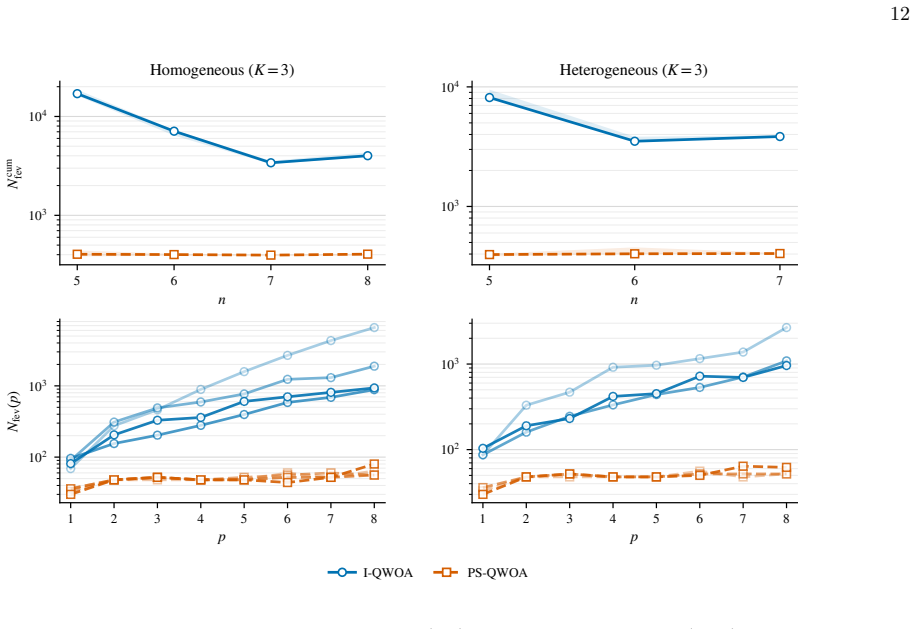
A continuous-time quantum walk over a product space that coincides with combinatorial structures intrinsic to the CVRP solution space enables optimisation of the capacitated vehicle routing problem for homogeneous and heterogeneous vehicle fleets, reducing per-layer gate complexity from O(n³ log n) to O(n² log n), supporting a fixed-parameter circuit schedule, and yielding improved convergence in exact simulations up to n=8 and K=3.
What carries the argument
continuous-time quantum walk over a product space that coincides with combinatorial structures intrinsic to the CVRP solution space
Load-bearing premise
The continuous-time quantum walk over the product space coincides with combinatorial structures intrinsic to the CVRP solution space, allowing the walk to explore only feasible solutions without additional constraint mechanisms.
What would settle it
An exact state-vector simulation on a CVRP instance with n=9 customers where the walk produces infeasible solutions or requires more objective evaluations than prior methods would falsify the central claim.
Figures
read the original abstract
The capacitated vehicle routing problem (CVRP) is an appealing candidate for quantum optimisation due to its combinatorial complexity and practical importance. However, the problem's constrained search space poses a challenge for such quantum algorithms. We introduce a quantum walk-based optimisation algorithm (QWOA) for the CVRP with homogeneous or heterogeneous vehicle fleets, addressing this challenge through a continuous-time quantum walk over a product space that coincides with combinatorial structures intrinsic to the CVRP solution space. Relative to the prior QWOA-based formulation, this approach reduces the per-layer gate complexity from $\mathcal{O}(n^{3}\log n)$ to $\mathcal{O}(n^{2}\log n)$ and supports a circuit parameterisation schedule generated by a fixed number of classical parameters. Exact state-vector simulation on instances with up to $n=8$ customers and $K=3$ vehicles demonstrates improved convergence to low-cost solutions using markedly fewer objective function evaluations, with the advantage broadening as problem size increases. These results identify structured product-space walks as a promising tool for optimisation over constrained combinatorial spaces.
Editorial analysis
A structured set of objections, weighed in public.
Referee Report
Summary. The manuscript introduces a quantum walk-based optimisation algorithm (QWOA) for the capacitated vehicle routing problem (CVRP) with homogeneous or heterogeneous fleets. It employs a continuous-time quantum walk on a product space asserted to coincide with the feasible CVRP solution space, yielding a per-layer gate complexity reduction from O(n³ log n) to O(n² log n) and a fixed-parameter circuit schedule. Exact state-vector simulations on instances up to n=8 customers and K=3 vehicles report improved convergence to low-cost solutions with fewer objective evaluations, with the advantage increasing with problem size.
Significance. If the product-space construction is shown to map bijectively onto feasible solutions without extraneous states, the work would provide a concrete route to constraint-free quantum optimisation for a practically relevant combinatorial problem, with the reported complexity improvement and simulation scaling offering a measurable advance over prior QWOA formulations.
major comments (2)
- [Abstract / formulation section] Abstract and main formulation: the central claim that the continuous-time quantum walk 'coincides with combinatorial structures intrinsic to the CVRP solution space' and therefore explores only feasible routes (no penalties or projectors required) is load-bearing for both the O(n² log n) gate-complexity reduction and the reported simulation advantage. No explicit bijection, Hamiltonian support argument, or verification that all basis states satisfy capacity, single-visit, and route-continuity constraints is supplied for either fleet type; without this the complexity and feasibility claims do not hold.
- [Numerical experiments] Simulation results: the exact state-vector experiments are restricted to n≤8 and K=3; the manuscript does not report the number of independent runs, variance in objective values, or any scaling analysis that would confirm the claimed broadening advantage is not an artifact of the small-instance regime.
Simulated Author's Rebuttal
We thank the referee for their constructive feedback, which helps clarify the presentation of our results. We address each major comment below and indicate the revisions that will be made.
read point-by-point responses
-
Referee: [Abstract / formulation section] Abstract and main formulation: the central claim that the continuous-time quantum walk 'coincides with combinatorial structures intrinsic to the CVRP solution space' and therefore explores only feasible routes (no penalties or projectors required) is load-bearing for both the O(n² log n) gate-complexity reduction and the reported simulation advantage. No explicit bijection, Hamiltonian support argument, or verification that all basis states satisfy capacity, single-visit, and route-continuity constraints is supplied for either fleet type; without this the complexity and feasibility claims do not hold.
Authors: We agree that a formal bijection is required to fully substantiate the feasibility claims. While the manuscript constructs the product space in Section 3 to encode only valid routes, we acknowledge that an explicit proof of bijectivity and constraint verification was not presented with sufficient rigor. In the revised version we will add a dedicated subsection providing a formal bijection for both homogeneous and heterogeneous fleets, together with a Hamiltonian support argument confirming that the walk operator acts only on states satisfying capacity, single-visit and route-continuity constraints. revision: yes
-
Referee: [Numerical experiments] Simulation results: the exact state-vector experiments are restricted to n≤8 and K=3; the manuscript does not report the number of independent runs, variance in objective values, or any scaling analysis that would confirm the claimed broadening advantage is not an artifact of the small-instance regime.
Authors: The restriction to n≤8 follows from the exponential memory cost of exact state-vector simulation. We will revise the numerical section to report the number of independent runs (20 per instance), include standard deviations of the final objective values, and add a supplementary figure showing the scaling of the convergence advantage across the tested sizes. We will also add an explicit discussion noting that the observed trend is preliminary and that larger instances will require approximate simulators. revision: partial
Circularity Check
No significant circularity; claims rest on encoding definition and simulation outcomes.
full rationale
The abstract and provided context present the product-space walk as coinciding with feasible CVRP structures by the choice of encoding, with complexity reduction stated relative to prior formulation and convergence demonstrated via exact simulations on small instances. No equations, fitted parameters, or self-citation chains are shown that reduce the central claims (gate complexity O(n² log n), constraint-free exploration) to inputs by construction. The derivation chain is self-contained against external benchmarks like the reported state-vector results.
Axiom & Free-Parameter Ledger
axioms (1)
- domain assumption The product space coincides with combinatorial structures intrinsic to the CVRP solution space
Reference graph
Works this paper leans on
-
[1]
,||Ω| −1⟩} , where Ωcan denotes the canoni- cal solution space [ 8, 16]
Indexed formulation In its original formulation, the QWOA addresses con- strained combinatorial optimisation and non-bijective solution-space embeddings by introducing anindexing unitary U# that maps a representative subset of en- coded solution states onto an indexed subspace H# = span{|0⟩, . . . ,||Ω| −1⟩} , where Ωcan denotes the canoni- cal solution s...
-
[2]
For p > 1, the layer-wise values are γℓ = γ σ h β+ (1−β) ℓ−1 p−1 i ,(13) and tℓ =t h 1 + (β−1) ℓ−1 p−1 i ,(14) with γ1 = γ/σ and t1 = t when p = 1
Three-parameter schedule The parameter schedule of thenon-variational QWOA[ 10], reduces the 2 p variational parameters of the QWOA to at most three. For p > 1, the layer-wise values are γℓ = γ σ h β+ (1−β) ℓ−1 p−1 i ,(13) and tℓ =t h 1 + (β−1) ℓ−1 p−1 i ,(14) with γ1 = γ/σ and t1 = t when p = 1. The taper pa- rameter β∈ [0, 1] controls how the phase-sepa...
-
[3]
Over-capacity routes are penalised linearly in the amount of excess demand using the default rule λ = λmean of Eq
Problem instances Each problem instance places n customers and a depot in a two-dimensional plane, with the pairwise costs cij computed from a sum of the Euclidean distance and small antisymmetric perturbation. Over-capacity routes are penalised linearly in the amount of excess demand using the default rule λ = λmean of Eq. (E3), where the mean is taken o...
-
[4]
Simulation Simulations are performed using QuOp MPI [27], which implements an exact simulation of the dynamics in the effective Hilbert space of each QWOA-variant. With this approach, we aim to characterise baseline algorithmic per- formance on instances larger than those that are tractable with a circuit-based simulation – which would require the inclusi...
-
[5]
The PS-QWOA uses the depth-independent three-parameter linear schedule of Section II B
Optimisation For each algorithm and problem instance, simulations were conducted at circuit depths p = 1 to 8. The PS-QWOA uses the depth-independent three-parameter linear schedule of Section II B. The I-QWOA uses a fully variational parameterisation with 2p free parameters (γℓ, tℓ)p ℓ=1, each γℓ normalised by the standard deviation of the penalised cost...
-
[6]
(10) through a combination of feasibility, solution-quality, and concentration measures
Figures of merit We evaluate each optimised QWOA state |ψ(p)⟩ ≡ |ψ(⃗ γ,⃗t)⟩ of Eq. (10) through a combination of feasibility, solution-quality, and concentration measures. Through- out, Px(p) = | ⟨x⟩ψ(p)| 2 denotes the depth- p mea- surement probability of basis state |x⟩, and P (z, p) =P x∈z Px(p) for any subset z⊆ Ω. We use F ⊆ Ω for the feasible (capac...
-
[7]
G. B. Dantzig and J. H. Ramser, Management Science6, 80 (1959)
1959
-
[8]
Toth and D
P. Toth and D. Vigo, Discrete Applied Mathematics123, 487 (2002). 13
2002
-
[9]
Braekers, K
K. Braekers, K. Ramaekers, and I. Van Nieuwenhuyse, Computers & Industrial Engineering99, 300 (2016)
2016
-
[10]
Laporte, European Journal of Operational Research 59, 345 (1992)
G. Laporte, European Journal of Operational Research 59, 345 (1992)
1992
-
[11]
Osaba, E
E. Osaba, E. Villar-Rodriguez, and I. Oregi, IEEE Access 10, 55805 (2022)
2022
-
[12]
E. Farhi, J. Goldstone, and S. Gutmann, A quantum ap- proximate optimization algorithm (2014), arXiv:1411.4028 [quant-ph]
Pith/arXiv arXiv 2014
-
[13]
Marsh and J
S. Marsh and J. B. Wang, Quantum Information Process- ing18, 61 (2019)
2019
-
[14]
Marsh and J
S. Marsh and J. Wang, Physical Review Research2, 023302 (2020)
2020
-
[15]
E. Matwiejew and J. B. Wang, Quantum walk informed variational algorithm design (2024), arXiv:2406.11620 [quant-ph]
arXiv 2024
-
[16]
Bennett, L
T. Bennett, L. Noakes, and J. Wang, in2024 IEEE In- ternational Conference on Quantum Computing and En- gineering (QCE)(2024) pp. 31–41
2024
-
[17]
H. Irie, G. Wongpaisarnsin, M. Terabe, A. Miki, and S. Taguchi, Quantum annealing of vehicle routing problem with time, state and capacity (2019), arXiv:1903.06322 [quant-ph]
Pith/arXiv arXiv 2019
-
[18]
R. Harikrishnafkumar, S. Nannapaneni, N. H. Nguyen, J. E. Steck, and E. C. Behrman, A quantum annealing approach for dynamic multi-depot capacitated vehicle routing problem (2020), arXiv:2005.12478 [math.OC]
arXiv 2020
-
[19]
Borowski, P
M. Borowski, P. Gora, K. Karnas, M. B lajda, K. Kr´ ol, A. Matyjasek, D. Burczyk, M. Szewczyk, and M. Kutwin, inComputational Science – ICCS 2020(Springer Inter- national Publishing, 2020) pp. 546–561
2020
-
[20]
Syrichas and A
A. Syrichas and A. Crispin, Computers & Operations Research87, 52 (2017)
2017
-
[21]
S. Feld, C. Roch, T. Gabor, C. Seidel, F. Neukart, I. Gal- ter, W. Mauerer, and C. Linnhoff-Popien, Frontiers in ICT6, 13 (2019)
2019
-
[22]
Bennett, E
T. Bennett, E. Matwiejew, S. Marsh, and J. B. Wang, Frontiers in Physics9, 730856 (2021)
2021
-
[23]
Decoding of the speech envelope from EEG using the VLAAI deep neural network,
D. Fitzek, T. Ghandriz, L. Laine, M. Granath, and A. F. Kockum, Scientific Reports14, 10.1038/s41598- 024-76967-w (2024)
-
[24]
Laporte, Transportation Science43, 408 (2009)
G. Laporte, Transportation Science43, 408 (2009)
2009
-
[25]
Toth and D
P. Toth and D. Vigo, eds.,Vehicle Routing: Problems, Methods, and Applications, 2nd ed., MOS-SIAM Series on Optimization (Society for Industrial and Applied Mathe- matics, 2014)
2014
-
[26]
R. P. Stanley,Enumerative Combinatorics, Volume 1, 2nd ed. (Cambridge University Press, 2011)
2011
-
[27]
Petkovˇ sek and T
M. Petkovˇ sek and T. Pisanski, Pi Mu Epsilon Journal12, 417 (2007)
2007
-
[28]
N. Xie, J. Xu, T. Chen, X. Lee, Y. Saito, N. Asai, and D. Cai, Physical Review A111, 012401 (2025)
2025
-
[29]
L. Binkowski and M. Schwiering, Quantum fisher-yates shuffle: Unifying methods for generating uniform superpo- sitions of permutations (2025), arXiv:2504.17965 [quant- ph]
arXiv 2025
-
[30]
M. A. Nielsen and I. L. Chuang,Quantum Computation and Quantum Information(Cambridge University Press, 2000)
2000
-
[31]
Barenco, C
A. Barenco, C. H. Bennett, R. Cleve, D. P. DiVincenzo, N. Margolus, P. Shor, T. Sleator, J. A. Smolin, and H. We- infurter, Physical Review A52, 3457 (1995)
1995
-
[32]
I. D. Kivlichan, J. McClean, N. Wiebe, C. Gidney, A. Aspuru-Guzik, G. K.-L. Chan, and R. Babbush, Phys- ical Review Letters120, 110501 (2018)
2018
-
[33]
Matwiejew and J
E. Matwiejew and J. B. Wang, Journal of Computational Science62, 101711 (2022)
2022
-
[34]
Physical Review X 10:021067, ://dx.doi.org/10.1103/PhysRevX.10.021067
L. Zhou, S.-T. Wang, S. Choi, H. Pichler, and M. D. Lukin, Physical Review X10, 10.1103/physrevx.10.021067 (2020)
-
[35]
Bennett, A
T. Bennett, A. Smith, E. Matwiejew, and J. B. Wang, Physical Review A113, 032603 (2026)
2026
-
[36]
Brassard, P
G. Brassard, P. Hoyer, M. Mosca, and A. Tapp, Contem- porary Mathematics305, 53 (2002)
2002
-
[37]
S. A. Cuccaro, T. G. Draper, S. A. Kutin, and D. P. Moulton, A new quantum ripple-carry addition circuit (2004), arXiv:quant-ph/0410184
Pith/arXiv arXiv 2004
-
[38]
D. E. Knuth,The Art of Computer Programming (Addison-Wesley, 1997–2011)
1997
-
[39]
Nijenhuis and H
A. Nijenhuis and H. S. Wilf,Combinatorial Algorithms for Computers and Calculators, 2nd ed. (Academic Press, 1978)
1978
-
[40]
P. J. Cameron,Permutation Groups(Cambridge Univer- sity Press, 1999)
1999
-
[41]
Babbush, C
R. Babbush, C. Gidney, D. W. Berry, N. Wiebe, J. Mc- Clean, A. Paler, A. Fowler, and H. Neven, Physical Review X8, 041015 (2018)
2018
-
[42]
D. W. Berry, C. Gidney, M. Motta, J. R. McClean, and R. Babbush, Quantum3, 208 (2019)
2019
-
[43]
Vedral, A
V. Vedral, A. Barenco, and A. Ekert, Physical Review A 54, 147 (1996). Appendix A: Reduced basis and walk generators in the symmetric subspace
1996
-
[44]
If G commutes with g, so does its matrix exponential, and for any|ψ⟩ ∈ H π ⊗ Hsym a , g e−itG |ψ⟩=e −itG g|ψ⟩=e −itG |ψ⟩,(A2) so the mixing unitaries preserve Hπ ⊗Hsym a
Relabelling-symmetric subspace The action of the symmetric group SK on the assign- ment register is g|π, a⟩ = |π, g(a)⟩ with (g(a))j = g(aj) forg∈S K, and therelabelling-symmetric subspaceis Hsym a = |ψ⟩ ∈ H a :g|ψ⟩=|ψ⟩ ∀g∈S K .(A1) Both walk generators Gπ and Ga commute with this ac- tion because each is a sum of edge terms |π′, a′⟩ ⟨π, a| + |π, a⟩ ⟨π′, ...
-
[45]
, sn) satisfying s1 = 0, si ≤ 1 + max(s1,
Canonical representatives and reduced basis Given identical vehicles, an equivalence class of vehicle assignments can be uniquely represented by acanonical restricted growth string(RGS) s = (s1, . . . , sn) satisfying s1 = 0, si ≤ 1 + max(s1, . . . , si−1), and maxi si < K [32, 33]. Positions sharing the same RGS value are assigned to the same vehicle, an...
-
[46]
1 For a group G acting on a set X, the orbit–stabiliser theorem states |G| = |Gx| · |Stab (x)| for any x∈X [34]
Restricted walk generators Since Gπ acts only on the permutation register, its restriction to each canonical RGS s∈ R n,K is a disjoint copy of the symmetric Cayley graph ofS n. 1 For a group G acting on a set X, the orbit–stabiliser theorem states |G| = |Gx| · |Stab (x)| for any x∈X [34]. Here G = SK and x = s, and the stabiliser consists of all permutat...
discussion (0)
Sign in with ORCID, Apple, or X to comment. Anyone can read and Pith papers without signing in.