A micromagnetic model with bidirectional magneto-thermal coupling
Pith reviewed 2026-06-27 06:14 UTC · model grok-4.3
The pith
Integrating the stochastic LLG equation with a generalized heat transfer equation creates a bidirectional magneto-thermal model that obeys the first law of thermodynamics.
A machine-rendered reading of the paper's core claim, the machinery that carries it, and where it could break.
Core claim
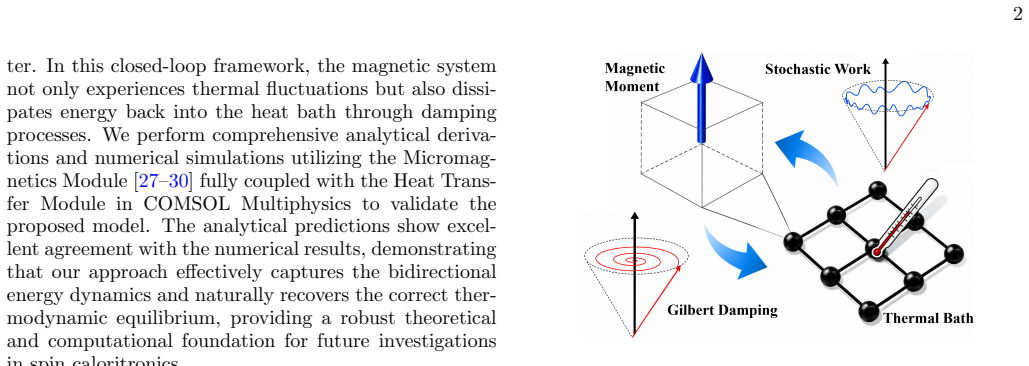
We establish a rigorously self-consistent bidirectional magneto-thermal coupling model by integrating the stochastic Landau-Lifshitz-Gilbert (sLLG) equation with a generalized heat transfer equation. In this closed-loop framework, the local temperature acts as a dynamical variable, and the damping-induced dissipation alongside stochastic work dynamically feeds back into the thermal bath as localized heat sources. Utilizing Ito stochastic calculus, we analytically prove that this coupled system strictly obeys the first law of thermodynamics and spontaneously recovers the correct Boltzmann statistics at equilibrium.
What carries the argument
The closed-loop integration of the sLLG equation and generalized heat transfer equation, with damping dissipation and stochastic work serving as heat sources to the thermal bath.
If this is right
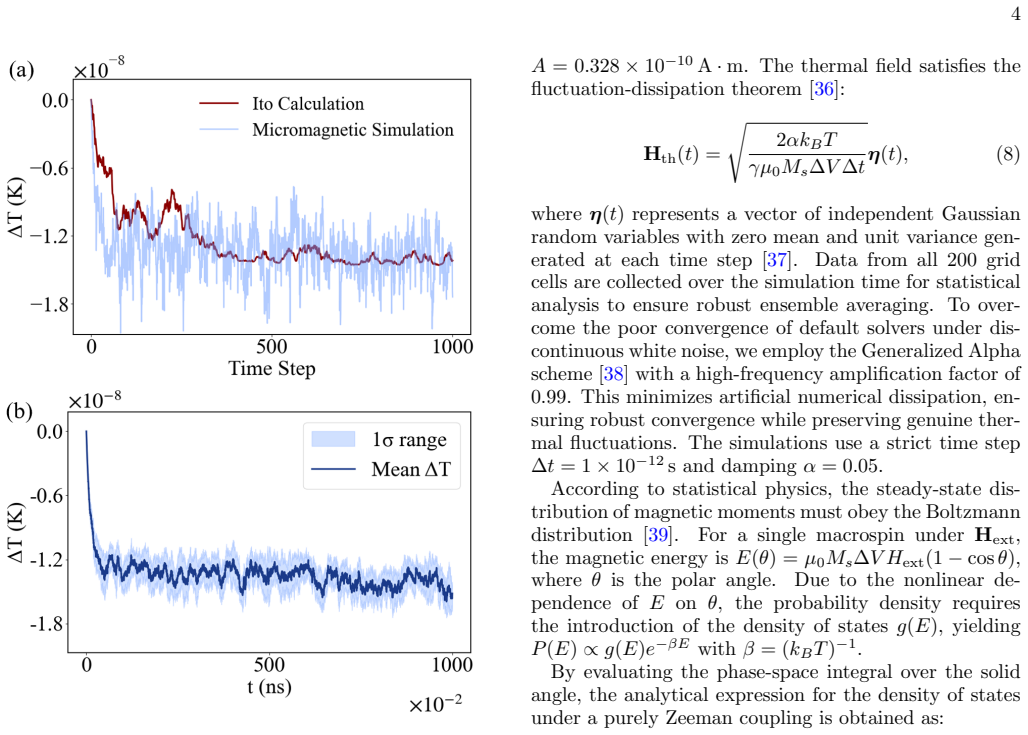
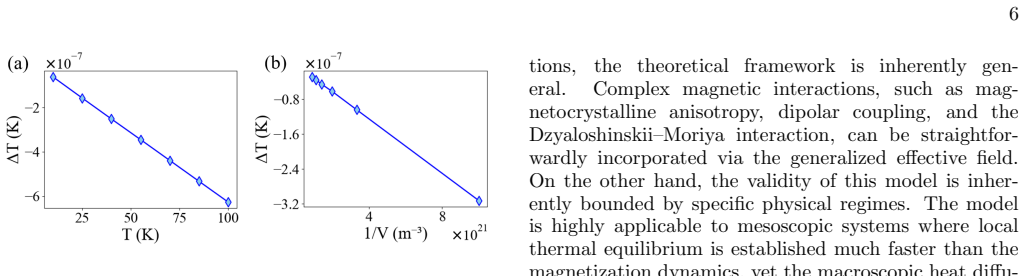
- The model captures finite-bath temperature reduction induced by spatial variation of magnetic moments.
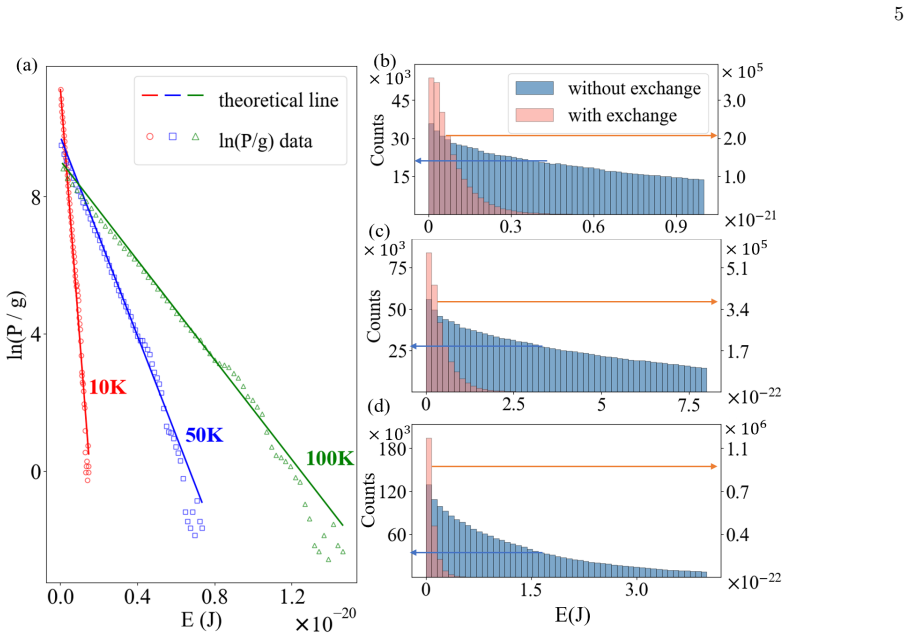
- It accounts for the modified density of states under exchange interactions.
- The framework supports investigation of nonequilibrium dynamics such as the unidirectional spin-wave heat conveyer effect.
- It provides a microscopic foundation for advanced spin-caloritronic applications.
Where Pith is reading between the lines
- This approach could enable more accurate modeling of systems where magnetic processes significantly heat or cool local regions.
- Extensions might include coupling to other transport equations for multi-physics simulations.
- Similar bidirectional couplings could be tested in related stochastic models outside magnetism.
Load-bearing premise
The generalized heat transfer equation integrates directly with the sLLG equation such that damping dissipation and stochastic work fully account for all energy exchanges without additional missing terms.
What would settle it
Demonstration that the coupled equations violate energy conservation over time or fail to produce the Boltzmann distribution in long-time equilibrium simulations would disprove the consistency claim.
Figures
read the original abstract
Most conventional micromagnetic frameworks in spin caloritronics rely on a unidirectional coupling approximation, wherein thermal fluctuations drive magnetization dynamics while the feedback of magnetic dissipation onto the thermal reservoir is neglected. Here, we establish a rigorously self-consistent bidirectional magneto-thermal coupling model by integrating the stochastic Landau-Lifshitz-Gilbert (sLLG) equation with a generalized heat transfer equation. In this closed-loop framework, the local temperature acts as a dynamical variable, and the damping-induced dissipation alongside stochastic work dynamically feeds back into the thermal bath as localized heat sources. Utilizing Ito stochastic calculus, we analytically prove that this coupled system strictly obeys the first law of thermodynamics and spontaneously recovers the correct Boltzmann statistics at equilibrium. Spatially resolved micromagnetic simulations further validate the energy exchange mechanism, capturing the finite-bath temperature reduction induced by spatial variation of magnetic moments and the modified density of states under exchange interactions. This bidirectional framework provides a robust microscopic foundation for investigating complex nonequilibrium magneto-thermal dynamics, such as the unidirectional spin-wave heat conveyer effect, paving the way for advanced spin-caloritronic applications.
Editorial analysis
A structured set of objections, weighed in public.
Referee Report
Summary. The paper introduces a bidirectional magneto-thermal coupling model by integrating the stochastic Landau-Lifshitz-Gilbert (sLLG) equation with a generalized heat transfer equation, treating local temperature as a dynamical variable sourced by damping dissipation and stochastic work. It claims an analytical proof via Ito stochastic calculus that the coupled system obeys the first law of thermodynamics exactly and recovers the Boltzmann distribution at equilibrium, with micromagnetic simulations validating energy exchange and finite-bath effects.
Significance. If the central analytical claim holds without gaps, the work supplies a thermodynamically consistent microscopic framework for spin caloritronics that removes the unidirectional approximation common in prior models. The explicit use of Ito calculus to derive first-law obedience and equilibrium statistics, together with simulation evidence for spatially resolved temperature reduction, would constitute a substantive advance for nonequilibrium magneto-thermal studies such as the spin-wave heat conveyer effect.
major comments (2)
- [Ito-calculus proof section] The Ito-calculus proof of first-law obedience (the section deriving dE_total via Ito's lemma on the coupled sLLG + heat equation): the derivation is performed under the assumption that the stochastic field remains delta-correlated white noise whose variance is set by the instantaneous local T(t). Once T becomes a dynamical variable, the effective noise acquires temporal correlations on the thermal relaxation timescale; the manuscript does not demonstrate that the required counter-terms are present to restore exact cancellation of the quadratic-variation contributions, leaving the claimed strict thermodynamic consistency unverified.
- [Equilibrium statistics recovery] Equilibrium statistics recovery claim: the proof that the coupled system spontaneously recovers the correct Boltzmann measure relies on the same white-noise Ito structure. With dynamical T the Fokker-Planck operator may acquire additional drift terms from the colored-noise spectrum; no explicit verification (analytic or numerical) is supplied that the stationary measure remains exactly exp(-E/kT) rather than a modified distribution.
minor comments (2)
- [Abstract] The abstract is overly dense; the sentence describing the simulation validation mixes multiple distinct results (finite-bath reduction, modified density of states) without separating them.
- [Model definition] Notation for the generalized heat equation and the stochastic field correlation should be introduced with explicit time-dependence when T is dynamical, to avoid ambiguity with the fixed-T case.
Simulated Author's Rebuttal
We thank the referee for their careful reading and constructive comments on our manuscript. We address each major comment below, providing clarifications and indicating planned revisions where appropriate.
read point-by-point responses
-
Referee: [Ito-calculus proof section] The Ito-calculus proof of first-law obedience (the section deriving dE_total via Ito's lemma on the coupled sLLG + heat equation): the derivation is performed under the assumption that the stochastic field remains delta-correlated white noise whose variance is set by the instantaneous local T(t). Once T becomes a dynamical variable, the effective noise acquires temporal correlations on the thermal relaxation timescale; the manuscript does not demonstrate that the required counter-terms are present to restore exact cancellation of the quadratic-variation contributions, leaving the claimed strict thermodynamic consistency unverified.
Authors: We acknowledge that treating T as dynamical raises the question of noise correlations. In our framework the stochastic field is defined to be white at each instant with variance fixed by the current local T(t), which is the standard modeling choice for such coupled magneto-thermal systems. The Ito lemma is applied directly to the total energy functional using this instantaneous white-noise structure, and the quadratic-variation terms from the sLLG equation are shown to cancel exactly against the heat-source term in the generalized heat equation by construction. We will revise the manuscript to add an explicit remark justifying the white-noise approximation and confirming that no further counter-terms arise within the adopted stochastic calculus. revision: partial
-
Referee: [Equilibrium statistics recovery] Equilibrium statistics recovery claim: the proof that the coupled system spontaneously recovers the correct Boltzmann measure relies on the same white-noise Ito structure. With dynamical T the Fokker-Planck operator may acquire additional drift terms from the colored-noise spectrum; no explicit verification (analytic or numerical) is supplied that the stationary measure remains exactly exp(-E/kT) rather than a modified distribution.
Authors: The analytic proof proceeds by showing that, once the system reaches equilibrium (constant T), the Fokker-Planck operator reduces to the standard form whose unique stationary solution is the Boltzmann measure. We agree that an explicit demonstration for the fully dynamical-T case strengthens the claim. In the revised manuscript we will include additional long-time micromagnetic simulations that confirm the magnetization statistics converge to the expected Boltzmann distribution for several lattice sizes and exchange strengths. revision: yes
Circularity Check
No circularity: thermodynamic consistency derived analytically via Ito calculus on the coupled equations
full rationale
The paper's central claim is an analytical proof that the integrated sLLG + generalized heat equation system obeys the first law and recovers Boltzmann statistics, obtained by direct application of Ito stochastic calculus to the closed-loop dynamics. No fitted parameters are renamed as predictions, no self-citations are invoked as load-bearing uniqueness theorems, and no ansatz or known result is smuggled in via definition. The derivation is presented as self-contained from the stochastic differential equations themselves, with no reduction of outputs to inputs by construction visible in the abstract or described model establishment.
Axiom & Free-Parameter Ledger
axioms (1)
- standard math Ito stochastic calculus governs the coupled sLLG and heat equations
Reference graph
Works this paper leans on
-
[1]
ichi Uchida and T
K. ichi Uchida and T. Hirai, Spin caloritronics: history and future prospects of experiments, Journal of Mag- netism and Magnetic Materials652, 174195 (2026)
2026
-
[2]
G. E. W. Bauer, E. Saitoh, and B. J. van Wees, Spin caloritronics, Nature Materials11, 391 (2012)
2012
-
[3]
H. Y. Yuan, Y. Wu, and O. Gomonay, Harnessing plas- monic heating for switching in antiferromagnets, Physical Review Letters136, 206702 (2026)
2026
-
[4]
A. V. Chumak, V. I. Vasyuchka, A. A. Serga, and B. Hillebrands, Magnon spintronics, Nature Physics11, 453 (2015)
2015
-
[5]
Kikkawa and E
T. Kikkawa and E. Saitoh, Spin seebeck effect: Sensitive probe for elementary excitation, spin correlation, trans- port, magnetic order, and domains in solids, Annual Re- view of Condensed Matter Physics14, 129 (2023)
2023
-
[6]
T. An, V. I. Vasyuchka, K. ichi Uchida, K. ichi Uchida, A. V. Chumak, K. Yamaguchi, K. Harii, J. ichiro Ohe, M. B. Jungfleisch, Y. Kajiwara, H. Adachi, B. Hille- brands, S. Maekawa, and E. Saitoh, Unidirectional spin- wave heat conveyer., Nature materials12 6, 549 (2013)
2013
-
[7]
Adachi, K.-i
H. Adachi, K.-i. Uchida, E. Saitoh, and S. Maekawa, The- ory of the spin seebeck effect, Reports on Progress in Physics76, 036501 (2013)
2013
-
[8]
J. Xiao, G. E. W. Bauer, and A. Brataas, Spin-transfer torque in magnetic tunnel junctions: Scattering theory, Physical Review B77, 224419 (2008)
2008
-
[9]
Xiao and G
J. Xiao and G. E. W. Bauer, Spin-wave excitation in mag- netic insulators by spin-transfer torque, Physical Review Letters108, 217204 (2012)
2012
-
[10]
Flipse, F
J. Flipse, F. K. Bakker, A. Slachter, F. K. Dejene, and B. J. van Wees, The spin-dependent Peltier effect in metal-based spin valves, Nature Nanotechnology7, 166 (2012)
2012
-
[11]
Brataas, Quantum scattering theory of spin transfer torque, spin pumping, and fluctuations, Physical Review B106, 064402 (2022)
A. Brataas, Quantum scattering theory of spin transfer torque, spin pumping, and fluctuations, Physical Review B106, 064402 (2022)
2022
-
[12]
Maekawa, T
S. Maekawa, T. Kikkawa, H. Chudo, J. Ieda, and E. Saitoh, Spin and spin current – from fundamentals to recent progress, Journal of Applied Physics132, 140902 (2022)
2022
-
[13]
Johnson and R
M. Johnson and R. H. Silsbee, Thermodynamic analysis of interfacial transport and of the thermomagnetoelectric system, Phys. Rev. B35, 4959 (1987)
1987
-
[14]
Hatami, G
M. Hatami, G. E. W. Bauer, Q. Zhang, and P. J. Kelly, Thermal spin-transfer torque in magnetoelectronic de- vices, Phys. Rev. Lett.99, 066603 (2007)
2007
-
[15]
Uchida, S
K. Uchida, S. Takahashi, K. Harii, J. Ieda, W. Koshibae, K. Ando, S. Maekawa, and E. Saitoh, Observation of the spin seebeck effect, Nature455, 778 (2008)
2008
-
[16]
Atxitia, P
U. Atxitia, P. Nieves, and O. Chubykalo-Fesenko, Landau-lifshitz-bloch equation for ferrimagnetic materi- als, Phys. Rev. B86, 104414 (2012)
2012
-
[17]
A. L. Soenjaya, Mixed finite element methods for the landau–lifshitz–baryakhtar and the regularised landau– lifshitz–bloch equations in micromagnetics, Journal of Scientific Computing103, 10.1007/s10915-025-02868-3 (2025)
-
[18]
Tzoufras and M
M. Tzoufras and M. K. Grobis, Dynamics of single- domain magnetic particles at elevated temperatures, New Journal of Physics17, 103014 (2015)
2015
-
[19]
L. Hong, C. Xu, and H. Xiang, Evaluating gilbert damp- ing in magnetic insulators from first principles, Physical Review B109, 094429 (2024)
2024
-
[20]
Zhang and J
L. Zhang and J. Wang, Unified framework of the mi- croscopic landau–lifshitz–gilbert equation and its appli- cation to skyrmion dynamics, Physical Review B108, 144409 (2023)
2023
-
[21]
Vansteenkiste, J
A. Vansteenkiste, J. Leliaert, M. Dvornik, M. Helsen, F. Garcia-Sanchez, and B. Van Waeyenberge, The design and verification of MuMax3, AIP Advances4, 107133 (2014)
2014
-
[22]
M. J. Donahue and D. G. Porter,OOMMF User’s Guide, Version 1.0, Tech. Rep. NISTIR 6376 (National Institute of Standards and Technology, Gaithersburg, MD, 1999)
1999
-
[23]
Scholz, magpar: A parallel finite-element micromag- netics package, Journal of Magnetism and Magnetic Ma- terials258-259, 488 (2003)
W. Scholz, magpar: A parallel finite-element micromag- netics package, Journal of Magnetism and Magnetic Ma- terials258-259, 488 (2003)
2003
-
[24]
Fischbacher, M
T. Fischbacher, M. Franchin, G. Bordignon, and H. Fan- gohr, A systematic approach to multiphysics exten- sions of finite-element-based micromagnetic simulations: Nmag, IEEE Transactions on Magnetics43, 2896 (2007)
2007
-
[25]
Chang, S
R. Chang, S. Li, M. V. Lubarda, B. Livshitz, and V. Lo- makin, FastMag: Fast micromagnetic simulator for com- plex magnetic structures (invited), Journal of Applied Physics109, 07D358 (2011)
2011
-
[26]
Lepadatu, Boris computational spintronics — High performance multi-mesh magnetic and spin transport modelling software, Journal of Applied Physics128, 093902 (2020)
S. Lepadatu, Boris computational spintronics — High performance multi-mesh magnetic and spin transport modelling software, Journal of Applied Physics128, 093902 (2020)
2020
-
[27]
Zhang, W
J. Zhang, W. Yu, X. Chen, and J. Xiao, A frequency- domain micromagnetic simulation module based on COMSOL Multiphysics, AIP Advances13, 055108 (2023)
2023
-
[28]
M. Xu, C. Hua, Y. Chen, and W. Yu, Frequency modu- lation on magnons in synthetic dimensions, Nature Com- munications16, 3356 (2025)
2025
-
[29]
C. Hua, K. Wu, and W. Yu, Micromagnetic simulation tools: OOMMF, Mumax3, and COMSOL Multiphysics, inMagnetic Nanoparticles in Nanomedicine, edited by K. Wu and J.-P. Wang (Elsevier, 2024) Chap. 2, p. , iSBN: 978-0-443-21668-8
2024
-
[30]
C. Wang, C. Hua, and W. Yu, Effective spin-spin cou- pling in magnon-polarons toward acoustic-assisted prob- ing of magnetic domains, Science China Physics, Mechan- ics & Astronomy69, 247512 (2026)
2026
-
[31]
Widom, C
A. Widom, C. Vittoria, and S. D. Yoon, Gilbert ferro- magnetic damping theory and the fluctuation-dissipation theorem, Journal of Applied Physics108, 073924 (2010). 8
2010
-
[32]
ITO, On a stochastic integral equation, Proceedings of the Japan Academy22, 32 (1946)
K. ITO, On a stochastic integral equation, Proceedings of the Japan Academy22, 32 (1946)
1946
-
[33]
D. V. Berkov, Fast switching of magnetic nanoparticles: Simulation of thermal noise effects using the langevin dynamics, IEEE Transactions on Magnetics38, 2489 (2002)
2002
-
[34]
V. Levati, M. Vitali, A. Del Giacco,et al., Three- dimensional nanoscale control of magnetism in crys- talline yttrium iron garnet, Nature Communications 10.1038/s41467-025-64630-5 (2025)
-
[35]
Y. Y. Kim, Thermal Conductivity of a Nanoscale Yt- trium Iron Garnet Thin-Film Prepared by the Sol-Gel Process, Nanomaterials7, 247 (2017)
2017
-
[36]
W. F. Brown, Thermal Fluctuations of a Single-Domain Particle, Physical Review130, 1677 (1963)
1963
-
[37]
C. W. Gardiner,Stochastic Methods: A Handbook for the Natural and Social Sciences, 4th ed. (Springer, 2009)
2009
-
[38]
COMSOL Multiphysics®v. 6.4. www.comsol.com. COMSOL AB, Stockholm, Sweden
-
[39]
J. Rogel-Salazar, Econophysics and companies: Sta- tistical life and death in complex business networks, by hideaki aoyama, yoshi fijiwara, yuichi ikeda, hirishi iyetomi and wataru souma, Contemporary Physics52, 605 (2011)
2011
-
[40]
Kainuma, R
Y. Kainuma, R. Iguchi, D. Prananto, V. I. Vasyuchka, B. Hillebrands, T. An, and K.-i. Uchida, Local heat emis- sion due to unidirectional spin-wave heat conveyer effect observed by lock-in thermography, Applied Physics Let- ters118, 222404 (2021)
2021
-
[41]
Science China Press, High-precision infrared imaging technology reveals the magnetic domain structure of non- collinear antiferromagnets, Science China Press (News Release) (2024), a news report summarizing the work published in National Science Review (Wang et al. 2024)
2024
-
[42]
Alasli, R
A. Alasli, R. Iguchi, K.-i. Uchida, H. Nagano, and D. Hou, Measurements of in-plane thermophysical prop- erties on nanoscale-thick films by lock-in thermography, Applied Physics Letters126, 044102 (2025)
2025
-
[43]
P. Wang, W. Xia, J. Shen, Y. Chen, W. Peng, J. Zhang, H. Pan, X. Yu, Z. Liu, Y. Gao, Q. Niu, Z. Xu, H. Yang, Y. Guo, and D. Hou, Infrared imaging of magnetic oc- tupole domains in non-collinear antiferromagnets, Na- tional Science Review11, nwad308 (2024)
2024
-
[44]
Adachi and S
H. Adachi and S. Maekawa, Theory of unidirectional spin heat conveyer, Journal of Applied Physics117, 17C710 (2015)
2015
-
[45]
Uchida, J
K. Uchida, J. Xiao, H. Adachi, J. Ohe, S. Takahashi, J. Ieda, T. Ota, Y. Kajiwara, H. Umezawa, H. Kawai, G. E. W. Bauer, S. Maekawa, and E. Saitoh, Spin seebeck insulator, Nature Materials9, 894 (2010)
2010
-
[46]
Xuet al., Enhancing spin pumping by nonlocal manip- ulation of magnon temperature, Matter7, 4332 (2024)
Z. Xuet al., Enhancing spin pumping by nonlocal manip- ulation of magnon temperature, Matter7, 4332 (2024)
2024
-
[47]
A. Takahagi, T. Hirai, A. Alasli, S. J. Park, H. Nagano, and K.-i. Uchida, Observation of the transverse thom- son effect, Nature Physics 10.1038/s41567-025-02936-3 (2025)
-
[48]
ichi UCHIDA, Transport phenomena in spin caloritronics, Proceedings of the Japan Academy, Series B97, 69 (2021)
K. ichi UCHIDA, Transport phenomena in spin caloritronics, Proceedings of the Japan Academy, Series B97, 69 (2021)
2021
-
[49]
Shigematsu, Y
E. Shigematsu, Y. Ando, S. Dushenko, T. Shinjo, and M. Shiraishi, Spin-wave-induced lateral temperature gra- dient in a yig thin film/ggg system excited in an esr cav- ity, Applied Physics Letters113, 183505 (2018)
2018
-
[50]
Hirai, T
T. Hirai, T. Morita, S. Biswas, J. Uzuhashi, T. Yagi, Y. Yamashita, V. K. Kushwaha, F. Makino, R. Modak, Y. Sakuraba, T. Ohkubo, R. Guo, B. Xu, J. Shiomi, D. Chiba, and K. ichi Uchida, Non-equilibrium magnon engineering enabling significant thermal transport mod- ulation, Advanced Functional Materials35, 2506554 (2025)
2025
-
[51]
O. Wid, J. Bauer, A. M¨ uller, O. Breitenstein, S. S. P. Parkin, and G. Schmidt, Investigation of the unidirec- tional spin heat conveyer effect in a 200 nm thin yttrium iron garnet film, Scientific Reports6, 28233 (2016)
2016
-
[52]
Schlitz, V
R. Schlitz, V. E. Demidov, M. Lammel, S. O. Demokri- tov, and P. Gambardella, Auto-oscillations and direc- tional magnon emission induced by spin current injec- tion into large magnetic volumes, Nature Communica- tions16, 8472 (2025). Appendix A: Appendix
2025
-
[53]
(Hy +H xαcosθ) cosϕ−H zαsinθ + (−Hx +H yαcosθ) sinϕ dt + √ T ακ −αsinθ dW z + (αcosθcosϕ−sinϕ)dW x + (cosϕ+αcosθsinϕ)dW y # , (A2) 9 dϕ= γ 1 +α 2
Projection of the sLLG Equation into Spherical Coordinates To facilitate numerical integration and energy tracking, it is highly advantageous to project the sLLG equation from the Cartesian basis onto the local spherical coordi- nate basis. Let the normalized magnetization vector be parameterized asm= (sinθcosϕ,sinθsinϕ,cosθ) T . Us- ing the mathematicall...
-
[54]
For computational reproducibility, it is necessary to expand this abstract matrix operation into explicit scalar partial derivatives
Explicit Expansion of the Itˆ o Energy Correction In the main text, the noise-induced energy drift is com- pactly expressed using the trace of the Hessian matrix: 1 2Tr(BT HEB)dt. For computational reproducibility, it is necessary to expand this abstract matrix operation into explicit scalar partial derivatives. Let the magnetic energy beE(θ, ϕ). Accordin...
-
[55]
Choosing the local polar axis (θ= 0) to align with the effective field direction, the magnetic energy isE=µ 0Ms∆V Heff(1− cosθ)
Derivation of the Density of States with Exchange Interaction To analytically verify the Boltzmann distribution, the density of statesg(E) must be evaluated. Choosing the local polar axis (θ= 0) to align with the effective field direction, the magnetic energy isE=µ 0Ms∆V Heff(1− cosθ). The density of states is defined via the Dirac delta function over the...
discussion (0)
Sign in with ORCID, Apple, or X to comment. Anyone can read and Pith papers without signing in.