YOLO-AMC: An Improved YOLO Architecture with Attention Mechanisms for Building Crack Detection
Pith reviewed 2026-06-27 07:32 UTC · model grok-4.3
The pith
Inserting the Global Attention Mechanism into YOLOv11's neck after C2PSA removal raises crack detection mAP@0.5 to 0.9917.
A machine-rendered reading of the paper's core claim, the machinery that carries it, and where it could break.
Core claim
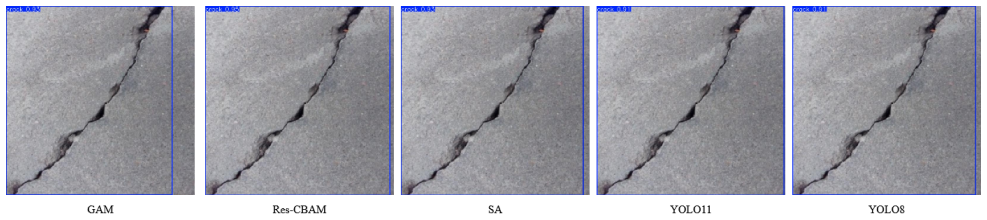
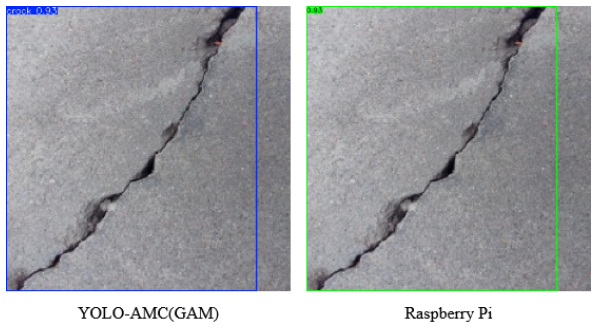
YOLO-AMC with GAM inserted into the multi-scale feature fusion layers of the Neck after C2PSA removal achieves mAP@0.5 of 0.9917 and mAP@0.5:0.95 of 0.9506 on the test dataset, exceeding YOLOv11's 0.9833 and 0.9112 as well as YOLOv8's 0.9707 and 0.8921, while operating at 7.6 GFLOPs, 110.95 FPS on RTX 4090, and roughly 5 FPS on Raspberry Pi 5.
What carries the argument
Attention modules placed in the multi-scale feature fusion layers of the Neck to strengthen cross-scale feature integration for low-contrast crack detection.
If this is right
- GAM outperforms the other tested attention modules for this crack detection task.
- The resulting model maintains real-time speeds on both desktop GPUs and edge hardware such as the Raspberry Pi 5.
- The architecture offers a direct accuracy improvement over standard YOLOv11 and YOLOv8 for thin-structure detection in noisy images.
- Deployment remains feasible at low computational cost of 7.6 GFLOPs.
Where Pith is reading between the lines
- The same neck-level attention placement could be tested on detection of other low-contrast linear features such as roads or pipelines in aerial imagery.
- If the gain depends on cross-scale fusion, applying the modules earlier in the backbone might yield different trade-offs worth measuring.
- The approach could be combined with data augmentation targeted at crack-like artifacts to see whether the mAP ceiling rises further.
Load-bearing premise
The reported accuracy gains arise specifically from the attention module insertions and C2PSA removal rather than from unstated choices in training data, optimization, or other implementation details.
What would settle it
Reproduce the exact training protocol on the same dataset using unmodified YOLOv11 without the attention additions or C2PSA removal, then measure whether its mAP@0.5 and mAP@0.5:0.95 match the lower baseline values or rise to the reported YOLO-AMC levels.
Figures




read the original abstract
Crack detection plays an important role in infrastructure inspection and Structural Health Monitoring (SHM). However, cracks typically appear as thin, low-contrast structures and are easily affected by background noise, posing challenges for existing object detection models. This study proposes an improved YOLO-based architecture with integrated attention mechanisms, termed YOLO-AMC (YOLO with Attention Mechanisms for Crack Detection), to enhance automated crack detection performance. Based on YOLOv11, the original C2PSA module is removed, and multiple attention mechanisms, including Global Attention Mechanism (GAM), Residual Convolutional Block Attention Module (Res-CBAM), and Shuffle Attention (SA), are introduced into the multi-scale feature fusion layers of the Neck to strengthen cross-scale feature integration. Experimental results demonstrate that YOLO-AMC consistently outperforms baseline models YOLOv11n and YOLOv8n across multiple evaluation metrics. Among the evaluated attention modules, GAM achieves the best detection performance, obtaining mAP@0.5 = 0.9917 and mAP@0.5:0.95 = 0.9506 on the test dataset, which are higher than those of YOLOv11 (0.9833 / 0.9112) and YOLOv8 (0.9707 / 0.8921). Furthermore, while maintaining a computational complexity of 7.6 GFLOPs, the proposed model achieves 110.95 FPS on an NVIDIA RTX 4090 platform and approximately 5 FPS on a Raspberry Pi 5 edge device, demonstrating a favorable trade-off between accuracy and deployment efficiency. The implementation code for this study is available on GitHub at https://github.com/CY-Tsai24/YOLO-AMC.
Editorial analysis
A structured set of objections, weighed in public.
Referee Report
Summary. The paper proposes YOLO-AMC, an improved YOLOv11-based detector for building crack detection. It removes the original C2PSA module and inserts attention mechanisms (GAM, Res-CBAM, or SA) into the multi-scale feature fusion layers of the Neck. On a held-out test set the GAM variant reports mAP@0.5 = 0.9917 and mAP@0.5:0.95 = 0.9506, exceeding the unmodified YOLOv11n (0.9833 / 0.9112) and YOLOv8n (0.9707 / 0.8921) baselines, while retaining 7.6 GFLOPs and 110.95 FPS on an RTX 4090 (≈5 FPS on Raspberry Pi 5). Public code is provided.
Significance. If the reported gains can be isolated to the attention insertions, the work would supply a concrete, deployable improvement for low-contrast crack detection in structural health monitoring. The public GitHub link and edge-device FPS numbers are concrete strengths that would aid reproducibility and practical adoption.
major comments (1)
- [Abstract and Experimental Results] Abstract and Experimental Results: the central claim attributes the mAP@0.5 / mAP@0.5:0.95 gains specifically to insertion of GAM (or Res-CBAM/SA) after C2PSA removal. However, the only reported comparisons are the full YOLO-AMC model versus unmodified YOLOv11n and YOLOv8n; no ablation table or section shows (a) YOLOv11 with C2PSA removed but no attention added, (b) attention added without C2PSA removal, or (c) identical training schedule, augmentations, and optimizer across variants. Without these controls the performance delta cannot be confidently assigned to the attention modules.
minor comments (2)
- The manuscript does not state the number of images in the training/validation/test splits or the precise training protocol (optimizer, learning-rate schedule, augmentation policy, number of epochs).
- Table or figure captions should explicitly list the exact attention-module variants evaluated and the baseline configurations.
Simulated Author's Rebuttal
We thank the referee for the constructive feedback and the recommendation for major revision. The key concern is the absence of ablation studies needed to attribute performance gains specifically to the attention insertions after C2PSA removal. We address this point below and will revise the manuscript accordingly.
read point-by-point responses
-
Referee: [Abstract and Experimental Results] Abstract and Experimental Results: the central claim attributes the mAP@0.5 / mAP@0.5:0.95 gains specifically to insertion of GAM (or Res-CBAM/SA) after C2PSA removal. However, the only reported comparisons are the full YOLO-AMC model versus unmodified YOLOv11n and YOLOv8n; no ablation table or section shows (a) YOLOv11 with C2PSA removed but no attention added, (b) attention added without C2PSA removal, or (c) identical training schedule, augmentations, and optimizer across variants. Without these controls the performance delta cannot be confidently assigned to the attention modules.
Authors: We agree that the current experiments compare only the complete YOLO-AMC model against the unmodified YOLOv11n and YOLOv8n baselines, without the requested intermediate variants. This limits the ability to isolate the effect of the attention modules. In the revised manuscript we will add a new ablation subsection and table that reports: (a) YOLOv11 with C2PSA removed but no attention modules, (b) YOLOv11 with the attention modules inserted while retaining the original C2PSA, and (c) explicit confirmation that all variants (including baselines) were trained with identical schedules, augmentations, optimizer, learning-rate policy, and epoch count. These additional results will be generated from the publicly released code and will be used to strengthen the attribution of gains to the proposed modifications. revision: yes
Circularity Check
No circularity: empirical mAP results on held-out test set with no derivations or self-referential fits
full rationale
The paper proposes an architectural change (C2PSA removal + attention insertion in Neck) and reports measured mAP values on a test dataset. No equations, first-principles derivations, or predictions appear that reduce the reported metrics to quantities defined by the paper's own fitted parameters or self-citations. The central claim is an empirical comparison against unmodified baselines; absence of ablations affects evidential strength but does not create circularity by construction. No self-citation load-bearing steps, ansatz smuggling, or renaming of known results are present in the provided text.
Axiom & Free-Parameter Ledger
axioms (1)
- domain assumption Attention mechanisms improve cross-scale feature integration for thin, low-contrast objects such as cracks.
Reference graph
Works this paper leans on
-
[1]
Y.-J. Cha, W. Choi, G. Suh, S. Mahmoudkhani, and O. B¨ uy¨ uk¨ ozt¨ urk. Autonomous structural vi- sual inspection using region-based deep learning for detecting multiple damage types.Computer-Aided Civil and Infrastructure Engineering, 33(9):731–747, 2018
2018
-
[2]
R. Fan, M. J. Bocus, Y. Zhu, J. Jiao, L. Wang, F. Ma, S. Cheng, and M. Liu. Road crack detec- tion using deep convolutional neural network and adaptive thresholding. InProc. IEEE Intelligent Vehicles Symposium (IV), pages 474–479, 2019
2019
-
[3]
Smart structural health monitoring using computer vision and edge computing.Engineering Structures, 319:118809, 2024
Zhen Peng, Jun Li, Hong Hao, and Yue Zhong. Smart structural health monitoring using computer vision and edge computing.Engineering Structures, 319:118809, 2024
2024
-
[4]
S. Y. Mohammed. Architecture review: Two-stage and one-stage object detection.Franklin Open, page 100322, 2025
2025
-
[5]
M. L. Ali and Z. Zhang. The yolo framework: A comprehensive review of evolution, applications, and benchmarks in object detection.Computers, 13(12):336, 2024
2024
-
[6]
Ultralytics yolo (version 8.0.0)
Ultralytics. Ultralytics yolo (version 8.0.0). https: //github.com/ultralytics/ultralytics, 2025. Accessed: Jan. 13, 2025
2025
-
[7]
A lightweight underwater detector enhanced by attention mechanism, gsconv and wiou on yolov8
Shaobin Cai, Xiangkui Zhang, and Yuchang Mo. A lightweight underwater detector enhanced by attention mechanism, gsconv and wiou on yolov8. Scientific Reports, 14(1):25797, 2024
2024
-
[8]
Alzahrani, Arif Bramantoro, and Mira Kartiwi
Fatin Najihah Muhamad Zamri, Teddy Surya Gu- nawan, Siti Hajar Yusoff, Ahmad A. Alzahrani, Arif Bramantoro, and Mira Kartiwi. Enhanced small 12 drone detection using optimized yolov8 with atten- tion mechanisms.IEEE Access, 12:90629–90643, 2024
2024
-
[9]
N. S. Rupak, N. Rayvanth, Pulipati Kushank, and Rimjhim Padam Singh. An investigation into yolo- v8 model optimization for small object detection in uavs using attention mechanism. In2024 15th International Conference on Computing Commu- nication and Networking Technologies (ICCCNT), pages 1–7. IEEE, 2024
2024
-
[10]
Lai, C.-Y
J.-Y. Lai, C.-Y. Tsai, C. H. Yang, C.-M. Lin, and J.-S. Chiang. Yolo with attention mechanisms for building cracks detection. InProc. IET Interna- tional Conference on Engineering Technologies and Applications (ICETA), 2025
2025
-
[11]
Y.-J. Cha, W. Choi, and O. B¨ uy¨ uk¨ ozt¨ urk. Deep learning-based crack damage detection using convo- lutional neural networks.Computer-Aided Civil and Infrastructure Engineering, 32(5):361–378, 2017
2017
-
[12]
Z. Fan, Y. Wu, J. Lu, and W. Li. Automatic pavement crack detection based on structured prediction with the convolutional neural network. arXiv:1802.02208, 2018
work page internal anchor Pith review Pith/arXiv arXiv 2018
-
[13]
S. Li, X. Zhao, and G. Zhou. Automatic pixel-level multiple damage detection of concrete structure using fully convolutional network.Computer-Aided Civil and Infrastructure Engineering, 34(7):616–634, 2019
2019
-
[14]
F. Yang, L. Zhang, S. Yu, D. Prokhorov, X. Mei, and H. Ling. Feature pyramid and hierarchical boosting network for pavement crack detection. IEEE Transactions on Intelligent Transportation Systems, 21(4):1525–1535, 2019
2019
-
[15]
H. Li, P. Xiong, J. An, and L. Wang. Pyra- mid attention network for semantic segmentation. arXiv:1805.10180, 2018
work page internal anchor Pith review Pith/arXiv arXiv 2018
-
[16]
YOLOv3: An Incremental Improvement
J. Redmon and A. Farhadi. Yolov3: An incremental improvement. arXiv:1804.02767, 2018
work page internal anchor Pith review Pith/arXiv arXiv 2018
-
[17]
YOLOv4: Optimal Speed and Accuracy of Object Detection
A. Bochkovskiy, C.-Y. Wang, and H.-Y. M. Liao. Yolov4: Optimal speed and accuracy of object de- tection. arXiv:2004.10934, 2020
work page internal anchor Pith review Pith/arXiv arXiv 2004
-
[18]
Z. Zhou, J. Zhang, C. Gong, and W. Wu. Automatic tunnel lining crack detection via deep learning with generative adversarial network-based data augmen- tation.Underground Space, 9:140–154, 2023
2023
-
[19]
X. Li, N. Zhang, Y. Pan, Y. Lv, X. Xu, and Z. Wang. A lightweight and attention-enhanced framework for robust pavement defect detection.Engineering Applications of Artificial Intelligence, 165:113545, 2026
2026
-
[20]
Liang, H
S. Liang, H. Wu, L. Zhen, Q. Hua, S. Garg, G. Kad- doum, M. M. Hassan, and K. Yu. Edge yolo: Real-time intelligent object detection system based on edge-cloud cooperation in autonomous vehicles. IEEE Transactions on Intelligent Transportation Systems, 23(12):25345–25360, 2022
2022
-
[21]
S. Woo, J. Park, J.-Y. Lee, and I. S. Kweon. Cbam: Convolutional block attention module. InProceed- ings of the European Conference on Computer Vi- sion (ECCV), pages 3–19, 2018
2018
- [22]
-
[23]
Zhang and Y.-B
Q.-L. Zhang and Y.-B. Yang. Sa-net: Shuffle atten- tion for deep convolutional neural networks. InPro- ceedings of the IEEE International Conference on Acoustics, Speech and Signal Processing (ICASSP), pages 2235–2239, 2021
2021
-
[24]
F. Wang, M. Jiang, C. Qian, S. Yang, C. Li, H. Zhang, X. Wang, and X. Tang. Residual at- tention network for image classification. InProceed- ings of the IEEE Conference on Computer Vision and Pattern Recognition (CVPR), pages 3156–3164, 2017
2017
-
[25]
J. Hu, L. Shen, and G. Sun. Squeeze-and-excitation networks. InProceedings of the IEEE Conference on Computer Vision and Pattern Recognition (CVPR), pages 7132–7141, 2018
2018
-
[26]
Chien, R.-Y
C.-T. Chien, R.-Y. Ju, K.-Y. Chou, E. Xieerke, and J.-S. Chiang. Yolov8-am: Yolov8 based on effective attention mechanisms for pediatric wrist fracture detection.IEEE Access, 2025
2025
-
[27]
X. Dong, J. Yuan, and J. Dai. Study on lightweight bridge crack detection algorithm based on yolo11. Sensors, 25(11):3276, 2025
2025
-
[28]
M. Kim, J. Jeong, and S. Kim. Ecap-yolo: Ef- ficient channel attention pyramid yolo for small object detection in aerial image.Remote Sensing, 13(23):4851, 2021
2021
-
[29]
S. Tang, S. Zhang, and Y. Fang. Hic-yolov5: Im- proved yolov5 for small object detection. InPro- ceedings of the IEEE International Conference on Robotics and Automation (ICRA), pages 6614–6619, 2024
2024
-
[30]
G. Wang, H. Ding, Z. Yang, B. Li, Y. Wang, and L. Bao. Trc-yolo: A real-time detection method for lightweight targets based on mobile devices.IET Computer Vision, 16(2):126–142, 2022
2022
-
[31]
T. Saeheaw. Hfe-yolo: Hybrid feature enhancement with multi-attention mechanisms for construction site object detection.Buildings, 15(23):4274, 2025
2025
-
[32]
X. Li, W. Wang, X. Hu, and J. Yang. Selective kernel networks. InProceedings of the IEEE Confer- ence on Computer Vision and Pattern Recognition (CVPR), pages 510–519, 2019. 13
2019
-
[33]
T.-Y. Lin, P. Doll´ ar, R. Girshick, K. He, B. Hari- haran, and S. Belongie. Feature pyramid networks for object detection. InProceedings of the IEEE Conference on Computer Vision and Pattern Recog- nition (CVPR), pages 2117–2125, 2017
2017
-
[34]
M. Tan, R. Pang, and Q. V. Le. Efficientdet: Scal- able and efficient object detection. InProceedings of the IEEE Conference on Computer Vision and Pattern Recognition (CVPR), pages 10781–10790, 2020
2020
-
[35]
Jiang, C
T. Jiang, C. Li, M. Yang, and Z. Wang. An im- proved yolov5s algorithm for object detection with an attention mechanism.Electronics, 11(16):2494, 2022
2022
-
[36]
W. Li, K. Liu, L. Zhang, and F. Cheng. Object de- tection based on an adaptive attention mechanism. Scientific Reports, 10(1):11307, 2020
2020
-
[37]
Zhang, Y
Y. Zhang, Y. Chen, C. Huang, and M. Gao. Object detection network based on feature fusion and at- tention mechanism.Future Internet, 11(1):9, 2019
2019
-
[38]
Bac hien crack concrete 2024 dataset
Roboflow. Bac hien crack concrete 2024 dataset. Roboflow Universe, 2024. [Accessed: Feb. 10, 2025]
2024
-
[39]
Crack detection.v2 dataset
Roboflow. Crack detection.v2 dataset. Roboflow Universe, 2024. [Accessed: Feb. 10, 2025]
2024
-
[40]
Crack detection.v3i dataset
Roboflow. Crack detection.v3i dataset. Roboflow Universe, 2024. [Accessed: Feb. 10, 2025]
2024
-
[41]
Crack finder.v1i dataset
Roboflow. Crack finder.v1i dataset. Roboflow Uni- verse, 2024. [Accessed: Feb. 10, 2025]
2024
-
[42]
C. F. ¨Ozgenel and A. Sorgu¸ c. Concrete crack images for classification dataset. Mendeley Data / Kaggle,
-
[43]
3, 2025]
[Accessed: Feb. 3, 2025]
2025
-
[44]
Chattopadhay, A
A. Chattopadhay, A. Sarkar, P. Howlader, and V. N. Balasubramanian. Grad-cam++: General- ized gradient-based visual explanations for deep convolutional networks. InProceedings of the IEEE Winter Conference on Applications of Computer Vision (WACV), pages 839–847. IEEE, 2018
2018
-
[45]
Zeiler and Rob Fergus
Matthew D. Zeiler and Rob Fergus. Visualizing and understanding convolutional networks. InEuropean Conference on Computer Vision (ECCV), pages 818–833. Springer, 2014
2014
-
[46]
Wichmann, and Wieland Brendel
Robert Geirhos, Patricia Rubisch, Claudio Michaelis, Matthias Bethge, Felix A. Wichmann, and Wieland Brendel. Imagenet-trained cnns are biased towards texture; increasing shape bias im- proves accuracy and robustness. InInternational Conference on Learning Representations (ICLR), 2019
2019
-
[47]
B. Zhou, A. Khosla, A. Lapedriza, A. Oliva, and A. Torralba. Learning deep features for discrim- inative localization. InProceedings of the IEEE Conference on Computer Vision and Pattern Recog- nition (CVPR), pages 2921–2929, 2016
2016
-
[48]
R. R. Selvaraju, M. Cogswell, A. Das, R. Vedantam, D. Parikh, and D. Batra. Grad-cam: Visual ex- planations from deep networks via gradient-based localization. InProceedings of the IEEE Inter- national Conference on Computer Vision (ICCV), pages 618–626, 2017. 14
2017
discussion (0)
Sign in with ORCID, Apple, or X to comment. Anyone can read and Pith papers without signing in.