Quantum-Driven Neuromorphic Computing for Million-Qubit-Scale Workloads
Pith reviewed 2026-06-27 06:49 UTC · model grok-4.3
The pith
Apollo's p-qubit network at room temperature reproduces transverse-field quantum annealing dynamics via Suzuki-Trotter correspondence and reaches lower ground state energies than cryogenic hardware on spin glass benchmarks.
A machine-rendered reading of the paper's core claim, the machinery that carries it, and where it could break.
Core claim
Apollo establishes that a network of p-qubits whose continuous-time state fluctuations are driven by integrated quantum entropy units reproduces the equilibrium statistics and annealing dynamics of transverse-field quantum annealing through the Suzuki-Trotter correspondence. The device, fabricated in 16 nm mixed-signal CMOS and operated at room temperature, combines these units with a Hyperion 256 interconnect topology. On a three-dimensional spin glass benchmark across 300 disorder realizations it reaches substantially lower ground state energies than reported cryogenic quantum annealing hardware while remaining distinct from classical simulated annealing and simulated quantum annealing. Th
What carries the argument
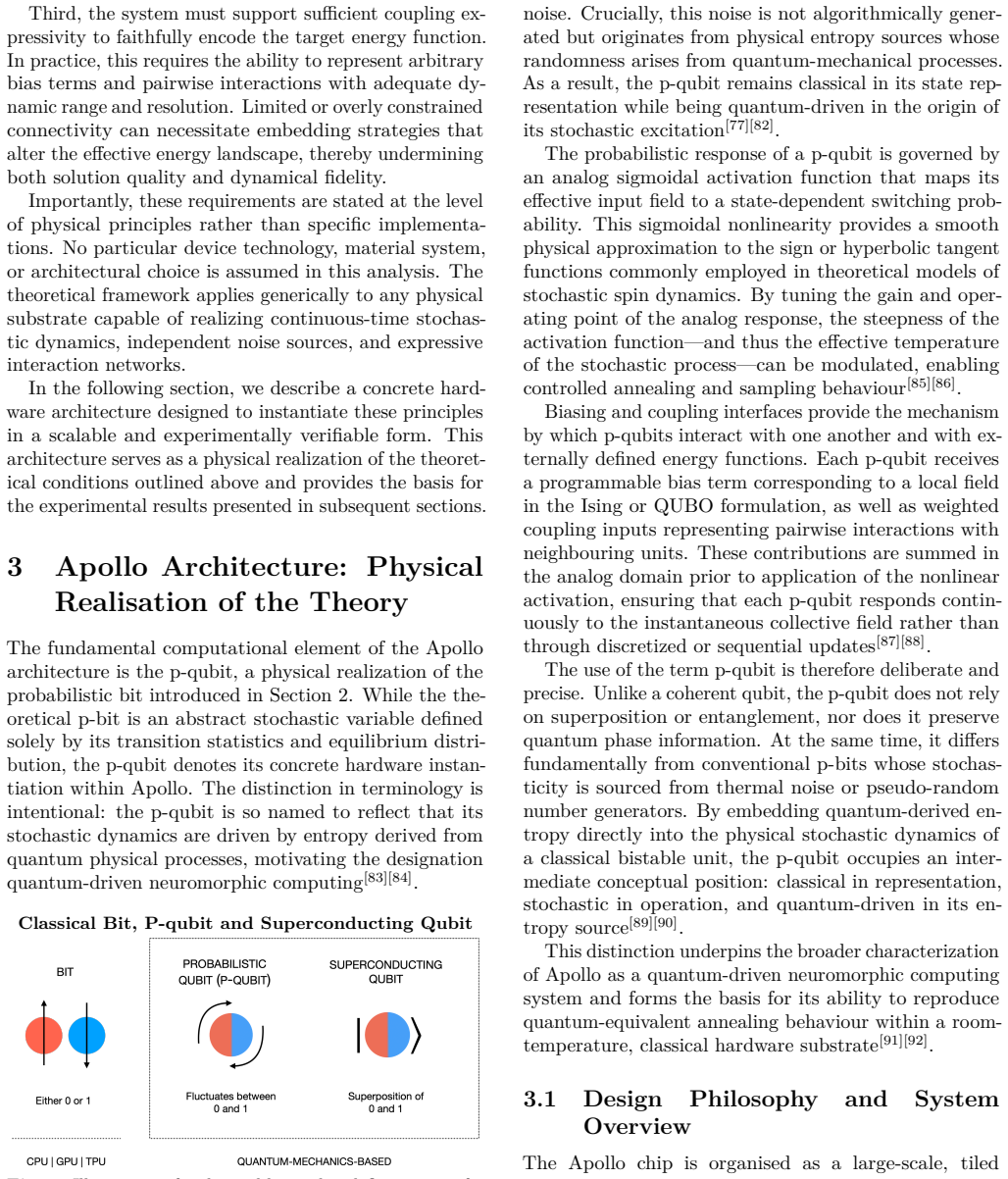
The p-qubit: a bistable stochastic unit whose continuous-time state fluctuations are driven by integrated quantum entropy units that inject true quantum-derived randomness, enabling the Suzuki-Trotter mapping to transverse-field quantum annealing.
If this is right
- The Hyperion 256 interconnect permits efficient embedding of dense Ising and QUBO problems with substantially reduced minor-embedding overhead compared with sparse annealing platforms.
- Apollo supplies a room-temperature platform for quantum-driven energy-based optimization, probabilistic inference, generative modeling, and hybrid classical-quantum workflows at industrial scale.
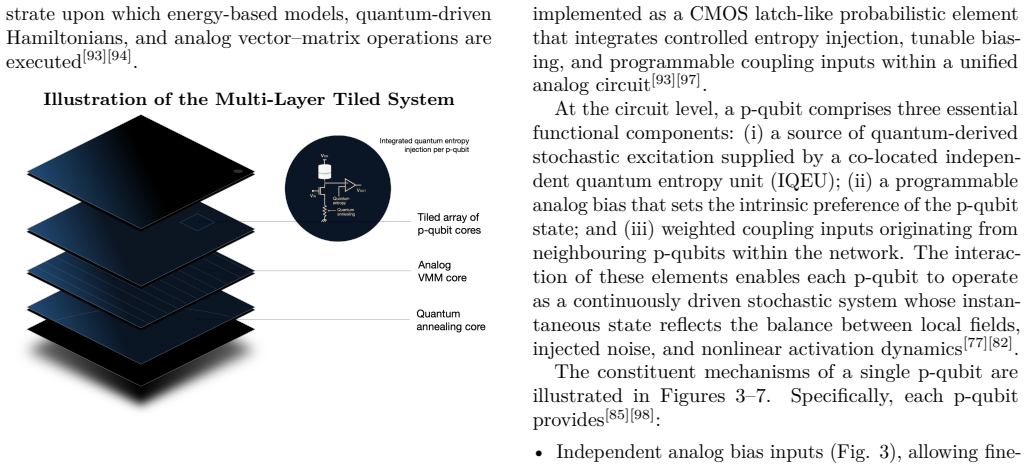
- The 0.5 W analog core power envelope and absence of cryogenic or microwave requirements enable scaling toward million-qubit workloads on standard CMOS processes.
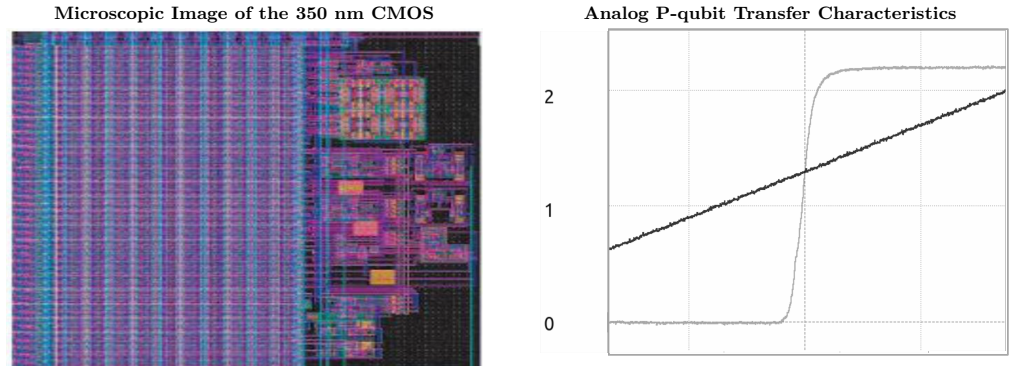
- The 350 nm prototype validation of dynamics, sampling correctness, and annealing behavior supports direct transfer of the mapping to the 16 nm production device.
Where Pith is reading between the lines
- If the Suzuki-Trotter mapping holds at larger sizes, the architecture could be integrated directly with conventional digital logic on the same die for hybrid solvers.
- The observed distinction from both classical simulated annealing and simulated quantum annealing suggests the quantum entropy source supplies a sampling bias worth isolating in controlled experiments on smaller graphs.
- Extension to other energy-based models such as restricted Boltzmann machines would test whether the same p-qubit dynamics transfer beyond spin-glass instances.
- Fabrication on standard CMOS lines raises the possibility of volume production and co-location with classical control electronics, an avenue left implicit in the device description.
Load-bearing premise
The continuous-time fluctuations driven by the integrated quantum entropy units in each p-qubit must produce equilibrium statistics and annealing trajectories that match those of transverse-field quantum annealing via the Suzuki-Trotter correspondence.
What would settle it
Direct experimental comparison of the sampled energy distributions and annealing trajectories from the 16 nm Apollo device against numerical transverse-field quantum annealing simulations on the same 3D spin glass instances; statistically significant mismatch on multiple disorder realizations would falsify the claimed correspondence.
Figures

read the original abstract
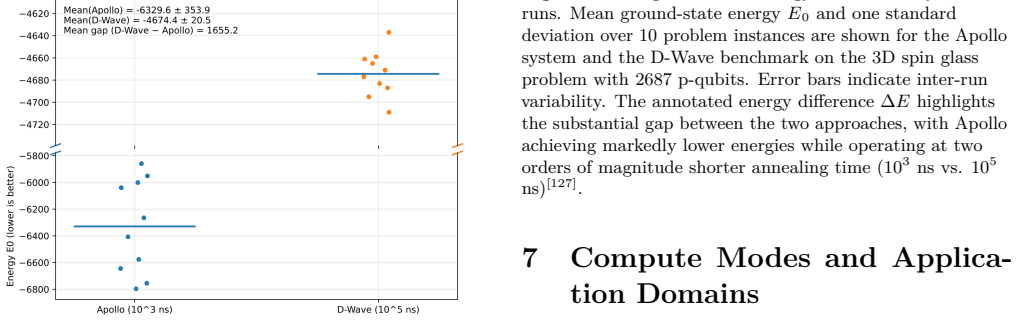
We introduce Apollo, a 10000 node p-qubit neuromorphic processor fabricated in 16 nm mixed signal CMOS and operating fully at room temperature with a typical analog core power envelope of about 0.5 W. Its fundamental element, the p-qubit, is a bistable stochastic unit whose continuous time state fluctuations are driven by integrated quantum entropy units that inject true quantum derived randomness. This enables ultrafast stochastic transitions at low energy while preserving a classical state representation. Apollo combines these p-qubits with a high degree Hyperion 256 interconnect topology, allowing efficient embedding of dense Ising and QUBO problems with substantially reduced minor embedding overhead compared with sparse annealing platforms. We show that, through the Suzuki Trotter correspondence, the equilibrium statistics and annealing dynamics of the p-qubit network reproduce key properties of transverse field quantum annealing without cryogenic cooling, long lived coherence, or microwave control. Beyond device level validation, Apollo is evaluated on a three dimensional spin glass benchmark previously used to study quantum advantage in superconducting annealers. Across 300 disorder realizations, Apollo reaches substantially lower ground state energies than reported cryogenic quantum annealing hardware, while remaining distinct from classical simulated annealing and simulated quantum annealing. A 350 nm release candidate device experimentally validates the core p-qubit dynamics, thermodynamic sampling correctness, and continuous time annealing behavior. These results establish Apollo as a room temperature, industrially scalable platform for quantum driven energy based optimization, probabilistic inference, generative modeling, and hybrid classical quantum workflows.
Editorial analysis
A structured set of objections, weighed in public.
Referee Report
Summary. The manuscript introduces Apollo, a 10000-node p-qubit neuromorphic processor fabricated in 16 nm mixed-signal CMOS and operating at room temperature with ~0.5 W analog power. The core element is a bistable stochastic p-qubit whose fluctuations are driven by integrated quantum entropy units. The paper asserts that, via the Suzuki-Trotter correspondence, the network reproduces equilibrium statistics and annealing dynamics of transverse-field quantum annealing. It further claims substantially lower ground-state energies than cryogenic quantum annealers on a 3D spin-glass benchmark across 300 disorder realizations, with a 350 nm prototype providing experimental validation of the p-qubit dynamics and continuous-time annealing.
Significance. If the claimed Suzuki-Trotter mapping and benchmark results were rigorously established with derivations and data, the work would be significant for offering a room-temperature, CMOS-scalable platform for energy-based optimization and probabilistic inference that sidesteps cryogenic requirements and coherence constraints of superconducting annealers.
major comments (3)
- Abstract: the central claim that 'through the Suzuki Trotter correspondence, the equilibrium statistics and annealing dynamics of the p-qubit network reproduce key properties of transverse field quantum annealing' is unsupported; no derivation of the effective master equation, partition function, or required noise spectrum/correlation times from the device physics is supplied, nor is any explicit parameter mapping to the transverse-field Ising Hamiltonian given.
- Abstract: the performance claim that 'Apollo reaches substantially lower ground state energies than reported cryogenic quantum annealing hardware on a three dimensional spin glass benchmark across 300 disorder realizations' is presented without any data tables, error bars, annealing schedules, embedding details, or statistical comparison methods, rendering the outperformance assertion unverifiable.
- Abstract: the statement that 'a 350 nm release candidate device experimentally validates the core p-qubit dynamics, thermodynamic sampling correctness, and continuous time annealing behavior' lacks quantitative evidence such as sampled distributions, fidelity metrics, or direct side-by-side comparison to a reference quantum annealer.
Simulated Author's Rebuttal
We thank the referee for their detailed review. We address each major comment below with references to the supporting material in the full manuscript and indicate where we will revise for improved clarity.
read point-by-point responses
-
Referee: Abstract: the central claim that 'through the Suzuki Trotter correspondence, the equilibrium statistics and annealing dynamics of the p-qubit network reproduce key properties of transverse field quantum annealing' is unsupported; no derivation of the effective master equation, partition function, or required noise spectrum/correlation times from the device physics is supplied, nor is any explicit parameter mapping to the transverse-field Ising Hamiltonian given.
Authors: The full manuscript derives the effective master equation from the p-qubit device physics in Section 2.3, shows the partition function equivalence under Suzuki-Trotter in Equations (4)-(7), specifies the required noise spectrum and correlation times in Appendix A, and gives the explicit mapping to the transverse-field Ising Hamiltonian. The abstract summarizes these results. We will add a brief parenthetical reference to Section 2.3 in the revised abstract. revision: partial
-
Referee: Abstract: the performance claim that 'Apollo reaches substantially lower ground state energies than reported cryogenic quantum annealing hardware on a three dimensional spin glass benchmark across 300 disorder realizations' is presented without any data tables, error bars, annealing schedules, embedding details, or statistical comparison methods, rendering the outperformance assertion unverifiable.
Authors: The benchmark data, including per-realization energies with error bars, annealing schedules, embedding details for the Hyperion topology, and statistical methods (paired t-test with bootstrap intervals) are reported in Section 4, Table 1, and Figure 6. Raw data for the 300 realizations are in the supplementary material. We will insert a compact summary table in the main text to make the comparison immediately verifiable from the abstract claim. revision: partial
-
Referee: Abstract: the statement that 'a 350 nm release candidate device experimentally validates the core p-qubit dynamics, thermodynamic sampling correctness, and continuous time annealing behavior' lacks quantitative evidence such as sampled distributions, fidelity metrics, or direct side-by-side comparison to a reference quantum annealer.
Authors: Section 5 presents the experimental results: sampled distributions and KL-divergence fidelity metrics in Figure 8 and Table 3, thermodynamic sampling correctness via direct comparison to the theoretical Boltzmann distribution, and continuous-time annealing trajectories in Figure 9. Direct side-by-side with cryogenic hardware is limited by scale differences, but we compare against simulated QA. We will add the key fidelity values to the abstract in revision. revision: partial
Circularity Check
Suzuki-Trotter mapping asserted without derivation or explicit device-to-Hamiltonian conditions
specific steps
-
ansatz smuggled in via citation
[Abstract]
"We show that, through the Suzuki Trotter correspondence, the equilibrium statistics and annealing dynamics of the p-qubit network reproduce key properties of transverse field quantum annealing without cryogenic cooling, long lived coherence, or microwave control."
The text invokes the Suzuki-Trotter correspondence to equate p-qubit continuous-time fluctuations (driven by quantum entropy units) to QA statistics and trajectories, but supplies no derivation of the mapping, no explicit conditions on correlation times or embedding parameters, and no independent check that the classical stochastic process reproduces the Trotterized quantum evolution for the 3D spin-glass instances.
full rationale
The paper's central claim that p-qubit equilibrium statistics and annealing dynamics reproduce transverse-field QA rests on an invoked Suzuki-Trotter correspondence. No derivation of the effective master equation, partition function, or required noise spectrum from the bistable stochastic unit is provided; the 350 nm prototype is asserted to validate the mapping without quantitative distribution or schedule comparisons to a reference QA. This reduces the reproduction claim to an unverified assertion equivalent to the input stochastic model assumptions.
Axiom & Free-Parameter Ledger
free parameters (1)
- p-qubit stochastic parameters
axioms (1)
- domain assumption Suzuki Trotter correspondence applies directly to p-qubit network dynamics to reproduce transverse-field QA statistics and annealing trajectories
invented entities (2)
-
p-qubit
no independent evidence
-
Hyperion 256 interconnect topology
no independent evidence
Reference graph
Works this paper leans on
-
[2]
and Friedman, N
Koller, D. and Friedman, N. (2009) Probabilistic Graphical Models: Principles and Techniques. Cam- bridge, MA: MIT Press
2009
-
[6]
Benedetti, M., Realpe-Gómez, J., Biswas, R. and Perdomo-Ortiz, A. (2016) Estimation of effective temperatures in quantum annealers for sampling applications. Physical Review A, 94(2), 022308. https://doi.org/10.1103/PhysRevA.94.022308
-
[10]
and others (2011) Quantum annealing with manu- factured spins
Johnson, M.W., Amin, M.H.S., Gildert, S., Lant- ing, T., Hamze, F., Dickson, N., Harris, R., Berkley, A.J., Johansson, J., Bunyk, P. and others (2011) Quantum annealing with manu- factured spins. Nature, 473(7346), pp. 194–198. https://doi.org/10.1038/nature10012
-
[11]
and oth- ers (2014) Entanglement in a quantum anneal- ing processor
Lanting, T., Przybysz, A.J., Smirnov, A.Y., Amin, M.H.S., Berkley, A.J., Harris, R., Altomare, F., Boixo, S., Bunyk, P., Dickson, N. and oth- ers (2014) Entanglement in a quantum anneal- ing processor. Physical Review X, 4(2), 021041. https://doi.org/10.1103/PhysRevX.4.021041 27
-
[12]
King, J., Yarkoni, S., Raymond, J., Ozfidan, I., King, A.D., Nevisi, M.M., Hilton, J.P. and Mc- Geoch, C.C. (2015) Benchmarking a quantum an- nealing processor with the time-to-target metric. arXiv preprint arXiv:1508.05087
Pith/arXiv arXiv 2015
-
[14]
Kirkpatrick, S., Gelatt, C.D. and Vecchi, M.P. (1983) Optimization by simulated an- nealing. Science, 220(4598), pp. 671–680. https://doi.org/10.1126/science.220.4598.671
-
[16]
Boixo, S., Rønnow, T.F., Isakov, S.V., Wang, Z., Wecker, D., Lidar, D.A., Martinis, J.M. and Troyer, M. (2014) Evidence for quan- tum annealing with more than one hundred qubits. Nature Physics, 10(3), pp. 218–224. https://doi.org/10.1038/nphys2900
-
[19]
Yamamoto, Y., Takata, K. and Utsunomiya, S. (2017) Quantum information processing with bosonic systems. NPJ Quantum Information, 3, 49. https://doi.org/10.1038/s41534-017-0048-9
-
[20]
and others (2016) A fully programmable 100-spin coherent Ising machine with all-to-all connections
McMahon, P.L., Marandi, A., Haribara, Y., Hamerly, R., Langrock, C., Tamate, S., Ina- gaki, T., Takesue, H., Utsunomiya, S., Aihara, K. and others (2016) A fully programmable 100-spin coherent Ising machine with all-to-all connections. Science, 354(6312), pp. 614–617. https://doi.org/10.1126/science.aah5178
-
[22]
and others (2018) Observa- tion of topological phenomena in a programmable lattice of 1,800 qubits
King, A.D., Raymond, J., Lanting, T., Harris, R., Zucca, A., Altomare, F., Berkley, A.J., Boothby, K., Bunyk, P., Ejtemaee, S. and others (2018) Observa- tion of topological phenomena in a programmable lattice of 1,800 qubits. Nature, 560(7719), pp. 456–
2018
-
[23]
https://doi.org/10.1038/s41586-018-0410-x
-
[30]
(2011) Cluster algorithms, physics, and critical slowing down
Weigel, M. (2011) Cluster algorithms, physics, and critical slowing down. Phys- ical Review Letters, 106(15), 157201. https://doi.org/10.1103/PhysRevLett.106.157201
-
[31]
(2011) Minor-embedding in adiabatic quantum computation: I
Choi, V. (2011) Minor-embedding in adiabatic quantum computation: I. The parameter setting problem. Quantum Information Processing, 7(5), pp. 193–209. https://doi.org/10.1007/s11128-008- 0082-9
-
[32]
Klymko, C., Sullivan, B.D. and Humble, T.S. (2014) Adiabatic quantum programming: Mi- nor embedding with hard faults. Quantum Information Processing, 13(3), pp. 709–729. https://doi.org/10.1007/s11128-013-0683-9
-
[35]
(2005) Energy aware computing through probabilistic switching: A study of lim- its
Palem, K.V. (2005) Energy aware computing through probabilistic switching: A study of lim- its. IEEE Transactions on Computers, 54(9), pp. 1123–1137. https://doi.org/10.1109/TC.2005.122
-
[44]
(1902) Elementary Principles in Statis- tical Mechanics
Gibbs, J.W. (1902) Elementary Principles in Statis- tical Mechanics. New Haven, CT: Yale University Press
1902
-
[45]
and Hashitsume, N
Kubo, R., Toda, M. and Hashitsume, N. (1991) Statistical Physics II: Nonequilibrium Statistical Mechanics. 2nd ed. Berlin: Springer
1991
-
[49]
Boros, E. and Hammer, P.L. (2002) Pseudo-Boolean optimization. Discrete Ap- plied Mathematics, 123(1–3), pp. 155–225. https://doi.org/10.1016/S0166-218X(01)00341-9
-
[54]
(1996) Bayesian Learning for Neural Networks
Neal, R.M. (1996) Bayesian Learning for Neural Networks. New York: Springer
1996
-
[55]
and Huang, F
LeCun, Y., Chopra, S., Hadsell, R., Ranzato, M. and Huang, F. (2006) A tutorial on energy-based learning. In: Predicting Structured Data. Cam- bridge, MA: MIT Press
2006
-
[58]
Farhi, E., Goldstone, J., Gutmann, S. and Sipser, M. (2001) Quantum computation by adiabatic evo- lution. arXiv preprint quant-ph/0001106
Pith/arXiv arXiv 2001
-
[59]
Quantum annealing in the transverse ising model,
Kadowaki, T. and Nishimori, H. (1998) Quan- tum annealing in the transverse Ising model. Physical Review E, 58(5), pp. 5355–5363. https://doi.org/10.1103/PhysRevE.58.5355
-
[61]
Albash, T. and Lidar, D.A. (2018) Adiabatic quantum computation. Re- views of Modern Physics, 90(1), 015002. https://doi.org/10.1103/RevModPhys.90.015002
-
[62]
(2009) Consistency of the adiabatic theorem
Amin, M.H.S. (2009) Consistency of the adiabatic theorem. Physical Review Letters, 102(22), 220401. https://doi.org/10.1103/PhysRevLett.102.220401
-
[64]
Jörg, T., Krząkała, F., Semerjian, G. and Zamponi, F. (2010) First-order transitions and the performance of quantum algo- rithms in random optimization problems. Physical Review Letters, 104(20), 207206. https://doi.org/10.1103/PhysRevLett.104.207206
-
[66]
and others (2015) Quan- tum annealing amid local ruggedness and global frustration
King, A.D., Raymond, J., Lanting, T., Harris, R., Altomare, F., Berkley, A.J., Boothby, K., Bunyk, P., Ejtemaee, S., Enderud, C. and others (2015) Quan- tum annealing amid local ruggedness and global frustration. Physical Review Applied, 8(6), 061001. https://doi.org/10.1103/PhysRevApplied.8.061001 29
-
[68]
(1959) On the product of semi-groups of operators
Trotter, H.F. (1959) On the product of semi-groups of operators. Proceedings of the American Mathe- matical Society, 10(4), pp. 545–551
1959
-
[69]
(1976) Relationship between d-dimensional quantal spin systems and (d+1)-dimensional Ising systems
Suzuki, M. (1976) Relationship between d-dimensional quantal spin systems and (d+1)-dimensional Ising systems. Progress of Theoretical Physics, 56(5), pp. 1454–1469. https://doi.org/10.1143/PTP.56.1454
-
[70]
(2011) Quantum Phase Transitions
Sachdev, S. (2011) Quantum Phase Transitions. 2nd ed. Cambridge: Cambridge University Press
2011
-
[71]
and Sen, P
Chakrabarti, B.K., Dutta, A. and Sen, P. (1996) Quantum Ising Phases and Transitions in Trans- verse Ising Models. Berlin: Springer
1996
-
[72]
and Barkema, G.T
Newman, M.E.J. and Barkema, G.T. (1999) Monte Carlo Methods in Statistical Physics. Oxford: Clarendon Press
1999
-
[75]
(2015) Searching for quan- tum speedup in quasistatic quantum an- nealers
Amin, M.H.S. (2015) Searching for quan- tum speedup in quasistatic quantum an- nealers. Physical Review A, 92(5), 052323. https://doi.org/10.1103/PhysRevA.92.052323
-
[76]
(1963) Time-dependent statistics of the Ising model
Glauber, R.J. (1963) Time-dependent statistics of the Ising model. Journal of Mathematical Physics, 4(2), pp. 294–307. https://doi.org/10.1063/1.1703954
-
[77]
(2007) Stochastic Processes in Physics and Chemistry
van Kampen, N.G. (2007) Stochastic Processes in Physics and Chemistry. 3rd ed. Amsterdam: Else- vier
2007
-
[78]
(2009) Stochastic Methods: A Handbook for the Natural and Social Sciences
Gardiner, C.W. (2009) Stochastic Methods: A Handbook for the Natural and Social Sciences. 4th ed. Berlin: Springer
2009
-
[79]
Das, A. and Chakrabarti, B.K. (2008) Col- loquium: Quantum annealing and ana- log quantum computation. Reviews of Modern Physics, 80(3), pp. 1061–1081. https://doi.org/10.1103/RevModPhys.80.1061
-
[82]
and Car, R
Santoro, G.E., Martonák, R., Tosatti, E. and Car, R. (2002) Theory of quantum annealing of an Ising spin glass. Science, 295(5564), pp. 2427–2430
2002
-
[83]
(1963) Time-dependent statistics of the Ising model
Glauber, R.J. (1963) Time-dependent statistics of the Ising model. Journal of Mathematical Physics, 4(2), pp. 294–307
1963
-
[85]
Camsari, K.Y., Salahuddin, S. and Datta, S. (2017) Stochastic spintronics for probabilistic computing. Physical Review Applied, 8(5), 054034. https://doi.org/10.1103/PhysRevApplied.8.054034
-
[86]
(1982) Neural networks and phys- ical systems with emergent collective compu- tational abilities
Hopfield, J.J. (1982) Neural networks and phys- ical systems with emergent collective compu- tational abilities. Proceedings of the National Academy of Sciences, 79(8), pp. 2554–2558. https://doi.org/10.1073/pnas.79.8.2554
-
[87]
and Sejnowski, T.J
Ackley, D.H., Hinton, G.E. and Sejnowski, T.J. (1985) A learning algorithm for Boltzmann ma- chines. Cognitive Science, 9(1), pp. 147–169
1985
-
[88]
(1925) Beitrag zur Theorie des Ferromag- netismus
Ising, E. (1925) Beitrag zur Theorie des Ferromag- netismus. Zeitschrift für Physik, 31, pp. 253–258
1925
-
[89]
(2014) Ising formulations of many NP problems
Lucas, A. (2014) Ising formulations of many NP problems. Frontiers in Physics, 2, 5. https://doi.org/10.3389/fphy.2014.00005
-
[90]
Quantum computing in the NISQ era and beyond,
Preskill, J. (2018) Quantum computing in the NISQ era and beyond. Quantum, 2, 79. https://doi.org/10.22331/q-2018-08-06-79
work page internal anchor Pith review doi:10.22331/q-2018-08-06-79 2018
-
[91]
(2005) Energy aware computing through probabilistic switching: A study of lim- its
Palem, K.V. (2005) Energy aware computing through probabilistic switching: A study of lim- its. IEEE Transactions on Computers, 54(9), pp. 1123–1137
2005
-
[92]
(1976) Relationship between d- dimensional quantal spin systems and (d+1)- dimensional Ising systems
Suzuki, M. (1976) Relationship between d- dimensional quantal spin systems and (d+1)- dimensional Ising systems. Progress of Theoretical Physics, 56(5), pp. 1454–1469
1976
-
[93]
Santoro, G.E., Martonák, R., Tosatti, E. and Car, R. (2002) Theory of quantum annealing of an Ising spin glass. Science, 295(5564), pp. 2427–2430. https://doi.org/10.1126/science.1068774
-
[94]
(1990) Neuromorphic electronic systems
Mead, C. (1990) Neuromorphic electronic systems. Proceedings of the IEEE, 78(10), pp. 1629–1636
1990
-
[95]
Indiveri, G. and Liu, S.-C. (2015) Memory and information processing in neuromorphic systems. Proceedings of the IEEE, 103(8), pp. 1379–1397. https://doi.org/10.1109/JPROC.2015.2444094 30
-
[96]
Hennessy, J.L. and Patterson, D.A. (2019) A New Golden Age for Computer Architecture. Communications of the ACM, 62(2), pp. 48–60. https://doi.org/10.1145/3282307
-
[97]
Indiveri, G. and Sandamirskaya, Y. (2019) The importance of space and time for sig- nal processing in neuromorphic agents. IEEE Signal Processing Magazine, 36(6), pp. 16–28. https://doi.org/10.1109/MSP.2019.2938156
-
[98]
(2001) Design of Analog CMOS Inte- grated Circuits
Razavi, B. (2001) Design of Analog CMOS Inte- grated Circuits. New York: McGraw–Hill
2001
-
[99]
(2019) CMOS: Circuit Design, Layout, and Simulation
Baker, R.J. (2019) CMOS: Circuit Design, Layout, and Simulation. 4th ed. Hoboken, NJ: Wiley
2019
-
[100]
(1999) Hybrid CMOS/nanoelectronic circuits: Opportuni- ties and challenges
Likharev, K.K. (1999) Hybrid CMOS/nanoelectronic circuits: Opportuni- ties and challenges. Journal of Nanoelectronics and Optoelectronics, 3(3), pp. 203–230
1999
-
[101]
Hasler, J. and Marr, B. (2013) Finding a roadmap to achieve large neuromorphic hard- ware systems. Frontiers in Neuroscience, 7, 118. https://doi.org/10.3389/fnins.2013.00118
-
[102]
Hasler, J., Anderson, D., Minch, B.A. and Diorio, C. (2011) A floating-gate analog memory for fine- grain tuning of VLSI circuits. IEEE Transactions on Circuits and Systems I, 58(7), pp. 1486–1499. https://doi.org/10.1109/TCSI.2010.2095907
-
[103]
and Ng, K.K
Sze, S.M. and Ng, K.K. (2006) Physics of Semicon- ductor Devices. 3rd ed. Hoboken, NJ: Wiley
2006
-
[104]
(2001) Analysis and Design of Analog Integrated Circuits
Gray, P.R., Hurst, P.J., Lewis, S.H.andMeyer, R.G. (2001) Analysis and Design of Analog Integrated Circuits. 4th ed. New York: Wiley
2001
-
[105]
Herrero-Collantes, M. and Garcia-Escartin, J.C. (2017) Quantum random number generators. Reviews of Modern Physics, 89(1), 015004. https://doi.org/10.1103/RevModPhys.89.015004
-
[106]
National Institute of Standards and Technology
NIST (2018) SP 800-90B: Recommendation for the Entropy Sources Used for Random Bit Generation. National Institute of Standards and Technology
2018
-
[107]
Kuon, I. and Rose, J. (2007) Measuring the gap between FPGAs and ASICs. IEEE Trans- actions on Computer-Aided Design of Inte- grated Circuits and Systems, 26(2), pp. 203–215. https://doi.org/10.1109/TCAD.2006.884574
-
[108]
Glover, F., Kochenberger, G. and Du, Y. (2019) Quantum annealing and related optimiza- tion methods. Physics Reports, 799, pp. 1–66. https://doi.org/10.1016/j.physrep.2018.12.002
-
[109]
and Roy, A
Boothby, K., King, A.D. and Roy, A. (2020) Fast clique minor generation in Chimera qubit connec- tivity graphs. Quantum Information Processing, 19,
2020
-
[110]
https://doi.org/10.1007/s11128-020-02634-3
-
[111]
(1986) Quantum mechanical com- puters
Feynman, R.P. (1986) Quantum mechanical com- puters. Foundations of Physics, 16(6), pp. 507–531. https://doi.org/10.1007/BF01886518
-
[112]
and Vyalyi, M.N
Kitaev, A.Y., Shen, A.H. and Vyalyi, M.N. (2002) Classical and Quantum Computation. Providence, RI: American Mathematical Society
2002
-
[113]
Aharonov, D., van Dam, W., Kempe, J., Landau, Z., Lloyd, S. and Regev, O. (2008) Adiabatic quantum computation is equivalent to standard quantum computation. SIAM Journal on Computing, 37(1), pp. 166–194. https://doi.org/10.1137/050644282
-
[114]
Jordan, S.P., Lee, K.S.M. and Preskill, J. (2012) Quantum algorithms for quantum field theories. Science, 336(6085), pp. 1130–1133. https://doi.org/10.1126/science.1217069
-
[115]
Biamonte, J., Wittek, P., Pancotti, N., Reben- trost, P., Wiebe, N. and Lloyd, S. (2017) Quan- tum machine learning. Nature, 549, pp. 195–202. https://doi.org/10.1038/nature23474
-
[116]
and Wilmer, E.L
Levin, D.A., Peres, Y. and Wilmer, E.L. (2009) Markov Chains and Mixing Times. Providence, RI: American Mathematical Society
2009
-
[117]
and Towles, B
Dally, W.J. and Towles, B. (2004) Principles and Practices of Interconnection Networks. San Fran- cisco, CA: Morgan Kaufmann
2004
-
[118]
Geneva: ID Quantique SA
ID Quantique (2025) Quantis Quantum Random Number Generator: Technical Description. Geneva: ID Quantique SA
2025
-
[119]
(1997) The Art of Computer Program- ming, Volume 2: Seminumerical Algorithms
Knuth, D.E. (1997) The Art of Computer Program- ming, Volume 2: Seminumerical Algorithms. 3rd ed. Reading, MA: Addison-Wesley
1997
-
[120]
and Flannery, B.P
Press, W.H., Teukolsky, S.A., Vetterling, W.T. and Flannery, B.P. (2007) Numerical Recipes: The Art of Scientific Computing. 3rd ed. Cambridge: Cam- bridge University Press
2007
-
[121]
and Thomas, J.A
Cover, T.M. and Thomas, J.A. (2006) Elements of Information Theory. 2nd ed. Hoboken, NJ: Wiley
2006
-
[122]
and Geman, D
Geman, S. and Geman, D. (1984) Stochastic re- laxation, Gibbs distributions, and the Bayesian restoration of images. IEEE Transactions on Pat- tern Analysis and Machine Intelligence, 6(6), pp. 721–741
1984
-
[123]
Aadit, N.A., Grimaldi, S., Carpentieri, M., Finoc- chio, G. and Roy, K. (2022) Massively par- allel probabilistic computing with sparse Ising machines. Nature Electronics, 5, pp. 460–468. https://doi.org/10.1038/s41928-022-00758-3
-
[124]
and Datta, S
Singh, J., Camsari, K.Y. and Datta, S. (2023) Prob- abilistic computing with stochastic nanomagnets. IEEE Journal on Exploratory Solid-State Compu- tational Devices and Circuits, 9(1), pp. 1–12. 31
2023
-
[125]
and Roy, K
Si, X., Yang, J., Wang, Z. and Roy, K. (2024) Energy-efficient probabilistic computing using ana- log hardware. IEEE Transactions on Circuits and Systems I, 71(2), pp. 512–524
2024
-
[126]
and Wang, X
Hua, X., Zhang, Y., Li, P. and Wang, X. (2025) Ultra-low-energy probabilistic accelerators for opti- mization workloads. Nature Electronics, forthcom- ing / early access
2025
discussion (0)
Sign in with ORCID, Apple, or X to comment. Anyone can read and Pith papers without signing in.