The effect of in-phase current and temperature oscillations on the impedance of the cathode catalyst layer in a PEM fuel cell
Pith reviewed 2026-06-27 05:36 UTC · model grok-4.3
The pith
In-phase harmonic perturbations to current density and temperature lower CCL impedance and static resistivity in PEM fuel cells.
A machine-rendered reading of the paper's core claim, the machinery that carries it, and where it could break.
Core claim
An impedance model for the cathode catalyst layer demonstrates that in-phase harmonic perturbations to the cell current density and CCL temperature lower both CCL impedance and static resistivity. This mitigation is primarily driven by the oscillating exchange current density of the oxygen reduction reaction.
What carries the argument
Impedance model of the CCL incorporating in-phase current and temperature oscillations that modulate the exchange current density of the oxygen reduction reaction.
Load-bearing premise
Current and temperature perturbations remain perfectly in phase and the exchange current density responds directly and instantaneously to temperature without other limitations.
What would settle it
Measure CCL impedance while applying controlled in-phase sinusoidal current and temperature variations and compare the result to the steady-state case or to out-of-phase variations.
Figures
read the original abstract
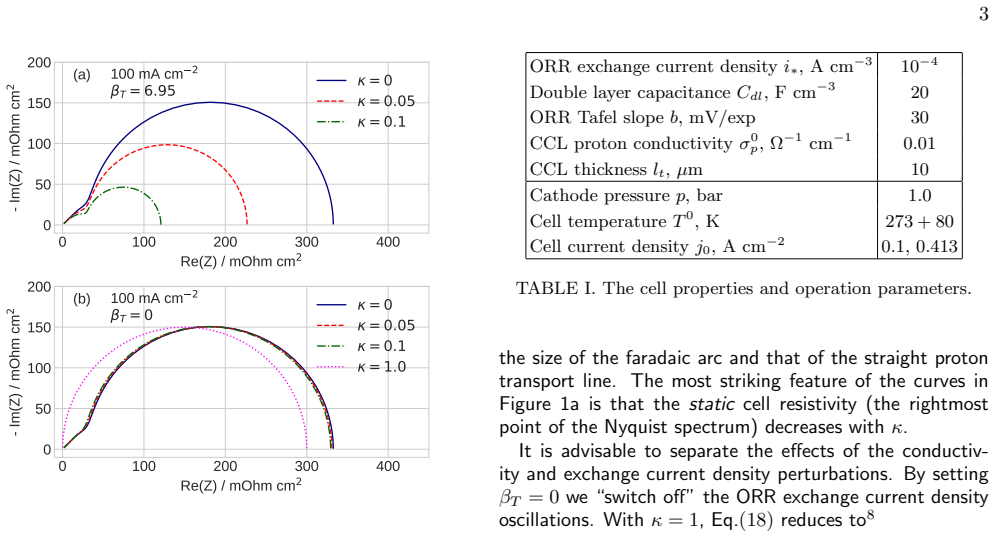
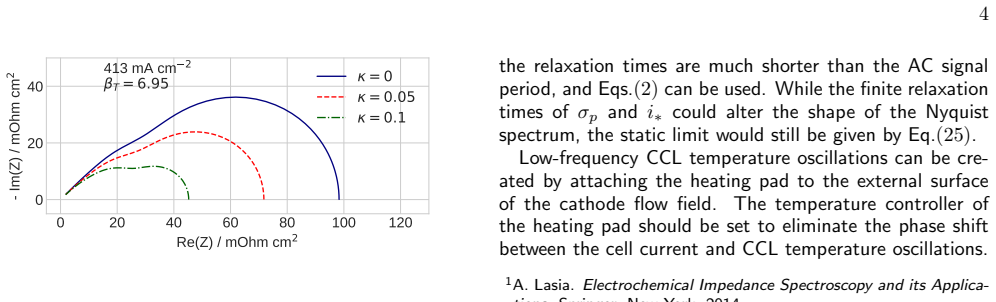
An impedance model for the cathode catalyst layer (CCL) in a PEM fuel cell demonstrates that in-phase harmonic perturbations to the cell current density and CCL temperature lower both CCL impedance and static resistivity. This mitigation is primarily driven by the oscillating exchange current density of the oxygen reduction reaction.
Editorial analysis
A structured set of objections, weighed in public.
Referee Report
Summary. The manuscript presents an impedance model for the cathode catalyst layer (CCL) in a PEM fuel cell. It claims that in-phase harmonic perturbations applied simultaneously to cell current density and CCL temperature reduce both the CCL impedance and static resistivity, with the effect driven primarily by the resulting oscillation in the exchange current density of the oxygen reduction reaction.
Significance. If the modeling result holds under the stated assumptions, it identifies a potential mechanism for dynamic impedance mitigation in fuel cells via coordinated current-temperature oscillations. This could inform operating strategies or control schemes, though its practical impact depends on whether the idealized in-phase condition can be realized without introducing counteracting transport effects.
major comments (2)
- [Model formulation / perturbation equations] The central claim rests on the linearized perturbation equations containing only an instantaneous Arrhenius dependence of i0 on T with no phase lag. The manuscript should explicitly state the governing equations for temperature (including any thermal diffusion term) and confirm that temperature dependence is omitted from oxygen diffusivity, proton conductivity, and double-layer capacitance; otherwise the reported impedance reduction may not survive inclusion of realistic time scales.
- [Impedance calculation / boundary conditions] The result that both impedance and static resistivity decrease requires that current and temperature perturbations remain exactly in phase at all frequencies considered. The paper should derive or cite the condition under which this phase lock is maintained (e.g., negligible thermal inertia or external control), as any finite thermal time constant would introduce a frequency-dependent phase shift that could cancel or reverse the mitigation.
minor comments (2)
- [Notation] Notation for the oscillating quantities (current density, temperature, overpotential) should be defined consistently with standard small-signal impedance notation (e.g., use of hats or deltas) to avoid ambiguity when comparing to experimental EIS data.
- [Results / discussion] The abstract states the mitigation is 'primarily driven' by oscillating i0; the text should quantify the relative contribution of this term versus any secondary effects that are retained in the model.
Simulated Author's Rebuttal
We thank the referee for the constructive comments, which help clarify the model assumptions. We address each major point below and will revise the manuscript accordingly.
read point-by-point responses
-
Referee: [Model formulation / perturbation equations] The central claim rests on the linearized perturbation equations containing only an instantaneous Arrhenius dependence of i0 on T with no phase lag. The manuscript should explicitly state the governing equations for temperature (including any thermal diffusion term) and confirm that temperature dependence is omitted from oxygen diffusivity, proton conductivity, and double-layer capacitance; otherwise the reported impedance reduction may not survive inclusion of realistic time scales.
Authors: We agree that the temperature equation and parameter assumptions require explicit statement. The model employs a lumped thermal balance for the thin CCL (no spatial diffusion term) with temperature treated as spatially uniform. In the revision we will add the governing temperature equation and explicitly confirm that only the ORR exchange current density follows the instantaneous Arrhenius dependence on T; oxygen diffusivity, proton conductivity, and double-layer capacitance are held constant. This isolates the mechanism under study while acknowledging the limitation. revision: yes
-
Referee: [Impedance calculation / boundary conditions] The result that both impedance and static resistivity decrease requires that current and temperature perturbations remain exactly in phase at all frequencies considered. The paper should derive or cite the condition under which this phase lock is maintained (e.g., negligible thermal inertia or external control), as any finite thermal time constant would introduce a frequency-dependent phase shift that could cancel or reverse the mitigation.
Authors: The in-phase condition is an explicit modeling assumption corresponding to either negligible thermal inertia or external temperature control. In the revision we will derive the phase-shift condition by linearizing the thermal balance, showing that the phase lag scales as ω au_thermal, and identify the frequency range where the lag remains negligible. This will be added as a dedicated paragraph on validity of the in-phase assumption. revision: yes
Circularity Check
No circularity: model result follows from linearized perturbation equations without reduction to fitted inputs or self-citations
full rationale
The abstract presents a standard impedance modeling result in which in-phase current and temperature oscillations affect CCL impedance via the temperature dependence of the ORR exchange current density. No equations, parameter fits, or self-citations are supplied that would make the claimed mitigation equivalent to the model inputs by construction. The derivation chain is therefore self-contained as an independent consequence of the stated assumptions rather than a renaming or tautological restatement of those assumptions.
Axiom & Free-Parameter Ledger
Reference graph
Works this paper leans on
-
[1]
The temperature oscillations induce the oscillations in the CCL proton conductivityσ p and the exchange current densityi ∗ of the oxygen reduction reaction (ORR). The oscillatingσ p lowers the proton transport losses, while the oscillatingi ∗ reduces the faradaic impedance. The dominating contribu- tion to the impedance reduction gives the oscillatingi ∗....
Pith/arXiv arXiv 2026
-
[2]
doi: 10.1016/j.jpowsour.2020.228361. 3J. Huang, Y. Gao, J. Luo, S. Wang, C. Li, S. Chen, and J. Zhang. Editors’ choice–review–impedance response of porous electrodes: Theoretical framework, physical models and applications.J. Elec- trochem. Soc., 167:166503,
-
[3]
doi:10.1149/1945-7111/abc655. 4Y. H. Kim, H. S. Han, S. Y. Kim, and G. H. Rhee. Influ- ence of cathode flow pulsation on performance of proton–exchange membrane fuel cell.J. Power Sources, 185:112–117,
-
[4]
doi: 10.1016/j.jpowsour.2008.06.069. 5Y.-S. Hwang, D.-Y. Lee, J. W. Choi, S.-Y. Kim, S. H. Cho, P. Joonho, M. S. Kim, J. H. Jang, S. H. Kim, and S.-W. Cha. Enhanced diffusion in polymer electrolyte membrane fuel cells us- ing oscillating flow.Int. J. Hydrogen Energy, 35:3676–3683,
-
[5]
doi:10.1016/j.ijhydene.2010.01.064. 6A. Kulikovsky. Performance of a PEM fuel cell cathode catalyst layer under oscillating potential and oxygen supply.Electrochem. Comm., 159:107655,
-
[6]
doi:10.1016/j.elecom.2023.107655. 7Andrei Kulikovsky. Reduction of PEM fuel cell impedance and re- sistivity under simultaneously applied oscillations of potential and oxygen supply.J. Phys. Chem. C, 128:7447–7454,
-
[7]
doi: 10.1021/acs.jpcc.4c01010. 8Andrei Kulikovsky. In-phase current and temperature oscillations reduce PEM fuel cell resistivity: A modeling study.Electrochem. Comm., 188:108169,
-
[8]
doi:10.1016/j.elecom.2026.108169. 9T. E. Springer, T. A. Zawodzinski, and S. Gottesfeld. Polymer elec- trolyte fuel cell model.J. Electrochem. Soc., 138(8):2334–42,
-
[9]
doi:10.1149/1.2085971. 10A. Parthasarathy, S. Srinivasan, and A. J. Appleby. Temperature dependence of the electrode kinetics of oxygen reduction reaction at the platinum/nafion interface - a microelectrode investigation.J. Electrochem. Soc., 139:2530–2537,
-
[10]
doi:10.1149/1.2221258. 11A. A. Kulikovsky and M. Eikerling. Analytical solutions for impedance of the cathode catalyst layer in PEM fuel cell: Layer pa- rameters from impedance spectrum without fitting.J. Electroanal. Chem., 691:13–17,
-
[11]
doi:10.1016/j.jelechem.2012.12.002
discussion (0)
Sign in with ORCID, Apple, or X to comment. Anyone can read and Pith papers without signing in.