Chemical signatures from the first stars embedded in metal-poor gas in galaxies at cosmic dawn
Pith reviewed 2026-06-27 06:45 UTC · model grok-4.3
The pith
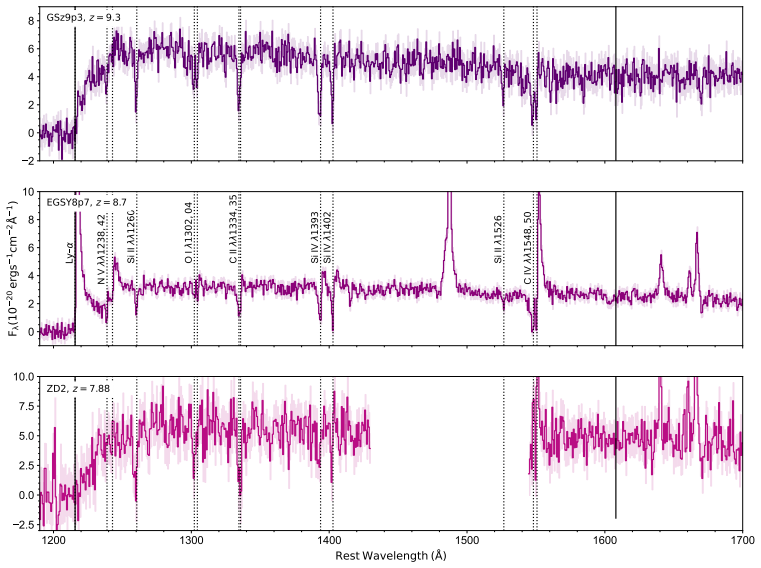
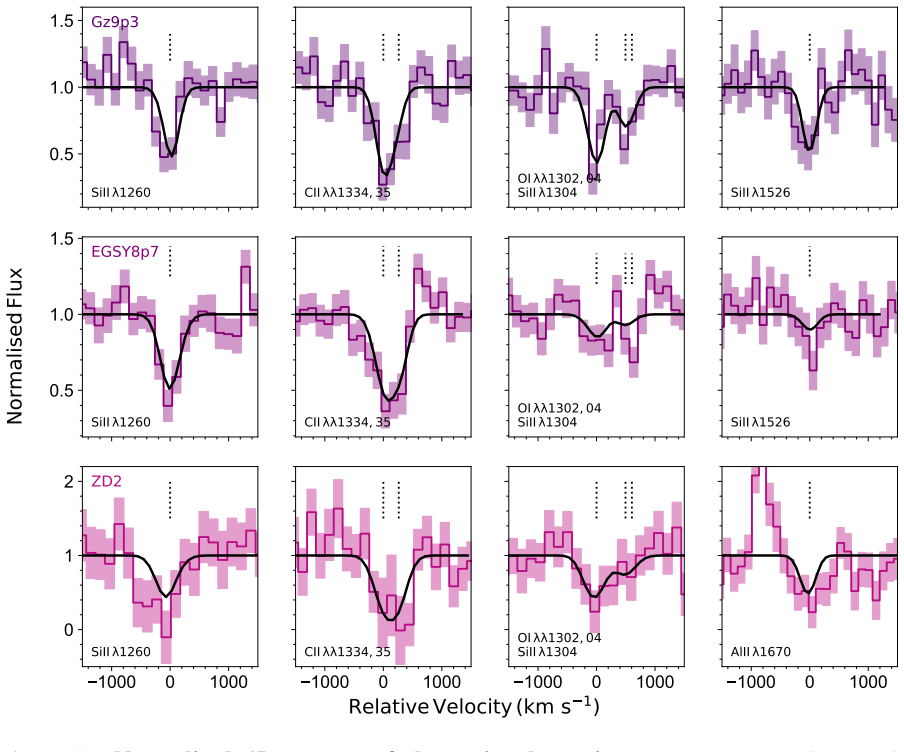
Absorption lines in three galaxies at redshifts 7.8-9.3 reveal metal-poor gas enriched by the first stars.
A machine-rendered reading of the paper's core claim, the machinery that carries it, and where it could break.
Core claim
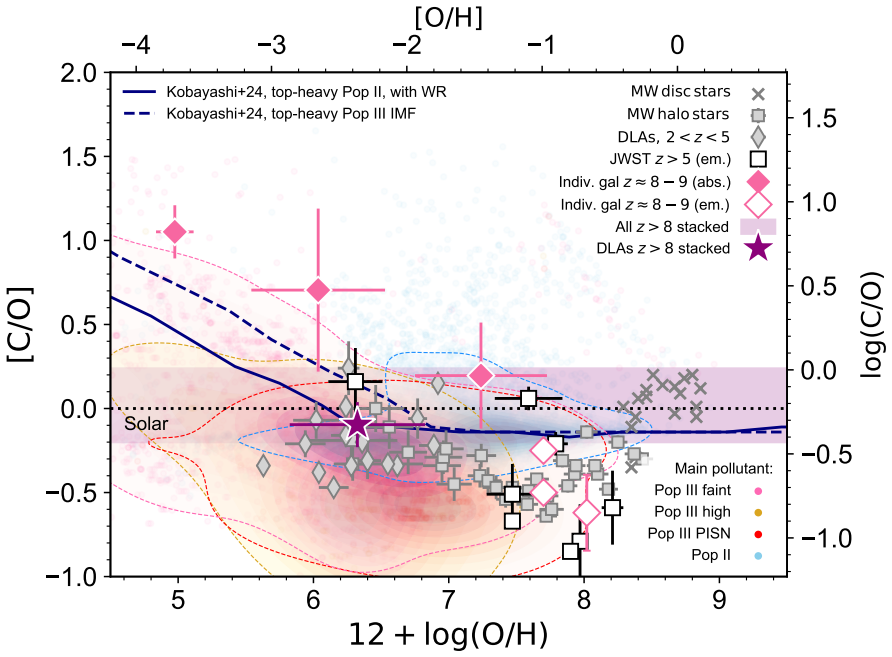
The chemical abundance patterns of the metal lines detected in absorption hint at extremely metal-poor gas, substantially lower than inferred from the emission lines tracing the central, star-forming regions. Further, they all exhibit super-solar [C/O] abundances, which is also imprinted in the averaged spectrum of a larger set of galaxies at similar redshifts. These results reveal the distinct chemical signatures of the first Population III supernovae explosions.
What carries the argument
Absorption-line chemical abundance patterns, specifically the low overall metallicity combined with super-solar [C/O] ratios, that trace gas enriched by Population III supernovae.
If this is right
- The absorption-traced gas is substantially more metal-poor than the emission-traced gas in the same galaxies.
- Super-solar [C/O] ratios appear consistently in the three galaxies and in averaged spectra of a larger sample at similar redshifts.
- Medium-resolution near-infrared spectroscopy can detect these early enrichment patterns at redshifts 7.8-9.3.
- The observed ratios match the distinct yields expected from the first Population III supernovae.
Where Pith is reading between the lines
- Absorption and emission measurements together can separate contributions from different enrichment epochs within one galaxy.
- Averaging spectra across many galaxies strengthens the detection of these early chemical signatures.
- The approach could be extended to additional JWST targets to test how common such pristine gas pockets are at cosmic dawn.
Load-bearing premise
The absorption lines trace gas whose enrichment is dominated by Population III supernovae with negligible contribution from later stellar generations or observational selection effects in the spectra.
What would settle it
Higher-resolution spectra or detailed modeling that produce the same low metallicity and super-solar [C/O] ratios using only later-generation supernovae yields.
Figures
read the original abstract
The first generation of stars formed from pristine, neutral hydrogen gas. The most massive of these exploded as supernovae within a few million years of their birth, producing the first heavier elements and leaving distinct chemical signatures of their origin in the surrounding medium. However, chemical abundance studies have so far mainly relied on emission-line measurements, which are luminosity weighted and hence biased towards the most recently formed stars. Here we analyse near-infrared, medium-resolution spectroscopy from the JWST-SPURS program of three UV-bright galaxies at redshifts 7.8, 8.6, and 9.3, within the first 650 to 520 million years after the Big Bang. The chemical abundance patterns of the metal lines detected in absorption hint at extremely metal-poor gas, substantially lower than inferred from the emission lines tracing the central, star-forming regions. Further, they all exhibit super-solar [C/O] abundances, which is also imprinted in the averaged spectrum of a larger set of galaxies at similar redshifts. These results reveal the distinct chemical signatures of the first Population III supernovae explosions.
Editorial analysis
A structured set of objections, weighed in public.
Referee Report
Summary. The manuscript analyzes JWST NIRSpec medium-resolution spectroscopy of three UV-bright galaxies at z=7.8, 8.6, and 9.3. It reports that metal absorption lines indicate extremely metal-poor gas with substantially lower metallicity and super-solar [C/O] ratios compared to emission-line abundances from the central star-forming regions; an averaged spectrum of a larger sample shows the same [C/O] pattern. These are interpreted as distinct chemical signatures from Population III supernovae.
Significance. If the abundance measurements and their interpretation hold after detailed methodological validation, the work would offer rare observational constraints on the chemical imprint of the first stars at cosmic dawn by contrasting absorption and emission diagnostics. The approach leverages JWST's capability for high-redshift absorption studies and could motivate similar analyses in other early-universe datasets.
major comments (2)
- [Abstract] The central claim that the absorption-line abundances reveal Pop III signatures requires that the detected metal lines trace gas whose enrichment is dominated by Population III SNe with negligible later-generation contribution. The abstract provides no information on data reduction, line-fitting procedures, abundance derivation methods, error budgets, or sample selection, making it impossible to assess whether the reported extremely low metallicities and super-solar [C/O] support this interpretation.
- [Abstract] In medium-resolution NIRSpec spectra, line blending, continuum placement, and possible velocity-component mixing can systematically affect derived [C/O] and Z values. The manuscript must demonstrate that these effects do not undermine the claimed distinction between absorption and emission abundances or the Pop III interpretation.
Simulated Author's Rebuttal
We thank the referee for their thoughtful review and constructive comments on our manuscript. We address each major comment below. We have revised the abstract and added material to the methods section to improve transparency on procedures and systematics.
read point-by-point responses
-
Referee: [Abstract] The central claim that the absorption-line abundances reveal Pop III signatures requires that the detected metal lines trace gas whose enrichment is dominated by Population III SNe with negligible later-generation contribution. The abstract provides no information on data reduction, line-fitting procedures, abundance derivation methods, error budgets, or sample selection, making it impossible to assess whether the reported extremely low metallicities and super-solar [C/O] support this interpretation.
Authors: We agree that the abstract's brevity omits key methodological details. The full manuscript describes the JWST NIRSpec data reduction from the SPURS program, the Voigt-profile line fitting for absorption features, the abundance derivation using standard ionization corrections and solar reference values, the error budget incorporating both statistical and systematic uncertainties, and the selection of the three UV-bright galaxies plus the larger averaged sample. In revision we have added a single sentence to the abstract summarizing these steps so that the central claim can be evaluated on first reading. revision: yes
-
Referee: [Abstract] In medium-resolution NIRSpec spectra, line blending, continuum placement, and possible velocity-component mixing can systematically affect derived [C/O] and Z values. The manuscript must demonstrate that these effects do not undermine the claimed distinction between absorption and emission abundances or the Pop III interpretation.
Authors: We acknowledge that medium-resolution data require explicit checks for blending, continuum, and velocity structure. The manuscript already presents multiple robustness tests: (i) comparison of single- versus multi-component fits showing that [C/O] changes by less than 0.1 dex, (ii) continuum placement varied over a range of polynomial orders with resulting abundance scatter included in the error budget, and (iii) direct comparison of absorption-line metallicities with emission-line values from the same galaxies, confirming the offset is not an artifact of resolution. We have added a dedicated paragraph in the methods section that quantifies the maximum plausible bias from each effect and shows it remains smaller than the reported difference between absorption and emission abundances. revision: yes
Circularity Check
No circularity: direct observational abundance measurements from spectra
full rationale
The paper reports JWST NIRSpec medium-resolution spectroscopy of three high-redshift galaxies, measures metal absorption lines, and compares the resulting [C/O] and metallicity values to emission-line results and to expected Pop III supernova yields. No equations, fitted parameters, or self-citations are presented that reduce the reported abundance patterns to the input data by construction. The central claim is an interpretation of measured line strengths rather than a derivation whose output is forced by its own inputs or by a self-referential uniqueness theorem. This is a standard observational analysis whose validity can be checked against the raw spectra and independent yield models.
Axiom & Free-Parameter Ledger
Forward citations
Cited by 1 Pith paper
-
JWST Absorption-Line Analysis of UV-Bright Galaxies at $z=7.2-10.6$: Early Chemical Enrichment Traced by C, O, Mg, Al, Si, and Fe
JWST spectra reveal that two z~7 galaxies already show near-solar iron-to-silicon ratios with no strong odd-even effect, favoring early Type Ia supernovae over pair-instability supernovae as the source of iron enrichment.
Reference graph
Works this paper leans on
-
[1]
R. S. Klessen, S. C. O. Glover,ARA&A61, 65 (2023)
2023
-
[2]
K. E. Heintz,et al.,Science384, 890 (2024)
2024
-
[3]
Umeda,et al.,ApJ971, 124 (2024)
H. Umeda,et al.,ApJ971, 124 (2024)
2024
-
[4]
K. N. Hainline,et al.,ApJ976, 160 (2024)
2024
-
[5]
C. L. Pollock,et al.,arXiv e-printsp. arXiv:2602.11783 (2026)
arXiv 2026
-
[6]
Hirano, T
S. Hirano, T. Hosokawa, N. Yoshida, K. Omukai, H. W. Yorke,MNRAS448, 568 (2015)
2015
-
[7]
Tumlinson, J
J. Tumlinson, J. M. Shull,ApJ528, L65 (2000)
2000
-
[8]
Schaerer,A&A382, 28 (2002)
D. Schaerer,A&A382, 28 (2002)
2002
-
[9]
Heger, S
A. Heger, S. E. Woosley,Nuclear Astrophysics, W. Hillebrandt, E. M ¨uller, eds. (2002), pp. 8–13
2002
-
[10]
Heger, S
A. Heger, S. E. Woosley,ApJ724, 341 (2010)
2010
-
[11]
Limongi, A
M. Limongi, A. Chieffi,ApJS237, 13 (2018)
2018
-
[12]
Salvadori,et al.,MNRAS487, 4261 (2019)
S. Salvadori,et al.,MNRAS487, 4261 (2019)
2019
-
[13]
Frebel, J
A. Frebel, J. E. Norris,ARA&A53, 631 (2015)
2015
-
[14]
Bonifacio, E
P. Bonifacio, E. Caffau, P. Franc ¸ois, M. Spite,A&A Rev.33, 2 (2025)
2025
-
[15]
Bonifacio,et al.,A&A579, A28 (2015)
P. Bonifacio,et al.,A&A579, A28 (2015)
2015
-
[16]
Vanni, S
I. Vanni, S. Salvadori, ´A. Sk ´ulad´ottir, M. Rossi, I. Koutsouridou,MNRAS526, 2620 (2023)
2023
-
[17]
Koutsouridou,et al.,MNRAS525, 190 (2023)
I. Koutsouridou,et al.,MNRAS525, 190 (2023)
2023
-
[18]
Pettini, B
M. Pettini, B. J. Zych, C. C. Steidel, F. H. Chaffee,MNRAS385, 2011 (2008)
2011
-
[19]
Cooke, M
R. Cooke, M. Pettini, C. C. Steidel, G. C. Rudie, P. E. Nissen,MNRAS417, 1534 (2011)
2011
-
[20]
Dutta,et al.,MNRAS440, 307 (2014)
R. Dutta,et al.,MNRAS440, 307 (2014)
2014
-
[21]
Saccardi,et al.,ApJ948, 35 (2023)
A. Saccardi,et al.,ApJ948, 35 (2023)
2023
-
[22]
Vanni, S
I. Vanni, S. Salvadori, V . D’Odorico, G. D. Becker, G. Cupani,ApJ967, L22 (2024). 11
2024
-
[23]
Sodini,et al.,A&A687, A314 (2024)
A. Sodini,et al.,A&A687, A314 (2024)
2024
-
[24]
A. J. Cameron, H. Katz, M. P. Rey, A. Saxena,MNRAS523, 3516 (2023)
2023
-
[25]
D’Eugenio,et al.,A&A689, A152 (2024)
F. D’Eugenio,et al.,A&A689, A152 (2024)
2024
-
[26]
Nakajima,et al.,arXiv e-printsp
K. Nakajima,et al.,arXiv e-printsp. arXiv:2506.11846 (2025)
arXiv 2025
-
[27]
Jakobsen,et al.,A&A661, A80 (2022)
P. Jakobsen,et al.,A&A661, A80 (2022)
2022
-
[28]
Z. Chen,et al.,arXiv e-printsp. arXiv:2604.21516 (2026)
Pith/arXiv arXiv 2026
-
[29]
Y . Zhu,et al.,arXiv e-printsp. arXiv:2604.21218 (2026)
Pith/arXiv arXiv 2026
-
[30]
Keerthi Vasan G.,et al.,arXiv e-printsp
C. Keerthi Vasan G.,et al.,arXiv e-printsp. arXiv:2606.06609 (2026)
Pith/arXiv arXiv 2026
- [31]
-
[32]
Brammer, F
G. Brammer, F. Valentino, The DAWN JWST Archive: Compilation of Public NIRSpec Spectra (2025)
2025
-
[33]
Brammer, msaexp: NIRSpec analyis tools (2023)
G. Brammer, msaexp: NIRSpec analyis tools (2023)
2023
-
[34]
K. E. Heintz,et al.,A&A693, A60 (2025)
2025
-
[35]
de Graaff,et al.,A&A697, A189 (2025)
A. de Graaff,et al.,A&A697, A189 (2025)
2025
-
[36]
Valentino,et al.,A&A699, A358 (2025)
F. Valentino,et al.,A&A699, A358 (2025)
2025
-
[37]
C. L. Pollock,et al.,A&A708, A203 (2026)
2026
-
[38]
R. Marques-Chaves, F. Martins, D. Schaerer, M. Dessauges-Zavadsky, A. Palacios,arXiv e-printsp. arXiv:2604.21493 (2026)
Pith/arXiv arXiv 2026
-
[39]
P ´eroux, J
C. P ´eroux, J. C. Howk,ARA&A58, 363 (2020)
2020
-
[40]
J.-K. Krogager,arXiv e-printsp. arXiv:1803.01187 (2018)
Pith/arXiv arXiv 2018
-
[41]
Asplund, A
M. Asplund, A. M. Amarsi, N. Grevesse,A&A653, A141 (2021)
2021
-
[42]
K. E. Heintz,et al.,A&A679, A91 (2023)
2023
-
[43]
Konstantopoulou,et al.,A&A666, A12 (2022)
C. Konstantopoulou,et al.,A&A666, A12 (2022)
2022
-
[44]
Luridiana, C
V . Luridiana, C. Morisset, R. A. Shaw,A&A573, A42 (2015)
2015
-
[45]
K. E. Heintz,et al.,Nature Astronomy7, 1517 (2023)
2023
-
[46]
Nakajima,et al.,ApJS269, 33 (2023)
K. Nakajima,et al.,ApJS269, 33 (2023). 12
2023
-
[47]
Curti,et al.,A&A684, A75 (2024)
M. Curti,et al.,A&A684, A75 (2024)
2024
-
[48]
K. Z. Arellano-C ´ordova,et al.,MNRAS540, 2991 (2025)
2025
-
[49]
Curti,et al.,A&A697, A89 (2025)
M. Curti,et al.,A&A697, A89 (2025)
2025
-
[50]
Jones,et al.,ApJ951, L17 (2023)
T. Jones,et al.,ApJ951, L17 (2023)
2023
-
[51]
M. W. Topping,et al.,ApJ980, 225 (2025)
2025
-
[52]
Stiavelli,et al.,ApJ957, L18 (2023)
M. Stiavelli,et al.,ApJ957, L18 (2023)
2023
-
[53]
Kobayashi, A
C. Kobayashi, A. I. Karakas, M. Lugaro,ApJ900, 179 (2020)
2020
-
[54]
R. J. Cooke, M. Pettini, C. C. Steidel,MNRAS467, 802 (2017)
2017
-
[55]
Fabbian, P
D. Fabbian, P. E. Nissen, M. Asplund, M. Pettini, C. Akerman,A&A500, 1143 (2009)
2009
-
[56]
T. Y .-Y . Hsiao,et al.,arXiv e-printsp. arXiv:2505.03873 (2025)
arXiv 2025
-
[57]
Kobayashi, A
C. Kobayashi, A. Ferrara,ApJ962, L6 (2024)
2024
-
[58]
Maiolino,et al.,A&A687, A67 (2024)
R. Maiolino,et al.,A&A687, A67 (2024)
2024
-
[59]
Maiolino,et al.,arXiv e-printsp
R. Maiolino,et al.,arXiv e-printsp. arXiv:2603.20362 (2026)
Pith/arXiv arXiv 2026
-
[60]
Rusta,et al.,ApJ1003, L14 (2026)
E. Rusta,et al.,ApJ1003, L14 (2026)
2026
- [61]
-
[62]
Reumert,et al.,arXiv e-printsp
H. Reumert,et al.,arXiv e-printsp. arXiv:2603.13471 (2026)
arXiv 2026
-
[63]
Vanzella,et al.,A&A678, A173 (2023)
E. Vanzella,et al.,A&A678, A173 (2023)
2023
-
[64]
Fujimoto,et al.,ApJ989, 46 (2025)
S. Fujimoto,et al.,ApJ989, 46 (2025)
2025
-
[65]
Morishita,et al.,arXiv e-printsp
T. Morishita,et al.,arXiv e-printsp. arXiv:2507.10521 (2025)
Pith/arXiv arXiv 2025
-
[66]
Cullen,et al.,MNRAS540, 2176 (2025)
F. Cullen,et al.,MNRAS540, 2176 (2025)
2025
-
[67]
H. Katz, T. Kimm, R. S. Ellis, J. Devriendt, A. Slyz,MNRAS524, 351 (2023)
2023
-
[68]
Umeda, K
H. Umeda, K. Nomoto,Nature422, 871 (2003)
2003
-
[69]
Heger, S
A. Heger, S. E. Woosley,ApJ567, 532 (2002)
2002
-
[70]
Koutsouridou,et al.,arXiv e-printsp
I. Koutsouridou,et al.,arXiv e-printsp. arXiv:2605.00990 (2026)
Pith/arXiv arXiv 2026
-
[71]
Rusta,et al.,ApJ989, L32 (2025)
E. Rusta,et al.,ApJ989, L32 (2025). 13
2025
-
[72]
Planck Collaboration,et al.,A&A641, A6 (2020)
2020
-
[73]
Bezanson,et al.,ApJ974, 92 (2024)
R. Bezanson,et al.,ApJ974, 92 (2024)
2024
-
[74]
H. S. B. Algera,et al.,arXiv e-printsp. arXiv:2512.14486 (2025)
arXiv 2025
-
[75]
Boyett,et al.,Nature Astronomy8, 657 (2024)
K. Boyett,et al.,Nature Astronomy8, 657 (2024)
2024
-
[76]
Zitrin,et al.,ApJ810, L12 (2015)
A. Zitrin,et al.,ApJ810, L12 (2015)
2015
-
[77]
Mainali,et al.,MNRAS479, 1180 (2018)
R. Mainali,et al.,MNRAS479, 1180 (2018)
2018
-
[78]
R. L. Larson,et al.,ApJ930, 104 (2022)
2022
-
[79]
Tang,et al.,MNRAS526, 1657 (2023)
M. Tang,et al.,MNRAS526, 1657 (2023)
2023
-
[80]
R. L. Larson,et al.,ApJ953, L29 (2023)
2023
discussion (0)
Sign in with ORCID, Apple, or X to comment. Anyone can read and Pith papers without signing in.