JWST Absorption-Line Analysis of UV-Bright Galaxies at z=7.2-10.6: Early Chemical Enrichment Traced by C, O, Mg, Al, Si, and Fe
Pith reviewed 2026-06-27 17:57 UTC · model grok-4.3
The pith
Two galaxies at z~7 already show near-solar iron-to-silicon ratios with no strong odd-even effect, favoring early Type Ia supernovae.
A machine-rendered reading of the paper's core claim, the machinery that carries it, and where it could break.
Core claim
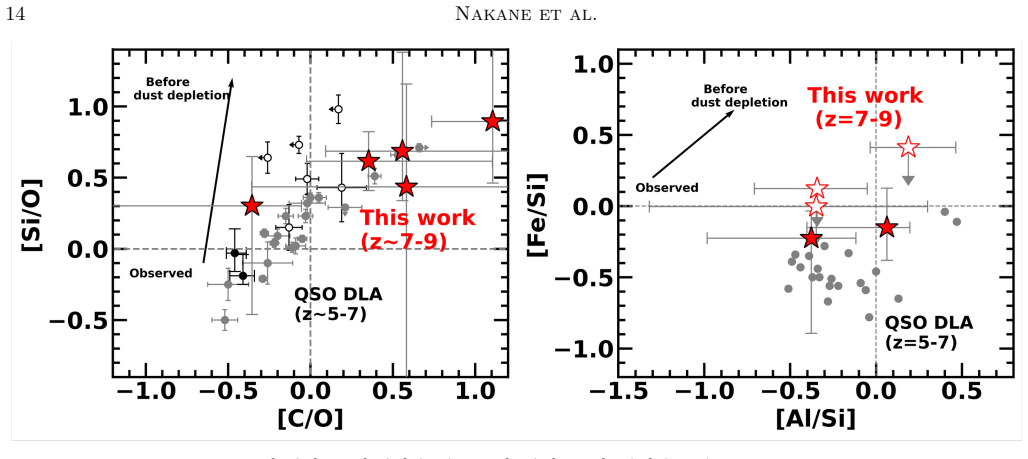
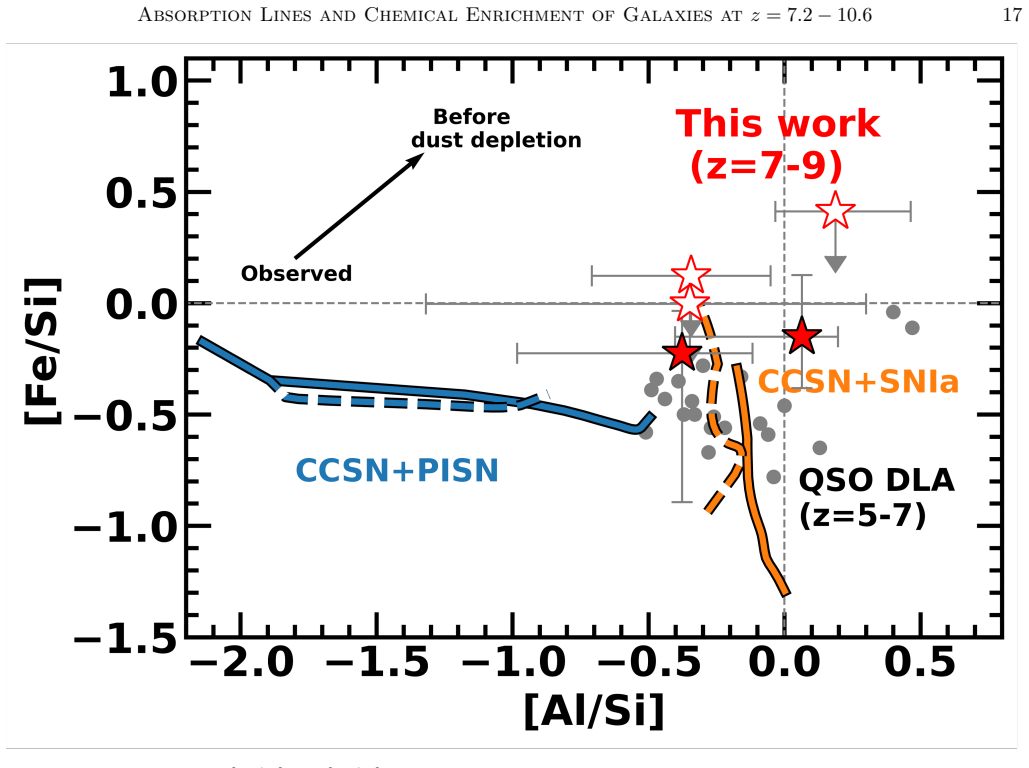
The absorbing gas in five of the eight galaxies follows the local covering-fraction versus column-density relation. Through the line fits the study derives chemical abundance ratios that place the galaxies near damped Ly alpha systems in the [Si/O] versus [C/O] and [Fe/Si] versus [Al/Si] planes. Two galaxies at z~7 exhibit [Fe/Si] approximately -0.2 near the solar ratio together with [Al/Si] approximately 0 and no signature of the strong odd-even effect expected from pair-instability supernovae, favoring enrichment from Type Ia supernovae instead.
What carries the argument
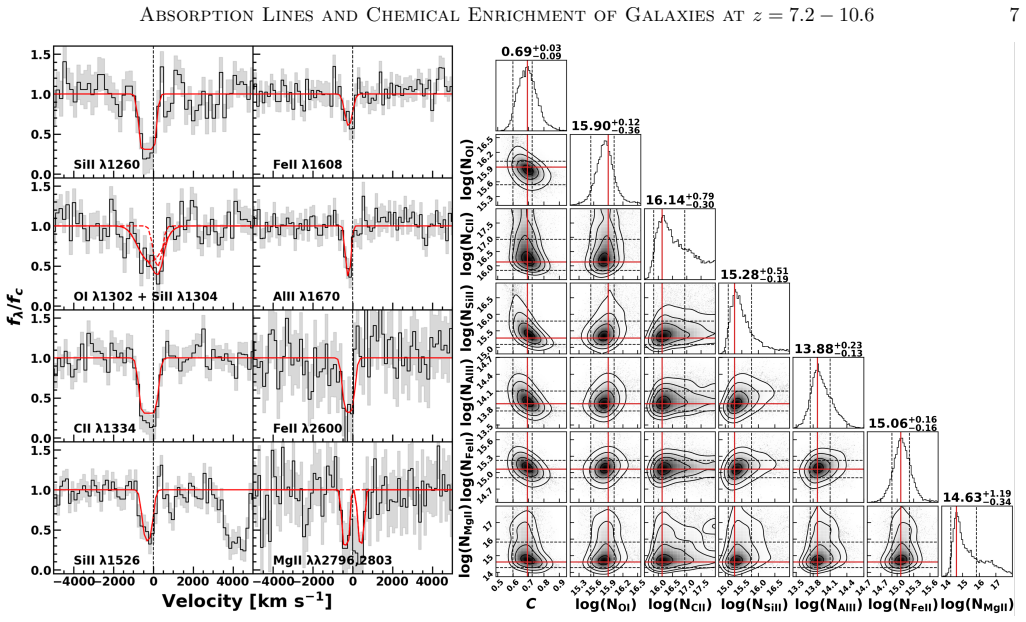
Simultaneous fitting of multiple low-ionization species (LIS) absorption lines to solve for both covering fraction Cf and column density N, yielding gas-phase abundance ratios.
If this is right
- The absorbing gas in the five galaxies resembles damped Ly alpha systems in the relevant abundance-ratio planes.
- Two galaxies at z~7 already reach near-solar [Fe/Si] ratios.
- The measured [Al/Si] near zero lacks the strong odd-even effect predicted for pair-instability supernovae, favoring Type Ia supernovae.
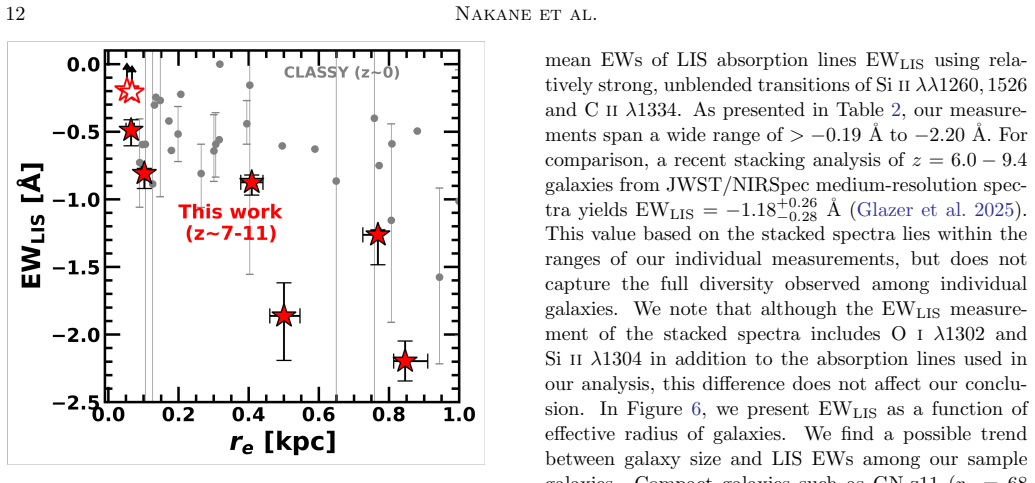
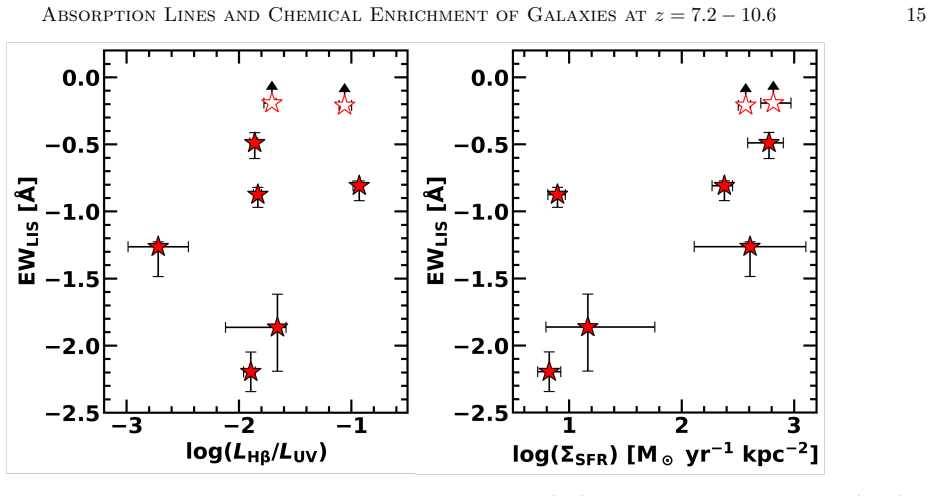
- Compact galaxies with high star-formation surface density show weaker average LIS equivalent widths.
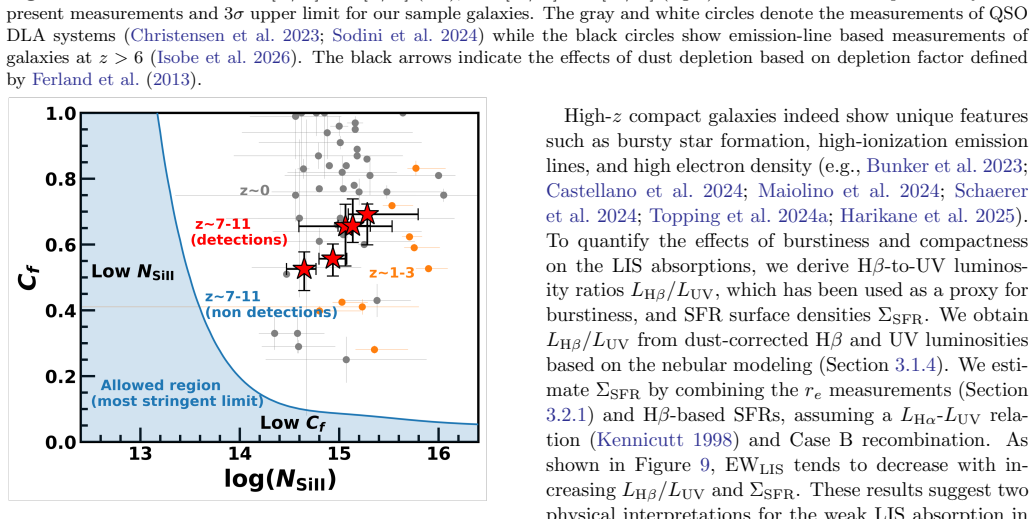
- The galaxies follow the local Cf versus N relation.
Where Pith is reading between the lines
- Early iron enrichment by z~7 would require Type Ia supernovae to operate on shorter delay times than some current models assume.
- Chemical-evolution models for the first galaxies may need to include prompt contributions from both core-collapse and Type Ia events to match the observed ratios.
- Future JWST spectra of additional UV-bright galaxies at z>7 could map how individual element ratios build up with cosmic time.
Load-bearing premise
The simultaneous fit of covering fraction and column density from multiple LIS lines accurately recovers the true gas-phase abundances without large ionization corrections or velocity-structure biases.
What would settle it
Higher-resolution spectra that resolve individual velocity components or reveal ionization states requiring large corrections that shift the derived [Fe/Si] and [Al/Si] ratios away from the reported values.
Figures
read the original abstract
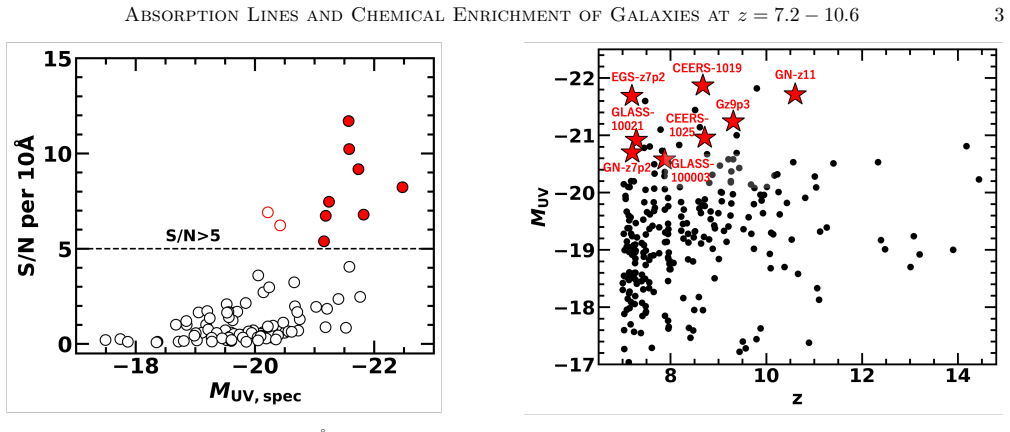
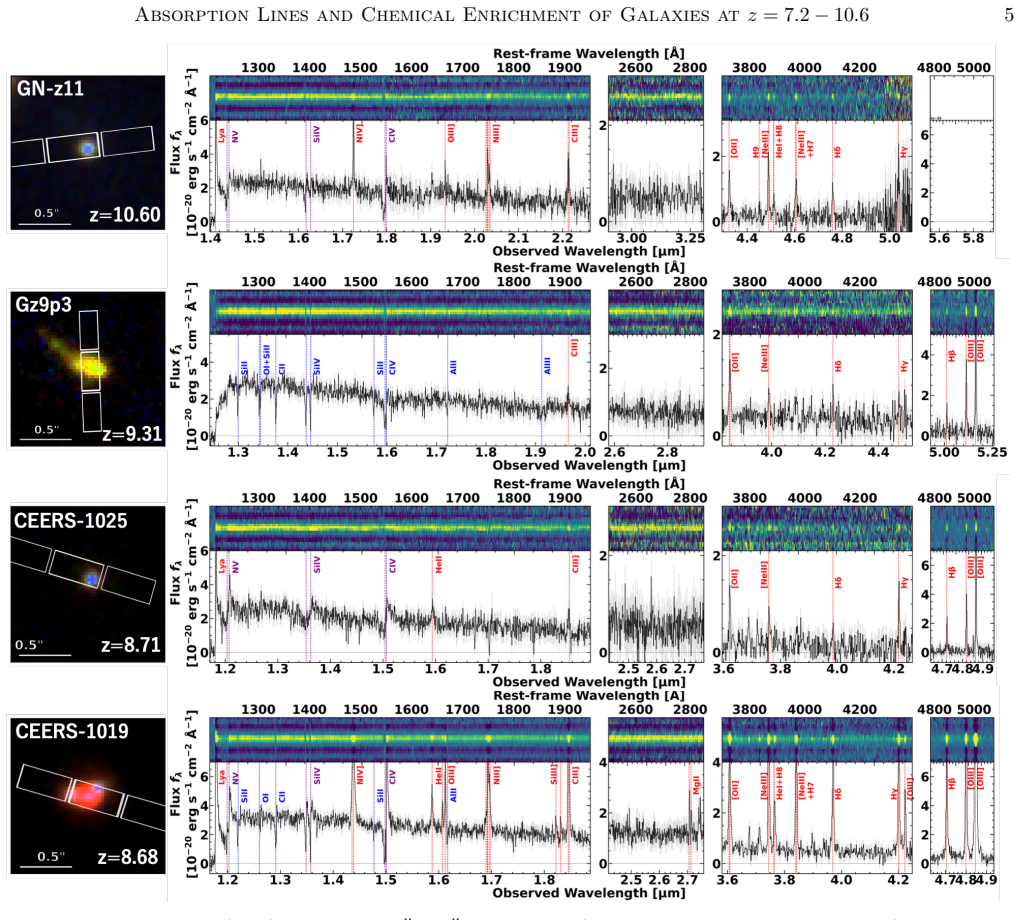
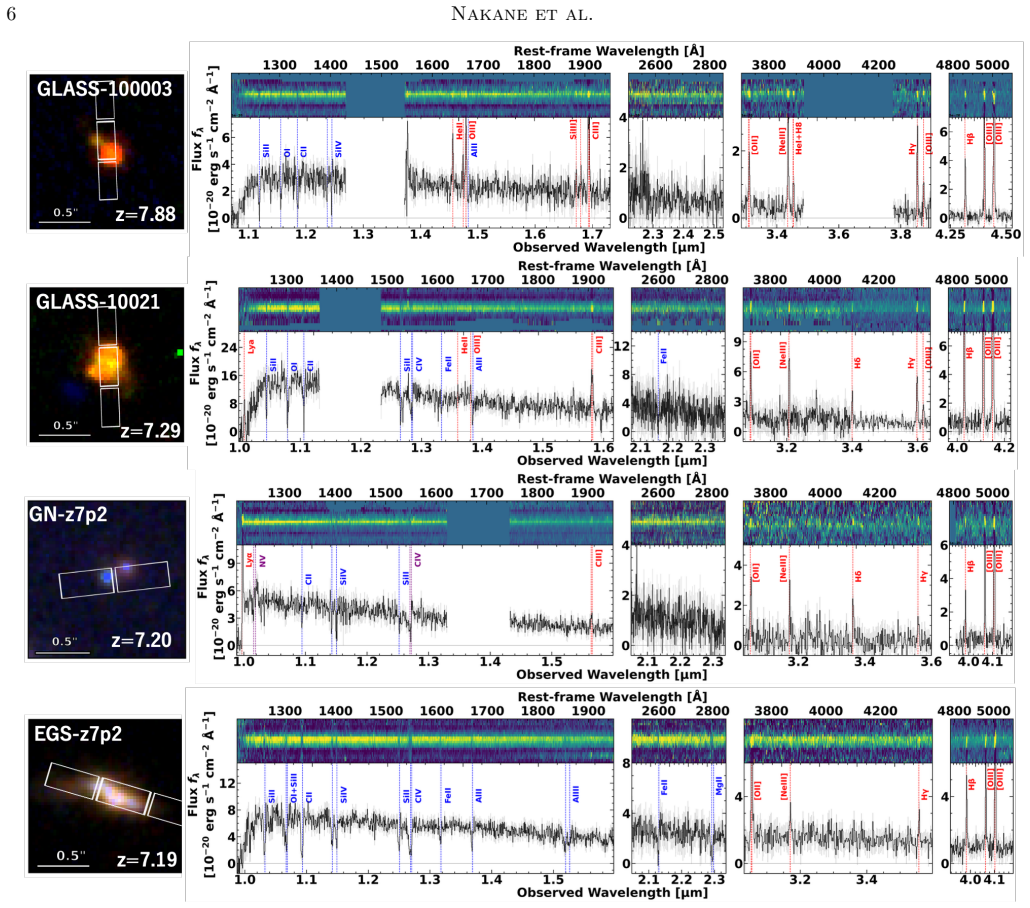
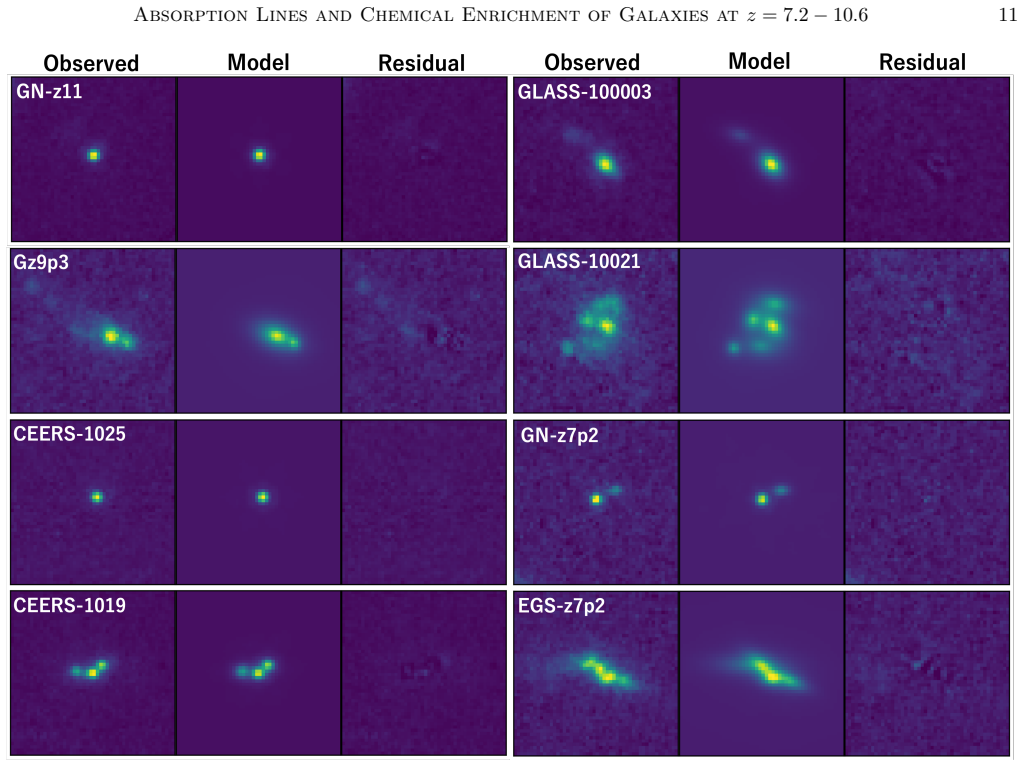
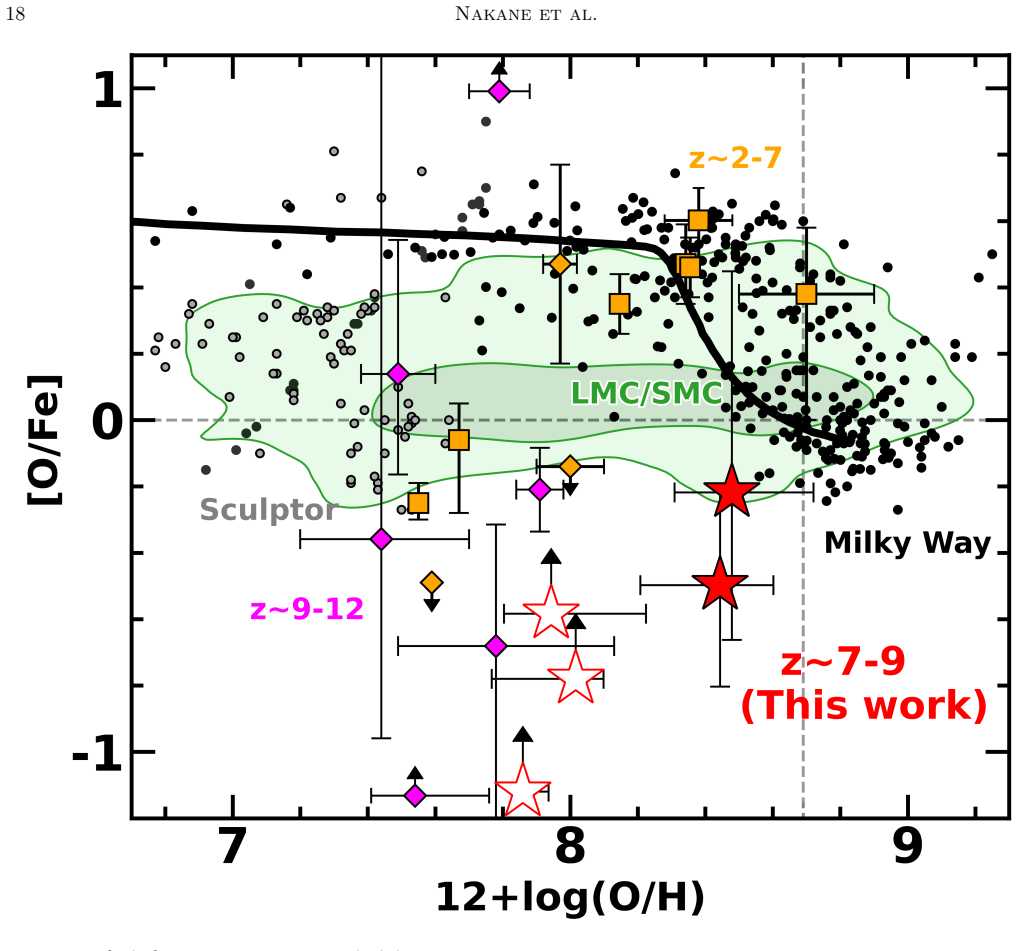
We investigate UV absorption lines tracing cool gas in eight bright ($-21.9 < M_\mathrm{UV} < -20.5$) galaxies at $z=7.2-10.6$ using deep archival JWST/NIRSpec medium-resolution spectra. The eight galaxies were homogeneously selected based on wavelength coverage and data quality from 362 galaxies at $z>7$ available to date, and all eight were observed as part of the SPURS program. We identify multiple absorption lines of low-ionization species (LIS) in five galaxies, while the remaining three show only one or no significant detections. The average LIS equivalent widths ($\mathrm{EW}_{\mathrm{LIS}}$) indicate weaker absorption lines in compact ($r_\mathrm{e}\lesssim100$ pc) galaxies with high $L_{\mathrm{H}\beta}/L_{\mathrm{UV}}$ and $\Sigma_{\mathrm{SFR}}$, suggestive of absorption-line suppression due to intense star formation or nuclear activity. We simultaneously fit multiple LIS lines, accounting for both covering fraction ($C_f$) and column density ($N$), and find that the five galaxies follow the local $C_f$ versus $N$ relation. Through the LIS-line fitting, we derive chemical abundance ratios. The five galaxies have abundance ratios similar to those of damped Ly$\alpha$ (DLA) systems in the [Si/O] versus [C/O] and [Fe/Si] versus [Al/Si] planes, suggesting that their absorbing gas is similar to that of DLAs. We find that two galaxies at $z\sim7$ are already highly Fe-enriched, with $\mathrm{[Fe/Si]}\simeq-0.2$, near the solar abundance ratio. While the high Fe enrichment may originate from early Type-Ia supernovae (SNe Ia) or pair-instability supernovae (PISNe), these two galaxies also show $\mathrm{[Al/Si]}\sim0$, with no signature of the strong odd-even effect expected from PISNe, favoring SNe Ia.
Editorial analysis
A structured set of objections, weighed in public.
Referee Report
Summary. The paper analyzes deep JWST/NIRSpec medium-resolution spectra of eight UV-bright galaxies at z=7.2-10.6 (selected homogeneously from 362 available z>7 sources), identifies low-ionization species (LIS) absorption lines in five objects, performs simultaneous fits for covering fraction Cf and column density N, derives abundance ratios, and compares them to DLA systems. It reports that two z~7 galaxies show [Fe/Si]≃−0.2 (near solar) and [Al/Si]~0 with no strong odd-even effect, favoring early SNe Ia enrichment over PISNe.
Significance. If the derived abundance ratios hold after accounting for fitting assumptions and corrections, the result provides direct evidence of rapid chemical enrichment by SNe Ia already at z~7 in UV-bright galaxies, with implications for early supernova yields and galaxy chemical evolution models. The homogeneous selection from a large parent sample and use of archival spectra are strengths; the small number of detections (five galaxies) limits broader claims.
major comments (3)
- [LIS-line fitting procedure (methods)] LIS-line fitting procedure (methods section, paragraph on simultaneous Cf+N fits): The headline result that two galaxies have [Fe/Si]≃−0.2 and [Al/Si]~0 (favoring SNe Ia) is obtained directly from column densities in this joint fit of multiple LIS lines. The manuscript reports no error bars on the abundance ratios, provides no ionization corrections, and includes no tests (e.g., curve-of-growth or multi-component modeling) for velocity-structure biases in the specific Fe, Al, and Si lines of these objects. This assumption is load-bearing; violation would shift the reported ratios and weaken the chemical-enrichment interpretation.
- [Sample selection and results] Sample selection and results (abstract and § on galaxy sample): The eight targets were chosen from 362 z>7 galaxies based on wavelength coverage and data quality, with three non-detections excluded from the abundance analysis. No quantitative assessment is given of how this selection, the exclusion of non-detections, or the compact/high-ΣSFR subset affects the derived averages or the specific [Fe/Si] and [Al/Si] values for the two highlighted galaxies.
- [Comparison to DLA planes (results)] Comparison to DLA planes (results section): The claim that the five galaxies follow DLA-like trends in the [Si/O] vs [C/O] and [Fe/Si] vs [Al/Si] planes assumes the LIS-derived ratios are directly comparable without significant ionization or depletion differences from the DLA reference sample. No explicit check or correction is described for the z~7 systems.
minor comments (1)
- [Notation] Notation for equivalent widths and abundances (throughout): EW_LIS and the bracket notation for ratios are used without explicit definition of the reference solar scale or any adopted atomic data in the main text; a short methods paragraph or table footnote would improve clarity.
Simulated Author's Rebuttal
We thank the referee for the detailed and constructive report. The comments highlight important aspects of the analysis that require clarification or expansion. We address each major comment below and indicate where revisions will be made to strengthen the manuscript.
read point-by-point responses
-
Referee: [LIS-line fitting procedure (methods)] LIS-line fitting procedure (methods section, paragraph on simultaneous Cf+N fits): The headline result that two galaxies have [Fe/Si]≃−0.2 and [Al/Si]~0 (favoring SNe Ia) is obtained directly from column densities in this joint fit of multiple LIS lines. The manuscript reports no error bars on the abundance ratios, provides no ionization corrections, and includes no tests (e.g., curve-of-growth or multi-component modeling) for velocity-structure biases in the specific Fe, Al, and Si lines of these objects. This assumption is load-bearing; violation would shift the reported ratios and weaken the chemical-enrichment interpretation.
Authors: We agree that error bars on the derived abundance ratios were omitted in the submitted version and will add them (derived from the posterior distributions of the simultaneous Cf+N fits) in the revision. Ionization corrections are expected to be small for the low-ionization species used, as these lines trace similar gas phases; we will add an explicit discussion of this assumption and a reference to typical IC values from the literature. For velocity-structure biases, the simultaneous multi-line fit already incorporates a single-component model with shared velocity parameters, but we acknowledge the lack of explicit multi-component or curve-of-growth tests. We will include a brief assessment using the available line profiles and note that the data quality limits more complex modeling; this will be presented as a caveat rather than a full re-analysis. revision: partial
-
Referee: [Sample selection and results] Sample selection and results (abstract and § on galaxy sample): The eight targets were chosen from 362 z>7 galaxies based on wavelength coverage and data quality, with three non-detections excluded from the abundance analysis. No quantitative assessment is given of how this selection, the exclusion of non-detections, or the compact/high-ΣSFR subset affects the derived averages or the specific [Fe/Si] and [Al/Si] values for the two highlighted galaxies.
Authors: The selection criteria (wavelength coverage and data quality from the parent sample of 362 sources) are described in the methods; the three non-detections were excluded because they lack sufficient LIS lines for the Cf+N fitting procedure. We will add a quantitative discussion in the revised text, including a comparison of the UV magnitudes, sizes, and SFR surface densities of the selected versus parent sample, and a statement that the two highlighted galaxies lie within the typical range of the detected subset. This will clarify that the reported ratios are specific to the detected systems rather than claimed as representative of all z>7 galaxies. revision: partial
-
Referee: [Comparison to DLA planes (results)] Comparison to DLA planes (results section): The claim that the five galaxies follow DLA-like trends in the [Si/O] vs [C/O] and [Fe/Si] vs [Al/Si] planes assumes the LIS-derived ratios are directly comparable without significant ionization or depletion differences from the DLA reference sample. No explicit check or correction is described for the z~7 systems.
Authors: The comparison is intended to show that the z~7 LIS ratios occupy a similar region of parameter space to local DLAs, supporting the interpretation that the absorbing gas has comparable physical conditions. We will add an explicit caveat in the revised results section noting that ionization and dust-depletion differences between the high-z and DLA samples have not been corrected for, and that the similarity is therefore qualitative. No quantitative correction is feasible with the current data, but the statement will be softened to 'broadly consistent with' rather than implying direct equivalence. revision: partial
Circularity Check
No significant circularity; direct measurements from spectra
full rationale
The paper performs standard absorption-line fitting on archival JWST spectra to extract column densities and abundance ratios, then compares the resulting [Fe/Si] and [Al/Si] values to external DLA samples. No step in the provided text reduces a reported abundance ratio to a quantity defined by the paper's own inputs, prior self-citations, or fitted parameters by construction. The central claims are observational outputs that remain falsifiable against independent data or modeling assumptions.
Axiom & Free-Parameter Ledger
free parameters (2)
- covering fraction Cf
- column density N
axioms (1)
- domain assumption The absorbing gas is in a single-phase cool medium whose ionization state allows direct conversion of fitted N to elemental abundances without large corrections.
Forward citations
Cited by 1 Pith paper
-
Chemical signatures from the first stars embedded in metal-poor gas in galaxies at cosmic dawn
JWST absorption spectra of galaxies at z~8-9 show metal-poor gas with high [C/O] suggesting enrichment by Population III supernovae.
Reference graph
Works this paper leans on
-
[1]
Charles R. Harris and K. Jarrod Millman and St. Array programming with. 2020 , month = sep, journal =. doi:10.1038/s41586-020-2649-2 , publisher =
-
[2]
Hunter, J. D. , Title =. Computing in Science & Engineering , Volume =
-
[3]
and Haberland, Matt and Reddy, Tyler and Cournapeau, David and Burovski, Evgeni and Peterson, Pearu and Weckesser, Warren and Bright, Jonathan and
Virtanen, Pauli and Gommers, Ralf and Oliphant, Travis E. and Haberland, Matt and Reddy, Tyler and Cournapeau, David and Burovski, Evgeni and Peterson, Pearu and Weckesser, Warren and Bright, Jonathan and. Nature Methods , year =
-
[7]
emcee: The MCMC Hammer. , keywords =. doi:10.1086/670067 , archivePrefix =. 1202.3665 , primaryClass =
work page internal anchor Pith review Pith/arXiv arXiv doi:10.1086/670067
-
[8]
Secondary standard stars for absolute spectrophotometry. , keywords =. doi:10.1086/160817 , adsurl =
-
[9]
The James Webb Space Telescope Mission. , keywords =. doi:10.1088/1538-3873/acd1b5 , archivePrefix =. 2304.04869 , primaryClass =
-
[10]
The Science Performance of JWST as Characterized in Commissioning. , keywords =. doi:10.1088/1538-3873/acb293 , archivePrefix =. 2207.05632 , primaryClass =
-
[11]
Performance of NIRCam on JWST in Flight. , keywords =. doi:10.1088/1538-3873/acac53 , archivePrefix =. 2212.12069 , primaryClass =
-
[12]
The Near-Infrared Spectrograph (NIRSpec) on the James Webb Space Telescope. I. Overview of the instrument and its capabilities. , keywords =. doi:10.1051/0004-6361/202142663 , archivePrefix =. 2202.03305 , primaryClass =
work page internal anchor Pith review Pith/arXiv arXiv doi:10.1051/0004-6361/202142663
-
[13]
The Near-Infrared Spectrograph (NIRSpec) on the James Webb Space Telescope. II. Multi-object spectroscopy (MOS). , keywords =. doi:10.1051/0004-6361/202142673 , archivePrefix =. 2202.03306 , primaryClass =
-
[14]
In-orbit Performance of the Near-infrared Spectrograph NIRSpec on the James Webb Space Telescope. , keywords =. doi:10.1088/1538-3873/acb846 , archivePrefix =. 2301.13766 , primaryClass =
-
[17]
Overview of the JWST Advanced Deep Extragalactic Survey (JADES)
Overview of the JWST Advanced Deep Extragalactic Survey (JADES). arXiv e-prints , keywords =. doi:10.48550/arXiv.2306.02465 , archivePrefix =. 2306.02465 , primaryClass =
work page internal anchor Pith review Pith/arXiv arXiv doi:10.48550/arxiv.2306.02465
-
[18]
The Mean Absorption-line Spectra of a Selection of Luminous z 6 Lyman Break Galaxies. , keywords =. doi:10.3847/1538-4357/abb597 , archivePrefix =. 2005.11078 , primaryClass =
-
[19]
An updated analytic model for the attenuation by the intergalactic medium
An updated analytic model for attenuation by the intergalactic medium. , keywords =. doi:10.1093/mnras/stu936 , archivePrefix =. 1402.0677 , primaryClass =
work page internal anchor Pith review Pith/arXiv arXiv doi:10.1093/mnras/stu936
-
[20]
The Stellar Mass versus Stellar Metallicity Relation of Star-forming Galaxies at 1.6 z 3.0 and Implications for the Evolution of the -enhancement. , keywords =. doi:10.3847/1538-4357/ac399e , archivePrefix =. 2109.06044 , primaryClass =
-
[21]
JWST Identification of Extremely Low C/N Galaxies with [N/O] 0.5 at z 6-10 Evidencing the Early CNO-cycle Enrichment and a Connection with Globular Cluster Formation. , keywords =. doi:10.3847/1538-4357/ad09be , archivePrefix =. 2307.00710 , primaryClass =
-
[22]
E., 1955, @doi [ ] 10.1086/145971 , https://ui.adsabs.harvard.edu/abs/1955ApJ...121..161S 121, 161
The Luminosity Function and Stellar Evolution. , year = 1955, month = jan, volume =. doi:10.1086/145971 , adsurl =
-
[25]
BPASS predictions for Binary Black-Hole Mergers
BPASS predictions for binary black hole mergers. , keywords =. doi:10.1093/mnras/stw1772 , archivePrefix =. 1602.03790 , primaryClass =
work page internal anchor Pith review Pith/arXiv arXiv doi:10.1093/mnras/stw1772
-
[26]
, year = 1998, month = jul, volume =
CLOUDY 90: Numerical Simulation of Plasmas and Their Spectra. , year = 1998, month = jul, volume =. doi:10.1086/316190 , adsurl =
-
[27]
Ultraviolet Line Spectra of Metal-Poor Star-Forming Galaxies
Ultraviolet Line Spectra of Metal-poor Star-forming Galaxies. , keywords =. doi:10.1086/319814 , archivePrefix =. astro-ph/0012358 , primaryClass =
work page internal anchor Pith review Pith/arXiv arXiv doi:10.1086/319814
-
[28]
Spectral Modeling of Star-forming Regions in the Ultraviolet: Stellar Metallicity Diagnostics for High-Redshift Galaxies. , keywords =. doi:10.1086/424031 , archivePrefix =. astro-ph/0407296 , primaryClass =
work page internal anchor Pith review Pith/arXiv arXiv doi:10.1086/424031
-
[29]
Stellar Population Effects on the Inferred Photon Density at Reionization
Stellar population effects on the inferred photon density at reionization. , keywords =. doi:10.1093/mnras/stv2661 , archivePrefix =. 1511.03268 , primaryClass =
work page internal anchor Pith review Pith/arXiv arXiv doi:10.1093/mnras/stv2661
-
[30]
Reconciling the Stellar and Nebular Spectra of High Redshift Galaxies
Reconciling the Stellar and Nebular Spectra of High-redshift Galaxies. , keywords =. doi:10.3847/0004-637X/826/2/159 , archivePrefix =. 1605.07186 , primaryClass =
work page internal anchor Pith review Pith/arXiv arXiv doi:10.3847/0004-637x/826/2/159
-
[31]
An ultraviolet line list for O star spectra. , keywords =. doi:10.1086/190998 , adsurl =
-
[32]
An Ultraviolet Spectral Atlas of 10 Lacertae Obtained with the Goddard High Resolution Spectrograph on the Hubble Space Telescope. , keywords =. doi:10.1086/300446 , adsurl =
-
[36]
EMPRESS. IV. Extremely Metal-poor Galaxies Including Very Low-mass Primordial Systems with M _ * = 10 ^ 4 - 10 ^ 5 M _ and 2\. , keywords =. doi:10.3847/1538-4357/ac3509 , archivePrefix =. 2108.03850 , primaryClass =
-
[37]
The chemical composition of metal-poor emission-line galaxies in the Data Release 3 of the Sloan Digital Sky Survey. , keywords =. doi:10.1051/0004-6361:20053763 , archivePrefix =. astro-ph/0511644 , primaryClass =
work page internal anchor Pith review Pith/arXiv arXiv doi:10.1051/0004-6361:20053763
-
[38]
Extreme N-emitters at high redshift: Possible signatures of supermassive stars and globular cluster or black hole formation in action. , keywords =. doi:10.1051/0004-6361/202347411 , archivePrefix =. 2307.04234 , primaryClass =
-
[39]
A small and vigorous black hole in the early Universe. , keywords =. doi:10.1038/s41586-024-07052-5 , archivePrefix =. 2305.12492 , primaryClass =
-
[40]
, year = 2013, month = aug, volume =
Nucleosynthesis in Stars and the Chemical Enrichment of Galaxies. , year = 2013, month = aug, volume =. doi:10.1146/annurev-astro-082812-140956 , adsurl =
-
[41]
GN-z11 in Context: Possible Signatures of Globular Cluster Precursors at Redshift 10. , keywords =. doi:10.3847/1538-4357/ad235e , archivePrefix =. 2303.04179 , primaryClass =
-
[42]
EMPRESS. XIII. Chemical Enrichment of Young Galaxies Near and Far at z 0 and 4 10: Fe/O, Ar/O, S/O, and N/O Measurements with a Comparison of Chemical Evolution Models. , keywords =. doi:10.3847/1538-4357/ad13ff , archivePrefix =. 2305.02078 , primaryClass =
-
[43]
Stellar Yields of Rotating First Stars. II. Pair-instability Supernovae and Comparison with Observations. , keywords =. doi:10.3847/1538-4357/aab95f , archivePrefix =. 1803.06630 , primaryClass =
work page internal anchor Pith review Pith/arXiv arXiv doi:10.3847/1538-4357/aab95f
-
[44]
How Much ^ 56 Ni Can Be Produced in Core-Collapse Supernovae? Evolution and Explosions of 30-100 M _ Stars. , keywords =. doi:10.1086/524767 , archivePrefix =. 0707.2598 , primaryClass =
work page internal anchor Pith review Pith/arXiv arXiv doi:10.1086/524767
-
[45]
An Ultraviolet Spectroscopic Atlas of Local Starbursts and Star-forming Galaxies: The Legacy of FOS and GHRS. , keywords =. doi:10.1088/0004-6256/141/2/37 , archivePrefix =. 1011.0385 , primaryClass =
work page internal anchor Pith review Pith/arXiv arXiv doi:10.1088/0004-6256/141/2/37
-
[46]
Nitrogen abundance in turn-off stars of NGC 6397 and NGC 6752. , keywords =. doi:10.1051/0004-6361:200809963 , adsurl =
-
[47]
Nitrogen abundances in giant stars of the globular cluster NGC 6752
Nitrogen Abundances in Giant Stars of the Globular Cluster NGC 6752. , keywords =. doi:10.1086/590658 , archivePrefix =. 0806.0187 , primaryClass =
work page internal anchor Pith review Pith/arXiv arXiv doi:10.1086/590658
-
[48]
Abundances in giant stars of the globular cluster NGC 6752
Abundances in giant stars of the globular cluster NGC 6752. , keywords =. doi:10.1051/0004-6361:20052916 , archivePrefix =. astro-ph/0504283 , primaryClass =
work page internal anchor Pith review Pith/arXiv arXiv doi:10.1051/0004-6361:20052916
-
[50]
Oxygen, Sodium, Magnesium and Aluminium as tracers of the Galactic Bulge Formation
Oxygen, sodium, magnesium, and aluminium as tracers of the galactic bulge formation. , keywords =. doi:10.1051/0004-6361:20066036 , archivePrefix =. astro-ph/0610346 , primaryClass =
work page internal anchor Pith review Pith/arXiv arXiv doi:10.1051/0004-6361:20066036
-
[52]
Systematic Non-LTE Study of the -.6 [Fe/H] 0.2 F and G Dwarfs in the Solar Neighborhood. II. Abundance Patterns from Li to Eu. , keywords =. doi:10.3847/1538-4357/833/2/225 , archivePrefix =. 1610.00193 , primaryClass =
work page internal anchor Pith review Pith/arXiv arXiv doi:10.3847/1538-4357/833/2/225
-
[54]
Properties of stellar generations in Globular Clusters and relations with global parameters
Properties of stellar generations in globular clusters and relations with global parameters. , keywords =. doi:10.1051/0004-6361/200913451 , archivePrefix =. 1003.1723 , primaryClass =
work page internal anchor Pith review Pith/arXiv arXiv doi:10.1051/0004-6361/200913451
-
[55]
Research Notes of the American Astronomical Society , keywords =
The 23.01 Release of Cloudy. Research Notes of the American Astronomical Society , keywords =. doi:10.3847/2515-5172/ad0e75 , archivePrefix =. 2311.10163 , primaryClass =
-
[56]
Exploring the Milky Way stellar disk. A detailed elemental abundance study of 714 F and G dwarf stars in the solar neighbourhood. , keywords =. doi:10.1051/0004-6361/201322631 , archivePrefix =. 1309.2631 , primaryClass =
work page internal anchor Pith review Pith/arXiv arXiv doi:10.1051/0004-6361/201322631
-
[57]
The Nucleosynthetic Signature of Population III
The Nucleosynthetic Signature of Population III. , keywords =. doi:10.1086/338487 , archivePrefix =. astro-ph/0107037 , primaryClass =
work page internal anchor Pith review Pith/arXiv arXiv doi:10.1086/338487
-
[58]
Nucleosynthesis of Zinc and Iron Peak Elements in Population III Type II Supernovae: Comparison with Abundances of Very Metal Poor Halo Stars. , keywords =. doi:10.1086/323946 , archivePrefix =. astro-ph/0103241 , primaryClass =
work page internal anchor Pith review Pith/arXiv arXiv doi:10.1086/323946
-
[59]
Exact and approximate expressions of energy generation rates and their impact on the explosion properties of pair instability supernovae. , keywords =. doi:10.1093/mnras/stv2649 , archivePrefix =. 1511.03040 , primaryClass =
work page internal anchor Pith review Pith/arXiv arXiv doi:10.1093/mnras/stv2649
-
[60]
Hypernovae and Other Black-Hole-Forming Supernovae
Hypernovae and Other Black-Hole-Forming Supernovae. Astrophysics and Space Science Library , year = 2004, editor =. doi:10.1007/978-0-306-48599-2_10 , archivePrefix =. astro-ph/0308136 , primaryClass =
work page internal anchor Pith review Pith/arXiv arXiv doi:10.1007/978-0-306-48599-2_10 2004
-
[61]
Nucleosynthesis Yields of Core-Collapse Supernovae and Hypernovae, and Galactic Chemical Evolution
Nucleosynthesis yields of core-collapse supernovae and hypernovae, and galactic chemical evolution. , keywords =. doi:10.1016/j.nuclphysa.2006.05.008 , archivePrefix =. astro-ph/0605725 , primaryClass =
work page internal anchor Pith review Pith/arXiv arXiv doi:10.1016/j.nuclphysa.2006.05.008 2006
-
[62]
EMPRESS. II. Highly Fe-enriched Metal-poor Galaxies with 1.0 (Fe/O) _ and 0.02 (O/H) _ : Possible Traces of Supermassive (>300 M _ ) Stars in Early Galaxies. , keywords =. doi:10.3847/1538-4357/abec3d , archivePrefix =. 2006.03831 , primaryClass =
-
[63]
JADES Imaging of GN-z11: Revealing the Morphology and Environment of a Luminous Galaxy 430 Myr after the Big Bang. , keywords =. doi:10.3847/1538-4357/acdbc6 , archivePrefix =. 2302.07234 , primaryClass =
-
[64]
Nucleosynthesis in Chandrasekhar Mass Models for Type IA Supernovae and Constraints on Progenitor Systems and Burning-Front Propagation. , keywords =. doi:10.1086/313278 , archivePrefix =. astro-ph/0002337 , primaryClass =
work page internal anchor Pith review Pith/arXiv arXiv doi:10.1086/313278
-
[65]
Characterizing Extreme Emission-line Galaxies. I. A Four-zone Ionization Model for Very High-ionization Emission. , keywords =. doi:10.3847/1538-4357/ac141b , archivePrefix =. 2105.12765 , primaryClass =
-
[66]
Low-redshift Lyman continuum leaking galaxies with high [OIII]/[OII] ratios
Low-redshift Lyman continuum leaking galaxies with high [O III]/[O II] ratios. , keywords =. doi:10.1093/mnras/sty1378 , archivePrefix =. 1805.09865 , primaryClass =
work page internal anchor Pith review Pith/arXiv arXiv doi:10.1093/mnras/sty1378
-
[67]
Heavy element abundances in blue compact galaxies
Heavy-Element Abundances in Blue Compact Galaxies. , keywords =. doi:10.1086/306708 , archivePrefix =. astro-ph/9811387 , primaryClass =
work page internal anchor Pith review Pith/arXiv arXiv doi:10.1086/306708
-
[68]
The Mg II 2797, 2803 emission in low-metallicity star-forming galaxies from the SDSS. , keywords =. doi:10.1051/0004-6361/201221010 , archivePrefix =. 1306.1848 , primaryClass =
-
[69]
GA-NIFS: An extremely nitrogen-loud and chemically stratified galaxy at z 5.55. , keywords =. doi:10.1093/mnras/stae2375 , archivePrefix =. 2404.04148 , primaryClass =
-
[70]
JADES -- The small blue bump in GN-z11: insights into the nuclear region of a galaxy at z=10.6. arXiv e-prints , keywords =. doi:10.48550/arXiv.2405.05772 , archivePrefix =. 2405.05772 , primaryClass =
-
[71]
GA-NIFS: A massive black hole in a low-metallicity AGN at z 5.55 revealed by JWST/NIRSpec IFS. , keywords =. doi:10.1051/0004-6361/202346137 , archivePrefix =. 2302.06647 , primaryClass =
-
[72]
Constraining Type Ia Supernova Delay Time with Spatially Resolved Star Formation Histories. , keywords =. doi:10.3847/1538-4357/ac178d , archivePrefix =. 2101.06242 , primaryClass =
-
[73]
De Re Metallica: The cosmic chemical evolution of galaxies
De re metallica: the cosmic chemical evolution of galaxies. , keywords =. doi:10.1007/s00159-018-0112-2 , archivePrefix =. 1811.09642 , primaryClass =
work page internal anchor Pith review Pith/arXiv arXiv doi:10.1007/s00159-018-0112-2
-
[74]
Mg II and Fe II Fluxes of Luminous Quasars at z 2.7 and the Evaluation of the Baldwin Effect in the Flux-to-abundance Conversion Method for Quasars. , keywords =. doi:10.3847/1538-4357/abc33b , archivePrefix =. 2010.10548 , primaryClass =
-
[75]
Potential Signature of Population III Pair-instability Supernova Ejecta in the BLR Gas of the Most Distant Quasar at z = 7.54. , keywords =. doi:10.3847/1538-4357/ac8163 , archivePrefix =. 2207.11909 , primaryClass =
-
[76]
Chemical Evolution of the Universe at 0.7 < z < 1.6 Derived from Abundance Diagnostics of the Broad-line Region of Quasars. , keywords =. doi:10.3847/1538-4357/834/2/203 , archivePrefix =. 1611.06027 , primaryClass =
work page internal anchor Pith review Pith/arXiv arXiv doi:10.3847/1538-4357/834/2/203
-
[77]
Nebular dominated galaxies: insights into the stellar initial mass function at high redshift. , keywords =. doi:10.1093/mnras/stae1547 , archivePrefix =. 2311.02051 , primaryClass =
-
[78]
How small were the first cosmological objects?
How Small Were the First Cosmological Objects?. , keywords =. doi:10.1086/303434 , archivePrefix =. astro-ph/9603007 , primaryClass =
work page internal anchor Pith review Pith/arXiv arXiv doi:10.1086/303434
-
[79]
On the variation of the initial mass function. , keywords =. doi:10.1046/j.1365-8711.2001.04022.x , archivePrefix =. astro-ph/0009005 , primaryClass =
-
[80]
One Hundred First Stars : Protostellar Evolution and the Final Masses
One Hundred First Stars: Protostellar Evolution and the Final Masses. , keywords =. doi:10.1088/0004-637X/781/2/60 , archivePrefix =. 1308.4456 , primaryClass =
work page internal anchor Pith review Pith/arXiv arXiv doi:10.1088/0004-637x/781/2/60
-
[81]
Primordial star formation under the influence of far ultraviolet radiation: 1540 cosmological haloes and the stellar mass distribution. , keywords =. doi:10.1093/mnras/stv044 , archivePrefix =. 1501.01630 , primaryClass =
work page internal anchor Pith review Pith/arXiv arXiv doi:10.1093/mnras/stv044
-
[82]
Uncovering the physical origin of the prominent Lyman- emission and absorption in GS9422 at z = 5.943. , keywords =. doi:10.1051/0004-6361/202450375 , archivePrefix =. 2404.06543 , primaryClass =
-
[83]
Extremely Metal-poor Representatives Explored by the Subaru Survey (EMPRESS). I. A Successful Machine-learning Selection of Metal-poor Galaxies and the Discovery of a Galaxy with M* < 10 ^ 6 M _ and 0.016 Z _. , keywords =. doi:10.3847/1538-4357/aba047 , archivePrefix =. 1910.08559 , primaryClass =
-
[84]
Accreting white dwarf models for type I supernovae. III. Carbon deflagration supernovae. , keywords =. doi:10.1086/162639 , adsurl =
-
[85]
Gemini-Phoenix infrared high-resolution abundance analysis of five giants in the bulge globular cluster NGC 6553. , keywords =. doi:10.1051/0004-6361:20031357 , archivePrefix =. astro-ph/0309552 , primaryClass =
work page internal anchor Pith review Pith/arXiv arXiv doi:10.1051/0004-6361:20031357
-
[86]
High-resolution near-infrared spectra of NGC 6624 and 6569. , keywords =. doi:10.1111/j.1365-2966.2011.18580.x , archivePrefix =. 1103.0233 , primaryClass =
-
[87]
Redshift Evolution of Electron Density in the Interstellar Medium at z 0-9 Uncovered with JWST/NIRSpec Spectra and Line-spread Function Determinations. , keywords =. doi:10.3847/1538-4357/acf376 , archivePrefix =. 2301.06811 , primaryClass =
-
[88]
GA-NIFS: the interplay between merger, star formation, and chemical enrichment in MACS1149-JD1 at z = 9.11 with JWST/NIRSpec. , keywords =. doi:10.1093/mnras/stae1971 , archivePrefix =. 2407.08616 , primaryClass =
-
[89]
JWST NIRSpec High-resolution Spectroscopy of MACS0647 JD at z = 10.167: Resolved [O II] Doublet and Electron Density in an Early Galaxy. , keywords =. doi:10.3847/1538-4357/ad6001 , archivePrefix =. 2404.16201 , primaryClass =
-
[90]
Single Degenerate Models for Type Ia Supernovae Progenitor's Evolution and Nucleosythesis Yields
Single Degenerate Models for Type Ia Supernovae: Progenitor's Evolution and Nucleosynthesis Yields. , keywords =. doi:10.1007/s11214-018-0499-0 , archivePrefix =. 1805.10811 , primaryClass =
work page internal anchor Pith review Pith/arXiv arXiv doi:10.1007/s11214-018-0499-0
-
[91]
Constraining the final fates of massive stars by oxygen and iron enrichment history in the Galaxy
Constraining the Final Fates of Massive Stars by Oxygen and Iron Enrichment History in the Galaxy. , keywords =. doi:10.3847/1538-4357/aaa024 , archivePrefix =. 1712.02013 , primaryClass =
work page internal anchor Pith review Pith/arXiv arXiv doi:10.3847/1538-4357/aaa024
-
[92]
Preparing the NIRSpec/JWST science data calibration: from ground testing to sky
Preparing the NIRSpec/JWST science data calibration: from ground testing to sky. Observatory Operations: Strategies, Processes, and Systems VII , year = 2018, series =. doi:10.1117/12.2313839 , archivePrefix =. 1805.06922 , primaryClass =
work page internal anchor Pith review Pith/arXiv arXiv doi:10.1117/12.2313839 2018
-
[93]
UNCOVER: The Growth of the First Massive Black Holes from JWST/NIRSpec-Spectroscopic Redshift Confirmation of an X-Ray Luminous AGN at z = 10.1. , keywords =. doi:10.3847/2041-8213/acf7c5 , archivePrefix =. 2308.02750 , primaryClass =
discussion (0)
Sign in with ORCID, Apple, or X to comment. Anyone can read and Pith papers without signing in.