The Graviton Propagator in Asymptotically Safe Gravity with Non-Local Form Factors
Pith reviewed 2026-06-27 06:11 UTC · model grok-4.3
The pith
The graviton propagator constructed from running non-local form factors in asymptotically safe gravity has a single pole at zero momentum with positive residue and no ghost poles.
A machine-rendered reading of the paper's core claim, the machinery that carries it, and where it could break.
Core claim
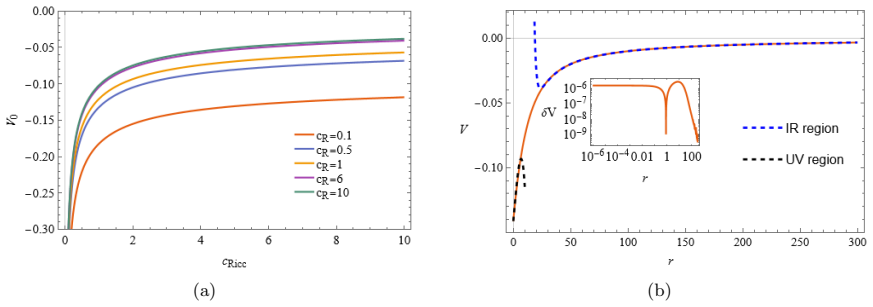
The background graviton propagator, obtained by flowing the non-local form factors to k=0 and continuing to Minkowski space, exhibits a single pole at q²=0 with positive residue and no additional ghost poles at this level of approximation. The corresponding Newtonian potential is found to be regular at r=0.
What carries the argument
The running non-local form factors obtained from the functional renormalization group flow at quadratic curvature order, which set the momentum dependence of the propagator.
If this is right
- Only the physical massless graviton mode appears in the propagator.
- No ghost poles are generated by the running form factors at this truncation.
- The Newtonian potential between point masses remains finite as their separation approaches zero.
- The result holds after analytic continuation from the Euclidean to the Minkowski signature.
Where Pith is reading between the lines
- If the same form-factor structure survives in truncations with additional curvature terms, the absence of ghosts may be a robust feature of the theory.
- The finite short-distance potential suggests that classical curvature singularities could be resolved once the full quantum dynamics are taken into account.
- Extending the same construction to include matter fields would show whether the regular potential alters particle scattering or bound-state formation.
Load-bearing premise
The quadratic curvature truncation and the specific running of the non-local form factors from the functional renormalization group flow must remain valid; if higher-order curvature terms change the form-factor running, the pole structure could change.
What would settle it
Recomputing the propagator after enlarging the truncation to include cubic or quartic curvature invariants and checking whether new poles with negative residue appear would directly test the claim.
Figures
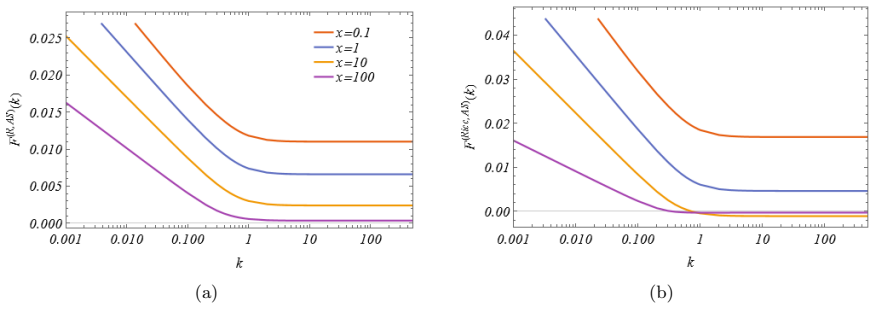
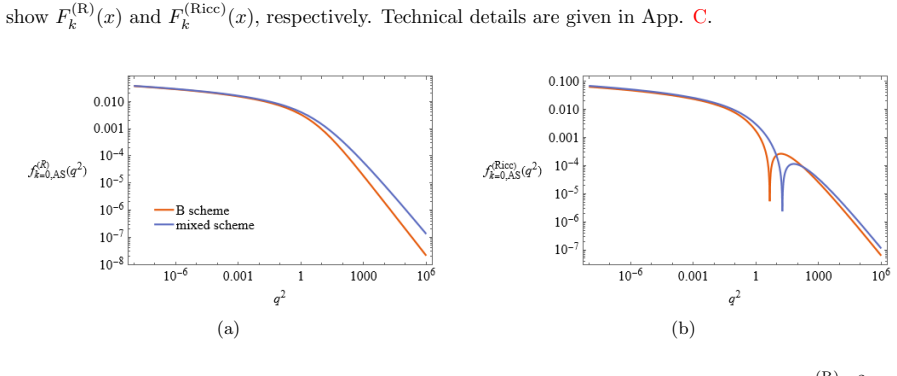
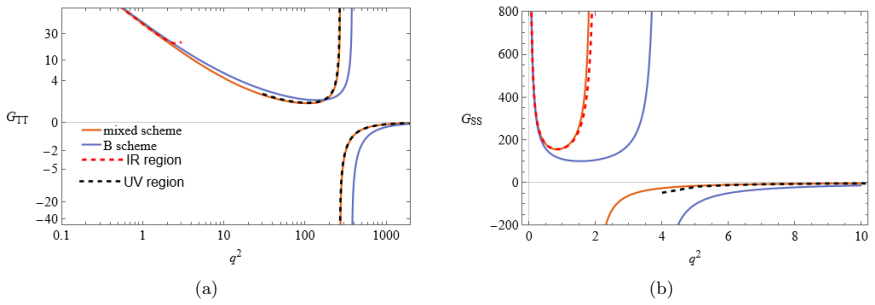
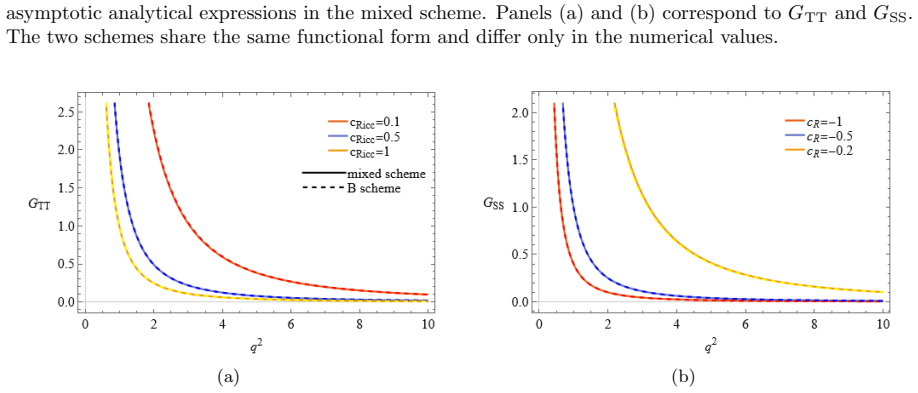
read the original abstract
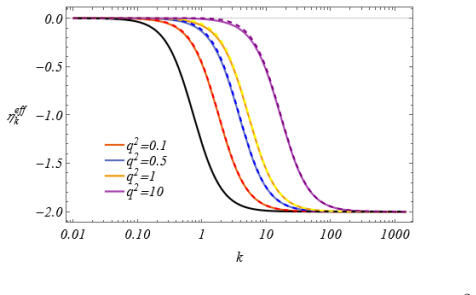
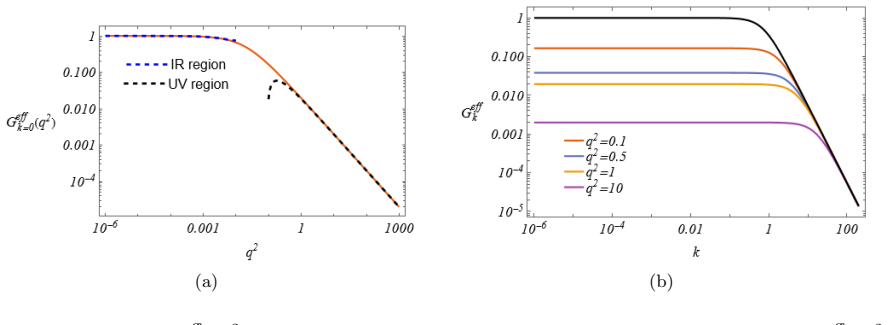
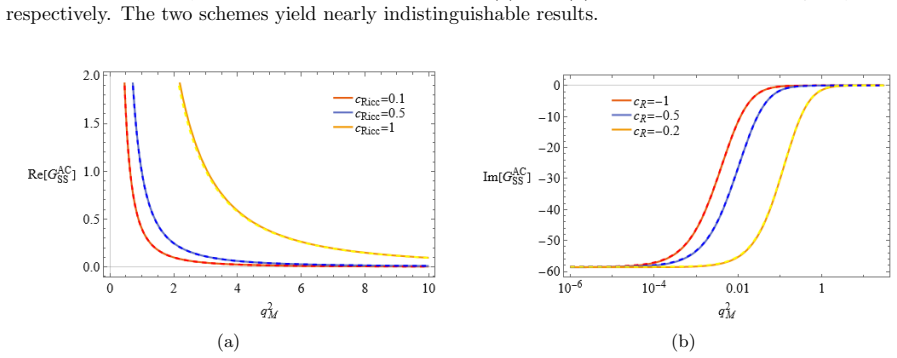
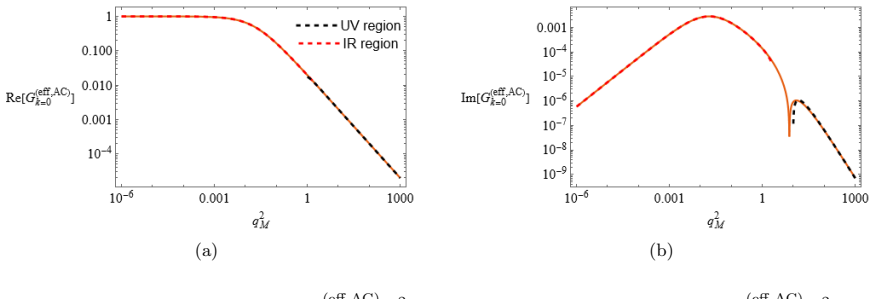
We analyze the flow of the background graviton propagator driven by the running of asymptotically safe form factors in four-dimensional quantum gravity at quadratic order in the curvature expansion. We construct the propagator in the $k=0$ limit and investigate its momentum dependence. The non-local form factors are then analytically continued to Minkowski spacetime, from which the corresponding Minkowskian propagator is obtained. We find a single pole at $q^2=0$ with positive residue and no additional ghost poles at this level of approximation. The corresponding Newtonian potential is found to be regular at $r=0$.
Editorial analysis
A structured set of objections, weighed in public.
Referee Report
Summary. The manuscript analyzes the flow of the background graviton propagator in four-dimensional asymptotically safe quantum gravity, driven by running non-local form factors obtained from the functional renormalization group within a quadratic curvature truncation. The k=0 propagator is constructed in Euclidean signature, the form factors are analytically continued to Minkowski space, and the resulting propagator is examined for its pole structure. The authors report a single pole at q²=0 with positive residue, the absence of additional ghost poles at this level of approximation, and a Newtonian potential that remains regular at r=0.
Significance. If the reported pole structure and regularity hold under further scrutiny, the work would constitute a concrete advance for the asymptotically safe gravity program by exhibiting an explicit, ghost-free graviton propagator derived from FRG flow equations and a regular low-energy potential. The technical step of analytically continuing the non-local form factors supplies a direct link between the renormalization-group running and observable quantities.
major comments (1)
- [Abstract] Abstract: the central claim of a single pole at q²=0 with positive residue and no additional ghosts is explicitly restricted to the quadratic curvature truncation. No quantitative estimate or stability analysis is supplied for the effect of higher-order curvature invariants on the form-factor beta functions and the subsequent analytic continuation; because the form factors are truncation-dependent, this omission directly affects the robustness of the no-ghost conclusion.
minor comments (2)
- The manuscript would benefit from an explicit statement, early in the text, of the precise truncation ansatz (including the number of independent form factors retained) to allow readers to assess the scope of the approximation without consulting the methods section.
- Notation for the non-local form factors and their momentum arguments should be introduced with a compact table or equation block to improve readability for readers outside the immediate FRG community.
Simulated Author's Rebuttal
We thank the referee for the careful reading and constructive feedback on our manuscript. We address the single major comment below.
read point-by-point responses
-
Referee: Abstract: the central claim of a single pole at q²=0 with positive residue and no additional ghosts is explicitly restricted to the quadratic curvature truncation. No quantitative estimate or stability analysis is supplied for the effect of higher-order curvature invariants on the form-factor beta functions and the subsequent analytic continuation; because the form factors are truncation-dependent, this omission directly affects the robustness of the no-ghost conclusion.
Authors: We agree that the results are obtained within the quadratic curvature truncation, which is already stated explicitly in the abstract ('at quadratic order in the curvature expansion' and 'at this level of approximation'). A quantitative stability analysis under inclusion of higher-order curvature invariants would require a substantially extended truncation and new FRG computations, which are computationally demanding and lie outside the scope of the present work. The manuscript therefore reports the pole structure and regularity properties at the current level of approximation, consistent with standard practice in the field when presenting truncation-dependent results. revision: no
Circularity Check
No circularity; propagator poles are direct output of FRG flow in quadratic truncation
full rationale
The paper computes the k=0 graviton propagator by inserting non-local form factors obtained from the FRG beta functions inside an explicit quadratic-curvature truncation, then performs the analytic continuation to Minkowski space. The single-pole result with positive residue is stated as the outcome of that calculation, qualified by 'at this level of approximation.' No equation redefines a quantity in terms of itself, no fitted parameter is relabeled as a prediction, and no load-bearing uniqueness claim rests on a self-citation chain. The derivation is therefore self-contained against the truncation's own flow equations.
Axiom & Free-Parameter Ledger
Forward citations
Cited by 2 Pith papers
-
Spectral Functions of Lorentzian Quantum Gravity
Spectral functions for graviton and scalar graviton modes are derived in Lorentzian asymptotically safe quantum gravity via adapted FRG flow equations, yielding normalisable results consistent with infrared effective theory.
-
The pole truth: an analytical graviton propagator from Asymptotic Safety
Analytical approximation to the graviton propagator from Asymptotic Safety shows no extra poles and identifies a mechanism where spurious pole residues vanish at higher orders.
Reference graph
Works this paper leans on
-
[1]
Deriving propagators in the presence of non-local form factors is technically challenging, as it requires the inversion of the Hessian discussed in App
to analyze their implications for the graviton propagator. Deriving propagators in the presence of non-local form factors is technically challenging, as it requires the inversion of the Hessian discussed in App. A, which can presently be carried out only around flat spacetime. The resulting Euclidean propagators atk= 0 exhibit a non-trivial momentum depen...
-
[2]
M. E. Peskin and D. V. Schroeder,An Introduction to quantum field theory(Addison-Wesley, Reading, USA, 1995)
1995
-
[3]
Weinberg,The Quantum theory of fields
S. Weinberg,The Quantum theory of fields. Vol. 1: Foundations(Cambridge University Press, 2005)
2005
-
[4]
Weinberg,The quantum theory of fields
S. Weinberg,The quantum theory of fields. Vol. 2: Modern applications(Cambridge University Press, 2013)
2013
-
[5]
J. F. Donoghue, Leading quantum correction to the Newtonian potential, Phys. Rev. Lett.72, 2996 (1994), arXiv:gr-qc/9310024
Pith/arXiv arXiv 1994
-
[6]
J. F. Donoghue, General relativity as an effective field theory: The leading quantum corrections, Phys. Rev. D50, 3874 (1994), arXiv:gr-qc/9405057
Pith/arXiv arXiv 1994
-
[7]
B. R. Holstein and J. F. Donoghue, Classical physics and quantum loops, Phys. Rev. Lett.93, 201602 (2004), arXiv:hep-th/0405239
Pith/arXiv arXiv 2004
-
[8]
A. A. Akhundov, S. Bellucci, and A. Shiekh, Gravitational interaction to one loop in effective quantum gravity, Phys. Lett. B395, 16 (1997), arXiv:gr-qc/9611018
Pith/arXiv arXiv 1997
-
[9]
A. Codello and R. K. Jain, On the covariant formalism of the effective field theory of gravity and leading order corrections, Class. Quant. Grav.33, 225006 (2016), arXiv:1507.06308 [gr-qc]
Pith/arXiv arXiv 2016
- [10]
-
[11]
J. G. Taylor, A Review of Supersymmetry and Supergravity, Prog. Part. Nucl. Phys.12, 1 (1984)
1984
- [12]
-
[13]
Eichhorn, Status of the asymptotic safety paradigm for quantum gravity and matter, Found
A. Eichhorn, Status of the asymptotic safety paradigm for quantum gravity and matter, Found. Phys.48, 1407 (2018), arXiv:1709.03696 [gr-qc]
Pith/arXiv arXiv 2018
-
[14]
A. Bonanno, A. Eichhorn, H. Gies, J. M. Pawlowski, R. Percacci, M. Reuter, F. Saueressig, and G. P. Vacca, Critical reflections on asymptotically safe gravity, Front. in Phys.8, 269 (2020), arXiv:2004.06810 [gr-qc]
arXiv 2020
-
[15]
Niedermaier, The Asymptotic safety scenario in quantum gravity: An Introduction, Class
M. Niedermaier, The Asymptotic safety scenario in quantum gravity: An Introduction, Class. Quant. Grav.24, R171 (2007), arXiv:gr-qc/0610018
Pith/arXiv arXiv 2007
-
[16]
M. Reuter and F. Saueressig, Quantum Einstein Gravity, New J. Phys.14, 055022 (2012), arXiv:1202.2274 [hep-th]
Pith/arXiv arXiv 2012
- [17]
-
[18]
Pawlowski and M
J. Pawlowski and M. Reichert, Quantum gravity: A fluctuating point of view, Frontiers in Physics 8, 551848 (2021)
2021
-
[19]
Percacci,An Introduction to Covariant Quantum Gravity and Asymptotic Safety(World Scien- tific, 2017) pp
R. Percacci,An Introduction to Covariant Quantum Gravity and Asymptotic Safety(World Scien- tific, 2017) pp. 1–300
2017
-
[20]
Saueressig, The Functional Renormalization Group in Quantum Gravity (2023) arXiv:2302.14152 [hep-th]
F. Saueressig, The Functional Renormalization Group in Quantum Gravity (2023) arXiv:2302.14152 [hep-th]
arXiv 2023
-
[21]
Reuter and F
M. Reuter and F. Saueressig,Quantum Gravity and the Functional Renormalization Group: The Road towards Asymptotic Safety, Cambridge Monographs on Mathematical Physics (Cambridge University Press, 2019)
2019
-
[22]
P. G. Freund and M. Olson, Non-archimedean strings, Physics Letters B199, 186 (1987)
1987
-
[23]
Witten, Noncommutative Geometry and String Field Theory, Nucl
E. Witten, Noncommutative Geometry and String Field Theory, Nucl. Phys. B268, 253 (1986)
1986
-
[24]
T. Biswas, M. Grisaru, and W. Siegel, Linear Regge trajectories from worldsheet lattice parton field theory, Nucl. Phys. B708, 317 (2005), arXiv:hep-th/0409089
Pith/arXiv arXiv 2005
- [25]
- [26]
- [27]
-
[28]
A. O. Barvinsky and G. A. Vilkovisky, Covariant perturbation theory. 2: Second order in the curvature. General algorithms, Nucl. Phys. B333, 471 (1990)
1990
-
[29]
A. O. Barvinsky and G. A. Vilkovisky, Beyond the schwinger-dewitt technique: Converting loops into trees and in-in currents, Nuclear Physics282, 163 (1987). 49
1987
-
[30]
A. O. Barvinsky and G. A. Vilkovisky, Covariant perturbation theory. 3: Spectral representations of the third order form-factors, Nucl. Phys. B333, 512 (1990)
1990
-
[31]
A. O. Barvinsky, Y. V. Gusev, V. V. Zhytnikov, and G. A. Vilkovisky, Covariant perturbation theory. 4. Third order in the curvature (1993), arXiv:0911.1168 [hep-th]
Pith/arXiv arXiv 1993
-
[32]
I. G. Avramidi,Heat kernel and quantum gravity, Vol. 64 (Springer, New York, 2000)
2000
-
[33]
T. Biswas, E. Gerwick, T. Koivisto, and A. Mazumdar, Towards singularity and ghost free theories of gravity, Phys. Rev. Lett.108, 031101 (2012), arXiv:1110.5249 [gr-qc]
Pith/arXiv arXiv 2012
-
[34]
V. P. Frolov and A. Zelnikov, Head-on collision of ultrarelativistic particles in ghost-free theories of gravity, Phys. Rev. D93, 064048 (2016), arXiv:1509.03336 [hep-th]
Pith/arXiv arXiv 2016
-
[35]
T. Biswas, A. Conroy, A. S. Koshelev, and A. Mazumdar, Generalized ghost-free quadratic cur- vature gravity, Class. Quant. Grav.31, 015022 (2014), [Erratum: Class.Quant.Grav. 31, 159501 (2014)], arXiv:1308.2319 [hep-th]
Pith/arXiv arXiv 2014
-
[36]
T. Biswas, T. Koivisto, and A. Mazumdar, Nonlocal theories of gravity: the flat space propagator, inBarcelona Postgrad Encounters on Fundamental Physics(2013) pp. 13–24, arXiv:1302.0532 [gr- qc]
Pith/arXiv arXiv 2013
-
[37]
Modesto, Super-renormalizable Quantum Gravity, Phys
L. Modesto, Super-renormalizable Quantum Gravity, Phys. Rev. D86, 044005 (2012), arXiv:1107.2403 [hep-th]
Pith/arXiv arXiv 2012
-
[38]
E. T. Tomboulis, Superrenormalizable gauge and gravitational theories (1997), arXiv:hep- th/9702146
arXiv 1997
-
[39]
A. Bas i Beneito, G. Calcagni, and L. Rachwa l, Classical and Quantum Nonlocal Gravity (2024) arXiv:2211.05606 [hep-th]
arXiv 2024
-
[40]
Modesto and L
L. Modesto and L. Rachwa l, Nonlocal quantum gravity: A review, Int. J. Mod. Phys. D26, 1730020 (2017)
2017
-
[41]
T. Biswas, T. Koivisto, and A. Mazumdar, Towards a resolution of the cosmological singularity in non-local higher derivative theories of gravity, JCAP11, 008, arXiv:1005.0590 [hep-th]
-
[42]
T. Biswas, A. Mazumdar, and W. Siegel, Bouncing universes in string-inspired gravity, JCAP03, 009, arXiv:hep-th/0508194
-
[43]
B. L. Giacchini, On the cancellation of Newtonian singularities in higher-derivative gravity, Phys. Lett. B766, 306 (2017), arXiv:1609.05432 [hep-th]
Pith/arXiv arXiv 2017
-
[44]
N. Burzill` a, B. L. Giacchini, T. d. P. Netto, and L. Modesto, Newtonian potential in higher- derivative quantum gravity, Phys. Rev. D103, 064080 (2021), arXiv:2012.06254 [gr-qc]
arXiv 2021
-
[45]
B. L. Giacchini and T. de Paula Netto, Effective delta sources and regularity in higher-derivative and ghost-free gravity, JCAP07, 013, arXiv:1809.05907 [gr-qc]
-
[46]
L. Buoninfante, A. S. Koshelev, G. Lambiase, and A. Mazumdar, Classical properties of non-local, ghost- and singularity-free gravity, JCAP09, 034, arXiv:1802.00399 [gr-qc]. 50
-
[47]
L. Buoninfante, A. S. Koshelev, G. Lambiase, J. Marto, and A. Mazumdar, Conformally-flat, non- singular static metric in infinite derivative gravity, JCAP06, 014, arXiv:1804.08195 [gr-qc]
-
[48]
N. Burzill` a, B. L. Giacchini, T. d. P. Netto, and L. Modesto, Higher-order regularity in local and nonlocal quantum gravity, Eur. Phys. J. C81, 462 (2021), arXiv:2012.11829 [gr-qc]
arXiv 2021
-
[49]
L. Buoninfante, B. L. Giacchini, and T. de Paula Netto, Black Holes in Non-local Gravity (2024) arXiv:2211.03497 [gr-qc]
arXiv 2024
-
[50]
Burzill` a, B
N. Burzill` a, B. L. Giacchini, L. Modesto, and T. de Paula Netto, On models of regular black holes from effective sources, J. Phys. Conf. Ser.3177, 012031 (2026)
2026
-
[51]
L. Buoninfante, G. Harmsen, S. Maheshwari, and A. Mazumdar, Nonsingular metric for an electri- cally charged point-source in ghost-free infinite derivative gravity, Phys. Rev. D98, 084009 (2018), arXiv:1804.09624 [gr-qc]
Pith/arXiv arXiv 2018
-
[52]
L. Buoninfante, G. Lambiase, Y. Miyashita, W. Takebe, and M. Yamaguchi, Generalized ghost-free propagators in nonlocal field theories, Phys. Rev. D101, 084019 (2020), arXiv:2001.07830 [hep-th]
arXiv 2020
-
[53]
Modesto, Super-renormalizable Multidimensional Quantum Gravity, Astron
L. Modesto, Super-renormalizable Multidimensional Quantum Gravity, Astron. Rev.8, 4 (2013), arXiv:1202.3151 [hep-th]
Pith/arXiv arXiv 2013
- [54]
-
[55]
B. Knorr and M. Schiffer, Non-Perturbative Propagators in Quantum Gravity, Universe7, 216 (2021), arXiv:2105.04566 [hep-th]
arXiv 2021
-
[56]
B. Knorr and A. Platania, Sifting quantum black holes through the principle of least action, Phys. Rev. D106, L021901 (2022), arXiv:2202.01216 [hep-th]
arXiv 2022
-
[57]
B. Knorr and F. Saueressig, Towards reconstructing the quantum effective action of gravity, Phys. Rev. Lett.121, 161304 (2018), arXiv:1804.03846 [hep-th]
Pith/arXiv arXiv 2018
-
[58]
N. Christiansen, D. F. Litim, J. M. Pawlowski, and A. Rodigast, Fixed points and infrared com- pletion of quantum gravity, Phys. Lett. B728, 114 (2014), arXiv:1209.4038 [hep-th]
Pith/arXiv arXiv 2014
-
[59]
N. Christiansen, B. Knorr, J. M. Pawlowski, and A. Rodigast, Global Flows in Quantum Gravity, Phys. Rev. D93, 044036 (2016), arXiv:1403.1232 [hep-th]
Pith/arXiv arXiv 2016
-
[60]
N. Christiansen, B. Knorr, J. Meibohm, J. M. Pawlowski, and M. Reichert, Local Quantum Gravity, Phys. Rev. D92, 121501 (2015), arXiv:1506.07016 [hep-th]
Pith/arXiv arXiv 2015
-
[61]
T. Denz, J. M. Pawlowski, and M. Reichert, Towards apparent convergence in asymptotically safe quantum gravity, Eur. Phys. J. C78, 336 (2018), arXiv:1612.07315 [hep-th]
Pith/arXiv arXiv 2018
-
[62]
A. Bonanno, T. Denz, J. M. Pawlowski, and M. Reichert, Reconstructing the graviton, SciPost Phys.12, 001 (2022), arXiv:2102.02217 [hep-th]
arXiv 2022
-
[63]
A. Eichhorn, S. Lippoldt, J. M. Pawlowski, M. Reichert, and M. Schiffer, How perturbative is quantum gravity?, Phys. Lett. B792, 310 (2019), arXiv:1810.02828 [hep-th]. 51
Pith/arXiv arXiv 2019
-
[64]
A. Eichhorn, P. Labus, J. M. Pawlowski, and M. Reichert, Effective universality in quantum gravity, SciPost Phys.5, 031 (2018), arXiv:1804.00012 [hep-th]
Pith/arXiv arXiv 2018
-
[65]
A. Eichhorn, S. Lippoldt, and M. Schiffer, Zooming in on fermions and quantum gravity, Phys. Rev. D99, 086002 (2019), arXiv:1812.08782 [hep-th]
Pith/arXiv arXiv 2019
-
[66]
J. M. Pawlowski and J. Tr¨ ankle, Effective action and black hole solutions in asymptotically safe quantum gravity, Phys. Rev. D110, 086011 (2024), arXiv:2309.17043 [hep-th]
arXiv 2024
-
[67]
A. P. Chiesa, J. M. Pawlowski, and M. Reichert, Towards Two-to-Two Scattering of Scalars in Asymptotically Safe Quantum Gravity (2026), arXiv:2603.10168 [hep-th]
arXiv 2026
-
[68]
B. Knorr, Asymptotically (un)safe scattering amplitudes from scratch: a deep dive into the IR jungle (2026), arXiv:2602.21285 [hep-th]
arXiv 2026
- [69]
-
[70]
´A. Pastor-Guti´ errez, J. M. Pawlowski, M. Reichert, and G. Ruisi, e+e-→µ+µ- in the asymptotically safe standard model, Phys. Rev. D111, 106005 (2025), arXiv:2412.13800 [hep-ph]
arXiv 2025
- [71]
-
[72]
J. M. Pawlowski, M. Reichert, and J. Wessely, Self-consistent graviton spectral function in Lorentzian quantum gravity (2025), arXiv:2507.22169 [hep-th]
arXiv 2025
- [73]
-
[74]
V. Kher, B. King, D. F. Litim, and M. Reichert, Matter Spectral Functions from Quantum Gravity (2025), arXiv:2507.17862 [hep-th]
arXiv 2025
-
[75]
A. Eichhorn, A. Platania, and M. Schiffer, Lorentz invariance violations in the interplay of quantum gravity with matter, Phys. Rev. D102, 026007 (2020), arXiv:1911.10066 [hep-th]
arXiv 2020
-
[76]
S. Nagy, K. Sailer, and I. Steib, Renormalization of lorentzian conformally reduced gravity, Classical and Quantum Gravity36, 155004 (2019)
2019
-
[77]
A. Baldazzi, R. Percacci, and V. Skrinjar, Wicked metrics, Class. Quant. Grav.36, 105008 (2019), arXiv:1811.03369 [gr-qc]
Pith/arXiv arXiv 2019
-
[78]
Knorr, Lorentz symmetry is relevant, Phys
B. Knorr, Lorentz symmetry is relevant, Phys. Lett. B792, 142 (2019), arXiv:1810.07971 [hep-th]
Pith/arXiv arXiv 2019
-
[79]
Wetterich, Graviton fluctuations erase the cosmological constant, Phys
C. Wetterich, Graviton fluctuations erase the cosmological constant, Phys. Lett. B773, 6 (2017), arXiv:1704.08040 [gr-qc]
Pith/arXiv arXiv 2017
-
[80]
W. B. Houthoff, A. Kurov, and F. Saueressig, Impact of topology in foliated Quantum Einstein Gravity, Eur. Phys. J. C77, 491 (2017), arXiv:1705.01848 [hep-th]
Pith/arXiv arXiv 2017
discussion (0)
Sign in with ORCID, Apple, or X to comment. Anyone can read and Pith papers without signing in.