Model structures and electron transfer properties of conductive nickel-organic nanoribbons in cable bacteria
Pith reviewed 2026-06-27 05:31 UTC · model grok-4.3
The pith
Nickel-organic nanoribbons in cable bacteria support efficient charge transport via electron delocalization.
A machine-rendered reading of the paper's core claim, the machinery that carries it, and where it could break.
Core claim
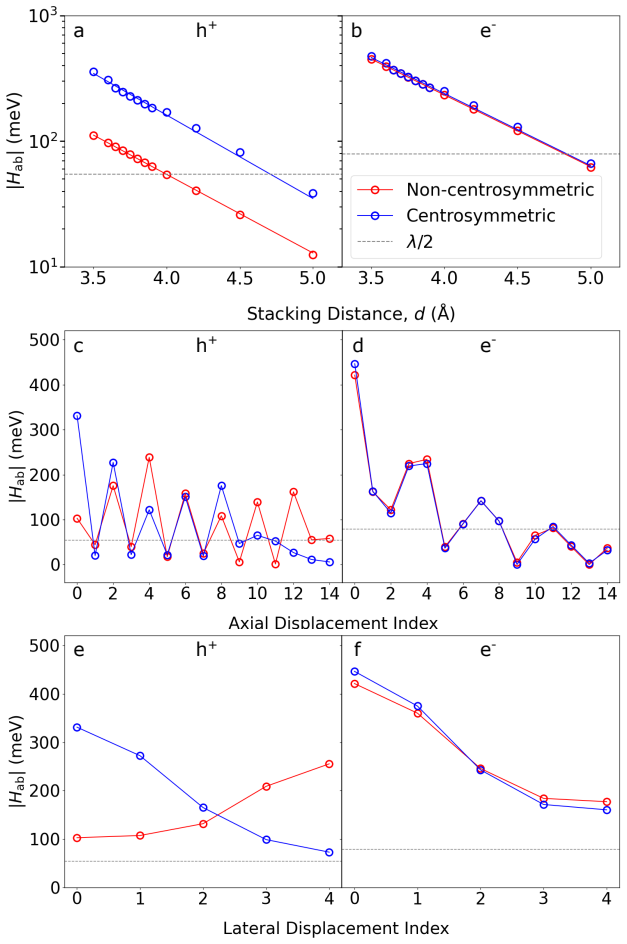
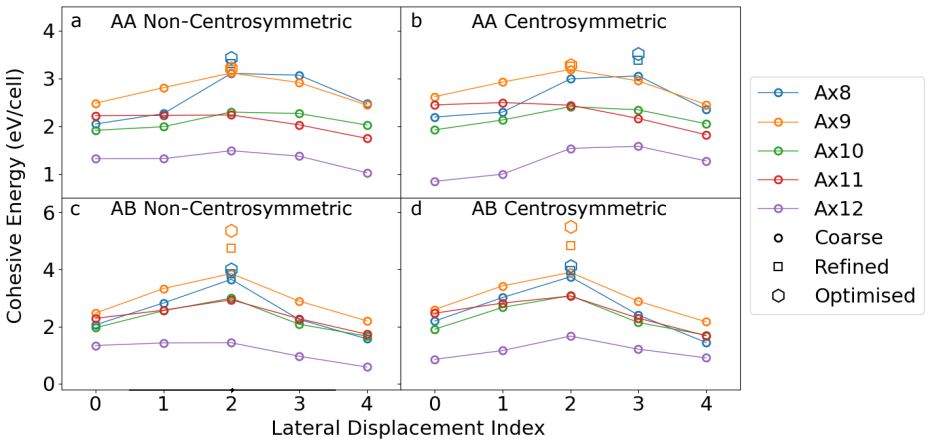
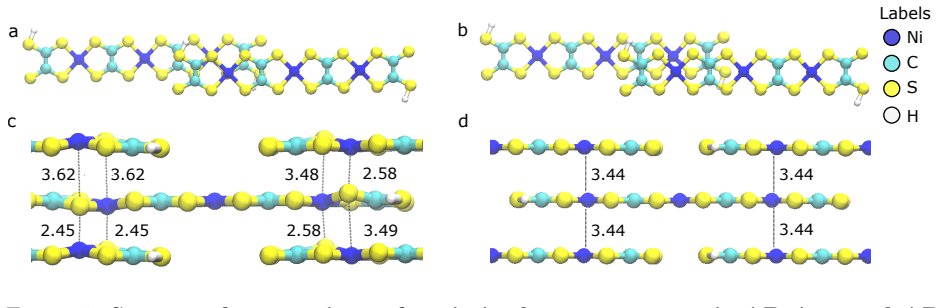
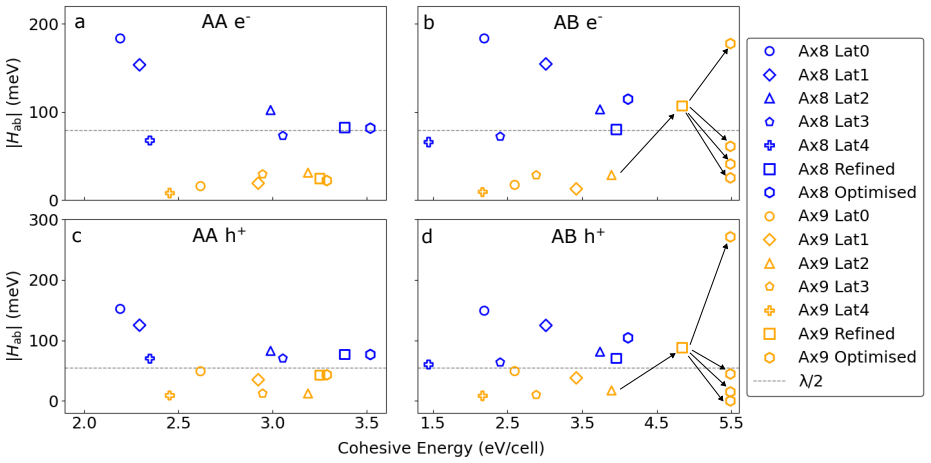
Our simulations indicate that nanoribbons are comprised of tightly stacked AA or AB-type packings of NiBiD units. In the most energetically stable structure (AB-type) some Ni centers are predicted to be 5-fold coordinated due to formation of an inter-layer Ni-S coordination bond. In several energetically low-lying structures, the electronic coupling between neighboring molecules exceeds the critical threshold for charge delocalization permitting efficient charge transport beyond small polaron hopping. Our results hence reveal that nanoribbons based on NiBiD units exhibit favorable charge transfer properties that may explain the unusually high conductivities measured in the fibers of cable ba
What carries the argument
Electronic coupling strength between adjacent nickel bis(1,2-dithiolene) units across different nanoribbon stackings, evaluated against the threshold for charge delocalization rather than small polaron hopping.
If this is right
- Efficient long-range conduction in cable bacteria can occur without reliance on small polaron hopping.
- AB-type stacking with 5-fold nickel coordination is both structurally stable and electronically favorable.
- The intertwined nanoribbons embedded in the cell envelope provide the physical conduit for centimeter-scale electron flow.
- These electronic properties position the nickel-organic framework as the source of the fibers' high biological conductivity.
Where Pith is reading between the lines
- Synthetic analogs of these nanoribbons could be assembled to produce new high-conductivity materials.
- Advanced imaging or spectroscopy on intact bacterial samples could directly test for the predicted nickel coordination geometry.
- The same modeling strategy could be applied to other metal-organic assemblies suspected to mediate biological electron transport.
Load-bearing premise
The chosen model nanoribbon structures and DFT parameters accurately capture the real atomic arrangements and electronic couplings present in the bacterial fibers.
What would settle it
Spectroscopic detection of 5-fold coordinated nickel or direct measurement showing coupling below the delocalization threshold in the fibers would falsify the claim.
Figures

read the original abstract
Cable bacteria are multicellular bacteria capable of centimeter-scale conduction through a regular fiber network embedded in their cell envelope. The conductivity of these fibers is extremely high for biological materials, and rivals that of the best synthetic conductive polymers, but the underlying electron transport mechanism remains elusive. Recent microscopic and spectroscopic evidence indicates that each fiber embeds a bundle of intertwined nanoribbons as the conductive conduit. Each nanoribbon consists of a one-dimensional nickel-organic framework, built from stacked nickel bis(1,2-dithiolene) oligomers (NiBiD units) as molecular building blocks. Here we performed DFT calculations of nanoribbon model structures, in order to characterize their electronic properties, examine potential stacking configurations and verify whether these structures can support efficient conductance. Our simulations indicate that nanoribbons are comprised of tightly stacked AA or AB-type packings of NiBiD units. In the most energetically stable structure (AB-type) some Ni centers are predicted to be 5-fold coordinated due to formation of an inter-layer Ni-S coordination bond. In several energetically low-lying structures, the electronic coupling between neighboring molecules exceeds the critical threshold for charge delocalization permitting efficient charge transport beyond small polaron hopping. Our results hence reveal that nanoribbons based on NiBiD units exhibit favorable charge transfer properties that may explain the unusually high conductivities measured in the fibers of cable bacteria.
Editorial analysis
A structured set of objections, weighed in public.
Referee Report
Summary. The manuscript reports DFT calculations on model nanoribbon structures formed from stacked nickel bis(1,2-dithiolene) (NiBiD) oligomers, proposed as the conductive conduits in cable bacteria fibers. It identifies AA- and AB-type packings as low-energy configurations, predicts 5-fold Ni coordination via inter-layer Ni-S bonds in the most stable AB structure, and concludes that electronic couplings in several low-lying structures exceed the threshold for charge delocalization, thereby permitting efficient transport beyond small-polaron hopping.
Significance. If the quantitative results and model validity hold, the work supplies a plausible molecular mechanism linking the observed high conductivity of cable-bacteria fibers to specific stacking geometries and coordination motifs. The identification of stable 5-fold coordinated Ni centers is a concrete structural prediction that could guide future spectroscopic tests. No machine-checked proofs, reproducible code, or parameter-free derivations are presented.
major comments (2)
- [Abstract] Abstract: the claim that 'the electronic coupling between neighboring molecules exceeds the critical threshold for charge delocalization' is presented without any reported numerical values for the couplings, the numerical value or derivation of the threshold, or error estimates on the DFT results. Because this comparison is the sole basis for the assertion that transport exceeds small-polaron hopping, the central claim cannot be evaluated.
- [Abstract] Abstract (paragraph describing the simulations): the nanoribbon models are selected solely by energy minimization, yet no experimental anchor (EXAFS, diffraction, or measured Ni-S distances) is supplied to validate the stacking geometry or coordination distances. The conclusion that the structures 'exhibit favorable charge transfer properties' therefore rests on an untested assumption that the chosen models faithfully represent the bacterial fibers; a shift in geometry or coupling would remove the support for delocalized transport.
minor comments (1)
- The abstract would be strengthened by inclusion of at least one representative numerical result (e.g., a coupling value in meV or an energy difference between AA and AB packings) together with the DFT functional and basis set employed.
Simulated Author's Rebuttal
We thank the referee for the careful reading and constructive feedback on our manuscript. We address the two major comments point-by-point below. Where the comments identify deficiencies in the abstract, we have revised the text to improve clarity and evaluability while preserving the computational nature of the study.
read point-by-point responses
-
Referee: [Abstract] Abstract: the claim that 'the electronic coupling between neighboring molecules exceeds the critical threshold for charge delocalization' is presented without any reported numerical values for the couplings, the numerical value or derivation of the threshold, or error estimates on the DFT results. Because this comparison is the sole basis for the assertion that transport exceeds small-polaron hopping, the central claim cannot be evaluated.
Authors: We agree that the abstract as originally written does not supply the numerical values needed for independent evaluation. The main text contains the computed couplings, the delocalization threshold (derived from the condition 2J > λ in the Marcus framework), and discussion of DFT functional sensitivity. In the revised version we have updated the abstract to state the key coupling magnitudes, the numerical threshold employed, and a brief reference to the computational details section. This makes the central claim directly assessable from the abstract without altering the underlying results. revision: yes
-
Referee: [Abstract] Abstract (paragraph describing the simulations): the nanoribbon models are selected solely by energy minimization, yet no experimental anchor (EXAFS, diffraction, or measured Ni-S distances) is supplied to validate the stacking geometry or coordination distances. The conclusion that the structures 'exhibit favorable charge transfer properties' therefore rests on an untested assumption that the chosen models faithfully represent the bacterial fibers; a shift in geometry or coupling would remove the support for delocalized transport.
Authors: The study is a first-principles exploration of candidate nanoribbon geometries consistent with the NiBiD building blocks proposed in the experimental literature on cable bacteria. No direct structural data (EXAFS or diffraction) for the in vivo fibers currently exist to provide an experimental anchor, which is a genuine limitation of the present work. The models were chosen by energy minimization and cross-checked against known crystal structures of molecular Ni dithiolene compounds. In revision we have added an explicit limitations paragraph that states the reliance on computational selection, notes the absence of experimental geometric constraints, and calls for future spectroscopic tests of the predicted 5-fold Ni coordination and stacking motifs. The claim of favorable charge-transfer properties is therefore presented as a prediction rather than a validated fact. revision: partial
Circularity Check
No circularity; forward DFT computation from model structures
full rationale
The paper performs standard DFT geometry optimization and electronic coupling calculations on chosen nanoribbon model packings (AA/AB stackings of NiBiD units). Electronic couplings are computed directly from the resulting wavefunctions and compared to a delocalization threshold; no parameter is fitted to the target conductance property and then renamed as a prediction, no self-citation supplies the load-bearing uniqueness or ansatz, and no equation reduces to its input by construction. The derivation chain is therefore self-contained against external benchmarks (DFT energies and couplings).
Axiom & Free-Parameter Ledger
axioms (1)
- domain assumption Standard DFT functionals and basis sets are adequate to predict electronic couplings and relative energies in nickel dithiolene complexes.
Reference graph
Works this paper leans on
-
[1]
Moser, Christopher C. and Keske, J. M. and Warncke, K. and Farid, R. S. and Dutton, P. Leslie , title =. Nature , year =. doi:10.1038/355796a0 , pmid =
-
[2]
Gray, Harry B. and Winkler, Jay R. , title =. Quart. Rev. Biophys. , year =. doi:10.1017/S0033583503003913 , pmid =
-
[3]
and Reardon, Catherine L
Hartshorne, Robert S. and Reardon, Catherine L. and Ross, Daniel and Nuester, Jochen and Clarke, Thomas A. and Gates, Andrew J. and Mills, Philippa C. and Fredrickson, Jim K. and Zachara, John M. and Shi, Liang and Beliaev, Alex S. and Marshall, Marvin J. and Tien, Ming and Brantley, Susan and Butt, Julea N. and Richardson, David J. , title =. Proc. Natl....
-
[4]
Wang, Fang and Gu, Yangqi and O'Brien, John P. and Yi, Seunghwan M. and Yalcin, Sinan E. and Srikanth, Vishok and Shen, Chong and Vu, Duy and Ing, Nathan L. and Hochbaum, Allon I. and Egelman, Edward H. and Malvankar, Nikhil S. , title =. Cell , year =. doi:10.1016/j.cell.2019.03.029 , pmid =
-
[5]
and Hirst, Judy , title =
Zhu, Jun and Vinothkumar, Kutti R. and Hirst, Judy , title =. Nature , year =
-
[6]
Decoding the Elusive Redox Properties of
Gao, Yanxin and Wan, Lei and DeBeer, Serena and Zhang, Liyun and R. Decoding the Elusive Redox Properties of. J. Am. Chem. Soc. , year =. doi:10.1021/jacs.5c12671 , pmid =
-
[7]
Blumberger, Jochen , title =. Chem. Rev. , year =
-
[8]
Structure and Mechanism of Respiratory
Brzezinski, Peter and Moe, Agnes and. Structure and Mechanism of Respiratory. Chem. Rev. , year =. doi:10.1021/acs.chemrev.1c00140 , pmid =
-
[9]
and Jensen, Grant J
Subramanian, Prangishvili and Pirbadian, Sahand and El-Naggar, Mohamed Y. and Jensen, Grant J. , title =. Proc. Natl. Acad. Sci. U.S.A. , year =
-
[10]
Bostick, Christopher D. and Mukhopadhyay, Soumyadip and Pecht, Israel and Sheves, Mordechai and Cahen, David and Lederman, David , title =. Rep. Prog. Phys. , year =. doi:10.1088/1361-6633/aa85f2 , pmid =
-
[11]
Garg, Kunal and Ghosh, Moumita and Eliash, Tair and van Wonderen, Jeroen H. and Butt, Julea N. and Shi, Liang and Jiang, Xia and Futera, Zdenek and Blumberger, Jochen and Pecht, Israel and Sheves, Mordechai and Cahen, David , title =. Chem. Sci. , year =. doi:10.1039/C8SC01716F , pmid =
-
[12]
Futera, Zdenek and Wu, Xiaoxi and Blumberger, Jochen , title =. J. Phys. Chem. Lett. , year =. doi:10.1021/acs.jpclett.2c03361 , pmid =
-
[13]
Garg, Kunal and Futera, Zdenek and Wu, Xiaoxi and Jeong, Yujin and Chiu, Ryan and Pisharam, Vishnu C. and Ha, Ta Q. and Aragon. Shallow conductance decay along the heme array of a single tetraheme protein wire , journal =. 2024 , volume =. doi:10.1039/D4SC01366B , pmid =
-
[14]
Nielsen, Lars Peter and Risgaard-Petersen, Nils and Fossing, Henrik and Christensen, Peter Bondo and Sayama, Mikio , title =. Nature , year =. doi:10.1038/nature08790 , pmid =
-
[15]
Pfeffer, Christian and Larsen, Steffen and Song, Jie and Dong, Mingdong and Besenbacher, Flemming and Meyer, Rikke Louise and Kjeldsen, Kasper Urup and Schreiber, Lars and Gorby, Yuri A. and El-Naggar, Mohamed Y. and Leung, Kam Tin and Schramm, Andreas and Risgaard-Petersen, Nils and Nielsen, Lars Peter , title =. Nature , year =. doi:10.1038/nature11586 , pmid =
-
[16]
Meysman, Filip J. R. and Cornelissen, Robin and Trashin, Stanislav and Bonn. A highly conductive fibre network enables centimetre-scale electron transport in multicellular cable bacteria , journal =. 2019 , volume =. doi:10.1038/s41467-019-12115-7 , pmid =
-
[17]
Intrinsic electrical properties of cable bacteria reveal an
Bonn. Intrinsic electrical properties of cable bacteria reveal an. Sci. Rep. , year =
-
[18]
The organo-metal-like nature of long-range conduction in cable bacteria , journal =
Pankratov, Dmitry and Hidalgo Martinez, Silvia and Karman, C. The organo-metal-like nature of long-range conduction in cable bacteria , journal =. 2024 , volume =. doi:10.1016/j.bioelechem.2024.108675 , pmid =
-
[19]
and Valianti, Stephanie and van der Zant, Herre S
van der Veen, Jasper R. and Valianti, Stephanie and van der Zant, Herre S. J. and Blanter, Yaroslav M. and Meysman, Filip J. R. , title =. Phys. Chem. Chem. Phys. , year =. doi:10.1039/D3CP04466A , pmid =
-
[20]
and Rosso, Kevin M
Wigginton, Nicholas S. and Rosso, Kevin M. and Lower, Brian H. and Shi, Liang and Hochella, Michael F. Jr. , title =. Geochim. Cosmochim. Acta , year =
-
[21]
Jiang, Xia and van Wonderen, Jeroen H. and Butt, Julea N. and Edwards, Marcus J. and Clarke, Thomas A. and Blumberger, Jochen , title =. J. Phys. Chem. Lett. , year =. doi:10.1021/acs.jpclett.0c02842 , pmid =
-
[22]
Meysman, Filip J. R. and Smets, Bent and Hidalgo Martinez, Silvia and Claes, Nathalie and Schroeder, Bob C. and Geelhoed, Jeanine S. and Liu, Yun and Choyikutty, Jiji Alingapoyil and Chennit, Tamazouzt and Bodson, Thijs and Collauto, Alberto and Roessler, Maxie M. and Karpov, Dmitry and Bohic, Sylvain and Aramini, Matteo and Hayama, Shusaku and Wetheringt...
2026
-
[23]
Xie, Jin and Ewing, Samuel and Boyn, Jonathan N. and Filatov, Alexander S. and Cheng, Bin and Ma, Tianyu and Grocke, Gabriel L. and Zhao, Nan and Itani, Rami and Sun, Xin and Cho, Hyun and Chen, Zhen and Chapman, Karena W. and Patel, Sahil N. and Talapin, Dmitri V. and Park, Jiwoong and Mazziotti, David A. and Anderson, John S. , title =. Nature , year =....
-
[24]
Fratini, Simone and Mayou, Didier and Ciuchi, Sergio , title =. Adv. Funct. Mater. , volume =. doi:https://doi.org/10.1002/adfm.201502386 , url =. https://advanced.onlinelibrary.wiley.com/doi/pdf/10.1002/adfm.201502386 , abstract =
-
[25]
A map of high-mobility molecular semiconductors , journal =
Fratini, Simone and Ciuchi, Sergio and Mayou, Didier and de Laissardi. A map of high-mobility molecular semiconductors , journal =. 2017 , volume =. doi:10.1038/nmat4970 , pmid =
-
[26]
Fratini, Simone and Nikolka, Mark and Salleo, Alberto and Schweicher, Guillaume and Sirringhaus, Henning , title =. Nat. Mater. , year =. doi:10.1038/s41563-020-0647-2 , pmid =
-
[27]
Heck, Alexander and Kranz, Julian J. and Kuba. Multi-scale approach to non-adiabatic charge transport in high-mobility organic semiconductors , journal =. 2015 , volume =. doi:10.1021/acs.jctc.5b00719 , pmid =
-
[28]
Xie, Wei and Holub, David and Kuba. Performance of mixed quantum-classical approaches on modeling the crossover from hopping to bandlike charge transport in organic semiconductors , journal =. 2020 , volume =. doi:10.1021/acs.jctc.9b01271 , pmid =
-
[29]
Roosta, Sanaz and Ghalami, Fatemeh and Elstner, Marcus and Xie, Wei , title =. J. Chem. Theory Comput. , year =. doi:10.1021/acs.jctc.1c00944 , pmid =
-
[30]
and Ghosh, Soumya and Blumberger, Jochen , title =
Giannini, Samuele and Carof, Antoine and Ellis, Michael and Yang, Hongling and Ziogos, Orestis G. and Ghosh, Soumya and Blumberger, Jochen , title =. Nat. Commun. , year =. doi:10.1038/s41467-019-11775-9 , pmid =
-
[31]
Giannini, Samuele and Ziogos, Orestis George and Carof, Antoine and Ellis, Matthew and Blumberger, Jochen , title =. Adv. Theory Simul. , volume =. doi:https://doi.org/10.1002/adts.202000093 , url =. https://advanced.onlinelibrary.wiley.com/doi/pdf/10.1002/adts.202000093 , abstract =
-
[32]
Giannini, Samuele and Blumberger, Jochen , title =. Acc. Chem. Res. , year =. doi:10.1021/acs.accounts.1c00675 , pmid =
-
[33]
and Zheng, Weijia and Volpi, Matteo and Elsner, Jonas and Broch, Katharina and Geerts, Yves H
Giannini, Samuele and Di Virgilio, Lorenzo and Bardini, Mattia and Hausch, Johannes and Geuchies, Jasper J. and Zheng, Weijia and Volpi, Matteo and Elsner, Jonas and Broch, Katharina and Geerts, Yves H. and Schreiber, Frank and Schweicher, Guillaume and Wang, Hai I. and Blumberger, Jochen and Bonn, Mischa and Beljonne, David , title =. Nat. Mater. , year ...
-
[34]
Elsner, Jonas and Xu, Yifan and Goldberg, Emily D. and Ivanovic, Filip and Dines, Adam and Giannini, Samuele and Sirringhaus, Henning and Blumberger, Jochen , title =. Sci. Adv. , year =. doi:10.1126/sciadv.adr1758 , pmid =
-
[35]
and Beljonne, David and Rao, Akshay , title =
Sneyd, Alexander J. and Beljonne, David and Rao, Akshay , title =. J. Phys. Chem. Lett. , year =. doi:10.1021/acs.jpclett.2c01133 , pmid =
-
[36]
Polycarpou, Georgia and Skourtis, Spiros S. , title =. J. Phys. Chem. B , year =. doi:10.1021/acs.jpcb.4c08264 , pmid =
-
[37]
Available: https://doi.org/10.1103/PhysRevLett.77.3865
Perdew, John P. and Burke, Kieron and Ernzerhof, Matthias , title =. Phys. Rev. Lett. , year =. doi:10.1103/PhysRevLett.77.3865 , pmid =
-
[38]
Grimme, Stefan and Antony, Jens and Ehrlich, Stephan and Krieg, Helge , title =. J. Chem. Phys. , year =. doi:10.1063/1.3382344 , pmid =
-
[39]
Becke, Axel D. and Johnson, Erin R. , title =. J. Chem. Phys. , year =. doi:10.1063/1.2065267 , pmid =
-
[40]
Adamo, Carlo and Barone, Vincenzo , title =. J. Chem. Phys. , year =
-
[41]
K. J. Chem. Phys. , year =
-
[42]
Futera, Zdenek and Blumberger, Jochen , title =. J. Phys. Chem. C , year =
-
[43]
Kubas, Adam and Hoffmann, Fabian and Heck, Alexander and Oberhofer, Harald and Elstner, Marcus and Blumberger, Jochen , title =. J. Chem. Phys. , year =. doi:10.1063/1.4867077 , pmid =
-
[44]
Kubas, Adam and Gajdos, Fruzsina and Heck, Alexander and Oberhofer, Harald and Elstner, Marcus and Blumberger, Jochen. Electronic couplings for molecular charge transfer: benchmarking CDFT , FODFT and FODFTB against high-level ab initio calculations. II. Phys. Chem. Chem. Phys. 2015. doi:10.1039/C4CP04749D
-
[45]
Ziogos, Orestis George and Kubas, Adam and Futera, Zdenek and Xie, Weiwei and Elstner, Marcus and Blumberger, Jochen , title =. J. Chem. Phys. , year =
-
[46]
Charge transport in organic semiconductors , journal =
Coropceanu, Veaceslav and Cornil, J. Charge transport in organic semiconductors , journal =. 2007 , volume =. doi:10.1021/cr050140x , pmid =
-
[47]
Tsuzuki, Seiji and Uchimaru, Tadafumi. Accuracy of intermolecular interaction energies , particularly those of hetero-atom containing molecules obtained by DFT calculations with Grimme ' s D2 , D3 and D3BJ dispersion corrections. Phys. Chem. Chem. Phys. 2020. doi:10.1039/D0CP03679J
-
[48]
Boschker, Henricus T. S. and Cook, Perran L. M. and Polerecky, Lubos and Eachambadi, Ranjith T. and Lozano, Hector and Hidalgo-Martinez, Silvia and Khalenkow, Dmytro and Spampinato, Valentina and Claes, Nathalie and Kundu, Prabir and Wang, Da and Bals, Sara and Sand, Karina K. and Cavezza, Fabio and Hauffman, Tom and Bjerg, Jesper T. and Skirtach, Andre G...
-
[49]
Malkin, Sergei Y. and Rao, Aniruddha M. and Seitaj, Dhimiter and Vasquez-Cardenas, Diana and Zetsche, Eva-Maria and Hidalgo-Martinez, Silvia and Boschker, Henricus T. S. and Meysman, Filip J. R. , title =. ISME J. , year =. doi:10.1038/ismej.2014.41 , pmid =
-
[50]
Meysman, Filip J. R. , title =. Trends Microbiol. , year =. doi:10.1016/j.tim.2017.10.011 , pmid =
-
[51]
The cell envelope structure of cable bacteria , journal =
Cornelissen, Robin and B. The cell envelope structure of cable bacteria , journal =. 2018 , volume =. doi:10.3389/fmicb.2018.03044 , pmid =
-
[52]
Digel, Liselotte and Justesen, Mie L. and Madsen, Nanna S. and Fransaert, Niels and Wouters, Koen and Bonn. Comparison of cable bacteria genera reveals details of their conduction machinery , journal =. 2025 , volume =. doi:10.1038/s44319-025-00387-8 , pmid =
-
[53]
Yang, Yang and Wang, Zhen and Gan, Cheng and Klausen, Louise H. and Bonn. Long-distance electron transfer in a filamentous. Nat. Commun. , year =. doi:10.1038/s41467-021-21709-z , pmid =
-
[54]
and Hidalgo Martinez, Silvia and Wieland, Albert and De Pellegrin, Matteo and Verweij, Rick and Blanter, Yaroslav M
van der Veen, Jasper R. and Hidalgo Martinez, Silvia and Wieland, Albert and De Pellegrin, Matteo and Verweij, Rick and Blanter, Yaroslav M. and van der Zant, Herre S. J. and Meysman, Filip J. R. , title =. ACS Nano , year =
-
[55]
Kato, Reizo , title =. Chem. Rev. , year =
-
[56]
and Neese, Frank , title =
Petrenko, Taras and Ray, Kallol and Wieghardt, Karl E. and Neese, Frank , title =. J. Am. Chem. Soc. , year =
-
[57]
and Heth, Christopher L
Amb, Chad M. and Heth, Christopher L. and Evenson, Sean J. and Pokhodnya, Konstantin I. and Rasmussen, Seth C. , title =. Inorg. Chem. , year =
-
[58]
Electronic structure of square planar bis(benzene-1,2-dithiolato)metal complexes [
Ray, Kallol and Weyherm. Electronic structure of square planar bis(benzene-1,2-dithiolato)metal complexes [. Inorg. Chem. , year =
-
[59]
and Tuominen, Mark T
Malvankar, Nikhil S. and Tuominen, Mark T. and Lovley, Derek R. , title =. Energy Environ. Sci. , year =
-
[60]
Janak, J. F. , title =. Phys. Rev. B , year =
-
[61]
, title =
Koopmans, T. , title =. Physica , year =
-
[62]
Elmaslmane, A. R. and Wetherell, J. and Hodgson, M. J. P. and McKenna, K. P. and Godby, R. W. , title =. Phys. Rev. Mater. , year =
-
[63]
and Blumberger, Jochen , title =
McKenna, Keith P. and Blumberger, Jochen , title =. Phys. Rev. B , year =
-
[64]
, title =
Bondi, A. , title =. J. Phys. Chem. , volume =. 1964 , doi =
1964
-
[65]
C.; Keske, J
Moser, C. C.; Keske, J. M.; Warncke, K.; Farid, R. S.; Dutton, P. L. Nature of biological electron transfer. Nature 1992, 355, 796--802
1992
-
[66]
B.; Winkler, J
Gray, H. B.; Winkler, J. R. Electron tunneling through proteins. Quart. Rev. Biophys. 2003, 36, 341--372
2003
-
[67]
S.; Reardon, C
Hartshorne, R. S.; Reardon, C. L.; Ross, D.; Nuester, J.; Clarke, T. A.; Gates, A. J.; Mills, P. C.; Fredrickson, J. K.; Zachara, J. M.; Shi, L. et al. Characterization of an extracellular conduit between bacteria and the extracellular environment. Proc. Natl. Acad. Sci. U.S.A. 2009, 106, 22169--22174
2009
-
[68]
P.; Yi, S
Wang, F.; Gu, Y.; O'Brien, J. P.; Yi, S. M.; Yalcin, S. E.; Srikanth, V.; Shen, C.; Vu, D.; Ing, N. L.; Hochbaum, A. I. et al. Structure of Microbial Nanowires Reveals Stacked Hemes that Transport Electrons over Micrometers. Cell 2019, 177, 361--369.e10
2019
-
[69]
R.; Hirst, J
Zhu, J.; Vinothkumar, K. R.; Hirst, J. Structure of mammalian respiratory complex I. Nature 2016, 536, 354--358
2016
-
[70]
Decoding the Elusive Redox Properties of [FeS] Clusters in [FeFe] -Hydrogenase on a Nanostructured Electrode
Gao, Y.; Wan, L.; DeBeer, S.; Zhang, L.; R \"u diger, O. Decoding the Elusive Redox Properties of [FeS] Clusters in [FeFe] -Hydrogenase on a Nanostructured Electrode. J. Am. Chem. Soc. 2025, 147, 44661--44666
2025
-
[71]
Recent advances in the theory and molecular simulation of biological electron transfer reactions
Blumberger, J. Recent advances in the theory and molecular simulation of biological electron transfer reactions. Chem. Rev. 2015, 115, 11191--11238
2015
-
[72]
Structure and Mechanism of Respiratory III-IV Supercomplexes in Bioenergetic Membranes
Brzezinski, P.; Moe, A.; \"A delroth , P. Structure and Mechanism of Respiratory III-IV Supercomplexes in Bioenergetic Membranes. Chem. Rev. 2021, 121, 9644--9673
2021
-
[73]
Y.; Jensen, G
Subramanian, P.; Pirbadian, S.; El-Naggar, M. Y.; Jensen, G. J. Ultrastructure of Shewanella oneidensis MR-1 nanowires revealed by electron cryotomography. Proc. Natl. Acad. Sci. U.S.A. 2018, 115, E3246--E3255
2018
-
[74]
S.; Tuominen, M
Malvankar, N. S.; Tuominen, M. T.; Lovley, D. R. Lack of cytochrome involvement in long-range electron transport through conductive biofilms and nanowires of Geobacter sulfurreducens . Energy Environ. Sci. 2012, 5, 8651--8659
2012
-
[75]
P.; Risgaard-Petersen, N.; Fossing, H.; Christensen, P
Nielsen, L. P.; Risgaard-Petersen, N.; Fossing, H.; Christensen, P. B.; Sayama, M. Electric currents couple spatially separated biogeochemical processes in marine sediment. Nature 2010, 463, 1071--1074
2010
-
[76]
L.; Kjeldsen, K
Pfeffer, C.; Larsen, S.; Song, J.; Dong, M.; Besenbacher, F.; Meyer, R. L.; Kjeldsen, K. U.; Schreiber, L.; Gorby, Y. A.; El-Naggar, M. Y. et al. Filamentous bacteria transport electrons over centimetre distances. Nature 2012, 491, 218--221
2012
-
[77]
Y.; Rao, A
Malkin, S. Y.; Rao, A. M.; Seitaj, D.; Vasquez-Cardenas, D.; Zetsche, E.-M.; Hidalgo-Martinez, S.; Boschker, H. T. S.; Meysman, F. J. R. Natural occurrence of microbial sulphur oxidation by long-range electron transport in the seafloor. ISME J. 2014, 8, 1843--1854, Erratum: ISME J. 2014, 8, 2551--2552
2014
-
[78]
Meysman, F. J. R. Cable bacteria take a new breath using long-distance electricity. Trends Microbiol. 2018, 26, 411--422
2018
-
[79]
T.; Koning, R
Cornelissen, R.; B ggild, A.; Eachambadi, R. T.; Koning, R. I.; Kremer, A.; Hidalgo-Martinez, S.; Zetsche, E.-M.; Damgaard, L. R.; Bonn \'e , R.; Drijkoningen, J. et al. The cell envelope structure of cable bacteria. Front. Microbiol. 2018, 9, 3044
2018
-
[80]
Meysman, F. J. R.; Cornelissen, R.; Trashin, S.; Bonn \'e , R.; Martinez, S. H.; van der Veen, J.; Blom, C. J.; Karman, C.; Hou, J. L.; Eachambadi, R. T. et al. A highly conductive fibre network enables centimetre-scale electron transport in multicellular cable bacteria. Nat. Commun. 2019, 10, 4120
2019
discussion (0)
Sign in with ORCID, Apple, or X to comment. Anyone can read and Pith papers without signing in.