REVIEW 2 major objections 2 minor 129 references
Switching Hamiltonian Monte Carlo for sampling from mixture distributions
T0 review · 2 major / 2 minor · reviewed 2026-06-27 · grok-4.3
Pith's one-line read Switching Hamiltonian Monte Carlo produces a geometrically ergodic Markov chain for sampling finite mixture distributions.
desk verdict Switching HMC adds a regime-switching layer with uniformization jumps and a Poisson-equation bias argument for mixture targets; the claims are specific but rest on unshown proofs. read the letter →
The pith
A machine-rendered reading of the paper's core claim, the machinery that carries it, and where it could break.
The reading
What carries the argument
Symmetric numerical integrators for switching Hamiltonian dynamics interlaced with Poisson jumps, which preserve the structural properties needed for the Poisson-equation error analysis to deliver second-order bias bounds.
What would settle it
A simulation on a two-component Gaussian mixture in which the empirical convergence rate of the chain is slower than geometric or the observed bias in ergodic averages deviates from second order.
Extended reading notes
Core claim
The central claim is that the switching Hamiltonian Monte Carlo method, built from symmetric numerical integrators for switching Hamiltonian dynamics with Poisson jumps, generates a Markov chain that converges geometrically to the target mixture and whose ergodic averages incur only second-order bias, with the bias order established through the discrete Poisson equation associated with the numerical scheme.
Load-bearing premise
The target must be a finite mixture of Boltzmann-Gibbs distributions whose components allow construction of symmetric integrators that keep the properties required for the Poisson-equation error analysis.
Editorial extensions
If this is right
- The Markov chain converges geometrically fast to the target mixture distribution.
- Ergodic averages computed from the chain have bias of order two with respect to the integration step size.
- The same error-analysis technique based on the discrete Poisson equation applies to other sampling dynamics such as kinetic Langevin equations.
- The method works for any finite mixture whose components admit the required symmetric integrators.
Reading between the lines
- The approach may allow more reliable posterior sampling in Bayesian models whose priors or likelihoods are finite mixtures.
- Using uniformization for the Poisson jumps could keep simulation cost low when the switching rate is moderate.
- The framework might extend to mixtures whose components are not exactly Boltzmann-Gibbs if suitable symmetric integrators can still be built.
Editorial analysis
A structured set of objections, weighed in public.
Referee Report
Summary. The paper introduces a switching Hamiltonian Monte Carlo (SHMC) sampler for finite mixtures of Boltzmann-Gibbs distributions. Symmetric numerical integrators are proposed to discretize switching Hamiltonian dynamics interlaced with Poisson jumps (simulated via uniformization or SSA). Geometric ergodicity of the resulting Markov chain is proved, and a discrete Poisson-equation analysis is developed to establish that the integrators incur only second-order bias when computing ergodic averages. The approach is claimed to generalize (e.g., to kinetic Langevin dynamics) and is illustrated by a numerical experiment verifying convergence.
Significance. If the stated proofs hold under the listed assumptions, the work supplies a theoretically grounded MCMC method for multimodal targets together with an explicit, generalizable bias-analysis technique based on the discrete Poisson equation. These guarantees address a persistent practical difficulty in sampling from mixtures and could influence the design of other piecewise-deterministic or regime-switching samplers.
major comments (2)
- [Proof of second-order bias (around the discrete Poisson equation section)] The central claims rest on the existence of symmetric integrators that preserve the structural properties needed for the Poisson-equation error analysis to yield second-order bias. The manuscript should state this assumption explicitly (including the precise conditions on each mixture component) and verify it for at least one non-trivial example before the bias theorem; otherwise the scope of the result remains unclear.
- [Geometric ergodicity theorem] Geometric ergodicity is asserted for the continuous-time switching process and its numerical discretization, yet the drift and minorization conditions used in the proof are not summarized with explicit constants or dependence on the mixture weights and temperatures. Without these, it is impossible to judge how the ergodicity rate scales with the number of components.
minor comments (2)
- [Numerical experiment] The numerical experiment is described only qualitatively; quantitative tables or plots reporting effective sample size, bias estimates, and comparison against standard HMC or MALA on the same mixtures would strengthen the verification claim.
- Notation for the regime-switching intensity and the Poisson jump times is introduced without a consolidated table of symbols; a short notation table would improve readability.
Simulated Author's Rebuttal
We thank the referee for the careful reading, positive assessment, and recommendation of minor revision. We address the two major comments point by point below.
read point-by-point responses
-
Referee: [Proof of second-order bias (around the discrete Poisson equation section)] The central claims rest on the existence of symmetric integrators that preserve the structural properties needed for the Poisson-equation error analysis to yield second-order bias. The manuscript should state this assumption explicitly (including the precise conditions on each mixture component) and verify it for at least one non-trivial example before the bias theorem; otherwise the scope of the result remains unclear.
Authors: We agree that an explicit statement would improve clarity and scope. In the revised manuscript we will add a dedicated paragraph immediately preceding the bias theorem that states the precise conditions the symmetric integrators must satisfy (including the required smoothness, symmetry, and volume-preservation properties on each mixture component). We will also verify these conditions hold for the leapfrog integrator on a standard two-component Gaussian mixture example. revision: yes
-
Referee: [Geometric ergodicity theorem] Geometric ergodicity is asserted for the continuous-time switching process and its numerical discretization, yet the drift and minorization conditions used in the proof are not summarized with explicit constants or dependence on the mixture weights and temperatures. Without these, it is impossible to judge how the ergodicity rate scales with the number of components.
Authors: The geometric ergodicity proof applies standard Foster-Lyapunov and minorization arguments to the switching dynamics under the finite-mixture assumptions. While explicit numerical constants are not derived (as is common in such general results), the dependence of the drift and minorization parameters on the number of components, weights, and temperatures is encoded in the construction of the Lyapunov function and the uniform bounds on the Hamiltonians. In the revision we will add a remark immediately after the theorem that summarizes this dependence explicitly. revision: yes
Circularity Check
No significant circularity detected
full rationale
The paper's central claims consist of a proof of geometric ergodicity for the switching HMC Markov chain (via uniformization/SSA) and a discrete Poisson-equation analysis establishing second-order bias for the symmetric integrators. These are presented as independent mathematical results resting on stated assumptions about the mixture components and integrator properties, with no reduction of any derived quantity to a fitted parameter, self-definition, or load-bearing self-citation chain. The derivation chain is therefore self-contained against external benchmarks and does not exhibit any of the enumerated circularity patterns.
Assumptions & free parameters
Cite this review
Pith. "Pith review of Switching Hamiltonian Monte Carlo for sampling from mixture distributions." pith.science (2026). https://pith.science/paper/WST43J4U
@misc{pith2026260613234,
  author       = {Pith},
  title        = {Pith review of: Switching Hamiltonian Monte Carlo for sampling from mixture distributions},
  year         = {2026},
  howpublished = {\url{https://pith.science/paper/WST43J4U}},
  note         = {Machine review of arXiv:2606.13234}
}
read the original abstract
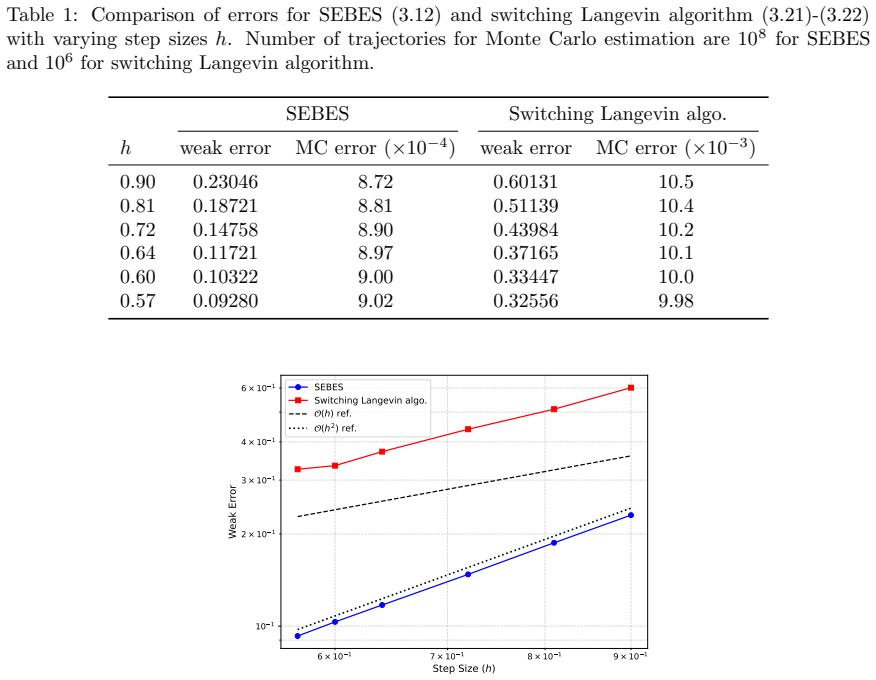
We introduce a switching Hamiltonian Monte Carlo method for sampling from finite mixture Boltzmann-Gibbs distributions. We propose symmetric numerical integrators to approximate switching Hamiltonian dynamics interlaced with Poisson jumps, where the regime-switching chain is simulated using the uniformization technique or the stochastic simulation algorithm. We prove geometric ergodicity of the resulting Markov chain. We develop an approach based on the discrete Poisson equation associated with numerical schemes to estimate the error in computing ergodic averages. Using this approach we prove that the proposed numerical integrators have second-order bias. This approach is simple and can be generalized to other settings, for example, kinetic Langevin equations. Finally, we verify the convergence result via numerical experiment.
Figures
Reference graph
Works this paper leans on
-
[1]
, author=
On stochastic equations with respect to semimartingales I. , author=. Stochastics , volume=. 1980 , publisher=
1980
-
[2]
Glynn, P. W. and Meyn, S. P. , journal=. A. 1996 , publisher=
1996
-
[3]
ESAIM: Control, Optimisation and Calculus of Variations , volume=
Stability in distribution and stabilization of switching jump diffusions , author=. ESAIM: Control, Optimisation and Calculus of Variations , volume=. 2022 , publisher=
2022
-
[4]
Word Series for the Numerical Integration of Stochastic Differential Equations
Alfonso Alamo Zapatero. Word Series for the Numerical Integration of Stochastic Differential Equations. 2021
2021
-
[5]
Numerical solutions of regime-switching jump diffusions , author=. Appl. Math. Comput. , volume=. 2014 , publisher=
2014
-
[6]
and Yuan, C
Mao, X. and Yuan, C. , year=. Stochastic differential equations with
-
[7]
and Paulin, D
Leimkuhler, B. and Paulin, D. and Whalley, P. A. , journal=. Contraction and convergence rates for discretized kinetic. 2024 , publisher=
2024
-
[8]
Milstein, G. N. and Tretyakov, M. V. , journal=. Quasi-symplectic methods for. 2003 , publisher=
2003
Show all 129 references
-
[9]
Sampling from mixture distributions based on regime-switching diffusions , author=. SIAM J. Sci. Comput. , volume=. 2025 , publisher=
2025
-
[10]
A technique for studying strong and weak local errors of splitting stochastic integrators , author=. SIAM J. Numer. Anal. , volume=. 2016 , publisher=
2016
-
[11]
2006 , publisher=
Finite mixture and Markov switching models , author=. 2006 , publisher=
2006
-
[12]
and Owhadi, H
Bou-Rabee, N. and Owhadi, H. , title =. SIAM J. Numer. Anal. , fjounral =. 2010 , number =
2010
-
[13]
High-dimensional
Monmarch. High-dimensional. Electron. J. Stat. , volume=. 2021 , publisher=
2021
-
[14]
2020 , publisher=
Mixture models and applications , author=. 2020 , publisher=
2020
-
[15]
Weak backward error analysis for SDEs , author=. SIAM J. Numer. Anal. , volume=. 2012 , publisher=
2012
-
[16]
1990 , publisher=
Adaptive algorithms and stochastic approximations , author=. 1990 , publisher=
1990
-
[17]
Nummelin, E , journal=. On the. 1991 , publisher=
1991
-
[18]
and Chen, S
Borkar, V. and Chen, S. and Devraj, A. and Kontoyiannis, I. and Meyn, S. , journal=. The. 2025 , publisher=
2025
-
[19]
Concentration of contractive stochastic approximation and reinforcement learning , author=. Stoch. Syst. , volume=. 2022 , publisher=
2022
-
[20]
and Chen, Z
Nanda, P. and Chen, Z. , journal=. A Minimal-Assumption Analysis of
-
[21]
2012 , publisher=
Markov chains and stochastic stability , author=. 2012 , publisher=
2012
-
[22]
Annales de l'Institut Henri Poincare (B) Probabilites et statistiques , volume=
Poisson equations with locally-Lipschitz coefficients and uniform in time averaging for stochastic differential equations via strong exponential stability , author=. Annales de l'Institut Henri Poincare (B) Probabilites et statistiques , volume=. 2026 , organization=
2026
-
[23]
and Sanz-Serna, J
Bou-Rabee, N. and Sanz-Serna, J. M. , journal=. Geometric integrators and the. 2018 , publisher=
2018
-
[24]
Almost sure and moment exponential stability of regime-switching jump diffusions , author=. SIAM J. Control Optim. , volume=. 2017 , publisher=
2017
-
[25]
2011 , publisher=
Topics in noncommutative algebra: the theorem of Campbell, Baker, Hausdorff and Dynkin , author=. 2011 , publisher=
2011
-
[26]
Recurrence and ergodicity for a class of regime-switching jump diffusions , author=. Appl. Math. Optim. , volume=. 2019 , publisher=
2019
-
[27]
Bernoulli , volume=
Properties of switching jump diffusions , author=. Bernoulli , volume=. 2019 , publisher=
2019
-
[28]
, journal=
Shao, J. , journal=. Invariant measures and. 2018 , publisher=
2018
-
[29]
Stability of regime-switching diffusion systems with discrete states belonging to a countable set , author=. SIAM J. Control Optim. , volume=. 2018 , publisher=
2018
-
[30]
and Zhu, C
Xi, F. and Zhu, C. , journal=. On. 2017 , publisher=
2017
-
[31]
Stochastics , volume=
Feynman--Kac formulas for regime-switching jump diffusions and their applications , author=. Stochastics , volume=. 2015 , publisher=
2015
-
[32]
Stability of regime-switching jump diffusions , author=. SIAM J. Control Optim. , volume=. 2010 , publisher=
2010
-
[33]
Approximation methods for hybrid diffusion systems with state-dependent switching processes: Numerical algorithms and existence and uniqueness of solutions , author=. SIAM J. Math. Anal. , volume=. 2010 , publisher=
2010
-
[34]
2009 , publisher=
Hybrid switching diffusions: properties and applications , author=. 2009 , publisher=
2009
-
[35]
Stochastic processes and their applications , volume=
Stability of regime-switching diffusions , author=. Stochastic processes and their applications , volume=. 2007 , publisher=
2007
-
[36]
and Yin, G
Xi, F. and Yin, G. , journal=. Jump-diffusions with state-dependent switching: existence and uniqueness,. 2011 , publisher=
2011
-
[37]
Stochastic Process
Asymptotic properties of jump-diffusion processes with state-dependent switching , author=. Stochastic Process. Appl. , volume=. 2009 , publisher=
2009
-
[38]
2010 , publisher=
Free energy computations: A mathematical perspective , author=. 2010 , publisher=
2010
-
[39]
and Yin, G
Zhu, C. and Yin, G. , journal=. On strong. 2009 , publisher=
2009
-
[40]
Nonlinear Analysis: Theory, Methods & Applications , volume=
Stability of nonlinear regime-switching jump diffusion , author=. Nonlinear Analysis: Theory, Methods & Applications , volume=. 2012 , publisher=
2012
-
[41]
and Matthews, C
Leimkuhler, B. and Matthews, C. and Stoltz, G. , title =. IMA J. Numer. Anal. , FJOURNAL =. 2016 , number =
2016
-
[42]
Journal of Difference Equations and Applications , volume=
Stability and stochastic stabilization of numerical solutions of regime-switching jump diffusion systems , author=. Journal of Difference Equations and Applications , volume=. 2013 , publisher=
2013
-
[43]
Almost sure and p th-moment stability and stabilization of regime-switching jump diffusion systems , author=. SIAM J. Control Optim. , volume=. 2014 , publisher=
2014
-
[44]
Acta Numerica , volume=
Splitting methods , author=. Acta Numerica , volume=. 2002 , publisher=
2002
-
[45]
Accurate stationary densities with partitioned numerical methods for stochastic differential equations , author=. SIAM J. Numer. Anal. , volume=. 2009 , publisher=
2009
-
[46]
Stochastics , volume=
Numerical solutions for jump-diffusions with regime switching , author=. Stochastics , volume=. 2005 , publisher=
2005
-
[47]
Automatica , volume=
Numerical methods for controlled regime-switching diffusions and regime-switching jump diffusions , author=. Automatica , volume=. 2006 , publisher=
2006
-
[48]
and Casas, F
Blanes, S. and Casas, F. and Sanz-Serna, J. , journal=. Numerical integrators for the. 2014 , publisher=
2014
-
[49]
and Bou-Rabee, N
Akhmatskaya, E. and Bou-Rabee, N. and Reich, S. , journal=. A comparison of generalized hybrid. 2009 , publisher=
2009
-
[50]
1980 , publisher=
Perturbation theory for linear operators , author=. 1980 , publisher=
1980
-
[51]
, edition=
Lang, S. , edition=. Real and. 1993 , publisher=
1993
-
[52]
1988 , volume=
Manifolds, tensor analysis, and applications , author=. 1988 , volume=
1988
-
[53]
2011 , publisher=
Functional analysis, Sobolev spaces and partial differential equations , author=. 2011 , publisher=
2011
-
[54]
and Hairer, M
Bou-Rabee, N. and Hairer, M. , journal=. Nonasymptotic mixing of the. 2013 , publisher=
2013
-
[55]
and Schauer, M
Jansson, E. and Schauer, M. and Seyer, R. and Sharma, A. , journal=. Rebalancing
-
[56]
SIAM/ASA J
HMC and underdamped Langevin united in the unadjusted convex smooth case , author=. SIAM/ASA J. Uncertain. Quantif. , volume=. 2025 , publisher=
2025
-
[57]
Rational construction of stochastic numerical methods for molecular sampling , author=. Appl. Math. Res. Express , volume=. 2013 , publisher=
2013
-
[58]
and Reich, S
Akhmatskaya, E. and Reich, S. , journal=. 2008 , publisher=
2008
-
[59]
Wasserstein distance estimates for the distributions of numerical approximations to ergodic stochastic differential equations , author=. J. Mach. Learn. Res. , volume=
-
[60]
Chada, N. K. and Leimkuhler, B. and Paulin, D. and Whalley, P. A. , journal=. Unbiased kinetic
-
[61]
Bernoulli , FJOURNAL =
Beskos, Alexandros and Pillai, Natesh and Roberts, Gareth and Sanz-Serna, Jesus-Maria and Stuart, Andrew , TITLE =. Bernoulli , FJOURNAL =. 2013 , NUMBER =
2013
-
[62]
Physics Letters B , volume=
A generalized guided Monte Carlo algorithm , author=. Physics Letters B , volume=. 1991 , publisher=
1991
-
[63]
arXiv preprint arXiv:2511.04413 , year=
Mean square error analysis of stochastic gradient and variance-reduced sampling algorithms , author=. arXiv preprint arXiv:2511.04413 , year=
-
[64]
C and Stuart, A
Mattingly, J. C and Stuart, A. M. and Higham, D. J. , journal=. Ergodicity for. 2002 , publisher=
2002
-
[65]
Seminar on Stochastic Analysis, Random Fields and Applications VI: Centro Stefano Franscini, Ascona, May 2008 , pages=
Yet another look at Harris’ ergodic theorem for Markov chains , author=. Seminar on Stochastic Analysis, Random Fields and Applications VI: Centro Stefano Franscini, Ascona, May 2008 , pages=. 2011 , organization=
2008
-
[66]
Journal of Machine Learning Research , volume=
Sampling and estimation on manifolds using the Langevin diffusion , author=. Journal of Machine Learning Research , volume=
-
[67]
Mattingly and A
J. Mattingly and A. Stuart and M. V. Tretyakov , title =. SIAM J. Numer. Anal. , volume =
-
[68]
and Zhang, W
Sharma, U. and Zhang, W. , title =. SIAM J. Numer. Anal. , volume =
-
[69]
Stochastic simulation of chemical kinetics , author=. Annu. Rev. Phys. Chem. , volume=. 2007 , publisher=
2007
-
[70]
A general method for numerically simulating the stochastic time evolution of coupled chemical reactions , author=. J. Comput. Phys. , volume=. 1976 , publisher=
1976
-
[71]
Approximate accelerated stochastic simulation of chemically reacting systems , author=. J. Chem. Phys. , volume=. 2001 , publisher=
2001
-
[72]
Markoff chains as an aid in the study of Markoff processes , author=. Scand. Actuar. J. , volume=. 1953 , publisher=
1953
-
[73]
and Byrne, S
Betancourt, M. and Byrne, S. and Livingstone, S. and Girolami, M. , journal=. The geometric foundations of. 2017 , publisher=
2017
-
[74]
Molecular dynamics simulations at constant pressure and/or temperature , author=. J. Chem. Phys. , volume=. 1980 , publisher=
1980
-
[75]
and Sanz-Serna, J
Bou-Rabee, N. and Sanz-Serna, J. M. , journal=. Randomized. 2017 , publisher=
2017
-
[76]
2021 , publisher=
Stochastic numerics for mathematical physics , author=. 2021 , publisher=
2021
-
[77]
2002 , publisher=
Stochastic analysis on manifolds , author=. 2002 , publisher=
2002
-
[78]
2018 , publisher=
Introduction to Riemannian manifolds , author=. 2018 , publisher=
2018
-
[79]
and Lei, Q
Wang, X. and Lei, Q. and Panageas, I. , journal=. Fast convergence of
-
[80]
, journal=
Ichihara, K. , journal=. Curvature, geodesics and the
-
[81]
Rapid mixing of geodesic walks on manifolds with positive curvature , author=. Ann. Appl. Probab. , volume=
-
[82]
Talay and L
D. Talay and L. Tubaro. Expansion of the global error for numerical schemes solving stochastic differential equations. Stoch. Anal. Appl. 1990
1990
-
[83]
2022 , publisher=
Simulation , author=. 2022 , publisher=
2022
-
[84]
and Smith, R
Reibman, A. and Smith, R. and Trivedi, K. , journal=. Markov and. 1989 , publisher=
1989
-
[85]
Brownian motion on a surface of negative curvature , author=. S
-
[86]
Computational and Geometric Aspects of Modern Algebra
Constructing hyperbolic manifolds , author=. Computational and Geometric Aspects of Modern Algebra. Michael Atkinson et al.(Editors), London Maths. Soc. Lect. Notes , volume=
-
[87]
2014 , publisher=
Stochastic differential equations and diffusion processes , author=. 2014 , publisher=
2014
-
[88]
Elworthy, K. D. , year=. Stochastic differential equations on manifolds , publisher=
-
[89]
1975 , publisher=
Comparison theorems in Riemannian geometry , author=. 1975 , publisher=
1975
-
[90]
Journal of Machine Learning Research , volume=
Piecewise deterministic sampling with splitting schemes , author=. Journal of Machine Learning Research , volume=
-
[91]
2008 , publisher=
Riemannian geometry and geometric analysis , author=. 2008 , publisher=
2008
-
[92]
1992 , school=
Stochastic flow on noncompact manifolds , author=. 1992 , school=
1992
-
[93]
Freidlin , publisher =
M. Freidlin , publisher =. Functional integration and partial differential equations , year =
-
[94]
2023 , school=
Contributions to. 2023 , school=
2023
-
[95]
and Nomizu, K
Kobayashi, S. and Nomizu, K. , year=. Foundations of differential geometry, vol
-
[96]
, title =
Wang, F.-Y. , title =
-
[97]
Moakher, M. and Z. The. J. Mathem. Imaging and Vision , volume=
-
[98]
and Bombrun, L
Said, S. and Bombrun, L. and Berthoumieu, Y. and Manton, J. H. , journal=. Riemannian
-
[99]
and Ilea, I
Hajri, H. and Ilea, I. and Said, S. and Bombrun, L. and Berthoumieu, Y. , journal=. Riemannian
-
[100]
arXiv preprint arXiv:1807.01113 , year=
Differential properties of spaces of symmetric real matrices , author=. arXiv preprint arXiv:1807.01113 , year=
-
[101]
M. B. Li and M. A. Erdogdu , title =. Bernoulli , pages =
-
[102]
, journal=
Bakry, D. , journal=. Un
-
[103]
and Gentil, I
Bakry, D. and Gentil, I. and Ledoux, M. , volume=. Analysis and geometry of. 2014 , publisher=
2014
-
[104]
, journal=
Wang, F.-Y. , journal=. Log-
-
[105]
2006 , publisher=
Function theory on manifolds which possess a pole , author=. 2006 , publisher=
2006
-
[106]
G. N. Milstein and M. V. Tretyakov. Computing ergodic limits for L angevin equations. Physica D. 2007
2007
-
[107]
2008 , publisher=
Optimization algorithms on matrix manifolds , author=. 2008 , publisher=
2008
-
[108]
2012 , publisher=
Stochastic stability of differential equations , author=. 2012 , publisher=
2012
-
[109]
Talay , title =
D. Talay , title =. Stoch. Stoch. Reports , volume =
-
[110]
Sato and A
K. Sato and A. Takeda and R. Kawai and T. Suzuki , year=. Convergence Error Analysis of Reflected Gradient
-
[111]
Payne and G.A
L.E. Payne and G.A. Philippin , title =. Math. Models Methods Appl. Sci. , volume =
-
[112]
Abdulle and G
A. Abdulle and G. Vilmart and K.C. Zygalakis , year =. High order numerical approximation of the invariant measure of ergodic
-
[113]
Grigor'yan , year =
A. Grigor'yan , year =. Analytic and geometric background of the recurrence and non-explosion of the brownian motion on
-
[114]
THEORY OF PROBABILITY AND ITS APPLICATIONS C/C OF TEORIIA VEROIATNOSTEI I EE PRIMENENIE , volume=
Application of the numerical integration of stochastic equations to solving boundary-value problems with Neumann's boundary conditions , author=. THEORY OF PROBABILITY AND ITS APPLICATIONS C/C OF TEORIIA VEROIATNOSTEI I EE PRIMENENIE , volume=. 1996 , publisher=
1996
-
[115]
Leimkuhler and A
B. Leimkuhler and A. Sharma and M. V. Tretyakov , title =. Ann. Appl. Probab. , number =
-
[116]
and Fillard, P
Pennec, X. and Fillard, P. and Ayache, N. , journal=. A. 2006 , publisher=
2006
-
[117]
2011 , publisher=
Robert, Christian and Casella, George , journal=. 2011 , publisher=
2011
-
[118]
James Bradbury and Roy Frostig and Peter Hawkins and Matthew James Johnson and Chris Leary and Dougal Maclaurin and George Necula and Adam Paszke and Jake Vander
-
[119]
International Conference on Machine Learning , pages=
Cornish, Rob and Vanetti, Paul and Bouchard-C. International Conference on Machine Learning , pages=. 2019 , organization=
2019
-
[120]
2006 , publisher=
Bishop, Christopher M and Nasrabadi, Nasser M , volume=. 2006 , publisher=
2006
-
[121]
and Kennedy, A
Duane, S. and Kennedy, A. D. and Pendleton, B. J. and Roweth, D. , journal=. 1987 , publisher=
1987
-
[122]
arXiv preprint arXiv:2308.04634 , year=
Bou-Rabee, Nawaf and Oberd. arXiv preprint arXiv:2308.04634 , year=
-
[123]
Hamiltonian
Apers, Simon and Gribling, Sander and Szil. Hamiltonian. arXiv preprint arXiv:2209.12771 , year=
-
[124]
The strong convergence of operator-splitting methods for the
Telatovich, Adam and Li, Xiantao , journal=. The strong convergence of operator-splitting methods for the
-
[125]
and Chewi, Sinho , booktitle=
Altschuler, Jason M. and Chewi, Sinho , booktitle=. Faster high-accuracy log-concave sampling via algorithmic warm starts , year=
-
[126]
Chen, Yuansi and Gatmiry, Khashayar , journal=
-
[127]
Brooks and Martin Karplus , abstract =
Axel Brünger and Charles L. Brooks and Martin Karplus , abstract =. Stochastic boundary conditions for molecular dynamics simulations of. Chemical Physics Letters , volume =. 1984 , issn =
1984
-
[128]
Philosophical Transactions of the Royal Society of America , volume=
The approximate arithmetical solution by finite differences with an application to stresses in masonry dams , author=. Philosophical Transactions of the Royal Society of America , volume=
-
[129]
The Journal of Chemical Physics , volume=
Izaguirre, Jes. The Journal of Chemical Physics , volume=. 2001 , publisher=
2001
Reviewed June 27, 2026 · model on record in the stance chip above.
Discussion (0). Continue with ORCID to comment.