A q-analogue of the rational normal curve and linearized Reed-Solomon codes
Pith reviewed 2026-06-27 05:49 UTC · model grok-4.3
The pith
A q-analogue of the rational normal curve gives a geometric characterization of linearized Reed-Solomon codes for certain parameters and shows their points satisfy many hypersurface conditions of degree q+1.
A machine-rendered reading of the paper's core claim, the machinery that carries it, and where it could break.
Core claim
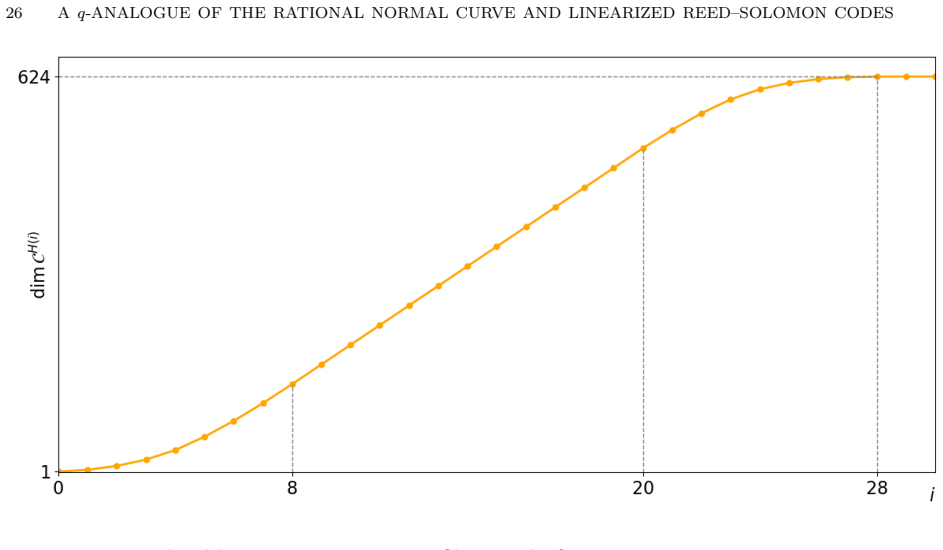
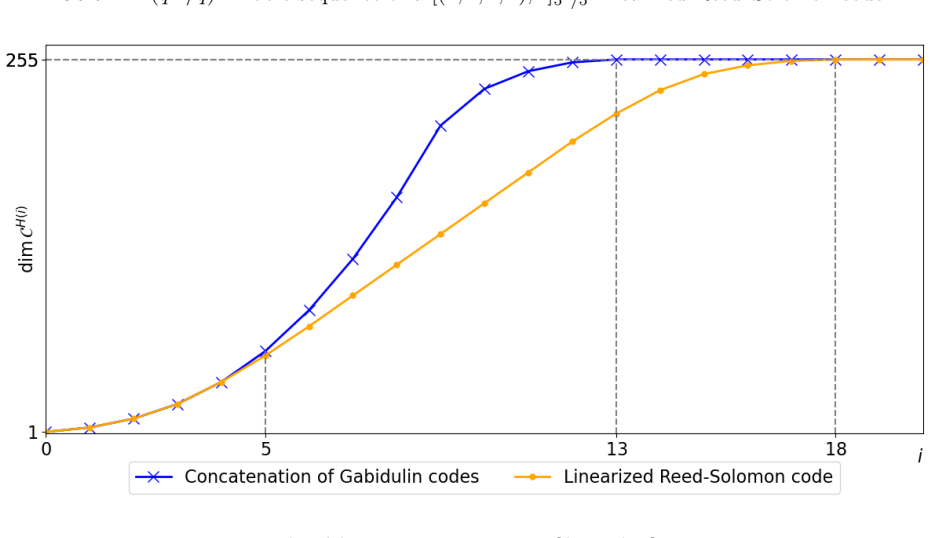
We introduce a q-analogue of the rational normal curve to study linearized Reed-Solomon codes. For certain parameter choices this analogue supplies a geometric characterization of the codes. The corresponding point sets satisfy an unexpectedly large number of conditions coming from hypersurfaces of degree q+1. We extend Schur-product methods to the sum-rank metric and examine the Hilbert function of the associated coordinate ring, giving a detailed description of its behavior together with its regularity and additional insight into Gabidulin codes.
What carries the argument
The q-analogue of the rational normal curve, whose point configurations translate code properties into projective geometric conditions.
If this is right
- Linearized Reed-Solomon codes admit a geometric description via the q-analogue for the indicated parameters.
- The point sets lie on more hypersurfaces of degree q+1 than expected, supplying new algebraic invariants.
- Schur-product distinguishers extend directly to sum-rank metric codes.
- The Hilbert function of the coordinate ring has explicitly described behavior and a known regularity index.
- Gabidulin codes receive additional structural information from the same ring analysis.
Where Pith is reading between the lines
- The hypersurface conditions could serve as practical invariants for distinguishing these codes from random matrices in applications.
- The regularity result may help bound other algebraic invariants such as the minimum distance in the sum-rank metric.
- Similar q-analogues of classical varieties could be tested on other optimal sum-rank codes to produce comparable characterizations.
- Small-field computational verification of the exact number of hypersurface conditions would provide an immediate consistency check.
Load-bearing premise
The chosen q-analogue of the rational normal curve must actually deliver a valid geometric characterization of the codes rather than an artifact of the selected parameters.
What would settle it
Finding a parameter set where the q-analogue fails to characterize the codes or where the point sets satisfy strictly fewer than the claimed number of independent (q+1)-degree hypersurface conditions would refute the framework.
Figures
read the original abstract
The relationship between linear codes in the Hamming metric and projective algebraic varieties has led to deep interactions between coding theory and algebraic geometry, with classical examples such as Reed-Solomon codes and the rational normal curve. On the other hand, the sum-rank metric has recently gained attention due to applications in network coding, distributed storage, and post-quantum cryptography, with linearized Reed-Solomon codes emerging as optimal constructions. Despite recent advances, their structural and geometric properties are still not fully understood, and existing distinguishers remain limited. In this paper, we develop a geometric framework for linearized Reed-Solomon codes by considering a $q$-analogue of the rational normal curve. This yields a geometric characterization for certain parameter choices and reveals that the corresponding sets of points satisfy unexpectedly many $(q+1)$-degree hypersurface conditions. Our approach extends Schur-product-based techniques from the Hamming and rank-metric settings to the sum-rank metric case. Finally, we study the Hilbert function of the associated coordinate ring, providing a detailed description of its behavior and identifying its regularity, which also sheds new light on Gabidulin codes.
Editorial analysis
A structured set of objections, weighed in public.
Referee Report
Summary. The paper develops a geometric framework for linearized Reed-Solomon codes by introducing a q-analogue of the rational normal curve. For certain parameter choices this yields a geometric characterization of the codes and shows that the associated point sets satisfy unexpectedly many (q+1)-degree hypersurface conditions. The approach extends Schur-product techniques from the Hamming and rank-metric settings to the sum-rank metric; the manuscript also analyzes the Hilbert function of the associated coordinate ring, determines its regularity, and draws implications for Gabidulin codes.
Significance. If the q-analogue construction is valid and the hypersurface conditions are shown to be structural, the work would establish a concrete algebraic-geometric bridge for sum-rank metric codes, which are relevant to network coding, distributed storage, and post-quantum cryptography. The explicit Hilbert-function description and regularity result constitute a concrete algebraic contribution that could be used in future distinguishers or parameter studies.
major comments (1)
- [construction section (around the definition of the q-analogue)] The central claim rests on the q-analogue construction producing a valid geometric characterization and on the (q+1)-degree hypersurface conditions being structural rather than artifacts of parameter choice. The manuscript must supply the explicit ideal generators or variety equations for the q-analogue (presumably in the section introducing the construction) together with a dimension count showing that the observed number of conditions exceeds what follows from linearity and the q-power map alone.
minor comments (2)
- The abstract states that the point sets satisfy 'unexpectedly many' conditions; a precise comparison (e.g., to the expected dimension of the degree-(q+1) part of the coordinate ring) should appear in the main text.
- Notation for the sum-rank metric and linearized Reed-Solomon parameters should be introduced with a short table or explicit reference to prior work for readers coming from the Hamming-metric setting.
Simulated Author's Rebuttal
We thank the referee for the detailed reading and the constructive suggestion regarding the construction section. We address the single major comment below and will incorporate the requested material in the revised manuscript.
read point-by-point responses
-
Referee: [construction section (around the definition of the q-analogue)] The central claim rests on the q-analogue construction producing a valid geometric characterization and on the (q+1)-degree hypersurface conditions being structural rather than artifacts of parameter choice. The manuscript must supply the explicit ideal generators or variety equations for the q-analogue (presumably in the section introducing the construction) together with a dimension count showing that the observed number of conditions exceeds what follows from linearity and the q-power map alone.
Authors: We agree that an explicit presentation of the ideal generators (or defining equations) of the q-analogue variety, together with a dimension count, would make the geometric characterization more transparent and would confirm that the observed (q+1)-degree conditions are not merely consequences of linearity and the q-power map. In the revised manuscript we will add, in the section introducing the q-analogue, the explicit generators of the ideal and a direct dimension computation (via the Hilbert function of the coordinate ring already studied later in the paper) showing that the number of independent conditions strictly exceeds the dimension predicted by the linear and q-power constraints alone. This addition will also clarify the parameter range for which the geometric characterization holds. revision: yes
Circularity Check
No circularity: framework presented as independent geometric extension
full rationale
The abstract and provided context describe a new q-analogue construction for linearized Reed-Solomon codes that extends Schur-product techniques, with no quoted equations, definitions, or citations showing self-definition, fitted inputs renamed as predictions, or load-bearing self-citations. The derivation chain is presented as building on prior independent work in coding theory and algebraic geometry without reducing the central claims to the inputs by construction. This is the expected non-finding for a paper whose claims rest on explicit new constructions rather than tautological renaming or parameter fitting.
Axiom & Free-Parameter Ledger
Reference graph
Works this paper leans on
-
[1]
G. N. Alfarano, M. Borello, and A. Neri. A geometric characterization of minimal codes and their asymptotic performance.Advances in Mathematics of Communications, 16(1):115–133, 2022
2022
-
[2]
G. N. Alfarano, M. Borello, A. Neri, and A. Ravagnani. Linear cutting blocking sets and minimal codes in the rank metric.Journal of Combinatorial Theory, Series A, 192:105658, 2022
2022
-
[3]
Arbarello, M
E. Arbarello, M. Cornalba, P. Griffiths, and J. D. Harris.Geometry of Algebraic Curves: Volume I, volume 267. Springer Science & Business Media, 2013
2013
-
[4]
Astore, 2026.https://github.com/Valentina-Astore/HilbertSequencesOfCodes
V. Astore, 2026.https://github.com/Valentina-Astore/HilbertSequencesOfCodes. Aq-ANALOGUE OF THE RATIONAL NORMAL CURVE AND LINEARIZED REED–SOLOMON CODES 27
2026
-
[5]
Astore, M
V. Astore, M. Borello, M. Calderini, and F. Salizzoni. A geometric invariant of linear rank-metric codes.SIAM Journal on Applied Algebra and Geometry, 9(4):741–764, 2025
2025
-
[6]
S. Ball. On sets of vectors of a finite vector space in which every subset of basis size is a basis.Journal of the European Mathematical Society (EMS Publishing), 14(3), 2012
2012
-
[7]
Beelen, M
P. Beelen, M. Datta, and S. R. Ghorpade. Vanishing ideals of projective spaces over finite fields and a projective footprint bound.Acta Mathematica Sinica, English Series, 35(1):47–63, 2019
2019
-
[8]
Berardini and X
E. Berardini and X. Caruso. Algebraic geometry codes in the sum–rank metric.IEEE Transactions on Information Theory, 70(5):3345–3356, 2024
2024
-
[9]
Berardini and X
E. Berardini and X. Caruso. Reed-Muller codes in the sum-rank metric.Journal of Algebra and Its Applications, 2025
2025
-
[10]
Bosma, J
W. Bosma, J. Cannon, and C. Playoust. The Magma algebra system I: The user language.Journal of Symbolic Computation, 24(3-4):235–265, 1997
1997
-
[11]
Camps-Moreno, E
E. Camps-Moreno, E. Gorla, C. Landolina, E. L. Garc´ ıa, U. Mart´ ınez-Pe˜ nas, and F. Salizzoni. Optimal anti- codes, MSRD codes, and generalized weights in the sum-rank metric.IEEE Transactions on Information Theory, 68(6):3806–3822, 2022
2022
-
[12]
Caruso and A
X. Caruso and A. Durand. Duals of linearized Reed-Solomon codes.Designs, Codes and Cryptography, 91(1):241– 271, 2023
2023
-
[13]
D. A. Cox, J. Little, and D. O’Shea.Ideals, Varieties, and Algorithms. Undergraduate Texts in Mathematics. Springer, Cham, 5 th edition, 2025
2025
-
[14]
A. A. Davydov, M. Giulietti, S. Marcugini, and F. Pambianco. Linear nonbinary covering codes and saturating sets in projective spaces.Advances in Mathematics of Communications, 5(1):119–147, 2011
2011
-
[15]
Donati and N
G. Donati and N. Durante. A generalization of the normal rational curve in PG(d, qn) and its associated non-linear MRD codes.Designs, Codes and Cryptography, 86(6):1175–1184, 2018
2018
-
[16]
Eisenbud.The geometry of syzygies: A second course in commutative algebra and algebraic geometry
D. Eisenbud.The geometry of syzygies: A second course in commutative algebra and algebraic geometry. Springer, 2005
2005
-
[17]
Eisenbud.Commutative algebra: with a view toward algebraic geometry, volume 150
D. Eisenbud.Commutative algebra: with a view toward algebraic geometry, volume 150. Springer Science & Business Media, 2013
2013
-
[18]
Eisenbud and B
D. Eisenbud and B. Sturmfels. Binomial ideals.Duke Mathematical Journal, 84(1):1, 1996
1996
-
[19]
Eliahou and E
S. Eliahou and E. Mazumdar. Iterated sumsets and Hilbert functions.Journal of Algebra, 593:274–294, 2022
2022
-
[20]
J. Elias. Sumsets and projective curves.Mediterranean Journal of Mathematics, 19(4):177, 2022
2022
-
[21]
Gimenez and M
P. Gimenez and M. Gonz´ alez-S´ anchez. Castelnuovo–Mumford regularity of projective monomial curves via sum- sets.Mediterranean Journal of Mathematics, 20(5):287, 2023
2023
- [22]
-
[23]
G¨ ortz and T
U. G¨ ortz and T. Wedhorn.Algebraic Geometry I: Schemes. Springer Spektrum Wiesbaden, 2 edition, 2020
2020
-
[24]
S. Goto, N. Suzuki, and K. Watanabe. On affine semigroup rings.Japanese journal of mathematics. New series, 2(1):1–12, 1976
1976
-
[25]
Harris.Algebraic geometry: a first course
J. Harris.Algebraic geometry: a first course. Springer Science & Business Media, 2013
2013
-
[26]
Hartshorne.Algebraic geometry, volume 52 ofGraduate Texts in Mathematics
R. Hartshorne.Algebraic geometry, volume 52 ofGraduate Texts in Mathematics. Springer-Verlag, New York, 1977
1977
-
[27]
H¨ ormann, H
F. H¨ ormann, H. Bartz, and A.-L. Horlemann. Distinguishing and recovering generalized linearized Reed–Solomon codes. InCode-Based Cryptography, pages 1–20. Springer Nature Switzerland, 2023
2023
-
[28]
Distinguishers for Skew and Linearized Reed-Solomon Codes
F. H¨ ormann and A.-L. Horlemann. Distinguishers for skew and linearized Reed-Solomon codes.arXiv preprint arXiv:2604.12954, 2026
work page internal anchor Pith review Pith/arXiv arXiv 2026
-
[29]
Kshevetskiy and E
A. Kshevetskiy and E. Gabidulin. The new construction of rank codes. InProceedings. International Symposium on Information Theory, 2005. ISIT 2005, pages 2105–2108. IEEE, 2005
2005
-
[30]
Lidl.Introduction to finite fields and their applications
R. Lidl.Introduction to finite fields and their applications. Cambridge University Press, 1994
1994
-
[31]
J. Mannaert, M. Messia, and F. Zullo. On the number of inequivalent linearized Reed-Solomon codes.arXiv preprint arXiv:2603.17636, 2026
-
[32]
Mart´ ınez-Pe˜ nas
U. Mart´ ınez-Pe˜ nas. Theory of supports for linear codes endowed with the sum-rank metric.Designs, Codes and Cryptography, 87(10):2295–2320, 2019
2019
-
[33]
Mart´ ınez-Pe˜ nas
U. Mart´ ınez-Pe˜ nas. Hamming and simplex codes for the sum-rank metric.Designs, Codes and Cryptography, 88(8):1521–1539, 2020
2020
-
[34]
Mart´ ınez-Pe˜ nas, M
U. Mart´ ınez-Pe˜ nas, M. Shehadeh, and F. R. Kschischang. Codes in the sum-rank metric: Fundamentals and applications.Foundations and Trends®in Communications and Information Theory, 19(5):814–1031, 2022
2022
-
[35]
Mart´ ınez-Pe˜ nas
U. Mart´ ınez-Pe˜ nas. Skew and linearized Reed–Solomon codes and maximum sum rank distance codes over any division ring.Journal of Algebra, 504:587–612, 2018
2018
-
[36]
Mirandola and G
D. Mirandola and G. Z´ emor. Critical pairs for the product Singleton bound.IEEE Transactions on Information Theory, 61(9):4928–4937, 2015
2015
-
[37]
M. B. Nathanson.Additive number theory, volume 164. Springer New York, 1996. 28 Aq-ANALOGUE OF THE RATIONAL NORMAL CURVE AND LINEARIZED REED–SOLOMON CODES
1996
-
[38]
A. Neri, S. Puchinger, and A.-L. Horlemann-Trautmann. Equivalence and characterizations of linear rank-metric codes based on invariants.Linear Algebra and its Applications, 603:418–469, 2020
2020
-
[39]
A. Neri, P. Santonastaso, and F. Zullo. The geometry of one-weight codes in the sum-rank metric.Journal of Combinatorial Theory, Series A, 194:105703, 2023
2023
-
[40]
K. E. Nouetowa. A post-quantum encryption scheme based on linearized Reed-Solomon codes. working paper or preprint, Jan. 2026
2026
-
[41]
O. Ore. Theory of non-commutative polynomials.Annals of mathematics, 34(3):480–508, 1933
1933
-
[42]
Overbeck
R. Overbeck. Structural attacks for public key cryptosystems based on Gabidulin codes.J. Cryptology, 21:280– 301, 2008
2008
-
[43]
Randriambololona
H. Randriambololona. Asymptotically good binary linear codes with asymptotically good self-intersection spans. IEEE Transactions on Information Theory, 59(5):3038–3045, 2013
2013
-
[44]
Randriambololona
H. Randriambololona. On products and powers of linear codes under componentwise multiplication. InAlgorith- mic arithmetic, geometry, and coding theory, volume 637 ofContemp. Math., pages 3–78. Amer. Math. Soc., Providence, RI, 2015
2015
-
[45]
T. H. Randrianarisoa. A geometric approach to rank metric codes and a classification of constant weight codes. Designs, Codes and Cryptography, 88:1331–1348, 2020
2020
-
[46]
Reid and L
L. Reid and L. G. Roberts. Non-Cohen–Macaulay projective monomial curves.Journal of Algebra, 291(1):171– 186, 2005
2005
-
[47]
J. W. Renner.Post-Quantum Cryptography in the Hamming Metric, the Rank Metric, and the Sum-Rank Metric. PhD thesis, Technische Universit¨ at M¨ unchen, 2022
2022
-
[48]
Santonastaso and F
P. Santonastaso and F. Zullo. On subspace designs.EMS Surveys in Mathematical Sciences, 11(1):1–62, 2023
2023
-
[49]
Santonastaso and F
P. Santonastaso and F. Zullo. Invariants for sum-rank metric codes.Annali di Matematica Pura ed Applicata (1923-), pages 1–41, 2025
1923
-
[50]
B. Segre. Curve razionali normali ek-archi negli spazi finiti.Annali di Matematica Pura ed Applicata, 39:357–379, 1955
1955
-
[51]
Serre.Groupes alg´ ebriques et corps de classes
J.-P. Serre.Groupes alg´ ebriques et corps de classes. Publications de l’institut de math´ ematique de l’universit´ e de Nancago, VII. Hermann, Paris, 1959
1959
-
[52]
I. R. Shafarevich.Basic Algebraic Geometry I, Varieties in projective space. Springer, Berlin, 3 edition, 2013
2013
-
[53]
J. Sheekey. Linear sets are to rank-metric codes as arcs are to hamming-metric codes.Oberwolfach Report, 13:2019, 2019
2019
-
[54]
Sturmfels.Gr¨ obner bases and convex polytopes, volume 8
B. Sturmfels.Gr¨ obner bases and convex polytopes, volume 8. American Mathematical Soc., 1996
1996
-
[55]
Tsfasman and S
M. Tsfasman and S. G. Vl˘ adut ¸.Algebraic-geometric codes, volume 58. Springer Science & Business Media, 2013
2013
discussion (0)
Sign in with ORCID, Apple, or X to comment. Anyone can read and Pith papers without signing in.