To GAN or Not To GAN: Segmentation Analysis on Mars DEM
Pith reviewed 2026-06-27 07:30 UTC · model grok-4.3
The pith
Adding GAN-generated data does not improve neural network segmentation for detecting mounds on Mars.
A machine-rendered reading of the paper's core claim, the machinery that carries it, and where it could break.
Core claim
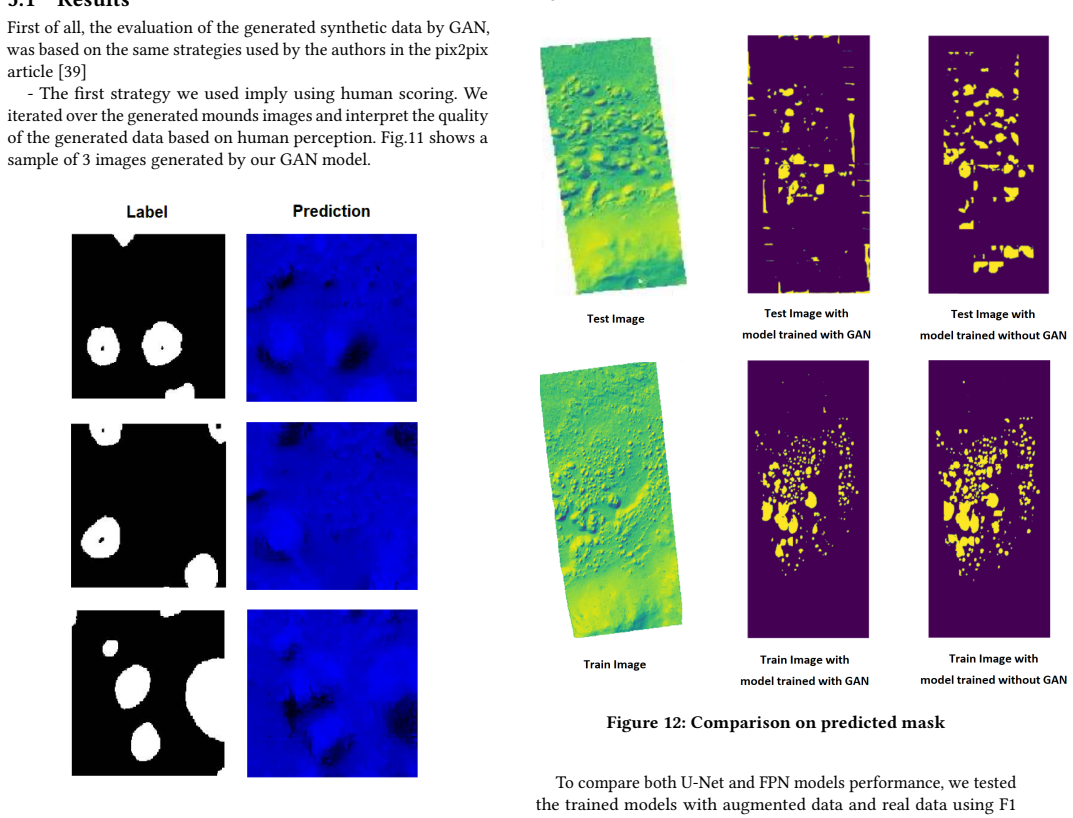
A comparison of the approaches shows that adding extra artificially generated data did not improve the result when using supervised semantic segmentation and generative adversarial methods to detect mounds on Mars digital elevation models.
What carries the argument
Direct comparison of supervised semantic segmentation performance versus the same models trained with additional GAN-generated training examples, measured against manually mapped morphological parameters as ground truth.
If this is right
- Manual mapping of mound morphologies can remain the primary source of training labels without loss of model performance.
- Computational effort spent on GAN training and data synthesis may be redirected toward collecting more real DEM coverage or refining network architectures.
- For this Mars dataset size and terrain variety, standard supervised training suffices for mound segmentation.
Where Pith is reading between the lines
- The result may indicate that the distribution of GAN outputs diverges enough from real Martian terrain to add noise rather than signal.
- Similar segmentation tasks on other planetary bodies with sparse labeled data might also see limited gains from current GAN augmentation techniques.
- Varying the GAN architecture or conditioning it more tightly on elevation statistics could be tested to see if the negative finding persists.
Load-bearing premise
The manually mapped morphological parameters supply accurate and sufficiently representative ground-truth labels for both training and evaluating the segmentation models.
What would settle it
A replication study that reports higher segmentation accuracy (for example by IoU or F1 score) when the GAN-augmented dataset is used compared with the supervised-only baseline on an identical held-out test set.
Figures

read the original abstract
To better understand Martian Surface, which is needed to enable Rovers navigate Mars with ease, it is necessary to be able to determine the location of mounds. Detecting and studying these morphologies can also help us find evidence of extraterrestrial life, in this case, more specifically, water or signs of life conducive environments. Detection of mounds was done by manually mapping morphological parameters onto Digital Elevation Models. This paper solves the problem by automatically detecting and or predicting mounds on Mars using Neural Network based Semantic Segmentation methodologies. This is done by using supervised semantic segmentation model and generative adversarial approach. A comparison of the approaches shows that adding extra artificially generated data did not improve the result.
Editorial analysis
A structured set of objections, weighed in public.
Referee Report
Summary. The paper addresses automatic detection of mounds on Mars using semantic segmentation on Digital Elevation Models (DEMs). It describes supervised neural network segmentation and a generative adversarial approach, with the central empirical claim being that augmenting the training set with GAN-generated data does not improve segmentation performance over the supervised baseline. Ground truth is obtained by manually mapping morphological parameters onto DEMs.
Significance. If the no-improvement result is substantiated with proper controls, it would provide a concrete negative finding on the utility of GAN augmentation for this planetary mapping task, which could inform data-scarce remote-sensing applications. The work also highlights the potential of semantic segmentation for extraterrestrial feature detection, but the current manuscript supplies none of the quantitative evidence needed to evaluate that claim.
major comments (2)
- [Abstract] Abstract: the headline claim that 'adding extra artificially generated data did not improve the result' is presented without any dataset size, train/test split, evaluation metrics (IoU, precision, recall, etc.), training hyperparameters, or statistical tests. This absence makes the comparison impossible to assess and directly undermines the soundness of the central result.
- [Abstract] Abstract and methods description: the ground-truth labels are produced by 'manually mapping morphological parameters onto Digital Elevation Models' with no reported inter-annotator agreement, coverage statistics, boundary-error analysis, or class-balance information. Because both the baseline and GAN-augmented models are trained and scored against the same unvalidated labels, any 'no improvement' conclusion could be an artifact of label noise rather than a property of the augmentation strategy.
Simulated Author's Rebuttal
We thank the referee for these constructive comments on the abstract and methods. We agree that the current version lacks essential quantitative details and will revise accordingly to make the central empirical claim evaluable.
read point-by-point responses
-
Referee: [Abstract] Abstract: the headline claim that 'adding extra artificially generated data did not improve the result' is presented without any dataset size, train/test split, evaluation metrics (IoU, precision, recall, etc.), training hyperparameters, or statistical tests. This absence makes the comparison impossible to assess and directly undermines the soundness of the central result.
Authors: We agree that the abstract is missing these details and that this prevents proper evaluation of the no-improvement result. In the revised manuscript we will expand the abstract (and add a corresponding results table) to report dataset size, train/test split, IoU/precision/recall/F1 scores for both models, training hyperparameters, and any statistical significance tests. The underlying experiments already contain these quantities; they were simply omitted from the original submission. revision: yes
-
Referee: [Abstract] Abstract and methods description: the ground-truth labels are produced by 'manually mapping morphological parameters onto Digital Elevation Models' with no reported inter-annotator agreement, coverage statistics, boundary-error analysis, or class-balance information. Because both the baseline and GAN-augmented models are trained and scored against the same unvalidated labels, any 'no improvement' conclusion could be an artifact of label noise rather than a property of the augmentation strategy.
Authors: We acknowledge the concern. The original manuscript provides only a brief description of the manual labeling process. In revision we will add a dedicated subsection on label generation that includes coverage statistics, class balance, and any available boundary-error analysis. If inter-annotator agreement was not collected, we will explicitly discuss this limitation and its possible effect on the interpretation of the GAN-augmentation result. We will also clarify that both models were evaluated against the identical label set, so any label noise affects both equally. revision: yes
Circularity Check
No circularity: empirical comparison with no derivations or self-referential fits
full rationale
The paper reports an empirical study: manual morphological mapping supplies labels for training supervised segmentation models, with and without GAN augmentation; performance is compared directly on held-out data. No equations, parameter fits presented as predictions, uniqueness theorems, or self-citation chains appear in the provided text. The central claim reduces to measured IoU/F1 differences rather than any definitional or fitted-input reduction. This matches the default expectation for non-circular empirical ML papers.
Axiom & Free-Parameter Ledger
Reference graph
Works this paper leans on
-
[1]
2015.Sapiens: A Brief History of Hu- mankind
Yuval Noah Harari. 2015.Sapiens: A Brief History of Hu- mankind. Harper, 195 Broadway New York, NY 10007 USA
2015
-
[2]
Forsyth and Jean Ponce
David A. Forsyth and Jean Ponce. 2012.Computer Vision - A Modern Approach, Second Edition.Pitman, Hoboken, New Jersey, 1–91.isbn: 978-0-273-76414-4
2012
-
[3]
Ying Tan. 2016. Chapter 11 - applications. InGpu-Based Par- allel Implementation of Swarm Intelligence Algorithms. Ying Tan, editor. Morgan Kaufmann, San Francisco, CA, 167–177. isbn: 978-0-12-809362-7.doi: https://doi.org/10.1016/B978- 0-12-809362-7.50011-X
-
[4]
Rajeshwar Dass and Swapna Devi. 2012. Image segmentation techniques.International Journal of Electronics & Communi- cation Technology, 3, 1.issn: 2230-7109 (Online)
2012
-
[5]
Pham, Chenyang Xu, and Jerry L
Dzung L. Pham, Chenyang Xu, and Jerry L. Prince. 2000. Cur- rent methods in medical image segmentation.Annual Review of Biomedical Engineering, 2, 1, 315–337. PMID: 11701515. doi: 10.1146/annurev.bioeng.2.1.315. https://doi.org/10.1146/ annurev.bioeng.2.1.315
-
[6]
Ming Zeng, Youfu Li, Qinghao Meng, Ting Yang, and Jian Liu
-
[7]
doi: https://doi.org/10.1016/j.ijleo.2011.05.017
Improving histogram-based image contrast enhance- ment using gray-level information histogram with applica- tion to x-ray images.Optik, 123, 6, 511–520.issn: 0030-4026. doi: https://doi.org/10.1016/j.ijleo.2011.05.017
-
[8]
Jamil A. M. Saif, Mahgoub H. Hammad, and Ibrahim A. A. Alqubati. 2016. Gradient based image edge detection.IACSIT International Journal of Engineering and Technology, 8, 3.doi: 10.7763/IJET.2016.V8.876
-
[9]
Mohamed Abd Elaziz, Siddhartha Bhattacharyya, and Songfeng Lu. 2019. Swarm selection method for multi- level thresholding image segmentation.Expert Systems with Applications, 138, 112818.issn: 0957-4174.doi: https: //doi.org/10.1016/j.eswa.2019.07.035
-
[10]
Essam H. Houssein, Marwa M. Emam, and Abdelmgeid A. Ali. 2021. An efficient multilevel thresholding segmentation method for thermography breast cancer imaging based on improved chimp optimization algorithm.Expert Systems with Applications, 185, 115651.issn: 0957-4174.doi: https://doi. org/10.1016/j.eswa.2021.115651
-
[11]
Zhuang Cheng and Jianfeng Wang. 2020. Improved region growing method for image segmentation of three-phase ma- terials.Powder Technology, 368, 80–89.issn: 0032-5910.doi: https://doi.org/10.1016/j.powtec.2020.04.032
-
[12]
Abraham Sundar, and Bala- subramanian Karthikeyan
Nagaraj Jothiaruna, Joseph K. Abraham Sundar, and Bala- subramanian Karthikeyan. 2019. A segmentation method for disease spot images incorporating chrominance in compre- hensive color feature and region growing.Computers and Electronics in Agriculture, 165, 104934.issn: 0168-1699.doi: https://doi.org/10.1016/j.compag.2019.104934
-
[13]
Marie Lachaize, Sylvie Le Hégarat-Mascle, Emanuel Aldea, Aude Maitrot, and Roger Reynaud. 2018. Evidential split-and- merge: application to object-based image analysis.Interna- tional Journal of Approximate Reasoning, 103, 303–319.issn: 0888-613X.doi: https://doi.org/10.1016/j.ijar.2018.10.008
-
[14]
Lifeng Liu and Stan Sclaroff. 2004. Deformable model-guided region split and merge of image regions.Image and Vision Data Science Lab, 2021/2022, Uni Passau Team 5 Computing, 22, 4, 343–354.issn: 0262-8856.doi: https://doi. org/10.1016/j.imavis.2003.11.006
-
[15]
Michael Kass, Andrew Witkin, and Demetri Terzopoulos
-
[16]
Snakes: active contour models.nternational Journal of Computer Vision, 1, 321–331.doi: https://doi.org/10.1007/ BF00133570
-
[17]
Xianghai Wang, Yu Wan, Rui Li, Jinling Wang, and Lingling Fang. 2016. A multi-object image segmentation c–v model based on region division and gradient guide.Journal of Visual Communication and Image Representation, 39, 100–106.issn: 1047-3203.doi: https://doi.org/10.1016/j.jvcir.2016.05.011
-
[18]
Man Yan, Jianyong Cai, Jiexing Gao, and Lili Luo. 2012. K- means cluster algorithm based on color image enhancement for cell segmentation. In2012 5th International Conference on BioMedical Engineering and Informatics, 295–299.doi: 10.1109/BMEI.2012.6513157
-
[19]
Shaoqing Ren, Kaiming He, Ross Girshick, and Jian Sun. 2016. Faster r-cnn: towards real-time object detection with region proposal networks. (2016). arXiv: 1506.01497[cs.CV]
Pith/arXiv arXiv 2016
-
[21]
Fausto Milletari, Nassir Navab, and Seyed-Ahmad Ahmadi
-
[22]
V-net: fully convolutional neural networks for volumet- ric medical image segmentation. (2016). arXiv: 1606.04797 [cs.CV]
Pith/arXiv arXiv 2016
-
[23]
Kaiming He, Georgia Gkioxari, Piotr Dollár, and Ross Gir- shick. 2018. Mask r-cnn. (2018). arXiv: 1703.06870[cs.CV]
Pith/arXiv arXiv 2018
-
[24]
Francesco Visin, Marco Ciccone, Adriana Romero, Kyle Kast- ner, Kyunghyun Cho, Yoshua Bengio, Matteo Matteucci, and Aaron Courville. 2016. Reseg: a recurrent neural network- based model for semantic segmentation. (2016). arXiv: 1511. 07053[cs.CV]
2016
-
[25]
Pauline Luc, Camille Couprie, Soumith Chintala, and Jakob Verbeek. 2016. Semantic segmentation using adversarial net- works. (2016). arXiv: 1611.08408[cs.CV]
Pith/arXiv arXiv 2016
-
[26]
Nasim Souly, Concetto Spampinato, and Mubarak Shah. 2017. Semi supervised semantic segmentation using generative adversarial network. In2017 IEEE International Conference on Computer Vision (ICCV), 5689–5697.doi: 10.1109/ICCV. 2017.606
-
[27]
Wei-Chih Hung, Yi-Hsuan Tsai, Yan-Ting Liou, Yen-Yu Lin, and Ming-Hsuan Yang. 2018. Adversarial learning for semi- supervised semantic segmentation. (2018). arXiv: 1802.07934 [cs.CV]
Pith/arXiv arXiv 2018
-
[28]
d.] https://github.com/hindupuravinash/the-gan-zoo
[n. d.] https://github.com/hindupuravinash/the-gan-zoo. accessed: 18-11-2021
2021
-
[29]
Suman Paneru and Idris Jeelani. 2021. Computer vision ap- plications in construction: current state, opportunities & challenges.Automation in Construction, 132, 103940.issn: 0926-5805.doi: https://doi.org/10.1016/j.autcon.2021.103940
-
[30]
BigdataAILab. 2021. What is semantic segmentation, in- stance segmentation, panoramic segmentation? (April 2021). https : / / becominghuman . ai / what - is - semantic - segmentation-instance-segmentation-panoramic-segmentation- 3bbb03856c12. accessed: 18-11-2021
2021
-
[31]
Alec Radford, Luke Metz, and Soumith Chintala. 2016. Un- supervised representation learning with deep convolutional generative adversarial networks. (2016). arXiv: 1511.06434 [cs.LG]
Pith/arXiv arXiv 2016
-
[32]
Ryan J. Spick, Peter Cowling, and James Alfred Walker. 2019. Procedural generation using spatial gans for region-specific learning of elevation data. In2019 IEEE Conference on Games (CoG), 1–8.doi: 10.1109/CIG.2019.8848120
-
[33]
Nikolay Jetchev, Urs Bergmann, and Roland Vollgraf. 2017. Texture synthesis with spatial generative adversarial net- works. (2017). arXiv: 1611.08207[cs.CV]
Pith/arXiv arXiv 2017
-
[34]
Christopher Bowles, Liang Chen, Ricardo Guerrero, Paul Bentley, Roger Gunn, Alexander Hammers, David Alexan- der Dickie, Maria Valdés Hernández, Joanna Wardlaw, and Daniel Rueckert. 2018. Gan augmentation: augmenting train- ing data using generative adversarial networks. (2018). arXiv: 1810.10863[cs.CV]
Pith/arXiv arXiv 2018
-
[35]
Tero Karras, Timo Aila, Samuli Laine, and Jaakko Lehtinen
-
[36]
Progressive growing of gans for improved quality, sta- bility, and variation. (2018). arXiv: 1710.10196[cs.NE]
Pith/arXiv arXiv 2018
-
[37]
O. Ronneberger, P.Fischer, and T. Brox. 2015. U-net: con- volutional networks for biomedical image segmentation. InMedical Image Computing and Computer-Assisted In- tervention (MICCAI)(LNCS). Volume 9351. (available on arXiv:1505.04597 [cs.CV]). Springer, 234–241. http://lmb. informatik.uni-freiburg.de/Publications/2015/RFB15a
Pith/arXiv arXiv 2015
-
[38]
Girshick, Kaiming He, Bharath Hariharan, and Serge J
Tsung-Yi Lin, Piotr Dollár, Ross B. Girshick, Kaiming He, Bharath Hariharan, and Serge J. Belongie. 2016. Feature pyra- mid networks for object detection.CoRR, abs/1612.03144. arXiv: 1612.03144. http://arxiv.org/abs/1612.03144
Pith/arXiv arXiv 2016
-
[39]
Ian J. Goodfellow, Jean Pouget-Abadie, Mehdi Mirza, Bing Xu, David Warde-Farley, Sherjil Ozair, Aaron Courville, and Yoshua Bengio. 2014. Generative adversarial networks. (2014). arXiv: 1406.2661[stat.ML]
Pith/arXiv arXiv 2014
-
[40]
Girshick, Piotr Dollár, Zhuowen Tu, and Kaiming He
Saining Xie, Ross B. Girshick, Piotr Dollár, Zhuowen Tu, and Kaiming He. 2016. Aggregated residual transformations for deep neural networks.CoRR, abs/1611.05431. arXiv: 1611. 05431. http://arxiv.org/abs/1611.05431
Pith/arXiv arXiv 2016
-
[41]
Pavel Yakubovskiy. 2020. Segmentation models pytorch. https://github.com/qubvel/segmentation_models.pytorch. (2020)
2020
-
[42]
Kaiming He, Xiangyu Zhang, Shaoqing Ren, and Jian Sun
-
[43]
Deep residual learning for image recognition.CoRR, abs/1512.03385. arXiv: 1512.03385. http://arxiv.org/abs/1512. 03385
-
[44]
Phillip Isola, Jun-Yan Zhu, Tinghui Zhou, and Alexei A Efros
-
[45]
Image-toimage translation with conditional adversarial networks.In Computer Vision and Pattern Recognition (CVPR)
discussion (0)
Sign in with ORCID, Apple, or X to comment. Anyone can read and Pith papers without signing in.