Navigating the Safety-Fidelity Trade-off: Massive-Variate Time Series Forecasting for Power Systems via Probabilistic Scenarios
Pith reviewed 2026-06-27 07:14 UTC · model grok-4.3
The pith
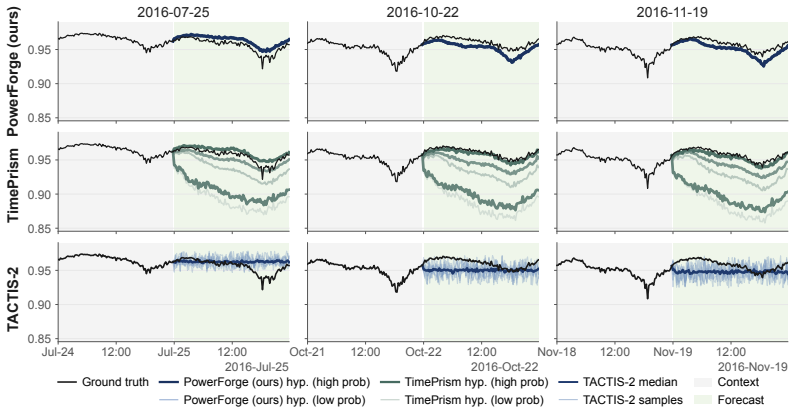
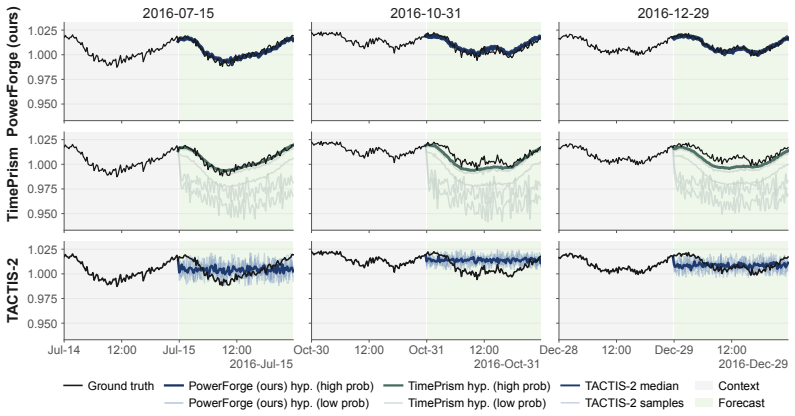
PowerForge achieves the best average rank on every power grid by balancing safety metrics against forecast fidelity.
A machine-rendered reading of the paper's core claim, the machinery that carries it, and where it could break.
Core claim
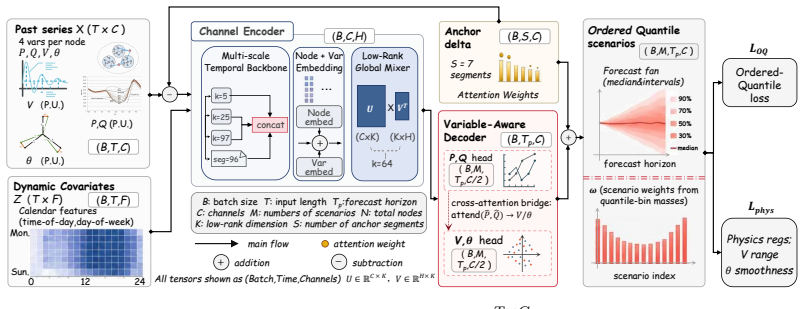
PowerForge is a scenario-based quantile forecaster with type-specific decoding heads and a causal bridge between variable groups that achieves the best average rank on every grid in the PowerPhase benchmark. The benchmark covers six transmission grids with 2,000 to 36,964 channels whose targets come from AC power-flow solves and ships with constraint-aware metrics Safety_mBrier, NECV, and CVaR-alpha that complement CRPS and Distortion. Across eight baselines and three seeds, distributional accuracy and constraint satisfaction produce different model rankings.
What carries the argument
scenario-based quantile forecaster with type-specific decoding heads and a causal bridge between variable groups
If this is right
- Distributional accuracy and constraint satisfaction rank models differently, exposing a safety-fidelity trade-off.
- PowerForge outperforms eight baselines on every one of the six grids under both standard and constraint-aware evaluation.
- Existing canonical multivariate benchmarks are too small and lack the scale or constraint evaluation needed for power systems.
- Constraint-aware metrics must be used alongside CRPS when selecting models for safety-critical deployment.
Where Pith is reading between the lines
- The causal bridge between variable groups could be adapted to other domains that contain distinct physical subgroups such as traffic networks or climate variables.
- Training objectives that directly optimize the safety metrics might reduce the observed trade-off further.
- Power system operators could adopt the new metrics as a filter when short-listing models for real-time use.
Load-bearing premise
The constraint-aware metrics Safety_mBrier, NECV, and CVaR-alpha correctly capture operational safety requirements that matter in real power-system control rooms.
What would settle it
Deploying the top-ranked models in a live grid simulation or control-room setting and checking whether higher scores on the safety metrics correspond to fewer actual constraint violations during operation.
Figures
read the original abstract
Probabilistic forecasting models are increasingly deployed on multivariate systems with distinct channel physics and operational constraints, but existing benchmarks evaluate neither property at scale. Public canonical multivariate benchmarks cap out at 2,000 channels, while power-system benchmarks either lack temporal structure or probabilistic evaluation. We introduce PowerPhase, a probabilistic forecasting benchmark built on six transmission grids ranging from 2,000 to 36,964 jointly forecasted channels, more than an order of magnitude beyond popular canonical multivariate benchmarks. Each target trajectory is the output of an AC power-flow solve, and PowerPhase ships with constraint-aware metrics, including Safety_mBrier, NECV, and CVaR-alpha, that complement CRPS and Distortion. Across eight baselines and three seeds, distributional accuracy and constraint satisfaction rank models differently, a trade-off we term safety-fidelity. We further propose PowerForge, a scenario-based quantile forecaster with type-specific decoding heads and a causal bridge between variable groups, which achieves the best average rank on every grid.
Editorial analysis
A structured set of objections, weighed in public.
Referee Report
Summary. The manuscript introduces the PowerPhase benchmark consisting of six transmission-grid datasets (2,000–36,964 channels) whose trajectories are AC power-flow solutions, defines three new constraint-aware metrics (Safety_mBrier, NECV, CVaR-alpha) that supplement CRPS and Distortion, and presents PowerForge, a scenario-based quantile forecaster with type-specific heads and a causal bridge, which obtains the best average rank on every grid when evaluated on the new metrics.
Significance. If the new metrics are shown to track real operational constraint violations, the work supplies the first large-scale benchmark that explicitly separates distributional accuracy from constraint satisfaction and demonstrates a concrete model that improves the latter without sacrificing the former.
major comments (2)
- [Abstract / Evaluation section] The central claim that PowerForge 'achieves the best average rank on every grid' is computed exclusively on Safety_mBrier, NECV, and CVaR-alpha (Abstract). The manuscript provides no correlation analysis, historical violation logs, or operator-decision data showing that lower values of these metrics correspond to fewer or less severe real-world constraint violations on the six grids.
- [Evaluation section] Because the headline ranking result and the safety-fidelity trade-off narrative rest entirely on the unvalidated metrics, the empirical superiority of PowerForge for the stated application cannot be assessed from the reported experiments.
Simulated Author's Rebuttal
We thank the referee for the constructive feedback emphasizing the need for validation of the new metrics. We respond to each major comment below and propose targeted revisions where appropriate.
read point-by-point responses
-
Referee: [Abstract / Evaluation section] The central claim that PowerForge 'achieves the best average rank on every grid' is computed exclusively on Safety_mBrier, NECV, and CVaR-alpha (Abstract). The manuscript provides no correlation analysis, historical violation logs, or operator-decision data showing that lower values of these metrics correspond to fewer or less severe real-world constraint violations on the six grids.
Authors: We agree that the manuscript contains no correlation analysis, historical violation logs, or operator-decision data linking the metrics to real-world outcomes. The PowerPhase datasets consist of AC power-flow solutions on transmission grids, and the metrics (Safety_mBrier, NECV, CVaR-alpha) are defined directly from the constraint equations (voltage and line-flow limits) embedded in those solutions. The paper's stated contribution is the introduction of a benchmark that separates distributional accuracy from constraint satisfaction and the demonstration that these two objectives produce different model rankings. We do not claim external validation of the metrics. We will revise the Evaluation and Discussion sections to (i) state explicitly that the metrics serve as domain-derived proxies rather than empirically validated predictors of operational incidents and (ii) add a limitations paragraph on the absence of public historical violation data for these grids. revision: partial
-
Referee: [Evaluation section] Because the headline ranking result and the safety-fidelity trade-off narrative rest entirely on the unvalidated metrics, the empirical superiority of PowerForge for the stated application cannot be assessed from the reported experiments.
Authors: The headline result is that PowerForge obtains the best average rank on the three constraint-aware metrics across all six grids; the manuscript does not assert operational superiority beyond performance on these metrics. We acknowledge that, without external validation, claims about real-world impact remain limited. We will add a short paragraph in the Discussion clarifying that the safety-fidelity trade-off is demonstrated within the benchmark and that transfer to live operator decisions would require additional utility-specific data. revision: partial
- Direct empirical correlation of the proposed metrics with historical violation logs or operator decisions, because such data is not publicly available for the transmission grids used in PowerPhase.
Circularity Check
No significant circularity; empirical benchmark and model evaluation are self-contained
full rationale
The manuscript introduces PowerPhase as a new benchmark on six grids and PowerForge as a new scenario-based forecaster, then reports empirical ranks on Safety_mBrier, NECV, CVaR-alpha, CRPS and Distortion. No derivation, uniqueness theorem, ansatz, or fitted-parameter prediction is claimed; the headline result is a direct comparison of eight baselines on the introduced data and metrics. No self-citation is invoked to justify the core claims, and the evaluation chain does not reduce to its own inputs by construction. This is the normal case of an independent empirical contribution.
Axiom & Free-Parameter Ledger
Reference graph
Works this paper leans on
-
[1]
Gluonts: Probabilistic and neural time series modeling in python.Journal of Machine Learning Research, 21(116):1–6, 2020
Alexander Alexandrov, Konstantinos Benidis, Michael Bohlke-Schneider, Valentin Flunkert, Jan Gasthaus, Tim Januschowski, Danielle C Maddix, Syama Rangapuram, David Salinas, Jasper Schulz, et al. Gluonts: Probabilistic and neural time series modeling in python.Journal of Machine Learning Research, 21(116):1–6, 2020
2020
-
[2]
Angelopoulos and Stephen Bates
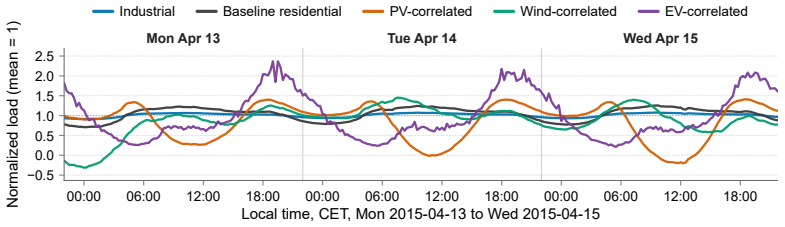
Anastasios N. Angelopoulos and Stephen Bates. A gentle introduction to conformal prediction and distribution-free uncertainty quantification.CoRR, abs/2107.07511, 2021. URL https: //arxiv.org/abs/2107.07511
Pith/arXiv arXiv 2021
-
[3]
Abdul Fatir Ansari, Oleksandr Shchur, Jaris Küken, Andreas Auer, Boran Han, Pedro Mercado, Syama Sundar Rangapuram, Huibin Shen, Lorenzo Stella, Xiyuan Zhang, Mononito Goswami, Shubham Kapoor, Danielle C. Maddix, Pablo Guerron, Tony Hu, Junming Yin, Nick Erickson, Prateek Mutalik Desai, Hao Wang, Huzefa Rangwala, George Karypis, Yuyang Wang, and Michael B...
Pith/arXiv arXiv 2025
-
[4]
Arjun Ashok, Étienne Marcotte, Valentina Zantedeschi, Nicolas Chapados, and Alexandre Drouin. Tactis-2: Better, faster, simpler attentional copulas for multivariate time series.arXiv preprint arXiv:2310.01327, 2023
arXiv 2023
-
[5]
Sogol Babaeinejadsarookolaee, Adam Birchfield, Richard D Christie, Carleton Coffrin, Christo- pher DeMarco, Ruisheng Diao, Michael Ferris, Stephane Fliscounakis, Scott Greene, Renke Huang, et al. The power grid library for benchmarking ac optimal power flow algorithms.arXiv preprint arXiv:1908.02788, 2019
arXiv 1908
-
[6]
Deep learning for time series forecasting: Tutorial and literature survey.ACM Computing Surveys, 55(6):1–36, 2022
Konstantinos Benidis, Syama Sundar Rangapuram, Valentin Flunkert, Yuyang Wang, Danielle Maddix, Caner Turkmen, Jan Gasthaus, Michael Bohlke-Schneider, David Salinas, Lorenzo Stella, et al. Deep learning for time series forecasting: Tutorial and literature survey.ACM Computing Surveys, 55(6):1–36, 2022
2022
-
[7]
Grid structural characteristics as validation criteria for synthetic networks.IEEE Transactions on power systems, 32(4):3258–3265, 2016
Adam B Birchfield, Ti Xu, Kathleen M Gegner, Komal S Shetye, and Thomas J Overbye. Grid structural characteristics as validation criteria for synthetic networks.IEEE Transactions on power systems, 32(4):3258–3265, 2016
2016
-
[8]
Gridlab-d: an agent-based simulation framework for smart grids.Journal of Applied Mathematics, 2014(1):492320, 2014
David P Chassin, Jason C Fuller, and Ned Djilali. Gridlab-d: an agent-based simulation framework for smart grids.Journal of Applied Mathematics, 2014(1):492320, 2014
2014
-
[9]
Winner-takes-all for multivariate probabilistic time series forecasting
Adrien Cortes, Remi Rehm, and Victor Letzelter. Winner-takes-all for multivariate probabilistic time series forecasting. InForty-second International Conference on Machine Learning, 2025. URLhttps://openreview.net/forum?id=4QcFfTu6UT
2025
-
[10]
From Samples to Scenarios: A New Paradigm for Probabilistic Forecasting
Xilin Dai, Zhijian Xu, Wanxu Cai, and Qiang Xu. From Samples to Scenarios: A New Paradigm for Probabilistic Forecasting. InThe Fourteenth International Conference on Learning Representations, October 2025. 10
2025
-
[11]
Xilin Dai, Ruidi Zhou, Jinhao Zhang, Keyi He, Fanfan Lin, and Hao Ma. SocNet: A Physics- Guided Neural Network for Battery State-of-Charge Estimation Robust to Temperature Varia- tions and Sensor Noises.IEEE Transactions on Transportation Electrification, 11(5):11165– 11176, October 2025
2025
-
[12]
Position: Universal time series foundation models rest on a category error, 2026
Xilin Dai, Wanxu Cai, Zhijian Xu, and Qiang Xu. Position: Universal time series foundation models rest on a category error, 2026. URLhttps://arxiv.org/abs/2602.05287
Pith/arXiv arXiv 2026
-
[13]
Xilin Dai, Ruidi Zhou, Jinhao Zhang, Fanfan Lin, Weifeng Zhang, and Hao Ma. Socgate: Physics-gated neural network for stable multicycle estimation of battery state-of-charge.IEEE Transactions on Industrial Electronics, 73(4):5518–5529, 2026. doi: 10.1109/TIE.2025. 3626581
-
[14]
Tactis: Transformer-attentional copulas for time series
Alexandre Drouin, Étienne Marcotte, and Nicolas Chapados. Tactis: Transformer-attentional copulas for time series. InInternational Conference on Machine Learning, pages 5447–5493. PMLR, 2022
2022
-
[15]
Cengage Learning Stamford, CT, USA, 2012
J Duncan Glover, Mulukutla S Sarma, Thomas Jeffrey Overbye, and NP Padhy.Power system analysis and design, volume 2008. Cengage Learning Stamford, CT, USA, 2012
2008
-
[16]
Probabilistic forecasting.Annual Review of Statistics and Its Application, 1(1):125–151, 2014
Tilmann Gneiting and Matthias Katzfuss. Probabilistic forecasting.Annual Review of Statistics and Its Application, 1(1):125–151, 2014
2014
-
[17]
Strictly proper scoring rules, prediction, and estimation
Tilmann Gneiting and Adrian E Raftery. Strictly proper scoring rules, prediction, and estimation. Journal of the American statistical Association, 102(477):359–378, 2007
2007
-
[18]
Monash time series forecasting archive.arXiv preprint arXiv:2105.06643, 2021
Rakshitha Godahewa, Christoph Bergmeir, Geoffrey I Webb, Rob J Hyndman, and Pablo Montero-Manso. Monash time series forecasting archive.arXiv preprint arXiv:2105.06643, 2021
arXiv 2021
-
[19]
Decomposition of the continuous ranked probability score for ensemble prediction systems.Weather and Forecasting, 15(5):559–570, 2000
Hans Hersbach. Decomposition of the continuous ranked probability score for ensemble prediction systems.Weather and Forecasting, 15(5):559–570, 2000
2000
-
[20]
Probabilistic electric load forecasting: A tutorial review.International Journal of Forecasting, 32(3):914–938, 2016
Tao Hong and Shu Fan. Probabilistic electric load forecasting: A tutorial review.International Journal of Forecasting, 32(3):914–938, 2016
2016
-
[21]
Energy forecasting: A review and outlook.IEEE Open Access Journal of Power and Energy, 7:376–388, 2020
Tao Hong, Pierre Pinson, Yi Wang, Rafał Weron, Dazhi Yang, and Hamidreza Zareipour. Energy forecasting: A review and outlook.IEEE Open Access Journal of Power and Energy, 7:376–388, 2020
2020
-
[22]
Cédric Josz, Stéphane Fliscounakis, Jean Maeght, and Patrick Panciatici. Ac power flow data in matpower and qcqp format: itesla, rte snapshots, and pegase.arXiv preprint arXiv:1603.01533, 2016
Pith/arXiv arXiv 2016
-
[23]
Regression quantiles.Econometrica: journal of the Econometric Society, pages 33–50, 1978
Roger Koenker and Gilbert Bassett Jr. Regression quantiles.Econometrica: journal of the Econometric Society, pages 33–50, 1978
1978
-
[24]
Modeling long-and short-term temporal patterns with deep neural networks
Guokun Lai, Wei-Cheng Chang, Yiming Yang, and Hanxiao Liu. Modeling long-and short-term temporal patterns with deep neural networks. InThe 41st international ACM SIGIR conference on research & development in information retrieval, pages 95–104, 2018
2018
-
[25]
Stochastic multiple choice learning for training diverse deep ensembles.Advances in Neural Information Processing Systems, 29, 2016
Stefan Lee, Senthil Purushwalkam Shiva Prakash, Michael Cogswell, Viresh Ranjan, David Crandall, and Dhruv Batra. Stochastic multiple choice learning for training diverse deep ensembles.Advances in Neural Information Processing Systems, 29, 2016
2016
-
[26]
Falcon-x: A time series foundation model for heterogeneous multivariate modeling, 2026
Yiding Liu, Yifan Hu, Hongjie Xia, Peiyuan Liu, Hongzhou Chen, Xilin Dai, Zewei Dong, and Jiang-Ming Yang. Falcon-x: A time series foundation model for heterogeneous multivariate modeling, 2026. URLhttps://arxiv.org/abs/2605.27286
Pith/arXiv arXiv 2026
-
[27]
Sean Lovett, Miha Zgubic, Sofia Liguori, Sephora Madjiheurem, Hamish Tomlinson, Sophie Elster, Chris Apps, Sims Witherspoon, and Luis Piloto. Opfdata: Large-scale datasets for ac optimal power flow with topological perturbations.arXiv preprint arXiv:2406.07234, 2024. 11
arXiv 2024
-
[28]
Simbench—a benchmark dataset of electric power systems to compare innovative solutions based on power flow analysis.Energies, 13(12): 3290, 2020
Steffen Meinecke, Džanan Sarajli´c, Simon Ruben Drauz, Annika Klettke, Lars-Peter Lauven, Christian Rehtanz, Albert Moser, and Martin Braun. Simbench—a benchmark dataset of electric power systems to compare innovative solutions based on power flow analysis.Energies, 13(12): 3290, 2020
2020
-
[29]
Springer Science & Business Media, 2013
Juan M Morales, Antonio J Conejo, Henrik Madsen, Pierre Pinson, and Marco Zugno.Inte- grating renewables in electricity markets: operational problems. Springer Science & Business Media, 2013
2013
-
[30]
A new vector partition of the probability score.Journal of Applied Meteorology and Climatology, 12(4):595–600, 1973
Allan H Murphy. A new vector partition of the probability score.Journal of Applied Meteorology and Climatology, 12(4):595–600, 1973
1973
-
[31]
Distributionally robust optimization: A review.arXiv preprint arXiv:1908.05659, 2019
Hamed Rahimian and Sanjay Mehrotra. Distributionally robust optimization: A review.arXiv preprint arXiv:1908.05659, 2019
arXiv 1908
-
[32]
Maziar Raissi, Paris Perdikaris, and George E Karniadakis. Physics-informed neural networks: A deep learning framework for solving forward and inverse problems involving nonlinear partial differential equations.Journal of Computational physics, 378:686–707, 2019
2019
-
[33]
Deep state space models for time series forecasting.Advances in neural information processing systems, 31, 2018
Syama Sundar Rangapuram, Matthias W Seeger, Jan Gasthaus, Lorenzo Stella, Yuyang Wang, and Tim Januschowski. Deep state space models for time series forecasting.Advances in neural information processing systems, 31, 2018
2018
-
[34]
Kashif Rasul, Abdul-Saboor Sheikh, Ingmar Schuster, Urs Bergmann, and Roland V ollgraf. Multivariate probabilistic time series forecasting via conditioned normalizing flows.arXiv preprint arXiv:2002.06103, 2020
arXiv 2002
-
[35]
Autoregressive denois- ing diffusion models for multivariate probabilistic time series forecasting
Kashif Rasul, Calvin Seward, Ingmar Schuster, and Roland V ollgraf. Autoregressive denois- ing diffusion models for multivariate probabilistic time series forecasting. InInternational conference on machine learning, pages 8857–8868. PMLR, 2021
2021
-
[36]
Rivera, Anvita Bhagavathula, Alvaro Carbonero, and Priya Donti
Ana K. Rivera, Anvita Bhagavathula, Alvaro Carbonero, and Priya Donti. Pfδ: A benchmark dataset for power flow under load, generation, and topology variations, 2026. URL https: //arxiv.org/abs/2510.22048
Pith/arXiv arXiv 2026
-
[37]
Power systems optimization under uncertainty: A review of methods and applications.Electric Power Systems Research, 214:108725, 2023
Line A Roald, David Pozo, Anthony Papavasiliou, Daniel K Molzahn, Jalal Kazempour, and Antonio Conejo. Power systems optimization under uncertainty: A review of methods and applications.Electric Power Systems Research, 214:108725, 2023
2023
-
[38]
Optimization of conditional value-at-risk
R Tyrrell Rockafellar, Stanislav Uryasev, et al. Optimization of conditional value-at-risk. Journal of risk, 2:21–42, 2000
2000
-
[39]
High-dimensional multivariate forecasting with low-rank gaussian copula processes.Advances in neural information processing systems, 32, 2019
David Salinas, Michael Bohlke-Schneider, Laurent Callot, Roberto Medico, and Jan Gasthaus. High-dimensional multivariate forecasting with low-rank gaussian copula processes.Advances in neural information processing systems, 32, 2019
2019
-
[40]
Deepar: Probabilistic forecasting with autoregressive recurrent networks.International journal of forecasting, 36(3): 1181–1191, 2020
David Salinas, Valentin Flunkert, Jan Gasthaus, and Tim Januschowski. Deepar: Probabilistic forecasting with autoregressive recurrent networks.International journal of forecasting, 36(3): 1181–1191, 2020
2020
-
[41]
Think globally, act locally: A deep neural network approach to high-dimensional time series forecasting.Advances in neural information processing systems, 32, 2019
Rajat Sen, Hsiang-Fu Yu, and Inderjit S Dhillon. Think globally, act locally: A deep neural network approach to high-dimensional time series forecasting.Advances in neural information processing systems, 32, 2019
2019
-
[42]
pandapower—an open-source python tool for convenient modeling, analysis, and optimization of electric power systems.IEEE Transactions on Power Systems, 33(6):6510–6521, 2018
Leon Thurner, Alexander Scheidler, Florian Schäfer, Jan-Hendrik Menke, Julian Dollichon, Friederike Meier, Steffen Meinecke, and Martin Braun. pandapower—an open-source python tool for convenient modeling, analysis, and optimization of electric power systems.IEEE Transactions on Power Systems, 33(6):6510–6521, 2018
2018
-
[43]
Powergraph: A power grid benchmark dataset for graph neural networks
Anna Varbella, Kenza Amara, Blazhe Gjorgiev, Mennatallah El-Assady, and Giovanni Sansavini. Powergraph: A power grid benchmark dataset for graph neural networks. InThe Thirty-eight Conference on Neural Information Processing Systems Datasets and Benchmarks Track, 2024. URLhttps://openreview.net/forum?id=qWTfCO4HvT. 12
2024
-
[44]
Linformer: Self-attention with linear complexity.arXiv preprint arXiv:2006.04768, 2020
Sinong Wang, Belinda Z Li, Madian Khabsa, Han Fang, and Hao Ma. Linformer: Self-attention with linear complexity.arXiv preprint arXiv:2006.04768, 2020
Pith/arXiv arXiv 2006
-
[45]
Open power system data–frictionless data for electricity system modelling.Applied Energy, 236: 401–409, 2019
Frauke Wiese, Ingmar Schlecht, Wolf-Dieter Bunke, Clemens Gerbaulet, Lion Hirth, Martin Jahn, Friedrich Kunz, Casimir Lorenz, Jonathan Mühlenpfordt, Juliane Reimann, et al. Open power system data–frictionless data for electricity system modelling.Applied Energy, 236: 401–409, 2019
2019
-
[46]
Unified training of universal time series forecasting transformers
Gerald Woo, Chenghao Liu, Akshat Kumar, Caiming Xiong, Silvio Savarese, and Doyen Sahoo. Unified training of universal time series forecasting transformers. InForty-first International Conference on Machine Learning, 2024
2024
-
[47]
John wiley & sons, 2013
Allen J Wood, Bruce F Wollenberg, and Gerald B Sheblé.Power generation, operation, and control. John wiley & sons, 2013
2013
-
[48]
Autoformer: Decomposition trans- formers with auto-correlation for long-term series forecasting.Advances in neural information processing systems, 34:22419–22430, 2021
Haixu Wu, Jiehui Xu, Jianmin Wang, and Mingsheng Long. Autoformer: Decomposition trans- formers with auto-correlation for long-term series forecasting.Advances in neural information processing systems, 34:22419–22430, 2021
2021
-
[49]
Sequential predictive conformal inference for time series
Chen Xu and Yao Xie. Sequential predictive conformal inference for time series. InInternational Conference on Machine Learning, pages 38707–38727. PMLR, 2023
2023
-
[50]
SSM2Mel: State Space Model to Reconstruct Mel Spectrogram from the EEG,
Kaijie Xu, Xilin Dai, and Lin Qiu. Opformer: Real-time optimal power flow with cnn-based transformer. InICASSP 2025 - 2025 IEEE International Conference on Acoustics, Speech and Signal Processing (ICASSP), pages 1–5, 2025. doi: 10.1109/ICASSP49660.2025.10888727
-
[51]
Optimal power flow under varying topologies via physics-guided neural network with stack-learning.International Journal of Electrical Power & Energy Systems, 173:111391, 2025
Kaijie Xu, Lin Qiu, Xilin Dai, Yi Ding, Chengjin Ye, and Youtong Fang. Optimal power flow under varying topologies via physics-guided neural network with stack-learning.International Journal of Electrical Power & Energy Systems, 173:111391, 2025
2025
-
[52]
Fidel-ts: A high-fidelity multimodal benchmark for time series forecasting, 2026
Zhijian Xu, Wanxu Cai, Xilin Dai, Zhaorong Deng, and Qiang Xu. Fidel-ts: A high-fidelity multimodal benchmark for time series forecasting, 2026. URL https://arxiv.org/abs/ 2509.24789
Pith/arXiv arXiv 2026
-
[53]
Tijin Yan, Hongwei Zhang, Tong Zhou, Yufeng Zhan, and Yuanqing Xia. Scoregrad: Multivari- ate probabilistic time series forecasting with continuous energy-based generative models.arXiv preprint arXiv:2106.10121, 2021
arXiv 2021
-
[54]
Disturbed security-constrained and time-variant optimal power flow for dynamic power system based on chaotic-genetic-centroid puffin optimization.Applied Energy, 397:126287, 2025
Xiaochen Zhang, Kaijie Xu, Shengchen Liao, Lin Qiu, Chengjin Ye, and Youtong Fang. Disturbed security-constrained and time-variant optimal power flow for dynamic power system based on chaotic-genetic-centroid puffin optimization.Applied Energy, 397:126287, 2025
2025
-
[55]
A multi-scale time-series dataset with benchmark for machine learning in decarbonized energy grids.Scientific Data, 9(1):359, 2022
Xiangtian Zheng, Nan Xu, Loc Trinh, Dongqi Wu, Tong Huang, S Sivaranjani, Yan Liu, and Le Xie. A multi-scale time-series dataset with benchmark for machine learning in decarbonized energy grids.Scientific Data, 9(1):359, 2022
2022
-
[56]
Informer: Beyond efficient transformer for long sequence time-series forecasting
Haoyi Zhou, Shanghang Zhang, Jieqi Peng, Shuai Zhang, Jianxin Li, Hui Xiong, and Wancai Zhang. Informer: Beyond efficient transformer for long sequence time-series forecasting. In Proceedings of the AAAI conference on artificial intelligence, volume 35, pages 11106–11115, 2021
2021
-
[57]
Mat- power: Steady-state operations, planning, and analysis tools for power systems research and education.IEEE Transactions on power systems, 26(1):12–19, 2010
Ray Daniel Zimmerman, Carlos Edmundo Murillo-Sánchez, and Robert John Thomas. Mat- power: Steady-state operations, planning, and analysis tools for power systems research and education.IEEE Transactions on power systems, 26(1):12–19, 2010. 13 Appendix A Benchmark Details . . . . . . . . . . . . . . . . . . . . . . . . . . . . . 15 A.1 Data Generation Pipe...
2010
-
[58]
3.PV-correlated: national load minusk pv ·solar withk pv = 3.0, normalised to unit mean
Industrial: a flattened version of the national load,µ+α ind(Lt −µ) with αind = 0.3, normalised to unit mean. 3.PV-correlated: national load minusk pv ·solar withk pv = 3.0, normalised to unit mean. 4.Wind-correlated: national load minusk wind ·wind withk wind = 2.0, normalised to unit mean
-
[59]
EV-correlated: the baseline profile boosted by +40% during 18:00–22:00, normalised to unit mean. Each HV bus is assigned the Industrial profile with probability 0.8 and the Baseline profile with prob- ability 0.2. Each LV bus draws from {Baseline, PV , EV , Wind} with base weights (0.4,0.3,0.2,0.1) , modulated by a deterministic region index r=bus_idmod 3...
arXiv 2015
discussion (0)
Sign in with ORCID, Apple, or X to comment. Anyone can read and Pith papers without signing in.