Probing damping effects in neutrino oscillations with the first JUNO data
Pith reviewed 2026-06-27 06:21 UTC · model grok-4.3
The pith
JUNO's first data already sets competitive bounds on neutrino damping from decoherence and decay.
A machine-rendered reading of the paper's core claim, the machinery that carries it, and where it could break.
Core claim
In all considered damping scenarios the first JUNO data already places competitive bounds on the new physics parameters while the standard neutrino oscillation parameters remain robustly determined from the spectrum.
What carries the argument
Phenomenological damping terms added to the oscillation probability, realized via wave-packet decoherence, an open-quantum-system model, and an invisible-decay model, then fitted directly to the JUNO energy spectrum.
If this is right
- Competitive upper limits on the decoherence parameters arising from wave-packet separation.
- Bounds on the energy-dependent decoherence coefficients allowed by the open-quantum-system framework.
- Limits on the invisible neutrino decay rate or lifetime.
- The standard mixing angles and mass-squared differences remain stable under the inclusion of damping terms.
Where Pith is reading between the lines
- Future JUNO data releases could tighten these bounds further or begin to exclude regions allowed by other experiments.
- The same damping models could be applied to data from long-baseline experiments to test consistency across baselines.
- Observation of any damping signal would require extending the standard quantum treatment of neutrino propagation.
Load-bearing premise
The chosen phenomenological parameterizations of decoherence and decay fully capture possible damping effects without biasing the extracted standard oscillation parameters.
What would settle it
A JUNO spectrum that deviates from both standard oscillations and all three damped models, or one that yields no improvement in damping-parameter bounds as statistics increase.
Figures
read the original abstract
We consider different scenarios which lead to a damping of the neutrino oscillation probability and investigate their impact on the first JUNO results. First, we study decoherence effects due to wave packet separation. In addition, we consider an open quantum system framework and adopt a phenomenological approach which allows us to parameterize the energy dependence of the decoherence effects more freely. Finally, we study the effect of invisible neutrino decay. In all cases with the first data JUNO can already place competitive bounds on the parameter space of the scenarios under consideration, while also maintaining a robust measurement of the standard neutrino oscillation parameters.
Editorial analysis
A structured set of objections, weighed in public.
Referee Report
Summary. The manuscript examines damping of neutrino oscillation probabilities using the first JUNO data. It considers three scenarios: decoherence from wave-packet separation, an open-quantum-system framework with phenomenological energy-dependent decoherence, and invisible neutrino decay. The central claim is that JUNO already sets competitive bounds on the damping parameters in each case while preserving robust measurements of the standard oscillation parameters.
Significance. If the fits are shown to be unbiased, the work would demonstrate that early JUNO data can usefully constrain non-standard damping effects without degrading the precision on Δm^{2}_{31} and heta_{12}, providing timely phenomenological limits in a field where such bounds are typically derived from longer-baseline or higher-statistics experiments.
major comments (1)
- [Abstract] Abstract: the claim that standard parameters remain 'robust' and unbiased cannot be verified because no fit results, covariance matrices, or marginalization details are supplied; the stress-test concern that phenomenological energy dependence (e.g., power-law decoherence) can correlate with oscillation parameters therefore remains unaddressed.
Simulated Author's Rebuttal
We thank the referee for the careful review. We address the single major comment below.
read point-by-point responses
-
Referee: [Abstract] Abstract: the claim that standard parameters remain 'robust' and unbiased cannot be verified because no fit results, covariance matrices, or marginalization details are supplied; the stress-test concern that phenomenological energy dependence (e.g., power-law decoherence) can correlate with oscillation parameters therefore remains unaddressed.
Authors: The abstract summarizes the conclusion but does not contain numerical results. The manuscript body reports the best-fit values and 1σ uncertainties on Δm^{2}_{31} and heta_{12} for each damping scenario (Tables 2–4 and Figs. 4–6), obtained after marginalization over all other parameters as described in Sec. 3. These values remain consistent with the standard three-flavor fit within the quoted uncertainties. The simultaneous fit of damping and oscillation parameters already constitutes the stress test; no statistically significant shifts or enlarged errors are observed. To make the claim verifiable from the abstract alone we will add a short clause referencing the consistency of the standard parameters and point to the relevant tables/figures. revision: yes
Circularity Check
No significant circularity; results are data-driven fits to external JUNO spectrum
full rationale
The paper fits phenomenological damping models (wave-packet decoherence, open-quantum-system decoherence with free energy scaling, invisible decay) to the first JUNO data and reports bounds on the new parameters together with checks that standard oscillation parameters remain unbiased. No step reduces a claimed prediction or bound to a quantity defined by the fit itself; the reported constraints are extracted from external experimental data rather than by algebraic construction or self-citation chains. The analysis is therefore self-contained against external benchmarks.
Axiom & Free-Parameter Ledger
free parameters (2)
- energy-dependent decoherence strength
- invisible decay rate
axioms (1)
- domain assumption Standard three-flavor neutrino oscillation framework remains valid in the presence of damping
Reference graph
Works this paper leans on
-
[1]
However, in this form it is easier to see how the inclusion of damping effects modifies the oscillation picture
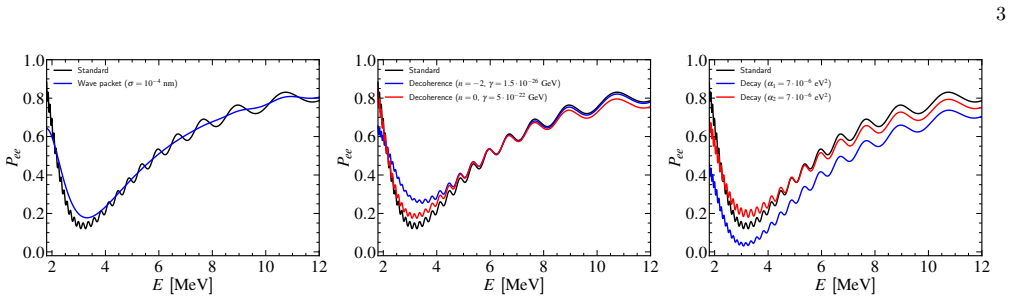
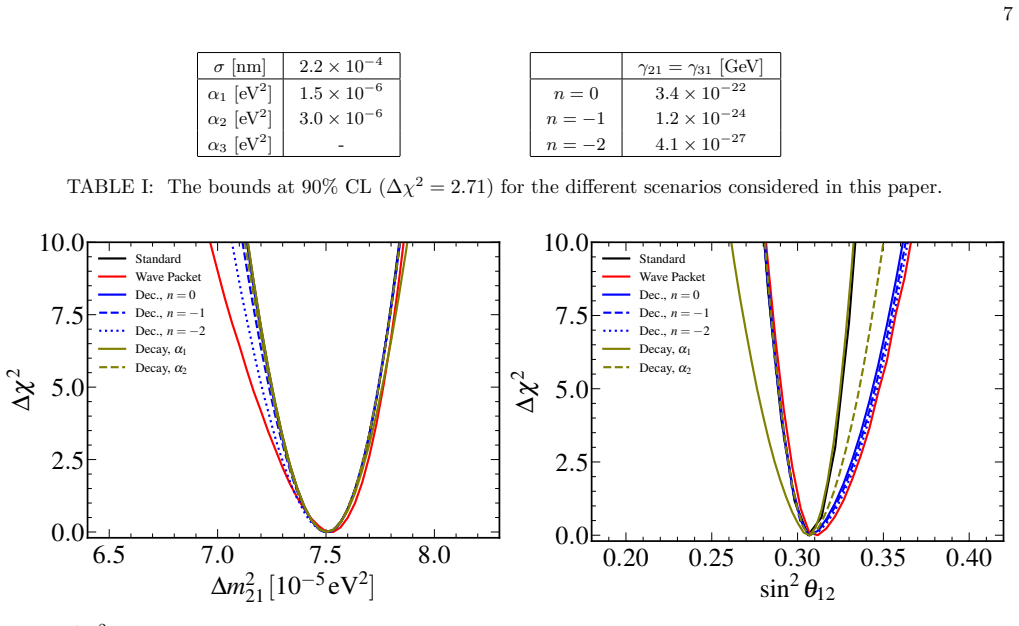
Note that this is not exactly the standard form used commonly in the literature. However, in this form it is easier to see how the inclusion of damping effects modifies the oscillation picture. Indeed, if we denote withDi(j)(E,L)some generic damping terms, the scenarios that we are going to investigate below will always be of the form P damp. ee =|Ue1|4e−...
-
[2]
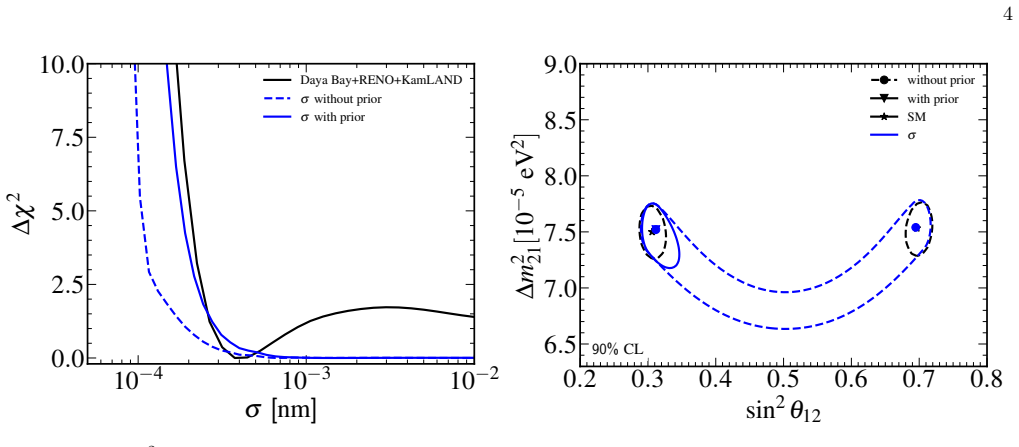
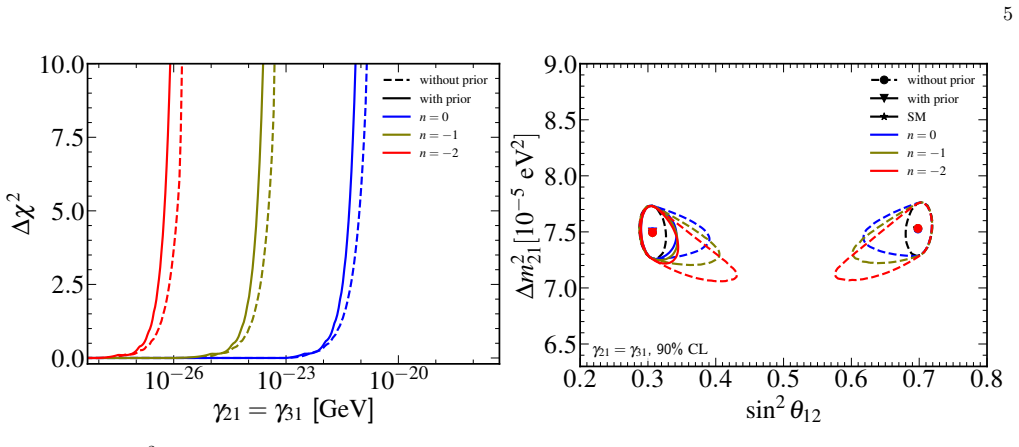
than in the standard analysis remain allowed. B. Neutrino environmental decoherence Next, we consider neutrino decoherence from interactions with some unknown environment. Note that the models that lead to Eq. (3) with the damping terms given in Ref. (6), sometimes called phase-perturbation models [64], can not be distinguished from decoherence due to wav...
-
[3]
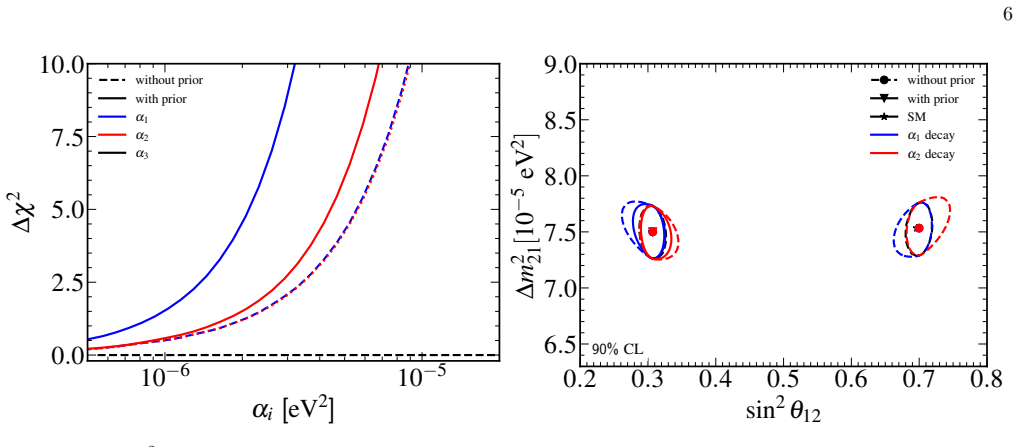
Nevertheless, once we include the external prior onsin2θ12 the determination of both parameters becomes fairly robust. C. Invisible decay Finally, we discuss the bounds on neutrino invisible decay and its impact on the determination of the solar oscillation parameters. The results of our analyses are shown in Fig. 4. In the left panel we present the bound...
-
[4]
First measurement of reactor neutrino oscillations at JUNO,
The summary of the different bounds is presented in Tab. I. These bounds are already competitive with other ones obtained in the literature as discussed in Sec. IV, and can be significantly improved in the future, in particular ones JUNO begins to observe the fast oscillations [31, 38, 68, 80]. Finally, in Fig. 5 we present the∆χ2 profiles for the standar...
-
[5]
2020 global reassessment of the neutrino oscillation picture,
P. F. de Salas, D. V. Forero, S. Gariazzo, P. Martínez-Miravé, O. Mena, C. A. Ternes, M. Tórtola, and J. W. F. Valle, “2020 global reassessment of the neutrino oscillation picture,”JHEP02(2021) 071,arXiv:2006.11237 [hep-ph]
Pith/arXiv arXiv 2020
-
[6]
NuFit-6.0: updated global analysis of three-flavor neutrino oscillations,
I. Esteban, M. C. Gonzalez-Garcia, M. Maltoni, I. Martinez-Soler, J. P. Pinheiro, and T. Schwetz, “NuFit-6.0: updated global analysis of three-flavor neutrino oscillations,”JHEP12(2024) 216,arXiv:2410.05380 [hep-ph]
Pith/arXiv arXiv 2024
-
[7]
Neutrino masses and mixing: Entering the era of subpercent precision,
F. Capozzi, W. Giarè, E. Lisi, A. Marrone, A. Melchiorri, and A. Palazzo, “Neutrino masses and mixing: Entering the era of subpercent precision,”Phys. Rev. D111no. 9, (2025) 093006,arXiv:2503.07752 [hep-ph]
arXiv 2025
-
[8]
Updated bounds on the (1,2) neutrino oscillation 8 parameters after first JUNO results,
F. Capozzi, E. Lisi, F. Marcone, A. Marrone, and A. Palazzo, “Updated bounds on the (1,2) neutrino oscillation 8 parameters after first JUNO results,”arXiv:2511.21650 [hep-ph]
-
[9]
Lessons from the first JUNO results,
I. Esteban, M. C. Gonzalez-Garcia, M. Maltoni, I. Martinez-Soler, J. P. Pinheiro, and T. Schwetz, “Lessons from the first JUNO results,”JHEP04(2026) 089,arXiv:2601.09791 [hep-ph]
Pith/arXiv arXiv 2026
-
[10]
S. Goswami, A. Gupta, U. Rahaman, and S. K. Raut, “Enhancing the sensitivity to neutrino oscillation parameters using synergy between T2K, NOnA and JUNO,”arXiv:2512.00172 [hep-ph]
-
[11]
Refractive neutrino masses in the solar DM halo: can the dark-LMA solution be revived?,
S. Chattopadhyay and A. Dighe, “Refractive neutrino masses in the solar DM halo: can the dark-LMA solution be revived?,”JHEP05(2026) 053,arXiv:2511.19420 [hep-ph]
arXiv 2026
-
[12]
JUNO’s Impact on the Neutrino Mass Ordering from Lorentz Invariance Violation,
T. Araya-Santander, C. Bonilla, and S. Pan, “JUNO’s Impact on the Neutrino Mass Ordering from Lorentz Invariance Violation,”arXiv:2512.11285 [hep-ph]
-
[13]
Neutrino mass ordering in JUNO at risk from scalar NSI induced resonance,
S. Choubey and A. Lund, “Neutrino mass ordering in JUNO at risk from scalar NSI induced resonance,” arXiv:2602.05564 [hep-ph]
-
[14]
Impact of New Physics on the JUNO-Long-Baseline Synergy in Neutrino Mass Ordering Determination,
G. F. S. Alves, H. Nunokawa, and R. Zukanovich Funchal, “Impact of New Physics on the JUNO-Long-Baseline Synergy in Neutrino Mass Ordering Determination,”arXiv:2603.17181 [hep-ph]
-
[15]
L. J. Flores, R. Pacheco-Aké, E. Peinado, G. Sanchez Garcia, and E. Vázquez-Jáuregui, “Constraints on Light Sterile Neutrinos and Scalar Non-Standard Interactions Using the First Reactor Antineutrino Oscillation Results at JUNO,” arXiv:2603.24677 [hep-ph]
-
[16]
EFT for Neutrino Oscillations: Theory Developments and Application to JUNO,
M. González-Alonso, A. Palavrić, and S. Prakash, “EFT for Neutrino Oscillations: Theory Developments and Application to JUNO,”arXiv:2606.11298 [hep-ph]
-
[17]
Leptonic first-row correlation and unitarity waiting for further JUNO tests,
Z.-z. Xing, “Leptonic first-row correlation and unitarity waiting for further JUNO tests,”Sci. Bull.71no. 8, (2026) , arXiv:2510.17583 [hep-ph]
arXiv 2026
-
[18]
J. Huang and S. Zhou, “Probing unitarity violation of lepton flavor mixing matrix with reactor antineutrinos at JUNO and TAO,”Phys. Lett. B873(2026) 140160,arXiv:2511.15525 [hep-ph]
arXiv 2026
-
[19]
Scale-Independent Relations Between Neutrino Mass Parameters,
M.-C. Chen, S. Perez, and M. Ratz, “Scale-Independent Relations Between Neutrino Mass Parameters,”Universe12 no. 2, (2026) 46,arXiv:2511.03974 [hep-ph]
arXiv 2026
-
[20]
Hunting for neutrino texture zeros with muon and tau flavor violation,
L. Calibbi, X. Gao, and M. Yuan, “Hunting for neutrino texture zeros with muon and tau flavor violation,”JHEP05 (2026) 188,arXiv:2511.08679 [hep-ph]
Pith/arXiv arXiv 2026
-
[21]
Trimaximal mixing patterns meet the first JUNO result,
D. Zhang, “Trimaximal mixing patterns meet the first JUNO result,”Phys. Rev. D113no. 5, (2026) 055035, arXiv:2511.15654 [hep-ph]
arXiv 2026
-
[22]
CP Prediction from ResidualZs 2 and Z s 2 Symmetries with JUNO First Data,
S.-F. Ge, C.-F. Kong, and J. P. Pinheiro, “CP Prediction from ResidualZs 2 and Z s 2 Symmetries with JUNO First Data,” arXiv:2511.15442 [hep-ph]
-
[23]
Modular TM1 mixing in light of precision measurement in JUNO,
W.-H. Jiang, R. Ouyang, and Y.-L. Zhou, “Modular TM1 mixing in light of precision measurement in JUNO,” arXiv:2511.16348 [hep-ph]
-
[24]
Modified tri-bimaximal neutrino mixing confronted by JUNOθ12 measurement,
X.-G. He, “Modified tri-bimaximal neutrino mixing confronted by JUNOθ12 measurement,”Phys. Lett. B874(2026) 140270,arXiv:2511.15978 [hep-ph]
arXiv 2026
-
[25]
Viability of A4, S4 and A5 flavour symmetries in light of the first JUNO result,
S. T. Petcov and A. V. Titov, “Viability of A4, S4 and A5 flavour symmetries in light of the first JUNO result,”Phys. Lett. B874(2026) 140295,arXiv:2511.19408 [hep-ph]
arXiv 2026
-
[26]
Zooming in on ‘bi-large’ neutrino mixing with the first JUNO results,
G.-J. Ding, R. Kumar, N. Nath, R. Srivastava, and J. W. F. Valle, “Zooming in on ‘bi-large’ neutrino mixing with the first JUNO results,”arXiv:2511.22689 [hep-ph]
-
[27]
Discrete flavour and CP symmetries in light of JUNO and neutrino global fit,
G.-J. Ding, C.-C. Li, J.-N. Lu, and S. T. Petcov, “Discrete flavour and CP symmetries in light of JUNO and neutrino global fit,”arXiv:2512.03809 [hep-ph]
-
[28]
D. Borah, P. Das, and D. Dutta, “Neutrino texture-zeros after JUNO’s first results: Implications for long-baseline neutrino experiments,”arXiv:2512.13587 [hep-ph]
-
[29]
AnA4-Symmetric Double Seesaw for Neutrino Masses and Mixing in Light of JUNO results,
S. K. Nanda, M. Ricky Devi, C. Dash, R. N. Panda, and S. Patra, “AnA4-Symmetric Double Seesaw for Neutrino Masses and Mixing in Light of JUNO results,”arXiv:2512.24132 [hep-ph]
-
[30]
New modular fixed point models and their phenomenological implications for JUNO, T2HK and DUNE,
E.-H. Shang, J.-N. Lu, G.-J. Ding, and S. F. King, “New modular fixed point models and their phenomenological implications for JUNO, T2HK and DUNE,”arXiv:2601.09598 [hep-ph]
-
[31]
Testing residual-symmetry-fixed columns ofUPMNS at DUNE and T2HK with initial JUNO constraints,
D. Dutta, S. Goswami, M. Kashav, and K. M. Patel, “Testing residual-symmetry-fixed columns ofUPMNS at DUNE and T2HK with initial JUNO constraints,”arXiv:2601.18397 [hep-ph]
-
[32]
Fate ofθ12 underµ-τreflection symmetry in light of the first JUNO results,
R. Kumar, “Fate ofθ12 underµ-τreflection symmetry in light of the first JUNO results,”Phys. Rev. D113no. 9, (2026) 095012,arXiv:2602.11277 [hep-ph]
Pith/arXiv arXiv 2026
-
[33]
Implications of the First JUNO Results for Dirac Neutrino Texture Zeros,
Priya, R. Kumar, L. Singh, and S. Verma, “Implications of the First JUNO Results for Dirac Neutrino Texture Zeros,” arXiv:2604.19122 [hep-ph]. [31]JUNOCollaboration, J. Wanget al., “Damping signatures at JUNO, a medium-baseline reactor neutrino oscillation experiment,”JHEP06(2022) 062,arXiv:2112.14450 [hep-ex]
Pith/arXiv arXiv 2022
-
[34]
Coherence of neutrino oscillations in vacuum and matter in the wave packet treatment,
C. Giunti, C. W. Kim, and U. W. Lee, “Coherence of neutrino oscillations in vacuum and matter in the wave packet treatment,”Phys. Lett. B274(1992) 87–94
1992
-
[35]
Neutrino oscillations in a model with a source and detector,
K. Kiers and N. Weiss, “Neutrino oscillations in a model with a source and detector,”Phys. Rev. D57(1998) 3091–3105,arXiv:hep-ph/9710289
Pith/arXiv arXiv 1998
-
[36]
Towards a unique formula for neutrino oscillations in vacuum,
M. Beuthe, “Towards a unique formula for neutrino oscillations in vacuum,”Phys. Rev. D66(2002) 013003, arXiv:hep-ph/0202068
Pith/arXiv arXiv 2002
-
[37]
Damping signatures in future neutrino oscillation experiments,
M. Blennow, T. Ohlsson, and W. Winter, “Damping signatures in future neutrino oscillation experiments,”JHEP06 (2005) 049,arXiv:hep-ph/0502147. [36]Daya BayCollaboration, F. P. Anet al., “Study of the wave packet treatment of neutrino oscillation at Daya Bay,” Eur. Phys. J. C77no. 9, (2017) 606,arXiv:1608.01661 [hep-ex]. 9
Pith/arXiv arXiv 2005
-
[38]
Quantum mechanics aspects and subtleties of neutrino oscillations,
E. Akhmedov, “Quantum mechanics aspects and subtleties of neutrino oscillations,” inInternational Conference on History of the Neutrino: 1930-2018. 1, 2019.arXiv:1901.05232 [hep-ph]
Pith/arXiv arXiv 1930
-
[39]
Probing neutrino quantum decoherence at reactor experiments,
A. de Gouvêa, V. De Romeri, and C. A. Ternes, “Probing neutrino quantum decoherence at reactor experiments,” JHEP08(2020) 018,arXiv:2005.03022 [hep-ph]
arXiv 2020
-
[40]
Z. Cheng, W. Wang, C. F. Wong, and J. Zhang, “Studying the neutrino wave-packet effects at medium-baseline reactor neutrino oscillation experiments and the potential benefits of an extra detector,”Nucl. Phys. B964(2021) 115304, arXiv:2009.06450 [hep-ph]
arXiv 2021
-
[41]
Combined analysis of neutrino decoherence at reactor experiments,
A. de Gouvêa, V. De Romeri, and C. A. Ternes, “Combined analysis of neutrino decoherence at reactor experiments,” JHEP06(2021) 042,arXiv:2104.05806 [hep-ph]
arXiv 2021
-
[42]
Addendum to: Combined analysis of neutrino decoherence at reactor experiments,
A. de Gouvêa, V. De Romeri, and C. A. Ternes, “Addendum to: Combined analysis of neutrino decoherence at reactor experiments,”JHEP11(2024) 095,arXiv:2410.01357 [hep-ph]
arXiv 2024
-
[43]
Quantum dissipative effects and neutrinos: Current constraints and future perspectives,
A. M. Gago, E. M. Santos, W. J. C. Teves, and R. Zukanovich Funchal, “Quantum dissipative effects and neutrinos: Current constraints and future perspectives,”Phys. Rev. D63(2001) 073001,arXiv:hep-ph/0009222
arXiv 2001
-
[44]
A Study on quantum decoherence phenomena with three generations of neutrinos,
A. M. Gago, E. M. Santos, W. J. C. Teves, and R. Zukanovich Funchal, “A Study on quantum decoherence phenomena with three generations of neutrinos,”arXiv:hep-ph/0208166
-
[45]
Open system approach to neutrino oscillations,
F. Benatti and R. Floreanini, “Open system approach to neutrino oscillations,”JHEP02(2000) 032, arXiv:hep-ph/0002221
Pith/arXiv arXiv 2000
-
[46]
Massless neutrino oscillations,
F. Benatti and R. Floreanini, “Massless neutrino oscillations,”Phys. Rev. D64(2001) 085015,arXiv:hep-ph/0105303
Pith/arXiv arXiv 2001
-
[47]
Probing possible decoherence effects in atmospheric neutrino oscillations,
E. Lisi, A. Marrone, and D. Montanino, “Probing possible decoherence effects in atmospheric neutrino oscillations,” Phys. Rev. Lett.85(2000) 1166–1169,arXiv:hep-ph/0002053
Pith/arXiv arXiv 2000
-
[48]
Probing quantum decoherence in atmospheric neutrino oscillations with a neutrino telescope,
D. Morgan, E. Winstanley, J. Brunner, and L. F. Thompson, “Probing quantum decoherence in atmospheric neutrino oscillations with a neutrino telescope,”Astropart. Phys.25(2006) 311–327,arXiv:astro-ph/0412618
Pith/arXiv arXiv 2006
-
[49]
Probing Planck scale physics with IceCube,
L. A. Anchordoqui, H. Goldberg, M. C. Gonzalez-Garcia, F. Halzen, D. Hooper, S. Sarkar, and T. J. Weiler, “Probing Planck scale physics with IceCube,”Phys. Rev. D72(2005) 065019,arXiv:hep-ph/0506168
Pith/arXiv arXiv 2005
-
[50]
Probing non-standard decoherence effects with solar and KamLAND neutrinos,
G. L. Fogli, E. Lisi, A. Marrone, D. Montanino, and A. Palazzo, “Probing non-standard decoherence effects with solar and KamLAND neutrinos,”Phys. Rev. D76(2007) 033006,arXiv:0704.2568 [hep-ph]
Pith/arXiv arXiv 2007
-
[51]
Quantum dissipation in vacuum neutrino oscillation,
R. L. N. Oliveira and M. M. Guzzo, “Quantum dissipation in vacuum neutrino oscillation,”Eur. Phys. J. C69(2010) 493–502
2010
-
[52]
Dissipation andθ13 in neutrino oscillations,
R. L. N. Oliveira and M. M. Guzzo, “Dissipation andθ13 in neutrino oscillations,”Eur. Phys. J. C73(2013) 2434
2013
-
[53]
Dissipative Effect in Long Baseline Neutrino Experiments,
R. L. N. Oliveira, “Dissipative Effect in Long Baseline Neutrino Experiments,”Eur. Phys. J. C76no. 7, (2016) 417, arXiv:1603.08065 [hep-ph]
Pith/arXiv arXiv 2016
-
[54]
Parameter Limits for Neutrino Oscillation with Decoherence in KamLAND,
G. Balieiro Gomes, M. M. Guzzo, P. C. de Holanda, and R. L. N. Oliveira, “Parameter Limits for Neutrino Oscillation with Decoherence in KamLAND,”Phys. Rev. D95no. 11, (2017) 113005,arXiv:1603.04126 [hep-ph]
Pith/arXiv arXiv 2017
-
[55]
Quantum Decoherence Effects in Neutrino Oscillations at DUNE,
G. Balieiro Gomes, D. V. Forero, M. M. Guzzo, P. C. De Holanda, and R. L. N. Oliveira, “Quantum Decoherence Effects in Neutrino Oscillations at DUNE,”Phys. Rev. D100no. 5, (2019) 055023,arXiv:1805.09818 [hep-ph]
arXiv 2019
-
[56]
Decoherence, matter effect, and neutrino hierarchy signature in long baseline experiments,
J. A. B. Coelho and W. A. Mann, “Decoherence, matter effect, and neutrino hierarchy signature in long baseline experiments,”Phys. Rev. D96no. 9, (2017) 093009,arXiv:1708.05495 [hep-ph]
Pith/arXiv arXiv 2017
-
[57]
Nonmaximalθ23 mixing at NOvA from neutrino decoherence,
J. A. B. Coelho, W. A. Mann, and S. S. Bashar, “Nonmaximalθ23 mixing at NOvA from neutrino decoherence,”Phys. Rev. Lett.118no. 22, (2017) 221801,arXiv:1702.04738 [hep-ph]
Pith/arXiv arXiv 2017
-
[58]
Revisiting quantum decoherence for neutrino oscillations in matter with constant density,
J. Carpio, E. Massoni, and A. M. Gago, “Revisiting quantum decoherence for neutrino oscillations in matter with constant density,”Phys. Rev. D97no. 11, (2018) 115017,arXiv:1711.03680 [hep-ph]
arXiv 2018
-
[59]
Testing quantum decoherence at DUNE,
J. A. Carpio, E. Massoni, and A. M. Gago, “Testing quantum decoherence at DUNE,”Phys. Rev. D100no. 1, (2019) 015035,arXiv:1811.07923 [hep-ph]
arXiv 2019
-
[60]
Decoherence in Neutrino Propagation Through Matter, and Bounds from IceCube/DeepCore,
P. Coloma, J. Lopez-Pavon, I. Martinez-Soler, and H. Nunokawa, “Decoherence in Neutrino Propagation Through Matter, and Bounds from IceCube/DeepCore,”Eur. Phys. J. C78no. 8, (2018) 614,arXiv:1803.04438 [hep-ph]
Pith/arXiv arXiv 2018
-
[61]
Probing CPT breaking induced by quantum decoherence at DUNE,
J. C. Carrasco, F. N. Díaz, and A. M. Gago, “Probing CPT breaking induced by quantum decoherence at DUNE,” Phys. Rev. D99no. 7, (2019) 075022,arXiv:1811.04982 [hep-ph]
Pith/arXiv arXiv 2019
-
[62]
Revealing neutrino nature andCPTviolation with decoherence effects,
L. Buoninfante, A. Capolupo, S. M. Giampaolo, and G. Lambiase, “Revealing neutrino nature andCPTviolation with decoherence effects,”Eur. Phys. J. C80no. 11, (2020) 1009,arXiv:2001.07580 [hep-ph]
arXiv 2020
-
[63]
Quantum decoherence and relaxation in neutrinos using long-baseline data,
A. L. G. Gomes, R. A. Gomes, and O. L. G. Peres, “Quantum decoherence and relaxation in neutrinos using long-baseline data,”arXiv:2001.09250 [hep-ph]
arXiv 2001
-
[64]
Density Matrix Formalism for PT-Symmetric Non-Hermitian Hamiltonians with the Lindblad Equation,
T. Ohlsson and S. Zhou, “Density Matrix Formalism for PT-Symmetric Non-Hermitian Hamiltonians with the Lindblad Equation,”Phys. Rev. A103no. 2, (2021) 022218,arXiv:2006.02445 [quant-ph]
arXiv 2021
-
[65]
Neutrino decoherence from quantum gravitational stochastic perturbations,
T. Stuttard and M. Jensen, “Neutrino decoherence from quantum gravitational stochastic perturbations,”Phys. Rev. D 102no. 11, (2020) 115003,arXiv:2007.00068 [hep-ph]
arXiv 2020
-
[66]
Neutrino signals of lightcone fluctuations resulting from fluctuating spacetime,
T. Stuttard, “Neutrino signals of lightcone fluctuations resulting from fluctuating spacetime,”Phys. Rev. D104no. 5, (2021) 056007,arXiv:2103.15313 [hep-ph]
arXiv 2021
-
[67]
Solar Neutrino Limits on Decoherence,
P. C. de Holanda, “Solar Neutrino Limits on Decoherence,”JCAP03(2020) 012,arXiv:1909.09504 [hep-ph]. [67]ICECUBE, IceCubeCollaboration, R. Abbasiet al., “Search for decoherence from quantum gravity with atmospheric neutrinos,”Nature Phys.20no. 6, (2024) 913–920,arXiv:2308.00105 [hep-ex]
arXiv 2020
-
[68]
Neutrino oscillation bounds on quantum decoherence,
V. De Romeri, C. Giunti, T. Stuttard, and C. A. Ternes, “Neutrino oscillation bounds on quantum decoherence,”JHEP 09(2023) 097,arXiv:2306.14699 [hep-ph]
arXiv 2023
-
[69]
Quantum decoherence effects on precision measurements at DUNE and T2HK,
G. Barenboim, A. M. Calatayud-Cadenillas, A. M. Gago, and C. A. Ternes, “Quantum decoherence effects on precision measurements at DUNE and T2HK,”Phys. Lett. B852(2024) 138626,arXiv:2402.16395 [hep-ph]. 10 [70]KM3NeTCollaboration, S. Aielloet al., “Search for quantum decoherence in neutrino oscillations with six detection units of KM3NeT/ORCA,”JCAP03(2025)...
arXiv 2024
-
[70]
SN1987A bounds on neutrino quantum decoherence,
C. A. Ternes, G. Pagliaroli, and F. L. Villante, “SN1987A bounds on neutrino quantum decoherence,”Phys. Rev. D112 no. 6, (2025) 063058,arXiv:2503.04573 [hep-ph]
arXiv 2025
-
[71]
Exploring neutrino loss with diffuse astrophysical neutrino fluxes,
I. Esteban, A. M. Gago, M. C. Gonzalez-Garcia, and G. D. Zapata, “Exploring neutrino loss with diffuse astrophysical neutrino fluxes,”arXiv:2605.13955 [hep-ph]
-
[72]
Neutrino Mixing, Decays and Supernova Sn1987a,
J. A. Frieman, H. E. Haber, and K. Freese, “Neutrino Mixing, Decays and Supernova Sn1987a,”Phys. Lett. B200 (1988) 115–121
1988
-
[73]
SN1987A and neutrino non-radiative decay,
P. Iváñez Ballesteros and M. C. Volpe, “SN1987A and neutrino non-radiative decay,”Phys. Lett. B847(2023) 138252, arXiv:2307.03549 [hep-ph]
arXiv 2023
-
[74]
Testing nonradiative neutrino decay scenarios with IceCube data,
G. Pagliaroli, A. Palladino, F. L. Villante, and F. Vissani, “Testing nonradiative neutrino decay scenarios with IceCube data,”Phys. Rev. D92no. 11, (2015) 113008,arXiv:1506.02624 [hep-ph]
Pith/arXiv arXiv 2015
-
[75]
Invisible Neutrino Decay Could Resolve IceCube’s Track and Cascade Tension,
P. B. Denton and I. Tamborra, “Invisible Neutrino Decay Could Resolve IceCube’s Track and Cascade Tension,”Phys. Rev. Lett.121no. 12, (2018) 121802,arXiv:1805.05950 [hep-ph]
Pith/arXiv arXiv 2018
-
[76]
Status of Oscillation plus Decay of Atmospheric and Long-Baseline Neutrinos,
M. C. Gonzalez-Garcia and M. Maltoni, “Status of Oscillation plus Decay of Atmospheric and Long-Baseline Neutrinos,”Phys. Lett. B663(2008) 405–409,arXiv:0802.3699 [hep-ph]
Pith/arXiv arXiv 2008
-
[77]
Invisible neutrino decay in the light of NOvA and T2K data,
S. Choubey, D. Dutta, and D. Pramanik, “Invisible neutrino decay in the light of NOvA and T2K data,”JHEP08 (2018) 141,arXiv:1805.01848 [hep-ph]
Pith/arXiv arXiv 2018
-
[78]
A Combined treatment of neutrino decay and neutrino oscillations,
M. Lindner, T. Ohlsson, and W. Winter, “A Combined treatment of neutrino decay and neutrino oscillations,”Nucl. Phys. B607(2001) 326–354,arXiv:hep-ph/0103170
Pith/arXiv arXiv 2001
-
[79]
Constraint on Neutrino Decay with Medium-Baseline Reactor Neutrino Oscillation Experiments,
T. Abrahão, H. Minakata, H. Nunokawa, and A. A. Quiroga, “Constraint on Neutrino Decay with Medium-Baseline Reactor Neutrino Oscillation Experiments,”JHEP11(2015) 001,arXiv:1506.02314 [hep-ph]
Pith/arXiv arXiv 2015
-
[80]
Neutrino Invisible Decay at DUNE: a multi-channel analysis,
A. Ghoshal, A. Giarnetti, and D. Meloni, “Neutrino Invisible Decay at DUNE: a multi-channel analysis,”J. Phys. G48 no. 5, (2021) 055004,arXiv:2003.09012 [hep-ph]
arXiv 2021
discussion (0)
Sign in with ORCID, Apple, or X to comment. Anyone can read and Pith papers without signing in.