Driven-dissipative entanglement of distant giant atoms
Pith reviewed 2026-06-27 06:17 UTC · model grok-4.3
The pith
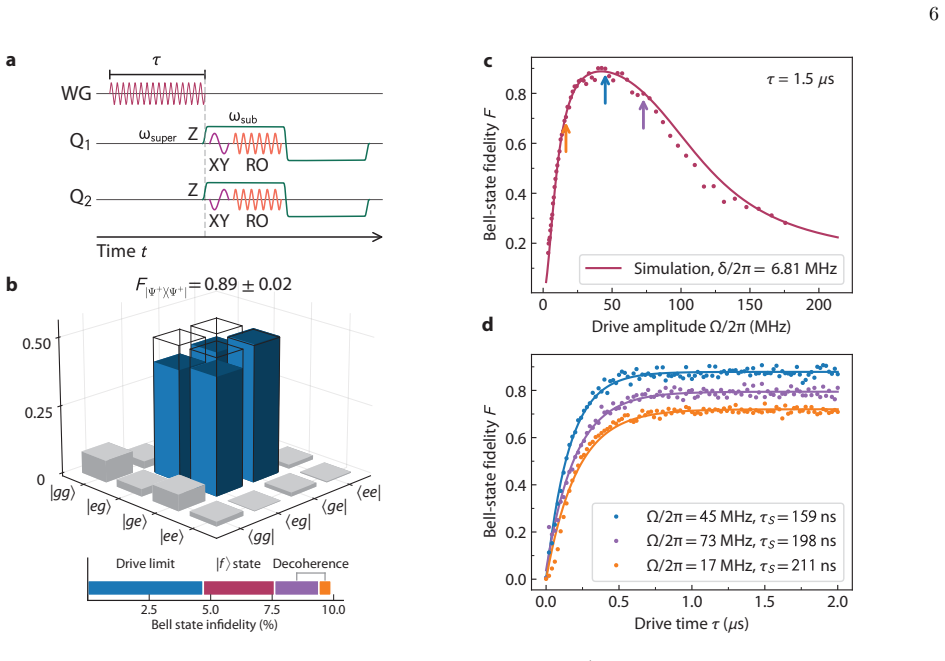
Continuous driving of two giant atoms coupled to a waveguide generates remote entanglement, preserved at 0.89 fidelity by frequency tuning that suppresses individual dissipation.
A machine-rendered reading of the paper's core claim, the machinery that carries it, and where it could break.
Core claim
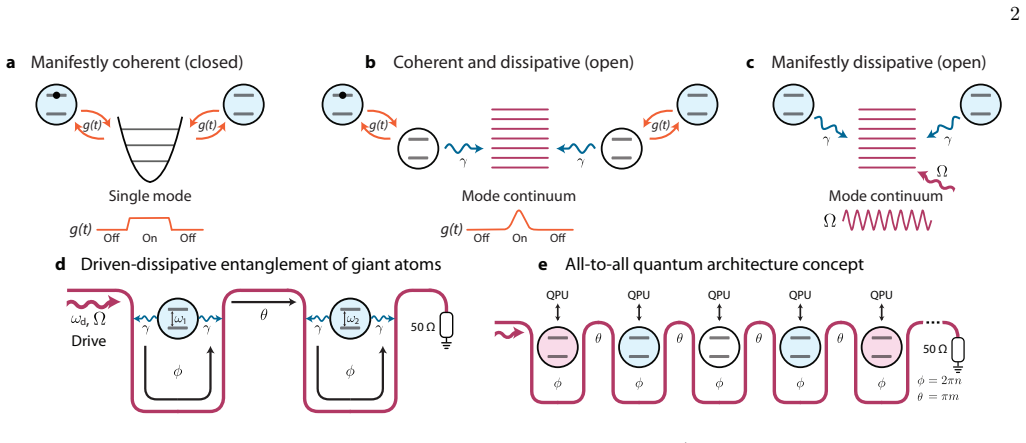
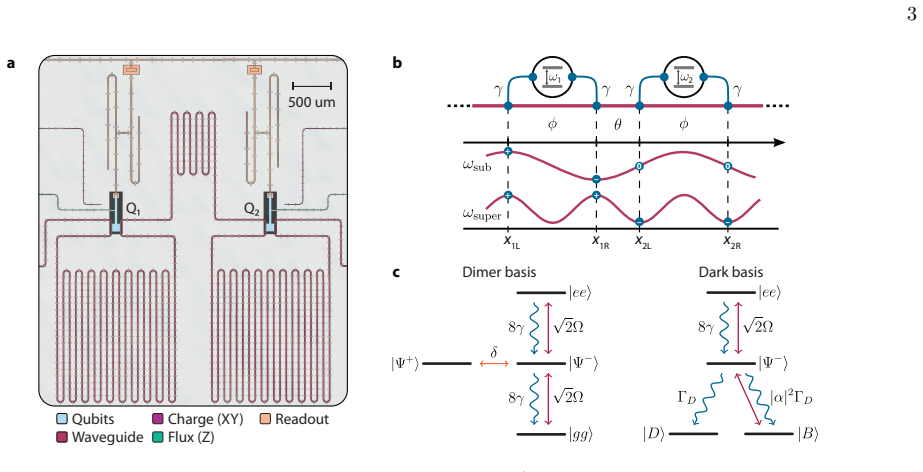
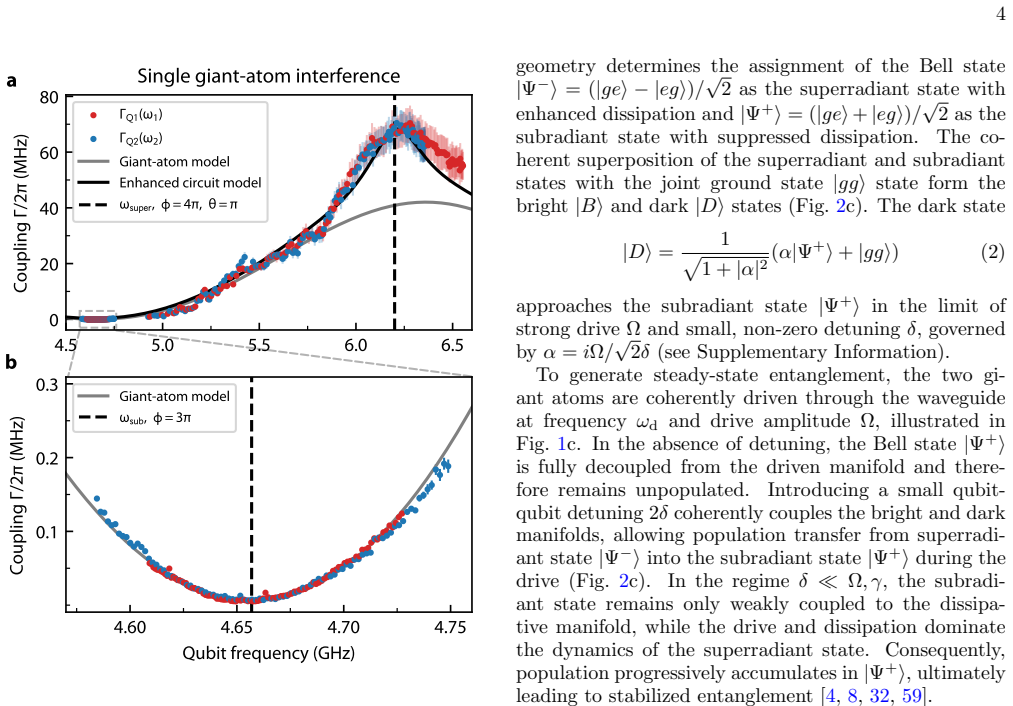
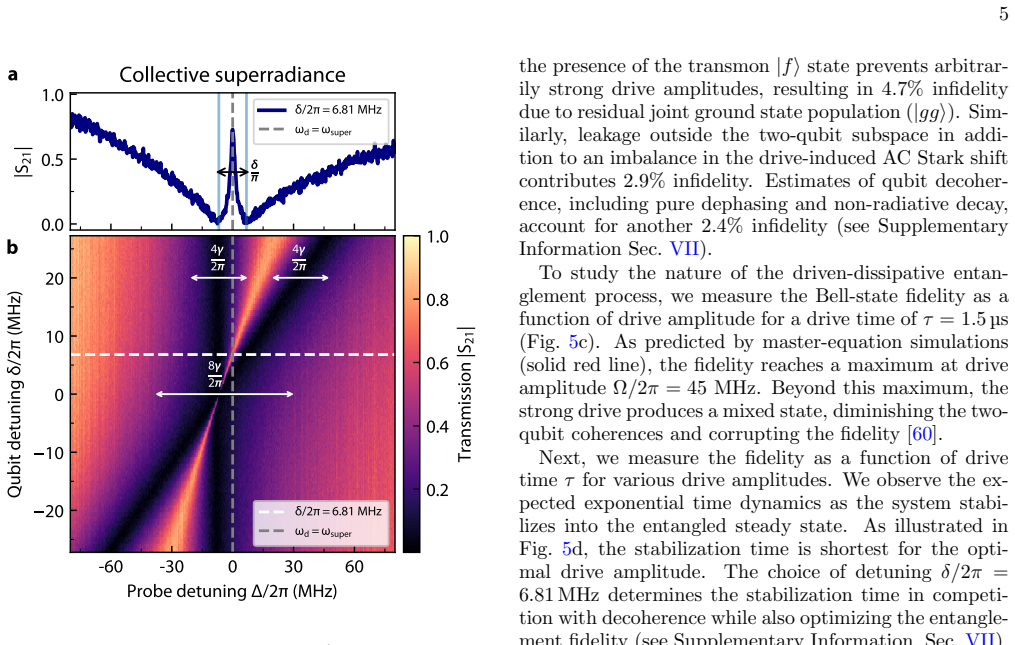
Engineering two giant atoms with sequential coupling to a waveguide allows tunable individual and correlated dissipation via interference; continuous waveguide driving exploits the correlated channel to generate remote entanglement, after which frequency tuning suppresses individual dissipation to preserve a Bell state with fidelity 0.89 plus or minus 0.02.
What carries the argument
Giant artificial atoms with multiple coupling points to a waveguide, using interference to control the balance between individual and correlated dissipation rates.
If this is right
- Continuous-wave driving can replace calibrated pulses for generating remote entanglement in waveguide systems.
- Entanglement generation and preservation can be performed as separate steps by adjusting dissipation channels independently.
- The protocol applies to atoms separated along the waveguide, enabling distribution without requiring close physical proximity.
- Driven-dissipative methods become viable for quantum interconnects once individual loss can be selectively suppressed.
Where Pith is reading between the lines
- The same interference-based tuning might extend to chains of more than two atoms to create larger protected entangled states.
- Combining this dissipation engineering with existing coherent control techniques could improve overall network fidelity.
- Distance dependence along the waveguide could be tested to determine how far the entanglement remains stable.
- The approach suggests dissipation can be treated as a controllable resource rather than solely a source of error in quantum networks.
Load-bearing premise
Tuning the qubit frequencies can suppress single-atom dissipation channels while leaving the correlated dissipation and the dark entangled state intact without adding new decoherence.
What would settle it
An experiment that tunes the frequencies as described yet measures Bell-state fidelity well below 0.89 because the correlated dissipation is also lost or new decoherence appears would falsify the claim.
Figures
read the original abstract
Quantum interconnects distribute entanglement via controlled light-matter interactions for quantum computing and sensing applications. Many entanglement generation schemes use coherent, reversible interactions that require precisely calibrated pulses to execute. In contrast, driven-dissipative protocols use a continuous-wave drive in the presence of correlated dissipation to stabilize entanglement in protected (dark) states. However, the same dissipation that generates the entanglement also limits its utility once the stabilization protocol ends. Here, we engineer a superconducting system of two giant artificial atoms coupled sequentially to a waveguide, with tunable individual and correlated dissipation enabled by interference between coupling points. Continuously driving the atoms through the waveguide exploits correlated dissipation to generate remote entanglement. We then tune the qubit frequencies in situ to suppress individual dissipation and thereby preserve the entanglement, achieving a Bell-state fidelity F = 0.89 +/- 0.02. This demonstration indicates that the driven dissipation of giant atoms is a viable approach for distributing entanglement across quantum networks.
Editorial analysis
A structured set of objections, weighed in public.
Referee Report
Summary. The manuscript reports an experimental demonstration in a superconducting circuit of two distant giant atoms coupled sequentially to a waveguide. Tunable individual and correlated dissipation is engineered via interference at multiple coupling points. A continuous-wave drive through the waveguide generates remote entanglement in a dark state; subsequent in-situ tuning of the qubit frequencies is used to suppress individual dissipation channels while preserving the correlated dissipation, yielding a Bell-state fidelity of 0.89 ± 0.02.
Significance. If the central experimental claim holds, the work establishes driven-dissipative entanglement stabilization with giant atoms as a viable route for quantum interconnects, offering continuous operation and post-generation preservation without pulsed coherent control. The interference-based separation of dissipation rates is a concrete technical advance that could scale to larger networks.
major comments (2)
- [Experimental methods and results on frequency tuning] The protocol for in-situ frequency tuning (described in the experimental methods and results sections) assumes that the relative phases and coupling strengths responsible for correlated dissipation remain unchanged when individual dissipation is suppressed. No explicit data or calculation is provided showing that the correlated decay rate is frequency-independent over the tuned range; any residual frequency dependence would directly compromise the dark-state protection and the reported fidelity.
- [Results section on entanglement fidelity] The Bell-state fidelity measurement (reported as F = 0.89 ± 0.02) relies on the preservation of the entangled state after tuning. The manuscript does not include a quantitative comparison of the entanglement generation rate versus the residual individual dissipation rate before and after tuning, which is required to confirm that the observed fidelity is attributable to the intended mechanism rather than other decoherence channels.
minor comments (2)
- [Abstract] The abstract states the fidelity with an error bar but does not indicate the number of experimental repetitions or the method used to extract the uncertainty; this detail should be added for reproducibility.
- [Figures and captions] Figure captions and axis labels in the main text use inconsistent notation for the individual versus collective decay rates; standardizing the symbols (e.g., Γ_ind vs. Γ_corr) would improve clarity.
Simulated Author's Rebuttal
We thank the referee for the positive assessment of the significance of our work and for the detailed comments. We address each major comment below.
read point-by-point responses
-
Referee: [Experimental methods and results on frequency tuning] The protocol for in-situ frequency tuning (described in the experimental methods and results sections) assumes that the relative phases and coupling strengths responsible for correlated dissipation remain unchanged when individual dissipation is suppressed. No explicit data or calculation is provided showing that the correlated decay rate is frequency-independent over the tuned range; any residual frequency dependence would directly compromise the dark-state protection and the reported fidelity.
Authors: The coupling-point positions are lithographically fixed, so the relative phases are set by the waveguide propagation distance at the operating frequency. The in-situ tuning range is narrow relative to the center frequency, and the waveguide dispersion over this interval produces only a small change in the effective phase. We will add an explicit calculation (or supporting measurement) of the correlated decay rate versus frequency across the tuned interval to the revised manuscript. revision: yes
-
Referee: [Results section on entanglement fidelity] The Bell-state fidelity measurement (reported as F = 0.89 ± 0.02) relies on the preservation of the entangled state after tuning. The manuscript does not include a quantitative comparison of the entanglement generation rate versus the residual individual dissipation rate before and after tuning, which is required to confirm that the observed fidelity is attributable to the intended mechanism rather than other decoherence channels.
Authors: We agree that a side-by-side rate comparison would strengthen the attribution to the driven-dissipative mechanism. We will include a quantitative comparison of the relevant rates (entanglement generation versus residual individual dissipation) extracted from the measured parameters before and after tuning in the revised results section. revision: yes
Circularity Check
No circularity: experimental demonstration with no derivation chain
full rationale
This paper is an experimental report on a superconducting circuit realizing driven-dissipative remote entanglement via giant atoms coupled to a waveguide. The central result is a measured Bell-state fidelity of 0.89 ± 0.02 obtained by tuning frequencies to suppress individual dissipation while preserving correlated dissipation. No mathematical derivation, ansatz, or prediction is claimed that reduces by construction to fitted inputs or self-citations. The protocol relies on physical interference conditions that are directly engineered and measured in the device; success is benchmarked against external experimental outcomes rather than internal consistency alone. The work is therefore self-contained with no load-bearing circular steps.
Axiom & Free-Parameter Ledger
free parameters (1)
- qubit frequencies
Reference graph
Works this paper leans on
-
[1]
Experimental Investigation of Quantum
Yu, Shang and Meng, Yu and Tang, Jian-Shun and Xu, Xiao-Ye and Wang, Yi-Tao and Yin, Peng and Ke, Zhi-Jin and Liu, Wei and Li, Zhi-Peng and Yang, Yuan-Ze and Chen, Geng and Han, Yong-Jian and Li, Chuan-Feng and Guo, Guang-Can , journal =. Experimental Investigation of Quantum. 2020 , month =. doi:10.1103/PhysRevLett.125.240506 , url =
-
[2]
and Zagoskin, A
Astafiev, O. and Zagoskin, A. M. and Abdumalikov, A. A. and Pashkin, Yu. A. and Yamamoto, T. and Inomata, K. and Nakamura, Y. and Tsai, J. S. , title =. 2010 , doi =
2010
-
[3]
On-Demand Microwave Generator of Shaped Single Photons , author =. Phys. Rev. Applied , volume =. 2017 , month =. doi:10.1103/PhysRevApplied.8.054015 , url =
-
[4]
Programmable directional emitter and receiver of itinerant microwave photons in a waveguide , author =. Physical Review A , volume =. 2020 , month =. doi:10.1103/PhysRevA.102.053720 , url =
-
[5]
, title =
Havel,Timothy F. , title =. Journal of Mathematical Physics , volume =. 2003 , doi =
2003
-
[6]
Hoi, Io-Chun and Wilson, C. M. and Johansson, G\"oran and Palomaki, Tauno and Peropadre, Borja and Delsing, Per , journal =. 2011 , month =. doi:10.1103/PhysRevLett.107.073601 , url =
-
[7]
New Journal of Physics , abstract =
Io-Chun Hoi and C M Wilson and Göran Johansson and Joel Lindkvist and Borja Peropadre and Tauno Palomaki and Per Delsing , title =. New Journal of Physics , abstract =. doi:10.1088/1367-2630/15/2/025011 , url =
-
[8]
Kurpiers, P. and Magnard, P. and Walter, T. and Royer, B. and Pechal, M. and Heinsoo, J. and Salath. Deterministic quantum state transfer and remote entanglement using microwave photons , journal=. 2018 , volume=. doi:10.1038/s41586-018-0195-y , url=
-
[9]
Mirhosseini, Mohammad and Kim, Eunjong and Zhang, Xueyue and Sipahigil, Alp and Dieterle, Paul B. and Keller, Andrew J. and Asenjo-Garcia, Ana and Chang, Darrick E. and Painter, Oskar , title=. Nature , year=. doi:10.1038/s41586-019-1196-1 , url=
-
[10]
Realization of a Universal Quantum Gate Set for Itinerant Microwave Photons , author =. Phys. Rev. X , volume =. 2022 , month =. doi:10.1103/PhysRevX.12.011008 , url =
-
[11]
Tunable Coupling Scheme for Implementing High-Fidelity Two-Qubit Gates , author =. Phys. Rev. Applied , volume =. 2018 , month =. doi:10.1103/PhysRevApplied.10.054062 , url =
-
[13]
Enhancing dispersive readout of superconducting qubits through dynamic control of the dispersive shift: Experiment and theory , author=. PRX Quantum , volume=. 2024 , publisher=. doi:https://doi.org/10.1103/PRXQuantum.5.040326 , url =
-
[14]
Quantum theory of a bandpass Purcell filter for qubit readout , author=. Physical Review A , volume=. 2015 , publisher=. doi:https://doi.org/10.1103/PhysRevA.92.012325 , url =
-
[15]
Input and output in damped quantum systems: Quantum stochastic differential equations and the master equation , author=. Physical Review A , volume=. 1985 , month =. doi:https://doi.org/10.1103/PhysRevA.31.3761 , url =
-
[16]
Reviews of Modern Physics , volume=
Circuit quantum electrodynamics , author=. Reviews of Modern Physics , volume=. 2021 , month =. doi:https://doi.org/10.1103/RevModPhys.93.025005 , url =
-
[17]
Physical Review Applied , volume=
Rapid high-fidelity multiplexed readout of superconducting qubits , author=. Physical Review Applied , volume=. 2018 , month =. doi:https://doi.org/10.1103/PhysRevApplied.10.034040 , url =
-
[18]
Physical Review Applied , volume=
Rapid high-fidelity single-shot dispersive readout of superconducting qubits , author=. Physical Review Applied , volume=. 2017 , month =. doi:https://doi.org/10.1103/PhysRevApplied.7.054020 , url =
-
[19]
Proceedings of the american physical society , author=. Phys. Rev. , volume=. 1946 , month =. doi:https://doi.org/10.1103/PhysRev.69.674 , url =
-
[20]
Gauge potentials on the M5 brane in twisted equivariant cohomotopy
Exploring the quantum: atoms, cavities, and photons , author=. 2006 , month =. doi:https://doi.org/10.1093/acprof:oso/9780198509141.001.0001 , url =
work page doi:10.1093/acprof:oso/9780198509141.001.0001 2006
-
[21]
Applied Physics Letters , volume=
Fast reset and suppressing spontaneous emission of a superconducting qubit , author=. Applied Physics Letters , volume=. 2010 , month =
2010
-
[22]
Physical Review Letters , volume=
Fast accurate state measurement with superconducting qubits , author=. Physical Review Letters , volume=. 2014 , month =
2014
-
[23]
IEEE Transactions on Applied Superconductivity , volume=
Reducing spontaneous emission in circuit quantum electrodynamics by a combined readout/filter technique , author=. IEEE Transactions on Applied Superconductivity , volume=. 2015 , month =
2015
-
[24]
Applied Physics Letters , volume=
Broadband filters for abatement of spontaneous emission in circuit quantum electrodynamics , author=. Applied Physics Letters , volume=. 2015 , month =. doi:https://doi.org/10.1063/1.4934867 , url =
-
[25]
2021 , month=
Microwave engineering: theory and techniques , author=. 2021 , month=
2021
-
[26]
A Three-Level Atom Interacting with a Single Mode Cavity Field:. Physica Scripta , volume =. doi:10.1088/0031-8949/76/3/006 , urldate =
-
[27]
, year = 1972, series =
Abramowitz, Milton and Stegun, Irene A. , year = 1972, series =. Handbook of Mathematical Functions: With Formulas, Graphs and Mathematical Tables , shorttitle =
1972
-
[28]
The Quantum Technologies Roadmap: A
Ac. The Quantum Technologies Roadmap: A. New Journal of Physics , volume =. doi:10.1088/1367-2630/aad1ea , urldate =
-
[29]
Entanglement Distribution with Continuous and Discrete Variable Systems , author =
-
[30]
Agust. Non-. Quantum , volume =. doi:10.22331/q-2026-04-15-2066 , urldate =
-
[31]
Physical Review Research , volume =
Classification and Reconstruction of Optical Quantum States with Deep Neural Networks , author =. Physical Review Research , volume =. doi:10.1103/PhysRevResearch.3.033278 , urldate =
-
[32]
Competition Effects in Presence of Dipole-Dipole Interaction in Two Atom Systems:
Ahmed, Shaik , year = 2014, month = jan, journal =. Competition Effects in Presence of Dipole-Dipole Interaction in Two Atom Systems:. doi:10.9734/PSIJ/2014/7448 , file =
-
[33]
Machine Learning for Quantum Information and Computing , author =
-
[34]
and Argyropoulos, Christos and Hoang, Thang B
Akselrod, Gleb M. and Argyropoulos, Christos and Hoang, Thang B. and Cirac. Probing the Mechanisms of Large. Nature Photonics , volume =. doi:10.1038/nphoton.2014.228 , urldate =
-
[35]
New Journal of Physics , volume =
Ultimate Limits for Quantum Magnetometry via Time-Continuous Measurements , author =. New Journal of Physics , volume =. doi:10.1088/1367-2630/aa9840 , urldate =
-
[36]
and Jiang, Liang , year = 2014, month = feb, journal =
Albert, Victor V. and Jiang, Liang , year = 2014, month = feb, journal =. Symmetries and Conserved Quantities in. doi:10.1103/PhysRevA.89.022118 , urldate =
-
[37]
New Journal of Physics , volume =
Coupling of Nitrogen Vacancy Centres in Nanodiamonds by Means of Phonons , author =. New Journal of Physics , volume =. doi:10.1088/1367-2630/15/8/083014 , urldate =
-
[38]
Deterministic Creation of Stationary Entangled States by Dissipation , author =. Physical Review A , volume =. doi:10.1103/PhysRevA.82.054103 , file =
-
[39]
Communications Physics , volume =
Collective Quantum Enhancement in Critical Quantum Sensing , author =. Communications Physics , volume =. doi:10.1038/s42005-025-01975-9 , urldate =
-
[40]
Alushi, Uesli and Ramos, Tom. Waveguide. PRX Quantum , volume =. doi:10.1103/prxquantum.4.030326 , urldate =
-
[41]
Information Geometry and Its Applications , author =
-
[42]
Reviews of Modern Physics , volume =
Entanglement in Many-Body Systems , author =. Reviews of Modern Physics , volume =. doi:10.1103/RevModPhys.80.517 , urldate =
-
[43]
New Journal of Physics , volume =
Noisy Atomic Magnetometry in Real Time , author =. New Journal of Physics , volume =. doi:10.1088/1367-2630/ac3b71 , urldate =
-
[44]
Noisy. PRX Quantum , volume =. doi:10.1103/k7nk-lrwd , urldate =
-
[45]
Amthor, Thomas and Giese, Christian and Hofmann, Christoph S. and Weidem. Evidence of. Physical Review Letters , volume =. doi:10.1103/PhysRevLett.104.013001 , urldate =
-
[46]
Strongly Modified Plasmon--Matter Interaction with Mesoscopic Quantum Emitters , author =. Nature Physics , volume =. doi:10.1038/nphys1870 , urldate =
-
[47]
and Astrakhantsev, Nikita and Karamlou, Amir H
Andersen, Trond I. and Astrakhantsev, Nikita and Karamlou, Amir H. and Berndtsson, Julia and Motruk, Johannes and Szasz, Aaron and Gross, Jonathan A. and Schuckert, Alexander and Westerhout, Tom and Zhang, Yaxing and Forati, Ebrahim and Rossi, Dario and Kobrin, Bryce and Di Paolo, Agustin and Klots, Andrey R. and Drozdov, Ilya and Kurilovich, Vladislav D....
-
[48]
Andersson, Gustav and Ekstr. Electromagnetically. Physical Review Letters , volume =. doi:10.1103/PhysRevLett.124.240402 , urldate =
-
[49]
doi:10.1007/978-3-319-04063-9 , urldate =
Quantum. doi:10.1007/978-3-319-04063-9 , urldate =
-
[50]
A Silicon Source of Frequency-Bin Entangled Photons , author =. Optics Letters , volume =. doi:10.1364/OL.471241 , urldate =
-
[51]
arXiv , keywords =:2212.05346 , primaryclass =
Dissipative Stabilization of Entangled Qubit Pairs in Quantum Arrays with a Single Localized Dissipative Channel , author =. arXiv , keywords =:2212.05346 , primaryclass =
-
[52]
Tailoring Nonlinear Processes for Quantum Optics with Pulsed Temporal-Mode Encodings , author =. Optica , volume =. doi:10.1364/OPTICA.5.000534 , urldate =
-
[53]
Quaestiones
Aquinas, Thomas , year =. Quaestiones
-
[54]
Arcari, M. and S. Near-. Physical Review Letters , volume =. doi:10.1103/PhysRevLett.113.093603 , urldate =
-
[55]
Optical Control of Nonlinearly Dressed States in an Individual Quantum Dot , author =. Physical Review B , volume =. doi:10.1103/PhysRevB.93.165305 , urldate =
-
[56]
arXiv , arxivid =:2102.03223v2 , abstract =
Quantum Metrology and Coherence , author =. arXiv , arxivid =:2102.03223v2 , abstract =
-
[57]
Ares, Laura and Luis, Alfredo , year = 2023, month = jan, journal =. Semiclassical Violation of. doi:10.1016/j.physleta.2022.128586 , urldate =
-
[58]
Liouvillian Exceptional Points of Any Order in Dissipative Linear Bosonic Systems:
Arkhipov, Ievgen I and Miranowicz, Adam and Minganti, Fabrizio and Nori, Franco , year = 2020, month = sep, journal =. Liouvillian Exceptional Points of Any Order in Dissipative Linear Bosonic Systems:. doi:10.1103/PhysRevA.102.033715 , keywords =
-
[59]
Arkhipov, Ievgen I and Miranowicz, Adam and Minganti, Fabrizio and Nori, Franco , year = 2020, month = jan, journal =. Quantum and Semiclassical Exceptional Points of a Linear System of Coupled Cavities with Losses and Gain within the. doi:10.1103/PhysRevA.101.013812 , abstract =
-
[60]
Journal of Physics B: Atomic and Molecular Physics , volume =
Photon Correlations between the Lines in the Spectrum of Resonance Fluorescence , author =. Journal of Physics B: Atomic and Molecular Physics , volume =. doi:10.1088/0022-3700/17/6/011 , urldate =
-
[61]
Quantum Supremacy Using a Programmable Superconducting Processor , author =. Nature , volume =. doi:10.1038/s41586-019-1666-5 , urldate =
-
[62]
Atom-Light Interactions in Quasi-One-Dimensional Nanostructures:. Physical Review A , volume =. doi:10.1103/PhysRevA.95.033818 , urldate =
-
[63]
Temporal Mode Transformations by Sequential Time and Frequency Phase Modulation for Applications in Quantum Information Science , author =. Optics Express , volume =. doi:10.1364/OE.410371 , urldate =
-
[64]
Ashida, Yuto and. Cavity. Physical Review Letters , volume =. doi:10.1103/PhysRevLett.126.153603 , urldate =
-
[65]
Aspect, Alain and Dalibard, Jean and Roger, G. Experimental. Physical Review Letters , volume =. doi:10.1103/PhysRevLett.49.1804 , urldate =
-
[66]
Aspect, Alain and Grangier, Philippe and Roger, G. Experimental. Physical Review Letters , volume =. doi:10.1103/PhysRevLett.47.460 , urldate =
-
[67]
Aspect, A. and Roger, G. and Reynaud, S. and Dalibard, J. and. Time. Physical Review Letters , volume =. doi:10.1103/PhysRevLett.45.617 , urldate =
-
[68]
Reviews of Modern Physics , volume =
Cavity Optomechanics , author =. Reviews of Modern Physics , volume =. doi:10.1103/RevModPhys.86.1391 , urldate =
-
[69]
Astafiev, O. and Zagoskin, A. M. and Abdumalikov, A. A. and Pashkin,. Resonance. Science , volume =. doi:10.1126/science.1181918 , urldate =
-
[70]
Single Artificial-Atom Lasing , author =. Nature , volume =. doi:10.1038/nature06141 , urldate =
-
[71]
Ates, C. and Pohl, T. and Pattard, T. and Rost, J. M. , year = 2007, month = jan, journal =. Antiblockade in. doi:10.1103/PhysRevLett.98.023002 , urldate =
-
[72]
Variational Characterizations of Separability and Entanglement of Formation , author =. Physical Review A , volume =. doi:10.1103/PhysRevA.64.052304 , urldate =
-
[73]
Quantum Technologies with Optically Interfaced Solid-State Spins , author =. Nature Photonics , volume =. doi:10.1038/s41566-018-0232-2 , urldate =
-
[74]
Adiabatic Elimination for Open Quantum Systems with Effective
Azouit, R and Sarlette, A and Rouchon, P , year = 2016, month = dec, pages =. Adiabatic Elimination for Open Quantum Systems with Effective. 2016. doi:10.1109/CDC.2016.7798963 , abstract =
-
[75]
Adiabatic Elimination for Open Quantum Systems , author =
-
[76]
Quantum Science and Technology , volume =
Towards Generic Adiabatic Elimination for Bipartite Open Quantum Systems , author =. Quantum Science and Technology , volume =. doi:10.1088/2058-9565/aa7f3f , abstract =
-
[77]
Bachor, Hans-A. and Ralph, Timothy C. , year = 2019, month = sep, journal =. A. doi:10.1002/9783527695805 , isbn =
-
[78]
Bacon, Francis , editor =. The. doi:10.1017/CBO9781139149549 , abstract =
-
[79]
and Lin, Hsin and Das, Tanmoy , year = 2016, month = jun, journal =
Bansil, A. and Lin, Hsin and Das, Tanmoy , year = 2016, month = jun, journal =. doi:10.1103/RevModPhys.88.021004 , urldate =
-
[80]
Bao, Zenghui and Wang, Zhiling and Wu, Yukai and Li, Yan and Ma, Cheng and Song, Yipu and Zhang, Hongyi and Duan, Luming , year = 2021, month = jul, journal =. On-. doi:10.1103/PhysRevLett.127.010503 , urldate =
-
[81]
Critical Steady States of All-to-All Driven-Dissipative Models:
Barberena, Diego and Rey, Ana Maria , year = 2023, month = jul, number =. Critical Steady States of All-to-All Driven-Dissipative Models:. arXiv , keywords =:2307.05115 , primaryclass =
arXiv 2023
discussion (0)
Sign in with ORCID, Apple, or X to comment. Anyone can read and Pith papers without signing in.