Polarizing ultrathin ferroelectric BaTiO3 films through interfacial layer polarization
Pith reviewed 2026-06-27 06:11 UTC · model grok-4.3
The pith
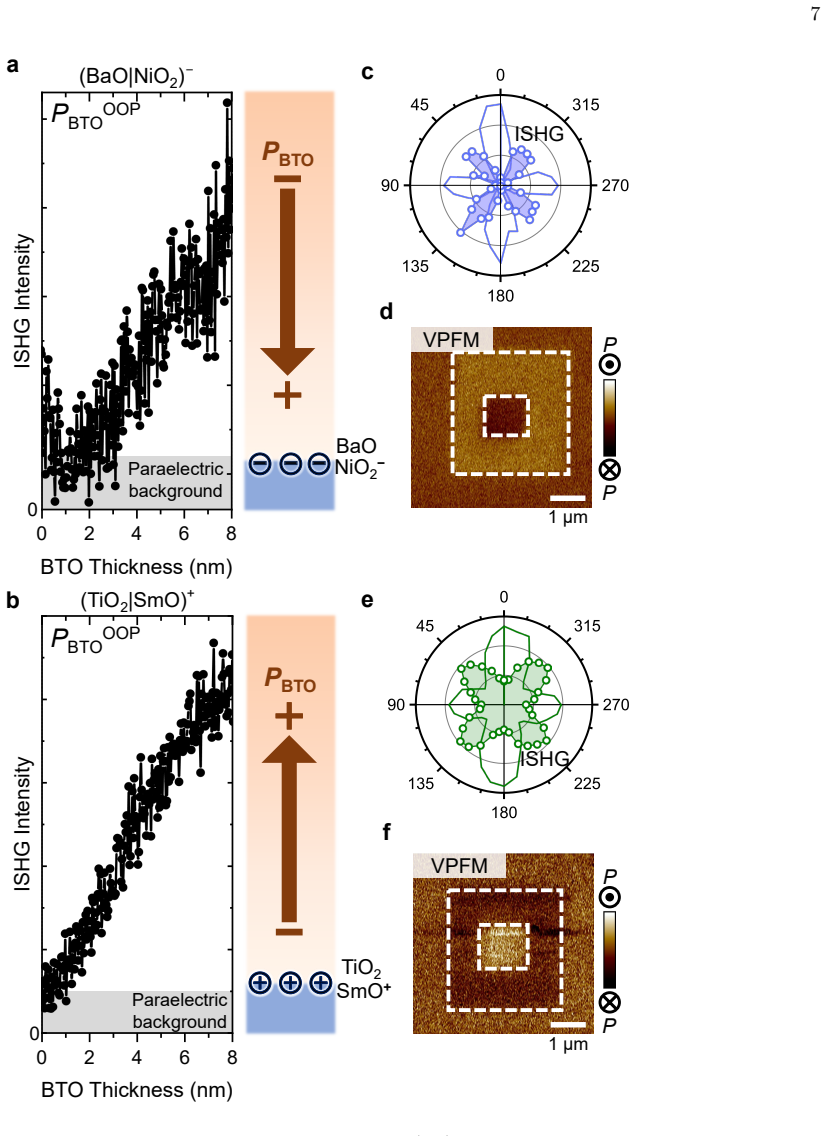
Charged atomic planes in SmNiO3 buffers stabilize net polarization in BaTiO3 films from the first unit cell.
A machine-rendered reading of the paper's core claim, the machinery that carries it, and where it could break.
Core claim
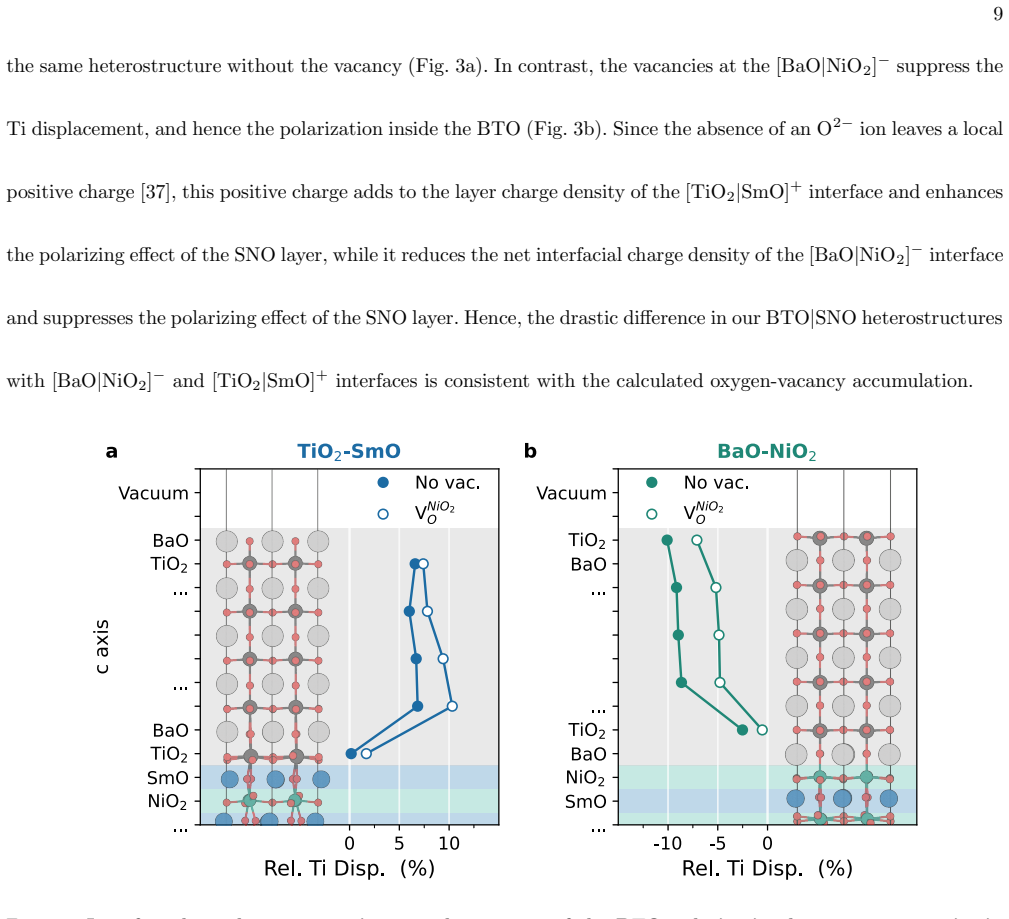
The charged atomic planes of (001)-oriented SmNiO3 buffer layers function as a polarizing template that sets the polarization direction in BaTiO3 films according to the chosen termination ([SmO]+ for upward, [NiO2]- for downward) and eliminates the depolarizing-field-induced critical thickness, so that a net polarization appears in the BaTiO3 layer from the first unit cell onward. Density-functional-theory calculations indicate that oxygen vacancies counteract the field from the negatively charged termination.
What carries the argument
The charged atomic planes of the SmNiO3 buffer layer, acting as a polarizing template whose sign is fixed by surface termination.
If this is right
- Buffer termination alone determines whether BaTiO3 polarization points up or down.
- The critical thickness for ferroelectricity is removed, allowing stable polarization at single-unit-cell thickness.
- Oxygen vacancies reduce the effectiveness of the negatively charged termination.
- Defect chemistry must be controlled to maintain the full polarizing strength of the interface.
Where Pith is reading between the lines
- The same termination-control approach could be tested in other perovskite ferroelectrics that suffer from depolarizing fields.
- Device stacks could be designed with a single atomic plane to preset polarity before the active layer is grown.
- In-situ termination monitoring during growth might become a practical route to polarity selection in ultrathin films.
Load-bearing premise
The observed net polarization in the first unit cell of BaTiO3 arises mainly from the electric field of the chosen SmNiO3 termination rather than from substrate strain, defects, or experimental artifacts.
What would settle it
An experiment or calculation in which BaTiO3 grown on a controlled SmNiO3 termination shows zero net polarization already in the first unit cell.
Figures
read the original abstract
An important requirement for the integration of ferroelectric thin films into devices is deterministic control of the polarization state in films of only a few unit cells in thickness. Here, we utilize the charged atomic planes of (001)-oriented SmNiO$_3$ (SNO) buffer layers as a polarizing template to stabilize the polarization in ferroelectric BaTiO$_3$ (BTO) model system thin films. We show that an upwards (downwards) oriented polarization is achieved by selection of the [SmO]$^+$ ([NiO$_2$]$^-$) buffer termination. Most importantly, the charged atomic planes of SNO suppress the depolarizing-field-induced critical thickness in BTO, and we record the emergence of a net polarization in our BTO films from the first unit cell deposited. Our experiments, guided by density-functional-theory (DFT) calculations, further highlight the impact of charged defects on the polarizing effectiveness of the SNO buffer. Specifically, oxygen vacancies counteract the polarizing field of the negatively charged, [NiO$_2$]$^-$-terminated surface of the SNO buffer. Our findings provide important insights into the interplay of defect chemistry and polarizing interfaces to stabilize ferroelectric polarization down to the single-unit-cell limit.
Editorial analysis
A structured set of objections, weighed in public.
Referee Report
Summary. The manuscript reports using charged atomic planes of (001) SmNiO3 (SNO) buffer layers as a polarizing template for ultrathin BaTiO3 (BTO) films. Selection of [SmO]+ versus [NiO2]- termination produces upwards or downwards polarization, respectively; the charged planes are claimed to suppress the depolarizing-field critical thickness, yielding net polarization already in the first BTO unit cell. Experiments are guided by DFT calculations, which also highlight that oxygen vacancies counteract the field from the negatively terminated surface.
Significance. If the mechanism is isolated from strain and defect contributions, the result would demonstrate a practical route to deterministic polarization control at the single-unit-cell limit, directly relevant to device integration of ultrathin ferroelectrics. The combination of termination control and DFT guidance is a positive feature.
major comments (2)
- [Abstract] Abstract: the central claim that net polarization emerges from the first unit cell due to the SNO charged-plane template is presented without data tables, error bars, or explicit exclusion criteria for alternative contributions (substrate strain, interface intermixing, or uncontrolled oxygen-vacancy distributions).
- [Abstract] Abstract: oxygen vacancies are stated to counteract the polarizing field of the [NiO2]– termination, yet no quantitative defect-density measurements (XPS, EELS, or transport) or strain maps (RSM, GPA) are referenced that would decouple these effects from the intended electrostatic template mechanism.
Simulated Author's Rebuttal
Thank you for the referee's insightful comments. We address each major comment point-by-point below, proposing revisions to improve clarity while remaining faithful to the data and calculations presented in the manuscript.
read point-by-point responses
-
Referee: [Abstract] Abstract: the central claim that net polarization emerges from the first unit cell due to the SNO charged-plane template is presented without data tables, error bars, or explicit exclusion criteria for alternative contributions (substrate strain, interface intermixing, or uncontrolled oxygen-vacancy distributions).
Authors: The abstract is a concise summary; supporting PFM data demonstrating net polarization from the first unit cell, together with structural characterization and DFT results, appear in the main text and supplementary information. We will revise the abstract to reference the relevant figures and add a brief clause noting that XRD and RSM data indicate limited intermixing while strain is incorporated in the DFT models. Error bars are shown in the figures; we will ensure the main text explicitly states the criteria used to rule out dominant alternative contributions. revision: partial
-
Referee: [Abstract] Abstract: oxygen vacancies are stated to counteract the polarizing field of the [NiO2]– termination, yet no quantitative defect-density measurements (XPS, EELS, or transport) or strain maps (RSM, GPA) are referenced that would decouple these effects from the intended electrostatic template mechanism.
Authors: The manuscript relies on DFT to quantify the counteracting effect of oxygen vacancies on the [NiO2]– surface; the experimental contrast between the two terminations provides indirect support for the electrostatic template. We acknowledge that direct quantitative defect densities (XPS/EELS) and GPA strain maps are not reported. We will revise the discussion to state explicitly that defect compensation is modeled rather than measured and will reference existing RSM data where available, while noting the absence of direct defect quantification as a limitation of the present study. revision: partial
- Quantitative defect-density measurements via XPS, EELS or transport were not performed, preventing full experimental decoupling of vacancy contributions from the electrostatic template.
Circularity Check
No circularity: experimental claims rest on independent observations and external DFT guidance
full rationale
The paper reports experimental PFM and related measurements of net polarization in BTO films from the first unit cell, achieved by selecting SNO buffer terminations, with DFT calculations used as separate guidance. No equations, fitted parameters, or predictions are defined in terms of the reported polarization values themselves. The mechanism attribution relies on termination choice and defect chemistry discussion rather than any self-referential construction, self-citation chain, or ansatz smuggled from prior author work. The derivation chain is therefore self-contained against external benchmarks and does not reduce to its inputs by construction.
Axiom & Free-Parameter Ledger
free parameters (1)
- oxygen vacancy concentration
axioms (1)
- domain assumption The charged atomic planes of the SNO buffer act as an unscreened polarizing template that dictates BTO polarization direction and suppresses the depolarizing field.
Reference graph
Works this paper leans on
-
[1]
Ferroelectric Thin Films for Oxide Electronics,
Marvin M¨ uller, Ipek Efe, Martin F. Sarott, Elzbieta Gradauskaite, and Morgan Trassin, “Ferroelectric Thin Films for Oxide Electronics,” ACS Applied Electronic Materials5, 1314–1334 (2023)
2023
-
[2]
Topological magnetic and ferroelectric systems for reservoir computing,
Karin Everschor-Sitte, Atreya Majumdar, Katharina Wolk, and Dennis Meier, “Topological magnetic and ferroelectric systems for reservoir computing,” Nature Reviews Physics6, 455–462 (2024)
2024
-
[3]
Critical thickness for ferroelectricity in perovskite ultrathin films,
Javier Junquera and Philippe Ghosez, “Critical thickness for ferroelectricity in perovskite ultrathin films,” Nature422, 506–509 (2003)
2003
-
[4]
Ferroelectric dead layer driven by a polar interface,
Y. Wang, M. K. Niranjan, K. Janicka, J. P. Velev, M. Ye. Zhuravlev, S. S. Jaswal, and E. Y. Tsymbal, “Ferroelectric dead layer driven by a polar interface,” Physical Review B82, 094114 (2010)
2010
-
[5]
Origin of the dielectric dead layer in nanoscale capacitors,
Massimiliano Stengel and Nicola A. Spaldin, “Origin of the dielectric dead layer in nanoscale capacitors,” Nature443, 679–682 (2006)
2006
-
[6]
Thin-film ferroelectric materials and their applications,
Lane W. Martin and Andrew M. Rappe, “Thin-film ferroelectric materials and their applications,” Nature Reviews Materials2, 16087 (2016)
2016
-
[7]
Interface Physics in Complex Oxide Heterostructures,
Pavlo Zubko, Stefano Gariglio, Marc Gabay, Philippe Ghosez, and Jean-Marc Triscone, “Interface Physics in Complex Oxide Heterostructures,” Annual Review of Condensed Matter Physics2, 141–165 (2011)
2011
-
[8]
Topological phases in polar oxide nanostructures,
Javier Junquera, Yousra Nahas, Sergei Prokhorenko, Laurent Bellaiche, Jorge ´I˜ niguez, Darrell G. Schlom, Long-Qing Chen, Sayeef Salahuddin, David A. Muller, Lane W. Martin, and R. Ramesh, “Topological phases in polar oxide nanostructures,” Reviews of Modern Physics95, 025001 (2023)
2023
-
[9]
Layer and spontaneous polarizations in perovskite oxides and their interplay in multiferroic bismuth ferrite,
Nicola A. Spaldin, Ipek Efe, Marta D. Rossell, and Chiara Gattinoni, “Layer and spontaneous polarizations in perovskite oxides and their interplay in multiferroic bismuth ferrite,” The Journal of Chemical Physics154, 154702 (2021)
2021
-
[10]
Electrostatic stability of insulating surfaces: Theory and applications,
Massimiliano Stengel, “Electrostatic stability of insulating surfaces: Theory and applications,” Physical Review B84, 205432 (2011). 16
2011
-
[11]
Polar oxide surfaces,
Claudine Noguera, “Polar oxide surfaces,” Journal of Physics: Condensed Matter12, R367 (2000)
2000
-
[12]
Polarity of oxide surfaces and nanostructures,
Jacek Goniakowski, Fabio Finocchi, and Claudine Noguera, “Polarity of oxide surfaces and nanostructures,” Reports on Progress in Physics71, 016501 (2007)
2007
-
[13]
The stability of ionic crystal surfaces,
P. W. Tasker, “The stability of ionic crystal surfaces,” Journal of Physics C: Solid State Physics12, 4977 (1979)
1979
-
[14]
Interface control of bulk ferroelectric polarization,
P. Yu, W. Luo, D. Yi, J. X. Zhang, M. D. Rossell, C.-H. Yang, L. You, G. Singh-Bhalla, S. Y. Yang, Q. He, Q. M. Ramasse, R. Erni, L. W. Martin, Y. H. Chu, S. T. Pantelides, S. J. Pennycook, and R. Ramesh, “Interface control of bulk ferroelectric polarization,” Proceedings of the National Academy of Sciences109, 9710–9715 (2012)
2012
-
[15]
Nanoscale design of polarization in ultrathin ferroelectric heterostructures,
Gabriele De Luca, Nives Strkalj, Sebastian Manz, Corinne Bouillet, Manfred Fiebig, and Morgan Trassin, “Nanoscale design of polarization in ultrathin ferroelectric heterostructures,” Nature Communications8, 1419 (2017), publisher: Nature Publishing Group
2017
-
[16]
On the happiness of ferroelectric surfaces and its role in water dissociation: The example of bismuth ferrite,
Ipek Efe, Nicola A. Spaldin, and Chiara Gattinoni, “On the happiness of ferroelectric surfaces and its role in water dissociation: The example of bismuth ferrite,” The Journal of Chemical Physics154, 024702 (2021)
2021
-
[17]
Enhancement of Interfacial Polarization in BaTiO 3 Thin Films via Oxygen Inhomogeneity,
Zhipeng Li, Zeyu Zhang, Jia Liu, Ruixue Zhu, Binghui Ge, Yueliang Li, Xin Zhang, Peng Gao, Dawei Wang, Xiaoguang Xu, Wenhuai Tian, and Yong Jiang, “Enhancement of Interfacial Polarization in BaTiO 3 Thin Films via Oxygen Inhomogeneity,” Advanced Electronic Materials8, 2100876 (2022)
2022
-
[18]
In-situ monitoring of interface proximity effects in ultrathin ferroelectrics,
Nives Strkalj, Chiara Gattinoni, Alexander Vogel, Marco Campanini, Rea Haerdi, Antonella Rossi, Marta D. Rossell, Nicola A. Spaldin, Manfred Fiebig, and Morgan Trassin, “In-situ monitoring of interface proximity effects in ultrathin ferroelectrics,” Nature Communications11, 5815 (2020)
2020
-
[19]
Interface and surface stabilization of the polarization in ferroelectric thin films,
Chiara Gattinoni, Nives Strkalj, Rea H¨ ardi, Manfred Fiebig, Morgan Trassin, and Nicola A. Spaldin, “Interface and surface stabilization of the polarization in ferroelectric thin films,” Proceedings of the National Academy of Sciences 117, 28589–28595 (2020)
2020
-
[20]
Controlling the Polarization in Ferroelectric PZT Films via the Epitaxial Growth Conditions,
Martin F. Sarott, Ursina Bucheli, Adrian Lochmann, Manfred Fiebig, and Morgan Trassin, “Controlling the Polarization in Ferroelectric PZT Films via the Epitaxial Growth Conditions,” Advanced Functional Materials33, 2214849 (2023). 17
2023
-
[21]
Prediction of a strong polarizing field in thin film paraelectrics,
Chiara Gattinoni and Nicola A. Spaldin, “Prediction of a strong polarizing field in thin film paraelectrics,” Physical Review Research4, L032020 (2022)
2022
-
[22]
Interplay of metallicity, ferroelectricity, and layer charges in SmNiO 3/BaTiO3 superlattices,
Edith Simmen and Nicola A. Spaldin, “Interplay of metallicity, ferroelectricity, and layer charges in SmNiO 3/BaTiO3 superlattices,” Physical Review Research7, 023044 (2025)
2025
-
[23]
Engineering of ferroelectricity in thin films using lattice chemistry: A perspective,
Ipek Efe, Bixin Yan, and Morgan Trassin, “Engineering of ferroelectricity in thin films using lattice chemistry: A perspective,” Applied Physics Letters125, 150503 (2024)
2024
-
[24]
Barium Titanate,
Bernard Jaffe, William R. Cook, and Hans Jaffe, “Barium Titanate,” inPiezoelectric Ceramics(Academic Press, 1971) pp. 53–114
1971
-
[25]
Critical thickness of ultrathin ferroelectric BaTiO 3 films,
Y. S. Kim, D. H. Kim, J. D. Kim, Y. J. Chang, T. W. Noh, J. H. Kong, K. Char, Y. D. Park, S. D. Bu, J.-G. Yoon, and J.-S. Chung, “Critical thickness of ultrathin ferroelectric BaTiO 3 films,” Applied Physics Letters86, 102907 (2005)
2005
-
[26]
Enhanced surface diffusion through termi- nation conversion during epitaxial SrRuO 3 growth,
Guus Rijnders, Dave H. A. Blank, Junghoon Choi, and Chang-Beom Eom, “Enhanced surface diffusion through termi- nation conversion during epitaxial SrRuO 3 growth,” Applied Physics Letters84, 505–507 (2004)
2004
-
[27]
Control of polarization and polar chiral textures in BiFeO 3 by epitaxial strain and interfacial chemistry,
Elzbieta Gradauskaite, Natascha Gray, Quintin N. Meier, Marta D. Rossell, and Morgan Trassin, “Control of polarization and polar chiral textures in BiFeO 3 by epitaxial strain and interfacial chemistry,” (2025)
2025
-
[28]
In situ monitoring of epitaxial ferroelectric thin-film growth,
Martin F Sarott, Elzbieta Gradauskaite, Johanna Nordlander, Nives Strkalj, and Morgan Trassin, “In situ monitoring of epitaxial ferroelectric thin-film growth,” Journal of Physics: Condensed Matter33, 293001 (2021)
2021
-
[29]
Probing Ferroic States in Oxide Thin Films Using Optical Second Harmonic Generation,
Johanna Nordlander, Gabriele De Luca, Nives Strkalj, Manfred Fiebig, and Morgan Trassin, “Probing Ferroic States in Oxide Thin Films Using Optical Second Harmonic Generation,” Applied Sciences8, 570 (2018)
2018
-
[30]
Probing Ferroelectrics Using Optical Second Harmonic Generation,
Sava A. Denev, Tom T. A. Lummen, Eftihia Barnes, Amit Kumar, and Venkatraman Gopalan, “Probing Ferroelectrics Using Optical Second Harmonic Generation,” Journal of the American Ceramic Society94, 2699–2727 (2011)
2011
-
[31]
Depolarizing-Field Effects in Epitaxial Capacitor Heterostructures,
N. Strkalj, G. De Luca, M. Campanini, S. Pal, J. Schaab, C. Gattinoni, N. A. Spaldin, M. D. Rossell, M. Fiebig, and M. Trassin, “Depolarizing-Field Effects in Epitaxial Capacitor Heterostructures,” Physical Review Letters123, 147601 (2019). 18
2019
-
[32]
Ferroelectricity in Ultrathin BaTiO 3 Films: Probing the Size Effect by Ultraviolet Raman Spectroscopy,
D. A. Tenne, P. Turner, J. D. Schmidt, M. Biegalski, Y. L. Li, L. Q. Chen, A. Soukiassian, S. Trolier-McKinstry, D. G. Schlom, X. X. Xi, D. D. Fong, P. H. Fuoss, J. A. Eastman, G. B. Stephenson, C. Thompson, and S. K. Streiffer, “Ferroelectricity in Ultrathin BaTiO 3 Films: Probing the Size Effect by Ultraviolet Raman Spectroscopy,” Physical Review Letter...
2009
-
[33]
Direct observation of oxygen-vacancy-enhanced polarization in a SrTiO 3-buffered ferroelectric BaTiO 3 film on GaAs,
Qiao Qiao, Yuyang Zhang, Rocio Contreras-Guerrero, Ravi Droopad, Sokrates T. Pantelides, Stephen J. Pennycook, Serdar Ogut, and Robert F. Klie, “Direct observation of oxygen-vacancy-enhanced polarization in a SrTiO 3-buffered ferroelectric BaTiO 3 film on GaAs,” Applied Physics Letters107, 201604 (2015)
2015
-
[34]
Local Enhancement of Polarization at PbTiO 3/BiFeO3 Interfaces Mediated by Charge Transfer,
Ying Liu, Yin-Lian Zhu, Yun-Long Tang, Yu-Jia Wang, Yi-Xiao Jiang, Yao-Bin Xu, Bin Zhang, and Xiu-Liang Ma, “Local Enhancement of Polarization at PbTiO 3/BiFeO3 Interfaces Mediated by Charge Transfer,” Nano Letters17, 3619–3628 (2017)
2017
-
[35]
Microscopic study of oxygen-vacancy defects in ferroelectric perovskites,
C. H. Park and D. J. Chadi, “Microscopic study of oxygen-vacancy defects in ferroelectric perovskites,” Physical Review B57, R13961–R13964 (1998)
1998
-
[36]
Unravelling the role of oxygen va- cancies on the current transport mechanisms in all-perovskite nickelate/titanate heterojunctions for nonvolatile memory applications,
Yong Zhang, Shunhua Gao, Chunrui Ma, Lu Lu, Chuan Yu Han, and Ming Liu, “Unravelling the role of oxygen va- cancies on the current transport mechanisms in all-perovskite nickelate/titanate heterojunctions for nonvolatile memory applications,” Journal of Applied Physics132, 135303 (2022)
2022
-
[37]
Synergistic Effect of Singly Charged Oxygen Vacancies and Ligand Field for Regulating Transport Properties of Resistive Switching Memories,
D. Das, A. Barman, S. Kumar, A. K. Sinha, M. Gupta, R. Singhal, P. Johari, and A. Kanjilal, “Synergistic Effect of Singly Charged Oxygen Vacancies and Ligand Field for Regulating Transport Properties of Resistive Switching Memories,” The Journal of Physical Chemistry C123, 26812–26822 (2019)
2019
-
[38]
Efficiency of ab-initio total energy calculations for metals and semiconductors using a plane-wave basis set,
G. Kresse and J. Furthm¨ uller, “Efficiency of ab-initio total energy calculations for metals and semiconductors using a plane-wave basis set,” Computational Materials Science6, 15–50 (1996)
1996
-
[39]
Efficient iterative schemes forab initiototal-energy calculations using a plane-wave basis set,
G. Kresse and J. Furthm¨ uller, “Efficient iterative schemes forab initiototal-energy calculations using a plane-wave basis set,” Physical Review B54, 11169–11186 (1996). 19
1996
-
[40]
Restoring the Density-Gradient Expansion for Exchange in Solids and Surfaces,
John P. Perdew, Adrienn Ruzsinszky, G´ abor I. Csonka, Oleg A. Vydrov, Gustavo E. Scuseria, Lucian A. Constantin, Xiaolan Zhou, and Kieron Burke, “Restoring the Density-Gradient Expansion for Exchange in Solids and Surfaces,” Physical Review Letters100, 136406 (2008)
2008
-
[41]
Projector augmented-wave method,
P. E. Bl¨ ochl, “Projector augmented-wave method,” Physical Review B50, 17953–17979 (1994)
1994
-
[42]
From ultrasoft pseudopotentials to the projector augmented-wave method,
G. Kresse and D. Joubert, “From ultrasoft pseudopotentials to the projector augmented-wave method,” Physical Review B59, 1758–1775 (1999)
1999
-
[43]
SrTiO 3 and BaTiO 3 revisited using the projector augmented wave method: Performance of hybrid and semilocal functionals,
Roman Wahl, Doris Vogtenhuber, and Georg Kresse, “SrTiO 3 and BaTiO 3 revisited using the projector augmented wave method: Performance of hybrid and semilocal functionals,” Physical Review B78, 104116 (2008)
2008
discussion (0)
Sign in with ORCID, Apple, or X to comment. Anyone can read and Pith papers without signing in.