Decays of heavy scalars in the Grimus-Neufeld model
Pith reviewed 2026-06-27 06:25 UTC · model grok-4.3
The pith
Heavy scalars in the Grimus-Neufeld model undergo tree-level two-body decays whose rates fix the pseudoscalar lifetime in the inert doublet model limit.
A machine-rendered reading of the paper's core claim, the machinery that carries it, and where it could break.
Core claim
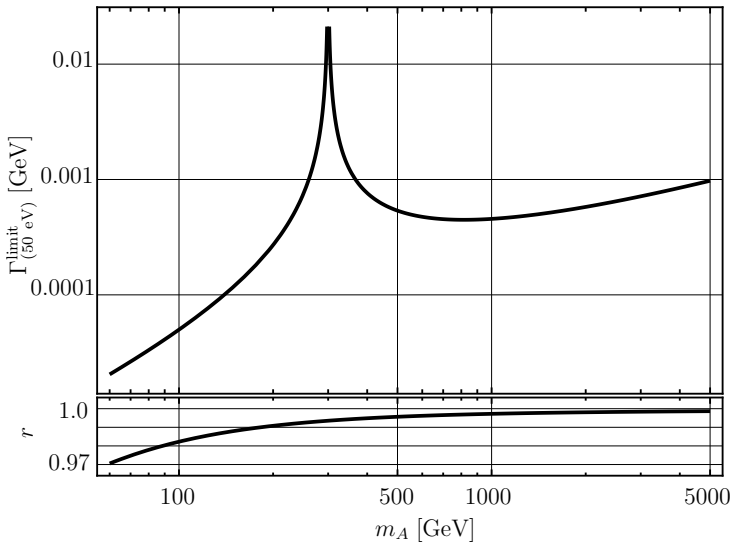
We present the tree-level two-body decays of the heavy scalars of the GNM and compute the lifetime of the pseudoscalar in the IDM limit for parameter choices that permit direct comparison to the inert doublet model.
What carries the argument
Tree-level two-body decay amplitudes of the additional neutral and charged scalars, including channels opened by the Majorana neutrino.
If this is right
- The computed decay rates impose upper limits on the pseudoscalar lifetime and thereby restrict its possible dark matter abundance.
- Decay channels that involve the Majorana neutrino produce collider signatures absent from the pure inert doublet model.
- The lifetime result supplies a direct criterion for whether the scalars can remain cosmologically stable.
- Matching the two models isolates the quantitative effect of the neutrino sector on scalar stability.
Where Pith is reading between the lines
- If the Majorana neutrino is light, extra decay modes would shorten the lifetime and further exclude a dark matter role.
- The rates can be folded into LHC missing-energy searches to predict signals for inert-like scalars.
- Inclusion of loop-induced or three-body decays would tighten the lifetime bound in lighter mass regions.
- The parameter matching constrains the allowed size of the neutrino Yukawa couplings.
Load-bearing premise
Certain parameter choices allow the Grimus-Neufeld model to be directly compared to the inert doublet model so that its scalars could contribute to dark matter.
What would settle it
A collider measurement or cosmological calculation showing the pseudoscalar lifetime is too short to yield the observed dark matter relic density would rule out the contribution scenario.
Figures
read the original abstract
We consider an extension of the Standard Model by an additional Higgs doublet and a Majorana neutrino, which we call the Grimus-Neufeld Model (GNM). For certain parameter choices the GNM can be compared to the Inert Doublet Model (IDM), which has a scalar dark matter candidate. This motivates that the scalars of the GNM could possibly contribute to dark matter. To check this, we present the tree-level two-body decays of the heavy scalars of the GNM and compute the lifetime of the pseudoscalar in the IDM limit.
Editorial analysis
A structured set of objections, weighed in public.
Referee Report
Summary. The manuscript considers the Grimus-Neufeld Model (GNM), an extension of the Standard Model by an additional Higgs doublet and a Majorana neutrino. For certain parameter choices the GNM can be compared to the Inert Doublet Model (IDM). The central results are the explicit tree-level two-body decay widths of the heavy scalars in the GNM together with the lifetime of the pseudoscalar evaluated in the IDM limit of the GNM.
Significance. If the calculations are correct, the work supplies concrete, model-specific decay rates and a lifetime that can be directly compared with experimental constraints and used to assess whether GNM scalars could contribute to dark matter phenomenology via the IDM limit. The explicit presentation of tree-level widths in this context is a useful addition to the literature on extended Higgs sectors.
minor comments (2)
- [Abstract] Abstract: the phrase 'we present the tree-level two-body decays' would be strengthened by a brief indication of the final expressions or numerical ranges obtained rather than only describing the scope of the computation.
- The connection between the GNM and IDM is stated as motivation but the precise parameter mapping (e.g., which couplings are set to zero or identified) should be stated explicitly in the section that defines the IDM limit, even if the decay calculation itself does not depend on it.
Simulated Author's Rebuttal
We thank the referee for the positive summary, significance assessment, and recommendation of minor revision for our manuscript on tree-level decays in the Grimus-Neufeld Model and the pseudoscalar lifetime in the IDM limit. No specific major comments were provided in the report.
Circularity Check
No significant circularity; direct computation of decay widths
full rationale
The paper's central claim is the explicit tree-level calculation of two-body decay widths for heavy scalars in the Grimus-Neufeld model, followed by evaluation of the pseudoscalar lifetime in the IDM limit. This is a standard model-building exercise that starts from the Lagrangian and derives widths via standard Feynman rules and phase-space integrals. No parameter is fitted to data and then relabeled as a prediction, no self-citation supplies a uniqueness theorem or ansatz that the present work depends on, and no quantity is defined in terms of itself. The IDM-limit comparison is a parameter choice, not a definitional loop. The derivation is therefore self-contained against external benchmarks.
Axiom & Free-Parameter Ledger
axioms (1)
- domain assumption Standard Model extended by one additional Higgs doublet and one Majorana neutrino
invented entities (2)
-
Additional Higgs doublet
no independent evidence
-
Majorana neutrino
no independent evidence
Reference graph
Works this paper leans on
-
[1]
11.005, https://linkinghub.elsevier.com/retrieve/pii/S0370157324003867
CMS Collaboration, Physics Reports 2025, 1115, 3–115, DOI 10.1016/j.physrep.2024. 11.005, https://linkinghub.elsevier.com/retrieve/pii/S0370157324003867
-
[2]
ATLAS Collaboration, Standard Model Summary Plots June 2024, CERN, Geneva, 2024, https://cds.cern.ch/record/2903866
arXiv 2024
-
[3]
Y. Fukuda, T. Hayakawa, E. Ichihara, K. Inoue, K. Ishihara, H. Ishino, Y. Itow, T. Kajita, J. Kameda, S. Kasuga, K. Kobayashi, Y. Kobayashi, Y. Koshio, M. Miura, M. Nakahata, Physical Review Letters 1998, 81, 1562–1567, DOI 10 . 1103 / PhysRevLett . 81 . 1562, https://link.aps.org/doi/10.1103/PhysRevLett.81.1562
-
[4]
M. Cirelli, A. Strumia, J. Zupan, SciPost Physics Reviews 2026, 1, DOI 10 . 21468 / SciPostPhysRev.1, https://scipost.org/10.21468/SciPostPhysRev.1
-
[6]
Verifiable Radiative Seesaw Mechanism of Neutrino Mass and Dark Matter
E. Ma, Physical Review D 2006, 73, 077301, DOI 10.1103/PhysRevD.73.077301, arXiv: hep-ph/0601225, http://arxiv.org/abs/hep-ph/0601225
work page internal anchor Pith review Pith/arXiv arXiv doi:10.1103/physrevd.73.077301 2006
-
[7]
Krawczyk, N
M. Krawczyk, N. Darvishi, D. Sokołowska, Acta Physica Polonica B 2016, 47, 183, DOI 10 . 5506 / APhysPolB . 47 . 183, http : / / www . actaphys . uj . edu . pl / findarticle ? series=Reg&vol=47&page=183
2016
-
[8]
Dodelson, L
S. Dodelson, L. M. Widrow, Physical Review Letters 1994, 72, 17–20, DOI 10.1103/ PhysRevLett . 72 . 17, arXiv: hep - ph / 9303287, http : / / arxiv . org / abs / hep - ph / 9303287
1994
-
[9]
J. Ghiglieri, M. Laine, Journal of High Energy Physics 2015, 2015, 171, DOI 10.1007/ JHEP11(2015)171, arXiv: 1506.06752 [hep-ph] , http://arxiv.org/abs/1506.06752
Pith/arXiv arXiv 2015
-
[10]
M. Drewes, J. U. Kang, Journal of High Energy Physics 2016, 2016, 51, DOI 10.1007/ JHEP05(2016)051, arXiv: 1510.05646 [hep-ph] , http://arxiv.org/abs/1510.05646
Pith/arXiv arXiv 2016
-
[11]
A. Boyarsky, M. Drewes, T. Lasserre, S. Mertens, O. Ruchayskiy, Progress in Particle and Nuclear Physics 2019, 104, 1–45, DOI 10 . 1016 / j . ppnp . 2018 . 07 . 004, arXiv: 1807.07938 [hep-ph] , http://arxiv.org/abs/1807.07938
Pith/arXiv arXiv 2019
-
[12]
Simplest Scoto-Seesaw Mechanism
N. Rojas, R. Srivastava, J. W. F. Valle, Physics Letters B 2019, 789, 132–136, DOI 10.1016/j.physletb.2018.12.014, arXiv: 1807.11447 [hep-ph], http://arxiv.org/ abs/1807.11447. 15
work page internal anchor Pith review Pith/arXiv arXiv doi:10.1016/j.physletb.2018.12.014 2019
- [13]
-
[14]
V. Dūdėnas, T. Gajdosik, U. Khasianevich, W. Kotlarski, D. Stöckinger, Journal of High Energy Physics 2022, 2022, 174, DOI 10 . 1007 / JHEP09(2022 ) 174, https : / / link . springer.com/10.1007/JHEP09(2022)174
-
[15]
Draukšas, Natural Sciences, Vilnius University, Lithuania, 2024, DOI 10
S. Draukšas, Natural Sciences, Vilnius University, Lithuania, 2024, DOI 10 . 15388 / vu . thesis . 614, https : / / www . lvb . lt / permalink / 370LABT _ NETWORK / 16p03o8 / alma9912937969108451
2024
-
[16]
R. N. Mohapatra, G. Senjanović, Physical Review Letters 1980, 44, 912–915, DOI 10. 1103/PhysRevLett.44.912 , https://link.aps.org/doi/10.1103/PhysRevLett.44. 912
-
[17]
J. Schechter, J. W. F. Valle, Physical Review D 1982, 25, 774–783, DOI 10 . 1103 / PhysRevD.25.774, https://link.aps.org/doi/10.1103/PhysRevD.25.774
-
[18]
Giganti, S
C. Giganti, S. Lavignac, M. Zito, Progress in Particle and Nuclear Physics 2018, 98, 1–54, DOI 10 . 1016 / j . ppnp . 2017 . 10 . 001, https : / / linkinghub . elsevier . com / retrieve/pii/S014664101730087X
2018
-
[19]
J. C. Romao, J. P. Silva, International Journal of Modern Physics A 2012, 27, 1230025, DOI 10.1142/S0217751X12300256 , arXiv: 1209.6213 [hep-ph] , http://arxiv.org/ abs/1209.6213
work page internal anchor Pith review Pith/arXiv arXiv doi:10.1142/s0217751x12300256 2012
-
[20]
Alloul, N
A. Alloul, N. D. Christensen, C. Degrande, C. Duhr, B. Fuks, Computer Physics Com- munications 2014, 185, 2250–2300, DOI 10 . 1016 / j . cpc . 2014 . 04 . 012, https : / / linkinghub.elsevier.com/retrieve/pii/S0010465514001350
2014
-
[21]
G. C. Branco, P. M. Ferreira, L. Lavoura, M. N. Rebelo, M. Sher, J. P. Silva, Physics Reports 2012, 516, 1–102, DOI 10.1016/j.physrep.2012.02.002 , arXiv: 1106.0034 [hep-ph], http://arxiv.org/abs/1106.0034
work page internal anchor Pith review Pith/arXiv arXiv doi:10.1016/j.physrep.2012.02.002 2012
-
[22]
J. F. Gunion, H. E. Haber, G. Kane, D. Sally, The Higgs Hunter’s Guide , 1st ed., CRC Press, 2018, DOI 10.1201/9780429496448, https://www.taylorfrancis.com/books/ 9780429964992
-
[24]
P. B. Pal, American Journal of Physics 2011, 79, 485–498, DOI 10.1119/1.3549729 , arXiv: 1006.1718 [hep-ph] , http://arxiv.org/abs/1006.1718
work page internal anchor Pith review Pith/arXiv arXiv doi:10.1119/1.3549729 2011
-
[25]
C. Degrande, Computer Physics Communications 2015, 197, 239–262, DOI 10.1016/j. cpc.2015.08.015, arXiv: 1406.3030 [hep-ph] , http://arxiv.org/abs/1406.3030
work page internal anchor Pith review Pith/arXiv arXiv doi:10.1016/j 2015
-
[26]
H. E. Haber, D. O’Neil, Physical Review D 2006, 74, 015018, DOI 10.1103/PhysRevD. 74.015018, arXiv: hep-ph/0602242, http://arxiv.org/abs/hep-ph/0602242
work page internal anchor Pith review Pith/arXiv arXiv doi:10.1103/physrevd 2006
-
[27]
T. Takagi, Japanese journal of mathematics :transactions and abstracts 1924, 1, 83–93, DOI 10.4099/jjm1924.1.0_83 , https://www.jstage.jst.go.jp/article/jjm1924/ 1/0/1_0_83/_article
-
[28]
W. Grimus, L. Lavoura, Journal of High Energy Physics 2001, 2001, 045–045, DOI 10.1088/1126-6708/2001/07/045 , http://stacks.iop.org/1126-6708/2001/i=07/ a=045?key=crossref.9d4da9553820ae0390ab6e211df4823d
-
[29]
Pontecorvo, Soviet Physics–JETP [translation of Zhurnal Eksperimentalnoi i Teo- reticheskoi Fiziki] 1958, 7, 172–173
B. Pontecorvo, Soviet Physics–JETP [translation of Zhurnal Eksperimentalnoi i Teo- reticheskoi Fiziki] 1958, 7, 172–173. 16
1958
-
[30]
Z. Maki, M. Nakagawa, S. Sakata, Progress of Theoretical Physics 1962, 28, 870–880, DOI 10.1143/PTP.28.870 , https://academic.oup.com/ptp/article-lookup/doi/ 10.1143/PTP.28.870
-
[31]
Dūdėnas, T
V. Dūdėnas, T. Gajdosik, A. Juodagalvis, D. Jurčiukonis, Acta Physica Polonica B 2017, 48, 2235, DOI 10 . 5506 / APhysPolB . 48 . 2235, http : / / www . actaphys . uj . edu . pl / findarticle?series=Reg&vol=48&page=2235
2017
-
[32]
S. Navas, C. Amsler, T. Gutsche, C. Hanhart, J. J. Hernández-Rey, C. Lourenço, A. Masoni, M. Mikhasenko, R. E. Mitchell, C. Patrignani, C. Schwanda, S. Spanier, G. Venanzoni, C. Z. Yuan, K. Agashe, Physical Review D 2024, 110, 030001, DOI 10.1103/ PhysRevD.110.030001, https://link.aps.org/doi/10.1103/PhysRevD.110.030001
-
[33]
L. L. Honorez, E. Nezri, J. F. Oliver, M. H. G. Tytgat, Journal of Cosmology and As- troparticle Physics 2007, 2007, 028–028, DOI 10.1088/1475-7516/2007/02/028, arXiv: hep-ph/0612275, http://arxiv.org/abs/hep-ph/0612275
work page internal anchor Pith review Pith/arXiv arXiv doi:10.1088/1475-7516/2007/02/028 2007
-
[34]
A. Ilnicka, M. Krawczyk, T. Robens, Physical Review D 2016, 93, 055026, DOI 10.1103/ PhysRevD.93.055026, https://link.aps.org/doi/10.1103/PhysRevD.93.055026
-
[35]
A. Belyaev, G. Cacciapaglia, I. P. Ivanov, F. Rojas-Abatte, M. Thomas, Physical Review D 2018, 97, 035011, DOI 10.1103/PhysRevD.97.035011 , https://link.aps.org/ doi/10.1103/PhysRevD.97.035011
-
[36]
A. Alves, D. A. Camargo, A. G. Dias, R. Longas, C. C. Nishi, F. S. Queiroz, Journal of High Energy Physics 2016, 2016, 15, DOI 10.1007/JHEP10(2016)015 , http://link. springer.com/10.1007/JHEP10(2016)015
-
[37]
C. Arina, F.-S. Ling, M. H. Tytgat, Journal of Cosmology and Astroparticle Physics 2009, 2009, 018–018, DOI 10.1088/1475- 7516/2009/10/018 , https://iopscience.iop. org/article/10.1088/1475-7516/2009/10/018. 17
discussion (0)
Sign in with ORCID, Apple, or X to comment. Anyone can read and Pith papers without signing in.