Towards Standardizing Affine Frequency Division Multiplexing (AFDM) for Future Wireless Networks
Pith reviewed 2026-06-27 05:42 UTC · model grok-4.3
The pith
AFDM integrates into 4G/5G and radar systems with only limited changes to existing chains.
A machine-rendered reading of the paper's core claim, the machinery that carries it, and where it could break.
Core claim
AFDM is a waveform with strong resilience to doubly selective channels that enables seamless integration of communication and sensing functionalities, and demonstrations show it can be incorporated into legacy processing chains with limited modification, positioning it as a timely technology for future wireless networks.
What carries the argument
AFDM waveform, which achieves channel robustness and communication-sensing fusion through affine frequency modulation that maps signals into a chirp-based domain.
If this is right
- AFDM supports multiple-antenna and multi-user operation while keeping peak-to-average power ratio manageable.
- AFDM can serve non-terrestrial networks, integrated sensing and communications, vehicle-to-everything, and underwater acoustic communications under severe dispersion.
- AFDM maintains compatibility with 4G/5G frameworks, FMCW radar waveforms, and LoRa modulation.
Where Pith is reading between the lines
- Standardizing AFDM could allow operators to reuse much of their existing baseband hardware rather than replace it outright.
- The review leaves open the question of how AFDM scales in very large antenna arrays or dense multi-user cells.
- AFDM's delay-Doppler resilience may prove useful in additional high-mobility settings such as high-speed rail or drone networks.
Load-bearing premise
The shown examples of backwards compatibility with 4G/5G, radar, and LoRa are treated as sufficient to support standardization without requiring extensive new implementation benchmarks.
What would settle it
A side-by-side hardware test or detailed receiver implementation study showing that AFDM requires substantial new processing blocks or fails performance targets in one of the reviewed scenarios such as high-mobility V2X.
Figures
read the original abstract
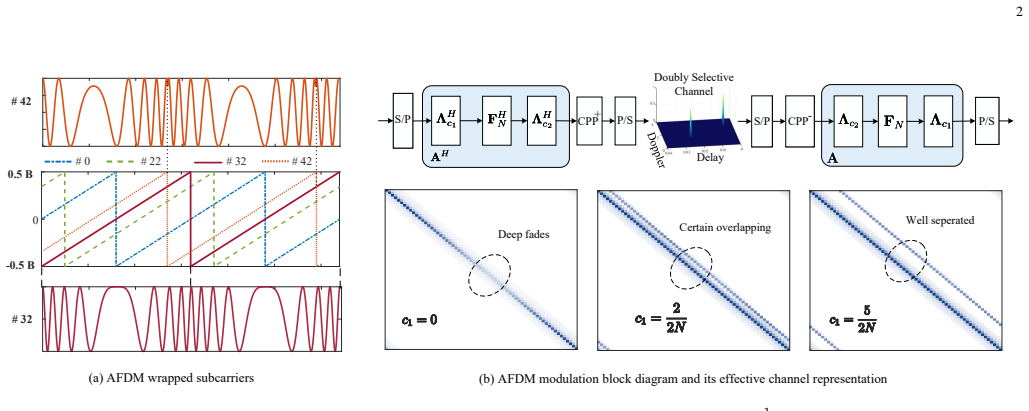
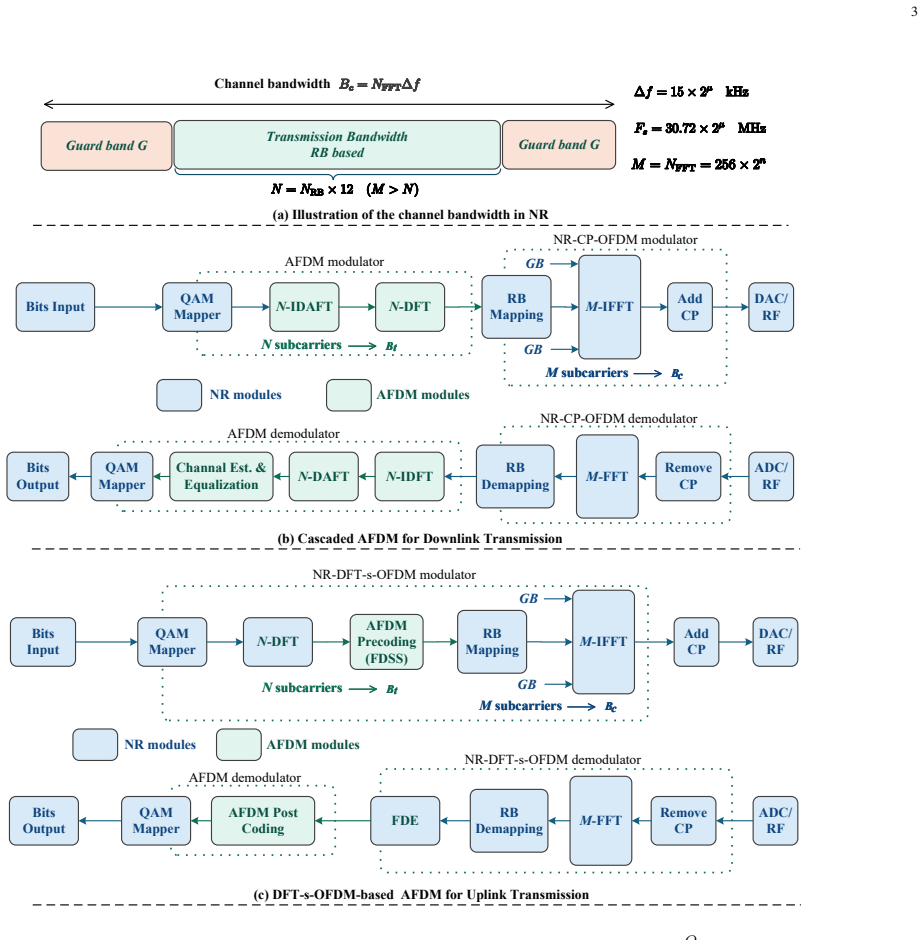
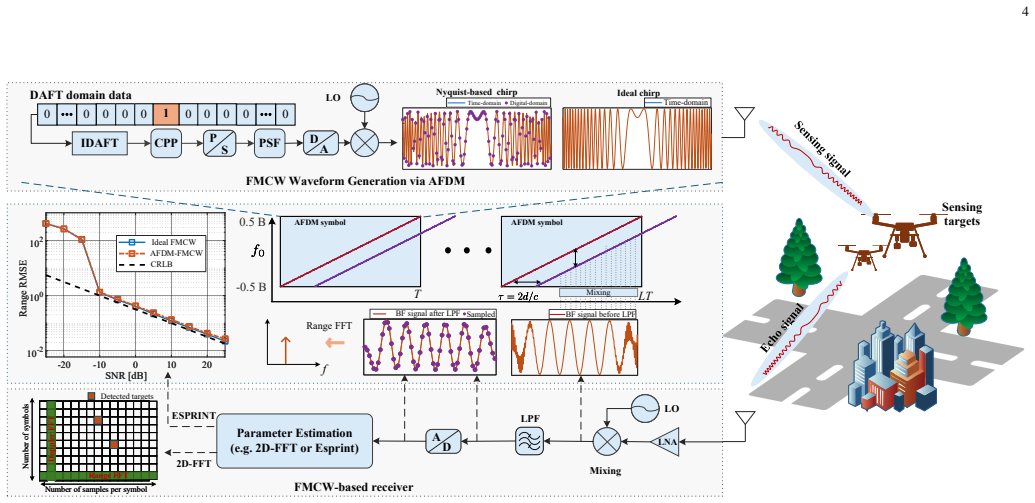
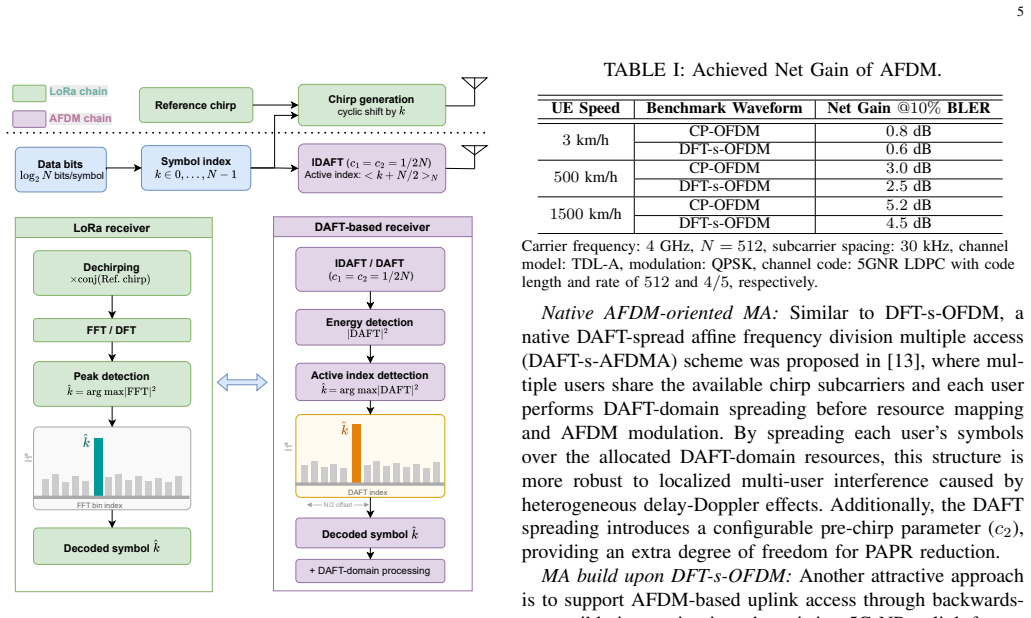
Affine frequency division multiplexing~(AFDM) has emerged as a compelling waveform candidate for future wireless networks, owing to its strong resilience to doubly selective channels and its ability to enable the seamless integration of communication and sensing functionalities. Against this context, this article provides a systematic study of AFDM from a standardization perspective. We first introduce the principles of AFDM and discuss the major considerations involved in waveform standardization. We then examine the backwards compatibility of AFDM with 4G/5G multi-numerology frameworks and their anticipated evolution, frequency-modulated continuous-wave (FMCW) radar waveforms, and long-range (LoRa) modulation, demonstrating that AFDM can be incorporated into legacy processing chains with limited modification. Key standardization-critical capabilities are further discussed, including multiple-antenna and multi-user support, and peak-to-average power ratio (PAPR). Finally, we investigate the potential of AFDM in several emerging scenarios, including non-terrestrial networks~(NTN), integrated sensing and communications (ISAC), vehicle-to-everything (V2X), and underwater acoustic (UWA) communications, whereby severe delay-Doppler dispersion places stringent demands on waveform robustness. Through these explorations, it is shown that that AFDM represents a timely and compelling technology for future wireless networks.
Editorial analysis
A structured set of objections, weighed in public.
Referee Report
Summary. The manuscript provides a systematic study of AFDM from a standardization perspective. It introduces AFDM principles and standardization considerations, examines conceptual backwards compatibility with 4G/5G multi-numerology frameworks, FMCW radar, and LoRa (claiming incorporation into legacy chains with limited modification), discusses multi-antenna/multi-user support and PAPR, and explores applications in NTN, ISAC, V2X, and UWA communications where delay-Doppler dispersion is severe. The central claim is that AFDM represents a timely and compelling technology for future networks.
Significance. If the conceptual compatibility arguments hold, this perspective could inform waveform standardization discussions for 6G-era systems by highlighting AFDM's potential resilience in doubly selective channels and its support for integrated sensing and communications. The systematic structure and coverage of legacy integration and emerging scenarios provide a useful reference point for the community.
minor comments (1)
- [Abstract] Abstract: the phrase 'it is shown that that AFDM' contains a repeated word.
Simulated Author's Rebuttal
We thank the referee for their positive evaluation of the manuscript and for recommending acceptance. The review accurately captures the paper's focus on AFDM's standardization potential, backwards compatibility aspects, and applicability to emerging scenarios with severe delay-Doppler dispersion.
Circularity Check
No significant circularity
full rationale
This is a review-style standardization perspective paper that introduces AFDM principles, conceptually examines backwards compatibility with 4G/5G, FMCW, and LoRa, and discusses use cases in NTN, ISAC, V2X, and UWA. No derivations, equations, fitted parameters, or closed-form results are advanced. All claims are framed as exploratory discussion rather than reductions from internal constructions or self-citation chains. The derivation chain is empty by design; the paper is self-contained as a survey without load-bearing technical assertions that could reduce to inputs.
Axiom & Free-Parameter Ledger
Forward citations
Cited by 1 Pith paper
-
MCRB and MSE Analysis for Parameter Estimation in AFDM-ISAC Systems
Derives MCRB and MSE lower bound showing standard CRB is optimistic under data-induced misspecification in AFDM-ISAC parameter estimation.
Reference graph
Works this paper leans on
-
[1]
Q. Luoet al., “Chirp-based OCDM and AFDM waveforms for 6G and beyond: Principles, recent advances, and future opportunities,” Feb. 2026, authorea preprint, DOI: 10.22541/au.177145233.37871971/v1. [Online]. Available: https://www.authorea.com/doi/full/10.22541/au. 177145233.37871971
-
[2]
Recommendation ITU-R M.2160-0: Framework and overall objectives of the future development of imt for 2030 and beyond,
International Telecommunication Union, “Recommendation ITU-R M.2160-0: Framework and overall objectives of the future development of imt for 2030 and beyond,” 2023. [Online]. Available: https://www. itu.int/dms pubrec/itu-r/rec/m/R-REC-M.2160-0-202311-I!!PDF-E.pdf
2030
-
[3]
AFDM-enabled integrated sensing and communication: Theoretical framework and pilot design,
F. Zhanget al., “AFDM-enabled integrated sensing and communication: Theoretical framework and pilot design,”IEEE J. Sel. Areas Commun., vol. 44, pp. 310–324, 2026
2026
-
[4]
Z. Suiet al., “Multi-functional chirp signalling for next-generation multi-carrier wireless networks: Communications, sensing and ISAC perspectives,” Aug. 2025. [Online]. Available: https://arxiv.org/abs/ 2508.06022
-
[5]
Performance degradation of OFDM systems due to doppler spreading,
T. Wang, J. Proakis, E. Masry, and J. Zeidler, “Performance degradation of OFDM systems due to doppler spreading,”IEEE Trans. Wireless Commun., vol. 5, no. 6, pp. 1422–1432, 2006. 9
2006
-
[6]
Affine frequency division multiplexing for next generation wireless communications,
A. Bemani, N. Ksairi, and M. Kountouris, “Affine frequency division multiplexing for next generation wireless communications,”IEEE Trans. Wireless Commun., vol. 22, no. 11, pp. 8214–8229, 2023
2023
-
[7]
Discussion on 6GR waveform & Discussion on waveform and signal for sensing,
ETRI and University of Surrey, “Discussion on 6GR waveform & Discussion on waveform and signal for sensing,” 3GPP TSG RAN WG1 contribution, status: Noted. Available from the 3GPP FTP server. [Online]. Available: https://www.3gpp.org/ftp/tsg Ran/WG1 RL1/TSGR1 124b/Docs?sortby=sizerev
-
[8]
3GPP specification series: 38 series,
3GPP, “3GPP specification series: 38 series,” Mar. 2026, accessed: 2026-03-20. [Online]. Available: https://www.3gpp.org/dynareport? code=38-series.htm
2026
-
[9]
On the Fourier transform of finite chirps,
A. Brodzik, “On the Fourier transform of finite chirps,”IEEE Signal Process. Lett., vol. 13, no. 9, pp. 541–544, 2006
2006
-
[10]
Special cases of DFT-based modulation and demodulation for affine frequency division multiplexing,
V . Savaux, “Special cases of DFT-based modulation and demodulation for affine frequency division multiplexing,”IEEE Trans. Commun., vol. 72, no. 12, pp. 7627–7638, 2024
2024
-
[11]
Automotive FMCW radar with difference co-chirps,
L. Xu, S. Sun, K. V . Mishra, and Y . D. Zhang, “Automotive FMCW radar with difference co-chirps,”IEEE Trans. Aerosp. Electron. Syst., vol. 59, no. 6, pp. 8145–8165, 2023
2023
-
[12]
ISAC with Affine Frequency Division Multiplexing: An FMCW-Based Signal Processing Perspective
J. Zhu, Y . Tang, C. Yi, H. Yin, Y . Ni, F. Liu, Z. Wei, and H. Arslan, “ISAC with affine frequency division multiplexing: An FMCW-based signal processing perspective,” Nov. 2025. [Online]. Available: https://arxiv.org/abs/2511.12308
work page internal anchor Pith review Pith/arXiv arXiv 2025
-
[13]
Affine frequency division multiple access based on DAFT spreading for next- generation wireless networks,
Y . Tao, M. Wen, Y . Ge, T. Mao, Y . Tang, and A. Doosti-Aref, “Affine frequency division multiple access based on DAFT spreading for next- generation wireless networks,”IEEE Trans. Wireless Commun., vol. 25, pp. 4626–4641, 2026
2026
-
[14]
PAPR reduction with pre-chirp selection for affine frequency division multiplexing,
H. Yuan, Y . Xu, X. Guo, Y . Ge, T. Ma, H. Li, D. He, and W. Zhang, “PAPR reduction with pre-chirp selection for affine frequency division multiplexing,”IEEE Wireless Commun. Lett., vol. 14, no. 3, pp. 736– 740, 2024
2024
-
[15]
Precoding design for MIMO-AFDM systems: Exploiting joint spatial-affine frequency domain potential in high-mobility scenarios,
Q. Tao, “Precoding design for MIMO-AFDM systems: Exploiting joint spatial-affine frequency domain potential in high-mobility scenarios,” IEEE Commun. Stand. Magaz., pp. 1–8, 2026
2026
discussion (0)
Sign in with ORCID, Apple, or X to comment. Anyone can read and Pith papers without signing in.