Coordinate-wise Polyhedral Method for Eliciting Multivariate Linear Utility and Univariate Nonlinear Utility Functions
Pith reviewed 2026-06-27 05:55 UTC · model grok-4.3
The pith
A coordinate-wise polyhedral method reduces the uncertainty polyhedron for utility functions at a linear convergence rate.
A machine-rendered reading of the paper's core claim, the machinery that carries it, and where it could break.
Core claim
Under the CPM framework, the diameter of the polyhedron is reduced at a linear convergence rate. For univariate piecewise-linear utility functions represented by their increment vectors, the Kantorovich distance between the true utility and the estimated one decreases at a linear convergence rate. The method further extends to general nondecreasing Lipschitz continuous utilities via piecewise-linear approximation with an adaptive-breakpoint strategy that ensures convergence of the ambiguity set to the true function as the number of queries increases.
What carries the argument
The coordinate-wise polyhedral method (CPM), which pre-specifies coordinate-wise cuts in advance and designs pairwise comparison queries by solving a linear system of equations.
If this is right
- The diameter of the polyhedron for multivariate linear utility functions decreases linearly with the number of queries.
- The Kantorovich distance for univariate nonlinear utility functions decreases at a linear rate.
- The set of piecewise-linear utility functions converges to the true nondecreasing Lipschitz utility as queries increase.
- An explicit bound for the approximation error is derived.
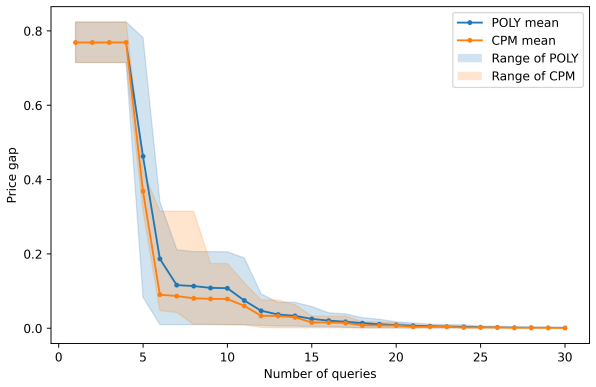
- Numerical experiments confirm stable convergence comparable to standard methods.
Where Pith is reading between the lines
- CPM may reduce computational cost compared to methods that solve optimization problems for each query since it uses linear systems.
- The adaptive breakpoint strategy could be tested in other approximation settings for utility functions.
- Linear convergence might enable efficient real-time elicitation in decision support systems.
Load-bearing premise
Pairwise comparison queries can always be obtained without inconsistencies by solving a linear system after pre-specifying the coordinate-wise cuts.
What would settle it
A case where solving the linear system for query design leads to inconsistent queries or where the polyhedron diameter fails to decrease linearly with successive cuts would disprove the convergence claim.
Figures

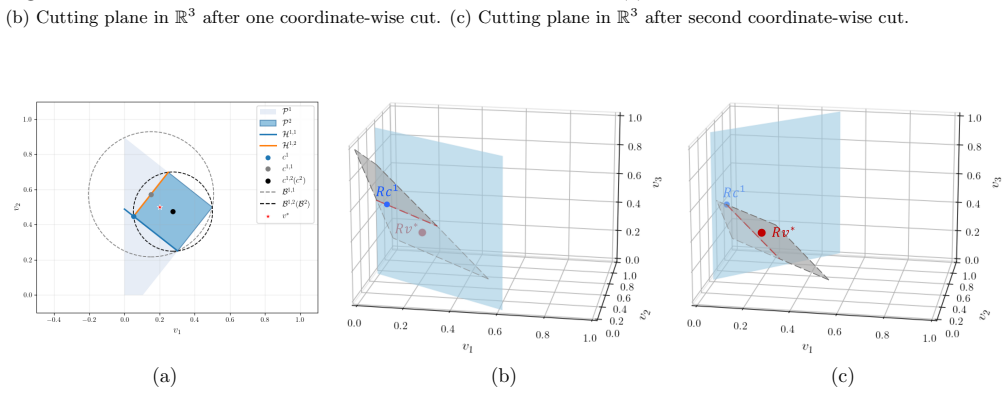
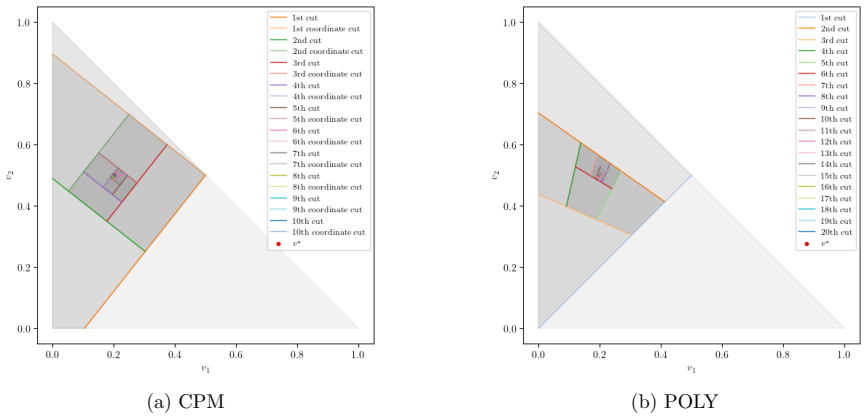



read the original abstract
In this paper, we propose a coordinate-wise polyhedral method (CPM) for cutting polyhedra with theoretical guarantees of convergence. Unlike the existing polyhedral method, which designs pairwise comparison queries by solving coupled optimization problems and performs cuts subsequently, CPM specifies coordinate-wise cuts in advance and then designs corresponding pairwise comparison queries by solving a linear system of equations. Under this framework, we show that CPM reduces the diameter of the polyhedron at a linear convergence rate. Moreover, we extend CPM to a univariate piecewise-linear utility function by representing it with its increment vector over consecutive breakpoints. We show that the Kantorovich distance between the true utility function and the estimated one obtained by CPM decreases at a linear convergence rate. Further, we extend the CPM to general nondecreasing Lipschitz continuous utility functions by piecewise-linear approximation (PLA). We introduce an adaptive-breakpoint strategy to avoid direction errors caused by PLA. We prove that the set of piecewise-linear utility functions corresponding to the ambiguity set of increment vectors converges to the true utility function as the number of queries increases, and derive an explicit bound for the approximation. Finally, to evaluate the performance of CPM, we conduct a series of numerical experiments. The results demonstrate comparable convergence to the standard polyhedral method in the case of linear multivariate utility functions. For nonlinear univariate utility functions, CPM achieves stable convergence to the true utility function, in line with the theoretical findings.
Editorial analysis
A structured set of objections, weighed in public.
Referee Report
Summary. The paper proposes a coordinate-wise polyhedral method (CPM) for eliciting multivariate linear utility functions by pre-specifying coordinate-wise cuts and designing pairwise comparison queries via a linear system of equations. It claims this yields linear convergence in polyhedron diameter reduction. The method is extended to univariate piecewise-linear utilities (with linear convergence in Kantorovich distance between true and estimated functions) and to general nondecreasing Lipschitz utilities via piecewise-linear approximation (PLA) with an adaptive breakpoint strategy that ensures convergence of the ambiguity set with an explicit bound. Numerical experiments compare CPM to the standard polyhedral method.
Significance. If the linear-system solvability and convergence arguments hold, CPM offers a structured alternative to coupled optimization-based polyhedral methods with explicit linear rates, which would be useful for preference elicitation in decision analysis and optimization. The PLA extension with adaptive breakpoints and Kantorovich-distance bound adds value for nonlinear cases.
major comments (2)
- [CPM Framework (prior to the diameter-reduction theorem)] The linear diameter reduction (abstract) and all subsequent rates rest on the claim that, after pre-specifying coordinate-wise cuts, the linear system for pairwise-query design always admits a solution that produces a valid cut reducing diameter by a fixed factor <1. No explicit proof, rank condition, or consistency argument for this system across iterations appears in the framework description; if the system is inconsistent or the query fails to implement the intended cut due to cross-coordinate coupling, the linear-rate claim fails.
- [Univariate Nonlinear and PLA Extensions] The Kantorovich-distance linear convergence for the univariate piecewise-linear case and the PLA convergence proof for Lipschitz utilities inherit the same linear-system assumption; any gap in solvability or diameter reduction propagates directly to these extensions and to the adaptive-breakpoint strategy.
minor comments (2)
- [Numerical Experiments] The numerical experiments claim 'comparable convergence' and 'stable convergence'; add quantitative tables or plots with explicit iteration counts, diameter values, and distance metrics to allow direct comparison with the theoretical rates.
- [CPM Framework] Clarify the precise form of the linear system (variables, constraints, and right-hand side) used to design the queries once cuts are pre-specified.
Simulated Author's Rebuttal
We thank the referee for the thorough review and for identifying the need for explicit justification of the linear-system solvability. We agree that a dedicated proof of consistency, rank conditions, and diameter reduction is required to support the linear-rate claims and their extensions. We will revise the manuscript accordingly by adding this material prior to the main theorems. Point-by-point responses follow.
read point-by-point responses
-
Referee: [CPM Framework (prior to the diameter-reduction theorem)] The linear diameter reduction (abstract) and all subsequent rates rest on the claim that, after pre-specifying coordinate-wise cuts, the linear system for pairwise-query design always admits a solution that produces a valid cut reducing diameter by a fixed factor <1. No explicit proof, rank condition, or consistency argument for this system across iterations appears in the framework description; if the system is inconsistent or the query fails to implement the intended cut due to cross-coordinate coupling, the linear-rate claim fails.
Authors: We appreciate this observation. The current framework description states that the linear system is solved to design queries but does not contain a self-contained argument establishing solvability, full rank of the system matrix, or invariance of the reduction factor across iterations. This omission leaves open the possibility of inconsistency due to coordinate coupling. We will insert a new subsection immediately before the diameter-reduction theorem that proves: (i) the coordinate-wise cut specification yields a square, full-rank matrix independent of prior cuts; (ii) the unique solution corresponds to a valid separating hyperplane; and (iii) the resulting cut reduces the polyhedron diameter by a fixed factor strictly less than one. This addition directly addresses the referee’s concern. revision: yes
-
Referee: [Univariate Nonlinear and PLA Extensions] The Kantorovich-distance linear convergence for the univariate piecewise-linear case and the PLA convergence proof for Lipschitz utilities inherit the same linear-system assumption; any gap in solvability or diameter reduction propagates directly to these extensions and to the adaptive-breakpoint strategy.
Authors: The referee is correct that the convergence statements for the piecewise-linear univariate case (Kantorovich distance) and the PLA extension (ambiguity-set convergence with explicit bound) rest on the base CPM linear-system properties. Once the new subsection establishes solvability and the fixed-factor diameter reduction for the linear multivariate setting, the same arguments carry over verbatim to the increment-vector representation used for univariate utilities and to the adaptive-breakpoint construction. We will add a short remark in each extension section that explicitly invokes the new proof, thereby closing the inheritance gap without altering the adaptive strategy itself. revision: yes
Circularity Check
No significant circularity; derivation self-contained with independent convergence proofs.
full rationale
The paper defines CPM by pre-specifying coordinate-wise cuts then solving a linear system for queries, and separately proves linear diameter reduction and Kantorovich convergence under that framework. No quoted step reduces a claimed prediction or theorem to a fitted input, self-citation, or definitional tautology. The extensions to univariate nonlinear and PLA cases inherit the same framework but add explicit adaptive strategies and approximation bounds that are derived rather than presupposed. This matches the default expectation of a non-circular paper.
Axiom & Free-Parameter Ledger
axioms (1)
- domain assumption Utility function is nondecreasing and Lipschitz continuous for the general nondecreasing case extension via PLA.
Reference graph
Works this paper leans on
-
[1]
Journal of the Royal Statistical Society: Series B , volume =
Optimum Experimental Designs , author =. Journal of the Royal Statistical Society: Series B , volume =
-
[2]
2006 , address =
Optimal Design of Experiments , author =. 2006 , address =
2006
-
[3]
Mathematical Programming , pages=
Eliciting Von Neumann--Morgenstern utility from discrete choices with response error , author=. Mathematical Programming , pages=. 2026 , publisher=
2026
-
[4]
Journal of Marketing Research , volume=
The effectiveness of alternative preference elicitation procedures in predicting choice , author=. Journal of Marketing Research , volume=. 1993 , publisher=
1993
-
[5]
Operations Research , volume=
Utility preference robust optimization with moment-type information structure , author=. Operations Research , volume=. 2024 , publisher=
2024
-
[6]
Omega , volume=
Filling in pattern designs for incomplete pairwise comparison matrices:(quasi-) regular graphs with minimal diameter , author=. Omega , volume=. 2022 , publisher=
2022
-
[7]
Proceedings of the 12th ACM Conference on Recommender Systems , pages=
Preference elicitation as an optimization problem , author=. Proceedings of the 12th ACM Conference on Recommender Systems , pages=
-
[8]
Proceedings of the 22nd ACM SIGKDD international conference on knowledge discovery and data mining , pages=
Towards conversational recommender systems , author=. Proceedings of the 22nd ACM SIGKDD international conference on knowledge discovery and data mining , pages=
-
[9]
Marketing Science , volume=
Construction of heterogeneous conjoint choice designs: A new approach , author=. Marketing Science , volume=. 2015 , publisher=
2015
-
[10]
Journal of Marketing Research , volume=
Heterogeneous conjoint choice designs , author=. Journal of Marketing Research , volume=. 2005 , publisher=
2005
-
[11]
Journal of Business & Economic Statistics , volume=
An efficient algorithm for constructing Bayesian optimal choice designs , author=. Journal of Business & Economic Statistics , volume=. 2009 , publisher=
2009
-
[12]
Journal of Marketing Research , volume=
A comparison of criteria to design efficient choice experiments , author=. Journal of Marketing Research , volume=. 2006 , publisher=
2006
-
[13]
Marketing Science , volume=
Profile construction in experimental choice designs for mixed logit models , author=. Marketing Science , volume=. 2002 , publisher=
2002
-
[14]
Journal of Marketing Research , volume=
Designing conjoint choice experiments using managers' prior beliefs , author=. Journal of Marketing Research , volume=. 2001 , publisher=
2001
-
[15]
Journal of Marketing Research , volume=
Optimal design for multinomial choice experiments , author=. Journal of Marketing Research , volume=. 2002 , publisher=
2002
-
[16]
SIAM Journal on Optimization , volume=
Two algorithms for the minimum enclosing ball problem , author=. SIAM Journal on Optimization , volume=. 2008 , publisher=
2008
-
[17]
Applied Sciences , volume=
AI-driven recommendations: A systematic review of the state of the art in e-commerce , author=. Applied Sciences , volume=. 2023 , publisher=
2023
-
[18]
The Palgrave handbook of interactive marketing , pages=
AI-based recommendation systems: the ultimate solution for market prediction and targeting , author=. The Palgrave handbook of interactive marketing , pages=. 2023 , publisher=
2023
-
[19]
Advanced Engineering Informatics , volume=
An AI-based open recommender system for personalized labor market driven education , author=. Advanced Engineering Informatics , volume=. 2022 , publisher=
2022
-
[20]
Mathematical Programming , pages=
Preference ambiguity and robustness in multistage decision making , author=. Mathematical Programming , pages=. 2025 , publisher=
2025
-
[21]
Behavioral Science , volume=
Measuring utility by a single-response sequential method , author=. Behavioral Science , volume=. 1964 , publisher=
1964
-
[22]
Management Science , volume=
Loss aversion under prospect theory: A parameter-free measurement , author=. Management Science , volume=. 2007 , publisher=
2007
-
[23]
Management Science , volume=
Parameter-free elicitation of utility and probability weighting functions , author=. Management Science , volume=. 2000 , publisher=
2000
-
[24]
Management Science , volume=
Eliciting von Neumann-Morgenstern utilities when probabilities are distorted or unknown , author=. Management Science , volume=. 1996 , publisher=
1996
-
[25]
Econometrica: Journal of the Econometric Society , pages=
Investigating generalizations of expected utility theory using experimental data , author=. Econometrica: Journal of the Econometric Society , pages=. 1994 , publisher=
1994
-
[26]
Journal of Risk and Uncertainty , volume=
Nonlinear weighting of probabilities and violations of the betweenness axiom , author=. Journal of Risk and Uncertainty , volume=
-
[27]
Journal of Risk and Uncertainty , volume=
Advances in prospect theory: Cumulative representation of uncertainty , author=. Journal of Risk and Uncertainty , volume=. 1992 , publisher=
1992
-
[28]
, author=
Weighing risk and uncertainty. , author=. Psychological Review , volume=. 1995 , publisher=
1995
-
[29]
Theory and Decision , volume=
Separating marginal utility and probabilistic risk aversion , author=. Theory and Decision , volume=. 1994 , publisher=
1994
-
[30]
Journal of Economic Behavior & Organization , volume=
A theory of anticipated utility , author=. Journal of Economic Behavior & Organization , volume=. 1982 , publisher=
1982
-
[31]
Econometrica: Journal of the Econometric Society , pages=
The dual theory of choice under risk , author=. Econometrica: Journal of the Econometric Society , pages=. 1987 , publisher=
1987
-
[32]
1947 , publisher=
Theory of games and economic behavior, 2nd rev , author=. 1947 , publisher=
1947
-
[33]
Mathematics of Operations Research , year=
On the convex formulations of robust Markov decision processes , author=. Mathematics of Operations Research , year=
-
[34]
Mathematics of Operations Research , volume=
Robust dynamic programming , author=. Mathematics of Operations Research , volume=. 2005 , publisher=
2005
-
[35]
1994 , publisher=
Markov decision processes: discrete stochastic dynamic programming , author=. 1994 , publisher=
1994
-
[36]
Science , volume=
Dynamic programming , author=. Science , volume=. 1966 , publisher=
1966
-
[37]
Mathematical Programming , pages=
Distributional utility preference robust optimization models in multi-attribute decision making , author=. Mathematical Programming , pages=. 2024 , publisher=
2024
-
[38]
Adaptive preference elicitation in preference robust CPT-based shortfall , author=. , year=
-
[39]
arXiv preprint arXiv:2503.23269 , year=
Modified Polyhedral Method for Elicitation of Shape-Free Utility and Conservatism Reduction in Robust Optimization , author=. arXiv preprint arXiv:2503.23269 , year=
-
[40]
Management Science , volume=
Dynamic experiments for estimating preferences: An adaptive method of eliciting time and risk parameters , author=. Management Science , volume=. 2013 , publisher=
2013
-
[41]
Marketing Science , volume=
Fast polyhedral adaptive conjoint estimation , author=. Marketing Science , volume=. 2003 , publisher=
2003
-
[42]
Journal of Marketing Research , volume=
Polyhedral methods for adaptive choice-based conjoint analysis , author=. Journal of Marketing Research , volume=. 2004 , publisher=
2004
-
[43]
Transportation Research Part B: Methodological , volume=
A comparison of different Bayesian design criteria for setting up stated preference studies , author=. Transportation Research Part B: Methodological , volume=. 2012 , publisher=
2012
-
[44]
Doklady Akademii Nauk , volume=
A polynomial algorithm in linear programming , author=. Doklady Akademii Nauk , volume=. 1979 , organization=
1979
-
[45]
Lecture Notes from Stanford University , year=
Analytic center cutting-plane method , author=. Lecture Notes from Stanford University , year=
-
[46]
Marketing Science , volume=
Probabilistic polyhedral methods for adaptive choice-based conjoint analysis: Theory and application , author=. Marketing Science , volume=. 2007 , publisher=
2007
-
[47]
Artificial Intelligence , volume=
Label ranking by learning pairwise preferences , author=. Artificial Intelligence , volume=. 2008 , publisher=
2008
-
[48]
International Symposium on Intelligent Data Analysis , pages=
A policy iteration algorithm for learning from preference-based feedback , author=. International Symposium on Intelligent Data Analysis , pages=. 2013 , organization=
2013
-
[49]
, author=
Preference-learning based Inverse Reinforcement Learning for Dialog Control. , author=. INTERSPEECH , volume=
-
[50]
2000 , publisher=
Stated choice methods: analysis and applications , author=. 2000 , publisher=
2000
-
[51]
Conditional logit analysis of qualitative choice behavior , author=
-
[52]
American Economic Review , volume=
Economic choices , author=. American Economic Review , volume=. 2001 , publisher=
2001
-
[53]
Biometrika , volume=
A continuum of paired comparisons models , author=. Biometrika , volume=. 1990 , publisher=
1990
-
[54]
Journal of Eeconometrics , volume=
Marketing models of consumer heterogeneity , author=. Journal of Eeconometrics , volume=. 1998 , publisher=
1998
-
[55]
Journal of Consumer Research , volume=
Improving parameter estimates and model prediction by aggregate customization in choice experiments , author=. Journal of Consumer Research , volume=. 2001 , publisher=
2001
-
[56]
Operations Research , volume=
Learning preferences under noise and loss aversion: An optimization approach , author=. Operations Research , volume=. 2013 , publisher=
2013
-
[57]
Operations Research , volume=
Ellipsoidal methods for adaptive choice-based conjoint analysis , author=. Operations Research , volume=. 2019 , publisher=
2019
-
[58]
Journal of Marketing Research , volume=
Efficient experimental design with marketing research applications , author=. Journal of Marketing Research , volume=. 1994 , publisher=
1994
-
[59]
Journal of Marketing research , volume=
The importance of utility balance in efficient choice designs , author=. Journal of Marketing research , volume=. 1996 , publisher=
1996
-
[60]
Management Science , volume=
Decision making under uncertainty when preference information is incomplete , author=. Management Science , volume=. 2015 , publisher=
2015
-
[61]
Financial Innovation , volume=
Personalized fund recommendation with dynamic utility learning , author=. Financial Innovation , volume=. 2025 , publisher=
2025
-
[62]
Advances in Neural Information Processing Systems , volume=
Active preference learning with discrete choice data , author=. Advances in Neural Information Processing Systems , volume=
-
[63]
A Cost-Effective Framework for Preference Elicitation and Aggregation
A cost-effective framework for preference elicitation and aggregation , author=. arXiv preprint arXiv:1805.05287 , year=
work page internal anchor Pith review Pith/arXiv arXiv
-
[64]
Ijcai , volume=
Incremental utility elicitation with the minimax regret decision criterion , author=. Ijcai , volume=
-
[65]
Artificial Intelligence , volume=
Constraint-based optimization and utility elicitation using the minimax decision criterion , author=. Artificial Intelligence , volume=. 2006 , publisher=
2006
-
[66]
Advances in Neural Information Processing Systems , volume=
A bayesian approach for policy learning from trajectory preference queries , author=. Advances in Neural Information Processing Systems , volume=
-
[67]
ICRA Workshop on autonomous learning , volume=
Preference-based evolutionary direct policy search , author=. ICRA Workshop on autonomous learning , volume=
-
[68]
Machine learning , volume=
Preference-based reinforcement learning: evolutionary direct policy search using a preference-based racing algorithm , author=. Machine learning , volume=. 2014 , publisher=
2014
-
[69]
arXiv preprint arXiv:2003.01899 , year=
Robust active preference elicitation , author=. arXiv preprint arXiv:2003.01899 , year=
-
[70]
Operations Research , volume=
A constructive approach to estimating pure characteristics demand models with pricing , author=. Operations Research , volume=. 2015 , publisher=
2015
-
[71]
1993 , publisher=
Automobile prices in market equilibrium: Part I and II , author=. 1993 , publisher=
1993
-
[72]
Optimisation Methods and Software , volume=
Linear convergence of a modified Frank--Wolfe algorithm for computing minimum-volume enclosing ellipsoids , author=. Optimisation Methods and Software , volume=. 2008 , publisher=
2008
-
[73]
2016 , publisher=
Minimum-volume ellipsoids: Theory and algorithms , author=. 2016 , publisher=
2016
discussion (0)
Sign in with ORCID, Apple, or X to comment. Anyone can read and Pith papers without signing in.