Dopant-induced modifications of the optical properties of GaSe
Pith reviewed 2026-06-27 06:04 UTC · model grok-4.3
The pith
Iron doping in GaSe introduces Fe-bound excitons that add sharp emission lines and two families of g-factors under magnetic fields.
A machine-rendered reading of the paper's core claim, the machinery that carries it, and where it could break.
Core claim
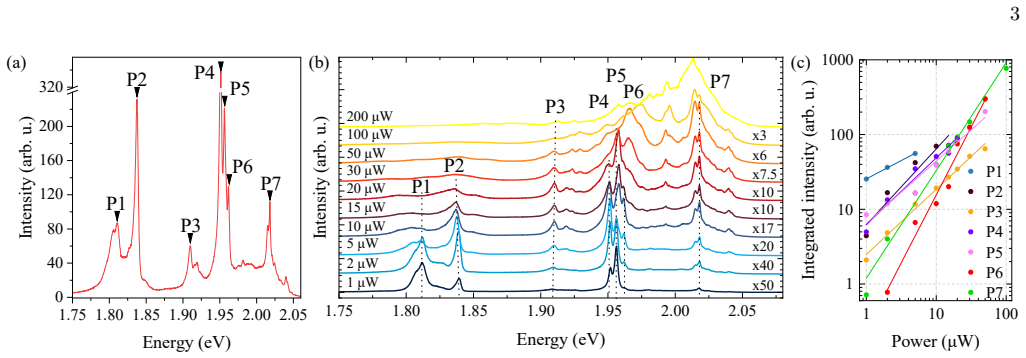
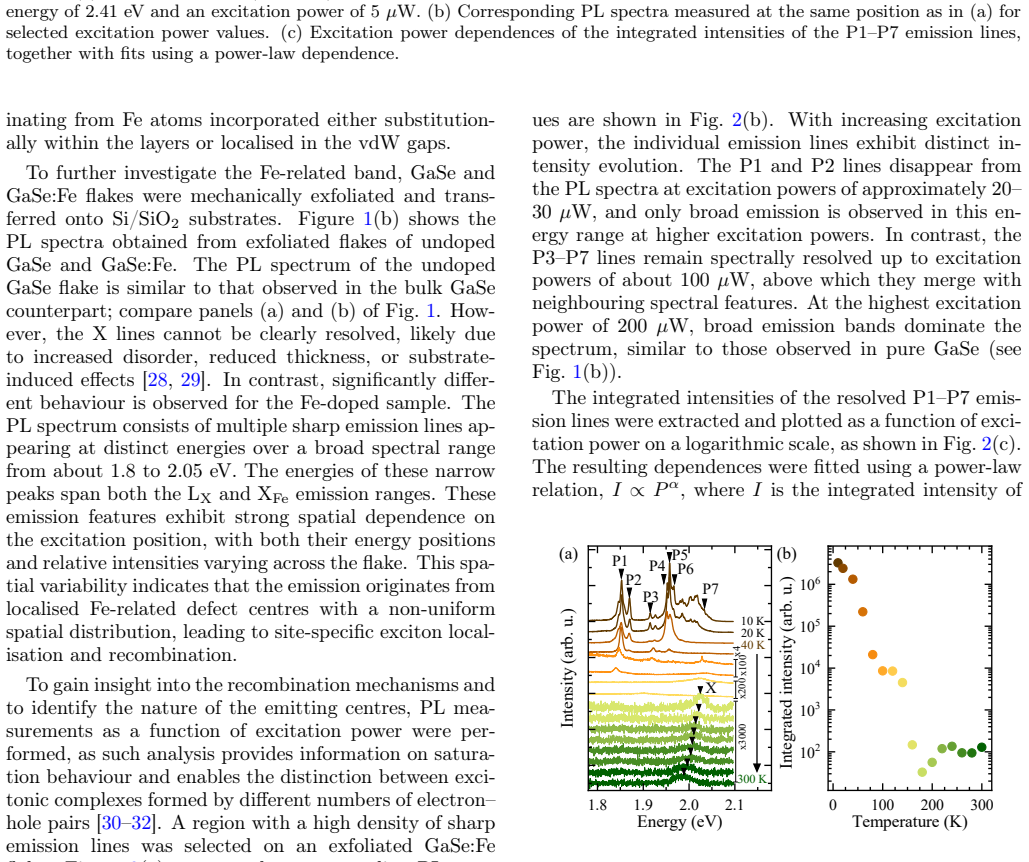
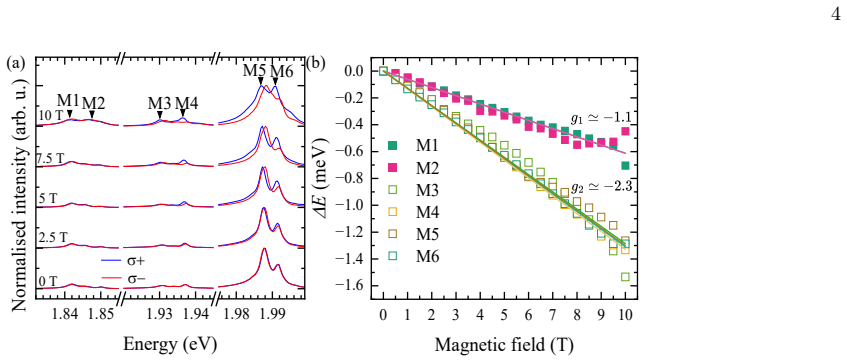
Fe incorporation introduces multiple sharp emission lines in addition to intrinsic excitonic transitions. Power- and temperature-dependent measurements indicate that these emission features are associated with Fe-related dopant centres (Fe-bound excitons). Magneto-PL measurements reveal two distinct families of g-factors, enabling the identification of intrinsic excitonic transitions and Fe-induced defect states. These results demonstrate that Fe doping creates optically and magnetically active centres in GaSe.
What carries the argument
Fe-bound excitons, identified by their sharp lines and distinct response to power, temperature, and magnetic field compared with intrinsic excitons.
If this is right
- Fe doping adds optically active centres that appear as distinct sharp lines in photoluminescence.
- The same centres respond to magnetic fields through a separate set of g-factors.
- The two g-factor families allow separation of intrinsic host transitions from dopant-induced states.
- The identified centres are relevant to magneto-optoelectronic and quantum photonic uses of GaSe.
Where Pith is reading between the lines
- The same dependence-based assignment method could be applied to other dopants or to related layered materials such as GaS.
- If the sharp lines prove narrow enough, they may serve as fixed-frequency emitters whose wavelength is set by the dopant species.
- Magnetic tuning of one g-factor family while leaving the other fixed offers a route to selective control of defect versus host emission.
Load-bearing premise
The new sharp lines and the two g-factor families can be assigned to iron dopant sites using only the dependence of the spectra on power, temperature, and magnetic field.
What would settle it
If chemical analysis of the same crystals detects no iron yet the extra sharp lines and the second g-factor family still appear, the assignment to Fe-bound excitons would be disproven.
Figures

read the original abstract
Doping plays a crucial role in tailoring the electronic, optical, and magnetic properties of semiconductors, enabling control of carrier dynamics and the formation of functional states for optoelectronic applications. We investigate the influence of Fe dopants on the optical properties of GaSe crystals using photoluminescence (PL) spectroscopy under varying excitation power, temperature, and magnetic field. Fe incorporation introduces multiple sharp emission lines in addition to intrinsic excitonic transitions, including free and localised excitons. Power- and temperature-dependent measurements indicate that these emission features are associated with Fe-related dopant centres (Fe-bound excitons). Magneto-PL measurements reveal two distinct families of $g$-factors, enabling the identification of intrinsic excitonic transitions and Fe-induced defect states. These results demonstrate that Fe doping creates optically and magnetically active centres in GaSe, providing insight into defect-related excitonic processes and their potential relevance for magneto-optoelectronic and quantum photonic applications.
Editorial analysis
A structured set of objections, weighed in public.
Referee Report
Summary. The manuscript reports photoluminescence (PL) spectroscopy on Fe-doped GaSe crystals under varying excitation power, temperature, and magnetic field. It claims that Fe incorporation introduces multiple sharp emission lines in addition to intrinsic free and localized excitons; power- and temperature-dependent data are used to assign these to Fe-bound excitons, while magneto-PL reveals two distinct g-factor families that separate intrinsic excitonic transitions from Fe-induced defect states. The central conclusion is that Fe doping creates optically and magnetically active centers with relevance to magneto-optoelectronic and quantum photonic applications.
Significance. If the spectroscopic assignments are robust, the work supplies concrete experimental evidence of dopant-induced bound-exciton states and their magnetic response in a layered III-VI semiconductor. Such data are useful for defect engineering in GaSe and related materials. The multi-parameter (power, temperature, field) approach is a strength, but the absence of independent chemical or structural confirmation limits the definitiveness of the Fe-specific interpretation.
major comments (3)
- [Results (power- and temperature-dependent PL)] The assignment of the additional sharp PL lines to Fe-bound excitons (Results section describing power- and temperature-dependent spectra) rests exclusively on quenching behavior and thermal activation without corroborating chemical analysis (SIMS, ICP-MS) or local-probe confirmation (EPR, TEM) of Fe site occupancy or actual dopant concentration. In GaSe, Se vacancies and unintentional impurities can produce comparable bound-exciton features with similar dependencies; this gap directly undermines the claim that the observed lines are specifically Fe-related.
- [Magneto-PL measurements] Magneto-PL data are presented as revealing two distinct g-factor families that distinguish intrinsic versus Fe-induced states, yet the manuscript provides neither tabulated g-values with uncertainties, details of the fitting procedure, nor raw field-dependent spectra. Without these, it is impossible to evaluate whether the separation is statistically robust or whether overlap with other defect states has been excluded.
- [Experimental methods] The experimental methods section does not report the nominal or measured Fe concentration, growth conditions specific to doping, or any post-growth characterization (XRD, EDX) that would establish that the observed spectral changes scale with Fe incorporation rather than with other growth-induced defects.
minor comments (2)
- [Figures] Figure captions should explicitly state the excitation wavelength, power density range, and magnetic-field orientation relative to the c-axis for each panel.
- [Abstract] The abstract states that Fe doping 'creates optically and magnetically active centres'; this phrasing should be softened to 'introduces additional emission features whose properties are consistent with' until independent confirmation is supplied.
Simulated Author's Rebuttal
We thank the referee for the constructive and detailed comments. We have revised the manuscript to improve the presentation of experimental details, add quantitative data where available, and expand the discussion of alternative interpretations. Point-by-point responses follow.
read point-by-point responses
-
Referee: [Results (power- and temperature-dependent PL)] The assignment of the additional sharp PL lines to Fe-bound excitons (Results section describing power- and temperature-dependent spectra) rests exclusively on quenching behavior and thermal activation without corroborating chemical analysis (SIMS, ICP-MS) or local-probe confirmation (EPR, TEM) of Fe site occupancy or actual dopant concentration. In GaSe, Se vacancies and unintentional impurities can produce comparable bound-exciton features with similar dependencies; this gap directly undermines the claim that the observed lines are specifically Fe-related.
Authors: We agree that direct chemical or structural confirmation would strengthen the Fe-specific assignment. The revised manuscript now includes an explicit comparison of PL spectra from Fe-doped and undoped crystals grown under identical conditions, showing that the sharp lines appear exclusively in the doped samples. We have added a paragraph discussing literature reports on Se-vacancy and impurity emissions in GaSe and explaining why the observed power dependence, thermal quenching energies, and magnetic response differ from those features. Techniques such as SIMS, ICP-MS, EPR or TEM were not performed in this work. revision: partial
-
Referee: [Magneto-PL measurements] Magneto-PL data are presented as revealing two distinct g-factor families that distinguish intrinsic versus Fe-induced states, yet the manuscript provides neither tabulated g-values with uncertainties, details of the fitting procedure, nor raw field-dependent spectra. Without these, it is impossible to evaluate whether the separation is statistically robust or whether overlap with other defect states has been excluded.
Authors: We have added a table in the revised manuscript listing all extracted g-factors together with their uncertainties. The fitting procedure (linear fits to Zeeman shifts of Lorentzian-fitted peak positions) is now described in the Methods section. Representative raw field-dependent spectra at selected B values have been included as a supplementary figure to allow assessment of data quality and the separation into two g-factor families. revision: yes
-
Referee: [Experimental methods] The experimental methods section does not report the nominal or measured Fe concentration, growth conditions specific to doping, or any post-growth characterization (XRD, EDX) that would establish that the observed spectral changes scale with Fe incorporation rather than with other growth-induced defects.
Authors: The Experimental methods section has been updated with the nominal Fe concentration used during growth and the specific Bridgman growth parameters for the doped crystals. Post-growth XRD patterns and EDX spectra confirming crystal quality and overall composition are now provided in the supplementary information. These additions demonstrate that the new spectral features are observed only in the intentionally doped material. revision: yes
- Independent chemical analysis (SIMS, ICP-MS) to quantify actual Fe concentration and confirm incorporation
- Local-probe confirmation of Fe site occupancy (EPR, TEM)
Circularity Check
No circularity: purely experimental spectroscopic observations
full rationale
The paper reports PL spectra under power, temperature, and magnetic-field variation on Fe-doped GaSe crystals. All claims rest on direct experimental trends (quenching, thermal activation, Zeeman splitting) interpreted via standard exciton physics; no equations, derivations, fitted parameters renamed as predictions, or self-citation chains appear. The central assignment of lines to Fe-bound excitons follows conventional spectroscopic reasoning rather than any self-referential construction. This is self-contained experimental work with no load-bearing circular steps.
Axiom & Free-Parameter Ledger
axioms (1)
- domain assumption Standard assignment of excitonic transitions and g-factors from power-, temperature-, and magnetic-field dependence in PL spectroscopy
Reference graph
Works this paper leans on
-
[1]
K. S. Novoselov, A. Mishchenko, A. Carvalho, and A. H. C. Neto, Science353, aac9439 (2016)
2016
-
[2]
Kirubasankar, A
B. Kirubasankar, A. Mondal, S. J. Yun, D. Daw, Y. Xu, L.-A. T. Nguyen, Y. Koo, K. K. Paul, H. Hong, H. Lee, Y. Luo, K. Liu, N. Higashitarumizu, D. Erkensten, C. Y. Heo, Y.-R. Jeon, T. Lee, D.-H. Nam, X. Liu, S. M. Kim, D. L. Duong, Q. Wu, D. Akinwande, M. C. Hersam, A. Javey, E. Malic, B. Liu, T. Zhai, H. Yang, K.-D. Park, K. K. Kim, and Y. H. Lee, ACS Na...
2026
-
[3]
Bianchi, U
D. Bianchi, U. Emiliani, P. Podini, and C. Paorici, phys- ica status solidi (b)60, 511 (1973)
1973
-
[4]
Mercier, E
A. Mercier, E. Mooser, and J. P. Voitchovsky, Phys. Rev. B12, 4307 (1975)
1975
-
[5]
Hirlimann, J
C. Hirlimann, J. F. Morhange, M. A. Kanehisa, A. Chevy, and C. H. Brito Cruz, Applied Physics Let- ters55, 2307 (1989)
1989
-
[6]
Nüsse, P
S. Nüsse, P. Haring Bolivar, H. Kurz, V. Klimov, and F. Levy, Phys. Rev. B56, 4578 (1997)
1997
-
[7]
S. Lei, L. Ge, Z. Liu, S. Najmaei, G. Shi, G. You, J. Lou, R. Vajtai, and P. M. Ajayan, Nano Letters13, 2777 (2013)
2013
-
[8]
Y. Cao, K. Cai, P. Hu, L. Zhao, T. Yan, W. Luo, X. Zhang, X. Wu, K. Wang, and H. Zheng, Scientific Reports5, 8130 (2015)
2015
-
[9]
D. J. Terry, V. Zólyomi, M. Hamer, A. V. Tyurnina, D. G. Hopkinson, A. M. Rakowski, S. J. Magorrian, N. Clark, Y. M. Andreev, O. Kazakova, K. Novoselov, S. J. Haigh, V. I. Fal’ko, and R. Gorbachev, 2D Materi- als5, 041009 (2018)
2018
-
[10]
B. Abay, H. S. Güder, H. Efeoglu, and Y. K. Yogurtçu, Semiconductor Science and Technology15, 535 (2000)
2000
-
[11]
Arora and A
H. Arora and A. Erbe, InfoMat3, 662 (2021). 6
2021
-
[12]
Osiekowicz, D
M. Osiekowicz, D. Staszczuk, K. Olkowska-Pucko, Ł. Kipczak, M. Grzeszczyk, M. Zinkiewicz, K. Noga- jewski, Z. R. Kudrynskyi, Z. D. Kovalyuk, A. Patanè, A. Babiński, and M. R. Molas, Scientific Reports11, 924 (2021)
2021
-
[13]
T. T. T. Huong, L. V. Le, N. T. Loan, M. H. Nam, T. T. Nguyen, T. T. H. Tran, U. T. D. Thuy, T. H. Nguyen, and T. J. Kim, Materials18, 4451 (2025)
2025
-
[14]
C. S. Jung, F. Shojaei, K. Park, J. Y. Oh, H. S. Im, D. M. Jang, J. Park, and H. S. Kang, ACS Nano9, 9585 (2015)
2015
-
[15]
A. Kuhn, A. Chevy, and R. Chevalier, physica status solidi (a)31, 469 (1975)
1975
-
[16]
J. P. Voitchovsky and A. Mercier, Il Nuovo Cimento B (1971-1996)22, 273 (1974)
1971
-
[17]
Matsumura, M
T. Matsumura, M. Sudo, C. Tatsuyama, and S. Ichimura, physica status solidi (a)43, 685 (1977)
1977
-
[18]
Alekperov, M
O. Alekperov, M. Godjaev, M. Zarbaliev, and R. Suleimanov, Solid State Communications77, 65 (1991)
1991
-
[19]
D. T. Do, S. D. Mahanti, and C. W. Lai, Scientific Re- ports5, 17044 (2015)
2015
-
[20]
G. P. Neupane, M. D. Tran, S. J. Yun, H. Kim, C. Seo, J. Lee, G. H. Han, A. K. Sood, and J. Kim, ACS Applied Materials & Interfaces9, 11950 (2017)
2017
-
[21]
B. Zhao, Z. Huo, L. Li, H. Liu, Z. Hu, Y. Wu, and H. Qiu, Nanomaterials13, 10.3390/nano13182520 (2023)
-
[22]
Z. R. Kudrynskyi, I. V. Mintyanskii, P. I. Sav- itskii, and Z. D. Kovalyuk, Applied Sciences12, 10.3390/app12199932 (2022)
-
[23]
Castellanos-Gomez, M
A. Castellanos-Gomez, M. Buscema, R. Molenaar, V. Singh, L. Janssen, H. S. J. van der Zant, and G. A. Steele, 2D Materials1, 011002 (2014)
2014
-
[24]
G. B. Abdullaev, G. L. Belenkii, E. Y. Salaev, and R. A. Suleimanov, Il Nuovo Cimento B (1971-1996)38, 469 (1977)
1971
-
[25]
Sasaki and Y
Y. Sasaki and Y. Nishina, Phys. Rev. B23, 4089 (1981)
1981
-
[26]
Capozzi, S
V. Capozzi, S. Caneppele, M. Montagna, and F. Lévy, physica status solidi (b)129, 247 (1985)
1985
-
[27]
N. C. Fernelius, Properties and bibliography of GaSe, Tech. Rep. (1994)
1994
-
[28]
Moody, C
G. Moody, C. Kavir Dass, K. Hao, C.-H. Chen, L.-J. Li, A. Singh, K. Tran, G. Clark, X. Xu, G. Berghäuser, E. Malic, A. Knorr, and X. Li, Nature Communications 6, 8315 (2015)
2015
-
[29]
F. Shao, S. Y. Woo, N. Wu, R. Schneider, A. J. Mayne, S. M. de Vasconcellos, A. Arora, B. J. Carey, J. A. Preuß, N. Bonnet, M. Och, C. Mattevi, K. Watanabe, T. Taniguchi, Z. Niu, R. Bratschitsch, and L. H. G. Tizei, Phys. Rev. Mater.6, 074005 (2022)
2022
-
[30]
Klingshirn,Semiconductor optics (Springer, 2007)
C. Klingshirn,Semiconductor optics (Springer, 2007)
2007
-
[31]
Molas, K
M. Molas, K. Gołasa, K. Kuldová, J. Borysiuk, A. Babiński, J. Lapointe, and Z. R. Wasilewski, Journal of Applied Physics111, 033510 (2012)
2012
-
[32]
Zinkiewicz, T
M. Zinkiewicz, T. Woźniak, T. Kazimierczuk, P. Ka- puscinski, K. Oreszczuk, M. Grzeszczyk, M. Bartoš, K. Nogajewski, K. Watanabe, T. Taniguchi, C. Faugeras, P. Kossacki, M. Potemski, A. Babiński, and M. R. Molas, Nano Letters21, 2519 (2021), pMID: 33683895
2021
-
[33]
Schmidt, K
T. Schmidt, K. Lischka, and W. Zulehner, Phys. Rev. B 45, 8989 (1992)
1992
-
[34]
M. R. Molas, K. Nogajewski, A. O. Slobodeniuk, J. Binder, M. Bartos, and M. Potemski, Nanoscale9, 13128 (2017)
2017
-
[35]
Zhang, M
Y. Zhang, M. D. Sturge, K. Kash, B. P. van der Gaag, A. S. Gozdz, L. T. Florez, and J. P. Harbison, Phys. Rev. B51, 13303 (1995)
1995
-
[36]
C. Wei, X. Chen, D. Li, H. Su, H. He, and J.-F. Dai, Scientific Reports6, 33890 (2016)
2016
-
[37]
D. Zhang, T. Jia, R. Dong, and D. Chen, Materials10, 10.3390/ma10111282 (2017)
-
[38]
Kipczak, A
Ł. Kipczak, A. O. Slobodeniuk, T. Woźniak, M. Bhatna- gar, N. Zawadzka, K. Olkowska-Pucko, M. Grzeszczyk, K. Watanabe, T. Taniguchi, A. Babiński, and M. R. Mo- las, 2D Materials10, 025014 (2023)
2023
-
[39]
K. O. Pucko, E. Blundo, N. Zawadzka, S. Cianci, D. Va- clavkova, P.Kapuściński, D.Jana, G.Pettinari, M.Felici, K. Nogajewski, M. Bartoš, K. Watanabe, T. Taniguchi, C. Faugeras, M. Potemski, A. Babiński, A. Polimeni, and M. R. Molas, 2D Materials10, 015018 (2022)
2022
-
[40]
Olkowska-Pucko, T
K. Olkowska-Pucko, T. Woźniak, E. Blundo, N. Za- wadzka, L. Kipczak, P. E. Faria Junior, J. Szpakowski, G. Krasucki, S. Cianci, D. Vaclavkova, D. Jana, P. Ka- puściński, A. Pawbake, S. Badola, M. Grzeszczyk, D. Cecchetti, G. Pettinari, I. Antoniazzi, Z. c. v. Sofer, I. Plutnarová, K. Watanabe, T. Taniguchi, C. Faugeras, M. Potemski, A. Babiński, A. Polime...
2026
-
[41]
Kuroda, Y
T. Kuroda, Y. Yamauchi, and F. Minami, Journal of Lu- minescence87-89, 213 (2000). 7 Supporting Information: Dopant-induced modifications of the optical properties of GaSe Jakub Sójka,1 Kacper Walczyk,1 Zakhar R. Kudrynskyi,2 Volodymyr Boledzjuk,1 Adam Babiński,1 Maciej R. Molas,3,4 and Grzegorz Krasucki1 1 University of Warsaw,Facultyof Physics, 02-093 W...
2000
discussion (0)
Sign in with ORCID, Apple, or X to comment. Anyone can read and Pith papers without signing in.