Quantum optical photoelectron interferometry
Pith reviewed 2026-06-27 06:44 UTC · model grok-4.3
The pith
Autocorrelation and cross-correlation functions of quantum light map directly onto photoelectron spectra.
A machine-rendered reading of the paper's core claim, the machinery that carries it, and where it could break.
Core claim
We present a general theoretical framework for multiphoton processes driven by quantum light fields, establishing a direct link between photon statistics and photoelectron observables. Our results show that the autocorrelation and cross-correlation functions, which quantify the underlying photon statistics, are directly mapped onto the resulting photoelectron spectra. In the RABBIT example the amplitude, contrast and phase of the sideband oscillations as a function of pump-probe delay reveal the quantum nature of the light across several configurations, including correlated modes and non-classical statistics.
What carries the argument
Direct mapping of photon autocorrelation and cross-correlation functions onto photoelectron spectra in the perturbative multiphoton regime.
If this is right
- In RABBIT the amplitude, contrast and phase of sideband oscillations depend on whether the light is classical, squeezed or correlated between modes.
- Correlations between infrared and harmonic fields control the coherence of the photoemission process.
- Non-classical statistics in the harmonic field alone produce distinct changes in the photoelectron sideband signals.
- Analytical expressions for the spectra match numerical simulations when the infrared field is in a squeezed coherent state and the harmonics are classical.
Where Pith is reading between the lines
- Electron spectrometers could serve as indirect detectors for reconstructing the photon statistics of quantum light sources.
- The same correlation-to-spectrum mapping may extend to other attosecond interferometric techniques that use two-photon transitions.
- Higher-order correlation functions could be accessed by examining higher-order sidebands or multi-electron coincidence spectra.
Load-bearing premise
Multiphoton ionization stays in the perturbative regime and no decoherence or propagation effects scramble the direct mapping from photon correlations to spectra.
What would settle it
A controlled experiment in which the measured photoelectron spectrum deviates from the spectrum calculated from independently measured photon autocorrelation and cross-correlation functions of the driving field.
Figures
read the original abstract
We present a general theoretical framework for multiphoton processes driven by quantum light fields, establishing a direct link between photon statistics and photoelectron observables. Our results show that the autocorrelation and cross-correlation functions, which quantify the underlying photon statistics, are directly mapped onto the resulting photoelectron spectra. Although our framework is broadly applicable, we demonstrate specifically in the example of reconstruction of attosecond beating by interference of two-photon transitions (RABBIT) the influence of the light statistical properties. In this approach, the amplitude, contrast and phase of the oscillations of the sideband signal as a function of pump-probe delay reveal the quantum nature of light. We analyze these observables across several quantum configurations, including correlated infrared and harmonic modes, as well as the uncorrelated case with non-classical harmonic statistics, thereby establishing a general framework for quantum-light RABBIT spectroscopy. We compare the analytical theory with numerical simulations for the case of classical harmonics and an infrared field in a squeezed coherent state, obtaining excellent agreement. Our results reveal how the interplay between classical and quantum correlations dictates the coherence of the photoemission process, providing a new window into the quantum-optical foundations of attosecond science.
Editorial analysis
A structured set of objections, weighed in public.
Referee Report
Summary. The manuscript develops a general theoretical framework for multiphoton ionization driven by quantum light, establishing a direct mapping from photon autocorrelation and cross-correlation functions to photoelectron spectra. It specializes the framework to RABBIT spectroscopy, showing how the amplitude, contrast, and phase of sideband oscillations encode the quantum statistics of the driving field for correlated and uncorrelated quantum configurations, and reports excellent analytic-numerical agreement for the case of classical harmonics plus a squeezed-coherent infrared field.
Significance. If the central mapping is correct, the work supplies a concrete spectroscopic route to extract photon-correlation information from attosecond photoelectron observables, extending quantum optics into the attosecond domain. The explicit numerical validation for one non-classical state and the parameter-free character of the correlation-to-spectrum link are notable strengths.
major comments (2)
- [abstract, §3] The central claim that autocorrelation and cross-correlation functions are 'directly mapped' onto photoelectron spectra is load-bearing, yet the manuscript provides only the final expressions without an explicit step-by-step derivation from the field operators to the sideband intensity formula; this prevents independent verification of the mapping (abstract and §3).
- [§2] The framework is stated to remain within the perturbative regime, but no quantitative bounds (e.g., on intensity or Keldysh parameter) or discussion of possible non-perturbative corrections appear; this assumption directly underpins the claimed direct mapping (weakest assumption noted in reader's report).
minor comments (2)
- [figure captions] Figure captions should explicitly state the parameters used in the numerical simulations (e.g., squeezing parameter, pulse durations) to allow direct comparison with the analytic curves.
- [§4] Notation for the two-photon transition amplitudes could be clarified by adding a short table that distinguishes the classical, squeezed, and correlated cases.
Simulated Author's Rebuttal
We thank the referee for their thorough review and constructive feedback on our manuscript. We address each of the major comments below and outline the revisions we will make to improve the clarity and completeness of the presentation.
read point-by-point responses
-
Referee: [abstract, §3] The central claim that autocorrelation and cross-correlation functions are 'directly mapped' onto photoelectron spectra is load-bearing, yet the manuscript provides only the final expressions without an explicit step-by-step derivation from the field operators to the sideband intensity formula; this prevents independent verification of the mapping (abstract and §3).
Authors: We agree that providing an explicit step-by-step derivation would enhance the verifiability of our central mapping. In the revised manuscript, we will expand §3 to include a detailed derivation starting from the quantized electromagnetic field operators and the perturbative interaction Hamiltonian. This will proceed through the calculation of the two-photon ionization amplitudes, incorporating the photon correlation functions, and arrive at the sideband intensity formula. Intermediate steps will be shown to allow independent verification. revision: yes
-
Referee: [§2] The framework is stated to remain within the perturbative regime, but no quantitative bounds (e.g., on intensity or Keldysh parameter) or discussion of possible non-perturbative corrections appear; this assumption directly underpins the claimed direct mapping (weakest assumption noted in reader's report).
Authors: We concur that quantitative bounds on the perturbative regime are important for delineating the applicability of the framework. We will add to §2 a discussion of the validity conditions, including reference to the Keldysh parameter being much greater than unity for the multiphoton regime and intensity limits to avoid significant non-perturbative contributions. Additionally, we will briefly address possible corrections from higher-order processes. revision: yes
Circularity Check
Derivation from standard quantum-optical operators is self-contained
full rationale
The framework starts from standard quantum field operators for the light field and derives photoelectron spectra via perturbative multiphoton ionization. The mapping of autocorrelation/cross-correlation functions to sideband oscillations is obtained directly from the interaction Hamiltonian without parameter fitting to the target observables. Numerical simulations for the squeezed coherent state case serve as an external validation rather than a fit. No self-citations, ansatzes smuggled via prior work, or self-definitional reductions appear in the derivation chain. The central claim remains independent of its own outputs.
Axiom & Free-Parameter Ledger
axioms (2)
- standard math Quantum light fields described by bosonic creation and annihilation operators whose correlation functions determine statistics
- domain assumption Perturbative treatment of the light-matter interaction for multiphoton processes
Reference graph
Works this paper leans on
-
[1]
(14) by retaining only one- photon processes
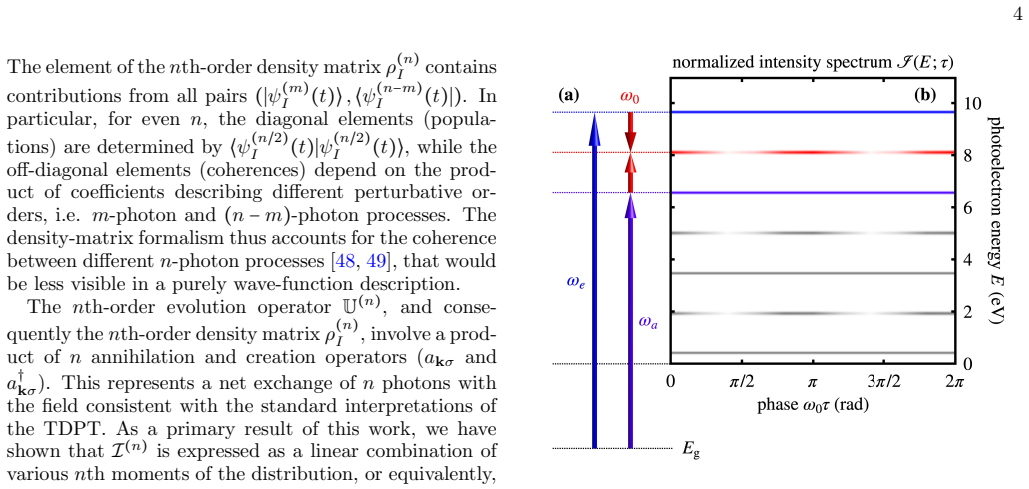
Main bands The intensity spectrum of the main bands is ob- tained fromρ (2)(t)in Eq. (14) by retaining only one- photon processes. Furthermore, onlyU (1) contributes to⟨E∣ρ(2) ∣E⟩, since⟨E∣U(0) ∣g⟩=⟨E∣g⟩is equal to zero. The first-order transition amplitude thus reduces to lim t→∞ t′→−∞ ⟨E∣U(1)(t, t′)∣g⟩=M(1) e (E)f e ae+M (1) a (E)f a aa. (20) Note that ...
-
[2]
Sidebands: RABBIT oscillations The intensity of the sidebands is obtained by consider- ing two-photon processes described by the second-order transition amplitude lim t→∞ t′→−∞ ⟨E∣U(2)(t, t′)∣g⟩=M(2) e (E)f ef0 aea† 0e−iω0τ +M(2) a (E)f af0 aaa0eiω0τ ,(22) withM (2) β (E)thesemiclassicaltwo-photon transition matrix element associated with the pathsaande[1...
-
[3]
The quantum condition for RABBIT interference The most general condition for observing a RAB- BIT interferometric signal, defined by the oscillation of the photoelectron yield as a function of delayτ[see Eqs. (24)], is the non-vanishing of the four-point correla- tion function ⟨a† eaa a2 0⟩≠0.(26) Thisquantum conditionconstitutes the fundamental physical ...
-
[4]
The classical limit as a special case Our quantum formalism recovers the standard semi- classical RABBIT results [11–15, 42] in the appropriate limit. Specifically, when the incoming electromagnetic field is in a product of coherent states ∣ψlight(−∞)⟩=∣α0⟩0⊗∣αe⟩e⊗∣αa⟩a ,(28) where∣αβ⟩β denotes the coherent state of modeβ with well-defined amplitude and c...
-
[5]
Attosecond timing The distinction between the general phase (27) ac- tually extracted by RABBIT and its classical counter- part (31) has direct consequences for the physical inter- pretation of attosecond timing measurements, such as the landmark measurement of the 250 as extreme-ultraviolet pulse duration [2]. The timing of an attosecond pulse is encoded...
-
[6]
inter-mode bunching
Inter-mode bunching The conditiong (2) β0 >1 denotes “inter-mode bunching”, a regime where the infrared and harmonic modes exhibit strong mutual correlations. Classically, this occurs when the intensity of the harmonicβtracks the fluctuations of the infrared driving field, a scenario intrinsic to high- order harmonic generation, where higher infrared inte...
-
[7]
inter-mode anti- bunching
Inter-mode anti-bunching The conditiong (2) β0 <1 denotes “inter-mode anti- bunching”, a purely quantum correlation regime. In this case, the joint probability of detecting a photon in the harmonic mode and another in the infrared mode simul- taneously is reduced compared to the statistically inde- pendent case. In the limiting scenario whereg (2) β0 =0 f...
-
[8]
However, it should be noted that the converse is not necessarily true; the presence of quantum states or en- tanglement does not strictly guaranty a violation of this bound
Characterization of non-classicality Turning to the formal characterization of non- classicality, a primary indicator of quantum correlations between the infrared and harmonic modes is the viola- tion of the classical inequality [33]g (2) β0 ≤[g(2) 00 g(2) ββ ]1/2. However, it should be noted that the converse is not necessarily true; the presence of quan...
-
[9]
Reduced expressions The amplitude (24a), contrast (24b) and phase (24c) thus reduce to A≈f2 0 ⟨a† 0a0⟩ ×{∣M(2) e (E)∣2 f 2 e ⟨a† eae⟩+∣M(2) a (E)∣2 f 2 a ⟨a† aaa⟩}, (38a) C≈ 2∣ξ(2)(E)∣µ {∣ξ(2)(E)∣µ} 2 +1 × ∣⟨a† eaa⟩∣ √ ⟨a† eae⟩⟨a† aaa⟩ ×∣⟨a2 0⟩∣ ⟨a† 0a0⟩ ,(38b) and θ=−arg [ξ(2)(E)]+arg⟨a† eaa⟩+arg⟨a2 0⟩.(38c) We have introduced in Eq. (38b) the ratio betw...
-
[10]
eras- ing
Examples of harmonic fields In the following examples, we specify the initial state of the harmonic field before the light-matter interaction. Whenever this state is pure, the corresponding density matrix isρ ea(−∞)=∣ψea(−∞)⟩⟨ψea(−∞)∣. a. Macroscopic Bell-like states:Several physical scenarios result in the disappearance of first-order coher- ence (g (1) ...
-
[11]
However, they still depend on auto- correlations of infrared light through⟨a † 0a0⟩and⟨a2 0⟩
Reduced expressions Under these assumptions, the field ratio reduces to µ=(F efa)/(F afe), and the general expressions for the amplitude (38a), contrast (38b) and phase (38c) simplify to A≈1 4 f 2 0 ⟨a† 0a0⟩{∣M(2) e (E)∣2 F 2 e +∣M(2) a (E)∣2 F 2 a}, (47a) C≈ 2∣ξ(2)(E)∣µ {∣ξ(2)(E)∣µ} 2 +1 ×∣⟨a2 0⟩∣ ⟨a† 0a0⟩ ,(47b) and θ=−arg [ξ(2)(E)]+arg⟨a2 0⟩.(47c) Note...
-
[12]
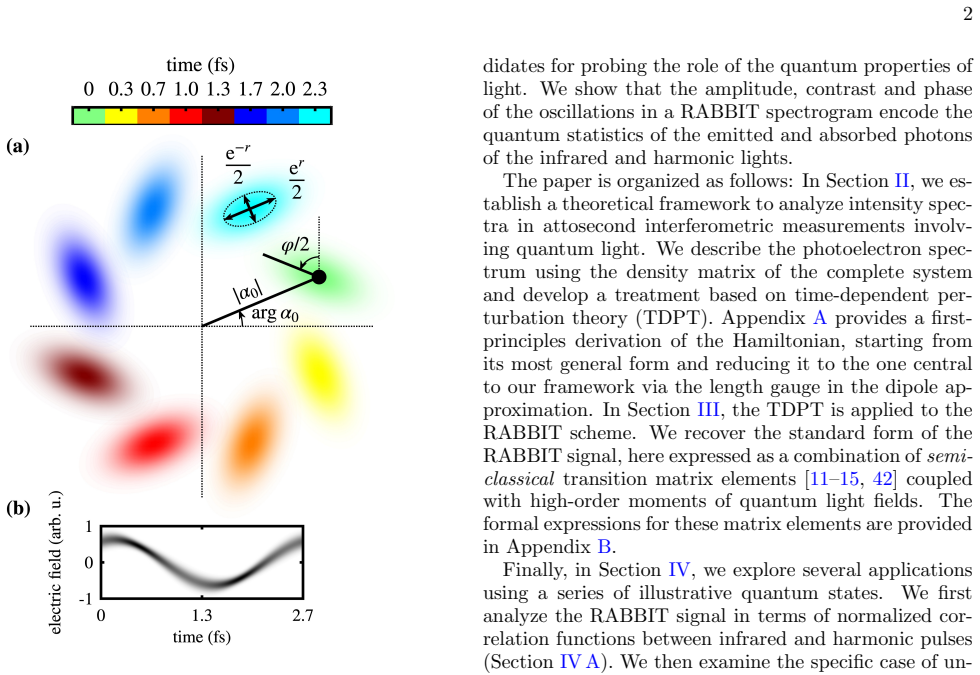
Expressions for squeezed coherent states Interestingly, for a squeezed coherent state character- ized by the squeezing parameterζ=re iφ and the dis- placementα 0, these two-point correlation functions do not factorize as for coherent states. The initial state can be formally written as ∣ψ0(−∞)⟩=D(α0)S(ζ)∣0⟩,(48a) in the convention that displacement D(α)=e...
-
[13]
The first one is based on TDPT, where we evaluate the semiclassical transition matrix elements and incorporate the auto-correlations of infrared light in (49)
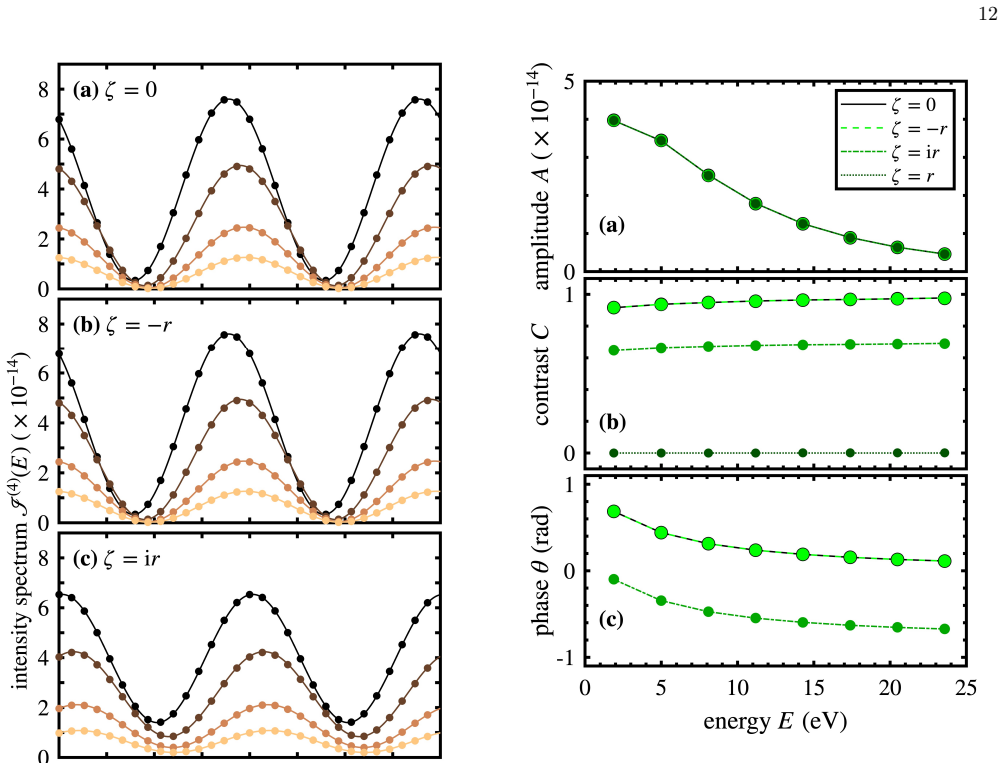
Numerical methods We employ two distinct numerical approaches to val- idate our theoretical model. The first one is based on TDPT, where we evaluate the semiclassical transition matrix elements and incorporate the auto-correlations of infrared light in (49). The second approach consists of ab initio simulations of the TDSE. For our numerical appli- cation...
-
[14]
classical
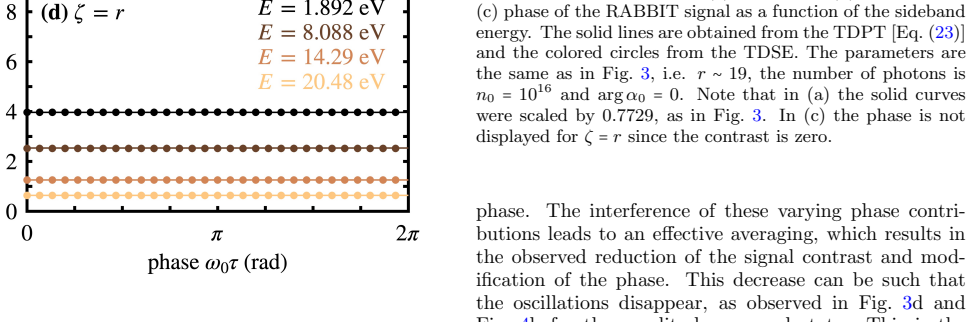
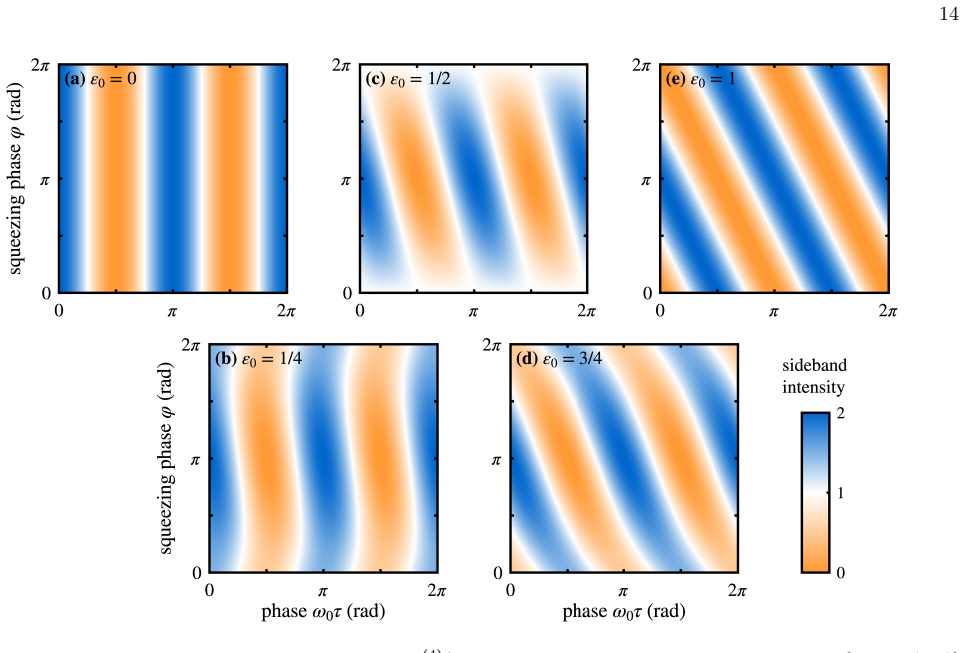
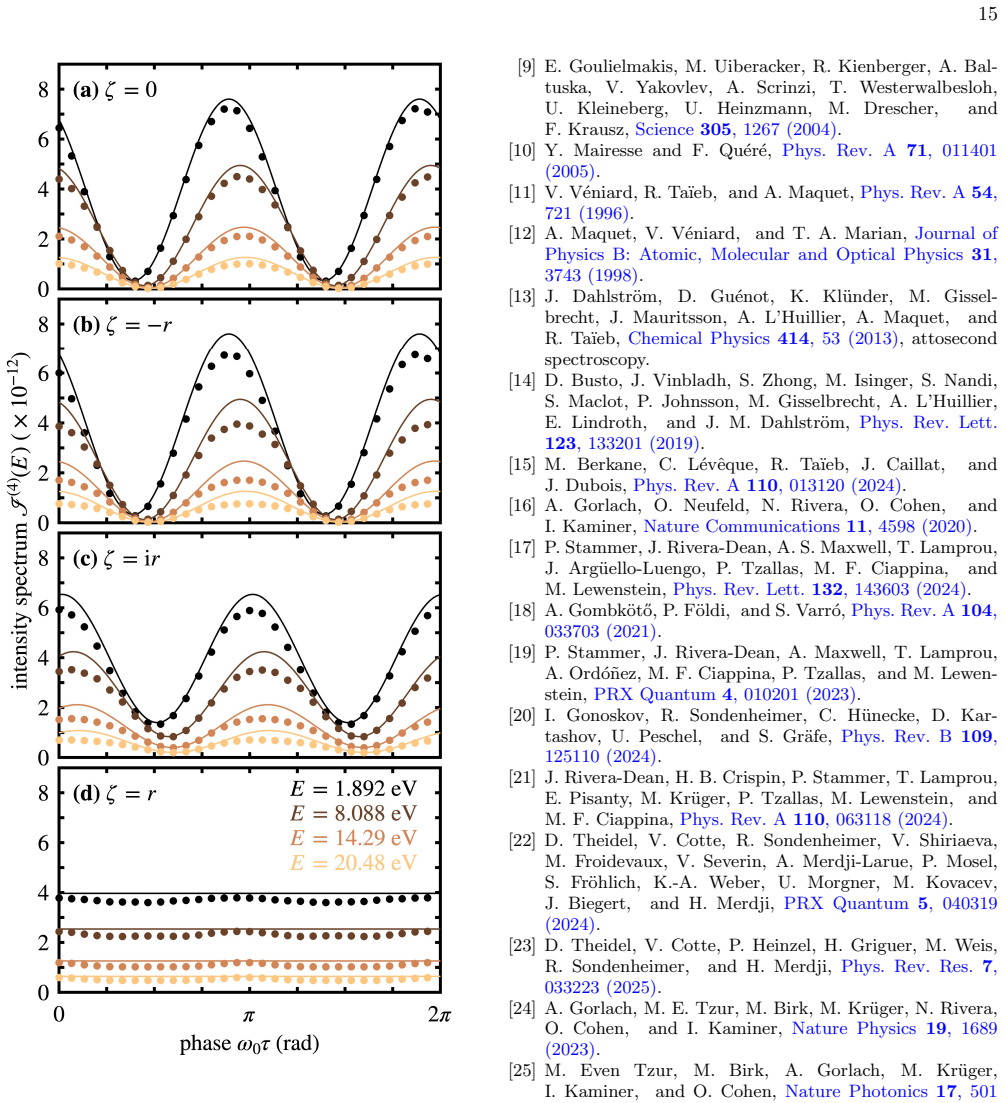
Analysis of RABBIT spectra We begin by examining four representative cases in Figs. 3, which show RABBIT spectra as a function of the phaseω 0τfor four values of sideband energies. Case (a) corresponds to a standard coherent state (ε 0 =0), i.e. the regime of classical light usually studied in attosecond E(in eV) M (2) a (E) M (2) e (E) 1.892 86.8374 exp(...
-
[15]
cross-mode bunching
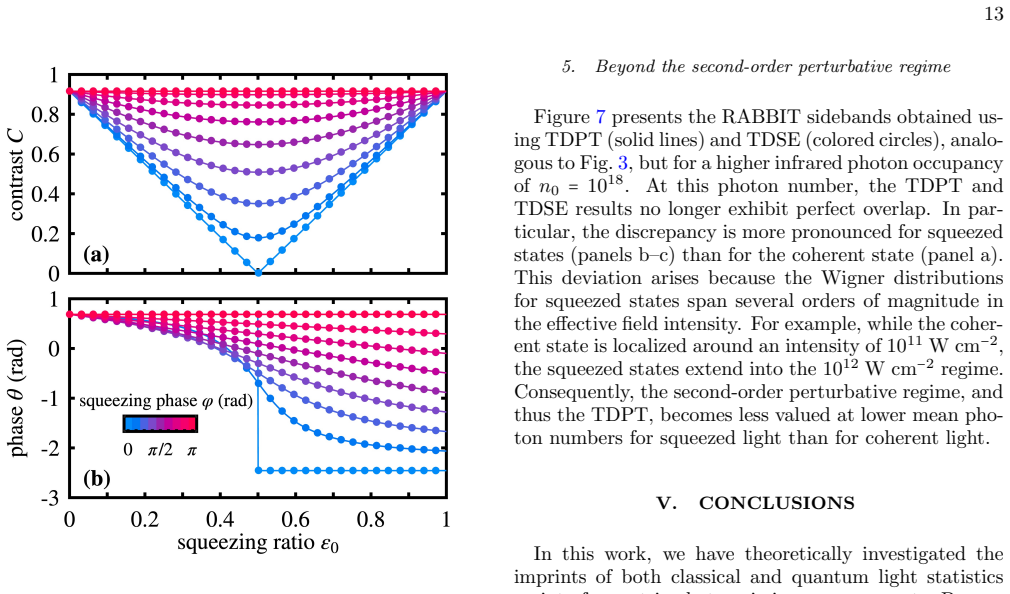
Beyond the second-order perturbative regime Figure 7 presents the RABBIT sidebands obtained us- ing TDPT (solid lines) and TDSE (colored circles), analo- gous to Fig. 3, but for a higher infrared photon occupancy ofn 0 =10 18. At this photon number, the TDPT and TDSE results no longer exhibit perfect overlap. In par- ticular, the discrepancy is more prono...
-
[16]
Ferray, A
M. Ferray, A. L’Huillier, X. F. Li, L. A. Lompre, G. Main- fray, and C. Manus, Journal of Physics B: Atomic, Molecular and Optical Physics21, L31 (1988)
1988
-
[17]
P. M. Paul, E. S. Toma, P. Breger, G. Mullot, F. Aug´ e, P. Balcou, H. G. Muller, and P. Agostini, Science292, 1689 (2001)
2001
-
[18]
Hentschel, R
M. Hentschel, R. Kienberger, C. Spielmann, G. A. Rei- der, N. Milosevic, T. Brabec, P. Corkum, U. Heinzmann, M. Drescher, and F. Krausz, Nature414, 509 (2001)
2001
-
[19]
Sansone, E
G. Sansone, E. Benedetti, F. Calegari, C. Vozzi, L. Avaldi, R. Flammini, L. Poletto, P. Villoresi, C. Al- tucci, R. Velotta, S. Stagira, S. D. Silvestri, and M. Nisoli, Science314, 443 (2006)
2006
-
[20]
Calegari, D
F. Calegari, D. Ayuso, A. Trabattoni, L. Belshaw, S. D. Camillis, S. Anumula, F. Frassetto, L. Poletto, A. Pala- cios, P. Decleva, J. B. Greenwood, F. Mart´ ın, and M. Nisoli, Science346, 336 (2014)
2014
-
[21]
Nisoli, P
M. Nisoli, P. Decleva, F. Calegari, A. Palacios, and 15 FIG. 7. Same as Fig. 3 but for an infrared photon number of n0 =10 18. F. Mart´ ın, Chemical Reviews117, 10760 (2017)
2017
-
[22]
I. C. D. Merritt, D. Jacquemin, and M. Vacher, The Journal of Physical Chemistry Letters12, 8404 (2021)
2021
-
[23]
O. G. Alexander, J. P. Marangos, M. Ruberti, and M. Vacher, in Advances in Atomic, Molecular, and Optical Physics, Advances In Atomic, Molecular, and Optical Physics, Vol. 72, edited by L. F. DiMauro, H. Perrin, and S. F. Yelin (Academic Press, 2023) pp. 183–251
2023
-
[24]
Goulielmakis, M
E. Goulielmakis, M. Uiberacker, R. Kienberger, A. Bal- tuska, V. Yakovlev, A. Scrinzi, T. Westerwalbesloh, U. Kleineberg, U. Heinzmann, M. Drescher, and F. Krausz, Science305, 1267 (2004)
2004
-
[25]
Mairesse and F
Y. Mairesse and F. Qu´ er´ e, Phys. Rev. A71, 011401 (2005)
2005
-
[26]
V´ eniard, R
V. V´ eniard, R. Ta¨ ıeb, and A. Maquet, Phys. Rev. A54, 721 (1996)
1996
-
[27]
Maquet, V
A. Maquet, V. V´ eniard, and T. A. Marian, Journal of Physics B: Atomic, Molecular and Optical Physics31, 3743 (1998)
1998
-
[28]
Dahlstr¨ om, D
J. Dahlstr¨ om, D. Gu´ enot, K. Kl¨ under, M. Gissel- brecht, J. Mauritsson, A. L’Huillier, A. Maquet, and R. Ta¨ ıeb, Chemical Physics414, 53 (2013), attosecond spectroscopy
2013
-
[29]
Busto, J
D. Busto, J. Vinbladh, S. Zhong, M. Isinger, S. Nandi, S. Maclot, P. Johnsson, M. Gisselbrecht, A. L’Huillier, E. Lindroth, and J. M. Dahlstr¨ om, Phys. Rev. Lett. 123, 133201 (2019)
2019
-
[30]
Berkane, C
M. Berkane, C. L´ evˆ eque, R. Ta¨ ıeb, J. Caillat, and J. Dubois, Phys. Rev. A110, 013120 (2024)
2024
-
[31]
Gorlach, O
A. Gorlach, O. Neufeld, N. Rivera, O. Cohen, and I. Kaminer, Nature Communications11, 4598 (2020)
2020
-
[32]
Stammer, J
P. Stammer, J. Rivera-Dean, A. S. Maxwell, T. Lamprou, J. Arg¨ uello-Luengo, P. Tzallas, M. F. Ciappina, and M. Lewenstein, Phys. Rev. Lett.132, 143603 (2024)
2024
-
[33]
Gombk¨ ot˝ o, P
A. Gombk¨ ot˝ o, P. F¨ oldi, and S. Varr´ o, Phys. Rev. A104, 033703 (2021)
2021
-
[34]
Stammer, J
P. Stammer, J. Rivera-Dean, A. Maxwell, T. Lamprou, A. Ord´ o˜ nez, M. F. Ciappina, P. Tzallas, and M. Lewen- stein, PRX Quantum4, 010201 (2023)
2023
-
[35]
Gonoskov, R
I. Gonoskov, R. Sondenheimer, C. H¨ unecke, D. Kar- tashov, U. Peschel, and S. Gr¨ afe, Phys. Rev. B109, 125110 (2024)
2024
-
[36]
Rivera-Dean, H
J. Rivera-Dean, H. B. Crispin, P. Stammer, T. Lamprou, E. Pisanty, M. Kr¨ uger, P. Tzallas, M. Lewenstein, and M. F. Ciappina, Phys. Rev. A110, 063118 (2024)
2024
-
[37]
Theidel, V
D. Theidel, V. Cotte, R. Sondenheimer, V. Shiriaeva, M. Froidevaux, V. Severin, A. Merdji-Larue, P. Mosel, S. Fr¨ ohlich, K.-A. Weber, U. Morgner, M. Kovacev, J. Biegert, and H. Merdji, PRX Quantum5, 040319 (2024)
2024
-
[38]
Theidel, V
D. Theidel, V. Cotte, P. Heinzel, H. Griguer, M. Weis, R. Sondenheimer, and H. Merdji, Phys. Rev. Res.7, 033223 (2025)
2025
-
[39]
Gorlach, M
A. Gorlach, M. E. Tzur, M. Birk, M. Kr¨ uger, N. Rivera, O. Cohen, and I. Kaminer, Nature Physics19, 1689 (2023)
2023
-
[40]
Even Tzur, M
M. Even Tzur, M. Birk, A. Gorlach, M. Kr¨ uger, I. Kaminer, and O. Cohen, Nature Photonics17, 501 (2023)
2023
-
[41]
Rasputnyi, Z
A. Rasputnyi, Z. Chen, M. Birk, O. Cohen, I. Kaminer, M. Kr¨ uger, D. Seletskiy, M. Chekhova, and F. Tani, Nature Physics20, 1960 (2024)
1960
-
[42]
M. E. Tzur, M. Birk, A. Gorlach, I. Kaminer, M. Kr¨ uger, and O. Cohen, Phys. Rev. Res.6, 033079 (2024)
2024
-
[43]
F. Wang, C. Yang, X. Cui, L. He, T. Ou, R.-B. Jin, Q. Liao, P. Lan, and P. Lu, Phys. Rev. A112, 043119 (2025)
2025
-
[44]
J. Li, Z. Lyu, H. Liu, and Y. Liu, Phys. Rev. A112, 033507 (2025)
2025
-
[45]
Rivera-Dean, P
J. Rivera-Dean, P. Stammer, M. F. Ciappina, and M. Lewenstein, Phys. Rev. Lett.135, 013801 (2025)
2025
-
[46]
Lemieux, S
S. Lemieux, S. A. Jalil, D. N. Purschke, N. Boroumand, 16 T. J. Hammond, D. Villeneuve, A. Naumov, T. Brabec, and G. Vampa, Nature Photonics19, 767 (2025)
2025
-
[47]
Rivera-Dean, P
J. Rivera-Dean, P. Stammer, C. F. d. M. Faria, and M. Lewenstein, Phys. Rev. A112, 063101 (2025)
2025
-
[48]
R. J. Glauber, Phys. Rev.131, 2766 (1963)
1963
-
[49]
Schnabel, Physics Reports684, 1 (2017), squeezed states of light and their applications in laser interferom- eters
R. Schnabel, Physics Reports684, 1 (2017), squeezed states of light and their applications in laser interferom- eters
2017
-
[50]
T. S. Iskhakov, A. M. P´ erez, K. Y. Spasibko, M. V. Chekhova, and G. Leuchs, Opt. Lett.37, 1919 (2012)
1919
-
[51]
Manceau, K
M. Manceau, K. Y. Spasibko, G. Leuchs, R. Filip, and M. V. Chekhova, Phys. Rev. Lett.123, 123606 (2019)
2019
-
[52]
Heimerl, A
J. Heimerl, A. Mikhaylov, S. Meier, H. H¨ ollerer, I. Kaminer, M. Chekhova, and P. Hommelhoff, Nature Physics20, 945 (2024)
2024
-
[53]
Heimerl, A
J. Heimerl, A. Rasputnyi, J. P¨ olloth, S. Meier, M. Chekhova, and P. Hommelhoff, Nature Physics21, 1899 (2025)
2025
-
[54]
Aasi andet al., Nature Photonics7, 613 (2013)
J. Aasi andet al., Nature Photonics7, 613 (2013)
2013
-
[55]
Mandel and E
L. Mandel and E. Wolf, Optical Coherence and Quantum Optics (Cambridge University Press, Cambridge, 1995)
1995
-
[56]
Dahan, A
R. Dahan, A. Gorlach, U. Haeusler, A. Karnieli, O. Eyal, P. Yousefi, M. Segev, A. Arie, G. Eisenstein, P. Hommel- hoff, and I. Kaminer, Science373, eabj7128 (2021)
2021
-
[57]
Kl¨ under, J
K. Kl¨ under, J. M. Dahlstr¨ om, M. Gisselbrecht, T. Fordell, M. Swoboda, D. Gu´ enot, P. Johnsson, J. Caillat, J. Mauritsson, A. Maquet, R. Ta¨ ıeb, and A. L’Huillier, Phys. Rev. Lett.106, 143002 (2011)
2011
-
[58]
Bourassin-Bouchet, L
C. Bourassin-Bouchet, L. Barreau, V. Gruson, J.-F. Her- gott, F. Qu´ er´ e, P. Sali` eres, and T. Ruchon, Phys. Rev. X10, 031048 (2020)
2020
-
[59]
Berkane, R
M. Berkane, R. Ta¨ ıeb, G. Granveau, P. Sali` eres, C. Bourassin-Bouchet, C. L´ evˆ eque, and J. Caillat, Phys. Rev. A111, L041101 (2025)
2025
-
[60]
C. S. Lange, T. Hansen, and L. B. Madsen, Phys. Rev. A109, 033110 (2024)
2024
-
[61]
Messiah, Quantum Mechanics, Vol
A. Messiah, Quantum Mechanics, Vol. 2 (North-Holland Publishing Company, Amsterdam, 1962) translated from the French by J. Anderson
1962
-
[62]
M. O. Scully and M. S. Zubairy, Quantum Optics (Cam- bridge University Press, 1997)
1997
-
[63]
Laurell, D
H. Laurell, D. Finkelstein-Shapiro, C. Dittel, C. Guo, R. Demjaha, M. Ammitzb¨ oll, R. Weissenbilder, L. Ne- oriˇ ci´ c, S. Luo, M. Gisselbrecht, C. L. Arnold, A. Buch- leitner, T. Pullerits, A. L’Huillier, and D. Busto, Phys. Rev. Res.4, 033220 (2022)
2022
-
[64]
Laurell, S
H. Laurell, S. Luo, R. Weissenbilder, M. Ammitzb¨ oll, S. Ahmed, H. S¨ oderberg, C. L. M. Petersson, V. Poulain, C. Guo, C. Dittel, D. Finkelstein-Shapiro, R. J. Squibb, R. Feifel, M. Gisselbrecht, C. L. Arnold, A. Buchleit- ner, E. Lindroth, A. Frisk Kockum, A. L’Huillier, and D. Busto, Nature Photonics19, 352 (2025)
2025
-
[65]
Caillat, A
J. Caillat, A. Maquet, S. Haessler, B. Fabre, T. Ruchon, P. Sali` eres, Y. Mairesse, and R. Ta¨ ıeb, Phys. Rev. Lett. 106, 093002 (2011)
2011
-
[66]
Beaulieu, A
S. Beaulieu, A. Comby, A. Clergerie, J. Caillat, D. Descamps, N. Dudovich, B. Fabre, R. G´ eneaux, F. L´ egar´ e, S. Petit, B. Pons, G. Porat, T. Ruchon, R. Ta¨ ıeb, V. Blanchet, and Y. Mairesse, Science358, 1288 (2017)
2017
-
[67]
Autuori, D
A. Autuori, D. Platzer, M. Lejman, G. Gallician, L. Ma¨ eder, A. Covolo, L. Bosse, M. Dalui, D. Bresteau, J.-F. Hergott, O. Tcherbakoff, H. J. B. Marroux, V. Lo- riot, F. L´ epine, L. Poisson, R. Ta¨ ıeb, J. Caillat, and P. Sali` eres, Science Advances8, eabl7594 (2022)
2022
-
[68]
H. G. Muller, Applied Physics B74, s17 (2002)
2002
-
[69]
W. H. Zurek, Rev. Mod. Phys.75, 715 (2003)
2003
-
[70]
Breuer and F
H.-P. Breuer and F. Petruccione, The Theory of Open Quantum Systems (Oxford Uni- versity Press, 2007)
2007
-
[71]
Fabre and N
C. Fabre and N. Treps, Rev. Mod. Phys.92, 035005 (2020)
2020
-
[72]
Isinger, R
M. Isinger, R. J. Squibb, D. Busto, S. Zhong, A. Harth, D. Kroon, S. Nandi, C. L. Arnold, M. Miranda, J. M. Dahlstr¨ om, E. Lindroth, R. Feifel, M. Gisselbrecht, and A. L’Huillier, Science358, 893 (2017)
2017
-
[73]
C. G. Wahlstr¨ om, J. Larsson, A. Persson, T. Starczewski, Svanberg, P. Sali` eres, P. Balcou, and A. L’Huillier, Phys. Rev. A48(1993)
1993
-
[74]
Weissenbilder, S
R. Weissenbilder, S. Carlstr¨ om, L. Rego, C. Guo, C. M. Heyl, P. Smorenburg, E. Constant, C. L. Arnold, and A. L’Huillier, Nature Reviews Physics4, 713 (2022)
2022
-
[75]
Ruo-Berchera, I
I. Ruo-Berchera, I. P. Degiovanni, S. Olivares, N. Saman- taray, P. Traina, and M. Genovese, Phys. Rev. A92, 053821 (2015)
2015
-
[76]
Heinrich, T
S. Heinrich, T. Saule, M. H¨ ogner, Y. Cui, V. S. Yakovlev, I. Pupeza, and U. Kleineberg, Nature Communications 12, 3404 (2021)
2021
-
[77]
Berrah, J
N. Berrah, J. Cryan, R. Robles, T. Driver, A. Marinelli, and P. Bucksbaum, Adv. Opt. Photon.17, 623 (2025)
2025
-
[78]
K. Y. Spasibko, D. A. Kopylov, V. L. Krutyanskiy, T. V. Murzina, G. Leuchs, and M. V. Chekhova, Phys. Rev. Lett.119, 223603 (2017)
2017
-
[79]
Javanainen, J
J. Javanainen, J. H. Eberly, and Q. Su, Phys. Rev. A 38, 3430 (1988)
1988
-
[80]
R. I. McLachlan, Comm. Comp. Phys31, 987 (2022)
2022
discussion (0)
Sign in with ORCID, Apple, or X to comment. Anyone can read and Pith papers without signing in.