Simulations of 3-Dimensional Recoil Response to Coherent Elastic Neutrino-Nucleus Scattering Events in Directional Direct Dark Matter Detectors
Pith reviewed 2026-06-27 05:49 UTC · model grok-4.3
The pith
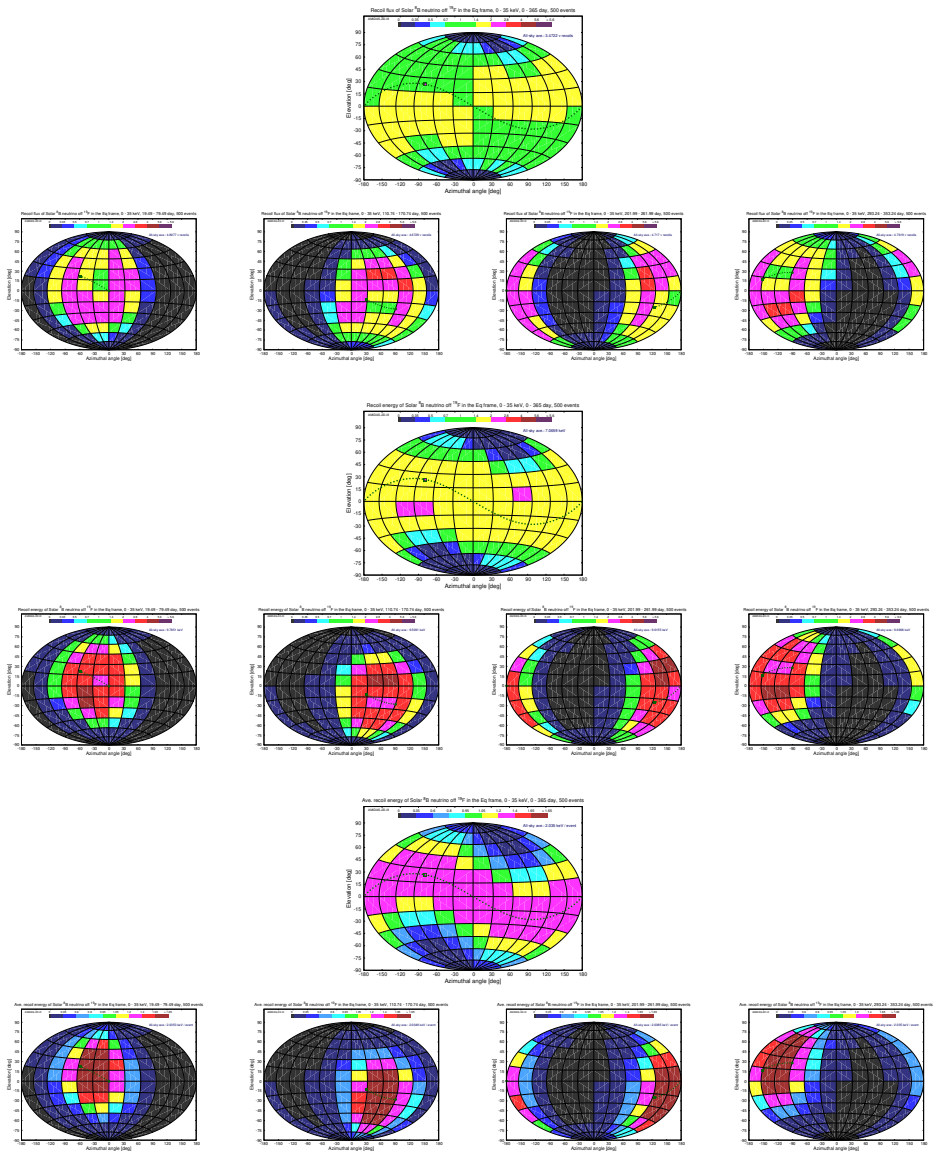
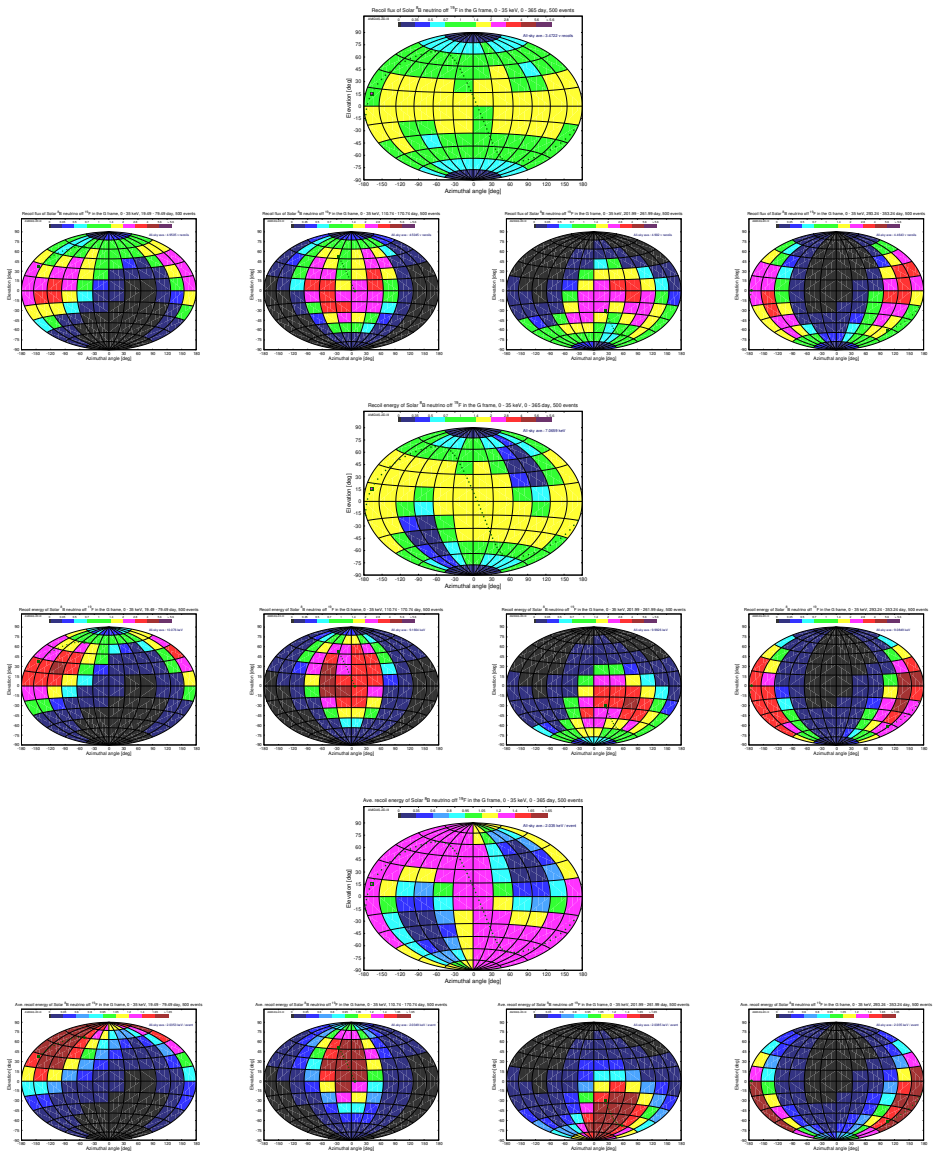
Simulations reveal that solar neutrino scattering produces annually varying ring-like recoil patterns distinct from fixed dark matter signals.
A machine-rendered reading of the paper's core claim, the machinery that carries it, and where it could break.
Core claim
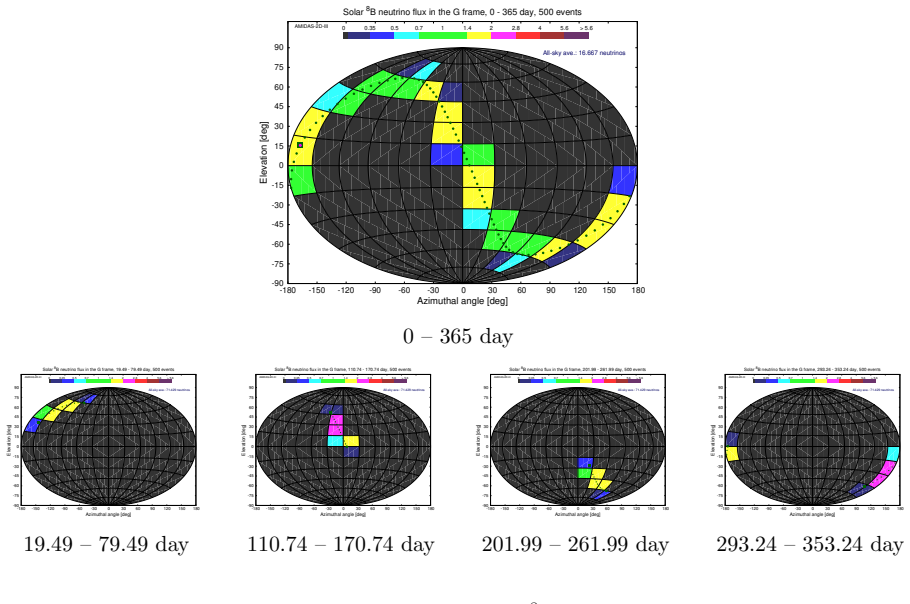
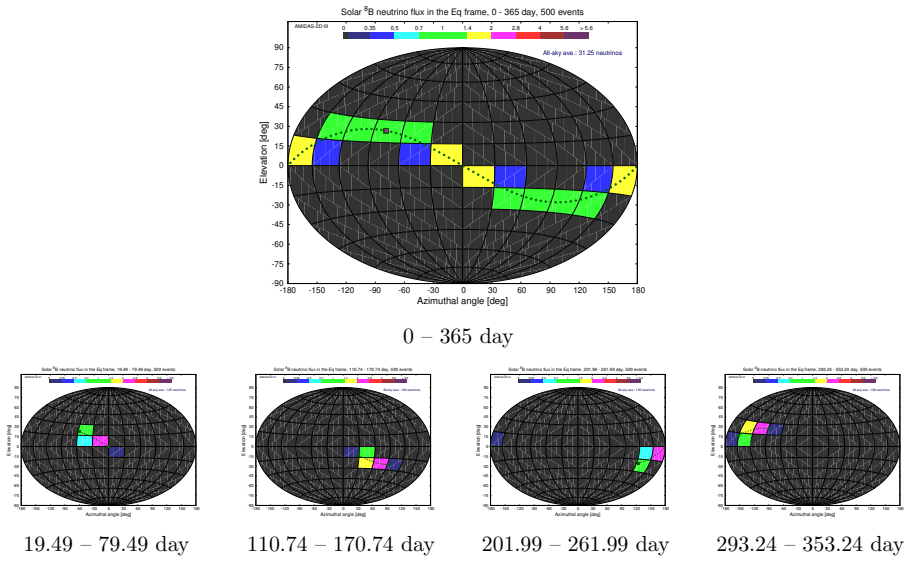
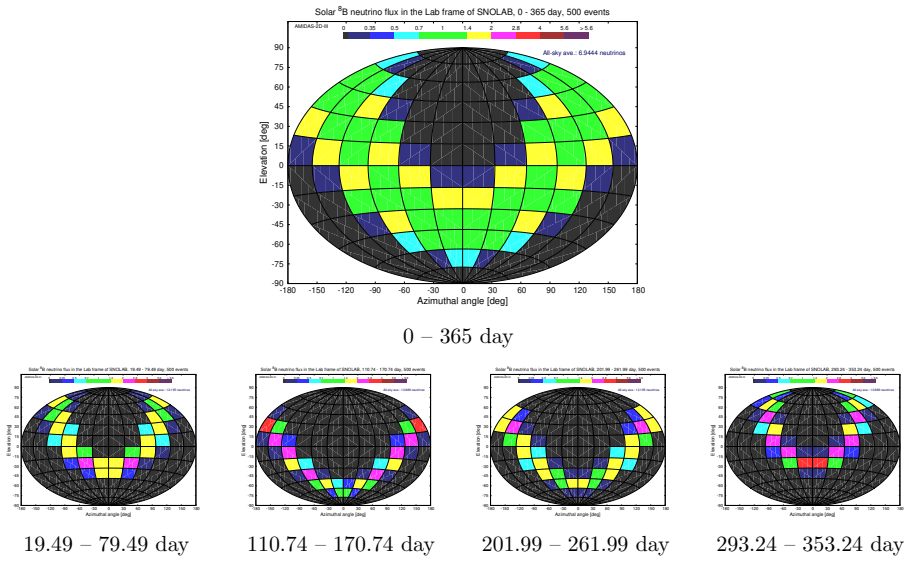
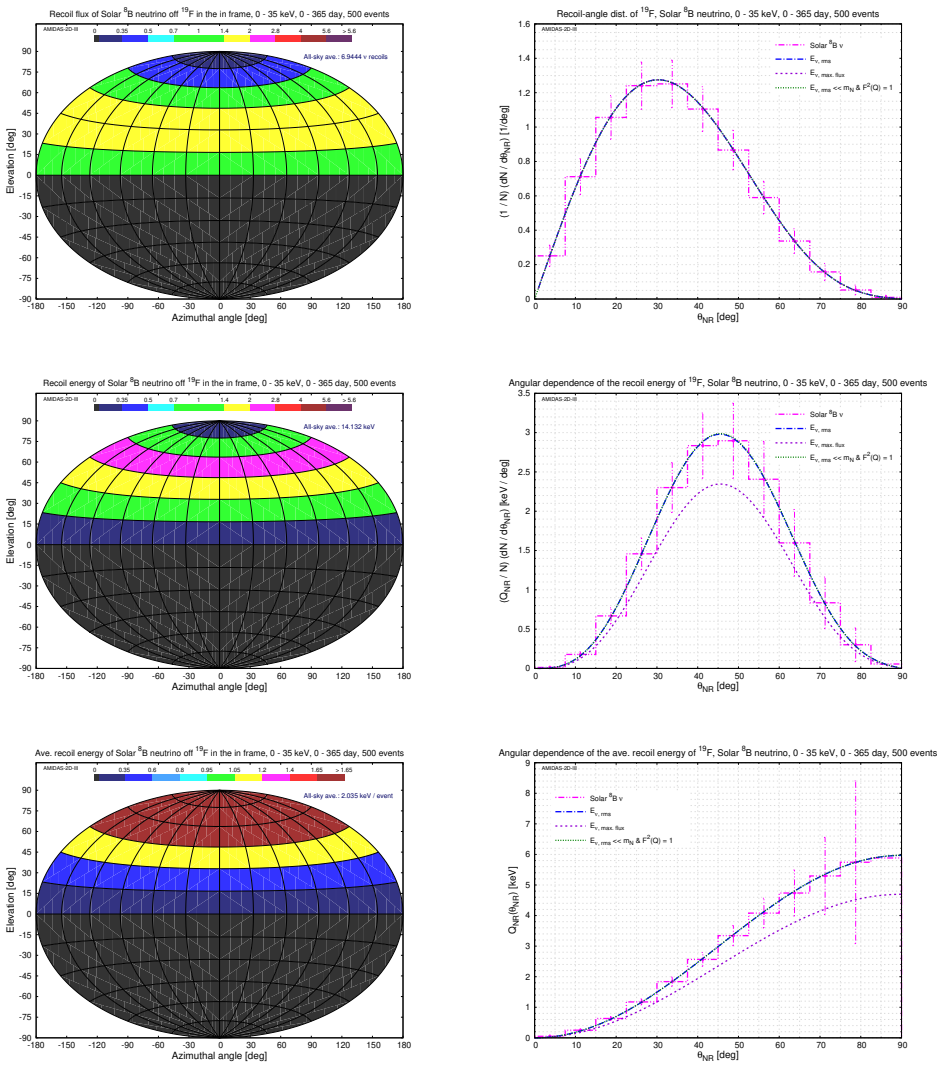
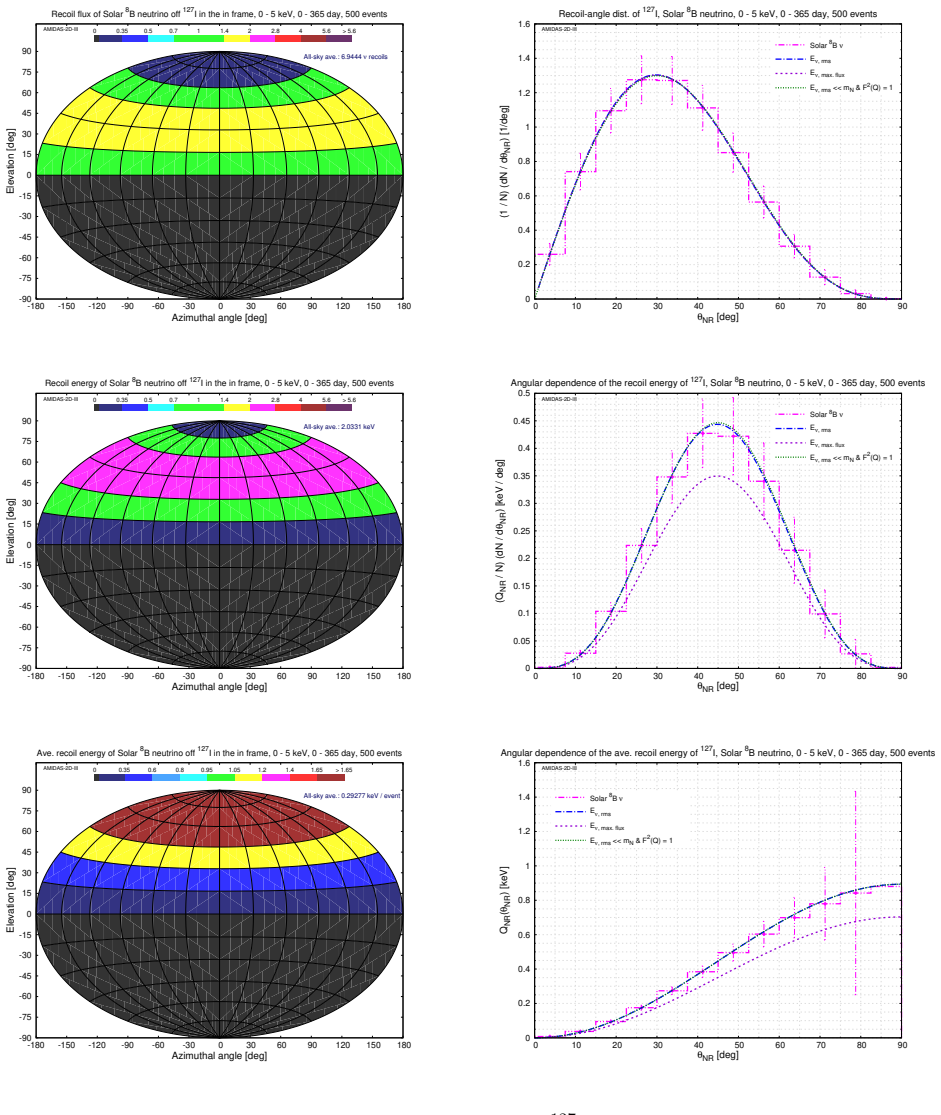
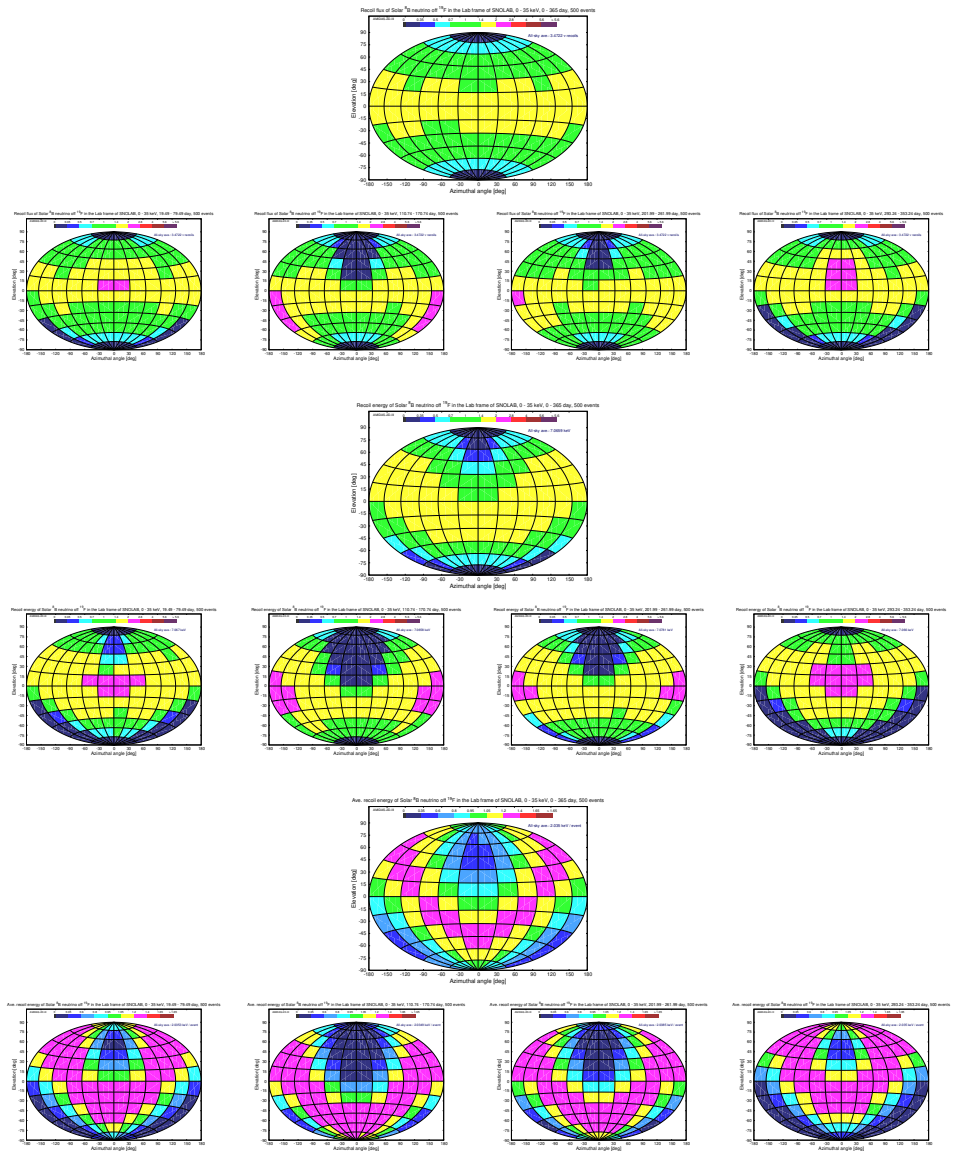
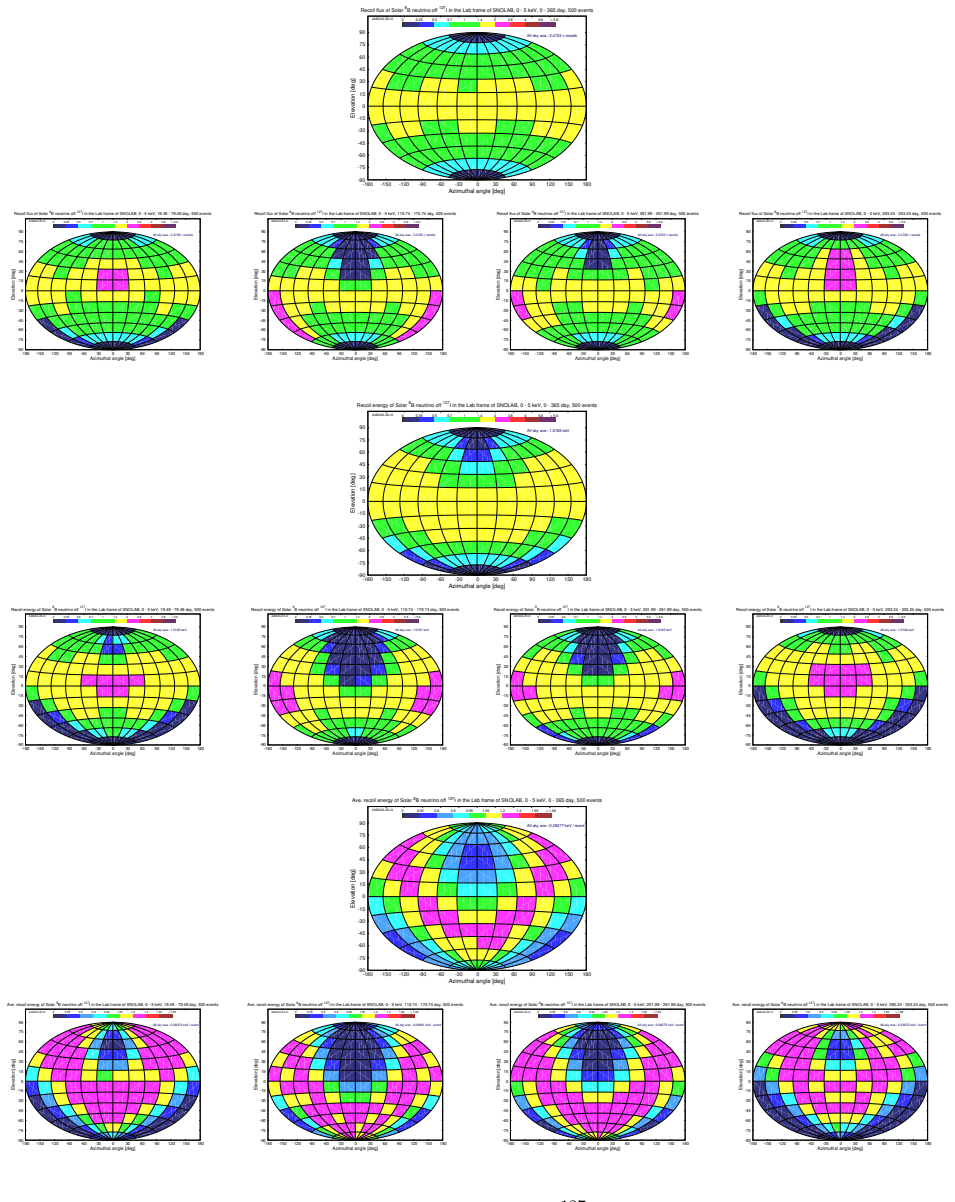
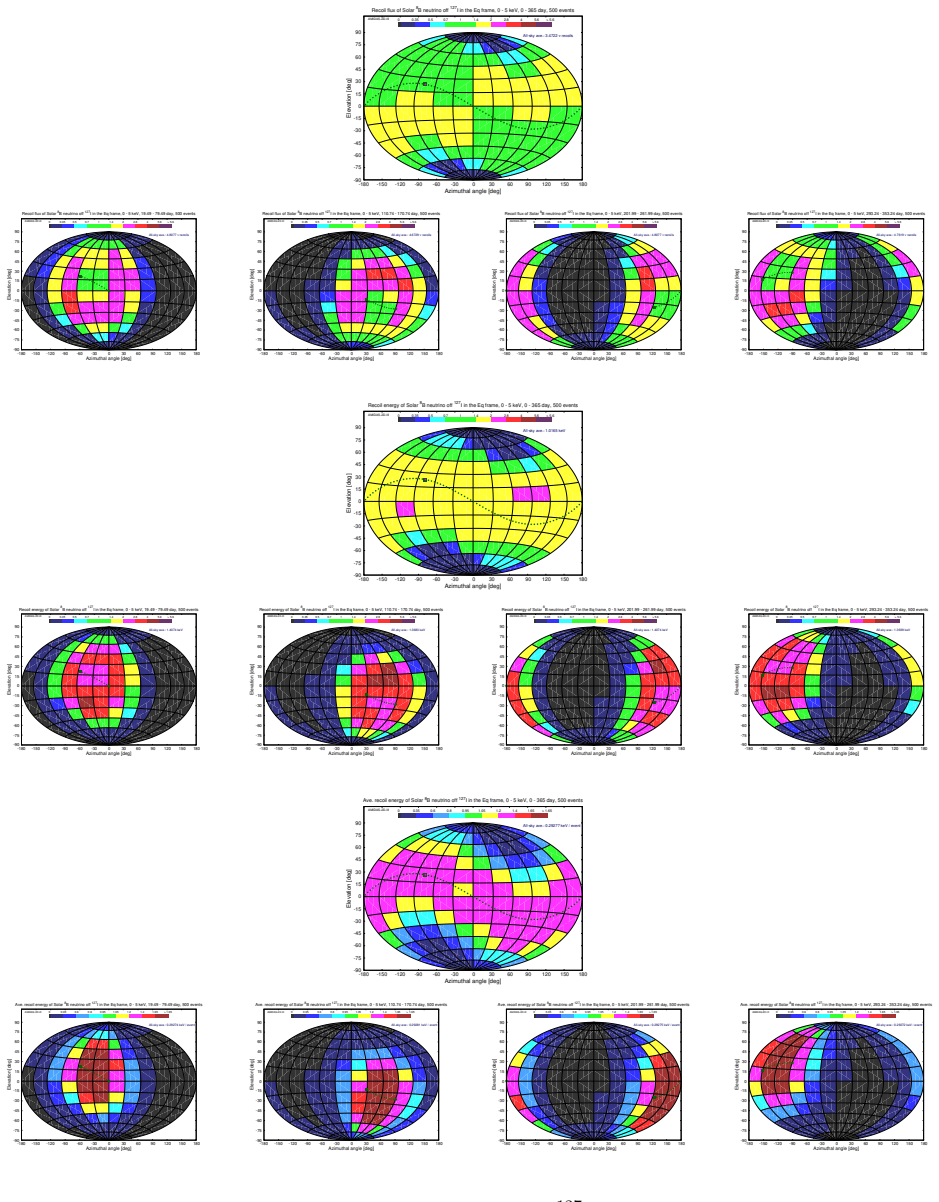
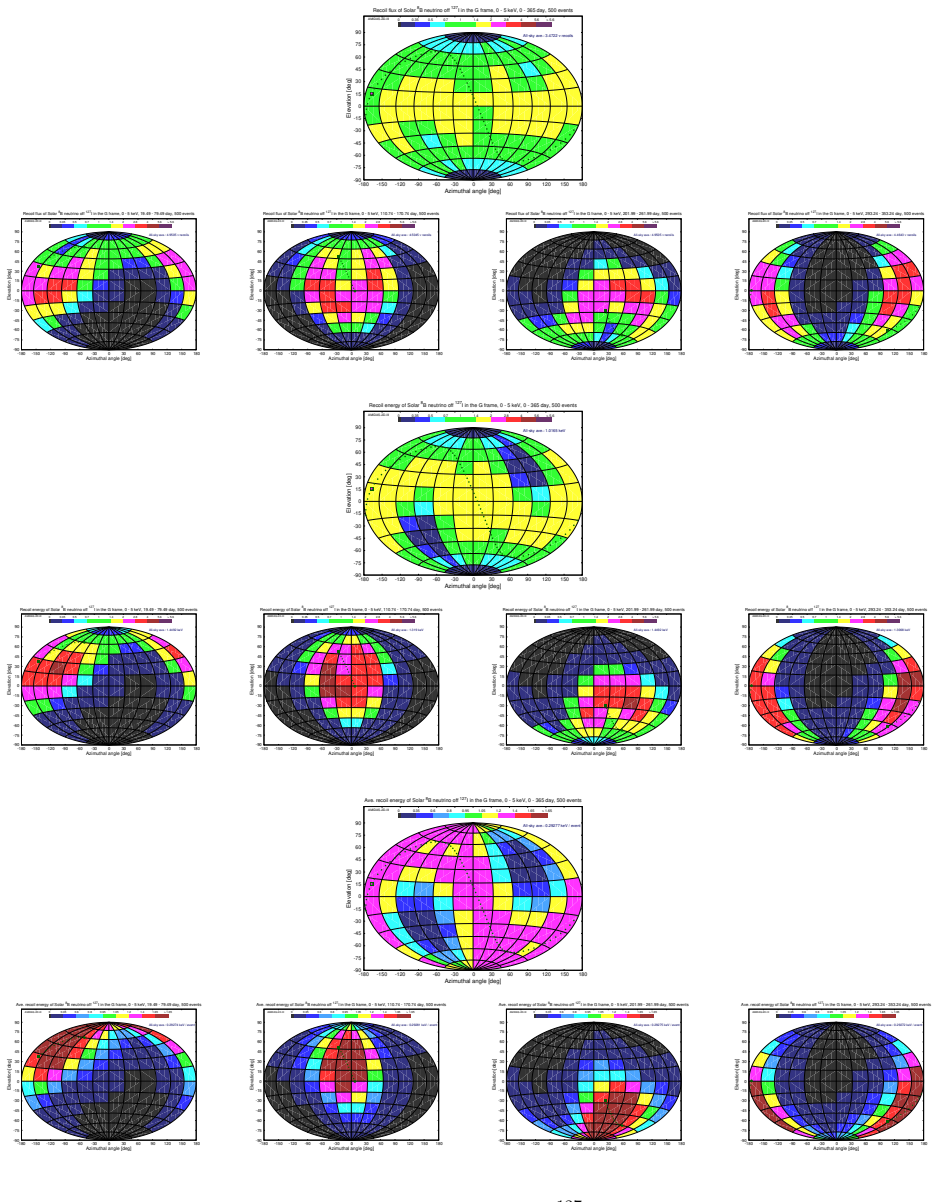
In contrast to the approximately fixed patterns of the WIMP-induced signals, the characteristic ring-like angular distributions of the nuclear recoil flux/energy of CEvNS events show clearly annual variations along the trajectories of the moving direction of incident Solar neutrinos in different celestial coordinate systems without experimentally distinguishable target dependence.
What carries the argument
Numerical simulations of three-dimensional nuclear recoil directions and energies from solar neutrino scattering, which produce characteristic ring-like angular distributions.
If this is right
- The ring-like distributions and their annual variations can distinguish CEvNS events from WIMP signals.
- These variations follow the trajectories of solar neutrinos in celestial coordinates.
- The lack of target dependence means the signature is consistent across different detector materials.
- Directional detectors may use this to reduce neutrino-induced backgrounds in dark matter searches.
Where Pith is reading between the lines
- If the required resolution is achieved, annual modulation in recoil directions could serve as an additional signature for solar neutrinos.
- The ring structures might enable reconstruction of the solar neutrino direction without relying on energy alone.
- This approach could be extended to study other neutrino fluxes in similar detectors.
- Combining with WIMP searches, it might improve limits on dark matter by subtracting neutrino backgrounds more effectively.
Load-bearing premise
The three-dimensional recoil direction and energy must be measurable with enough angular resolution and without detector distortions that erase the ring structure or its yearly changes.
What would settle it
A measurement in a directional detector showing that CEvNS recoil directions lack ring-like patterns or do not exhibit annual variations with solar motion, or display strong differences between target materials.
Figures
read the original abstract
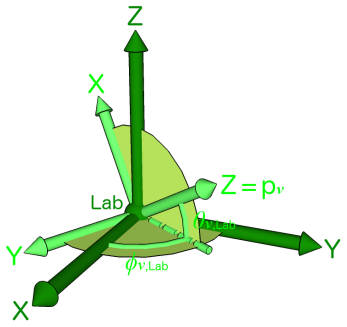
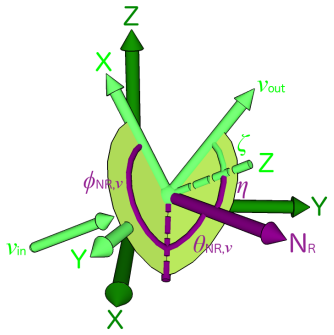
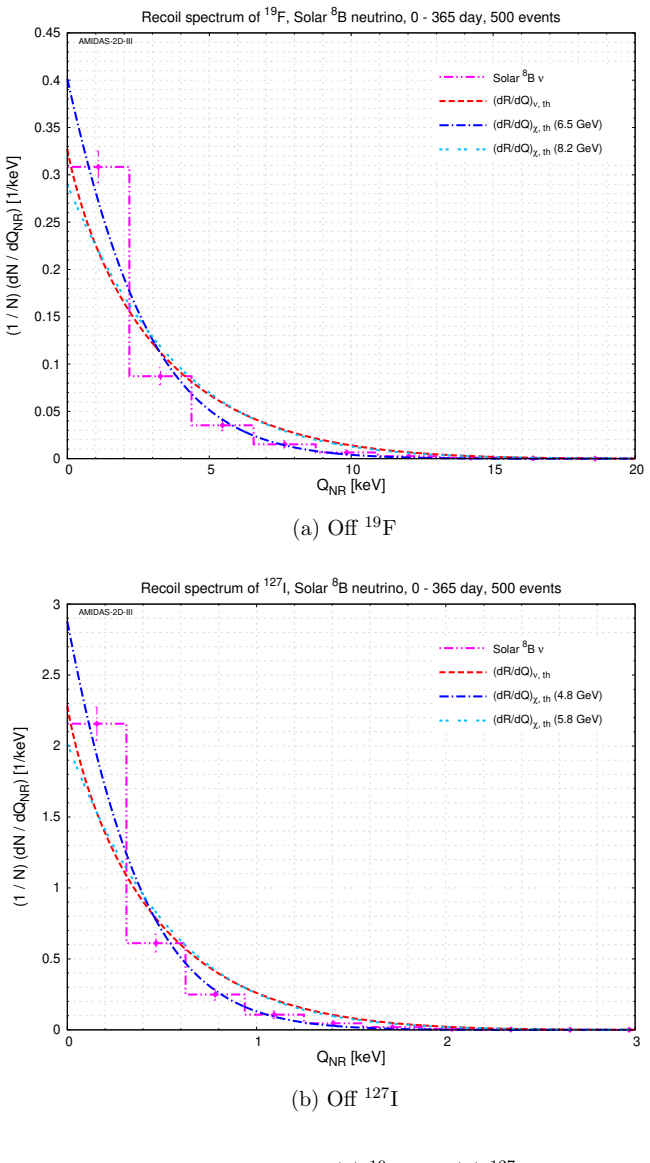
Following our earlier work on studying 3-dimensional nuclear recoil response to Galactic Weakly Interacting Massive Particles (WIMPs) in directional direct Dark Matter detectors, in this paper, we simulate 3-D coherent elastic neutrino-nucleus scattering (CEvNS) events induced by Solar B-8 neutrinos. Our numerical results show that, in contrast to the approximately fixed patterns of the WIMP-induced signals, the characteristic ring-like angular distributions of the nuclear recoil flux/energy of CEvNS events show clearly annual variations along the trajectories of the moving direction of incident Solar neutrinos in different celestial coordinate systems without experimentally distinguishable target dependence.
Editorial analysis
A structured set of objections, weighed in public.
Referee Report
Summary. The manuscript simulates the 3-dimensional nuclear recoil response to coherent elastic neutrino-nucleus scattering (CEvNS) events induced by solar 8B neutrinos in directional direct dark matter detectors. Building on prior WIMP work, the central claim is that the recoil flux and energy distributions form characteristic ring-like angular patterns whose orientations exhibit clear annual variations that track the changing direction of incident solar neutrinos across celestial coordinate systems, in contrast to the approximately fixed patterns expected from Galactic WIMPs, and that these features display no experimentally distinguishable dependence on target nucleus.
Significance. If the reported numerical results hold, the work identifies a geometrically robust annual-modulation signature in recoil directions that could serve as a diagnostic for solar-neutrino backgrounds versus potential WIMP signals in directional detectors. The absence of target dependence follows from the kinematics and is a strength, as is the direct connection to the known solar motion without additional free parameters. This could inform background rejection strategies in future experiments, though the result is primarily a demonstration of standard CEvNS geometry rather than a new physical prediction.
major comments (2)
- [Abstract] Abstract and presumed Methods section: the abstract states that numerical results were obtained but supplies no information on Monte Carlo event statistics, the cross-section libraries or differential CEvNS implementation used, or any validation against analytic forward-peaked recoil limits; these omissions are load-bearing for assessing whether the reported ring structures and their annual motion are statistically robust or could be affected by sampling noise or kinematic approximations.
- [Results] Results section (presumed §3 or equivalent): the claim of 'no experimentally distinguishable target dependence' requires explicit quantitative comparison (e.g., angular distribution differences across targets at fixed energy threshold) rather than a qualitative statement, because even weak mass dependence in the differential cross section could become visible once finite angular resolution and energy thresholds are folded in.
minor comments (2)
- [Abstract] Abstract: the sentence describing annual variations is long and could be split for clarity; the phrase 'without experimentally distinguishable target dependence' should specify the metric (e.g., angular distribution overlap or modulation amplitude difference) used to reach that conclusion.
- [Figures] Figure captions (throughout): ensure all celestial coordinate systems are defined on first use and that color scales for flux/energy are labeled with units.
Simulated Author's Rebuttal
We thank the referee for their thoughtful review and constructive suggestions. We address each major comment below and have revised the manuscript to incorporate additional details and quantitative support where appropriate.
read point-by-point responses
-
Referee: [Abstract] Abstract and presumed Methods section: the abstract states that numerical results were obtained but supplies no information on Monte Carlo event statistics, the cross-section libraries or differential CEvNS implementation used, or any validation against analytic forward-peaked recoil limits; these omissions are load-bearing for assessing whether the reported ring structures and their annual motion are statistically robust or could be affected by sampling noise or kinematic approximations.
Authors: We agree that the abstract and methods would benefit from explicit details on the simulation methodology. In the revised manuscript we have expanded the Methods section to specify the Monte Carlo event statistics (typically >10^5 events per target and epoch), the standard differential CEvNS cross-section implementation drawn from the literature, and direct comparisons of the simulated recoil angular distributions against analytic forward-peaked limits. The abstract has also been updated with a concise statement of these simulation parameters. revision: yes
-
Referee: [Results] Results section (presumed §3 or equivalent): the claim of 'no experimentally distinguishable target dependence' requires explicit quantitative comparison (e.g., angular distribution differences across targets at fixed energy threshold) rather than a qualitative statement, because even weak mass dependence in the differential cross section could become visible once finite angular resolution and energy thresholds are folded in.
Authors: The referee is correct that a purely qualitative assertion is insufficient for a strong claim. Although the absence of target dependence is a direct kinematic consequence of CEvNS (recoil direction is fixed by the neutrino direction and scattering angle, with nuclear mass affecting only the maximum recoil energy), we have added a new quantitative comparison in the revised Results section. This includes overlaid angular histograms for representative targets (Xe, Ar, Ge) at identical energy thresholds together with statistical tests demonstrating that any residual differences lie well below experimental distinguishability. revision: yes
Circularity Check
No significant circularity; results follow from standard kinematics and solar geometry
full rationale
The paper's central claim—that CEvNS recoil patterns exhibit ring-like angular distributions with annual variations and no target dependence—follows directly from applying the known direction of solar B-8 neutrinos, the annual change in that direction due to Earth's orbit, and the forward-peaked nature of CEvNS recoils (set by the differential cross section) in celestial coordinates. This is a geometric consequence of standard neutrino physics, not a derivation that reduces to fitted parameters or self-referential definitions. The reference to the authors' prior WIMP work is contextual for contrast and does not underpin or justify the CEvNS simulation results. No equations or simulation steps are shown to be equivalent to their inputs by construction, and the result remains externally falsifiable against solar neutrino data and CEvNS kinematics.
Axiom & Free-Parameter Ledger
Reference graph
Works this paper leans on
-
[1]
Coherent Neutrino–Nucleus Scattering as a Probe of the Weak Neutral Current
D. Z. Freedman,“Coherent Neutrino–Nucleus Scattering as a Probe of the Weak Neutral Current”,Phys. Rev.D9, 1389–1392 (1974)
1974
-
[2]
Principles and Applications of a Neutral Current Detector for Neutrino Physics and Astronomy
A. Drukier and L. Stodolsky,“Principles and Applications of a Neutral Current Detector for Neutrino Physics and Astronomy”,Phys. Rev.D30, 2295–2366 (1984). [3]“Software and Data for Solar Neutrino Research”, https://www.sns.ias.edu/~jnb/SNdata/sndata.html
1984
-
[3]
A New Generation of Standard Solar Models
N. Vinyoleset al.,“A New Generation of Standard Solar Models”,Astrophys. J.835, 202 (2017),arXiv:1611.09867 [astro-ph.SR]
Pith/arXiv arXiv 2017
-
[4]
History of Solar Neutrino Observations
M. Nakahata,“History of Solar Neutrino Observations”,Prog. Theor. Exp. Phys.2022, 12B103 (2022),arXiv:2202.12421 [hep-ex]
arXiv 2022
-
[5]
S. Chen and X.-J. Xu,“Solar Neutrinos”,arXiv:2501.09971 [hep-ph](2025). 46
arXiv 2025
-
[6]
XENONnT and LUX– ZEPLIN Constraints on DSNB–Boosted Dark Matter
V. De Romeri, A. Majumdar, D. K. Papoulias and R. Srivastava,“XENONnT and LUX– ZEPLIN Constraints on DSNB–Boosted Dark Matter”,J. Cosmol. Astropart. Phys.2403, 028 (2024),arXiv:2309.04117 [hep-ph]
arXiv 2024
-
[7]
G. Jungman, M. Kamionkowski and K. Griest,“Supersymmetric Dark Matter”, Phys. Rept.267, 195–373 (1996),arXiv:hep-ph/9506380
Pith/arXiv arXiv 1996
-
[8]
Direct Detection of WIMP Dark Matter: Concepts and Status
M. Schumann,“Direct Detection of WIMP Dark Matter: Concepts and Status”, J. Phys.G46, 103003 (2019),arXiv:1903.03026 [astro-ph.CO]
arXiv 2019
-
[9]
The Review of Particle Physics 2020
L. Baudis and S. Profumo, contribution to“The Review of Particle Physics 2020”, Prog. Theor. Exp. Phys.2020, 083C01 (2020),27. Dark Matter
2020
-
[10]
Dark Matter Direct Detection of Classical WIMPs
J. Cooley,“Dark Matter Direct Detection of Classical WIMPs”,SciPost Phys. Lect. Notes 55 (2022),arXiv:2110.02359 [hep-ph]
arXiv 2022
-
[11]
M. Cirelli, A. Strumia and J. Zupan,“Dark Matter”,arXiv:2406.01705 [hep-ph](2024)
Pith/arXiv arXiv 2024
-
[12]
Dark Matter Direct Detection: Status, Results and Future Plans
L. Baudis,“Dark Matter Direct Detection: Status, Results and Future Plans”, J. Phys.: Conf. Ser.3162, 012007 (2025),arXiv:2512.23039 [astro-ph.IM]
arXiv 2025
-
[13]
Dark Matter Search Results from 1.54 Tonne·Year Exposure of PandaX-4T
PandaX Collab., Z. Boet al.,“Dark Matter Search Results from 1.54 Tonne·Year Exposure of PandaX-4T”,Phys. Rev. Lett.134, 011805 (2025),arXiv:2408.00664 [hep-ex]
arXiv 2025
-
[14]
Dark Matter Search Results from 4.2 Tonne–Years of Exposure of the LUX–ZEPLIN (LZ) Experiment
LZ Collab., J. Aalberset al.,“Dark Matter Search Results from 4.2 Tonne–Years of Exposure of the LUX–ZEPLIN (LZ) Experiment”,Phys. Rev. Lett.135, 011802 (2025), arXiv:2410.17036 [hep-ex]
Pith/arXiv arXiv 2025
-
[15]
WIMP Dark Matter Search Using a 3.1 tonne× year Exposure of the XENONnT Experiment
XENON Collab., E. Aprileet al.,“WIMP Dark Matter Search Using a 3.1 tonne× year Exposure of the XENONnT Experiment”,Phys. Rev. Lett.135, 221003 (2025), arXiv:2502.18005 [hep-ex]
arXiv 2025
-
[16]
Neutrino Coherent Scattering Rates at Direct Dark Matter Detectors
L. E. Strigari,“Neutrino Coherent Scattering Rates at Direct Dark Matter Detectors”,New J. Phys.11, 105011 (2009),arXiv:0903.3630 [astro-ph.CO]
Pith/arXiv arXiv 2009
-
[17]
PandaX Collab., Z. Boet al.,“First Indication of Solar 8BNeutrinos through Coherent Elastic Neutrino–Nucleus Scattering in PandaX-4T”,Phys. Rev. Lett.133, 191001 (2024), arXiv:2407.10892 [hep-ex]
arXiv 2024
-
[18]
First Indication of Solar 8BNeutrinos via Coherent Elastic Neutrino–Nucleus Scattering with XENONnT
XENON Collab., E. Aprileet al.,“First Indication of Solar 8BNeutrinos via Coherent Elastic Neutrino–Nucleus Scattering with XENONnT”,Phys. Rev. Lett.133, 191002 (2024), arXiv:2408.02877 [nucl-ex]
arXiv 2024
-
[19]
LZ Collab., D. S. Akeribet al.,“Searches for Light Dark Matter and Evidence of Coher- ent Elastic Neutrino–Nucleus Scattering of Solar Neutrinos with the LUX–ZEPLIN (LZ) Experiment”,arXiv:2512.08065 [hep-ex](2025)
arXiv 2025
-
[20]
Probing the Solar 8B Neutrino Fog with XENONnT
XENON Collab., E. Aprileet al.,“Probing the Solar 8B Neutrino Fog with XENONnT”, arXiv:2604.06002 [hep-ex](2026)
Pith/arXiv arXiv 2026
-
[21]
Dark Matter Astrophysical Uncertainties and the Neutrino Floor
C. A. J. O’Hare,“Dark Matter Astrophysical Uncertainties and the Neutrino Floor”, Phys. Rev.D94, 063527 (2016),arXiv:1604.03858 [astro-ph.CO]. 47
Pith/arXiv arXiv 2016
-
[22]
Novel Neutrino– Floor and Dark Matter Searches with Deformed Shell Model Calculations
D. K. Papoulias, R. Sahu, T. S. Kosmas, V. K. B. Kota and B. Nayak,“Novel Neutrino– Floor and Dark Matter Searches with Deformed Shell Model Calculations”,Adv. High Energy Phys.2018, 6031362 (2018),arXiv:1804.11319 [hep-ph]
Pith/arXiv arXiv 2018
-
[23]
Can we Overcome the Neutrino Floor at High Masses?
C. A. J. O’Hare,“Can we Overcome the Neutrino Floor at High Masses?”,Phys. Rev.D102, 063024 (2020),arXiv:2002.07499 [astro-ph.CO]
arXiv 2020
-
[24]
Fog on the Horizon: New Definition of the Neutrino Floor for Direct Dark Matter Searches
C. A. J. O’Hare,“Fog on the Horizon: New Definition of the Neutrino Floor for Direct Dark Matter Searches”,Phys. Rev. Lett.127, 251802 (2021),arXiv:2109.03116 [hep-ph]
arXiv 2021
-
[25]
D. Aristizabal Sierra, V. De Romeri, L. J. Flores and D. K. Papoulias,“Impact of COHER- ENT measurements, Cross Section Uncertainties and New Interactions on the Neutrino Floor”,J. Cosmol. Astropart. Phys.2201, 055 (2022),arXiv:2109.03247 [hep-ph]
arXiv 2022
-
[26]
Looking for WIMPs Through the Neutrino Fogs
I. M. Bloch, S. Bottaro, D. Redigolo and L. Vittorio,“Looking for WIMPs Through the Neutrino Fogs”,J. High Energy Phys.2508, 216 (2025),arXiv:2410.02723 [hep-ph]
arXiv 2025
-
[27]
Solar and Atmospheric Neutrinos: Background Sources for the Di- rect Dark Matter Search
A. G¨ utleinet al.,“Solar and Atmospheric Neutrinos: Background Sources for the Di- rect Dark Matter Search”,Astropart. Phys.34, 90–96 (2010),arXiv:1003.5530 [hep-ph] (2021)
Pith/arXiv arXiv 2010
-
[28]
J. Billard, L. Strigari and E. Figueroa–Feliciano,“Implication of Neutrino Backgrounds on the Reach of Next Generation Dark Matter Direct Detection Experiments”,Phys. Rev.D89, 023524 (2014),arXiv:1307.5458 [hep-ph]
Pith/arXiv arXiv 2014
-
[29]
Neutrino Backgrounds in Future Liquid Noble Element Dark Matter Direct Detection Experiments
A. Gaspert, P. Giampa and D. E. Morrissey,“Neutrino Backgrounds in Future Liquid Noble Element Dark Matter Direct Detection Experiments”,Phys. Rev.D105, 035020 (2022), arXiv:2108.03248 [hep-ph]
arXiv 2022
-
[30]
Read- out Strategies for Directional Dark Matter Detection beyond the Neutrino Background
C. A. J. O’Hare, A. M. Green, J. Billard, E. Figueroa–Feliciano and L. E. Strigari,“Read- out Strategies for Directional Dark Matter Detection beyond the Neutrino Background”, Phys. Rev.D92, 063518 (2015),arXiv:1505.08061 [astro-ph.CO]
Pith/arXiv arXiv 2015
-
[31]
The Case for a Directional Dark Matter Detector and the Status of Current Experimental Efforts
S. Ahlenet al.,“The Case for a Directional Dark Matter Detector and the Status of Current Experimental Efforts”,Int. J. Mod. Phys.A25, 1–51 (2010),arXiv:0911.0323 [astro-ph.CO]
Pith/arXiv arXiv 2010
-
[32]
A Review of the Discovery Reach of Directional Dark Matter Detection
F. Mayetet al.,“A Review of the Discovery Reach of Directional Dark Matter Detection”, Phys. Rept.627, 1–49 (2016),arXiv:1602.03781 [astro-ph.CO]
Pith/arXiv arXiv 2016
-
[33]
S. E. Vahsen, C. A. J. O’Hare and D. Loomba,“Directional Recoil Detection”, Ann. Rev. Nucl. Part. Sci.71, 189–224 (2021),arXiv:2102.04596 [physics.ins-det]
arXiv 2021
-
[34]
Discovery Potential for Directional Dark Matter Detection with Nuclear Emulsions
NEWSdm Collab., N. Agafonovaet al.,“Discovery Potential for Directional Dark Matter Detection with Nuclear Emulsions”,J. Phys.: Conf. Ser.869, 012048 (2017), arXiv:1705.00613 [physics.ins-det]
Pith/arXiv arXiv 2017
-
[35]
T. Ikeda, T. Shimada, H. Ishiura, K. Nakamura, T. Nakamura and K. Miuchi,“Develop- ment of a Negative Ion Micro TPC Detector with SF 6 Gas for the Directional Dark Matter Search”,J. Inst.15, P07015 (2020),arXiv:2004.09706 [physics.ins-det]. 48
arXiv 2020
-
[36]
Direc- tional Detection of Dark Matter with Diamond
M. C. Marshall, M. J. Turner, M. J. H. Ku, D. F. Phillips, and R. L. Walsworth,“Direc- tional Detection of Dark Matter with Diamond”,Quantum Sci. Technol.6, 024011 (2021), arXiv:2009.01028 [physics.ins-det]
arXiv 2021
-
[37]
Readout Technologies for Directional WIMP Dark Matter Detection
J. B. R. Battatet al.,“Readout Technologies for Directional WIMP Dark Matter Detection”, Phys. Rept.662, 1–46 (2016),arXiv:1610.02396 [physics.ins-det]
Pith/arXiv arXiv 2016
-
[38]
CYGNUS Collab., S. E. Vahsenet al.,“CYGNUS: Feasibility of a Nuclear Recoil Ob- servatory with Directional Sensitivity to Dark Matter and Neutrinos”,arXiv:2008.12587 [physics.ins-det](2020)
arXiv 2008
-
[39]
Challenges for the Directional Dark Matter Direct Detection
K. Miuchi,“Challenges for the Directional Dark Matter Direct Detection”,J. Adv. In- strum. in Sci.2024, 473 (2024),arXiv:2309.13923 [hep-ex]
arXiv 2024
-
[40]
Complementarity of Dark Matter Detectors in Light of the Neutrino Background
F. Ruppin, J. Billard, E. Figueroa–Feliciano and L. Strigari,“Complementarity of Dark Matter Detectors in Light of the Neutrino Background”,Phys. Rev.D90, 083510 (2014), arXiv:1408.3581 [hep-ph]
Pith/arXiv arXiv 2014
-
[41]
Coherent Elastic Neutrino–Nucleus Scattering with Directional Detectors
M. Abdullah, D. Aristizabal Sierra, B. Dutta and L. E. Strigari,“Coherent Elastic Neutrino–Nucleus Scattering with Directional Detectors”,Phys. Rev.D102, 015009 (2020), arXiv:2003.11510 [hep-ph]
arXiv 2020
-
[42]
Detection of Astrophysical Neutrinos at Prospective Locations of Dark Matter Detectors
Y. Zhuang, L. E. Strigari, L. Jin and S. Sinha,“Detection of Astrophysical Neutrinos at Prospective Locations of Dark Matter Detectors”,Phys. Rev.D109, 043055 (2024), arXiv:2307.13792 [hep-ph]
arXiv 2024
-
[43]
Y. Zhuang, L. E. Strigari, L. Jin and S. Sinha,“Prospects for Measuring the Time Variation of Astrophysical Neutrino Sources at Dark Matter Detectors”,Phys. Rev.D110, 043037 (2024),arXiv:2402.18454 [hep-ph]
arXiv 2024
-
[44]
CYGνS: Detecting Solar Neutrinos with Directional Gas Time Projection Chambers
C. Lisottiet al.,“CYGνS: Detecting Solar Neutrinos with Directional Gas Time Projection Chambers”,Eur. Phys. J.C84, 1021 (2024),arXiv:2404.03690 [hep-ph]
arXiv 2024
-
[45]
D. Aristizabal Sierra, N. Mishra and L. Strigari,“Implications of First Neutrino–Induced Nuclear Recoil Measurements in Direct Detection Experiments: Probing Nonstandard In- teraction via CEνNS”,Phys. Rev.D111, 055007 (2025),arXiv:2409.02003 [hep-ph]
arXiv 2025
-
[46]
Searching for Beyond–Standard–Model Solar Neutrino Interactions Us- ing Directional Detectors
A. C. Shekaret al.,“Searching for Beyond–Standard–Model Solar Neutrino Interactions Us- ing Directional Detectors”,Phys. Rev.D112, 123021 (2025),arXiv:2506.09322 [hep-ph]
arXiv 2025
-
[47]
C. A. J. O’Hare, A. C. Shekar, C. Lisotti, M. Litke, N. Mishra, J. L. Newstead, L. E. Strigari and S. E. Vahsen,“Directional Recoil Detection for CEνNS Measurements with Light Nuclei at the Spallation Neutron Source”,arXiv:2602.19618 [hep-ph](2026)
arXiv 2026
-
[48]
C.-L. Shan,“Simulations of the Angular Recoil–Energy Distribution of WIMP–Scattered Target Nuclei for Directional Dark Matter Detection Experiments”,arXiv:2103.06486 [hep-ph](2021)
arXiv 2021
-
[49]
COHERENT at the Spallation Neutron Source
P. S. Barbeau, Yu. Efremenko and K. Scholberg,“COHERENT at the Spallation Neutron Source”,Ann. Rev. Nucl. Part. Sci.73, 41–68 (2023),arXiv:2111.07033 [hep-ex]
arXiv 2023
-
[50]
The Review of Particle Physics 2024
S. Navaset al.(Particle Data Group),“The Review of Particle Physics 2024”, Phys. Rev.D110, 030001 (2024),1. Physical Constants. 49
2024
-
[51]
Elastic and Inelastic Scattering of Neutrinos and Weakly Interacting Massive Particles on Nuclei
R. Sahu, D. K. Papoulias, V. K. B. Kota and T. S. Kosmas,“Elastic and Inelastic Scattering of Neutrinos and Weakly Interacting Massive Particles on Nuclei”,Phys. Rev.C102, 035501 (2020),arXiv:2004.04055 [nucl-th]
arXiv 2020
-
[52]
Response of Mica to Weakly Interacting Massive Particles
J. Engel, M. T. Ressell, I. Towner and W. Ormand,“Response of Mica to Weakly Interacting Massive Particles”,Phys. Rev.C52, 2216–2221 (1995),arXiv:hep-ph/9504322
Pith/arXiv arXiv 1995
-
[53]
Spin–Dependent Neutralino–Nucleus Scattering forA∼127 Nuclei
M. T. Ressell and D. J. Dean,“Spin–Dependent Neutralino–Nucleus Scattering forA∼127 Nuclei”,Phys. Rev.C56, 535–546 (1997),arXiv:hep-ph/9702290
Pith/arXiv arXiv 1997
-
[54]
Nuclear Spin Structure in Dark Matter Search: The Zero Momentum Transfer Limit
V. A. Bednyakov and F. Simkovic,“Nuclear Spin Structure in Dark Matter Search: The Zero Momentum Transfer Limit”,Phys. Part. Nucl.36, 131–152 (2005), Fiz. Elem. Chast. Atom. Yadra36, 257–290 (2005),arXiv:hep-ph/0406218 [hep-ph]
Pith/arXiv arXiv 2005
-
[55]
Model–Independent Limits from Spin–Dependent WIMP Dark Matter Experiments
F. Giuliani and T. A. Girard,“Model–Independent Limits from Spin–Dependent WIMP Dark Matter Experiments”,Phys. Rev.D71, 123503 (2005),arXiv:hep-ph/0502232. [57]https://www.webelements.com/
Pith/arXiv arXiv 2005
-
[56]
ExploringνSignals in Dark Matter Detectors
R. Harnik, J. Kopp and P. A. N. Machado,“ExploringνSignals in Dark Matter Detectors”, J. Cosmol. Astropart. Phys.1207, 026 (2012),arXiv:1202.6073 [hep-ph]
Pith/arXiv arXiv 2012
-
[57]
The Review of Particle Physics 2024
S. Navaset al.(Particle Data Group),“The Review of Particle Physics 2024”, Phys. Rev.D110, 030001 (2024),2. Astrophysical Constants and Parameters
2024
-
[58]
C.-L. Shan,“Simulations of the 3-Dimensional Velocity Distribution of Halo Weakly Interacting Massive Particles for Directional Dark Matter Detection Experiments”, arXiv:1905.11279 [astro-ph.HE](2019)
arXiv 1905
-
[59]
Review of Mathematics, Numerical Factors, and Corrections for Dark Matter Experiments Based on Elastic Nuclear Recoil
J. D. Lewin and P. F. Smith,“Review of Mathematics, Numerical Factors, and Corrections for Dark Matter Experiments Based on Elastic Nuclear Recoil”,Astropart. Phys.6, 87–112 (1996)
1996
-
[60]
C.-L. Shan,“Monte Carlo Scattering–by–Scattering Simulation of 3-Dimensional Elastic WIMP–Nucleus Scattering Events”,arXiv:2103.06485 [hep-ph](2021)
arXiv 2021
-
[61]
On Diurnal and Annual Variations of Direc- tional Detection Rates of Dark Matter
A. Bandyopadhyay and D. Majumdar,“On Diurnal and Annual Variations of Direc- tional Detection Rates of Dark Matter”,Astrophys. J.746, 107 (2012),arXiv:1006.3231 [hep-ph]. [64]https://en.wikipedia.org/wiki/Galactic coordinate system
Pith/arXiv arXiv 2012
-
[62]
Determining Ratios of WIMP–Nucleon Cross Sections from Direct Dark Mat- ter Detection Data
C.-L. Shan,“Determining Ratios of WIMP–Nucleon Cross Sections from Direct Dark Mat- ter Detection Data”,J. Cosmol. Astropart. Phys.1107, 005 (2011),arXiv:1103.0482 [hep-ph]
Pith/arXiv arXiv 2011
-
[63]
Signal Modulation in Cold–Dark–Matter Detection
K. Freese, J. Frieman and A. Gould,“Signal Modulation in Cold–Dark–Matter Detection”, Phys. Rev.D37, 3388–3405 (1988). 50
1988
discussion (0)
Sign in with ORCID, Apple, or X to comment. Anyone can read and Pith papers without signing in.