Observation of Non-Gaussian Magnon Dynamics in a Two-Dimensional Long-Range XY Model
Pith reviewed 2026-06-27 06:39 UTC · model grok-4.3
The pith
Trapped ion simulator isolates non-Gaussian magnon dynamics in two-dimensional long-range XY model independent of calibration errors.
A machine-rendered reading of the paper's core claim, the machinery that carries it, and where it could break.
Core claim
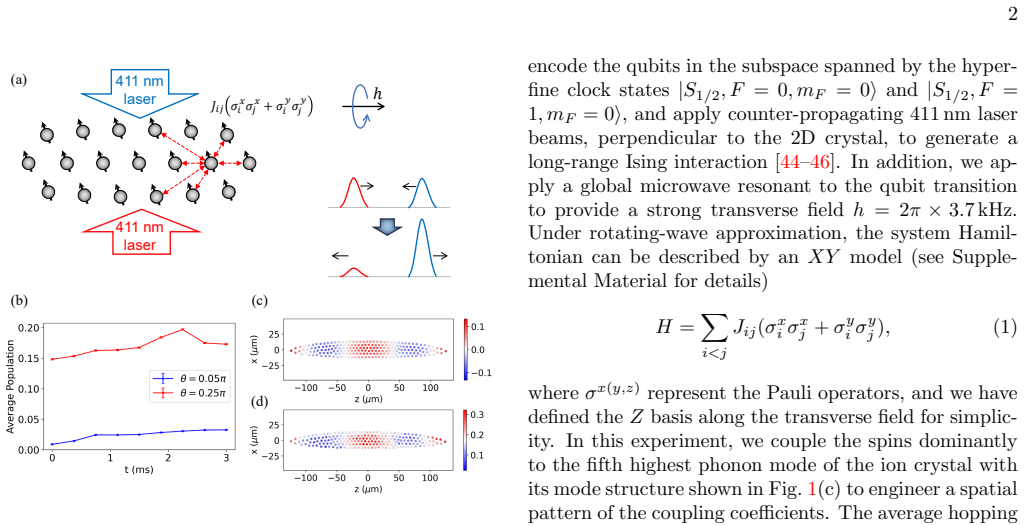
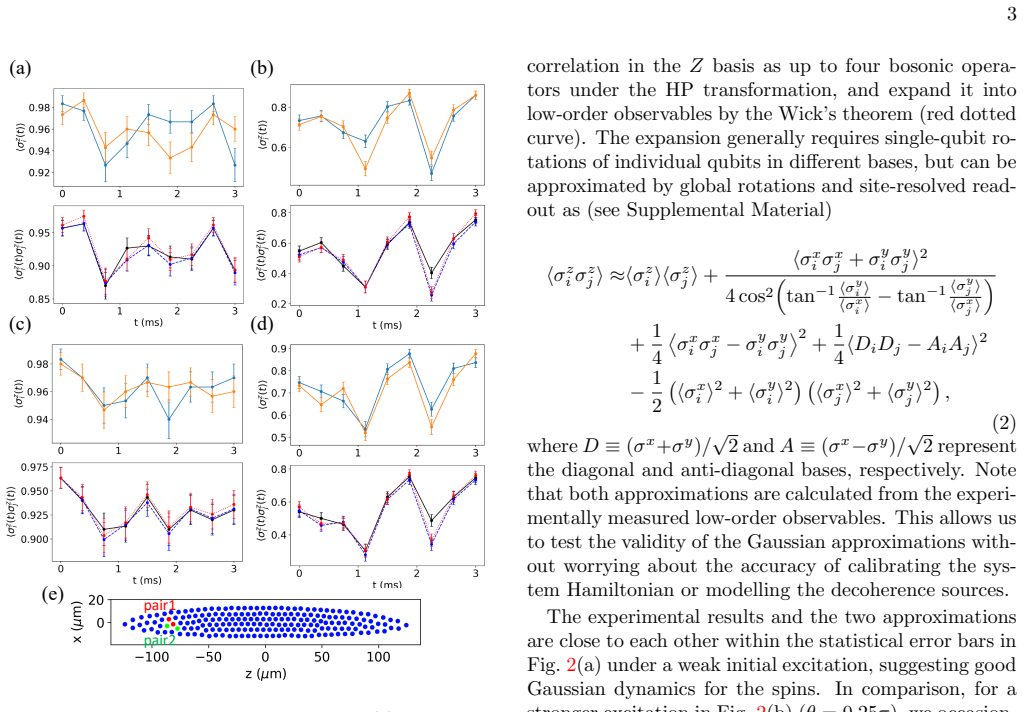
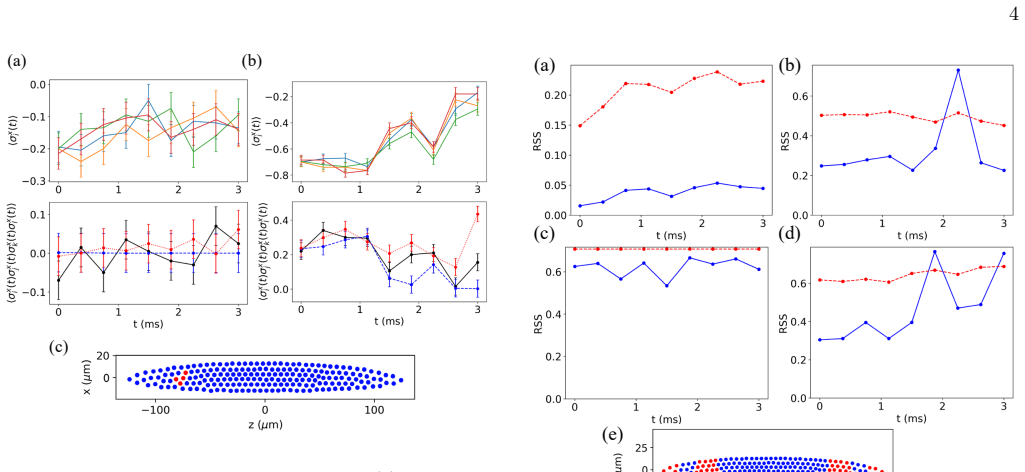
We demonstrate the crossover between Gaussian and non-Gaussian dynamics on a two-dimensional XY model with long-range and spatially structured interaction using a trapped ion quantum simulator. We prepare different initial densities of magnon excitations and verify the dynamics of single-spin observables for the engineered Hamiltonian. Then we compare the high-order spin correlations with the mean-field solution and the Holstein-Primakoff approximation, and demonstrate the non-Gaussian behavior in a way independent of the calibration errors.
What carries the argument
Comparison of measured high-order spin correlations against mean-field and Holstein-Primakoff predictions, which isolates non-Gaussian contributions without requiring accurate calibration of Hamiltonian parameters.
If this is right
- Varying the initial magnon density produces a tunable crossover between Gaussian and non-Gaussian regimes.
- Single-spin observables remain consistent with the engineered long-range XY Hamiltonian.
- High-order correlations furnish an error-robust witness of non-Gaussianity.
- The platform supplies a verifiable route toward interaction regimes where classical simulation becomes intractable.
Where Pith is reading between the lines
- The calibration-independent witness could be applied to other quantum simulators to certify non-Gaussian behavior without full Hamiltonian tomography.
- Extending the same initial-state preparation to three-dimensional or disordered long-range models would test whether the crossover persists when mean-field approximations become less reliable.
Load-bearing premise
The mean-field solution and Holstein-Primakoff approximation accurately capture the Gaussian component of the dynamics so that any observed deviations can be attributed to non-Gaussian evolution.
What would settle it
High-order spin correlations that remain consistent with mean-field and Holstein-Primakoff predictions across all tested magnon densities would falsify the claim of having observed non-Gaussian dynamics.
Figures
read the original abstract
Non-Gaussian evolution of high-order spin correlations characterizes important properties of quantum many-body systems. In practice, decoherence, statistical fluctuation and miscalibration of experimental parameters all hinder the witness of non-Gaussian dynamics. Here we demonstrate the crossover between Gaussian and non-Gaussian dynamics on a two-dimensional XY model with long-range and spatially structured interaction using a trapped ion quantum simulator. We prepare different initial densities of magnon excitations and verify the dynamics of single-spin observables for the engineered Hamiltonian. Then we compare the high-order spin correlations with the mean-field solution and the Holstein-Primakoff approximation, and demonstrate the non-Gaussian behavior in a way independent of the calibration errors. Our work provides a verifiable path from classically simulatable dynamics to regimes where quantum advantage may emerge.
Editorial analysis
A structured set of objections, weighed in public.
Referee Report
Summary. The manuscript reports an experimental demonstration, using a trapped-ion quantum simulator, of the crossover from Gaussian to non-Gaussian magnon dynamics in a two-dimensional XY model with long-range and spatially structured interactions. Different initial magnon densities are prepared, single-spin observables are verified against the engineered Hamiltonian, and high-order spin correlations are compared to mean-field and Holstein-Primakoff predictions to establish non-Gaussian behavior independent of calibration errors.
Significance. If the central attribution holds, the work supplies a concrete experimental route from classically simulatable regimes to non-Gaussian many-body dynamics in a long-range 2D system, with potential implications for identifying the onset of quantum advantage in quantum simulators.
major comments (1)
- [Abstract; comparison to approximations (Methods/Results sections on high-order correlations)] The claim that deviations from mean-field and Holstein-Primakoff predictions demonstrate non-Gaussian dynamics independent of calibration errors (abstract) rests on the assumption that these approximations exhaust all Gaussian (quadratic) contributions. In a 2D lattice with long-range, spatially structured couplings, the Holstein-Primakoff expansion around a mean-field state can omit momentum-dependent fluctuation corrections or residual Gaussian terms at moderate magnon densities; any such omission would misclassify Gaussian physics as non-Gaussian and weaken the calibration-error independence argument.
minor comments (1)
- Specify the precise interaction range, lattice geometry, and magnon-density regime in which the Holstein-Primakoff truncation is expected to remain valid.
Simulated Author's Rebuttal
We thank the referee for their careful reading and constructive comment on our manuscript. We address the major concern point by point below.
read point-by-point responses
-
Referee: [Abstract; comparison to approximations (Methods/Results sections on high-order correlations)] The claim that deviations from mean-field and Holstein-Primakoff predictions demonstrate non-Gaussian dynamics independent of calibration errors (abstract) rests on the assumption that these approximations exhaust all Gaussian (quadratic) contributions. In a 2D lattice with long-range, spatially structured couplings, the Holstein-Primakoff expansion around a mean-field state can omit momentum-dependent fluctuation corrections or residual Gaussian terms at moderate magnon densities; any such omission would misclassify Gaussian physics as non-Gaussian and weaken the calibration-error independence argument.
Authors: The Holstein-Primakoff (HP) transformation yields the exact quadratic bosonic Hamiltonian for the magnon modes once the long-range, spatially structured XY couplings are Fourier-transformed; all Gaussian (quadratic) contributions, including momentum-dependent fluctuation corrections, are thereby included by construction. The mean-field solution is the corresponding classical limit. Any deviation of measured high-order correlations from these predictions must therefore originate from higher-order (anharmonic) terms in the spin Hamiltonian, which generate non-Gaussian dynamics. For the moderate magnon densities realized in the experiment the 1/S expansion parameter remains controlled, rendering residual Gaussian corrections beyond the quadratic HP level negligible. The calibration-error independence follows from the separate verification that single-spin observables agree with the engineered Hamiltonian across the explored parameter range; plausible miscalibrations cannot simultaneously reproduce the observed higher-order deviations while preserving the lower-order agreement. We will add one clarifying sentence in the Methods section stating that the HP approximation incorporates the complete quadratic dynamics for the given interaction structure. revision: partial
Circularity Check
No circularity: non-Gaussian claim rests on external approximations
full rationale
The paper's central step compares measured high-order spin correlations against independent mean-field and Holstein-Primakoff predictions to attribute deviations to non-Gaussian dynamics. These approximations are standard theoretical constructions not derived from or fitted to the experimental high-order data within the paper, nor are they justified via self-citation chains that reduce to the target result. The claim of calibration-error independence follows directly from this external comparison without self-referential redefinition or renaming of known patterns. No load-bearing step reduces by construction to its own inputs.
Axiom & Free-Parameter Ledger
Reference graph
Works this paper leans on
-
[1]
I. M. Georgescu, S. Ashhab, and F. Nori, Quantum sim- ulation, Rev. Mod. Phys.86, 153 (2014)
2014
-
[2]
Bharti, A
K. Bharti, A. Cervera-Lierta, T. H. Kyaw, T. Haug, S. Alperin-Lea, A. Anand, M. Degroote, H. Heimonen, J. S. Kottmann, T. Menke, W.-K. Mok, S. Sim, L.-C. Kwek, and A. Aspuru-Guzik, Noisy intermediate-scale quantum algorithms, Rev. Mod. Phys.94, 015004 (2022)
2022
-
[3]
A. J. Daley, I. Bloch, C. Kokail, S. Flannigan, N. Pearson, M. Troyer, and P. Zoller, Practical quantum advantage in quantum simulation, Nature607, 667 (2022)
2022
-
[4]
Sachdev,Quantum Phase Transitions(Cambridge University Press, Cambridge, 2000)
S. Sachdev,Quantum Phase Transitions(Cambridge University Press, Cambridge, 2000)
2000
-
[5]
D’Alessio, Y
L. D’Alessio, Y. Kafri, A. Polkovnikov, and M. Rigol, From quantum chaos and eigenstate thermalization to statistical mechanics and thermodynamics, Advances in Physics65, 239 (2016)
2016
-
[6]
Swingle, Unscrambling the physics of out-of-time- order correlators, Nature Physics14, 988 (2018)
B. Swingle, Unscrambling the physics of out-of-time- order correlators, Nature Physics14, 988 (2018)
2018
-
[7]
G¨ uhne and G
O. G¨ uhne and G. T´ oth, Entanglement detection, Physics Reports474, 1 (2009)
2009
-
[8]
Schwinger, On the green’s functions of quantized fields
J. Schwinger, On the green’s functions of quantized fields. i, Proceedings of the National Academy of Sciences37, 452 (1951)
1951
-
[9]
Schwinger, On the green’s functions of quantized fields
J. Schwinger, On the green’s functions of quantized fields. ii, Proceedings of the National Academy of Sciences37, 455 (1951)
1951
-
[10]
Schweigler, V
T. Schweigler, V. Kasper, S. Erne, I. Mazets, B. Rauer, F. Cataldini, T. Langen, T. Gasenzer, J. Berges, and J. Schmiedmayer, Experimental characterization of a quantum many-body system via higher-order correla- tions, Nature545, 323 (2017)
2017
-
[11]
Schuch, J
N. Schuch, J. I. Cirac, and M. M. Wolf, Quantum states on harmonic lattices, Communications in Mathematical Physics267, 65 (2006)
2006
-
[12]
X.-B. Wang, T. Hiroshima, A. Tomita, and M. Hayashi, Quantum information with gaussian states, Physics Re- ports448, 1 (2007)
2007
-
[13]
Adesso, S
G. Adesso, S. Ragy, and A. R. Lee, Continuous vari- able quantum information: Gaussian states and beyond, Open Systems & Information Dynamics21, 1440001 (2014)
2014
-
[14]
Surace and L
J. Surace and L. Tagliacozzo, Fermionic Gaussian states: an introduction to numerical approaches, SciPost Phys. Lect. Notes , 54 (2022)
2022
-
[15]
G. C. Wick, The evaluation of the collision matrix, Phys. Rev.80, 268 (1950)
1950
-
[16]
S. D. Bartlett, B. C. Sanders, S. L. Braunstein, and K. Nemoto, Efficient classical simulation of continuous variable quantum information processes, Phys. Rev. Lett. 88, 097904 (2002)
2002
-
[17]
Mari and J
A. Mari and J. Eisert, Positive wigner functions ren- der classical simulation of quantum computation efficient, Phys. Rev. Lett.109, 230503 (2012)
2012
-
[18]
N. C. Menicucci, P. van Loock, M. Gu, C. Weedbrook, T. C. Ralph, and M. A. Nielsen, Universal quantum com- putation with continuous-variable cluster states, Phys. Rev. Lett.97, 110501 (2006)
2006
-
[19]
S. L. Braunstein and P. van Loock, Quantum informa- tion with continuous variables, Rev. Mod. Phys.77, 513 (2005)
2005
-
[20]
C. S. Hamilton, R. Kruse, L. Sansoni, S. Barkhofen, C. Silberhorn, and I. Jex, Gaussian boson sampling, Phys. Rev. Lett.119, 170501 (2017)
2017
-
[21]
Zhong, H
H.-S. Zhong, H. Wang, Y.-H. Deng, M.-C. Chen, L.-C. Peng, Y.-H. Luo, J. Qin, D. Wu, X. Ding, Y. Hu, P. Hu, X.-Y. Yang, W.-J. Zhang, H. Li, Y. Li, X. Jiang, L. Gan, G. Yang, L. You, Z. Wang, L. Li, N.-L. Liu, C.-Y. Lu, and J.-W. Pan, Quantum computational advantage using photons, Science370, 1460 (2020)
2020
-
[22]
L. S. Madsen, F. Laudenbach, M. F. Askarani, F. Rortais, T. Vincent, J. F. F. Bulmer, F. M. Miatto, L. Neuhaus, L. G. Helt, M. J. Collins, A. E. Lita, T. Gerrits, S. W. Nam, V. D. Vaidya, M. Menotti, I. Dhand, Z. Vernon, N. Quesada, and J. Lavoie, Quantum computational ad- vantage with a programmable photonic processor, Nature 606, 75 (2022)
2022
-
[23]
H.-L. Liu, H. Su, Y.-H. Deng, S.-Q. Gong, Y.-C. Gu, H.-Y. Tang, M.-H. Jia, Q. Wei, Y.-K. Song, D.-Z. Wang, M.-Y. Zheng, F.-X. Chen, L.-B. Li, S.-Y. Ren, X.-Z. Zhu, 6 M.-H. Wang, Y.-J. Chen, Y.-F. Liu, L.-S. Song, P.-Y. Yang, J.-S. Chen, H. An, L. Zhang, L. Gan, G.-w. Yang, J.-M. Xu, Y.-M. He, H. Wang, H.-S. Zhong, M.-C. Chen, X. Jiang, L. Li, N.-L. Liu, X...
-
[24]
Somma, H
R. Somma, H. Barnum, G. Ortiz, and E. Knill, Efficient solvability of hamiltonians and limits on the power of some quantum computational models, Phys. Rev. Lett. 97, 190501 (2006)
2006
-
[25]
Arute, K
F. Arute, K. Arya, R. Babbush, D. Bacon, J. C. Bardin, R. Barends, R. Biswas, S. Boixo, F. G. Brandao, D. A. Buell,et al., Quantum supremacy using a programmable superconducting processor, Nature574, 505 (2019)
2019
-
[26]
Wu, W.-S
Y. Wu, W.-S. Bao, S. Cao, F. Chen, M.-C. Chen, X. Chen, T.-H. Chung, H. Deng, Y. Du, D. Fan, M. Gong, C. Guo, C. Guo, S. Guo, L. Han, L. Hong, H.-L. Huang, Y.-H. Huo, L. Li, N. Li, S. Li, Y. Li, F. Liang, C. Lin, J. Lin, H. Qian, D. Qiao, H. Rong, H. Su, L. Sun, L. Wang, S. Wang, D. Wu, Y. Xu, K. Yan, W. Yang, Y. Yang, Y. Ye, J. Yin, C. Ying, J. Yu, C. Zh...
2021
-
[27]
DeCross, R
M. DeCross, R. Haghshenas, M. Liu, E. Rinaldi, J. Gray, Y. Alexeev, C. H. Baldwin, J. P. Bartolotta, M. Bohn, E. Chertkov, J. Cline, J. Colina, D. DelVento, J. M. Dreiling, C. Foltz, J. P. Gaebler, T. M. Gatterman, C. N. Gilbreth, J. Giles, D. Gresh, A. Hall, A. Hankin, A. Hansen, N. Hewitt, I. Hoffman, C. Holliman, R. B. Hutson, T. Jacobs, J. Johansen, P...
2025
-
[28]
Y. Kim, A. Eddins, S. Anand, K. X. Wei, E. van den Berg, S. Rosenblatt, H. Nayfeh, Y. Wu, M. Zaletel, K. Temme, and A. Kandala, Evidence for the utility of quantum computing before fault tolerance, Nature618, 500 (2023)
2023
-
[29]
A. D. King, A. Nocera, M. M. Rams, J. Dziarmaga, R. Wiersema, W. Bernoudy, J. Raymond, N. Kaushal, N. Heinsdorf, R. Harris, K. Boothby, F. Altomare, M. Asad, A. J. Berkley, M. Boschnak, K. Chern, H. Christiani, S. Cibere, J. Connor, M. H. Dehn, R. Desh- pande, S. Ejtemaee, P. Farre, K. Hamer, E. Hoskinson, S. Huang, M. W. Johnson, S. Kortas, E. Ladizinsky...
2025
-
[30]
D. A. Abanin, R. Acharya, L. Aghababaie-Beni, G. Aigeldinger, A. Ajoy, R. Alcaraz, I. Aleiner, T. I. Andersen, M. Ansmann, F. Arute, K. Arya, A. As- faw, N. Astrakhantsev, J. Atalaya, R. Babbush, D. Ba- con, B. Ballard, J. C. Bardin, C. Bengs, A. Bengtsson, A. Bilmes, S. Boixo, G. Bortoli, A. Bourassa, J. Bo- vaird, D. Bowers, L. Brill, M. Broughton, D. A...
2025
-
[31]
Schollw¨ ock, The density-matrix renormalization group, Rev
U. Schollw¨ ock, The density-matrix renormalization group, Rev. Mod. Phys.77, 259 (2005). 7
2005
-
[32]
Schollw¨ ock, The density-matrix renormalization group in the age of matrix product states, Annals of Physics 326, 96 (2011), january 2011 Special Issue
U. Schollw¨ ock, The density-matrix renormalization group in the age of matrix product states, Annals of Physics 326, 96 (2011), january 2011 Special Issue
2011
-
[33]
Schachenmayer, A
J. Schachenmayer, A. Pikovski, and A. M. Rey, Many- body quantum spin dynamics with monte carlo trajecto- ries on a discrete phase space, Phys. Rev. X5, 011022 (2015)
2015
-
[34]
Schachenmayer, A
J. Schachenmayer, A. Pikovski, and A. M. Rey, Dynamics of correlations in two-dimensional quantum spin models with long-range interactions: a phase-space monte-carlo study, New Journal of Physics17, 065009 (2015)
2015
-
[35]
Pucci, A
L. Pucci, A. Roy, and M. Kastner, Simulation of quantum spin dynamics by phase space sampling of bogoliubov- born-green-kirkwood-yvon trajectories, Phys. Rev. B93, 174302 (2016)
2016
-
[36]
Holstein and H
T. Holstein and H. Primakoff, Field dependence of the intrinsic domain magnetization of a ferromagnet, Phys. Rev.58, 1098 (1940)
1940
-
[37]
Manousakis, The spin-½heisenberg antiferromagnet on a square lattice and its application to the cuprous oxides, Rev
E. Manousakis, The spin-½heisenberg antiferromagnet on a square lattice and its application to the cuprous oxides, Rev. Mod. Phys.63, 1 (1991)
1991
-
[38]
L. M. Sieberer, M. Buchhold, and S. Diehl, Keldysh field theory for driven open quantum systems, Reports on Progress in Physics79, 096001 (2016)
2016
-
[39]
Aharonov, Quantum to classical phase transition in noisy quantum computers, Phys
D. Aharonov, Quantum to classical phase transition in noisy quantum computers, Phys. Rev. A62, 062311 (2000)
2000
-
[40]
Trivedi and J
R. Trivedi and J. I. Cirac, Transitions in computational complexity of continuous-time local open quantum dy- namics, Phys. Rev. Lett.129, 260405 (2022)
2022
-
[41]
Polkovnikov, K
A. Polkovnikov, K. Sengupta, A. Silva, and M. Vengalat- tore, Colloquium: Nonequilibrium dynamics of closed in- teracting quantum systems, Rev. Mod. Phys.83, 863 (2011)
2011
-
[42]
Kraus, H
B. Kraus, H. P. B¨ uchler, S. Diehl, A. Kantian, A. Micheli, and P. Zoller, Preparation of entangled states by quan- tum markov processes, Phys. Rev. A78, 042307 (2008)
2008
-
[43]
Verstraete, M
F. Verstraete, M. M. Wolf, and J. Ignacio Cirac, Quan- tum computation and quantum-state engineering driven by dissipation, Nature Physics5, 633 (2009)
2009
-
[44]
Guo, Y.-K
S.-A. Guo, Y.-K. Wu, J. Ye, L. Zhang, Y. Wang, W.-Q. Lian, R. Yao, Y.-L. Xu, C. Zhang, Y.-Z. Xu, B.-X. Qi, P.-Y. Hou, L. He, Z.-C. Zhou, and L.-M. Duan, Hamilto- nian learning for 300 trapped ion qubits with long-range couplings, Science Advances11, eadt4713 (2025)
2025
-
[45]
Guo, Y.-K
S.-A. Guo, Y.-K. Wu, J. Ye, L. Zhang, W.-Q. Lian, R. Yao, Y. Wang, R.-Y. Yan, Y.-J. Yi, Y.-L. Xu, B.- W. Li, Y.-H. Hou, Y.-Z. Xu, W.-X. Guo, C. Zhang, B.-X. Qi, Z.-C. Zhou, L. He, and L.-M. Duan, A site- resolved two-dimensional quantum simulator with hun- dreds of trapped ions, Nature630, 613 (2024)
2024
-
[46]
C. H. Baldwin, B. J. Bjork, M. Foss-Feig, J. P. Gae- bler, D. Hayes, M. G. Kokish, C. Langer, J. A. Sedlacek, D. Stack, and G. Vittorini, High-fidelity light-shift gate for clock-state qubits, Phys. Rev. A103, 012603 (2021)
2021
-
[47]
K. R. Brown, A. W. Harrow, and I. L. Chuang, Arbitrar- ily accurate composite pulse sequences, Phys. Rev. A70, 052318 (2004)
2004
-
[48]
observation of non- gaussian magnon dynamics in a two- dimensional long-range XY model
S.-A. Guo, Data for “observation of non- gaussian magnon dynamics in a two- dimensional long-range XY model” (2026), https://doi.org/10.6084/m9.figshare.32370780.v1. Supplemental Material for “Observation of Non-Gaussian Magnon Dynamics in a Two-Dimensional Long-Range XY Model” S.-A. Guo, 1 J.-Y. Tan,1 J. Ye,1 Y. Jiang, 1 L. Zhang,1 Y.-X. Chen, 1 H.-J. Ch...
-
[49]
Guo, Y.-K
S.-A. Guo, Y.-K. Wu, J. Ye, L. Zhang, W.-Q. Lian, R. Yao, Y. Wang, R.-Y. Yan, Y.-J. Yi, Y.-L. Xu, B.-W. Li, Y.-H. Hou, Y.-Z. Xu, W.-X. Guo, C. Zhang, B.-X. Qi, Z.-C. Zhou, L. He, and L.-M. Duan, A site-resolved two-dimensional quantum simulator with hundreds of trapped ions, Nature630, 613 (2024)
2024
-
[50]
Guo, Y.-K
S.-A. Guo, Y.-K. Wu, J. Ye, L. Zhang, Y. Wang, W.-Q. Lian, R. Yao, Y.-L. Xu, C. Zhang, Y.-Z. Xu, B.-X. Qi, P.-Y. Hou, L. He, Z.-C. Zhou, and L.-M. Duan, Hamiltonian learning for 300 trapped ion qubits with long-range couplings, Science Advances11, eadt4713 (2025)
2025
-
[51]
Roman, A
C. Roman, A. Ransford, M. Ip, and W. C. Campbell, Coherent control for qubit state readout, New Journal of Physics22, 073038 (2020)
2020
-
[52]
C. L. Edmunds, T. R. Tan, A. R. Milne, A. Singh, M. J. Biercuk, and C. Hempel, Scalable hyperfine qubit state detection via electron shelving in the 2D5/2 and 2F7/2 manifolds in 171yb+, Phys. Rev. A104, 012606 (2021)
2021
discussion (0)
Sign in with ORCID, Apple, or X to comment. Anyone can read and Pith papers without signing in.