Micron-sized magnonic 3-port rectilinear circulator
Pith reviewed 2026-06-27 05:42 UTC · model grok-4.3
The pith
A micron-sized magnon circulator routes unidirectional spin waves in a loop between three ports.
A machine-rendered reading of the paper's core claim, the machinery that carries it, and where it could break.
Core claim
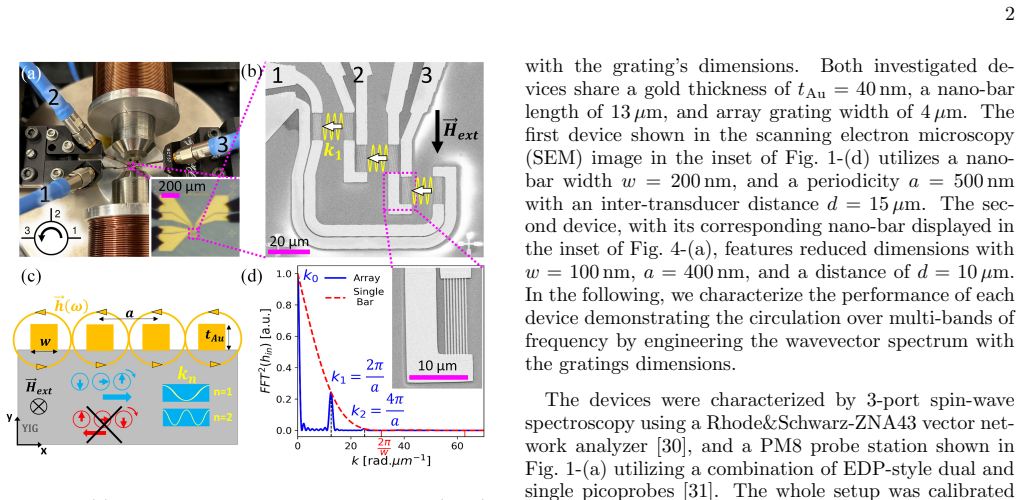
Taking advantage of the chiral excitation of spin-waves via nanowire gratings, we propose an original design of a circulator involving three channels of rectilinear and unidirectional spin-wave beams. We demonstrate via a full 3-port spin-wave spectroscopy a genuine spin-wave circulation between the three ports. The narrow frequency band of operation can be tuned over a broad range of frequencies (2-8 GHz) with both an external field of up to 100 mT, and the dimensions of the grating specifying the wavevectors.
What carries the argument
Nanowire gratings that produce chiral excitation of spin waves, forming three channels of rectilinear unidirectional beams.
If this is right
- Genuine spin-wave circulation occurs between the three ports in the measured device.
- The narrow operating band can be shifted across 2-8 GHz by external field or grating dimensions.
- The design is compatible with micron-scale integrated circuit architectures.
- It provides the first experimental characterization of a prototypical magnon circulator of this size.
Where Pith is reading between the lines
- The rectilinear beam geometry could be combined with other straight-channel magnonic components to build larger all-magnon circuits.
- Tuning via grating dimensions offers a way to match the circulator frequency to specific on-chip microwave sources without changing the external field.
- If backscattering remains low at higher wavevectors, the same principle may extend operation above 8 GHz in thinner films or different materials.
Load-bearing premise
The nanowire gratings produce truly unidirectional rectilinear spin-wave beams with negligible backscattering or parasitic coupling that would mask the circulation.
What would settle it
Three-port spectroscopy showing symmetric transmission or measurable power returning to the input port instead of circulating to the next port.
Figures
read the original abstract
The development of miniaturized non-reciprocal microwave technologies compatible with integrated circuit architectures remains a critical challenge for modern information technology. Here, we present the first experimental characterization of a micron-sized prototypical magnon circulator. Taking advantage of the chiral excitation of spin-waves via nanowire gratings, we propose an original design of a circulator involving three channels of rectilinear and unidirectional spin-wave beams. We demonstrate via a full 3-port spin-wave spectroscopy a genuine spin-wave circulation between the three ports. The narrow frequency band of operation can be tuned over a broad range of frequencies ($2$-$8$ GHz) with both an external field of up to $100$ mT, and the dimensions of the grating specifying the wavevectors. This proposed scheme opens up possibilities for new architectures of integrated and miniaturized non-reciprocal microwave devices.
Editorial analysis
A structured set of objections, weighed in public.
Referee Report
Summary. The manuscript claims the first experimental demonstration of a micron-sized 3-port magnonic circulator. It uses nanowire gratings to achieve chiral excitation of rectilinear, unidirectional spin-wave beams in three channels and reports genuine circulation via full 3-port spin-wave spectroscopy. The narrow operating band is stated to be tunable from 2-8 GHz by external field (up to 100 mT) and grating dimensions.
Significance. If the experimental demonstration of circulation is robust, the work would represent a meaningful step toward compact, integrated non-reciprocal magnonic components compatible with microwave circuits. The grating-based chiral excitation approach and field/grating tunability are potentially useful features for device engineering.
major comments (2)
- [Abstract / Results] Abstract and main text assert a 'demonstration via a full 3-port spin-wave spectroscopy' of genuine circulation, yet no transmission spectra (S-parameters), isolation ratios, error bars, or control measurements are supplied. Without these data the central experimental claim cannot be evaluated.
- [Device Design / Experimental Methods] The design rests on the assumption that the nanowire gratings produce truly unidirectional rectilinear beams with negligible backscattering or parasitic coupling. No direct characterization of beam directivity, isolation, or exclusion of reverse-propagating modes is described, which is load-bearing for interpreting the 3-port circulation data as genuine non-reciprocity rather than an artifact.
minor comments (2)
- [Introduction / Results] The frequency range is given as 2-8 GHz but no explicit relation between grating wavevector, dispersion relation, and observed band edges is provided.
- [Abstract] Notation for the three ports and circulation direction (clockwise vs. counterclockwise) should be defined consistently in text and any figures.
Simulated Author's Rebuttal
We thank the referee for their detailed and constructive review. We address each major comment below and will revise the manuscript accordingly to strengthen the presentation of the experimental evidence.
read point-by-point responses
-
Referee: [Abstract / Results] Abstract and main text assert a 'demonstration via a full 3-port spin-wave spectroscopy' of genuine circulation, yet no transmission spectra (S-parameters), isolation ratios, error bars, or control measurements are supplied. Without these data the central experimental claim cannot be evaluated.
Authors: We agree that the central claim requires explicit supporting data for full evaluation. The revised manuscript will include the complete 3-port transmission spectra presented as S-parameters, quantitative isolation ratios between ports, error bars derived from repeated measurements, and control experiments (e.g., measurements with reversed field polarity or modified grating orientations) to confirm genuine circulation rather than reciprocal behavior. revision: yes
-
Referee: [Device Design / Experimental Methods] The design rests on the assumption that the nanowire gratings produce truly unidirectional rectilinear beams with negligible backscattering or parasitic coupling. No direct characterization of beam directivity, isolation, or exclusion of reverse-propagating modes is described, which is load-bearing for interpreting the 3-port circulation data as genuine non-reciprocity rather than an artifact.
Authors: We acknowledge that direct experimental characterization of the beam properties is necessary to substantiate the unidirectional assumption. In the revision we will add dedicated measurements and/or micromagnetic simulations quantifying the directivity of the rectilinear beams, the isolation between forward and reverse propagation directions, and evidence that reverse-propagating modes are suppressed below detectable levels under the operating conditions used for the 3-port data. revision: yes
Circularity Check
No significant circularity: purely experimental demonstration
full rationale
The manuscript reports an experimental realization and 3-port spin-wave spectroscopy characterization of a magnonic circulator. No derivation chain, theoretical model, or set of equations is presented whose outputs are claimed to follow from first principles or predictions; the central claims rest on measured transmission spectra, device fabrication parameters, and external field tuning. The unidirectional-beam design is stated as an input assumption consistent with the observed data rather than a quantity derived or fitted within the paper itself. No self-citation load-bearing steps, fitted-input predictions, or ansatz smuggling appear in the reported work.
Axiom & Free-Parameter Ledger
Reference graph
Works this paper leans on
-
[1]
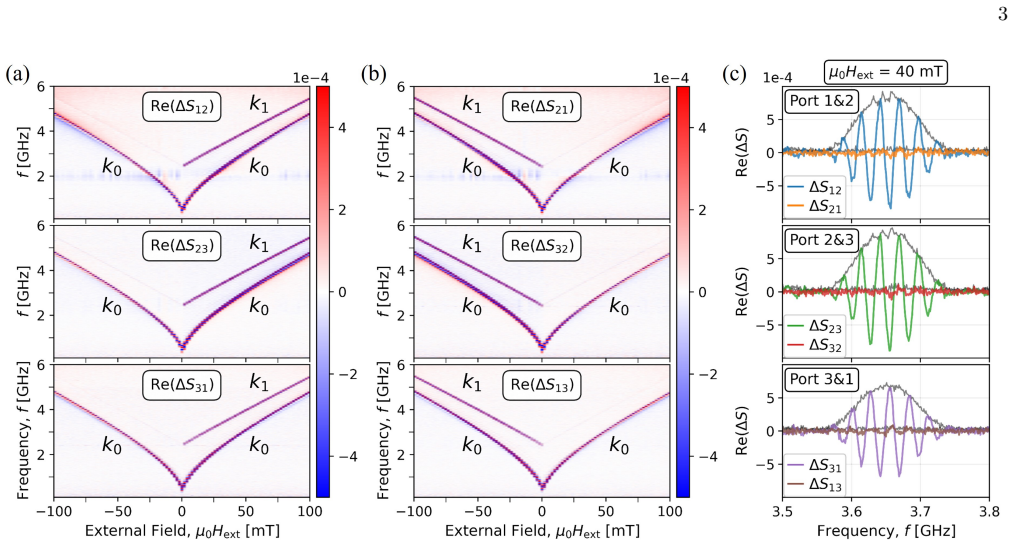
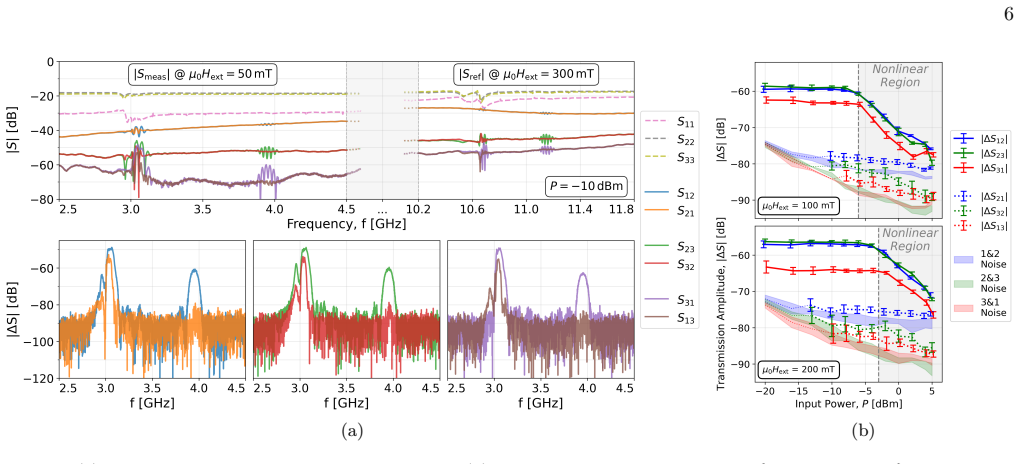
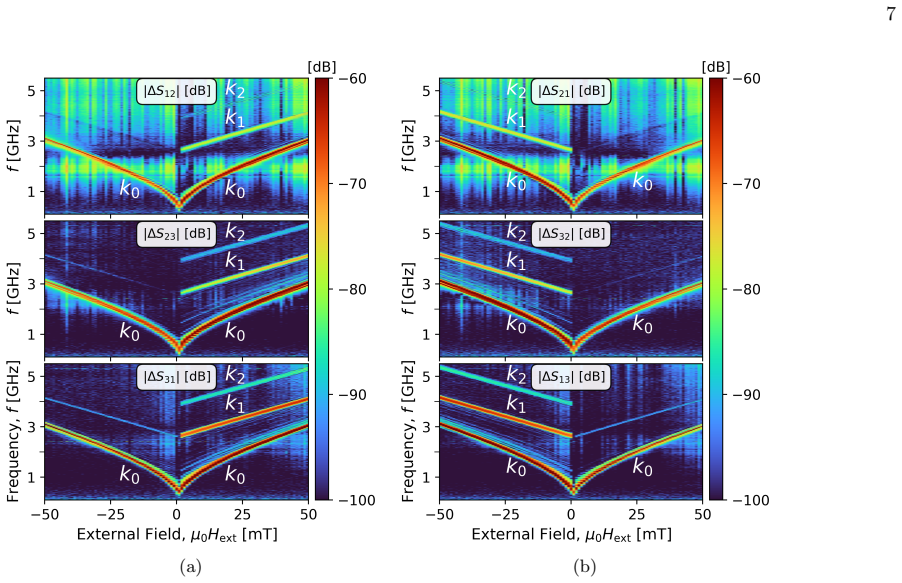
in order to de-embed the magnonic signal from the rest of the setup. Figure 2-(a) displays the frequency- field map of the real part ofS 12,S 23,S 31 in linear scale, namely the transmission from port 2 to port 1, port 3 to port 2, and port 1 to port 3, as indicated by the arrows in Fig. 1-(b). Measurements are performed across an ex- ternal field range f...
2030
-
[2]
V. G. Harris, Modern microwave ferrites, IEEE Transac- tions on Magnetics48, 1075 (2012)
2012
-
[3]
H. Lira, Z. Yu, S. Fan, and M. Lipson, Electrically driven nonreciprocity induced by interband photonic transi- tion on a silicon chip, Physical Review Letters109, 10.1103/PhysRevLett.109.033901 (2012)
-
[4]
N. Reiskarimian and H. Krishnaswamy, Magnetic-free non-reciprocity based on staggered commutation, Nature Communications7, 10.1038/ncomms11217 (2016)
-
[6]
Ranzani and J
L. Ranzani and J. Aumentado, Circulators at the Quan- tum Limit: Recent Realizations of Quantum-Limited Superconducting Circulators and Related Approaches, IEEE Microwave Magazine20, 112 (2019)
2019
-
[7]
M. Grassi, M. Geilen, D. Louis, M. Mohseni, T. Br¨ acher, M. Hehn, D. Stoeffler, M. Bailleul, P. Pirro, and Y. Henry, Slow-Wave-based nanomagnonic diode, Physical Review Applied14, 10.1103/PhysRe- vApplied.14.024047 (2020)
-
[8]
Haidar, M
M. Haidar, M. Bailleul, M. Kostylev, and Y. Lao, Nonre- ciprocal oersted field contribution to the current-induced frequency shift of magnetostatic surface waves, Physical Review B89(2014)
2014
-
[9]
O. Gladii, M. Haidar, Y. Henry, M. Kostylev, and M. Bailleul, Frequency nonreciprocity of surface spin wave in permalloy thin films, Physical Review B93, 10.1103/physrevb.93.054430 (2016)
-
[11]
L. Temdie, V. Castel, C. Dubs, G. Pradhan, J. Solano, H. Majjad, R. Bernard, Y. Henry, M. Bailleul, and V. Vlaminck, High wave vector non-reciprocal spin wave beams, AIP Advances13, 10.1063/9.0000535 (2023)
-
[12]
L. Temdie, V. Castel, T. Reimann, M. Lindner, C. Dubs, G. Pradhan, J. Solano, R. Bernard, H. Maj- jad, Y. Henry, M. Bailleul, and V. Vlaminck, Chiral Ex- citation of Exchange Spin Waves Using Gold Nanowire Grating, Magnetochemistry9, 10.3390/magnetochem- istry9080199 (2023). 9
-
[13]
T. Devolder, Propagating-spin-wave spectroscopy using inductive antennas: Conditions for unidirectional energy flow, Physical Review Applied20, 10.1103/physrevap- plied.20.054057 (2023)
-
[14]
Wagle, D
D. Wagle, D. Stoeffler, L. Temdie, M. T. Kaffash, V. Cas- tel, H. Majjad, R. Bernard, Y. Henry, M. Bailleul, M. B. Jungfleisch, and V. Vlaminck, Shaping nonrecip- rocal caustic spin-wave beams, Physical Review B113, L060405 (2026)
2026
-
[15]
Sluka, T
V. Sluka, T. Schneider, R. A. Gallardo, A. K´ akay, M. Weigand, T. Warnatz, R. Mattheis, A. Rold´ an- Molina, P. Landeros, V. Tiberkevich, A. Slavin, G. Sch¨ utz, A. Erbe, A. Deac, J. Lindner, J. Raabe, J. Fassbender, and S. Wintz, Emission and propaga- tion of 1d and 2d spin waves with nanoscale wavelengths in anisotropic spin textures, Nature Nanotechno...
2019
-
[16]
Heinz, T
B. Heinz, T. Br¨ acher, M. Schneider, Q. Wang, B. L¨ agel, A. M. Friedel, D. Breitbach, S. Steinert, T. Meyer, M. Kewenig, C. Dubs, P. Pirro, and A. V. Chumak, Prop- agation of spin-wave packets in individual nanosized yt- trium iron garnet magnonic conduits, Nano Letters20, 4220–4227 (2020)
2020
-
[17]
Temdie, V
L. Temdie, V. Castel, M. Jungfleisch, R. Bernard, H. Ma- jjad, D. Stoeffler, Y. Henry, M. Bailleul, and V. Vlam- inck, Probing spin wave diffraction patterns of curved antennas, Phys. Rev. Appl.21, 014032 (2024)
2024
-
[18]
J. Krˇ cma, O. Wojewoda, M. Hrtoˇ n, J. Holobr´ adek, J. A. Arregi, J. Panda, E. Pribytova, and M. Urb´ anek, Mie- enhanced microfocused brillouin light scattering for full wave vector resolution of nanoscale spin waves, Science Advances11, 10.1126/sciadv.ady8833 (2025)
-
[19]
V. V. Kruglyak, Chiral magnonic resonators: Rediscov- ering the basic magnetic chirality in magnonics, Applied Physics Letters119, 10.1063/5.0068820 (2021)
-
[21]
Dieny, I
B. Dieny, I. L. Prejbeanu, K. Garello, P. Gambardella, P. Freitas, R. Lehndorff, W. Raberg, U. Ebels, S. O. Demokritov, J. Akerman, A. Deac, P. Pirro, C. Adel- mann, A. Anane, A. V. Chumak, A. Hirohata, S. Man- gin, S. O. Valenzuela, M. C. Onba¸ slı, M. d’Aquino, G. Prenat, G. Finocchio, L. Lopez-Diaz, R. Chantrell, O. Chubykalo-Fesenko, and P. Bortolotti...
2020
-
[22]
Barman, G
A. Barman, G. Gubbiotti, S. Ladak, A. O. Adey- eye, M. Krawczyk, J. Grafe, C. Adelmann, S. Coto- fana, A. Naeemi, V. I. Vasyuchka, B. Hillebrands, S. A. Nikitov, H. Yu, D. Grundler, A. V. Sadovnikov, A. A. Grachev, S. E. Sheshukova, J. Y. Duquesne, M. Marangolo, G. Csaba, W. Porod, V. E. Demidov, S. Urazhdin, S. O. Demokritov, E. Albisetti, D. Petti, R. B...
2021
-
[23]
Q. Wang, A. V. Chumak, and P. Pirro, Inverse- design magnonic devices, Nature Communications12, 10.1038/s41467-021-22897-4 (2021)
-
[24]
K. Szulc, P. Graczyk, M. Mruczkiewicz, G. Gubbiotti, and M. Krawczyk, Spin-wave diode and circulator based on unidirectional coupling, Physical Review Applied14, 10.1103/PhysRevApplied.14.034063 (2020)
-
[25]
J. Lan, W. Yu, R. Wu, and J. Xiao, Spin-Wave Diode, Physical Review X5, 10.1103/PhysRevX.5.041049 (2015)
-
[26]
J. Zhao, L. Feng, M. Ma, and F. Ma, Three-terminal magnonic demultiplexer, power divider, and circulator, Journal of Magnetism and Magnetic Materials586, 10.1016/j.jmmm.2023.171161 (2023)
-
[27]
C. Dubs, O. Surzhenko, R. Thomas, J. Osten, T. Schneider, K. Lenz, J. Grenzer, R. H¨ ubner, and E. Wendler, Low damping and microstructural perfec- tion of sub-40nm-thin yttrium iron garnet films grown by liquid phase epitaxy, Physical Review Materials4, 10.1103/physrevmaterials.4.024416 (2020)
-
[28]
Kostylev, Non-reciprocity of dipole-exchange spin waves in thin ferromagnetic films, Journal of Applied Physics113(2013)
M. Kostylev, Non-reciprocity of dipole-exchange spin waves in thin ferromagnetic films, Journal of Applied Physics113(2013)
2013
-
[29]
Yu and G
T. Yu and G. E. W. Bauer, Chiral Coupling to Magne- todipolar Radiation, inChirality, Magnetism and Mag- netoelectricity: Separate Phenomena and Joint Effects in Metamaterial Structures, edited by E. Kamenetskii (Springer International Publishing, Cham, 2021) pp. 1– 23
2021
-
[30]
H. Yu, G. Duerr, R. Huber, M. Bahr, T. Schwarze, F. Brandl, and D. Grundler, Omnidirectional spin- wave nanograting coupler, Nature Communications4, 10.1038/ncomms3702 (2013)
-
[31]
com/products/test-and-measurement/vnas/ rs-zna-vector-network-analyzers_63493-551810
Rohde & Schwarz, ZNA Vector Network Analyzers,https://www.rohde-schwarz. com/products/test-and-measurement/vnas/ rs-zna-vector-network-analyzers_63493-551810. html(2026), accessed April 28, 2026
2026
-
[32]
GGB Industries, PICOPROBE Dual/Differential Microwave Probe,https://ggb.com/products/ dual-differential-microwave-probe/(2026), ac- cessed April 28, 2026
2026
-
[33]
GGB Industries, Differential Calibration Substrates,https://ggb.com/products/ differential-calibration-substrates/(2026), accessed April 28, 2026
2026
-
[34]
Loayza, M
N. Loayza, M. B. Jungfleisch, A. Hoffmann, M. Bailleul, and V. Vlaminck, Fresnel diffraction of spin waves, Phys. Rev. B98, 144430 (2018)
2018
-
[35]
B. A. Kalinikos and A. N. Slavin, Theory of dipole- exchange spin wave spectrum for ferromagnetic films with mixed exchange boundary conditions, Journal of Physics C: Solid State Physics19, 7013 (1986)
1986
-
[36]
D. A. Connelly, G. Csaba, H. R. O. Aquino, G. H. Bern- stein, A. Orlov, W. Porod, and J. Chisum, Efficient elec- tromagnetic transducers for spin-wave devices, Sci. Rep. 11, 18378 (2021)
2021
-
[37]
Vanderveken, V
F. Vanderveken, V. Tyberkevych, G. Talmelli, B. Sor´ ee, F. Ciubotaru, and C. Adelmann, Lumped circuit model for inductive antenna spin-wave transducers, Sci. Rep. 12, 3796 (2022)
2022
-
[38]
F. Bruckner, K. Dav´ ıdkov´ a, C. Abert, A. Chumak, and D. Suess, Micromagnetic simulation and optimiza- tion of spin-wave transducers, Scientific Reports15, 10 10.1038/s41598-025-05463-6 (2025)
-
[39]
Surpassing the en- ergy resolution limit with ferromagnetic torque sensors,
K. Davidkova, K. Levchenko, F. Bruckner, R. Verba, F. Majcen, Q. Wang, M. Lindner, C. Dubs, V. Vlam- inck, J. Kl´ ıma, M. Urb´ anek, D. Suess, and A. Chumak, Nanoscale spin-wave frequency-selective limiter for 5G technology, Physical Review Applied23, 10.1103/Phys- RevApplied.23.034026 (2025)
-
[40]
P. W. Anderson and H. Suhl, Instability in the motion of ferromagnets at high microwave power levels, Phys. Rev. 100, 1788 (1955)
1955
discussion (0)
Sign in with ORCID, Apple, or X to comment. Anyone can read and Pith papers without signing in.